Toledo Cathedral: A Building-Physics Reading of Daylight and Thermal Stability
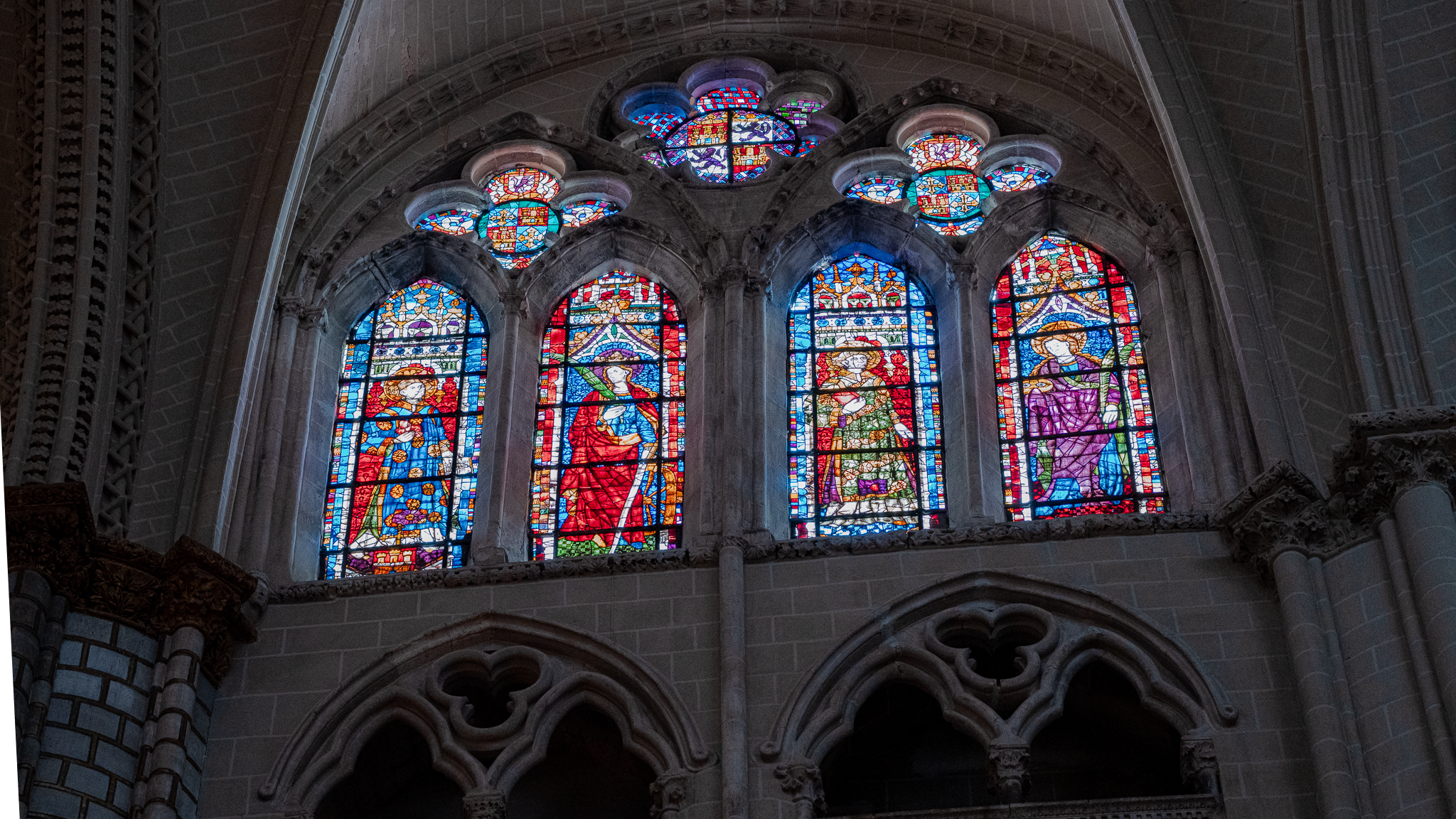
Walk into Toledo Cathedral on a bright afternoon and the first thing you notice is how little light there is. Despite its many stained glass windows, the interior feels dark. Stand in a bay of the nave and look up: the clerestory is the most conspicuous source of daylight. Below it, the blind triforium arcade, the piers and the aisle walls sit in shadow, receiving and reflecting the light that reaches them.
The instinct is to read this as a failure of architecture. A building-physics reading suggests another possibility: restrained glazing and substantial masonry can trade daylight quantity for thermal buffering. That relationship offers a useful way to read the building, and one famous intervention brings the competing value of light sharply into focus. It does not establish the medieval builders’ intentions; structure, liturgy, architectural tradition and later alterations also shaped what we see.
What they were trading against
Toledo sits at 513 m on the Castilian plateau, and its climate is harder than the postcards suggest. The AEMET normals for 1982–2010 give an annual mean of 15.8 °C, a July mean daily maximum of 34.6 °C, a January mean daily minimum of 1.3 °C, and annual precipitation of 342 mm.
Take those two monthly averages together: a difference of roughly 33 K separates January’s mean daily minimum from July’s mean daily maximum. This is a cross-season comparison, not a daily swing or a record temperature range. The daily range is substantial in its own right: the monthly mean maximum and minimum differ by about 10 K in January and 16 K in July. With hot, dry summers and cold winter nights, a building here has to deal with heat and cold in the same year, as well as sizeable temperature changes within a day.
Historic single glazing generally offers much less resistance to heat transfer, and much less heat-storage capacity, than thick masonry. It also admits solar energy, which can help in winter and add to overheating in summer. Window area therefore matters, alongside orientation, shading, air leakage and ventilation. Toledo’s restrained apertures are consistent with thermal buffering, although their form alone cannot tell us why the builders chose them.
The discipline of the aperture
Look closely at the photographed clerestory bay: four lancets and small rose oculi sit within deep stone reveals. The glazed area appears modest relative to the surrounding masonry. Below it, the triforium is a blind sculpted arcade that reads as an opening and is not one.
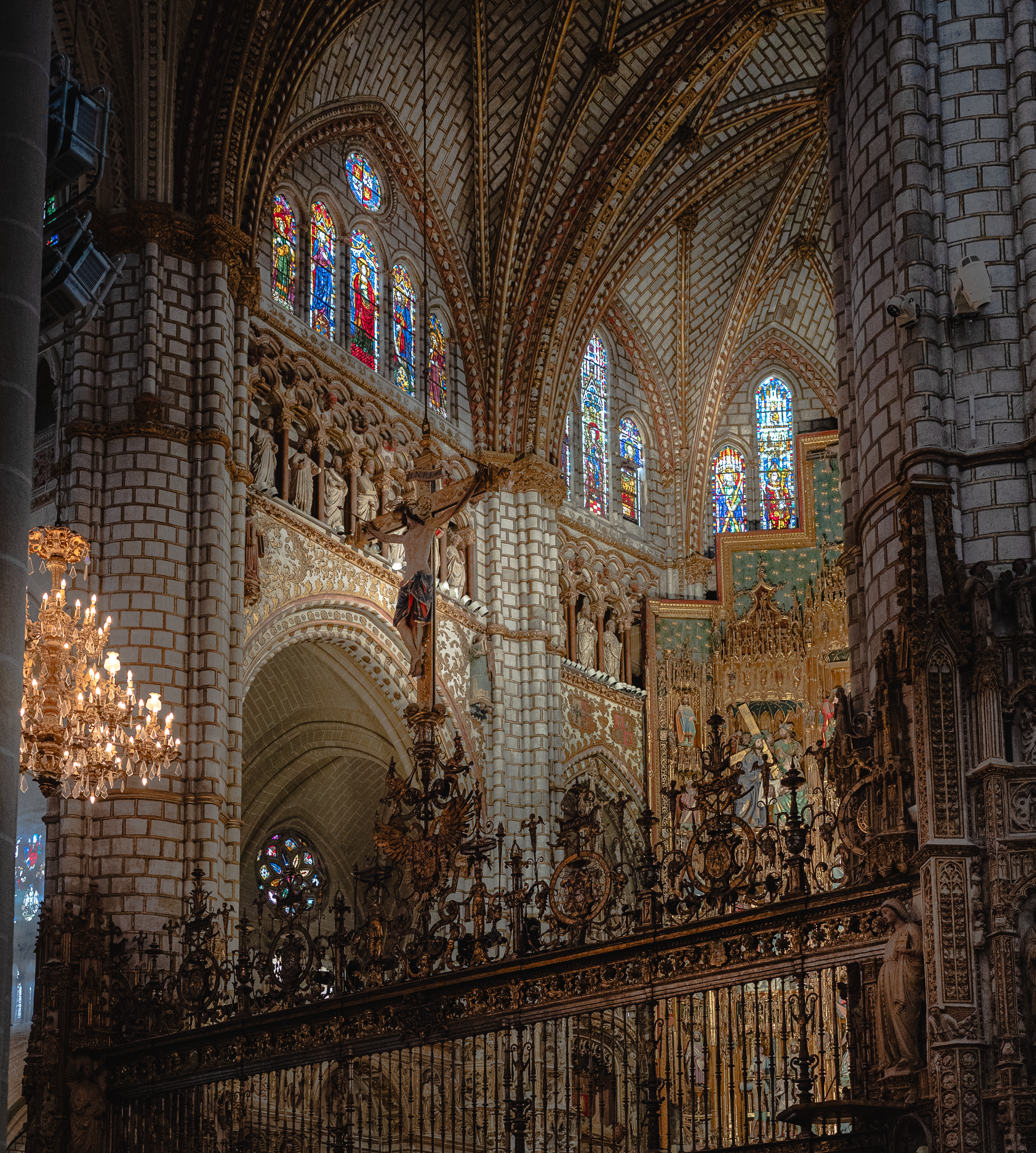
The coloured glass filters the spectrum and reduces the quantity of visible light transmitted. That shapes the interior’s luminance and colour, but it does not make the glass thermally equivalent to masonry. Visible transmittance, solar heat gain and thermal transmittance are distinct properties: absorbed solar energy can also contribute heat to the interior. No glazing measurements were taken here, so the thermal effect of Toledo’s coloured glass remains unquantified.
Set this against the fabric it is cut into. Toledo Cathedral is approximately 120 m long and 59 m wide, with a central nave about 44.5 m high, built largely in limestone. Five naves, a transept, a double ambulatory: an enormous mass of stone surrounds the openings. The relationship is clear enough to investigate—limited daylight admission alongside substantial heat-storage capacity—but Toledo’s resulting thermal performance has not been measured for this article.
What the trade bought
The strongest measured example used here comes from another building. A study of Girona Cathedral covering 2011–2016 examined the behaviour of its massive Gothic fabric without active space conditioning. Hourly monitoring, with a gap in the record and a change of sensor location, found strong damping of outdoor temperature fluctuations.
At Girona, the indoor daily temperature swing averaged about 0.5 °C, against roughly 13 °C outdoors. The paper describes summer interior temperatures around 24–25 °C and a seasonal lag of about a month from August to January. Relative humidity was below 75% for much of the record, with excursions; the researchers considered the monitored environment favourable for the artworks studied. These findings describe that building and monitoring period, rather than universal conservation conditions.
Half a degree of average daily movement without active space conditioning is a striking result. The building’s mass, ground coupling, envelope and air exchange all participate in that behaviour. It demonstrates how strongly a historic building can buffer daily changes without establishing equivalence to a modern museum’s environmental specification.
The caveat matters: this is a single-building case study in a different climate. Treat the figures as evidence of a mechanism to investigate at Toledo, not as values transferable to it. Monitoring would be needed to establish Toledo’s temperature and humidity patterns; the Girona study cannot establish the historical reason for Toledo’s window sizes.
The plan carries a longer history
The plan tells a longer story than the elevation. Toledo Cathedral’s five-aisled arrangement stands on a site occupied by earlier religious buildings, including the city’s principal mosque. That continuity invites an environmental reading, but it does not by itself prove continuity of design intent.

The site’s religious history predates the Gothic cathedral. After Alfonso VI took Toledo in 1085, the former mosque was converted to Christian use. Construction of the present cathedral began in 1226, and the central nave vaults were completed in 1493: more than two and a half centuries of work by successive generations of builders.
Historical accounts associate the earlier mosque’s layout and courtyard with parts of the later cathedral and cloister. Establishing the exact relationship requires archaeological and architectural evidence. A deep, many-aisled hall and a shaded courtyard can moderate exposure in a hot, dry setting; reading those environmental possibilities into the present plan remains an interpretation, rather than proof of an inherited thermal strategy.
Beside Chartres or León, Toledo’s daylight restraint invites questions about regional climate as well as structure and worship. The useful question is how those influences worked together, rather than whether one environmental logic explains them all.
Having given up quantity, they bought back quality
A dark interior need not be uniformly dark. Surface finish and local contrast shape the experience of the limited light that enters.
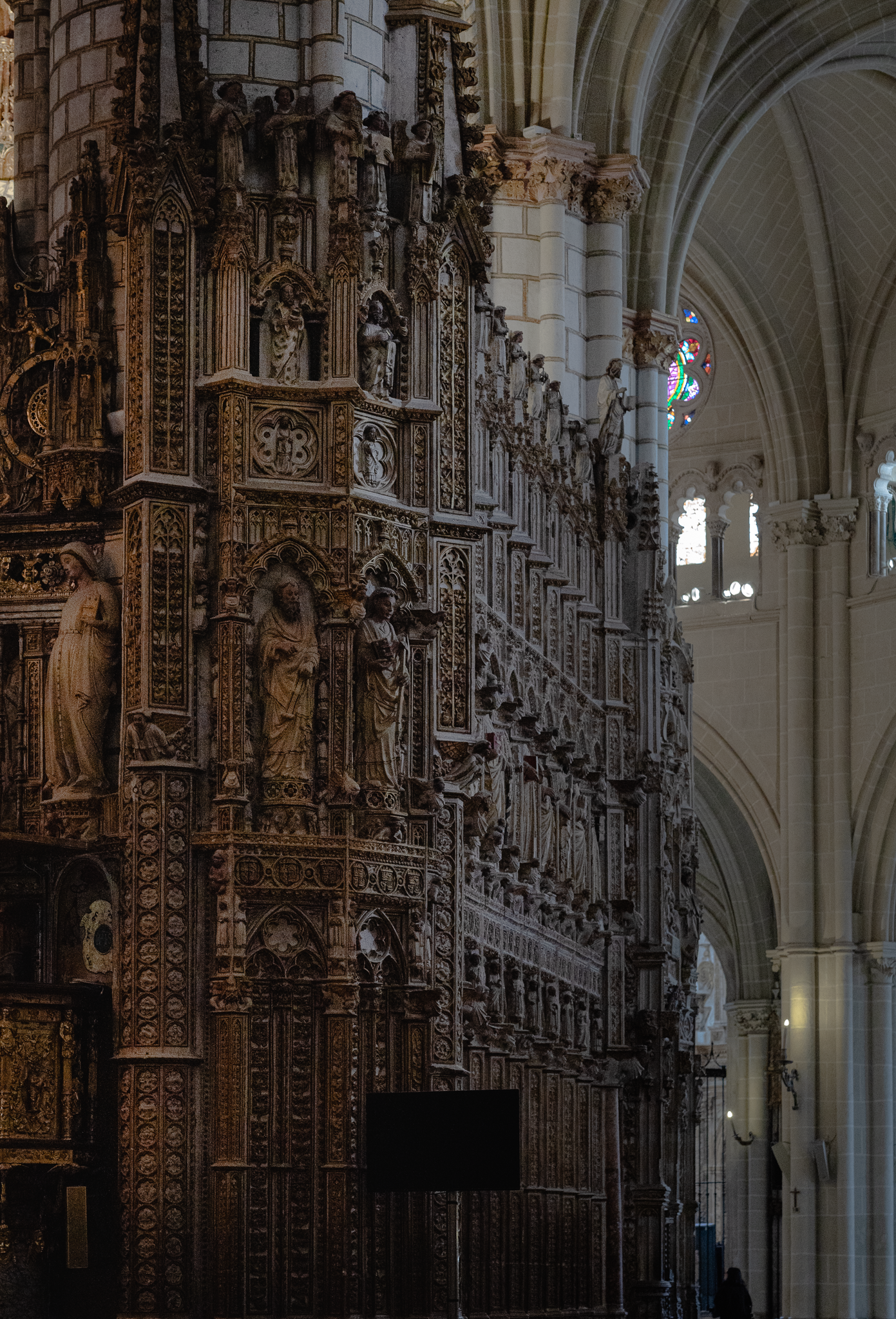
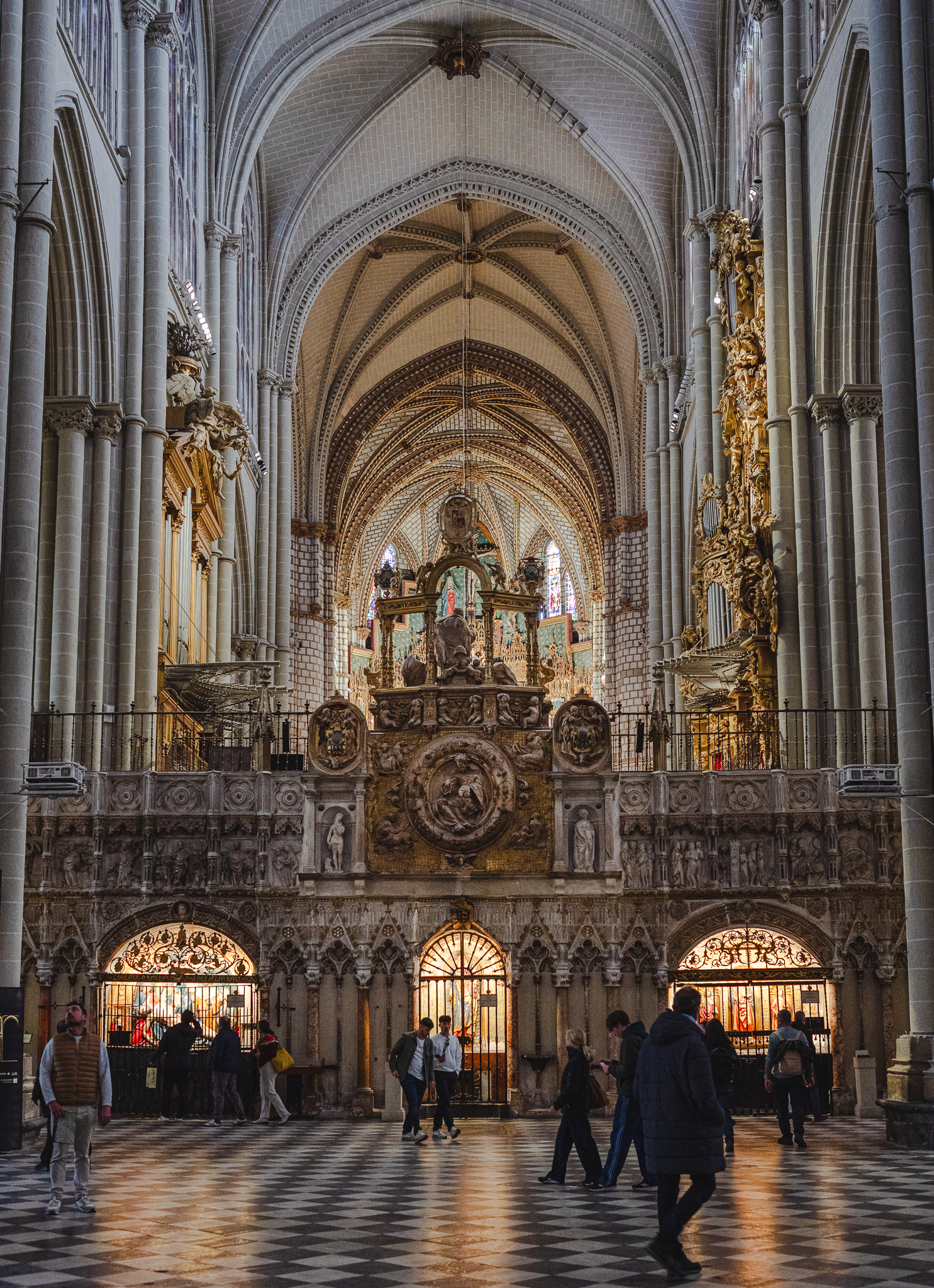
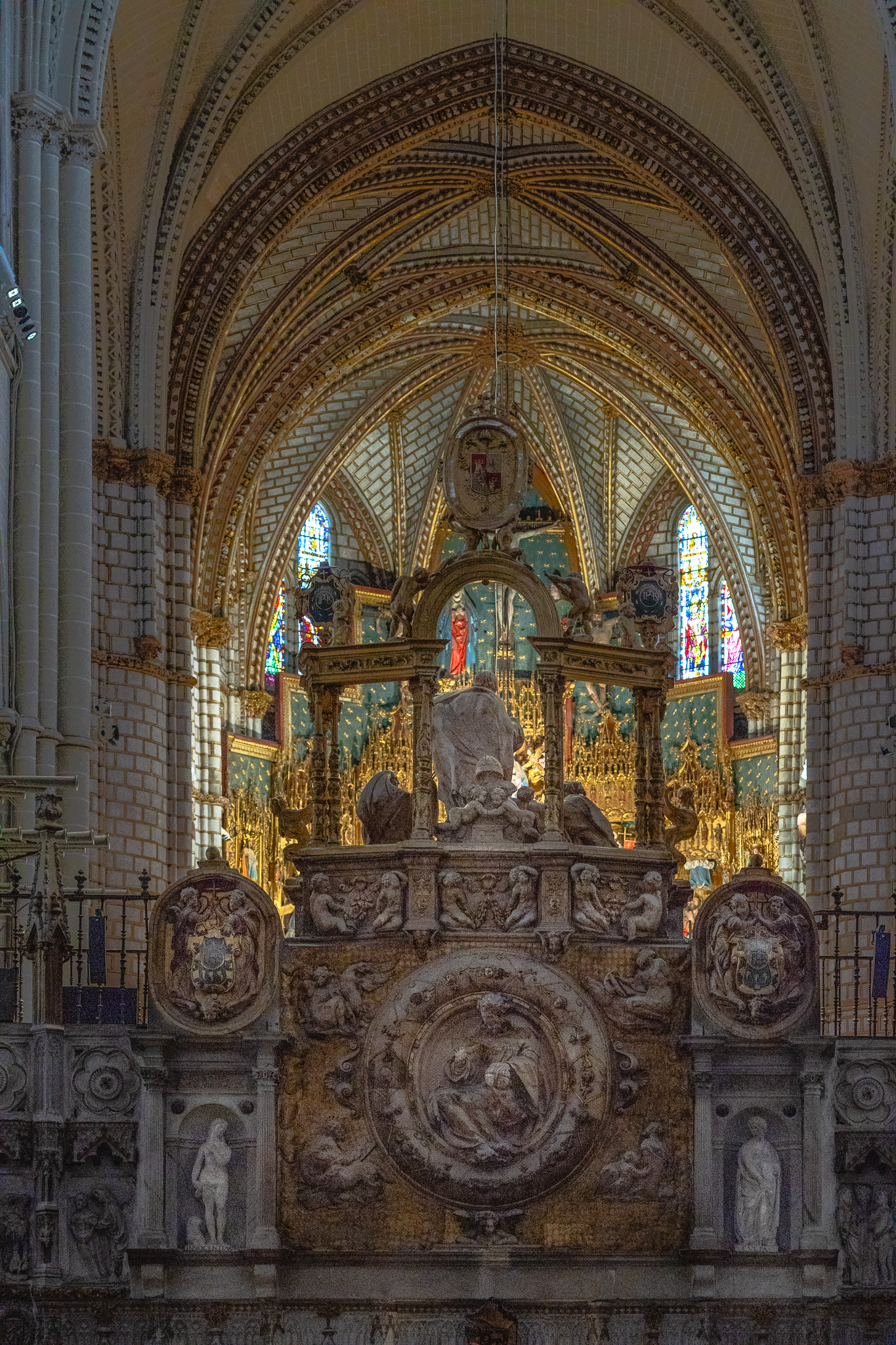
The polished chequered stone floor acts as a secondary reflector: daylight returns from it where visitors cross the space. Pale vault surfaces redistribute light, while gold leaf, polished marble and polychromy create highlights and colour. These elements belong to different phases of the building’s history; their present interaction does not establish a single original compensation strategy.
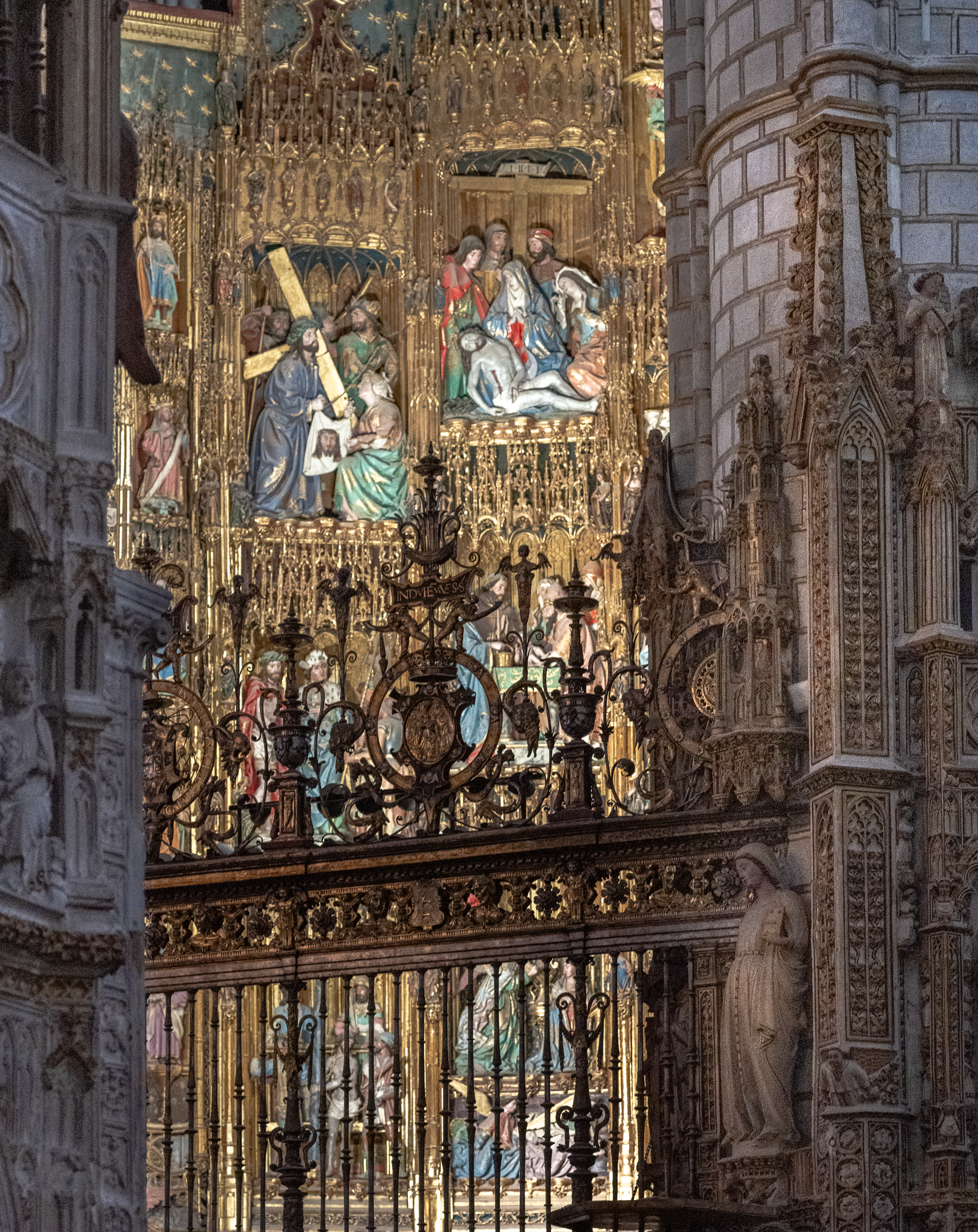
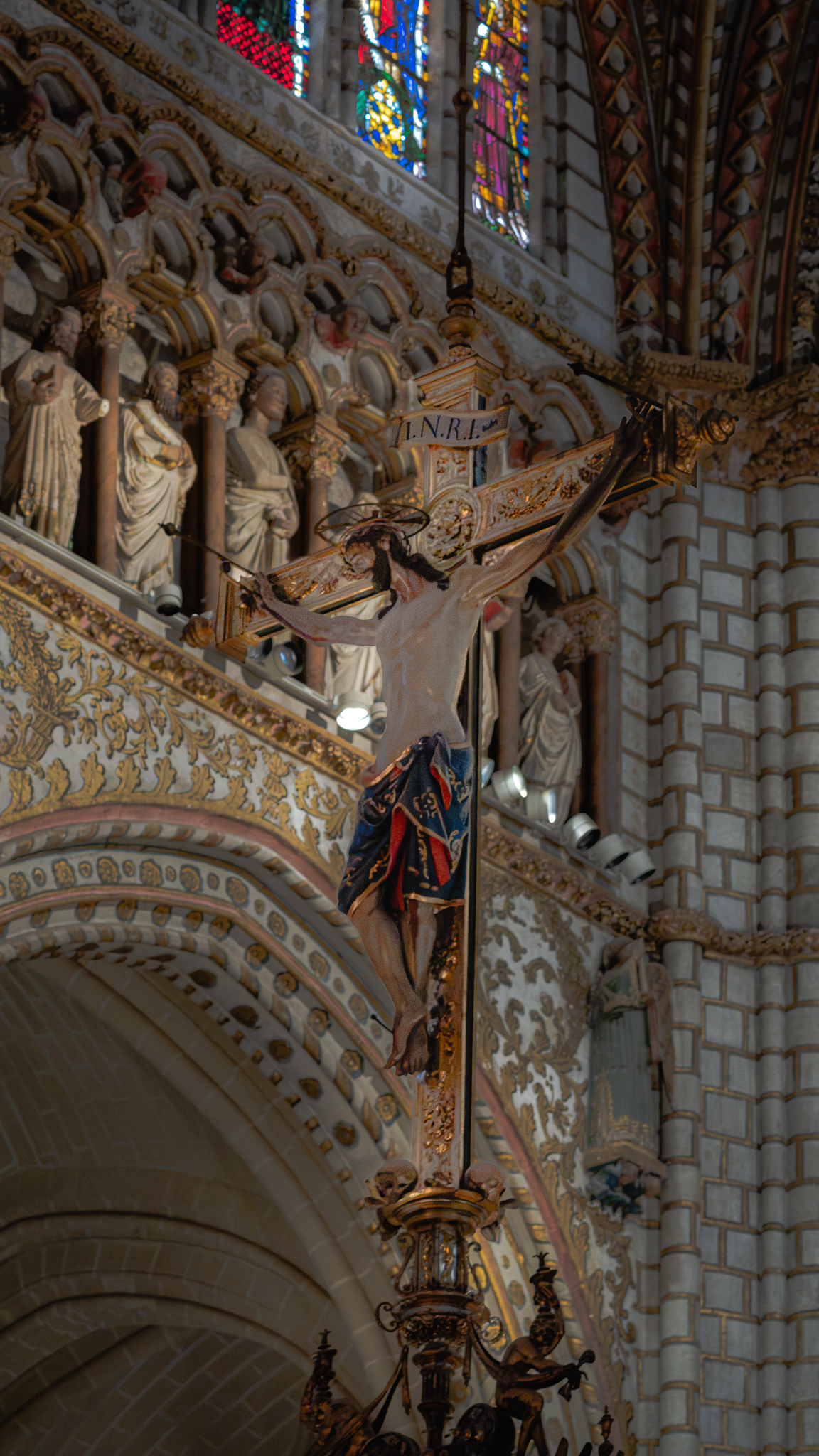
Gilding is not merely a display of wealth, though it is also that. Under a beam in a dim field, a polished gold surface can return a concentrated specular highlight. The gilded altarpiece behind its iron grille, the carved choir screen, and the painted and gilded sculpture become points of visual emphasis. This is about the direction and contrast of reflected light, not a claim that gold has the highest overall reflectance.
There is a lesson here for lighting design: perceived brightness depends on surfaces, contrast and adaptation as well as the quantity of light supplied. Craft can make limited light visually powerful.
The exception: when they bought the light back
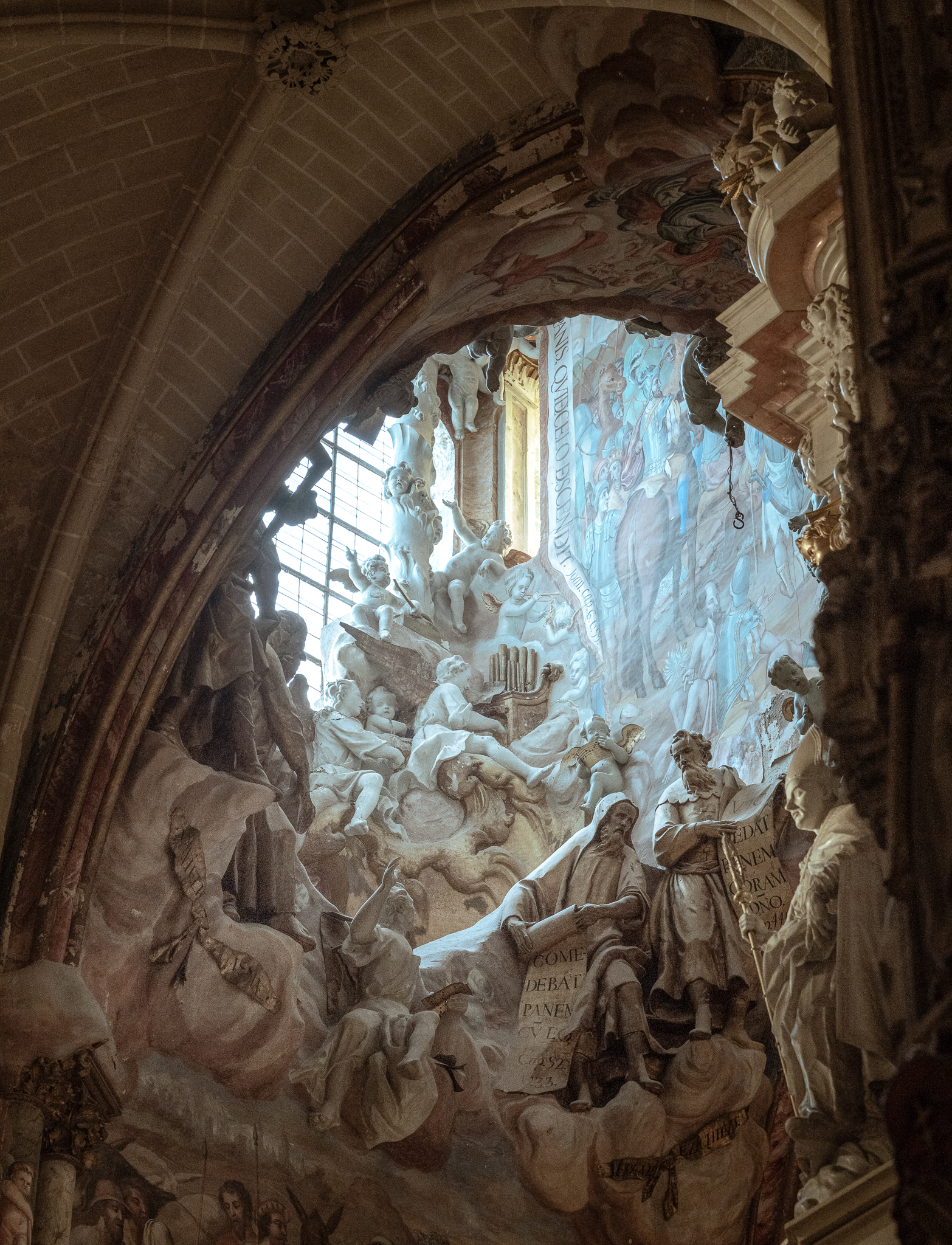
Narciso Tomé’s Transparente, completed in 1732 under Archbishop Diego de Astorga, makes the value of directed daylight explicit. The cathedral’s own account describes an opening pierced through the ambulatory vault to bring sunlight toward the tabernacle. An oval opening at the rear of the high altar forms part of the luminous connection, surrounded by marble, bronze, stucco and sculpture. The intervention serves a specific devotional purpose: illuminating the presence of the Blessed Sacrament.
Consider what that decision involved. Roughly 240 years after the nave vaults were completed, the cathedral’s fabric was altered to create a specific luminous event in a specific place. The intervention is documented; its thermal effect and the way its makers assessed risk are not established by the sources used here.
For me, it is the most extraordinary thing in the cathedral. The governance point I would want a client to take away is that historic buildings have been transformed by purposeful interventions in their fabric. The Transparente is a powerful precedent for that discussion. A present-day proposal still needs its own assessment of heritage significance, structure, environmental effects and conservation risk.
Where the trade breaks down
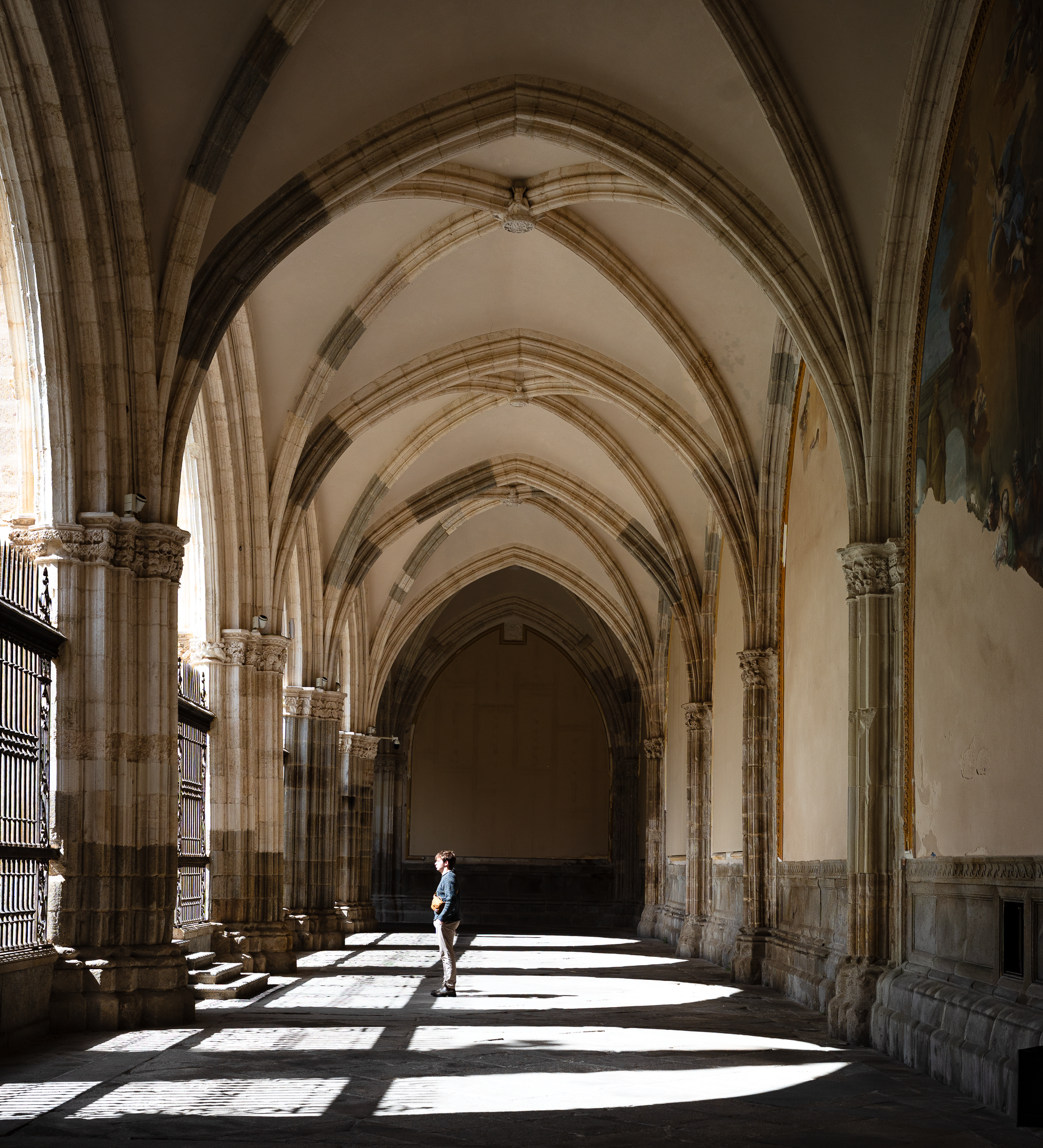
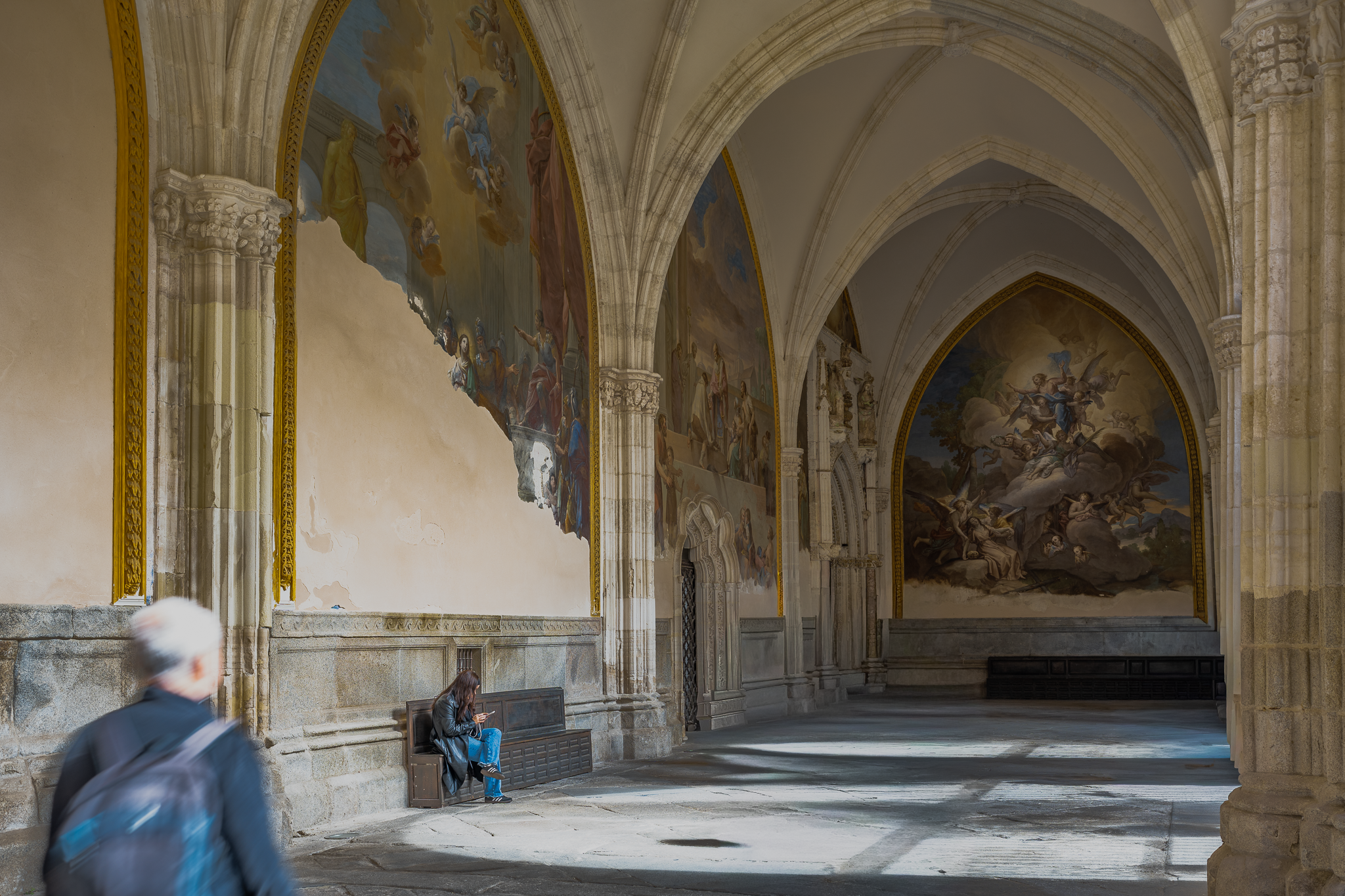
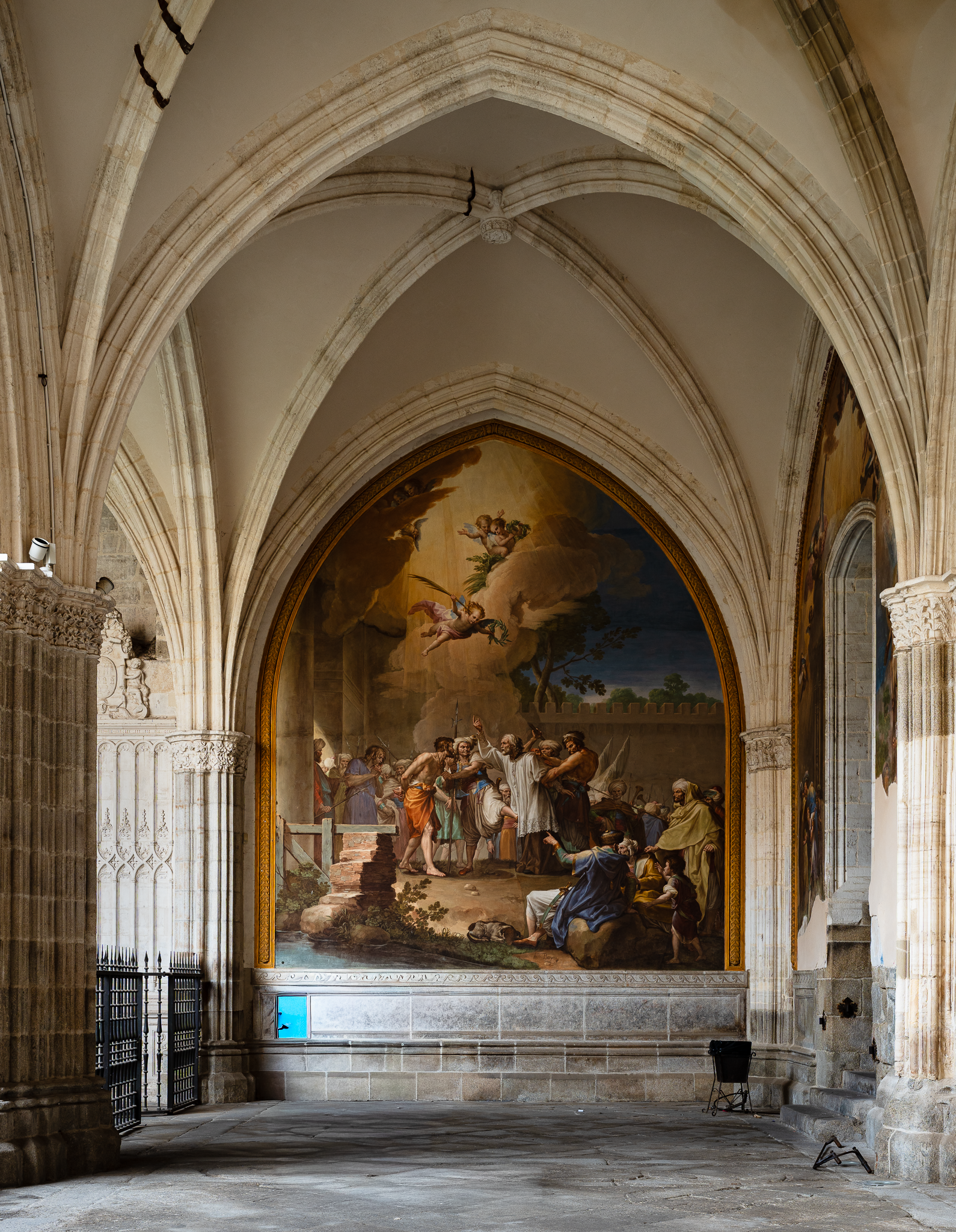
An argument this tidy should be tested, and the cloister is where I would test it first. Begun in 1389 and completed in the early fifteenth century, it provides a shaded perimeter walk around an open centre. Stand in it on a clear afternoon and sunlight falls across the floor in hard, opening-shaped patches. The geometry of daylight becomes visible in a way it rarely does in the nave.
The murals along the cloister walls show visible losses in irregular patches. Their more exposed setting raises questions about moisture, salts, weathering and past treatment, but appearance alone cannot identify the cause. Condition records, material investigation and environmental monitoring would be needed to explain the deterioration. It is a place to test the limits of passive buffering, rather than evidence that the proposed mechanism has been confirmed.
The layer that costs something to run
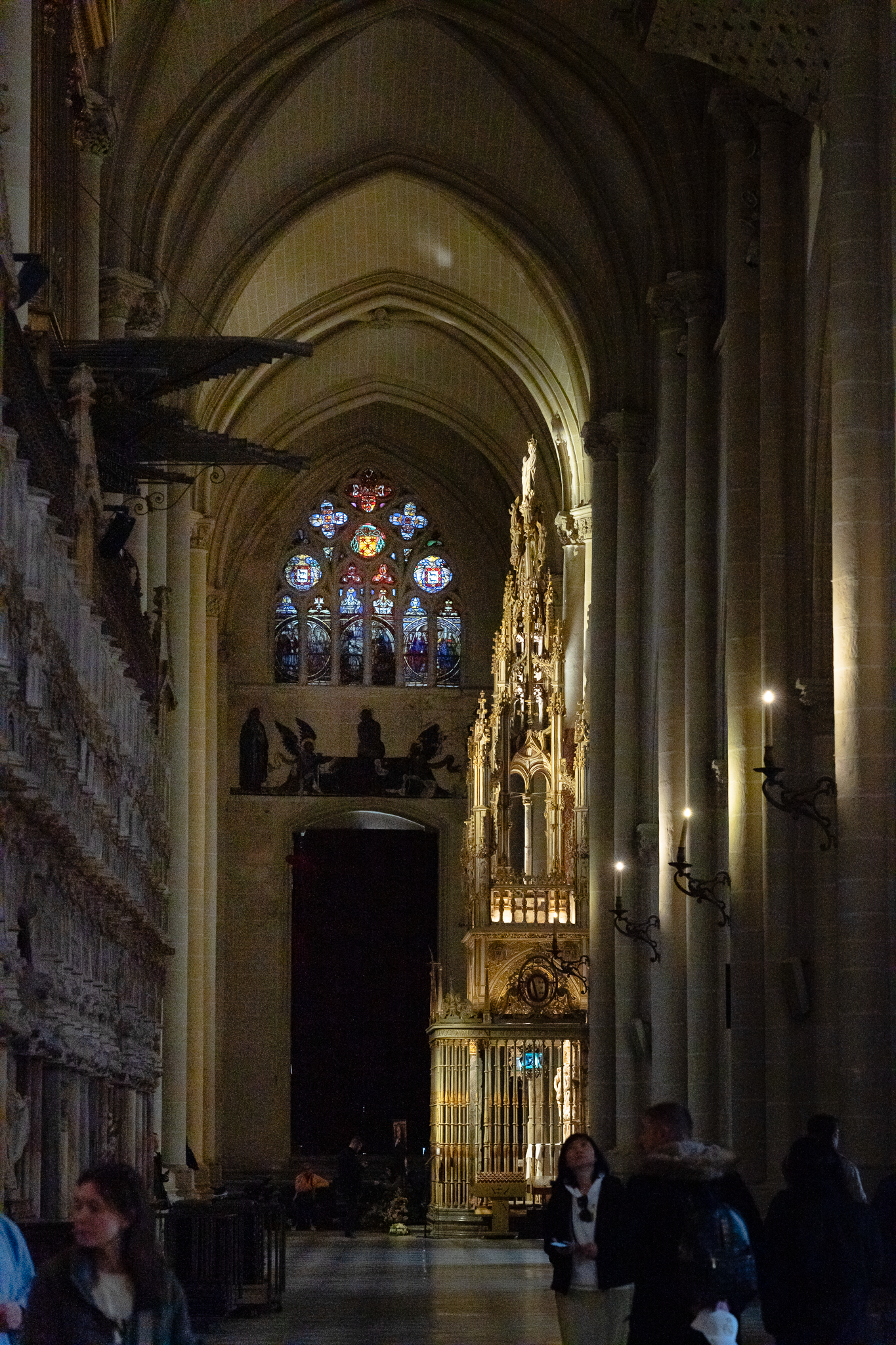
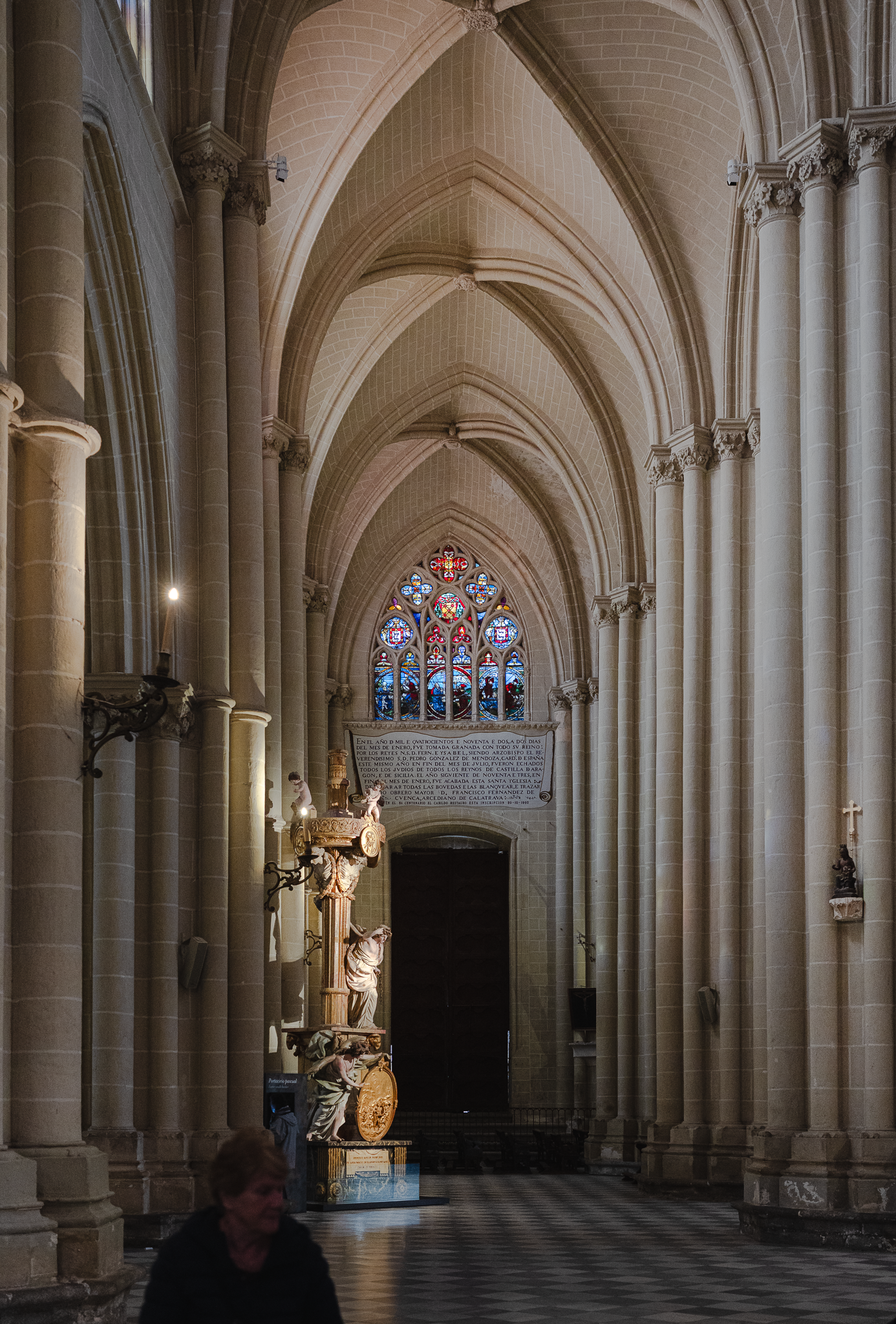
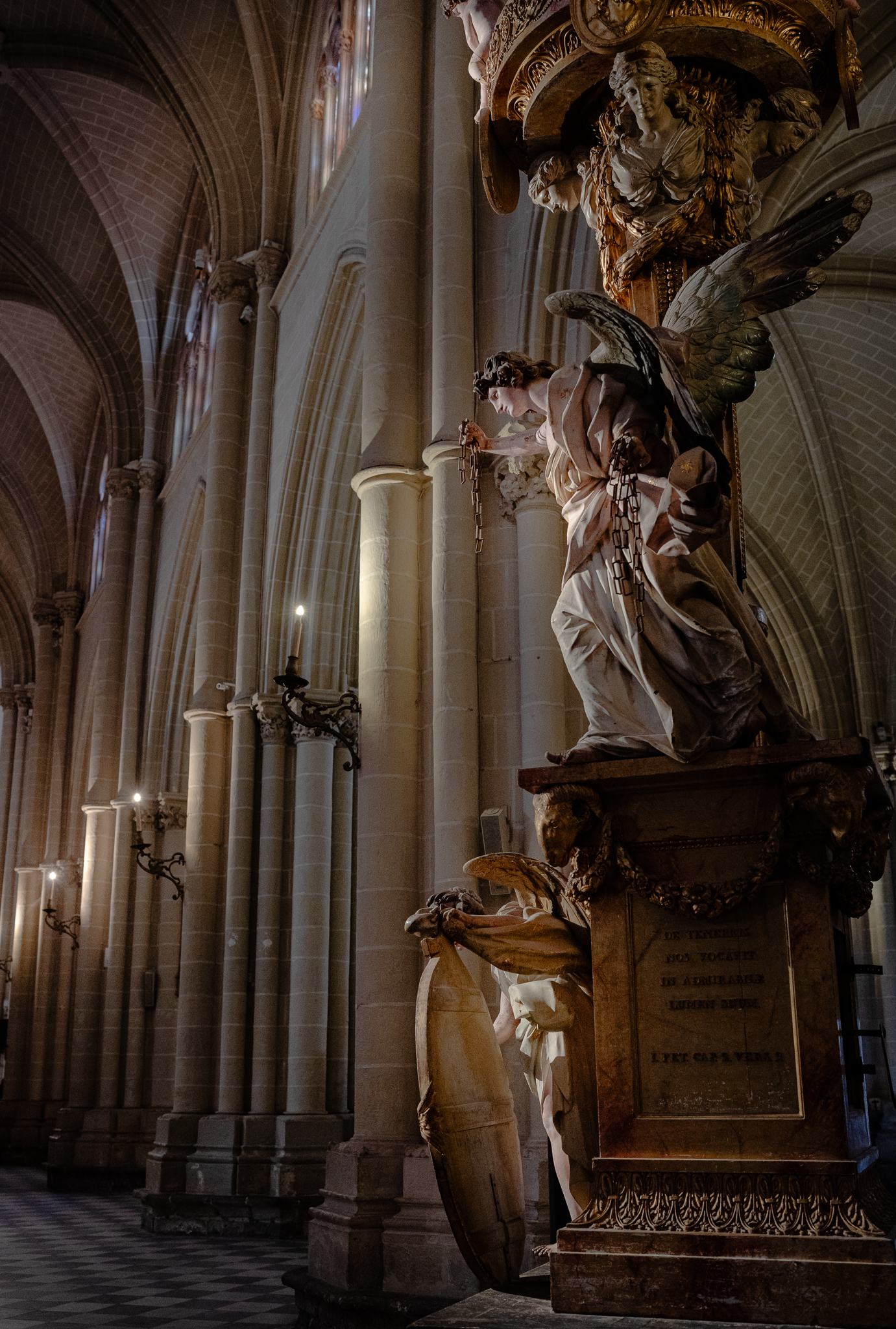
The lighting in Toledo Cathedral is not concealed. Walk down the north aisle and you see wall sconces bracketed off the piers, track-mounted spots angled down from above, and cabling accommodated within the historic fabric. The modern lighting layer is visibly part of the building’s present use.
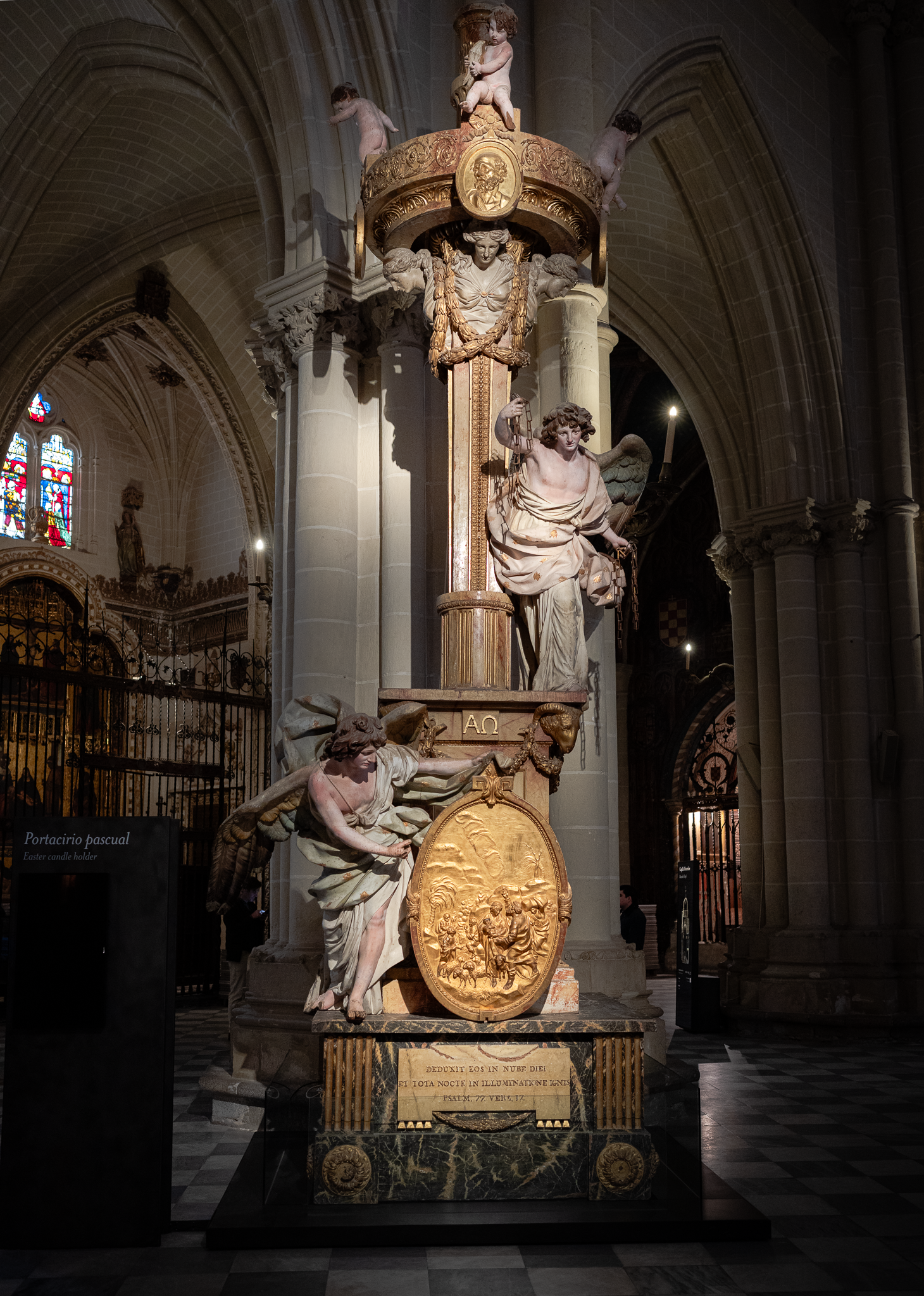
What this layer does is legitimate and, in places, necessary. It reaches deep aisles, chapels behind grilles and carved figures in niches that need modelling rather than an ambient wash. It supports visual access and present-day visitor use where available daylight is limited.
The operating relationship changes. Daylight admission is tied to the envelope and the weather; electric light can be directed, dimmed and timed independently, but uses electricity whenever it operates. Both the historic fabric and modern systems require maintenance. The design question is how much light is needed, where it is needed, and for how long.
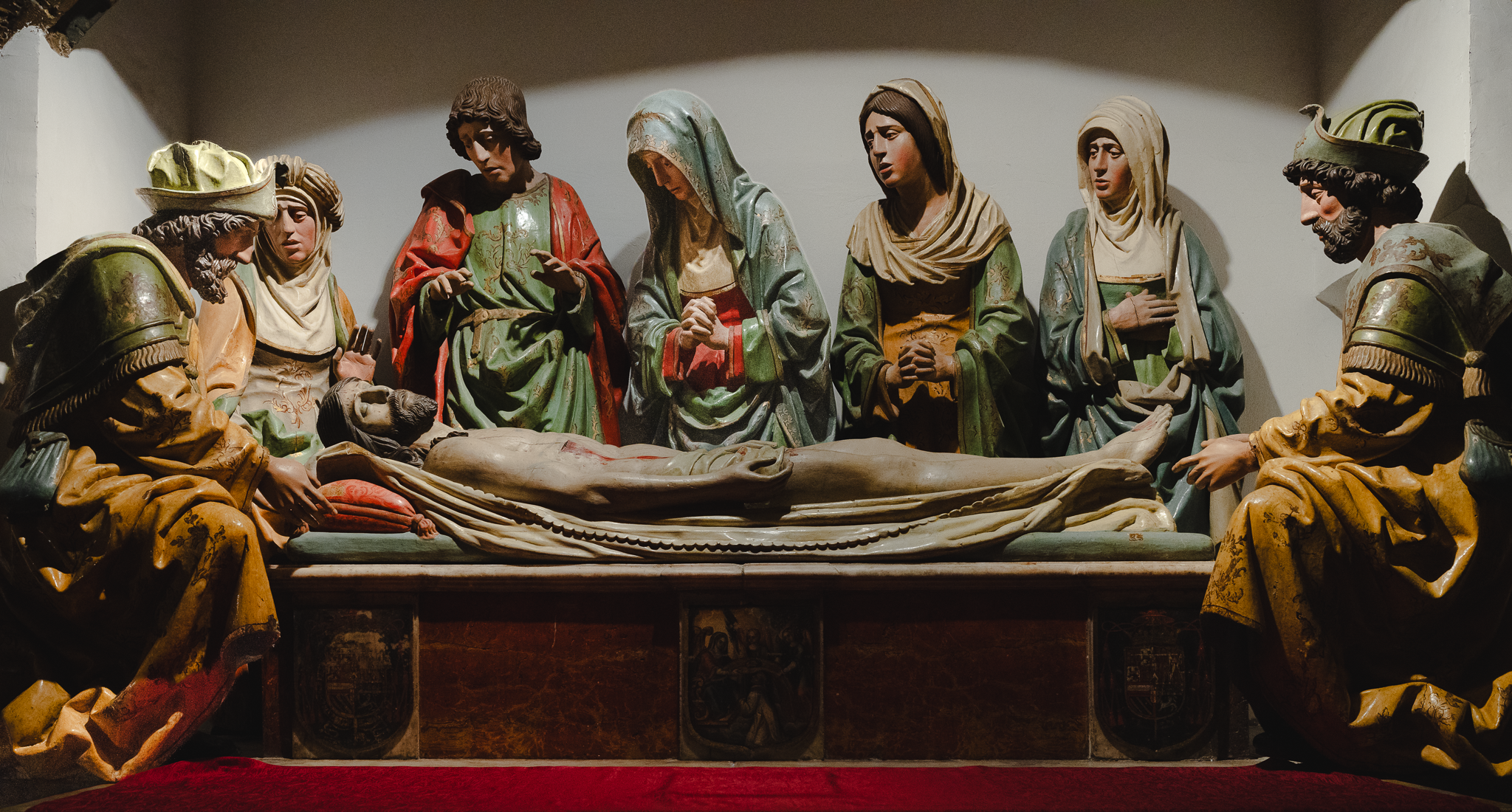
The second cost concerns conservation. For moderately sensitive materials, Museums Galleries Scotland gives guidance of around 200 lux and 450,000 lux-hours annually. These are category-based guidelines, not universal safe limits for polychrome sculpture. Pigments, binders, coatings and supports differ, and a conservator should assess the most sensitive component.
Directional lighting can concentrate exposure on the surface visitors are meant to see. Daylight can do the same. Visible-light fading, ultraviolet deterioration and infrared heating are distinct risks; their magnitude depends on the source, material, intensity, distance and exposure time. Appropriately selected LED lighting can provide low UV and infrared output, while visible-light exposure still needs management. This observation did not identify lamp spectra, measure surface temperatures or record lux-hours, so it does not establish damage from Toledo’s installed lighting.
The case is for metering exposure and managing it with aiming, dimming, timers and suitable sources. Light-induced changes can be irreversible. Temperatures may recover after a hot period, but any resulting material damage does not necessarily reverse with them.
The broader point is the one I would carry out of the building. Passive environmental buffering can reduce dependence on active systems, while electric lighting brings controllability and an operating cost. Both daylight and electric light need conservation management. Electricity appears in the accounts; cumulative exposure deserves a record of its own.
What I would put to a board
One: the envelope can serve for centuries while systems are renewed over decades. Toledo’s fabric illustrates longevity through continuing repair and alteration. Many building systems require several replacements within that timescale. Capital decisions should compare their service lives, maintenance needs and operational effects over a common assessment period.
Two: fabric can make a substantial contribution to environmental stability. Girona’s monitored daily swing of about half a degree demonstrates that potential in one building. It does not establish Toledo’s performance, occupant comfort or suitability for every artwork. Mass, apertures, ground coupling and ventilation deserve attention at concept stage, supported by monitoring and analysis appropriate to the project.
Three: the daylight question is also a thermal and conservation question. Every glazing decision affects light admission, solar gains and heat transfer; the resulting exposure also matters for vulnerable materials. Toledo offers a compelling setting in which to consider these relationships. Modern modelling and measurement allow us to assess them together deliberately.
Much of the cathedral’s power lies in the contrast between its shadowed interior and the place where daylight was deliberately brought back in.
Field observation, 14 March 2026
References
AEMET — Toledo station 3260B, climate normals 1982–2010
Toledo Cathedral — background chronology and dimensions (secondary overview)
Toledo Cathedral — official account of the Transparente
Energies 15(4), 1571 — Girona Cathedral monitoring and thermal model
US Department of Energy — window performance and selection
Museums Galleries Scotland — conservation and lighting
Canadian Conservation Institute — light, ultraviolet and infrared
Canadian Conservation Institute — LED lighting in museums and art galleries