What is STIPA or Speech Transmission Index for Public Address
Inclusivity Design Principle, every one is included.
“It is important to have good speech intelligibility in order for everyone to feel involved.”
Whether you design a meeting room, worship hall, auditorium and etc, considering Speech Transmission Index for Public Address (STIPA) is a must, before it's too late. And If you want people to be able to hear your voice from the back row of a room, then you have to read this.

Whether in a classroom, seminar, or worship place when someone has trouble hearing you, they will stop listening and become distracted by other things such as speak to someone sitting beside them, boring, sleepy, or do something with their smartphone.
Intelligibility
In speech communication, intelligibility is a measure of how well-received and understood your words are. It's affected by the quality of the speech signal of the normal voice level you put in when speaking as well as any background noise and reverberation from within a space where people will be listening. And, for speech over communication devices, the properties of the communication system.
The concept of speech intelligibility is relevant to the multi-discipline fields, including phonetics, human factor, acoustical engineering, audio engineering (for electronic amplification), and audiometry.
Understanding Speech Intelligibility in Modern Buildings
In airports, railway stations, houses of worship, classrooms, conference halls, transportation hubs, hospitals, and emergency evacuation systems, speech clarity is not simply an acoustic luxury — it is a critical performance requirement. Even the most advanced public address (PA) system can fail if occupants cannot clearly understand spoken announcements.
This is where STIPA (Speech Transmission Index for Public Address) becomes essential.
STIPA is an internationally recognized acoustic measurement method used to evaluate how intelligible speech is within a space through a public address or voice alarm system. It quantifies how clearly speech signals are transmitted from a loudspeaker system to listeners in real acoustic environments.
Speech Intelligibility Rating in simple method
Speech Intelligibility is a rating of the proportion of speech that is understood. For example, if the speaker says 100 words and we can hear 90 words out of 100 words clearly then we can say the speech intelligibility is 90 percent. The problem with this method is the measuring time will consume a lot of time. For example, if we want to measure the very long speech consist 10,000 or 100,000 words it will take forever.
Why Speech Intelligibility Matters
In many buildings, poor speech intelligibility can lead to:
Miscommunication
Occupant confusion
Reduced learning performance
Worship experience degradation
Operational inefficiency
Safety risks during emergency evacuation
A sound system may be loud enough, but still unintelligible because of:
Excessive reverberation
Background noise
Echoes
Poor loudspeaker placement
Distortion
Inadequate room acoustics
STIPA helps identify these issues scientifically and quantitatively.
What Does STIPA Mean?
STIPA stands for: Speech Transmission Index for Public Address. It is a simplified and faster version of the broader STI (Speech Transmission Index) methodology defined in the international standard: IEC 60268-16. The method was specifically developed to assess speech intelligibility in electro-acoustic systems such as:
Public Address Systems
Voice Alarm Systems
Emergency Evacuation Systems
Transportation Announcement Systems
Auditorium Sound Reinforcement
Worship Space Audio Systems
Educational and Corporate Communication Systems
Unlike subjective listening tests, STIPA provides an objective and repeatable numerical value that predicts how understandable speech will be to occupants within a space.
Video Explain: Why Rooms and Spaces Often Struggle With Speech Clarity? What is Speech Intelligibility? What is STIPA?
How STIPA Works
STIPA evaluates how speech modulation is preserved as sound travels through a transmission path consisting of:
Loudspeakers
Amplifiers
Digital signal processors
Room acoustics
Ambient noise conditions
The method uses a specialized test signal that simulates the modulation characteristics of human speech. The received signal is then analyzed to determine how much speech information has been degraded.
STI / STIPA Rating Scale
The IEC 60268-16 standard generally classifies STIPA/STI performance as table below.
Where: 0.00 = Completely unintelligible, 1.00 = Perfect speech intelligibility.
For most public buildings and emergency systems, a minimum target of STI is above 0.50.

Speech Transmission Index value to Percentage of Phonetic Balance (PB) word score
Factors That Affect STIPA Performance
Several architectural and electro-acoustic factors directly influence speech intelligibility:
1. Reverberation Time
Excessive reverberation causes syllables to overlap, reducing speech clarity.
2. Background Noise
HVAC systems, traffic noise, crowd noise, and mechanical equipment can mask speech information.
3. Loudspeaker Design & Placement
Incorrect speaker coverage or excessive spacing creates uneven intelligibility.
4. Echo & Reflections
Strong delayed reflections reduce articulation and comprehension.
5. Signal Processing
Improper equalization, delay settings, or dynamic processing may degrade intelligibility.
6. Room Geometry & Materials
Highly reflective surfaces often reduce speech definition.
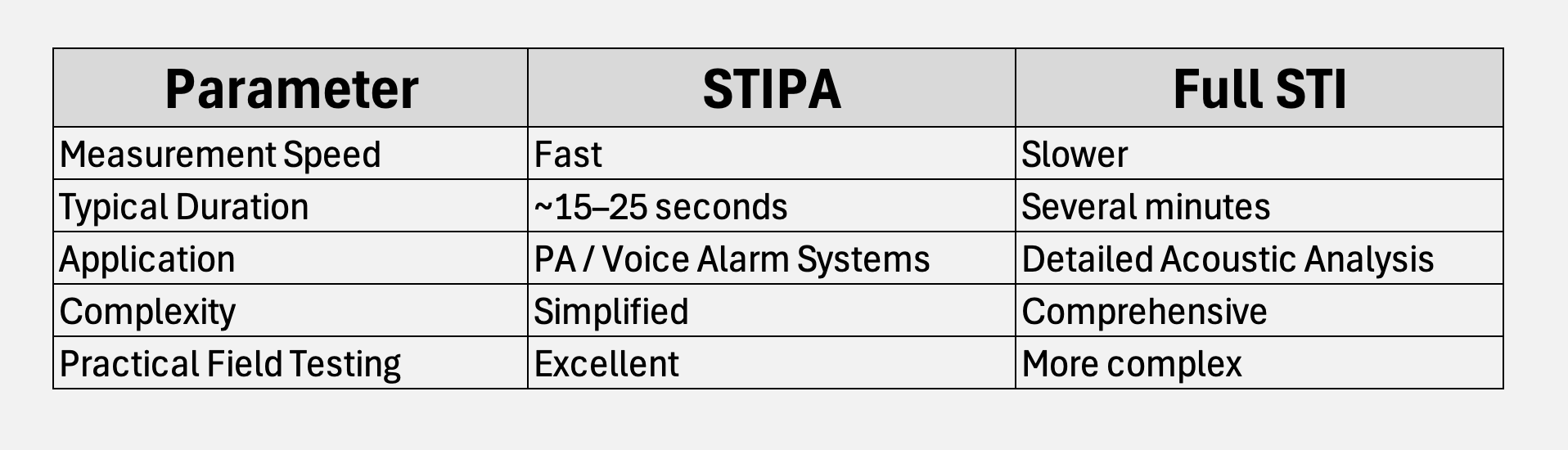
STIPA vs STI
Although closely related, STIPA and full STI are not identical. STIPA was developed specifically to provide rapid and reliable field measurements for installed public address systems.
What is STI? (Speech Transmission Index)
In order to have the objective method of prediction and measurement of Speech Intelligibility, Tammo Houtgast and Herman Steeneken were tasked to carry out a very lengthy series of dull speech intelligibility measurements for the Netherlands Armed Forces. In 1971 they introduced The Speech Transmission Index and was accepted by The Acoustical Society of America in 1980. Their Speech Transmission Index (STI) calculation for prediction and measurement method is a much quicker objective method to the predecessor method.
What is STIPA? (Speech Transmission Index for Public Address Systems)
STIPA is a condensed and approximate version of the Speech Transmission Index (STI) measurement method for Public Address systems. Within the STIPA signal, each octave band is modulated simultaneously with two modulation frequencies. The modulation frequencies are spread among the octave bands in a balanced way, making it possible to obtain a reliable STI measurement based on a sparsely sampled Modulation Transfer Function matrix. Although initially designed for Public Address systems (and similar installations, such as Voice Evacuation Systems and Mass Notification Systems), STIPA can also be used for a variety of other applications.
International Standards Related to STIPA
STIPA measurements are widely referenced in international acoustic and life-safety standards, including:
IEC 60268-16
ISO 7240-24
NFPA 72
BS 5839-8
EN 54
ANSI/ASA acoustic standards
These standards are particularly important for:
Emergency communication systems
Fire alarm voice evacuation systems
Transportation facilities
Educational environments
Large public venues
Typical Applications of STIPA
Transportation Facilities
Airports, railway stations, and transit terminals require clear announcements for operational efficiency and safety.
Worship Spaces
Churches, mosques, and temples often struggle with long reverberation times that reduce sermon intelligibility.
Educational Buildings
Speech intelligibility directly affects learning performance and listener fatigue.
Corporate & Conference Facilities
Clear communication improves collaboration and speech privacy management.
Emergency Evacuation Systems
Life-safety announcements must remain intelligible during emergencies and high-noise conditions.
STIPA Measurement Process
A professional STIPA assessment generally includes:
Acoustic site survey
Background noise measurement
Calibration of test equipment
STIPA signal playback through the PA system
Multi-point intelligibility measurements
Acoustic analysis and mapping
Optimization recommendations
Compliance verification reporting
Modern STIPA measurement systems follow IEC 60268-16 procedures and typically recommend multiple averaged measurements for reliable results.

Our Acoustic and Audio Engineering team did STIPA measurement at Indonesia Stock Exchange Hall
The Role of Acoustic Consultancy in STIPA Optimization
Achieving high speech intelligibility requires more than selecting loudspeakers. It demands integrated coordination between:
Architectural acoustics
Electro-acoustic system design
Noise control
Reverberation management
Loudspeaker modeling
Signal processing optimization
Professional acoustic consultants can simulate and optimize speech intelligibility performance during the design stage, reducing costly post-construction corrections.
Conclusion
STIPA has become one of the most important objective metrics for evaluating speech intelligibility in modern buildings. As architecture becomes increasingly complex and communication-critical environments continue to grow, intelligible sound systems are no longer optional — they are essential components of safety, functionality, and human experience.
By combining acoustic science, electro-acoustic engineering, and architectural integration, STIPA enables designers and consultants to create environments where speech is not only heard, but clearly understood.
References
IEC 60268-16 Standard
NTi Audio – Speech Intelligibility STI Guide
Svantek – STIPA Overview
Wikipedia – Speech Transmission Index
ALTA Integra Acoustic and Audio Engineering Design Team will ensure your room not only can be used for its purpose but is also an enjoyable experience. Our STIPA (speech transmission index for public address) prediction and measurement method allows you to design a room where people are comfortable enough with the conversation, yet loud enough from speakers still being audible from blocks away."
There's no such thing as an insignificant detail in the world of acoustic and audio engineering design. This is why we at ALTA Integra take great pride in helping architects and other design professionals prevent hearing occupants from having to endure inadequate acoustics while listening or speaking, distracting echoes, or just experiencing something that sounds wrong for one reason or another.
#speech #intelligibility #public-address #soundsystem #audiosystem #speaker #architectural-acoustic #room-acoustics