Human-Centered Building Performance
Literature Reviews, Research Insights & Evidence-Based Design Frameworks
Explore literature reviews, research insights, and evidence-based design frameworks.
Discover how acoustics, lighting, thermal comfort, indoor air quality, passive design, and smart building technologies work together bridging building physics, environmental psychology, and sustainable design—to create healthier, more comfortable, and higher-performing environments for people.
Transform Daylight Modeling into Measurable LEED & WELL Certification Value
Annual daylight modeling has evolved far beyond a sustainability compliance exercise. Today, it is a strategic design tool that enables architects, developers, and multinational corporations to make measurable decisions that improve building performance, occupant wellbeing, and long-term asset value.
By combining climate-based daylight simulation with internationally recognized methodologies such as IES LM-83, project teams can optimize façade design, visual comfort, energy efficiency, and workplace quality while simultaneously supporting LEED and WELL certification.
Rather than simply earning certification points, daylight modeling transforms natural light into measurable value for people, buildings, and business.
How annual daylight simulation is helping premium office developments across Asia optimize workplace performance, accelerate global sustainability certification, and create healthier, more valuable buildings.
Daylight Is No Longer an Architectural Amenity—It Is a Strategic Business Asset
For centuries, architects have celebrated daylight as one of the defining elements of exceptional architecture. From the monumental skylights of classical civic buildings to the transparent façades of today's corporate headquarters, natural light has shaped how people perceive space, materiality, and architectural beauty. Yet in the contemporary workplace, daylight has evolved far beyond an aesthetic consideration. It has become a measurable indicator of building performance, occupant wellbeing, and long-term business value.
This transformation reflects a broader shift in the priorities of the global real estate industry. As multinational corporations strengthen their commitments to sustainability, employee wellbeing, and Environmental, Social, and Governance (ESG) performance, the quality of the workplace has become a strategic differentiator. Office buildings are now expected to do more than accommodate business operations; they must attract talent, enhance productivity, support healthier working environments, and demonstrate measurable environmental performance. Consequently, international certification systems such as LEED and the WELL Building Standard have become key benchmarks for organizations seeking to align their workplaces with global best practices.
Within this evolving landscape, daylight occupies a unique position. It is one of the few design variables capable of influencing multiple dimensions of building performance simultaneously. A well-optimized daylight strategy enhances visual comfort, supports healthy circadian rhythms, reduces dependence on artificial lighting, improves energy efficiency, and contributes directly to both LEED and WELL certification. For developers and corporate occupiers alike, these outcomes translate into stronger ESG credentials, lower operating costs, greater employee satisfaction, and enhanced long-term asset value.
Realizing these benefits, however, requires far more than expansive glazing or visually striking architecture. The quantity, distribution, and quality of daylight must be carefully evaluated against solar exposure, glare risk, façade performance, and interior space planning. This level of precision can only be achieved through annual climate-based daylight modeling, where design decisions are informed by measurable performance rather than assumption.
Ultimately, daylight modeling is not about producing attractive renderings or satisfying certification checklists. It is about transforming natural light into actionable design intelligence. By quantifying how daylight performs throughout the year, project teams can optimize architectural form, façade systems, lighting strategies, and workplace layouts to create buildings that perform better for both people and the environment. In doing so, a single simulation becomes a powerful foundation for achieving measurable building performance while contributing to both LEED and WELL certification.
Why Premium Office Buildings Can No Longer Rely on Rules of Thumb
Designing with Evidence Instead of Assumptions
The era of designing office buildings based on intuition, precedent, or simplified rules of thumb is rapidly coming to an end. As workplaces become increasingly sophisticated and corporate expectations continue to evolve, every major design decision is expected to be supported by measurable performance data. Daylight, once considered primarily an architectural expression, is now evaluated as a critical factor influencing environmental quality, employee wellbeing, operational efficiency, and long-term asset performance.
This shift is driven in part by the growing complexity of contemporary office architecture. Expansive glazed façades have become synonymous with premium commercial developments, offering transparency, panoramic views, and abundant natural light. Yet these same façades also introduce significant design challenges. Without careful analysis, increased glazing can result in excessive solar heat gain, visual discomfort, glare, and higher cooling demands—compromising both occupant experience and building performance. The challenge is no longer maximizing daylight, but optimizing its quality and distribution throughout the occupied environment.
At the same time, workplace design has undergone a fundamental transformation. Traditional office layouts have given way to flexible environments that accommodate collaboration, focused work, hybrid meetings, and changing patterns of occupancy. Spaces are expected to adapt to diverse working styles while maintaining consistent visual comfort across open-plan workstations, meeting rooms, executive offices, and shared amenities. Achieving this level of performance requires a far more nuanced understanding of how daylight behaves across different spaces and throughout the changing seasons.
The widespread adoption of hybrid working has further elevated expectations for workplace quality. As organizations encourage employees to return to the office, the workplace must offer experiences that cannot be replicated remotely. Access to high-quality natural light, comfortable visual environments, and healthier indoor conditions has become an important component of employee engagement, workplace satisfaction, and talent retention. Increasingly, the office is viewed not merely as a place to work, but as an environment that supports wellbeing, collaboration, and organizational culture.
Delivering Annual Daylight Simulation for a LEED Gold Certified Workplace
These changing priorities are closely aligned with broader corporate commitments to Environmental, Social, and Governance (ESG) performance. Investors, shareholders, and corporate occupiers are placing greater emphasis on measurable indicators of sustainability and human-centered design. International certification systems such as LEED and the WELL Building Standard have become powerful frameworks for demonstrating these commitments, requiring project teams to validate building performance through evidence rather than design intent alone.
For projects across tropical Asia, the challenge becomes even more complex. Cities such as Jakarta, Singapore, Kuala Lumpur, Bangkok, Ho Chi Minh City, and Manila experience high solar intensity, elevated humidity, and year-round cooling demand. Strategies that perform successfully in temperate climates cannot simply be replicated without modification. Building orientation, façade composition, glazing performance, external shading, and daylight penetration must all respond to local climatic conditions to achieve an appropriate balance between daylight availability, thermal comfort, and energy efficiency.
In this context, visual judgment alone is no longer sufficient. Even experienced architects cannot accurately predict how daylight will penetrate deep floor plates, interact with complex façade geometries, or vary throughout the course of an entire year. Decisions based solely on experience or visual perception may inadvertently create spaces affected by excessive glare, uneven daylight distribution, or unnecessary energy consumption.
Annual climate-based daylight modeling transforms these uncertainties into measurable design intelligence. By simulating the interaction between daylight, building geometry, material properties, occupancy patterns, and local climate, project teams gain objective evidence to support critical design decisions before construction begins. Rather than relying on assumptions, architects and consultants can refine façade systems, optimize workspace layouts, coordinate lighting strategies, and evaluate design alternatives with confidence.
Ultimately, the most successful premium office developments are distinguished not by how much glass they incorporate, but by how intelligently they balance daylight, comfort, energy performance, and human experience. In an increasingly performance-driven real estate market, evidence-based design is no longer a competitive advantage—it has become the benchmark for delivering workplaces that are healthier, more sustainable, and more valuable over the long term.
What Is Annual Daylight Modeling?
Measuring Natural Light Across an Entire Year
Designing with daylight has always been one of architecture's greatest ambitions. Yet understanding how natural light performs inside a building requires far more than observing sunlight on a single day or relying on static renderings. The position of the sun changes from hour to hour, seasons alter daylight intensity, weather conditions influence sky luminance, and surrounding buildings continuously affect how light enters occupied spaces. A design that appears successful in one moment may perform very differently throughout the rest of the year.
To capture this complexity, contemporary building design increasingly relies on Annual Daylight Modeling, a sophisticated simulation methodology that predicts how daylight behaves across every occupied hour of an entire year. Rather than evaluating isolated moments under idealized conditions, annual daylight modeling provides a comprehensive understanding of daylight performance under real climatic conditions, enabling architects to make informed decisions long before construction begins.
At the heart of this process is Climate-Based Daylight Modeling (CBDM), a performance-based analytical approach that evaluates daylight using local climate data rather than simplified assumptions. By incorporating an entire year of hourly weather information—including solar position, sky conditions, cloud cover, and atmospheric luminance—the simulation reflects how natural light is likely to perform throughout the building's operational life. The result is a far more accurate representation of occupant experience than traditional point-in-time calculations.
This methodology is implemented through dynamic daylight simulation, where daylight conditions are calculated for every occupied hour of the year. Instead of producing a single illuminance value, dynamic simulation reveals how daylight fluctuates throughout changing seasons, different times of day, and varying weather patterns. This temporal perspective enables designers to identify both opportunities and potential challenges, from maximizing daylight penetration to minimizing periods of excessive solar exposure.
The internationally recognized framework for this analysis is IES LM-83, developed by the Illuminating Engineering Society (IES). Widely adopted by certification systems such as LEED and the WELL Building Standard, the standard establishes a consistent methodology for evaluating daylight performance using annual climate data. It has become the benchmark for performance-based daylight assessment, enabling project teams to compare design alternatives using objective, evidence-based metrics.
Behind many professional daylight studies is the Radiance simulation engine, one of the world's most respected daylight analysis tools. Developed through decades of scientific research, Radiance employs physically based ray-tracing algorithms to simulate the complex interaction of light with architectural geometry, glazing systems, surface materials, and interior spaces. Its high level of accuracy has made it the preferred calculation engine for leading architects, lighting designers, façade engineers, and sustainability consultants worldwide.
Equally important is the use of annual weather files, commonly based on Typical Meteorological Year (TMY) datasets. These files provide hourly climate information specific to a project's location, including direct and diffuse solar radiation, sky luminance, and meteorological conditions. By grounding simulations in local climate data, project teams can evaluate how buildings respond to the unique environmental characteristics of cities such as Jakarta, Singapore, Bangkok, Ho Chi Minh City, or Manila, where tropical solar intensity presents distinct design challenges.
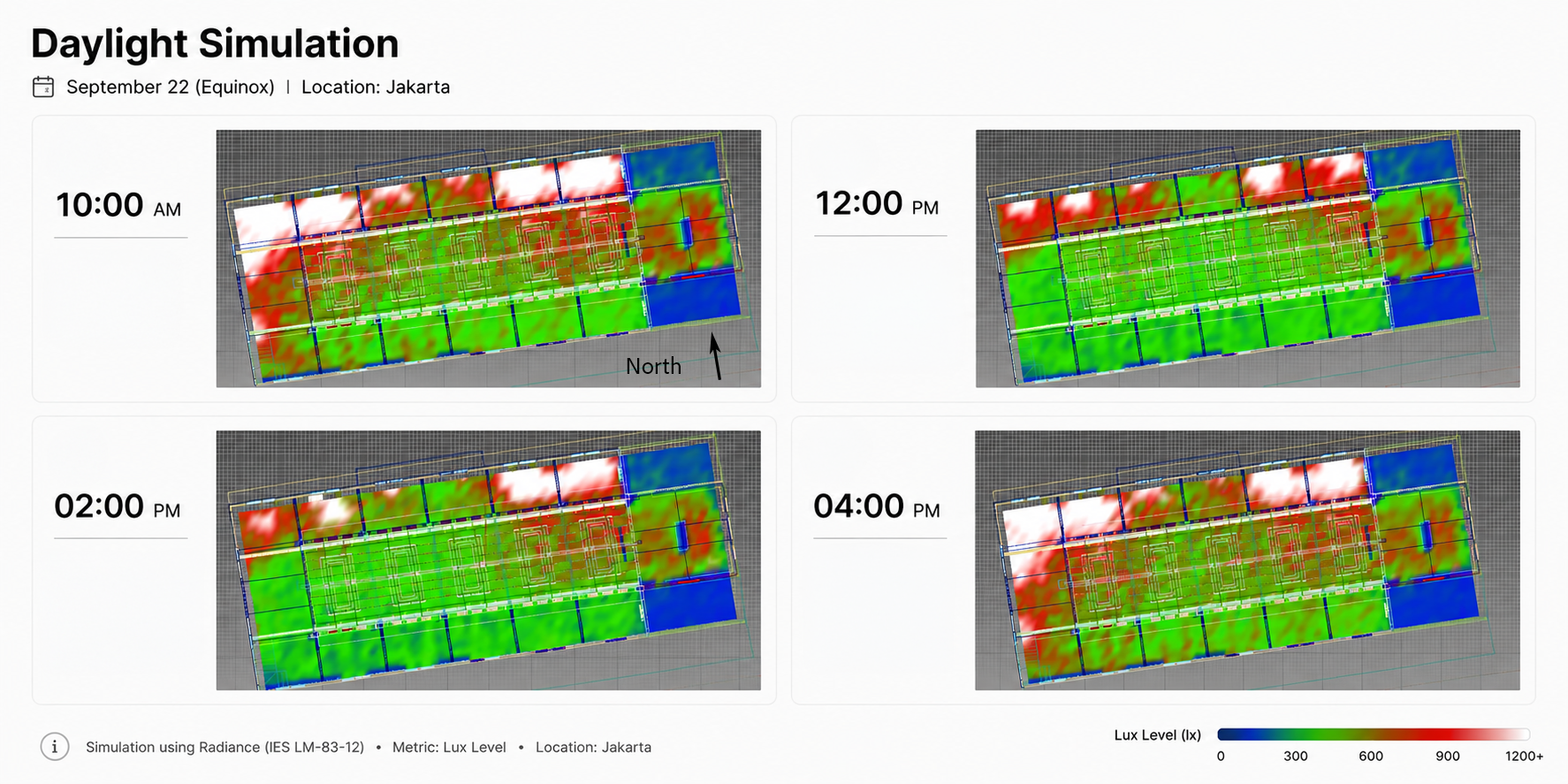
Horizontal Lux Level Daylight Simulation Analysis dated September 22 (Equinox)
The true value of annual daylight modeling lies in the performance metrics it generates. Among the most widely adopted is Spatial Daylight Autonomy (sDA), which measures the percentage of regularly occupied floor area receiving at least 300 lux of daylight for a minimum of 50 percent of annual occupied hours. Rather than focusing on isolated measurement points, sDA evaluates how effectively daylight serves the building as a whole, making it a powerful indicator of overall daylight quality.
Complementing this metric is Annual Sunlight Exposure (ASE), which identifies areas receiving excessive direct sunlight—typically spaces exposed to more than 1,000 lux for over 250 occupied hours each year. While abundant daylight is desirable, excessive sunlight can introduce glare, increase cooling loads, and reduce occupant comfort. ASE therefore ensures that daylight design achieves an appropriate balance between daylight access and visual wellbeing.
Beyond certification metrics, annual daylight modeling provides a broader understanding of building performance. It reveals daylight availability across different workplace settings, allowing designers to optimize the placement of workstations, meeting rooms, collaborative areas, and circulation spaces according to the quality of available natural light. It also helps identify glare risk, enabling façade design, shading systems, and glazing specifications to be refined before construction. Equally important, the simulation illustrates daylight distribution, highlighting how effectively natural light penetrates deep floor plates and whether illumination remains balanced throughout the interior environment.
Ultimately, annual daylight modeling transforms daylight from an intuitive design aspiration into measurable building intelligence. It allows architects and consultants to evaluate the relationship between climate, façade performance, spatial planning, lighting quality, and occupant comfort with scientific precision. Rather than asking whether a building has sufficient daylight, project teams can answer a far more valuable question: How does daylight perform, throughout every working hour of the year, for the people who will ultimately occupy the building?
This transition from intuition to evidence is redefining contemporary architectural practice. In premium office developments, annual daylight modeling is no longer simply a technical exercise undertaken to satisfy certification requirements—it has become a strategic design tool that supports healthier workplaces, more resilient buildings, improved energy performance, and higher long-term asset value.
Beyond Certification: The Business Value of Daylight Modeling
Better Buildings Create Better Business Outcomes
For many years, daylight simulation was regarded primarily as a technical exercise performed to satisfy sustainability certification requirements. Today, its role has expanded considerably. In premium commercial developments, annual daylight modeling has become a strategic decision-making tool that helps developers, corporate occupiers, and design teams create workplaces that perform better—not only environmentally, but economically and socially.
This evolution reflects a broader understanding that the value of a building is increasingly measured by the quality of the experiences it delivers. Investors evaluate long-term operational performance, multinational corporations seek workplaces that support employee wellbeing and organizational culture, while tenants expect environments that enhance comfort, productivity, and flexibility. Daylight sits at the intersection of these priorities, influencing outcomes that extend far beyond compliance with LEED or the WELL Building Standard.
One of the most immediate benefits of effective daylight design is its contribution to employee wellbeing. Access to balanced natural light supports healthier circadian rhythms, reduces visual fatigue, and strengthens occupants' connection to the external environment. Numerous workplace studies have shown that high-quality daylight contributes to greater psychological comfort, improved mood, and higher levels of employee engagement—factors that increasingly influence talent attraction and retention in today's competitive corporate landscape.
Closely associated with wellbeing is visual comfort, one of the defining characteristics of a high-performance workplace. A well-designed daylight strategy distributes natural light evenly across occupied spaces while minimizing excessive brightness contrasts that can cause eye strain or discomfort. Annual daylight modeling enables project teams to predict these conditions before construction begins, allowing façade systems, interior layouts, and shading strategies to be refined through objective performance analysis rather than subjective judgment.
This proactive approach also plays a critical role in reducing one of the most common post-occupancy complaints in modern office buildings: glare. Expansive glazing may create visually impressive architecture, but without careful daylight analysis it can expose occupants to excessive sunlight that disrupts computer-based work, increases reliance on window blinds, and diminishes overall workplace satisfaction. By identifying potential glare risks early in the design process, daylight modeling enables architects to integrate appropriate façade geometry, external shading, glazing specifications, and daylight control strategies that preserve natural light without compromising occupant comfort.
The cumulative effect of healthier daylight conditions often translates into improved workplace productivity. Employees who work in environments with balanced daylight and reduced visual discomfort are better able to maintain concentration throughout the working day. While architecture alone cannot determine organizational performance, evidence increasingly demonstrates that the quality of the physical environment can meaningfully influence cognitive performance, collaboration, and overall workplace effectiveness.
From an operational perspective, daylight modeling also contributes directly to energy performance. By optimizing the relationship between natural daylight and electric lighting systems, designers can reduce dependence on artificial lighting during occupied hours. When integrated with daylight-responsive controls, this strategy lowers lighting energy consumption while maintaining consistent illumination levels, supporting both operational efficiency and broader sustainability objectives. Importantly, effective daylight optimization also helps balance solar heat gain, reducing unnecessary cooling loads and improving overall building performance in warm climates.
For building owners and asset managers, these benefits extend into measurable commercial value. High-quality workplace environments consistently achieve greater occupant satisfaction, strengthening tenant loyalty and reducing the likelihood of relocation. In an increasingly competitive office market, where tenant experience has become a defining differentiator, healthier and more comfortable workplaces contribute to lower tenant churn, higher occupancy rates, and stronger long-term leasing performance.
Premium office developments that demonstrate measurable environmental quality are also increasingly recognized within the marketplace. Buildings designed around evidence-based daylight performance are better positioned to command premium rental values, particularly among multinational corporations that prioritize employee wellbeing, sustainability, and workplace quality within their corporate real estate strategies. For these organizations, daylight is not simply an architectural feature—it represents a tangible indicator of workplace excellence.
The strategic value of daylight modeling extends further as organizations strengthen their commitments to Environmental, Social, and Governance (ESG) reporting. Investors and corporate stakeholders increasingly expect measurable evidence of environmental performance and occupant wellbeing rather than aspirational sustainability statements. Annual daylight simulation provides quantifiable data that supports both certification documentation and broader ESG disclosures, demonstrating that design decisions have been validated through internationally recognized performance methodologies.
Perhaps most importantly, daylight modeling contributes to future-proof building design. As workplace expectations continue to evolve and sustainability standards become more demanding, buildings designed using performance-based simulation are inherently more adaptable and resilient. Decisions regarding façade design, workplace planning, lighting integration, and environmental performance are informed by objective analysis, reducing the risk of costly retrofits while extending the long-term relevance of the asset.
Ultimately, the greatest value of annual daylight modeling cannot be measured solely in certification points or simulation reports. Its true contribution lies in enabling architects, developers, and corporate occupiers to make better decisions before construction begins. By transforming natural light into measurable building intelligence, daylight modeling helps create workplaces that support healthier people, operate more efficiently, achieve stronger ESG performance, and deliver enduring commercial value. In today's premium real estate market, that combination of human performance and business performance has become one of the most compelling indicators of architectural success.
How Daylight Modeling Contributes to LEED Certification
Optimizing Environmental Quality Through Performance-Based Design
Today, however, daylight is no longer judged solely by architectural intuition or visual appeal. Within the Leadership in Energy and Environmental Design (LEED) rating system, daylight has become a measurable performance indicator that directly contributes to environmental quality, occupant experience, and sustainable building performance.
Rather than prescribing a fixed design solution, LEED adopts a performance-based approach, allowing project teams to demonstrate how effectively their design delivers natural daylight through rigorous annual computer simulation. This methodology encourages evidence-based decision-making, enabling architects to optimize building orientation, façade design, glazing selection, and interior planning long before construction begins.
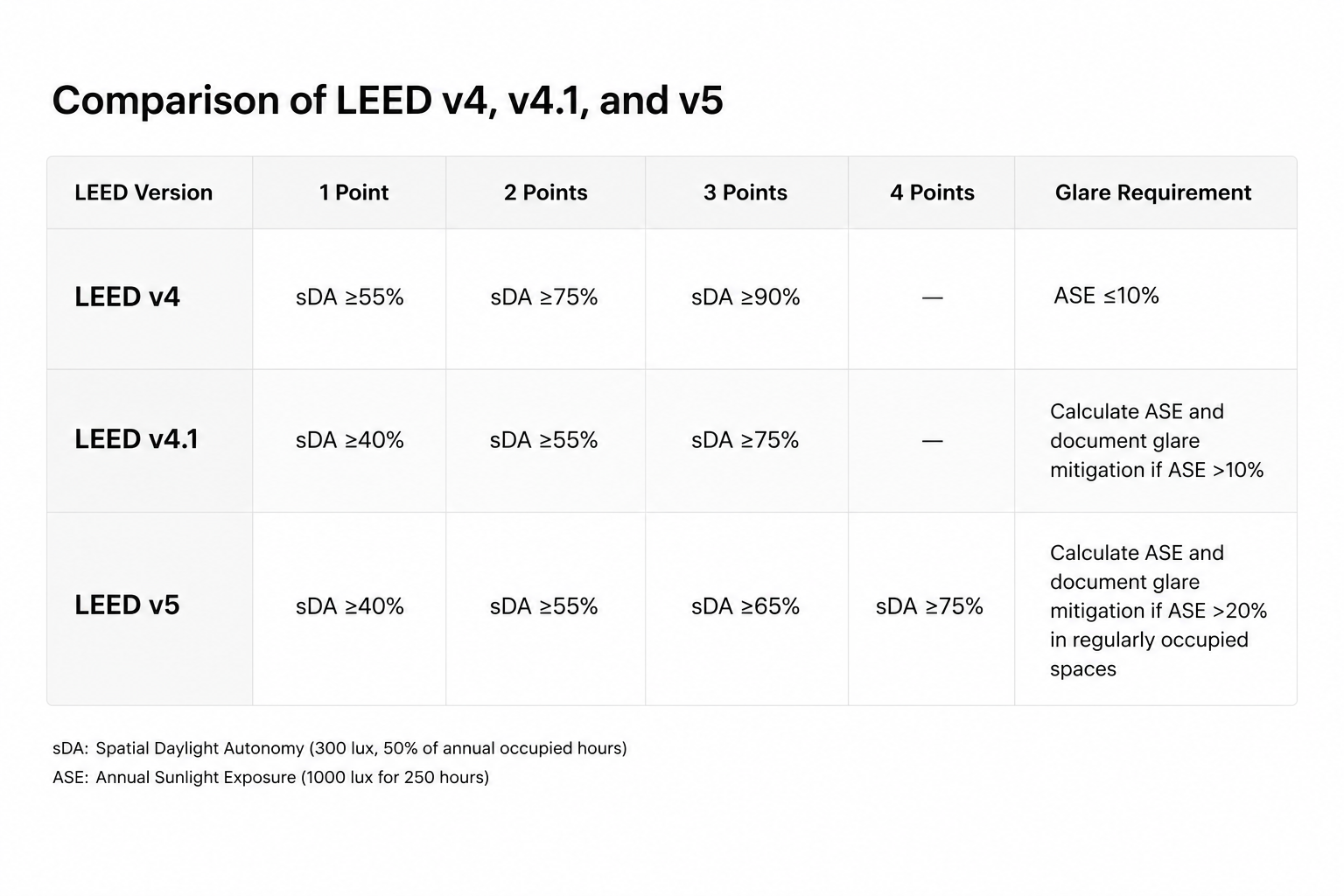
For the majority of projects pursuing LEED v4 or LEED v4.1 Building Design and Construction (BD+C) certification, daylight performance is evaluated using Climate-Based Daylight Modeling (CBDM) in accordance with the IES LM-83 standard. The simulation measures two internationally recognized performance metrics: Spatial Daylight Autonomy (sDA300/50%), which quantifies the proportion of regularly occupied floor area receiving sufficient daylight throughout the year, and Annual Sunlight Exposure (ASE1000,250), which evaluates the risk of excessive direct sunlight that may result in glare or occupant discomfort.
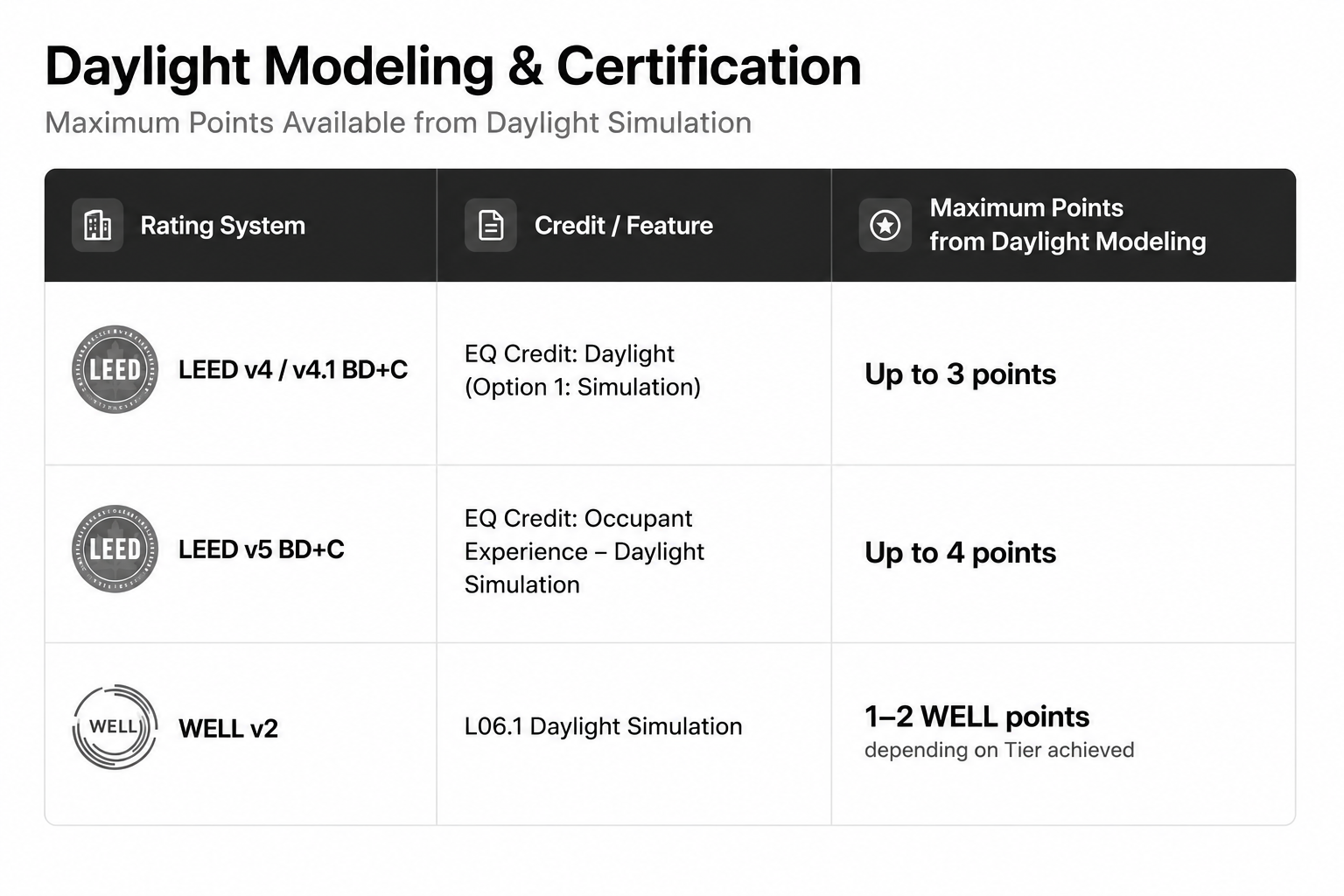
Projects demonstrating higher levels of daylight performance while effectively controlling excessive solar exposure may earn between one and three LEED points, depending on the percentage of regularly occupied floor area that satisfies the prescribed performance thresholds. This balanced assessment recognizes that exceptional daylight design is not simply about maximizing natural light, but about delivering the right quantity of daylight in the right locations while maintaining visual comfort.
With the introduction of LEED v5, the evaluation of daylight takes another significant step forward. While annual daylight simulation continues to rely on IES LM-83-23 and the same fundamental metrics of Spatial Daylight Autonomy (sDA300/50%) and Annual Sunlight Exposure (ASE1000,250), the underlying philosophy has evolved. Daylight is no longer considered solely an environmental quality metric; it is now positioned as a core component of Occupant Experience, recognizing its profound influence on health, wellbeing, productivity, and long-term workplace satisfaction.
This shift reflects a broader transformation within sustainable building design. High-performance workplaces are increasingly expected to deliver more than energy efficiency—they must also support human performance. By explicitly linking daylight to circadian health, visual comfort, and occupant engagement, LEED v5 encourages project teams to design environments that perform equally well for both buildings and the people who inhabit them.
Ultimately, annual daylight modeling has become far more than a pathway to certification. It is a strategic design instrument that enables multidisciplinary teams to evaluate the complex relationship between architecture, façade engineering, lighting design, and building performance. When integrated into the earliest stages of design, daylight simulation empowers project teams to create workplaces that are healthier, more energy efficient, and better prepared to meet the evolving expectations of global investors, multinational occupiers, and environmentally conscious developers.
Relationship with Energy Performance
Daylight modeling is far more than a certification exercise. It is one of the most influential analytical tools for balancing occupant wellbeing with building energy performance.
Effective daylight design reduces dependence on artificial lighting during occupied hours. When integrated with daylight-responsive lighting controls, annual lighting energy consumption can be significantly reduced while maintaining visual comfort throughout the workplace.
However, maximizing daylight does not simply mean increasing the amount of glazing. Excessive glass area may increase cooling loads, create glare, and reduce occupant comfort—particularly in tropical climates across Asia. High-performance daylight design therefore seeks an optimal balance between daylight availability, solar heat gain, visual comfort, and energy efficiency.
This integrated approach directly influences several aspects of building performance, including:
Reduced electric lighting energy demand through daylight harvesting.
Lower peak cooling loads by optimizing façade design and solar control.
Improved thermal comfort by limiting excessive solar radiation.
Enhanced occupant satisfaction through balanced daylight distribution and glare control.
Better coordination between architectural, façade, mechanical, and lighting systems.
Because daylight and energy performance are closely interconnected, daylight modeling is commonly performed alongside whole-building energy simulation during the early stages of design. Together, these analyses enable project teams to optimize building orientation, façade geometry, glazing specifications, external shading devices, and lighting control strategies before construction begins.
For premium office developments targeting LEED, WELL, ESG objectives, and net-zero carbon ambitions, this integrated workflow transforms daylight from a passive architectural feature into a measurable driver of operational efficiency, occupant wellbeing, and long-term asset value.
How Daylight Modeling Supports WELL Certification
Designing Workplaces Around Human Health
Natural daylight has long been recognized as one of architecture's most valuable resources, but within the WELL Building Standard v2, it is evaluated not simply as an environmental attribute, but as a measurable contributor to human health and wellbeing. Rather than focusing solely on energy performance or regulatory compliance, WELL emphasizes how daylight influences the daily experience of building occupants—from visual comfort and circadian health to productivity, satisfaction, and overall quality of life.
This human-centered philosophy distinguishes WELL from many traditional sustainability frameworks. While LEED primarily rewards environmental building performance, WELL measures how effectively the built environment supports the people who occupy it. Daylight therefore becomes more than a design feature; it becomes an evidence-based strategy for creating healthier workplaces.
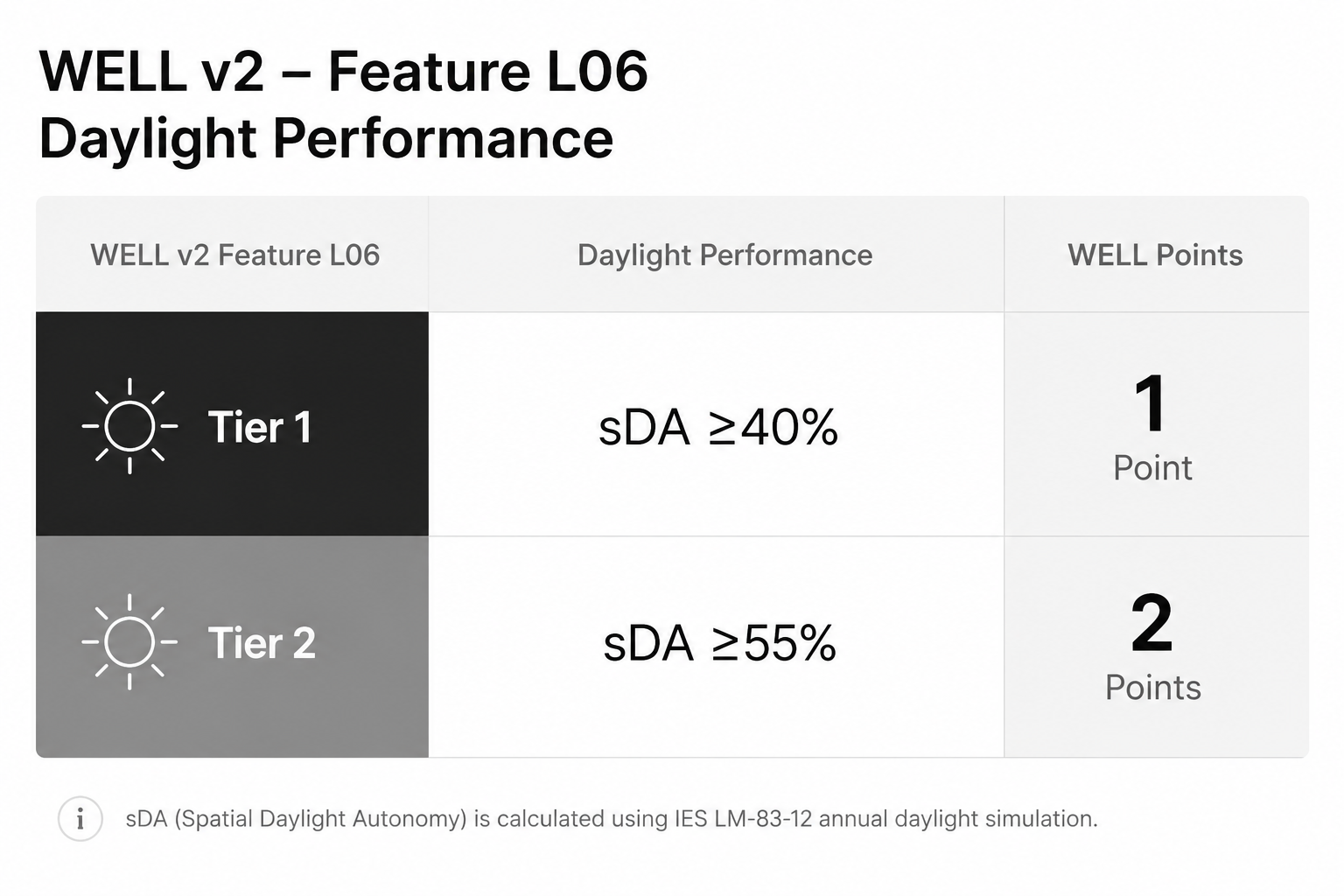
Within the Light Concept, Feature L06 – Daylight Simulation is an Optimization Feature that encourages project teams to use annual climate-based daylight modeling to evaluate the quality and distribution of natural light throughout regularly occupied spaces. The objective is straightforward: provide occupants with sufficient daylight while carefully controlling excessive sunlight and glare that could compromise visual comfort.
Unlike LEED, which awards points across multiple daylight performance thresholds, WELL adopts a two-tier performance pathway. Each tier reflects an increasing level of daylight availability and demonstrates a progressively stronger commitment to occupant wellbeing.
Tier 1: Establishing Healthy Daylight Performance
The first tier recognizes projects that provide consistent daylight access across a significant portion of the occupied floor area. Annual climate-based daylight simulation, typically performed using Radiance in accordance with IES LM-83, must demonstrate that at least 40 percent of regularly occupied floor area achieves Spatial Daylight Autonomy (sDA300/50%). In parallel, project teams must evaluate Annual Sunlight Exposure (ASE1000,250) to ensure that excessive direct sunlight is effectively managed.
Where areas exceed the recommended ASE threshold, WELL encourages thoughtful design responses rather than simple compliance. External shading systems, high-performance glazing, automated or manual blinds, and carefully designed façade geometries can all be employed to reduce glare while preserving valuable daylight. Projects satisfying these requirements are awarded Tier 1, contributing one WELL point toward certification.
Tier 2: Delivering Exceptional Daylight Performance
Tier 2 recognizes projects that demonstrate a higher level of daylight performance across a substantially larger proportion of the occupied floor area. To achieve this level, annual daylight simulation must show that at least 55 percent of regularly occupied spaces meet the sDA300/50% criterion while continuing to control excessive sunlight through appropriate glare mitigation strategies.
Reaching Tier 2 typically requires a more integrated design process. Building orientation, façade composition, glazing specification, shading devices, floor plate depth, interior planning, and workstation placement must all work together to distribute daylight effectively without introducing thermal discomfort or visual distraction. Rather than relying on expansive glazing alone, successful projects carefully balance daylight availability with occupant comfort throughout the year.
Projects meeting these enhanced performance criteria are awarded Tier 2, achieving the maximum two WELL points available under Feature L06.
One Simulation Supporting Two Global Certifications
Maximizing Certification Efficiency Through Integrated Daylight Modeling
In today's high-performance workplace developments, daylight modeling has evolved beyond a single-purpose certification exercise. It has become a multidisciplinary design tool that simultaneously informs architectural decision-making, optimizes building performance, and supports multiple international sustainability frameworks. Rather than preparing separate analyses for different certification systems, project teams can leverage a single annual daylight simulation to satisfy the technical requirements of both LEED and WELL Building Standard, while generating valuable insights that improve the building itself.
This integrated approach represents a significant shift in the way premium buildings are designed. A coordinated daylight simulation does far more than quantify access to natural light. It reveals how daylight interacts with building orientation, façade geometry, glazing performance, interior layouts, and occupant activities throughout the year. Every design iteration becomes an opportunity to improve both environmental performance and human experience before construction begins.
For projects pursuing LEED certification, annual daylight simulation demonstrates measurable compliance with daylight performance criteria through climate-based metrics such as Spatial Daylight Autonomy (sDA) and Annual Sunlight Exposure (ASE). The same simulation can also support WELL Building Standard documentation by evaluating daylight availability, visual comfort, and glare control, allowing a single analytical model to contribute toward two globally recognized certification systems.
The value of this integrated workflow extends well beyond certification. Because daylight influences multiple aspects of building performance, the simulation becomes a foundation for broader design optimization. Architects can refine building orientation and façade composition to improve daylight penetration without increasing unwanted solar heat gain. Façade consultants can evaluate glazing specifications, visible light transmittance, and external shading systems to achieve an appropriate balance between transparency and thermal performance. Lighting designers can coordinate daylight availability with electric lighting controls, reducing energy consumption while maintaining consistent visual comfort throughout the workplace.
Mechanical engineers also benefit from the same analytical process. Decisions that increase daylight often affect solar heat gain and cooling demand, making daylight modeling closely interconnected with whole-building energy simulation. By coordinating façade performance, daylight availability, lighting controls, and HVAC strategies from the earliest design stages, project teams can avoid the unintended consequences that frequently arise when each discipline works independently.
Perhaps the greatest advantage of integrated daylight modeling is its ability to reduce costly redesign. When daylight performance is evaluated during concept or schematic design, potential issues such as excessive glare, insufficient daylight penetration, oversized glazing areas, or poor workstation placement can be identified before they become expensive construction changes. Early simulation enables informed decisions while design flexibility remains high, minimizing late-stage revisions, reducing coordination conflicts, and preserving project schedules.
For multinational corporations and premium office developers, this integrated methodology delivers benefits that extend far beyond certification points. It supports healthier workplaces, improves operational efficiency, strengthens ESG performance, and enhances long-term asset value. More importantly, it allows every member of the design team—from architects and interior designers to façade engineers, lighting specialists, sustainability consultants, and EPC contractors—to work from a common set of performance data, ensuring that design decisions are driven by measurable evidence rather than assumption.
Ultimately, the most successful workplace projects recognize that daylight modeling is not simply a pathway to certification. It is a strategic design intelligence platform that transforms natural light into measurable outcomes—optimizing building performance, enhancing occupant wellbeing, and maximizing the return on investment in both LEED and WELL certification.
Understanding the Difference Between LEED and WELL Daylight Requirements
Two Global Standards, One Shared Objective
Natural daylight occupies an important place within both LEED and the WELL Building Standard, yet the two certification systems evaluate its performance from distinctly different perspectives. Although both rely on annual climate-based daylight simulation and employ the internationally recognized IES LM-83 methodology, they ask fundamentally different questions about what constitutes a successful building.
Understanding this distinction is essential for developers, architects, and corporate occupiers seeking to maximize the long-term value of their projects. While LEED and WELL often complement one another, they are designed to achieve different objectives. One measures how effectively a building performs as an environmental system; the other evaluates how that same environment supports the health, comfort, and performance of the people who occupy it.
LEED: Optimizing Environmental Performance
Within the Leadership in Energy and Environmental Design (LEED) framework, daylight is primarily assessed as an indicator of environmental quality and sustainable building performance. The emphasis is placed on delivering adequate daylight throughout regularly occupied spaces while balancing solar exposure, energy efficiency, and occupant comfort.
Annual daylight simulation is therefore used to quantify building performance through metrics such as Spatial Daylight Autonomy (sDA300/50%) and Annual Sunlight Exposure (ASE1000,250). These performance indicators allow project teams to evaluate whether the building envelope, façade, and spatial organization provide sufficient daylight while avoiding excessive solar penetration that could increase cooling loads or create visual discomfort.
From LEED's perspective, daylight contributes to a broader strategy of environmental optimization. It supports reductions in electric lighting energy, influences whole-building energy performance, and forms part of an integrated approach to sustainable design that considers the building as an interconnected environmental system.
WELL: Designing for Human Experience
The WELL Building Standard approaches daylight from a different perspective. Rather than asking how efficiently the building performs, WELL asks how effectively the built environment supports the people working within it.
Daylight is evaluated as a contributor to visual comfort, circadian health, cognitive performance, and overall workplace wellbeing. Although WELL also employs annual daylight simulation using IES LM-83, its objective extends beyond environmental performance to the quality of the daily human experience.
Within Feature L06 – Daylight Simulation, the emphasis is placed on ensuring that occupants receive meaningful access to natural daylight while minimizing glare and visual discomfort. Daylight therefore becomes part of a broader strategy that supports healthier workplaces, improved employee satisfaction, and enhanced organizational performance.
This human-centered philosophy reflects a growing recognition that workplace quality directly influences employee engagement, talent attraction, and long-term business performance.
Same Simulation, Different Questions
One of the most interesting aspects of contemporary building certification is that LEED and WELL often rely on the same technical analysis while interpreting the results through different performance lenses.
A single annual daylight simulation—performed using Radiance in accordance with IES LM-83—can frequently satisfy documentation requirements for both certification systems. Yet the value of that simulation differs depending on the framework.
For LEED, the simulation demonstrates that the building performs efficiently as part of a sustainable environmental strategy.
For WELL, the same simulation demonstrates that the workplace has been designed to support human health and visual wellbeing.
The technical methodology remains remarkably similar; the design intent is fundamentally different.
Performance Versus Experience
This distinction reflects a broader evolution within contemporary architecture.
Historically, sustainable buildings were evaluated primarily through operational metrics such as energy consumption, water efficiency, and carbon emissions. Increasingly, however, building performance is also measured by the experience of the people who occupy those environments every day.
An office that consumes little energy but provides poor visual comfort cannot truly be considered high performing. Equally, a workplace that delivers exceptional occupant wellbeing while operating inefficiently falls short of contemporary sustainability expectations.
The most successful buildings achieve both.
Why Leading Projects Pursue Both LEED and WELL
For premium commercial developments, LEED and WELL should not be viewed as competing certification systems but as complementary design frameworks.
LEED establishes the environmental foundation by optimizing energy performance, daylight availability, resource efficiency, and sustainable building operation.
WELL builds upon that foundation by focusing on the human outcomes of those environmental decisions, including health, comfort, productivity, and workplace satisfaction.
Together, they encourage project teams to design buildings that perform exceptionally from both environmental and human perspectives.
This integrated approach is increasingly valued by multinational corporations seeking workplaces that support ESG commitments, attract and retain talent, and create healthier environments for employees. Investors similarly recognize that buildings capable of delivering both operational excellence and superior occupant experience are better positioned to maintain long-term value within an increasingly competitive commercial real estate market.
Beyond Dual Certification
Perhaps the most significant lesson from comparing LEED and WELL is that daylight modeling itself should never be viewed simply as a pathway to certification points.
Its true value lies in providing objective evidence that enables better architectural decisions.
When annual daylight simulation informs building orientation, façade engineering, workplace planning, lighting design, thermal comfort, and occupant wellbeing simultaneously, certification becomes a natural outcome of good design rather than its primary purpose.
This is the philosophy increasingly embraced by the world's leading workplace projects. They recognize that buildings are not judged solely by how efficiently they operate or how many certification points they achieve, but by how effectively they improve the lives of the people who occupy them.
Ultimately, LEED measures how well a building performs, while WELL measures how well people perform within that building. Annual daylight modeling provides the scientific bridge between these two ambitions, transforming natural light into measurable value for both the built environment and the people it serves.
Required Documentation
Achieving LEED and WELL Daylight Credit through the simulation pathway requires comprehensive technical documentation that demonstrates compliance with the daylight performance criteria. More importantly, this documentation provides evidence that daylight performance has been intentionally engineered rather than assumed during the design process.
A typical LEED daylight simulation submission includes:
Annual Climate-Based Daylight Simulation (CBDM) Report following IES LM-83 methodology.
Spatial Daylight Autonomy (sDA) calculations showing the percentage of regularly occupied floor area receiving adequate daylight.
Annual Sunlight Exposure (ASE) analysis identifying areas with excessive direct sunlight and documenting glare mitigation strategies.
Simulation methodology, including weather files, occupancy schedules, calculation grids, and analysis parameters.
Building geometry and floor plans illustrating the simulated regularly occupied spaces.
Façade specifications, including glazing properties, visible light transmittance (VLT), shading devices, and window-to-wall ratio.
Interior material reflectance assumptions for ceilings, walls, floors, and major furniture elements.
Photometric and daylight visualization outputs, including false-color illuminance maps and daylight distribution diagrams.
Narrative documentation describing design strategies that optimize daylight while minimizing glare and visual discomfort.
For projects pursuing both LEED and WELL Certification, a single coordinated daylight simulation can often support documentation requirements for both rating systems, reducing duplication of effort and improving project delivery efficiency.
Design Decisions That Benefit Most from Daylight Modeling
Where Simulation Creates the Greatest Return on Investment
Design Decisions That Benefit Most from Daylight Modeling
Where Simulation Creates the Greatest Return on Investment
The greatest value of annual daylight modeling lies not in verifying a completed design, but in informing the decisions that shape it. When integrated into the earliest stages of the design process, daylight simulation becomes a powerful analytical tool that enables architects to evaluate alternatives, predict performance, and optimize the building before a single façade panel is installed.
Every architectural decision influences the quality of daylight experienced within a building. From the orientation of the site to the arrangement of interior workspaces, each variable contributes to how natural light is distributed, how occupants perceive the environment, and how efficiently the building operates throughout its lifecycle. By quantifying these relationships, annual daylight modeling transforms design intuition into measurable performance.
Perhaps the most influential decision is building orientation. The positioning of a building relative to the sun establishes the foundation for daylight availability, solar heat gain, and visual comfort. A carefully oriented building can maximize useful daylight while reducing excessive solar exposure, lowering cooling demand without compromising interior quality. In tropical climates across Asia, where solar intensity remains consistently high throughout the year, optimizing orientation during the earliest planning stages often delivers the greatest long-term performance benefits.
Closely linked to orientation is the optimization of the window-to-wall ratio (WWR). Expansive glazing has become a defining characteristic of contemporary office architecture, yet larger windows do not necessarily create better workplaces. Excessive glazing may increase cooling loads, introduce uncomfortable glare, and reduce occupant satisfaction despite abundant daylight. Annual daylight modeling enables architects to determine the appropriate balance between transparency and performance, identifying the glazing proportion that delivers generous daylight without sacrificing thermal comfort or operational efficiency.
The performance of a façade extends far beyond the quantity of glass it contains. Façade geometry, including setbacks, fins, overhangs, and articulated building forms, significantly influences how sunlight penetrates interior spaces throughout the year. Simulation allows designers to compare multiple façade configurations, revealing how subtle geometric adjustments can improve daylight distribution while reducing direct solar exposure. Rather than relying on standardized façade solutions, architects can develop climate-responsive envelopes tailored to the building's location and orientation.
Equally important are external shading devices, which remain among the most effective strategies for balancing daylight and solar control. Horizontal louvers, vertical fins, perforated screens, and dynamic shading systems can dramatically reduce glare and cooling demand while preserving valuable daylight. Through annual simulation, project teams can evaluate shading performance across every season and hour of occupancy, ensuring that shading devices respond to actual climatic conditions rather than generalized assumptions.
In some projects, light shelves offer an elegant means of extending daylight deeper into occupied spaces. By reflecting sunlight toward the ceiling, these architectural elements improve daylight penetration while reducing excessive brightness near the façade. Their effectiveness, however, depends on façade orientation, ceiling reflectance, floor plate depth, and local climate—factors that can only be accurately assessed through simulation.
Daylight modeling also informs decisions beyond the building envelope. The organization of the interior layout has a profound influence on how occupants experience natural light throughout the working day. Rather than allocating premium daylight exclusively to perimeter offices, many contemporary workplaces prioritize equitable daylight distribution across larger portions of the occupied floor. Simulation enables architects and interior designers to arrange functions according to daylight quality, creating more balanced and inclusive workplace environments.
This approach is particularly valuable in open-plan offices, where large numbers of occupants share expansive floor plates. Annual daylight analysis helps determine workstation placement, circulation routes, and collaboration zones, ensuring that natural light is distributed consistently while minimizing glare on digital displays. The result is a workplace that supports both visual comfort and operational flexibility.
More specialized spaces require equally careful consideration. Meeting rooms, for example, demand a balance between daylight access and audiovisual functionality. Excessive sunlight may interfere with presentations, video conferencing, or digital collaboration. Through simulation, architects can evaluate daylight conditions throughout the year and determine the appropriate combination of façade design, glazing specification, and shading controls to maintain both visual comfort and functional performance.
In executive offices, daylight contributes not only to comfort but also to spatial quality and corporate identity. Carefully balanced natural light enhances material expression, exterior views, and occupant wellbeing while reinforcing the premium character of leadership spaces. Annual simulation ensures that these environments remain comfortable throughout the year without excessive reliance on blinds or artificial lighting.
Similarly, collaborative spaces increasingly serve as the social heart of the contemporary workplace. Informal meeting areas, lounges, innovation hubs, and breakout spaces benefit from generous, evenly distributed daylight that encourages interaction and supports employee wellbeing. Simulation helps position these shared environments where daylight quality is highest, reinforcing their role as active destinations within the workplace.
Architectural features such as atriums further illustrate the value of daylight modeling. Beyond their visual impact, atriums introduce natural light deep into large buildings, improving daylight access across multiple floors while enhancing spatial connectivity. Their performance, however, depends on complex interactions between building geometry, skylight design, surface reflectance, and solar orientation. Dynamic simulation enables designers to optimize these relationships, ensuring that atriums become effective daylight collectors rather than sources of glare or overheating.
Likewise, skylights can dramatically improve daylight availability in deep-plan buildings where conventional façades provide limited illumination. Yet their performance varies considerably depending on size, placement, glazing properties, and shading strategy. Annual daylight modeling allows architects to evaluate these variables comprehensively, maximizing useful daylight while carefully controlling solar gain and occupant comfort.
Ultimately, the highest return on investment from daylight modeling is not achieved through certification alone. Its true value lies in enabling better architectural decisions across every scale of the project—from urban planning and façade engineering to interior workplace design. Each simulation provides objective evidence that allows multidisciplinary teams to refine design strategies before construction begins, reducing uncertainty, minimizing costly redesign, and delivering buildings that perform as successfully as they appear.
The most successful premium office developments are distinguished not by the amount of daylight they admit, but by how intelligently they manage it. When architecture is guided by measurable performance rather than assumption, daylight becomes more than an environmental resource—it becomes a strategic design asset that enhances human experience, operational efficiency, and long-term commercial value.
Daylight Modeling Throughout the Design Process
From Concept Design to Final Certification
The greatest value of daylight modeling is realized not at the end of a project, but throughout its entire design journey. While many project teams still regard daylight simulation as a technical requirement performed shortly before certification submission, the most successful developments integrate it from the earliest stages of design. When introduced at the beginning of the design process, daylight modeling becomes a continuous source of design intelligence, guiding architectural decisions, reducing project risk, and improving building performance long before construction begins.
Rather than functioning as a stand-alone sustainability assessment, annual daylight simulation serves as a collaborative platform that connects architecture, façade engineering, lighting design, mechanical systems, interior planning, and sustainability objectives. Each design iteration is informed by measurable evidence, allowing multidisciplinary teams to refine their decisions with greater confidence while avoiding costly revisions during later project phases.
Concept Design: Establishing Performance from the Beginning
The opportunity to influence building performance is greatest during concept design, when fundamental architectural decisions remain flexible. At this stage, daylight modeling provides valuable insight into building orientation, massing, floor plate configuration, and overall site planning. By understanding how the sun interacts with the proposed building throughout the year, architects can establish a design direction that maximizes useful daylight while minimizing excessive solar exposure and future cooling demand.
Rather than relying on intuition or precedent, the design team gains objective evidence that supports strategic decisions before they become constrained by later stages of development.
Schematic Design: Refining the Architectural Response
As the design evolves, daylight simulation becomes increasingly detailed. During schematic design, project teams evaluate façade composition, window-to-wall ratio, glazing performance, external shading devices, and preliminary interior layouts. Multiple design alternatives can be compared efficiently, allowing architects to balance visual transparency, daylight availability, thermal performance, and occupant comfort.
This iterative process enables design decisions to be based on measurable performance rather than assumptions, ensuring that architectural intent remains aligned with environmental performance objectives.
Design Development: Integrating Building Systems
By the design development stage, daylight modeling extends beyond architectural form to become a multidisciplinary coordination tool. Façade consultants, lighting designers, mechanical engineers, and sustainability specialists work from a common performance model to optimize the interaction between natural daylight, artificial lighting, solar control, and HVAC systems.
Simulation helps determine appropriate glazing specifications, shading strategies, lighting control zones, workstation layouts, and ceiling reflectance, ensuring that each discipline contributes to an integrated building performance strategy rather than optimizing individual systems in isolation.
This coordinated approach is particularly valuable for premium office developments pursuing both LEED and the WELL Building Standard, where daylight influences certification outcomes, energy performance, and occupant wellbeing simultaneously.
Construction Documentation: Translating Design Intent into Deliverable Performance
As the project progresses toward documentation, daylight simulation provides a performance benchmark against which construction documents can be validated. Final façade assemblies, glazing specifications, shading devices, and material reflectance values are confirmed to ensure that the documented design remains consistent with the daylight performance established during earlier design phases.
This level of verification reduces ambiguity during construction and helps preserve the environmental quality envisioned by the design team.
Tender: Supporting Performance-Based Procurement
During the tender stage, daylight modeling provides objective technical criteria that strengthen procurement decisions. Rather than specifying façade components solely by appearance or cost, project teams can evaluate products according to measurable performance characteristics, including visible light transmittance, solar heat gain coefficient, optical quality, and shading effectiveness.
Performance-based specifications also provide contractors and suppliers with clear expectations, minimizing substitutions that could compromise daylight quality, energy performance, or certification objectives during construction.
Performance Testing and Commissioning: Verifying Design Performance
Building performance does not conclude when construction is completed. During performance testing and commissioning, daylight strategies are verified to ensure they operate as intended. Automated shading systems, daylight-responsive lighting controls, and façade performance can be tested and calibrated to align with the original design assumptions.
This commissioning process helps bridge the gap between predicted performance and operational reality, ensuring that occupants experience the environmental quality envisioned during design while maximizing operational efficiency throughout the building's lifecycle.
LEED and WELL Certification: Demonstrating Measurable Performance
By the time a project reaches certification, daylight modeling has already fulfilled its most valuable role as a design optimization tool. The annual simulation now serves as documented evidence demonstrating compliance with internationally recognized performance standards for both LEED and the WELL Building Standard.
Because a single coordinated simulation can often support both certification systems, project teams benefit from a more efficient documentation process while avoiding duplicate analyses. More importantly, certification becomes the natural outcome of a rigorous performance-based design process rather than the primary objective itself.
Designing with Evidence at Every Stage
The most successful high-performance buildings are not created through isolated technical analyses conducted at the end of design. They emerge from a continuous process of evaluation, collaboration, and refinement, where every major architectural decision is informed by measurable evidence.
Annual daylight modeling enables this process by providing a consistent analytical framework from concept design through final certification. It transforms daylight from a qualitative design aspiration into quantifiable building intelligence, empowering architects, engineers, and developers to make better decisions with greater certainty.
For premium office developments, this integrated methodology delivers benefits that extend well beyond certification. It reduces redesign, improves multidisciplinary coordination, strengthens environmental performance, enhances occupant wellbeing, and protects long-term asset value. Ultimately, daylight modeling is not simply a milestone within the design process—it is a strategic thread that connects every stage of project development, ensuring that architectural ambition is translated into measurable building performance.
Predicting Performance Before Problems Become Reality
The true value of annual daylight modeling lies not only in optimizing successful design strategies, but also in identifying performance risks before they become costly construction challenges. Every major office development involves hundreds of architectural decisions, many of which directly influence how natural light will perform once the building is occupied. Without objective simulation, these decisions are often based on experience, precedent, or visual judgment—approaches that become increasingly unreliable as buildings grow more complex.
Performance-based daylight simulation allows project teams to evaluate potential issues while the design remains flexible, transforming uncertainty into informed decision-making. By revealing how daylight behaves across every occupied hour of the year, simulation enables architects to resolve problems digitally rather than physically, avoiding expensive redesign during construction or after occupancy.
One of the most common misconceptions in contemporary commercial architecture is the belief that more glazing automatically creates a better workplace. While expansive glass façades provide panoramic views and generous daylight, oversized glazing frequently introduces unintended consequences. Excessive solar heat gain, higher cooling demand, and uncomfortable glare can diminish workplace quality despite the building's visual appeal. Daylight simulation helps determine the optimum window-to-wall ratio, balancing transparency with environmental performance and occupant comfort.
Closely related is the challenge of excessive glare, one of the leading causes of dissatisfaction in modern office environments. Direct sunlight striking computer screens or work surfaces can reduce visual comfort, interfere with digital tasks, and encourage occupants to keep blinds permanently closed—ironically eliminating the very daylight the façade was intended to provide. Annual simulation identifies these conditions long before construction, allowing designers to refine façade geometry, glazing selection, and external shading strategies while preserving access to natural light.
Simulation also reveals areas where daylight is insufficient. Deep floor plates, poorly proportioned floor layouts, or inappropriate façade configurations can create dark workstations that rely heavily on artificial lighting throughout the day. Rather than discovering these deficiencies after occupancy, architects can reposition workstations, adjust floor planning, introduce atriums or skylights, or refine façade design to improve daylight penetration and visual comfort.
Equally important is achieving consistent daylight distribution throughout the workplace. A successful office should not provide exceptional daylight only at the perimeter while leaving interior spaces underlit. Uneven daylight conditions can create noticeable differences in occupant experience, reducing perceived workplace quality and limiting the flexibility of future space planning. Dynamic daylight modeling enables project teams to evaluate how natural light is distributed across the entire floor plate, creating more equitable and adaptable working environments.
Daylight decisions also have a significant influence on building energy performance. Poorly optimized façades may admit excessive solar radiation, increasing cooling loads and placing unnecessary demand on mechanical systems. By evaluating daylight together with solar exposure, architects and engineers can optimize glazing performance, external shading, and façade composition to reduce energy consumption without compromising daylight quality. This integrated approach is particularly important in tropical climates, where cooling energy represents a substantial portion of operational costs.
Another frequently overlooked issue is workstation orientation. The position of desks relative to windows, solar paths, and surrounding building geometry can significantly affect visual comfort throughout the working day. Employees seated directly in front of bright glazing or facing low-angle sunlight often experience discomfort, increased glare, and reduced productivity. Annual daylight simulation allows interior planners to organize workspaces according to daylight quality rather than simply available floor area, creating healthier and more comfortable workplaces.
Perhaps the most expensive consequence of insufficient daylight analysis is the need for late-stage façade redesign. When performance problems emerge after façade systems have been specified—or worse, after construction has commenced—design modifications become significantly more complex and costly. Changes to glazing specifications, shading devices, façade geometry, or mechanical systems at this stage frequently affect project budgets, procurement schedules, and construction timelines. Early simulation substantially reduces these risks by validating design decisions before documentation is finalized.
Insufficient daylight analysis can also jeopardize LEED and WELL certification objectives. Buildings that fail to achieve required daylight performance thresholds or adequately manage glare may lose valuable certification points, affecting overall certification outcomes and potentially diminishing the project's market positioning. More importantly, failure to meet these performance targets often reflects broader shortcomings in environmental quality that extend beyond certification itself.
Ultimately, daylight simulation is not about identifying problems for the sake of technical compliance. It is about enabling better architectural decisions before they become irreversible. Every issue resolved during digital modeling represents a risk avoided during construction, a cost eliminated from the project budget, and an improvement in the experience of future occupants.
The most successful premium office developments rarely achieve exceptional performance by chance. They succeed because critical design decisions are tested, measured, and refined through evidence rather than assumption. In this context, annual daylight modeling serves not only as a certification tool but as a form of design risk management—helping project teams avoid costly mistakes while delivering workplaces that are healthier, more efficient, and more valuable over the long term.
Why Architects, Interior Designers, and Engineers Must Collaborate Earlier
Daylight Performance Is a Multidisciplinary Challenge
Exceptional daylight performance is never the result of a single design decision or the responsibility of one discipline alone. It emerges from a carefully coordinated process in which architecture, engineering, interior design, and building performance strategies evolve together from the earliest stages of project development. As buildings become increasingly sophisticated and sustainability targets more ambitious, the traditional linear design process—where each consultant works independently before handing the project to the next discipline—is no longer sufficient.
Natural daylight interacts with virtually every aspect of a building. Decisions made by architects influence thermal performance. Façade geometry affects lighting quality. Interior layouts determine how occupants experience daylight. Mechanical systems respond to solar heat gain, while lighting controls adapt to changing daylight conditions throughout the day. Even acoustic treatments can influence surface reflectance and the overall perception of interior space. When these decisions are made in isolation, opportunities for optimization are often lost, and conflicts become increasingly difficult—and expensive—to resolve.
This is why the world's highest-performing office buildings are no longer designed through sequential workflows. They are developed through an integrated design process, where every discipline contributes simultaneously toward shared performance objectives.
The architect establishes the fundamental relationship between the building and its environment. Building orientation, massing, floor plate depth, ceiling heights, and façade composition define the potential for daylight long before detailed engineering begins. Yet these early architectural decisions have lasting implications for energy consumption, occupant comfort, and certification performance. Annual daylight modeling enables architects to evaluate these alternatives objectively, ensuring that design intent is supported by measurable environmental performance rather than intuition alone.
As architectural concepts mature, the interior designer transforms daylight into human experience. Workspace planning, circulation, material selection, furniture configuration, and visual hierarchy all influence how occupants perceive and benefit from natural light. Rather than concentrating premium daylight along the building perimeter, contemporary workplace design increasingly seeks to distribute daylight more equitably across open offices, collaborative environments, meeting spaces, and shared amenities. Daylight simulation provides the evidence needed to support these spatial decisions while balancing functionality, flexibility, and occupant wellbeing.
The lighting designer complements natural daylight with artificial illumination, ensuring a seamless visual experience throughout changing daylight conditions. Instead of treating electric lighting as an independent system, integrated lighting design responds dynamically to available daylight, supporting visual comfort, reducing energy consumption, and enhancing circadian health. By coordinating daylight availability with daylight-responsive lighting controls, project teams create workplaces that remain comfortable and efficient from morning until evening.
The mechanical engineer plays an equally critical role. Every decision that increases daylight has the potential to influence solar heat gain and cooling demand. Larger glazed façades may admit more daylight, but they can also increase air-conditioning loads if not carefully optimized. Through collaboration with architects and façade consultants, mechanical engineers help achieve an appropriate balance between daylight availability, thermal comfort, and operational efficiency. This integrated approach is particularly important in tropical climates, where cooling energy often represents one of the building's largest operational costs.
For the façade consultant, daylight modeling becomes a powerful design optimization tool. Rather than simply specifying glazing systems, façade consultants evaluate visible light transmittance, solar heat gain coefficients, external shading devices, façade articulation, and glazing geometry as interconnected variables. Their objective is to maximize useful daylight while minimizing unwanted solar radiation, creating building envelopes that perform as intelligently as they appear.
The sustainability consultant ensures that these multidisciplinary strategies align with broader environmental objectives, including LEED, WELL, energy efficiency, and ESG commitments. Annual daylight simulation provides quantifiable evidence that supports certification pathways while simultaneously strengthening broader sustainability strategies. Instead of viewing certification as a checklist, integrated project teams use performance modeling to improve the building itself.
At the center of this collaborative process is the Building Physics Consultant, whose role extends beyond any individual discipline. Building physics connects daylight, thermal performance, energy consumption, acoustics, indoor environmental quality, façade performance, and occupant comfort into a unified framework. Rather than optimizing isolated building systems, building physics evaluates how these systems interact, enabling project teams to make informed decisions based on measurable performance across the entire building lifecycle. It is this systems-level perspective that transforms individual technical analyses into a coherent strategy for high-performance architecture.
Even the acoustic consultant contributes to daylight performance in ways that are often overlooked. Interior surface materials selected for acoustic absorption influence reflectance values, which affect how daylight is distributed throughout a space. Ceiling systems, wall finishes, and suspended acoustic elements can alter daylight penetration, visual brightness, and perceived spatial quality. Coordinating acoustic and daylight strategies ensures that improvements in one aspect of indoor environmental quality do not inadvertently compromise another.
The most successful projects recognize that daylight is not an isolated environmental variable. It is part of a broader ecosystem in which architecture, lighting, acoustics, thermal comfort, energy performance, and human wellbeing continuously interact. Optimizing one system without understanding its influence on the others often produces unintended consequences, while integrated design creates opportunities for multiple performance improvements from a single design decision.
Annual daylight modeling provides the common analytical language that enables this collaboration. By establishing objective performance metrics early in the design process, it allows architects, engineers, interior designers, façade specialists, sustainability consultants, and building physics professionals to work from the same evidence rather than competing assumptions. Every design iteration becomes an opportunity to improve environmental quality, reduce operational costs, strengthen certification outcomes, and enhance the daily experience of occupants.
Ultimately, integrated design is not simply a method of coordinating consultants—it is a philosophy of designing buildings as interconnected systems rather than collections of independent components. The premium office developments that consistently achieve outstanding environmental performance are distinguished by the quality of this collaboration. They recognize that exceptional workplaces are created when every discipline contributes to a shared vision of measurable building performance, where natural daylight becomes the catalyst for healthier people, more efficient buildings, and enduring long-term value.
The Emerging Role of Building Physics in Workplace Design
Beyond Daylight: Designing Buildings as Integrated Performance Systems
As workplace design evolves, so too does the way building performance is understood. The contemporary office is no longer evaluated solely by its architectural expression or operational efficiency. Instead, its success is increasingly measured by how effectively it supports the people who occupy it. This shift has elevated Building Physics from a specialist engineering discipline to a central framework for creating healthier, more resilient, and higher-performing workplaces.
Traditionally, design disciplines have addressed environmental challenges independently. Architects focused on spatial composition, mechanical engineers optimized thermal systems, lighting designers pursued visual comfort, while acoustic consultants managed sound quality. Although each discipline contributed valuable expertise, decisions were often developed in parallel rather than as part of an integrated performance strategy.
Today's premium office developments demand a fundamentally different approach.
Natural daylight, for example, cannot be evaluated in isolation. Increasing daylight availability may improve visual comfort and reduce lighting energy consumption, yet it can also increase solar heat gain, influence cooling demand, affect glare conditions, and alter occupant behaviour. Likewise, modifying façade systems to improve thermal performance may inadvertently reduce daylight penetration or diminish visual connection with the outdoors. Every design decision creates a chain of interactions that extends across multiple aspects of building performance.
Building Physics provides the scientific framework for understanding these relationships.
Rather than evaluating environmental systems independently, Building Physics examines how light, sound, heat, air, and materials interact within the built environment to influence human experience. It transforms architecture from a collection of individual design decisions into an interconnected performance ecosystem, where each component contributes to the overall quality of the workplace.
Within this broader context, daylight modeling becomes considerably more valuable than a certification exercise. It becomes one layer of a comprehensive performance strategy that informs multiple disciplines simultaneously.
The relationship between daylight and architectural acoustics illustrates this integrated thinking. Contemporary workplaces increasingly employ acoustic ceilings, absorptive wall panels, suspended baffles, and soft interior finishes to improve speech privacy and reduce reverberation. These materials, however, also possess different surface reflectance characteristics that influence how daylight is distributed throughout a space. An acoustic ceiling with low reflectance may improve speech intelligibility while reducing daylight penetration into deep floor plates. Conversely, highly reflective finishes may improve daylight distribution but alter the acoustic character of the environment. Successful workplace design therefore requires these systems to be considered together rather than independently.
Daylight is equally inseparable from thermal comfort. Extensive glazing can introduce generous natural light while simultaneously increasing solar heat gain and cooling demand. In tropical climates across Southeast Asia, where cooling energy often represents the largest operational load, achieving an appropriate balance between daylight availability and thermal performance becomes essential. Building Physics enables architects and engineers to evaluate these competing variables simultaneously, ensuring that visual comfort is achieved without compromising energy efficiency or occupant comfort.
The interaction between daylight and indoor air quality is less obvious but equally significant. Building orientation, façade design, and solar control influence cooling strategies, natural ventilation opportunities, and HVAC system operation. Optimized daylight reduces internal lighting loads, which can in turn decrease heat generation and contribute to more stable indoor environmental conditions. Rather than viewing lighting, thermal performance, and ventilation as separate systems, Building Physics considers how they collectively shape occupant wellbeing.
The relationship between daylight and lighting quality is perhaps the most direct. High-performing workplaces no longer treat daylight and electric lighting as independent sources of illumination. Instead, they operate as a coordinated visual system. Daylight-responsive lighting controls, carefully selected luminaires, appropriate colour rendering, and balanced illumination levels work together to maintain visual comfort throughout changing daylight conditions. This integrated approach reduces energy consumption while supporting healthier circadian rhythms and a more comfortable visual environment.
Daylight modeling also plays an important role within whole-building energy modeling. The amount of daylight entering a building influences electric lighting demand, cooling loads, peak energy consumption, and overall operational efficiency. Decisions regarding glazing specifications, external shading, façade geometry, and daylight-responsive controls therefore affect multiple performance simulations simultaneously. Coordinating daylight analysis with energy modeling enables project teams to optimize environmental quality and energy performance together rather than treating them as competing objectives.
These interactions ultimately support a broader philosophy of human-centered design. The purpose of environmental simulation is not simply to produce buildings that consume less energy or achieve higher certification scores. Its greater objective is to create workplaces that improve health, enhance productivity, support cognitive performance, and provide environments where people genuinely want to work. Daylight becomes one component of a multisensory experience in which visual comfort, acoustic quality, thermal comfort, air quality, and spatial wellbeing are considered collectively rather than independently.
Looking ahead, this integrated perspective will become even more important as workplaces evolve into smart buildings. Advances in digital twins, connected sensors, intelligent façade systems, automated shading, occupancy analytics, and AI-assisted building management are enabling environmental conditions to be monitored and optimized continuously rather than evaluated only during design.
Within these intelligent environments, daylight modeling provides the predictive foundation upon which operational strategies can be built. The simulation model developed during design increasingly becomes part of the building's digital ecosystem, informing real-time lighting control, façade operation, energy optimization, and occupant comfort throughout the building's lifecycle.
Ultimately, the future of workplace design lies not in optimizing individual building systems, but in understanding how they perform together.
Building Physics provides this holistic perspective by integrating daylight, acoustics, thermal comfort, indoor air quality, lighting, energy performance, and smart building technologies into a single evidence-based design framework. In doing so, it transforms environmental simulation from a collection of technical analyses into a strategic methodology for creating workplaces that are healthier for occupants, more efficient for owners, and more resilient for the future.
As sustainability expectations continue to evolve beyond carbon reduction toward human performance, Building Physics is emerging as one of the defining disciplines of contemporary architecture. It enables project teams to move beyond designing buildings that merely meet standards, toward creating environments that measurably enhance the lives of the people who inhabit them. This is the future of high-performance workplace design—where every environmental decision is informed by science, integrated through design, and measured by its impact on human experience.
Daylight Modeling in Tropical Asia
Designing for High Solar Intensity Without Sacrificing Comfort
Designing with daylight in tropical Asia presents a fundamentally different challenge from designing in temperate climates. While cities across Europe and North America often seek to maximize daylight availability during shorter winter days, architects working in Singapore, Indonesia, Malaysia, Thailand, Vietnam, and the Philippines face the opposite dilemma. Here, natural daylight is abundant throughout the year, yet its intensity must be carefully moderated to prevent excessive heat gain, glare, and occupant discomfort.
This distinction reshapes the role of daylight modeling. The objective is no longer to introduce more daylight into buildings, but to deliver the right quality of daylight—providing generous natural illumination while carefully controlling the environmental consequences of intense tropical sunlight.
Across Southeast Asia, the sun follows a high solar path for much of the year, exposing building façades to sustained solar radiation from multiple orientations. Combined with consistently warm temperatures and elevated humidity, this climatic condition places significant demands on façade performance and cooling systems. An office tower with extensive unprotected glazing may achieve impressive daylight levels, yet simultaneously experience excessive cooling loads, uncomfortable workspaces, and increased operational costs.
Annual daylight modeling enables project teams to understand these complex interactions before construction begins. By evaluating solar exposure throughout every occupied hour of the year, architects can identify where daylight contributes positively to occupant wellbeing and where additional solar control becomes necessary. Rather than applying generalized façade solutions, simulation allows every elevation to respond precisely to its environmental context.
The tropical climate also introduces challenges that are often overlooked in conventional daylight analysis. Frequent cloud formation, seasonal monsoon conditions, and rapidly changing sky luminance create highly dynamic daylight environments. Buildings may transition from intense direct sunlight to heavily overcast conditions within a single day. Designing for these constantly changing conditions requires more than static calculations—it demands annual climate-based simulation capable of evaluating the full spectrum of daylight conditions experienced throughout the year.
This is particularly important in dense metropolitan centres such as Singapore, Jakarta, Kuala Lumpur, Bangkok, Ho Chi Minh City, and Manila, where neighbouring towers, urban canyons, and rapidly evolving skylines significantly influence daylight availability. Reflections from adjacent façades, partial obstruction from surrounding developments, and complex urban shading patterns can dramatically alter daylight performance within office spaces. Annual daylight modeling captures these variables, providing architects with a realistic understanding of how buildings will perform within their actual urban context rather than under idealized assumptions.
One of the most effective responses to tropical solar intensity lies in façade optimization. High-performance façades are no longer designed simply to maximize transparency or reduce energy consumption. They are engineered to balance daylight transmission, solar heat gain, exterior views, visual comfort, and architectural expression simultaneously. Decisions regarding glazing specifications, visible light transmittance, solar heat gain coefficients, façade articulation, and envelope geometry become interconnected variables that can only be evaluated effectively through performance simulation.
Equally important is the design of climate-responsive shading systems. Horizontal overhangs, vertical fins, perforated screens, deep recesses, and dynamic external shading devices each respond differently depending on façade orientation, solar altitude, and local weather conditions. A shading strategy that performs exceptionally well on one façade may prove ineffective on another. Annual daylight modeling allows designers to evaluate these strategies across every season and every occupied hour, ensuring that shading devices reduce unwanted solar radiation while preserving valuable natural daylight and outward views.
The benefits extend well beyond environmental performance. In premium office developments, carefully optimized daylight contributes to healthier workplaces, improved visual comfort, and reduced dependence on artificial lighting while simultaneously lowering operational energy demand. These outcomes support not only LEED and the WELL Building Standard, but also broader ESG commitments, corporate workplace strategies, and long-term asset resilience.
For multinational corporations expanding throughout Southeast Asia, climate-responsive daylight design has become increasingly important as organizations seek consistency in workplace quality across regional portfolios. Employees in Singapore should experience the same high standards of visual comfort and environmental quality as colleagues in Jakarta, Bangkok, Kuala Lumpur, Ho Chi Minh City, or Manila, despite the climatic variations between these locations. Annual daylight modeling provides the analytical framework that makes this consistency possible, allowing global workplace standards to be adapted intelligently to local environmental conditions.
Ultimately, successful daylight design in tropical Asia is not measured by how much sunlight enters a building, but by how effectively natural light is managed. The most accomplished projects recognize that abundant daylight is both an opportunity and a responsibility. Through annual climate-based simulation, architects can transform one of the region's greatest environmental challenges into a defining architectural advantage—creating workplaces that remain comfortable, energy efficient, and resilient throughout the year.
In this context, daylight modeling is far more than a technical verification exercise. It is an essential component of climate-responsive architecture, enabling design teams to reconcile the demands of tropical environments with the expectations of global occupiers. By balancing solar intensity, façade performance, occupant wellbeing, and operational efficiency, annual daylight modeling helps shape a new generation of high-performance workplaces designed specifically for the realities of tropical Asia.
The Technologies Behind High-Performance Daylight Modeling
The value of daylight modeling is determined not by the software used, but by the quality of decisions it enables. At ALTA Integra, annual daylight simulation is embedded within an integrated Building Physics workflow that connects architecture, façade engineering, lighting design, thermal performance, sustainability, and occupant wellbeing into a single evidence-based design process.
Rather than treating daylight analysis as an isolated technical exercise performed to satisfy certification requirements, our workflow supports design optimization from the earliest concept sketches through construction documentation and final LEED and WELL certification. Each simulation becomes a design conversation, helping project teams evaluate alternatives, quantify performance, and refine architectural decisions before they become costly construction changes.
To achieve this level of integration, ALTA combines internationally recognized simulation platforms with computational design tools that enable dynamic collaboration across multiple disciplines.
At the core of our daylight analysis is Radiance, the industry-leading physically based ray-tracing engine that has become the international benchmark for scientific daylight simulation. Radiance accurately predicts the interaction of natural light with architectural geometry, glazing systems, material reflectance, and surrounding urban context, providing reliable performance data that supports both LEED and WELL certification.
Building upon this foundation, Ladybug Tools and Honeybee provide a computational design environment that connects climate data directly to architectural modeling. Integrated within Rhino and Grasshopper, these tools enable designers to evaluate multiple design iterations in real time, allowing daylight performance to influence architectural decisions while they are still flexible. Rather than producing a single simulation at the end of design, architects can compare alternative building orientations, façade geometries, floor plate depths, and shading strategies throughout the design process.
For rapid design exploration and early-stage performance analysis, ALTA also utilizes ClimateStudio, enabling project teams to quickly evaluate daylight autonomy, glare risk, and solar exposure within an intuitive design environment. This accelerated workflow allows architects and developers to assess numerous design alternatives without compromising analytical accuracy, supporting faster and more informed design decisions during concept and schematic design.
Natural daylight cannot be evaluated independently from electric lighting. Consequently, ALTA integrates daylight analysis with DIALux Evo to develop coordinated lighting strategies that balance daylight availability with artificial illumination. This approach enables the optimization of daylight harvesting controls, illuminance levels, visual comfort, and energy-efficient lighting systems, creating workplaces that remain comfortable throughout changing daylight conditions while reducing operational energy demand.
Daylight performance is equally interconnected with building energy consumption. Through integration with EnergyPlus, annual daylight simulations inform whole-building energy analysis by evaluating the relationship between glazing performance, solar heat gain, lighting energy, cooling demand, and thermal comfort. Rather than optimizing environmental systems independently, this integrated workflow enables project teams to balance visual comfort and energy efficiency as complementary design objectives.
For projects requiring comprehensive environmental performance assessment, ALTA also incorporates IESVE into multidisciplinary simulation workflows. This platform enables the simultaneous evaluation of daylight, thermal comfort, solar gains, HVAC performance, and operational energy consumption, allowing project teams to understand how architectural decisions influence the building as an integrated environmental system rather than a collection of isolated components.
Underlying these analytical tools is a collaborative Building Information Modeling (BIM) workflow that facilitates coordination between architects, façade consultants, structural engineers, MEP engineers, lighting designers, and sustainability specialists. By integrating simulation data with coordinated digital building models, performance analysis becomes part of the design process rather than a separate verification exercise. Changes to façade geometry, material specifications, or interior layouts can be evaluated quickly, ensuring that every design revision is supported by measurable performance data.
This integrated workflow reflects ALTA's broader philosophy of Human-Centered Building Performance. Daylight is never considered in isolation. Instead, it is evaluated alongside thermal comfort, indoor environmental quality, energy performance, lighting quality, façade engineering, and occupant wellbeing to create buildings that perform holistically throughout their lifecycle.
Ultimately, software does not create high-performance buildings—collaboration does. Radiance, Honeybee, Ladybug Tools, ClimateStudio, DIALux Evo, Rhino, Grasshopper, EnergyPlus, IESVE, and BIM are not simply digital platforms within our workflow; they are instruments that enable architects and engineers to make better decisions with greater confidence. By integrating these technologies into a unified performance-based methodology, ALTA transforms complex simulation data into practical design intelligence, helping clients deliver workplaces that are healthier, more sustainable, and more valuable over the long term.
Successful Daylight Projects Across Asia
How Leading Workplaces Transform Daylight Modeling into LEED & WELL Certification Value
Citi Tower, One Bay East, Hong Kong
Citi Tower at One Bay East in Hong Kong is a benchmark for human-centered workplace design, achieving both LEED Platinum and WELL Platinum certification for its approximately 3,000-employee regional headquarters. The project integrates annual climate-based daylight simulation with solar glare control, circadian lighting, indoor air quality, thermal comfort, acoustic performance, and workplace planning to create a healthier and more productive office environment. While the detailed simulation models remain confidential, compliance with WELL Feature L06 – Daylight Simulation and LEED Indoor Environmental Quality credits required rigorous daylight and glare analysis, demonstrating how a single coordinated daylight simulation can support both environmental performance and occupant wellbeing.
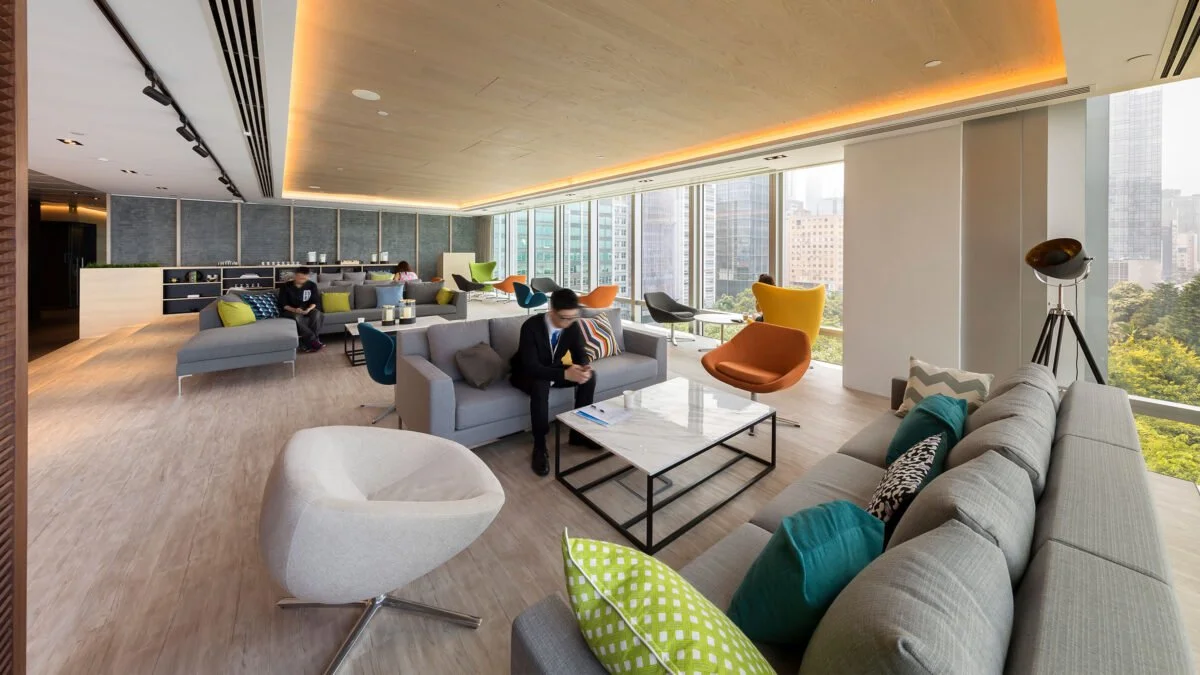
Daikin Vietnam Headquarters, Ho Chi Minh City
The Daikin Vietnam Headquarters is one of Southeast Asia's most compelling examples of climate-responsive workplace design, earning LEED Platinum, WELL Platinum, and LOTUS Platinum certification. Designed specifically for Vietnam's hot-humid tropical climate, the headquarters integrates passive solar control, a high-performance façade, optimized daylighting, natural ventilation strategies, and energy-efficient building systems to enhance occupant wellbeing while reducing operational energy demand. Annual daylight simulation played a critical role in validating daylight availability, glare control, and certification compliance, illustrating how performance-based design enables premium workplaces to balance abundant tropical daylight with visual comfort and energy efficiency.
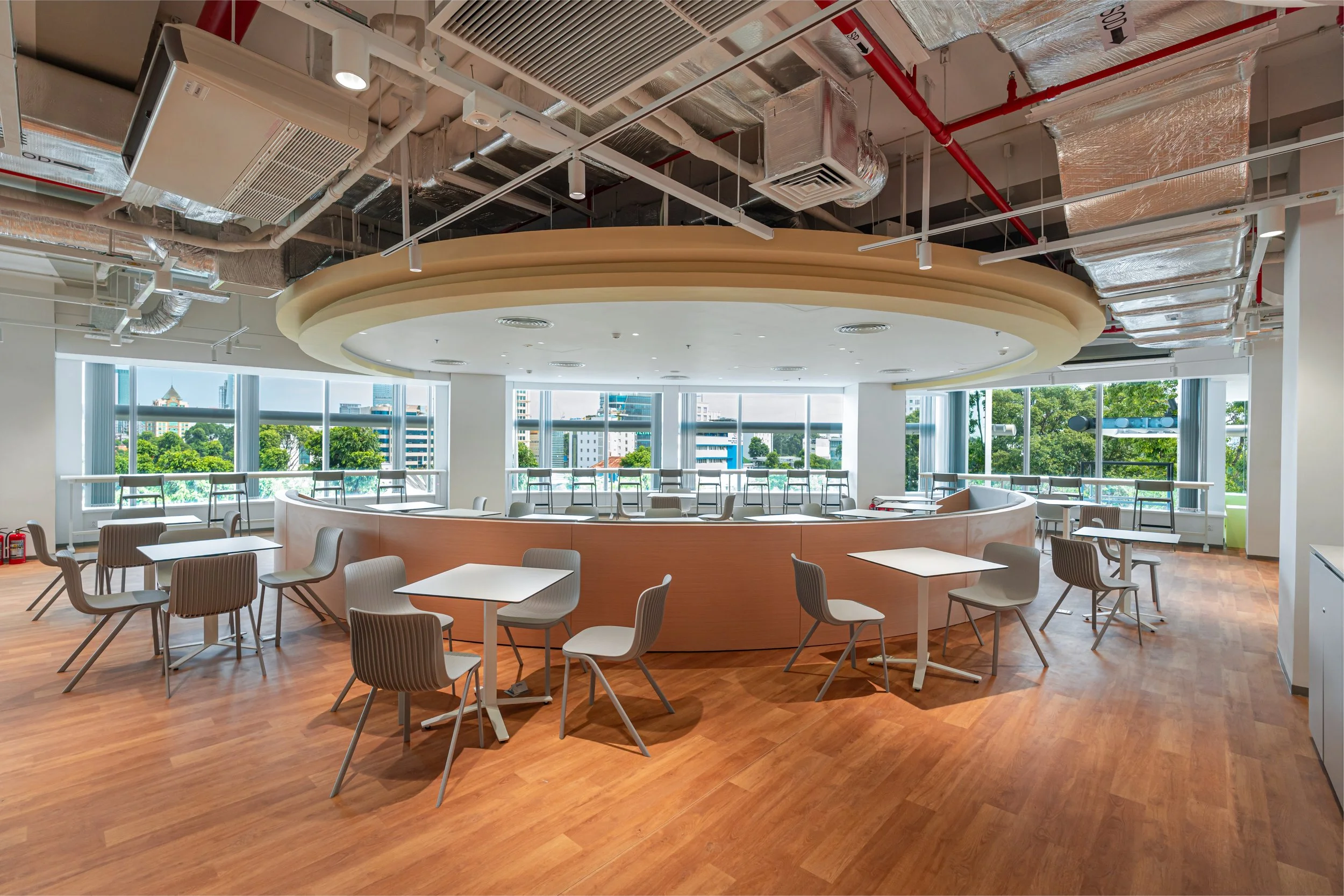
UBS Southeast Asia Headquarters (9 Penang Road), Singapore
The UBS Southeast Asia Headquarters at 9 Penang Road is one of Asia's most thoroughly documented examples of performance-based daylight simulation for a LEED Platinum office interior. Covering nearly 400,000 square feet, the project employed IESVE to integrate annual daylight simulation, façade performance analysis, lighting optimization, and whole-building energy modeling into a unified design workflow. Although the project did not pursue WELL Certification, it demonstrates how climate-based daylight modeling can guide architectural and engineering decisions simultaneously, delivering improved environmental performance, lower energy consumption, and a healthier workplace within one of Southeast Asia's largest premium corporate office developments.
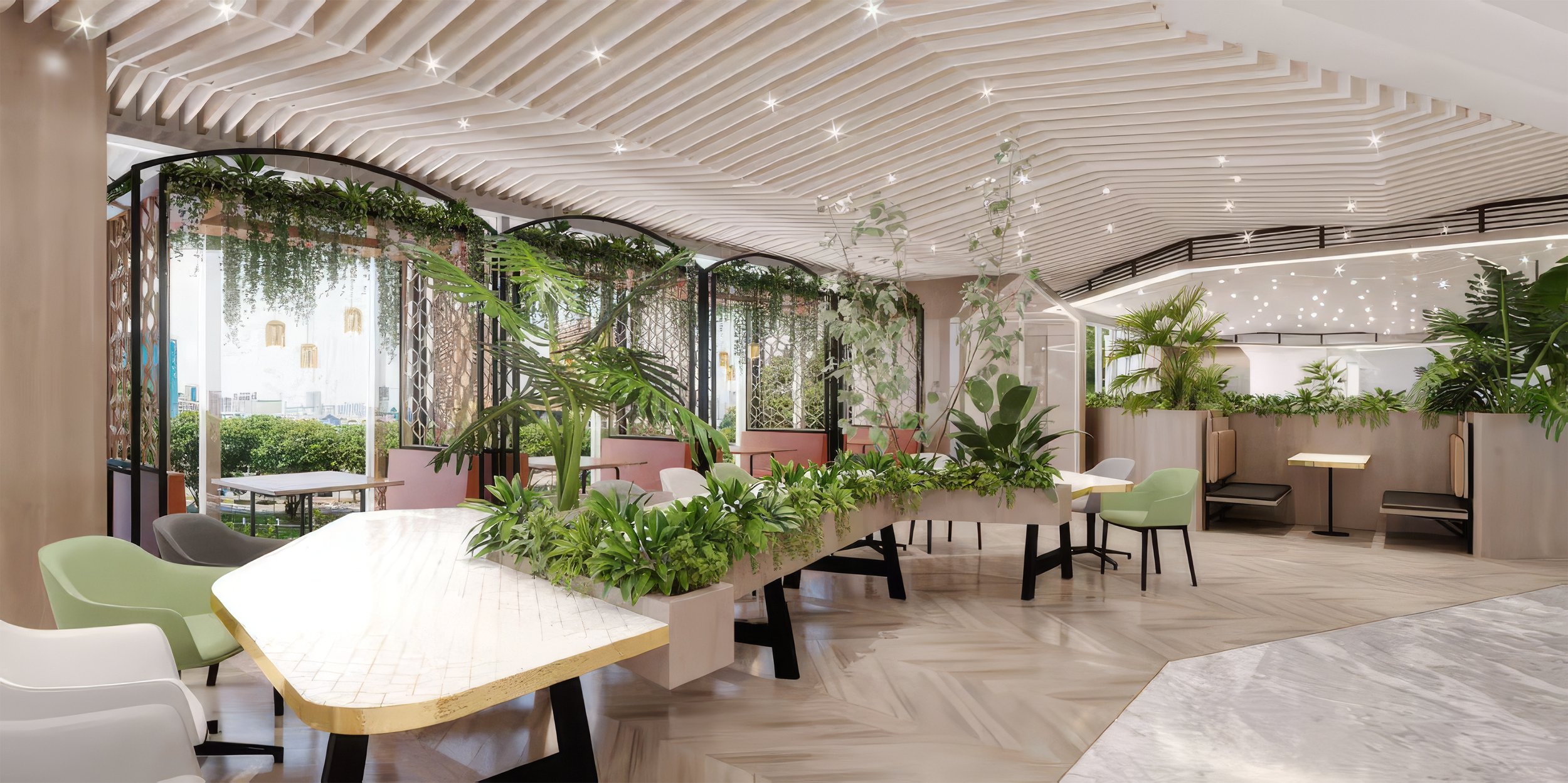
Conclusion
Transforming Natural Light into Measurable Building Performance
Daylight modeling is no longer performed simply to satisfy certification requirements.
It has become a strategic design tool that enables architects, developers, and multinational corporations to create healthier workplaces, improve operational performance, strengthen ESG outcomes, and maximize the value of both LEED and WELL certification.
The most successful projects are those that integrate daylight modeling from the earliest stages of design, allowing every decision—from façade geometry to interior planning—to be informed by measurable evidence rather than intuition.
Turn Daylight into a Competitive Advantage
For premium office developments, daylight modeling should be viewed as an investment in building performance—not merely a certification exercise. By integrating daylight analysis with building physics, lighting, thermal comfort, and human-centered design strategies, project teams can create workplaces that deliver measurable value for occupants, owners, and investors alike.
Temple Acoustics Consultation: Designing Sacred Soundscapes for Ritual, Silence, and Contemplation
Explore how Temple Acoustics Consultation integrates architectural acoustics, building physics, and sacred soundscape design to support ritual, chanting, meditation, silence, and contemplation.
Discover evidence-based strategies for designing Buddhist temples, viharas, and heritage worship spaces that balance spiritual experience, speech clarity, reverberation control, and cultural preservation.
Buddhist Temple Acoustic Consultation Framework Development
Buddhist temple architecture has evolved over millennia as a physical manifestation of humanity’s search for transcendence, embodying cultural beliefs, ritual practices, and sacred cosmologies. From the cave temples of India, the Buddhist stupas of Southeast Asia, and the intricate temple complexes of East Asia, sacred spaces were carefully shaped not only through visual symbolism but also through acoustic experience. Temple acoustic consultation helps architects, temple communities, and heritage organizations understand how sound influences worship, meditation, chanting, ritual performance, and spiritual perception within sacred environments.
Recent developments in archaeological acoustics have revealed that many historical buddhist temples possessed distinctive acoustic signatures that amplified chants, prayers, ritual music, and communal worship, suggesting that sound was an intentional component of sacred architecture rather than a by-product of construction. These findings demonstrate that the spatial characteristics of reverberation, resonance, sound diffusion, and auditory intimacy contributed significantly to the perception of spirituality, collective memory, and emotional engagement within sacred environments.
Building upon lessons from architectural history, archaeological acoustics, liturgical traditions, and contemporary building physics, ALTA Integra has developed a Buddhist Temple Acoustic Consultation Framework to guide the design, restoration, and modernization of sacred spaces. This temple acoustic consultation framework supports new temple developments, heritage conservation projects, meditation halls, vihara facilities, and worship environments seeking to balance acoustic performance with spiritual experience.
Professional temple acoustic consultation integrates Building Acoustics, Architectural Acoustics, Electroacoustics, Psychoacoustics, and Ritual Acoustics to create sacred soundscapes that support chanting clarity, contemplative silence, speech intelligibility, musical performance, and cultural preservation. The objective is not merely to achieve technical acoustic targets, but to strengthen the spiritual identity and worship experience of each temple community.
Temple Architecture Historical Study
The Genesis of Buddhist Sacred Space
Ashokan Monolithic Monuments and the Early Indian Stupa
The architectural lineage of Buddhism originated in the third century BCE under the patronage of the Mauryan Emperor Ashoka, who transformed Buddhism from a regional monastic sect into a state-sanctioned institutional religion. Prior to this imperial intervention, the material culture of Buddhism was primarily ephemeral. Ashoka reportedly initiated a monumental building campaign, commissioning approximately 84,000 brick stupas across the Indian subcontinent to distribute and venerate the bodily relics (sarira) of the historical Buddha.
To mark these sacred deposits and assert imperial-religious authority, Ashoka erected monolithic stone pillars (stambhas) along major trade routes and pilgrimage sites. The Ashokan pillar at Sanchi demonstrates the high level of Mauryan craftsmanship. Carved from a single block of Chunar sandstone transported hundreds of miles from regional quarries, the pillar stood approximately 42 feet high. It featured a slightly tapering round shaft finished with a highly reflective, glass-like "Mauryan polish," surmounted by a bell-shaped lotus capital, an abacus, and a crowning sculpture of four addorsed lions.
Concurrently, the stupa evolved from an ancient, pre-Buddhist earthen burial mound into a highly stylized cosmic symbol. This architectural form is epitomized by the Great Stupa (Stupa No. 1) at Sanchi, which began as a simple, hemispherical brick dome under Ashoka and was subsequently expanded and encased in stone during the Shunga and Andhra periods (second to first centuries BCE).
The structural anatomy of the developed Sanchi stupa represents a complex, multi-layered cosmological map:
The Medhi: A raised terrace 4.87 meters above the ground, which served as an upper ambulatory (pradakshina) pathway. This upper terrace, measuring 1.8 meters wide, was accessed on the southern side by a double staircase equipped with high stone balustrades.
The Vedika: A massive stone railing standing 3.35 meters high that enclosed the ground-level ambulatory path, separating the sacred precinct from the secular world.
The Toranas: Four monumental stone gateways positioned at the cardinal points of the compass. These gateways were slightly staggered from the main circular railing, forcing pilgrims to enter the circumambulation path in a clockwise direction. The gateways were carved with detailed reliefs depicting scenes from the Buddha's life and his past incarnations (Jatakas), utilizing a style derived from traditional wooden carpentry.
The Harmika: A square railing or pedestal atop the hemispherical dome (anda) that enclosed the sacred relic casket buried at the dome’s center.
The Chattra: A triple-tiered stone parasol mounted on a central shaft (yasti) rising from the harmika, symbolizing high spiritual rank, the Three Refuges (the Buddha, the Dharma, and the Sangha), and the path to liberation.
The physical components of the stupa were aligned with a five-element cosmic system: the square base represented earth; the hemispherical dome represented water; the conical spire represented fire; the upper crescent and parasol represented air; and the crowning pinnacle represented the infinite element of space. This architectural design served to direct the observer’s eye upward toward the apex, symbolizing the ultimate Buddhist goal of nirvana.
Early stupas like the Bharhut Stupa (second century BCE) utilized similar stone railings and gateways to display narrative reliefs, providing a visual teaching tool for a largely illiterate laity 1 . The Sanchi complex highlights the long-term architectural development of the stupa, preserving a sequence of structural modifications that spanned more than thirteen hundred years 2 .
Subterranean Devotion
The Rock-Cut Caves of the Western Deccan
Between 100 BCE and 900 CE, the monastic community (sangha) developed a parallel architectural tradition carved directly into the basalt cliffs of the Western Deccan region. These rock-cut cave complexes, numbering over 1,200 across India, were excavated at sites like Ajanta, Ellora, Bhaja, Karle, and Aurangabad.
The rock-cut caves were divided into two main functional typologies: the chaitya (worship hall) and the vihara (monastery). These subterranean spaces replicated the layouts and details of earlier wooden structures, preserving architectural forms that have otherwise been lost to decay.
The rock-cut chaitya hall functioned as a congregational prayer space centered on a stupa. The earliest surviving rock-cut chaitya is found at the Bhaja Caves, dating to the second century BCE. The Bhaja chaitya features an apsidal plan with a central nave and flanking side aisles separated by a row of octagonal columns.
To replicate timber framing, the stone columns slope inward, copy-modeling the structural angles necessary to support a real wooden roof. The ceiling is barrel-vaulted and embedded with actual ancient wooden ribs, and the hall was originally fronted by an elaborate wooden facade that has since perished.
The architectural layout of these Western Deccan caves was derived from early rock-cut prototypes like the Barabar Caves (specifically the Lomas Rishi and Sudama Caves), which were excavated during the reign of Ashoka for the Ajivikas. These early models featured a circular inner relic chamber connected to an outer rectangular congregational hall, a layout that was eventually unified into the classic apsidal rock-cut chaitya hall.
The Great Chaitya at Karle (Karli), excavated in the second century CE, represents the peak of this typological development. The hall measures 38.5 meters long, 13 meters wide, and rises to a height of 13.7 meters under a vaulted ceiling fitted with closely spaced wooden ribs. The central nave is separated from the side aisles by two rows of columns.
Each column measures 1.22 meters in diameter and stands 7.32 meters high, featuring a vase-shaped base, an octagonal shaft, and a bell-shaped capital. The capitals support pairs of kneeling elephants carrying male and female riders, backed by sculptures of horses and tigers.
At the far end of the nave sits a solid, rock-cut stupa crowned by a wooden umbrella and an inverted stepped pyramid (tee). The entrance to the Karli chaitya is fronted by a stone screen and a free-standing pillar (lat) surmounted by four addorsed lions, establishing a formal boundary between the secular exterior and the dim, cavernous interior.
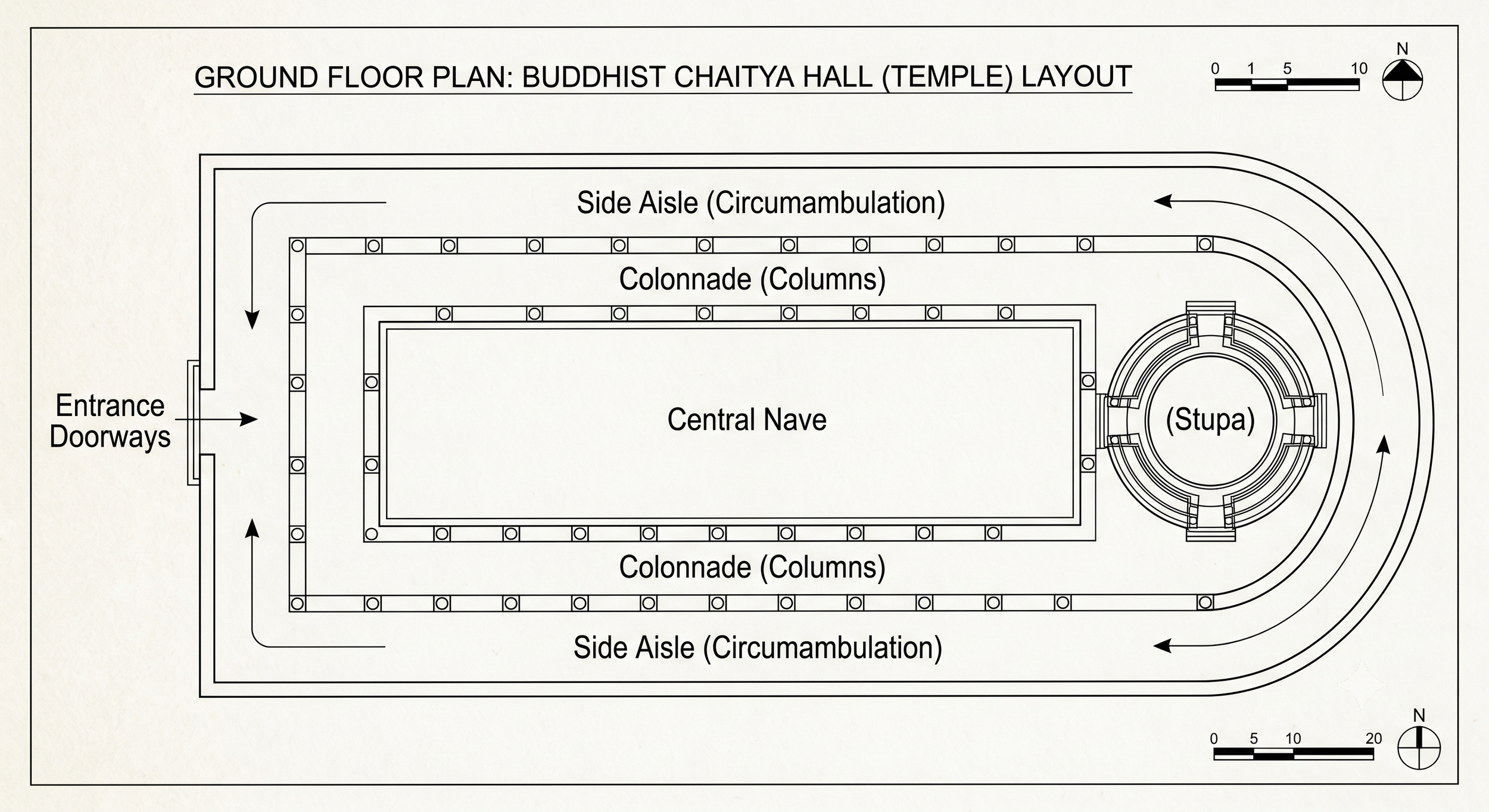
While the chaitya served as the temple space, the vihara functioned as the residential and educational monastery. The typical rock-cut vihara layout was organized around a central, square courtyard surrounded by small, individual cells where the monks resided. Each cell was carved with a stone bed, a stone pillow, and small niches and peg-holes for personal belongings.
At the Ajanta Caves, a complex of 30 hewn excavations along the Waghora River, the chronological development of the vihara is visible. Early viharas were purely residential, but later excavations dating from the fifth century CE, such as Cave 1 and Cave 17 integrated sacred shrines into the center of their rear walls.
These shrines housed carved stone Buddha images, transforming the monastery into a multifunctional space for living, study, and daily worship. The walls of these later viharas were decorated with detailed tempera murals depicting Bodhisattvas, scenes from the Buddha’s life, and Jataka tales, illustrating the integration of art and architecture to foster meditative focus.
The Classical Transition
Kushan and Gupta Free-Standing Shrines
The transition from subterranean rock carving to structural, free-standing stone and brick masonry occurred during the Kushan first to fourth centuries CE and Gupta fourth to sixth centuries CE eras. Under the Kushans, the traditional sculptural schools of Mathura and Gandhara developed distinct anthropomorphic representations of the Buddha.
The Gandhara school integrated Hellenistic stylistic elements, such as flowing drapery, with Buddhist themes. The Mathura school utilized local mottled red sandstone to sculpt robust, broad-shouldered figures.
Under the succeeding Gupta Empire, these regional styles merged into a highly refined, classical aesthetic centered at Sarnath. The Sarnath standing Buddha is characterized by delicate hair curls, meditative downcast eyes, an elaborately carved halo featuring floral and gem motifs, and thin, diaphanous robes that cling to the body.
This artistic refinement was accompanied by the development of free-standing temple architecture. This transition is epitomized by Temple No. 17 at Sanchi, a fifth-century CE structure that stands as one of the earliest surviving examples of a structural stone temple in India.
Temple No. 17 is characterized by structural simplicity and classical proportions, consisting of a single-chambered, flat-roofed sanctum (garbhagriha) fronted by a four-pillared portico (mandapa) 1 . This layout represents an architectural transition from earlier temporary shrines 2 as image below.
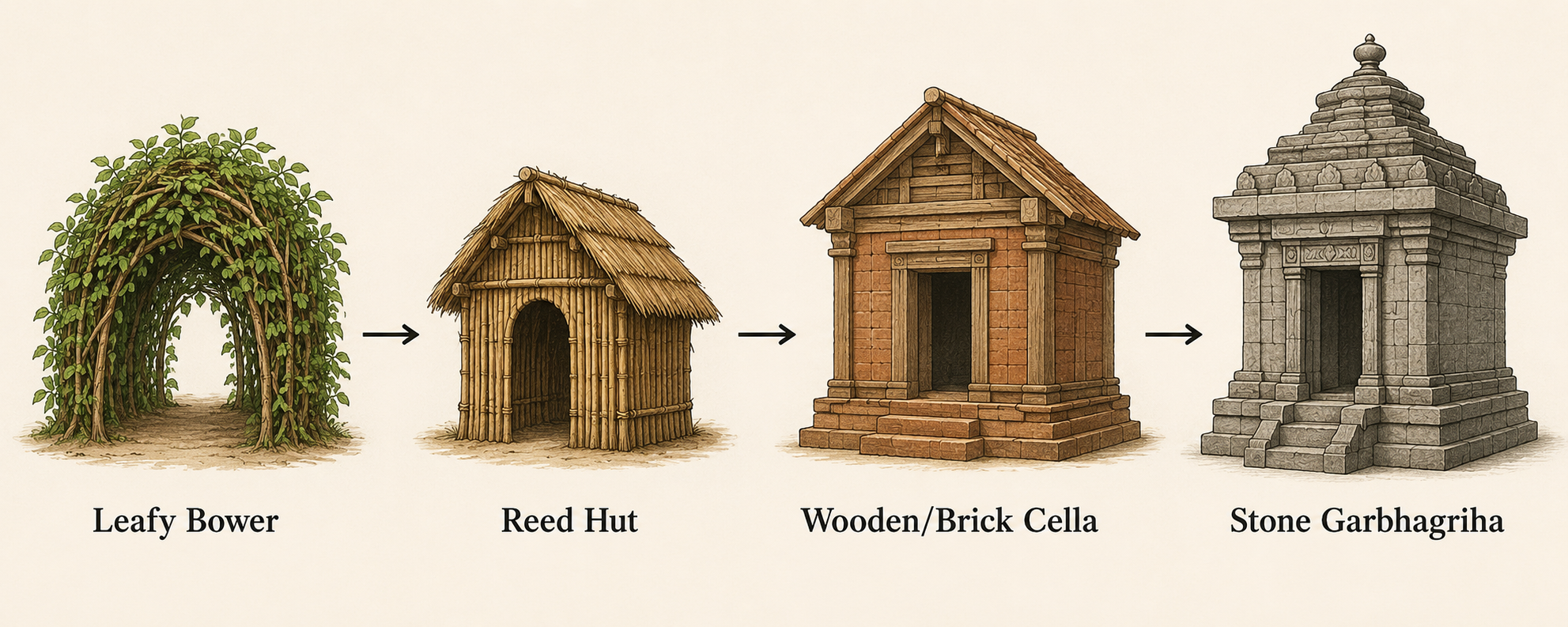
The structural features of Temple No. 17 include:
The Garbhagriha: A small, square sanctum with plain, unadorned interior and exterior walls, designed to house a singular image of the Buddha.
The Mandapa: A shallow portico supported by four stone columns. The columns feature square bases, transition to octagonal and sixteen-sided shafts, and are topped by capitals carved with inverted lotuses and small lions.
The Intercolumniation: The distance between the two central pillars of the portico is wider than the outer intervals, creating a visual emphasis on the entrance axis.
The Architrave: The stone architrave continues as a prominent string course around the entire perimeter of the building, unifying the portico with the sanctum.
Near Temple No. 17 sits Temple No. 18, a larger fifth-century structure built on a horseshoe-shaped plan that originally contained a central stupa, demonstrating that structural chaitya halls were built alongside flat-roofed image shrines.
Other structural innovations of the Gupta period include the Chejarla Kapoteswara temple, which demonstrates that free-standing brick chaitya halls with barrel-vaulted roofs were built in durable materials.
This era also witnessed the construction of towering brick monuments, most notably the Mahabodhi Temple at Bodh Gaya. Originally founded by Ashoka in the third century BCE, the temple was rebuilt during the fifth to sixth centuries CE as a tall, straight-sided pyramidal tower (sikhara) made of brick and coated with stucco.
Marking the exact spot of the Buddha’s enlightenment under the Bodhi Tree, the Mahabodhi Temple introduced a soaring verticality to Buddhist architecture, establishing a design that was copied by later kingdoms across Asia.
Sinicization and East Asian Systems
The Multi-Tiered Pagoda and Courtyard Axial Order
The transmission of Buddhism along the Silk Road to China during the Han Dynasty (first century CE) and subsequently to Korea (fourth century CE) and Japan (sixth century CE) required the adaptation of Indian architectural forms to match East Asian timber-frame engineering and Confucian spatial layouts. The primary result of this synthesis was the evolution of the Indian stupa into the East Asian pagoda.
The early Chinese pagoda combined the vertical, umbrella-capped spire of the Indian stupa with the design of native Han Dynasty multi-storied watchtowers and residential apartments. During the Southern and Northern Dynasties, pagodas were constructed primarily of wood and served as the physical and ritual center of the temple complex.
However, because wood was highly susceptible to rot, insect damage, and fire, architects began experimenting with brick and stone masonry during the Northern Wei and Sui dynasties. The Songyue Pagoda (built in 523 CE) is the oldest surviving brick pagoda in China. It features a dodecagonal plan, a hollow interior, and fifteen tiers of closely spaced brick eaves that mimic wooden support structures, illustrating an early transition from timber to brick engineering.
During the Tang (618–907 CE) and Song (960–1279 CE) dynasties, the architectural design of the pagoda stabilized into two dominant typologies:
The Multi-Eaved Style: Characterized by closely spaced exterior brick or stone eaves wrapping around a solid or restricted interior core, designed primarily as a vertical marker of the sacred, as seen in the Small Wild Goose Pagoda.
The Pavilion Style: Featuring accessible interior stories with functional staircases, wooden balustrades, and external balconies supported by complex wooden or brick brackets, as exemplified by the Giant Wild Goose Pagoda (originally built in 652 CE).
During the Song, Liao, and Jin dynasties, pagoda design transitioned from a four-sided square plan to hexagonal and octagonal geometries. This modification improved the seismic resistance of the tall structures by distributing horizontal forces more evenly.
Architects also developed hybrid construction systems that combined a load-bearing brick inner core with external timber eaves, galleries, and interlocking wooden brackets (dougong), such as the Liuhe (Six Harmonies) Pagoda in Hangzhou (rebuilt in 1156 CE) and the wood-and-brick Lingxiao Pagoda (built in 1045 CE).
The Yingxian Pagoda of Fogong Temple (built in 1056 CE during the Liao Dynasty) stands as the oldest fully wooden pagoda surviving in China, rising 67.31 meters without the use of nails or concrete, relying on a complex system of interlocking timber joints to withstand earthquakes and weathering.
The physical structure of the Chinese pagoda was organized into four distinct anatomical parts:
The Underground Palace: A brick- or stone-lined vault buried beneath the foundation, used to hold sacred relics, cremated remains, and scriptures inside nested caskets of precious metals and stone.
The Base: An elevated, decorated stone platform or pedestal that supported the main body.
The Body: The main multi-story tower, which transitioned from square to octagonal plans.
The Steeple: A metal spire crowning the apex, consisting of a base, a crescent moon, a series of dew basins (chattras), and a sacred bottle-shaped pinnacle.
In tandem with these structural changes, the overall layout of Chinese Buddhist temples shifted. In early Chinese temples (from the Eastern Han to the Northern and Southern Dynasties), the pagoda was placed at the absolute center of the temple courtyard.
However, as Confucian ideals of hierarchical order and imperial authority influenced monastic design, the layout shifted to a strict north-to-south axial symmetry modeled on imperial palace architecture. The central axis was dominated by sequential courtyards forming "quadrangular enclosures" leading to successive halls as image below.
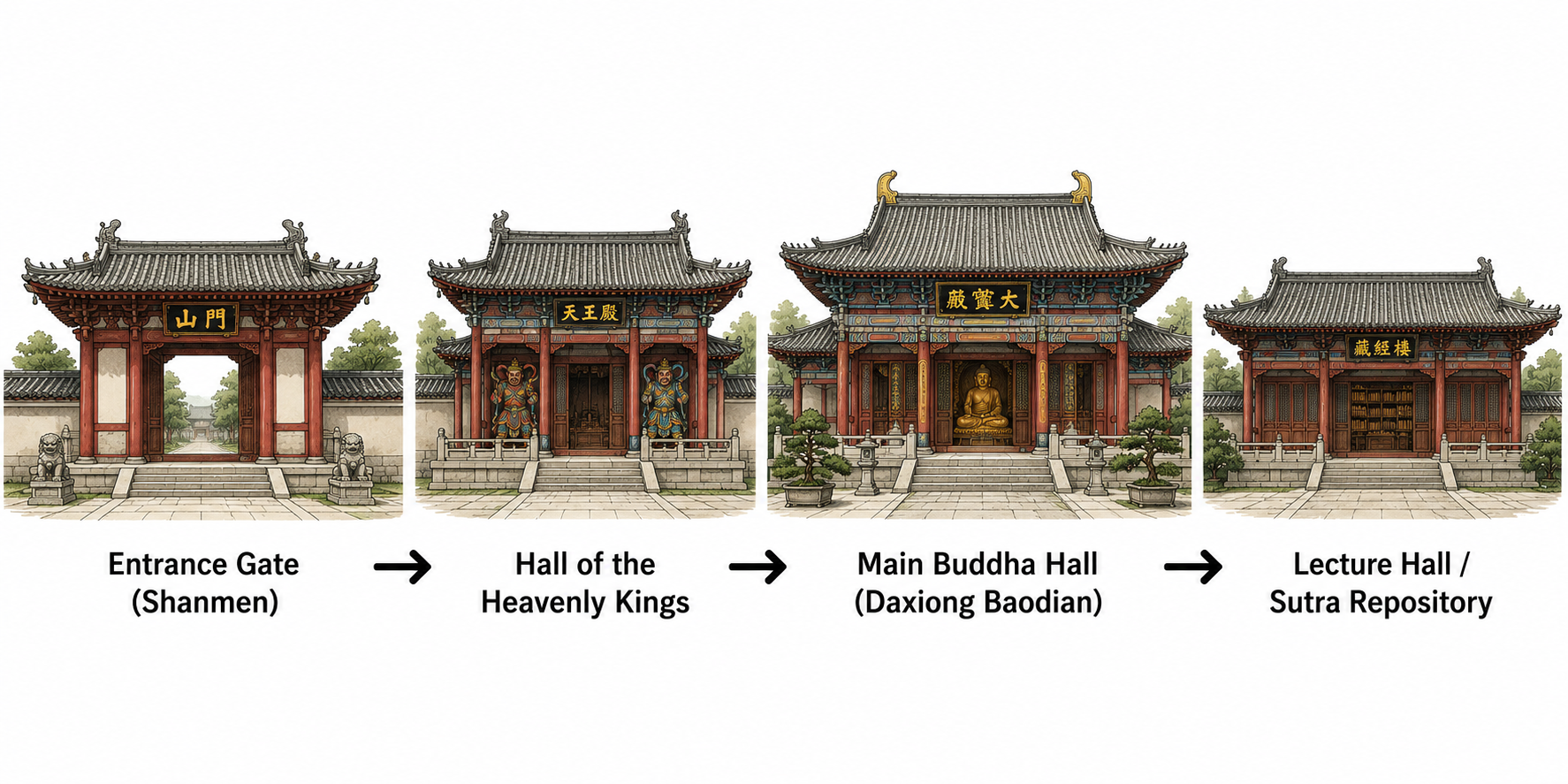
In this layout, the pagoda was either relegated to the rear of the complex, placed in an independent side courtyard, or built outside the city walls to avoid competition with imperial drum and gate towers.
Korean and Japanese Refinements
Buddhism was transmitted to the Korean peninsula in the fourth century CE, where it was adopted as a state religion by the kingdoms of Goguryeo, Baekje, and Silla. Early Korean temples of the Three Kingdoms period were built on a grand scale.
Excavations at Goguryeo sites, such as the Cheongam-ri and Sango-ri temple complexes, reveal a unique layout centered around an octagonal wooden pagoda flanked by three golden halls (geumdang) to the east, west, and north, all enclosed by a roofed corridor.
The early seventh-century Mireuksa (built by the Baekje Kingdom) was a massive monastic complex covering 165,000 square meters. Its layout consisted of three adjacent temples arranged side-by-side, representing the future Buddha Maitreya's three saving sermons.
Silla’s Hwangnyongsa (founded in 570 CE) featured a massive 80-meter-tall, nine-story wooden pagoda with interior staircases leading to the top floor, symbolizing the kingdom’s spiritual and political authority.
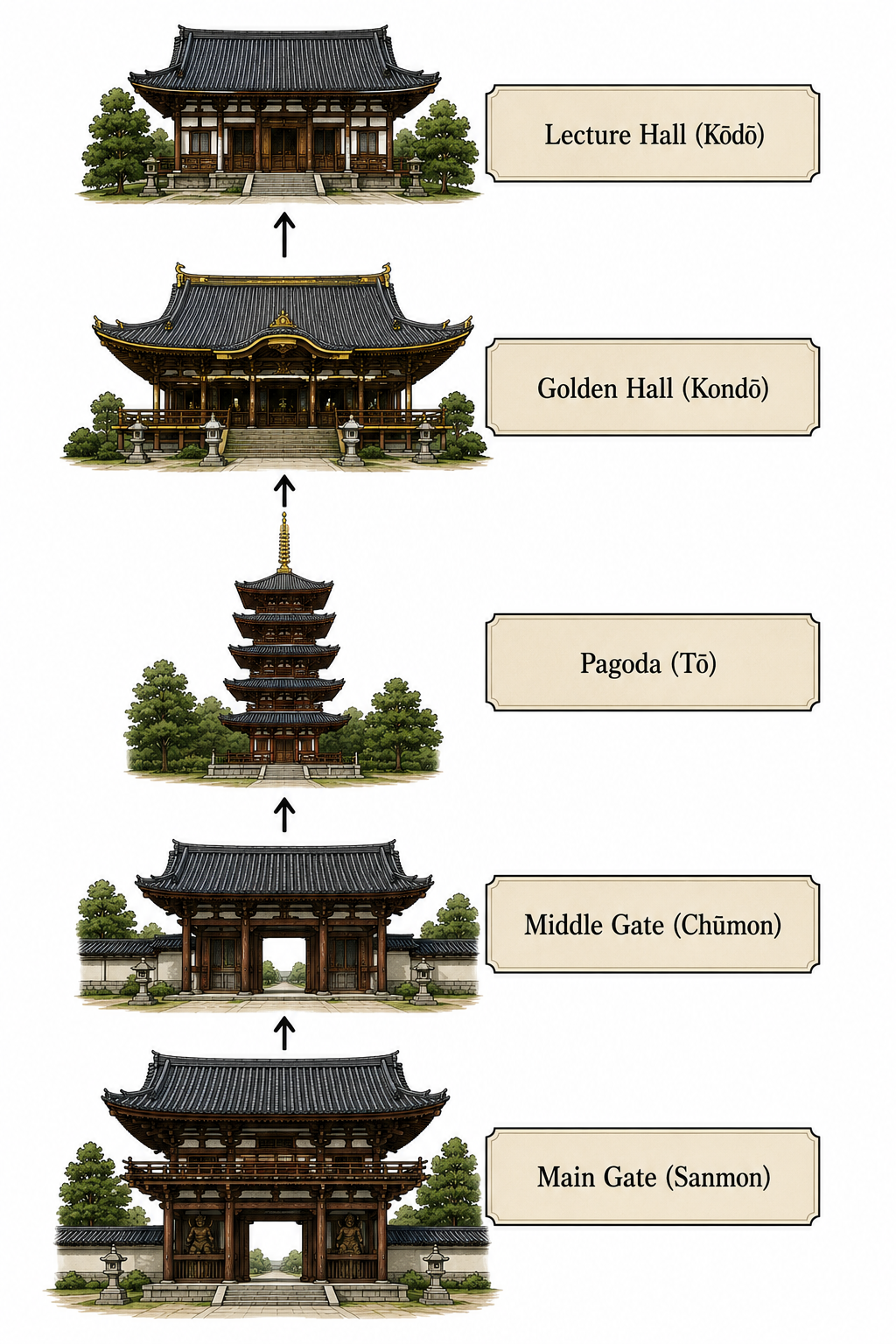
Korean Buddhist architecture developed a sophisticated timber-frame system designed to support heavy clay-tiled roofs over wide interior spaces:
The Stone Base: A raised, rammed-earth platform lined with dressed stone blocks to prevent ground moisture from rotting the timber columns.
The Timber Columns: Heavy wooden pillars placed on stone foundation pads, connected by horizontal lintels to form the structural skeleton of the walls.
The Brackets: Complex wooden brackets placed on top of column heads to distribute the heavy weight of the roof to the pillars.
The Roof System: A sloping roof with deep, overhanging eaves that curved upward at the corners to allow natural light to penetrate the interior during winter while blocking high-angle summer sun. The roof was finished with alternating rows of concave and convex clay tiles, and the ends of the eaves were capped with decorated tile ends stamped with Buddhist symbols like the lotus and the phoenix.
Dancheong: A system of decorative painting using bright red, blue, green, yellow, and white pigments to protect the wooden structures from moisture and rot while adding symbolic beauty.
In Japan, where Buddhism arrived via Korea in the sixth century, early temples reproduced continental styles. The spatial arrangement of the Japanese temple complex, known as the Garan or Shichidō Garan (Seven-Hall Garan), underwent a chronological evolution from the Asuka and Nara periods to the Kamakura period, characterized by a steady decline in the importance of the pagoda and the reorganization of the central axis.
Typological Reorganization of Japanese Garan Layouts (6th to 13th Century CE)
The evolution of the Japanese Garan layout illustrates the shift in ritual focus from relic veneration (centered on the pagoda) to icon worship (centered on the Golden Hall).
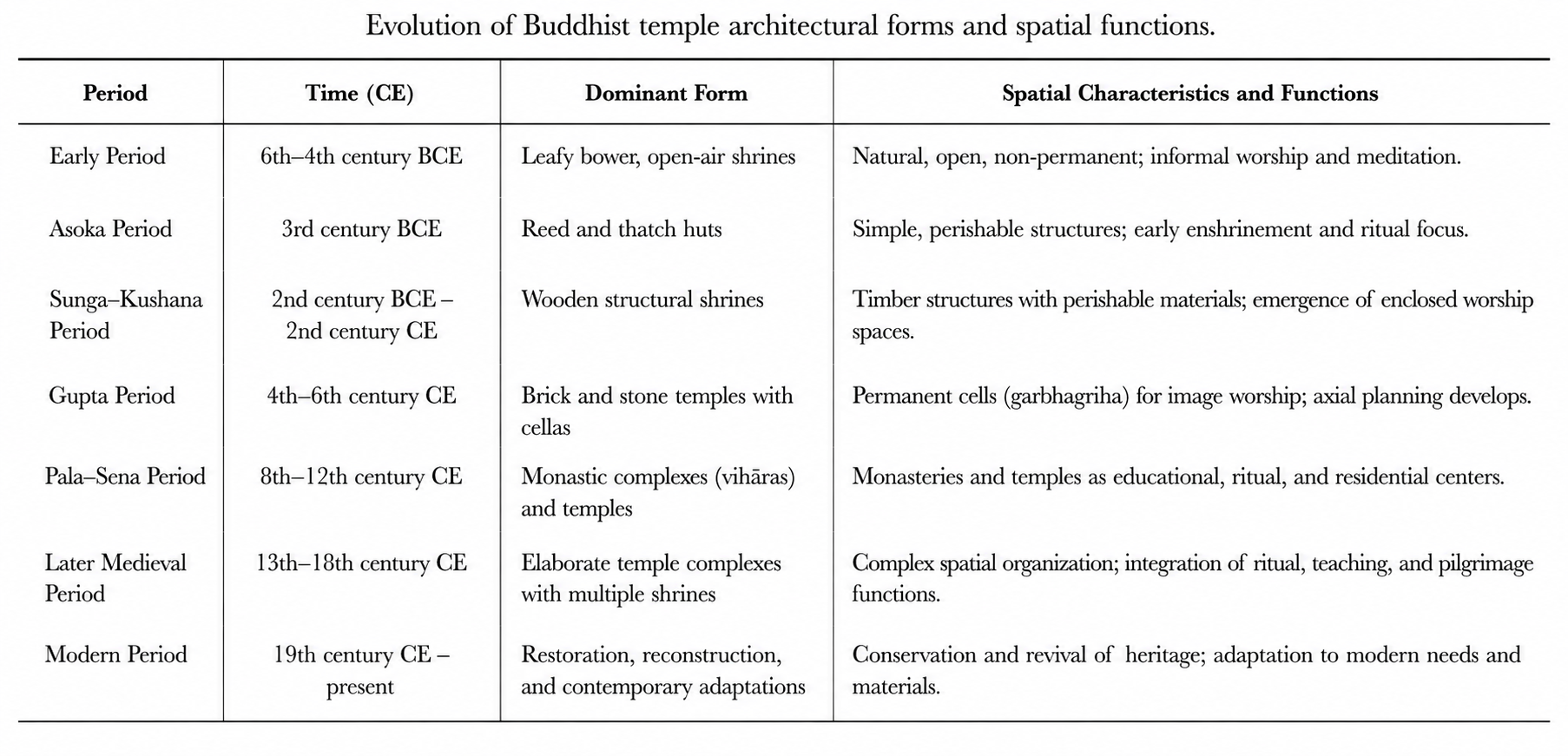
In the Nara period, the traditional shichidō (seven elements) of a temple stabilized to support scriptural study, comprising the Hon-dō (Main Hall), Tō (Pagoda), Kō-dō (Lecture Hall), Shōrō (Belfry), Jiki-dō (Refectory), Sōbō (Monks' Quarters), and Kyōzō (Sutra Repository).
With the later introduction of Zen (Chan) Buddhism during the Kamakura and Muromachi periods, the Shichidō Garan was reorganized to support daily meditation practice and administrative efficiency.
The Zen layout aligned its principal structures on a strict north-to-south axis: the Sanmon (Main Gate), Butsuden (Buddha Hall), Hattō (Dharma Hall), and Hōjō (Abbot’s Residence). To the west of this axis sat the Sōdō (Monks’ meditation hall), and to the east sat the Kuin (Kitchen and administrative office).
Structurally, Zen temples utilized unpainted cypress timber, heavy curved roofs supported by complex bracket systems (tokyō), and bell-shaped windows (katōmado). The interiors of Zen halls were paved with square stone or ceramic tiles laid at a 45-degree angle to the walls, a traditional practice known as shihanjiki (diagonal tiling). This layout minimized visual clutter to support meditative focus, illustrating how spatial design was used to guide monastic attention.
Southeast Asian Monumentalism and Regional Fusion
The expansion of Theravada and Mahayana Buddhism into Southeast Asia generated a wave of temple building between the ninth and eighteenth centuries CE. Rather than merely importing Indian styles, the builders of Java, Myanmar, and Thailand adapted these templates to match indigenous religious concepts and local environmental challenges.
Borobudur (Java, Indonesia)
Constructed in the ninth century under the Sailendra Dynasty in Central Java, Candi Borobudur is the world's largest Buddhist temple. Built using gray volcanic andesite stone, the monument is designed as a colossal, three-dimensional mandala representing Mahayana Buddhist cosmology. Borobudur features a stepped-pyramid layout consisting of nine stacked platforms: six square base platforms representing the realms of desire (Kamadhatu) and form (Rupadhatu), topped by three circular platforms representing the realm of formlessness (Arupadhatu).
The circular terraces are ringed by 72 bell-shaped, perforated stone stupas, each housing a seated Buddha image, and are crowned by a massive, solid central stupa symbolizing the ultimate state of Nirvana. This design synthesizes Indian Gupta art with the indigenous Javanese custom of constructing megalithic stepped mounds for ancestor worship, creating an architectural path for pilgrims to navigate.
Bagan (Myanmar)
The Kingdom of Bagan witnessed a monumental building boom from the eleventh to the thirteenth centuries, initiated by King Anawrahta’s adoption of Theravada Buddhism. The Ananda Temple (completed in 1105 CE) stands as Bagan's architectural masterpiece. Built on a massive cruciform plan with four projecting brick porches, the temple's central core contains a large square block housing four colossal, 9.5-meter-tall standing teakwood Buddhas facing the cardinal directions.
The exterior of the temple features white stucco walls topped by several terraces, a gilded North Indian-style tower (shikhara), and a crowning umbrella-shaped spire (hti). The interior is defined by a system of concentric corridors that regulate natural light, casting a subtle illumination on the golden Buddhas and directing the physical movement of worshippers.
The Evolution of Thai Temple Architecture
Thai Buddhist architecture is characterized by clear regional and chronological variations, shaped by the historical rise and fall of its major kingdoms.
The physical layout of the Thai Wat (temple complex) is divided into two distinct zones enclosed by a whitewashed brick wall: the Buddhavasa (the sacred zone dedicated to the Buddha and monastic rituals) and the Sangkhawat (the residential zone containing the monks’ living quarters, or Kuti).
Morphological Elements of Thai Buddhavasa Architecture
The structures within the Buddhavasa are organized to facilitate daily worship, monastic ordination, and relic veneration.
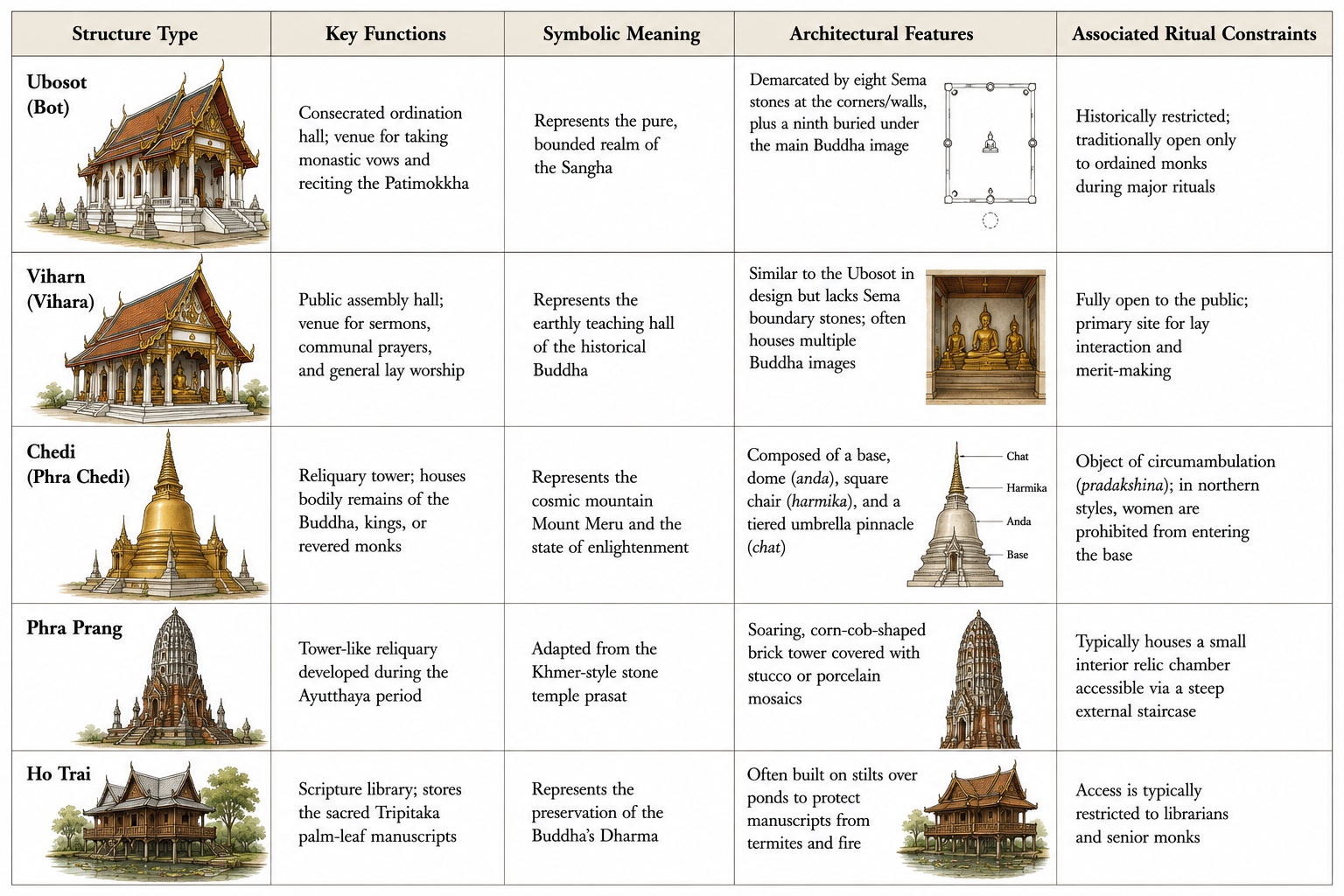
Thai temple architecture is also characterized by its decorative roof forms. The roofs of the Ubosot and Viharn are constructed with multiple, overlapping tiers designed to lighten the visual weight of the large structures.
The edge of the roof is trimmed with the Lamyong, an ornamental bargeboard shaped like the undulating body of the sacred serpent Naga. The scales of the Naga project upward as blade-like fins (Bai Raka), and the lower end of the bargeboard terminates in a stylized Naga head (Hang Hong).
The peak of the roof is crowned by the Chofah ("sky cluster"), a horn-like finial resembling the beak of the mythical bird Garuda, which symbolically holds the tail of the Naga that flows down the bargeboard. This decorative program represents the cosmic struggle between the Garuda and the Naga in Buddhist mythology, transforming the roofline into a visual narrative of protective spiritual forces.
Himalayan Vajrayana Fortification and Mandala Spaces
In the rugged, high-altitude landscapes of Tibet, Bhutan, and Ladakh, Vajrayana Buddhism developed a unique architectural language characterized by thick, sloping masonry walls, fortress-monasteries, and highly detailed visual representations of tantric cosmology.
The earliest phase of Buddhist temple construction in the Himalayas is associated with the seventh-century Tibetan King Songtsen Gampo. According to historical chronicles, Songtsen Gampo commissioned a network of 108 temples across the region (including the Jambay Lhakhang in Bumthang and the Kyichu Lhakhang in Paro).
These temples were strategically sited according to geomantic principles to symbolically "pin down" a massive, malevolent demoness who lay across the Himalayan landscape, with each temple pinning down a specific joint or organ to pacify local spirits and allow the spread of the Dharma.
In Bhutan, the seventeenth-century Dzong emerged as the defining architectural typology of Vajrayana Buddhism, developed under the political and religious leadership of Zhabdrung Ngawang Namgyal. Dzongs are massive fortress-monasteries that integrate religious and administrative functions within a single fortified complex.
Designed to withstand both military invasions and the harsh alpine climate, Dzongs are characterized by:
Sloping Masonry Walls: Heavy, inward-sloping walls built of rammed earth or stone, whitewashed and tapered to provide structural stability and defensive strength.
The Kem: A broad, red ochre band painted near the top of the white walls, identifying the building as a sacred structure.
Multi-Tiered Roofs: Timber roofs built with large overhangs to protect the earthen walls from heavy rains and snow.
The Utse: A towering central keep housing the main temple shrines, surrounded by stone courtyards that host administrative offices, monastic quarters, and public religious festivals.
Spirit Houses: Small, stand-alone shrines (lu khang) built within the complex to honor local earth deities and unseen spirits, illustrating the integration of local animistic traditions with Vajrayana practice.
Himalayan stupas, known as chortens, serve as symbolic models of Vajrayana cosmology and are typically solid structures composed of five geometric elements as image below.
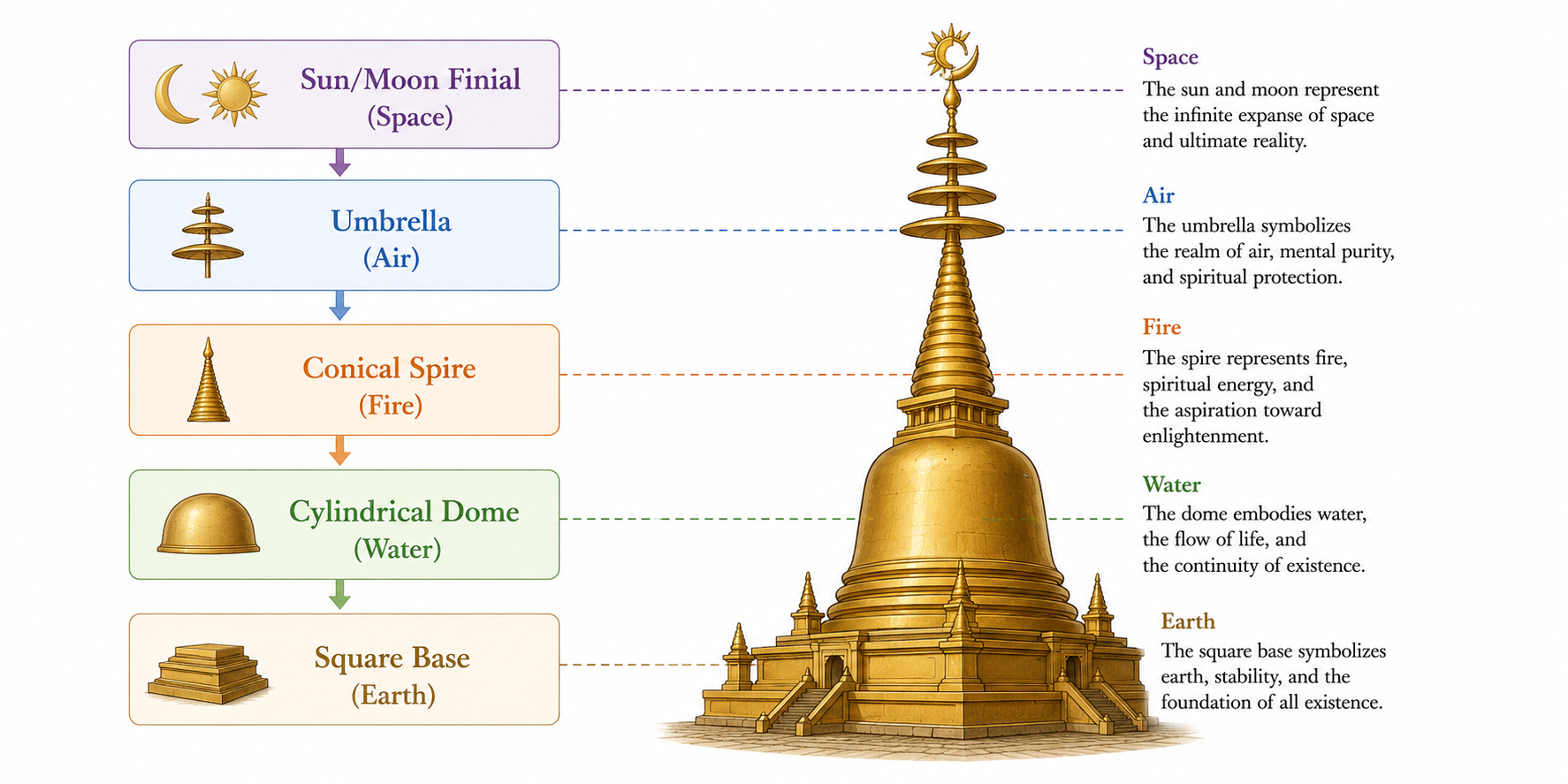
Chortens are built in three primary regional styles: Nepalese-style (featuring large domes and painted eyes), Tibetan-style (with flared bases and wooden superstructures), and indigenous Bhutanese-style (characterized by square stone pillars topped by solar and lunar symbols).
The eight classical chortens commemorate the eight miracles of the Buddha's life, including his birth at Lumbini, his enlightenment at Bodh Gaya, his first sermon at Sarnath, and his parinirvana at Kushinagar.
A unique variation is the Tashi Gomang ("many-doored") chorten, of which the Gyantse Kumbum (built in 1427 CE) is the premier example. The Kumbum features an eight-story layout with seventy-three interior chapels housing more than 20,000 images and deities, functioning as a physical path through the Tantric mandala.
Himalayan cave shrines, such as the Luri cave in Mustang, contain highly polished central chortens decorated with Esoteric Buddhist murals (including the Akshobhya mandala and the five Esoteric Buddhas on the harmika, with Vairochana facing east), demonstrating the integration of art and architecture to support advanced tantric practice.
Modern and Contemporary Paradigms
Contemporary Buddhist architecture balances historical continuity with modern materials like concrete, steel, and glass. Rather than relying on historical replication, modern architects utilize clean lines and minimalist geometries to express classical Buddhist concepts of emptiness (Sunyata), light, and impermanence.
In Sapporo, Japan, the Hill of the Buddha (designed by Tadao Ando) reinterprets the traditional temple approach. Ando encased a pre-existing 13.5-meter-tall stone seated Buddha within a massive, hollow concrete dome covered by a landscaped hill planted with 150,000 lavender plants.
To view the Buddha, visitors must navigate a 135-meter-long, dimly lit concrete tunnel that opens into a sky-lit circular chamber. Only the top of the Buddha's head is visible from the outside, and the transition from the dark tunnel to the light of the central hall serves as a physical metaphor for the transition from ignorance to awakening.
In Taipei, Taiwan, the Water-Moon Monastery (designed by Kris Yao of Artech) uses clean geometric forms and a 260-foot-long reflective lotus pond to mirror the concrete facade, emphasizing the concepts of illusion and impermanence.
The double-height main hall features prefabricated glass-reinforced concrete (GRC) panels carved with the Chinese characters of the Heart Sutra and the Diamond Sutra. As sunlight filters through the voids in the panels, the scriptures are projected onto the interior concrete floors and columns, dynamically changing throughout the day.
In Kaohsiung, Taiwan, the Fo Guang Shan Buddha Museum (completed in 2011) represents Humanistic Buddhism. Spanning over 100 hectares, the complex is built in the shape of a lotus petal across five mountain peaks, modeled after the Four Sacred Mountains of Chinese Buddhism.
Five-Peak Spatial Layout of Fo Guang Shan Temple
The architecture of Fo Guang Shan is organized across five peaks to support monastic living, public education, and spiritual practice.
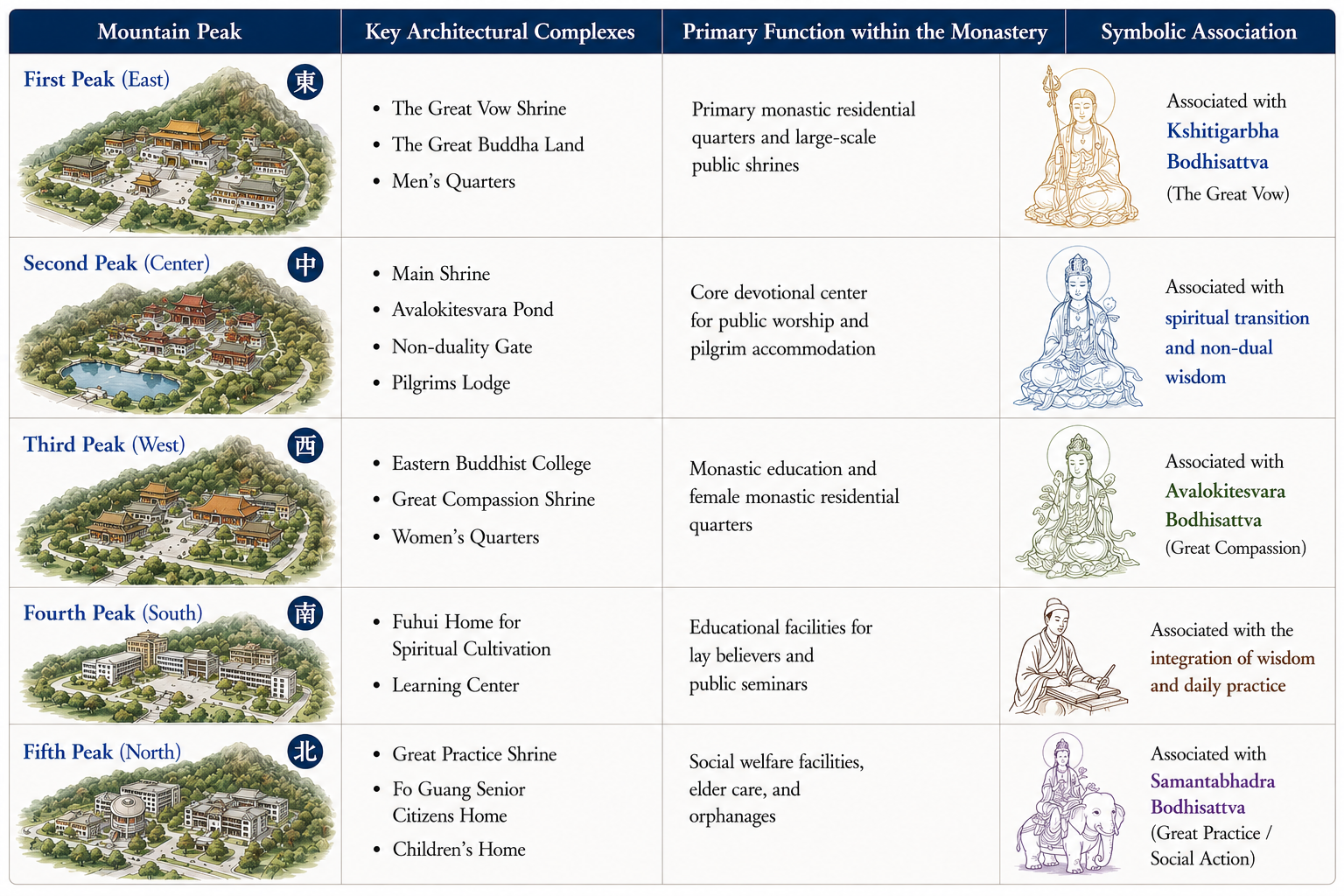
The main axis of the Fo Guang Shan Buddha Museum begins with the Front Hall, flanked by the Gate of Perfect Ease and the Gate of Liberation. Worshippers walk along the 240-meter-long Way to Buddhahood flanked by eight 38-meter-tall pagodas representing the Noble Eightfold Path, such as the Six Perfections Pagoda.
At the Bodhi Wisdom Concourse, eighteen Arhat statues are erected, uniquely containing three female arhats to showcase equal gender rights within modern Humanistic Buddhism.
The path terminates at a 50-meter-tall sandstone-clad Main Hall (housing the sacred Buddha Tooth Relic in the Jade Buddha Shrine) and the 108-meter bronze Fo Guang Big Buddha.
Other global projects demonstrate similar structural adaptations:
Tsz Shan Monastery (Hong Kong): Features a 76-meter-tall outdoor bronze statue of the Bodhisattva Guan Yin, supported by a heavy steel structure. The surrounding Dharma halls and courtyards use clean, symmetrical layouts that reference the aesthetics of the Tang Dynasty. However, the traditional timber joinery is replaced by a modern steel structural frame, clad in African zevil wood to maintain a warm, meditative atmosphere.
Wat Rong Khun (Chiang Rai, Thailand): Designed by Chalermchai Kositpipat, this contemporary Thai temple is built entirely of white plaster inset with pieces of mirrored glass. The white color symbolizes the purity of the Buddha, while the reflective glass represents his wisdom. The architecture updates traditional northern Thai lamyong bargeboards and chofah roof finials with highly stylized, flame-like details and modern allegorical carvings, creating a distinct contemporary interpretation of Thai cosmology.
Ekoin Nenbutsudo (Tokyo, Japan): Designed with features that include a bamboo forest and a Swarovski crystal facade, this temple was "stacked" to build upon a limited urban site.
The Upper Cloister (Jinshan, China): A minimalist steel meditation hall perched on a rugged mountain pass, utilizing a light structure that barely touches the ground to harmonize with the natural setting.
The Buddhist Retreat Centre (Netherlands): Combines a traditional Western Mansard roof with western red cedar and corrugated steel, showing how Buddhist spatial concepts can be integrated with Western building forms.
Conclusion
The structural trajectory of Buddhist architecture highlights a dynamic tension between cosmological continuity and local adaptation. Across two millennia, the basic components of the early stupa—the base, dome, spire, and umbrella—have been systematically adapted to match the materials and styles of different cultures.
In China and Japan, this process transformed the hemispherical stupa into the vertical, multi-tiered pagoda. In Southeast Asia, it led to the creation of stepped stone monuments like Borobudur. In the Himalayas, it produced the fortified, sloping walls of the Dzong.
This evolution was also driven by a theological shift from relic circumambulation to image veneration. The physical relocation of the reliquary (stupa/pagoda) from the center of the temple layout to its periphery or outer courtyards reflects the rise of Mahayana and Zen doctrines, which prioritized the Buddha image (Kondo/Butsuden) and active meditation spaces (Sodo) over the historical remains of the Buddha.
Finally, the contemporary era highlights how Buddhist architecture can adapt to modern environments while maintaining its core focus. By using materials like concrete, steel, and glass, modern architects are able to express classical Buddhist concepts of emptiness and light.
These clean, geometric, and light-filled structures serve to organize human movement and focus attention, demonstrating that the primary function of the Buddhist temple is to act as an architectural tool to calm the mind and facilitate introspection.
The Acoustic Ecology and Liturgical Spatialization of Buddhist Temple Architecture: A Historical, Structural, and Archaeoacoustic Analysis
Introduction: Redirection of the Research Paradigm and the Architecture of Attention
In analyzing the structural development of historical worship spaces, researchers must decouple physical forms from general assumptions and anchor their inquiries in the precise theological and liturgical frameworks of the studied faith. In correcting previous research plans that mistakenly focused on Islamic mosque architecture, this study centers exclusively on the spatial, material, and acoustic evolution of Buddhist architecture. While Islamic acoustics prioritize the speech intelligibility of horizontal congregations facing a single wall (qibla) and the vocal clarity of spoken sermons (khutba), the Buddhist spatial tradition is built upon the architecture of attention, designed to shape contemplative movement, guide ritual circumambulation, and establish a physical feedback loop between the practitioner and the sacred environment.
The fundamental purpose of a Buddhist temple is to act as a quiet partner to the meditating mind, employing structural elements to slow down physical movements, lower vocal volume, and minimize external sensory stimulation. The transition through physical thresholds—from open courtyards to progressively darker, more enclosed chambers—is designed to transition the mind from the scattered nature of the mundane world to a centered state of introspection. This sensory transition is reinforced by the unique soundscapes of Buddhist ritual practice, which rely on the acoustic properties of materials and geometries to amplify low-frequency chanting, diffuse the complex transients of metallic and wooden sounding objects, and symbolize core doctrinal tenets through the physics of sound.
The Rock-Cut Genesis: Archaeoacoustics of early Western Ghats Caves
The transition of Buddhist sanctuaries from temporary monsoon retreats built of perishable timber, bamboo, and thatch to permanent, monumental complexes occurred through rock-cut excavations carved into the solid basalt cliffs of the Western Ghats in India between the 2nd century BCE and the 5th century CE. Supported by wealthy merchant guilds and royal patrons, ancient builders carved entire monastic complexes directly into the hillsides, establishing a functional division between the vihara (monastery), consisting of small residential cells arranged around a central square courtyard, and the chaitya (worship hall), which housed a votive stupa at its curved end.
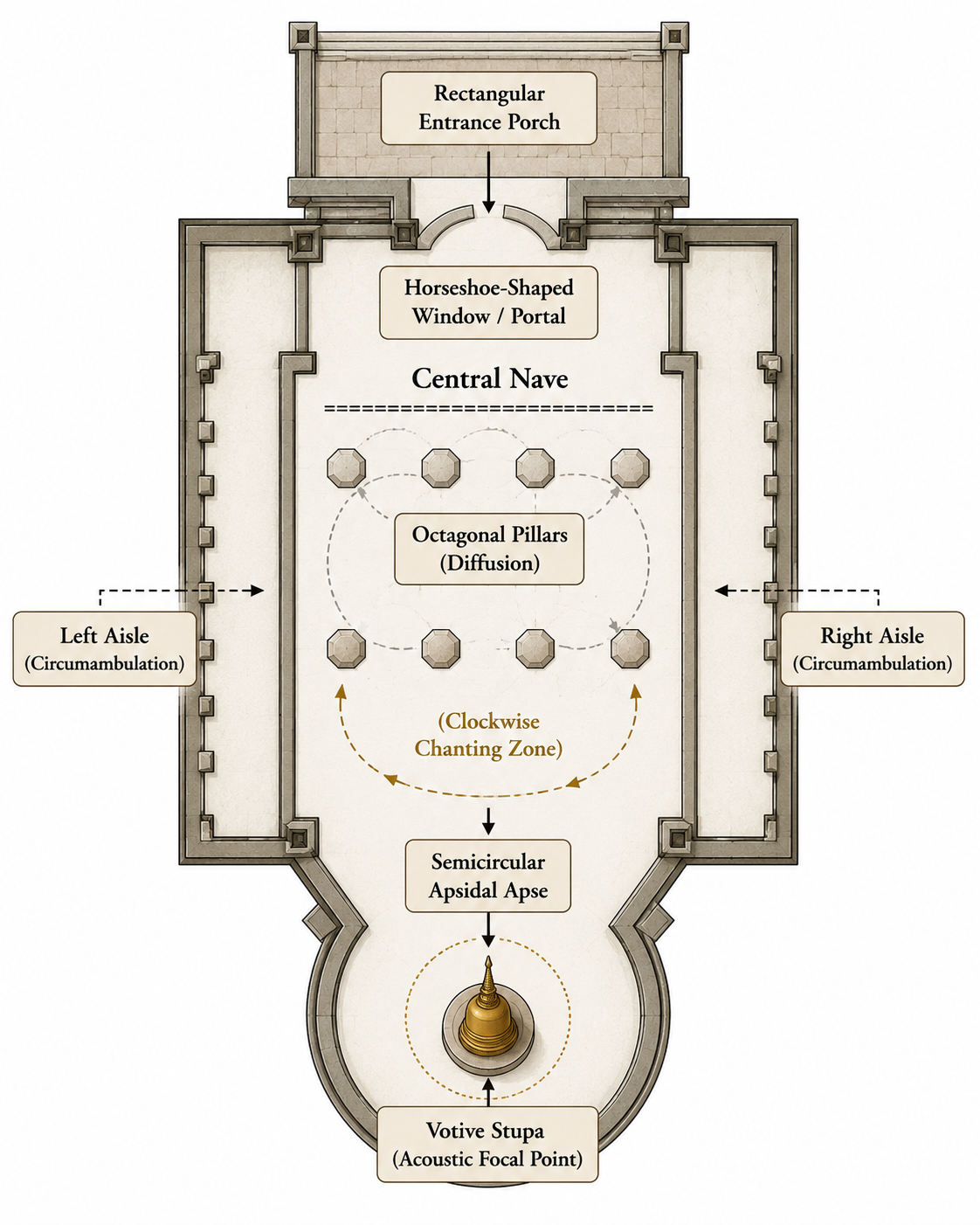
The structural design of the chaitya hall—exemplified by Cave 8 at the Karla Caves and the early halls at Bhaja, Ajanta, and Ellora—features a rectangular nave separated from narrower side aisles by rows of octagonal columns, terminating in a semicircular, apsidal apse containing the carved stupa. To maintain a symbolic connection with earlier freestanding timber prototypes, these rock-cut halls meticulously recreated decorative elements of wooden design, such as curved, barrel-vaulted ceiling ribs and inward-sloping pillars. At Bhaja and the "Great Chaitya" of the Karla Caves, actual ancient teak wood ribs survive, fitted directly into the carved stone vaulting of the ceiling.
These structural details establish a highly specialized acoustic environment. Unpolished, raw basalt is an exceptionally dense, non-porous rock with negligible sound absorption alpha 0.02, which would normally produce harsh flutter echoes and late, chaotic reflections. However, the geometric proportions of the chaitya act as a natural acoustic processor:
Diffusive Ribbing: The closely spaced wooden or stone ceiling ribs function as an acoustic scattering system, diffusing high-frequency sounds and preventing the build-up of flutter echoes along the vault.
Columnar Scattering: The octagonal shafts of the columns measuring 1.22 meter in diameter and 7.32 meters in height at Karla act as lateral scattering bodies, scattering sound waves as they pass between the nave and the side aisles.
Apsidal Focusing: The semicircular curve of the apse and the hemispherical dome of the stupa function as a concave acoustic reflector, focusing low-frequency energy from chanting monastics directly back into the nave.
This spatial-acoustic setup supports the primary liturgical activity of the chaitya: clockwise circumambulation (pradakshina) around the stupa. As monastics walk along the side aisles, their voices are acoustically compressed within the narrower corridors, while the central nave acts as a highly resonant chamber that sustains the fundamental frequencies of the chant. This combination creates a majestic, enveloping sound field that lowers the vocal effort of the chanter and reinforces the transition from the mundane exterior to the sacred interior of the hall.
Structural Evolution of the Stupa and the Freestanding Cella
As Buddhism expanded beyond rock-cut cliffs into open plains, the stupa evolved from an ancient pre-Buddhist earth burial mound into a highly decorated, freestanding cosmic monument representing the Buddha's enlightenment, the three-fold Eightfold Path, and the primordial elements of the universe. The architectural evolution of these structures is documented in the transition from early, simple brick mounds to complex stone complexes, and ultimately to the earliest freestanding stone devotional shrines.
The Great Stupa at Sanchi, originally commissioned by Emperor Ashoka in the 3rd century BCE and expanded during the Shunga and Andhra periods, illustrates the classic elements of this monumental style. Its nucleus, a simple brick hemisphere containing sacred relics of the Buddha within a central chamber, was encased in a stone dome and topped by a triple-tiered umbrella (chattra) representing high rank and the Three Refuges.
To facilitate the ritual of circumambulation, the builders raised a stone-dressed ambulatory terrace 4.87 meters above the ground, providing a 1.8 meter-wide upper pathway reached by a double staircase. The entire base was enclosed by a massive stone railing (vedika) standing 3.35 meters high, accessed through four highly decorated, slightly offset gateways (toranas) positioned at the cardinal points of the compass.
Nearby, the Ashokan monolithic sandstone pillar stood 12.8 meters high and weighed nearly 40 tons. Carved from the quarries of Chunar several hundred miles away, its polished, tapering shaft was topped by a bell-shaped capital supporting four back-to-back lions, displaying the exceptional logistical capability and masonry skill of the Mauryan period.
During the 5th-century Gupta period, a major structural transition occurred: the development of the earliest freestanding, single-celled stone shrines, exemplified by Temple No. 17 at Sanchi. Built near the Great Stupa, Temple 17 represents a shift away from massive, communal rock-cut excavations toward intimate, private devotional practices.
This tetrastyle prostyle temple consists of a simple, flat-roofed, square sanctum (garbhagriha) with a shallow, pillared portico in front supported by four carved stone pillars. The interior walls of the garbhagriha are perfectly plain, contrasted with the richly carved exterior doorway and columns.
This layout represents a clear evolutionary link, showing how early, impermanent shelters (such as leafy bowers, reed huts, and wooden shrines) were translated into structural stone. The design of Sanchi Temple 17 established several key architectural principles—including the square plan, the plain interior, the decorated doorway, and the pillared portico—that were later adopted into early Hindu temple architecture.
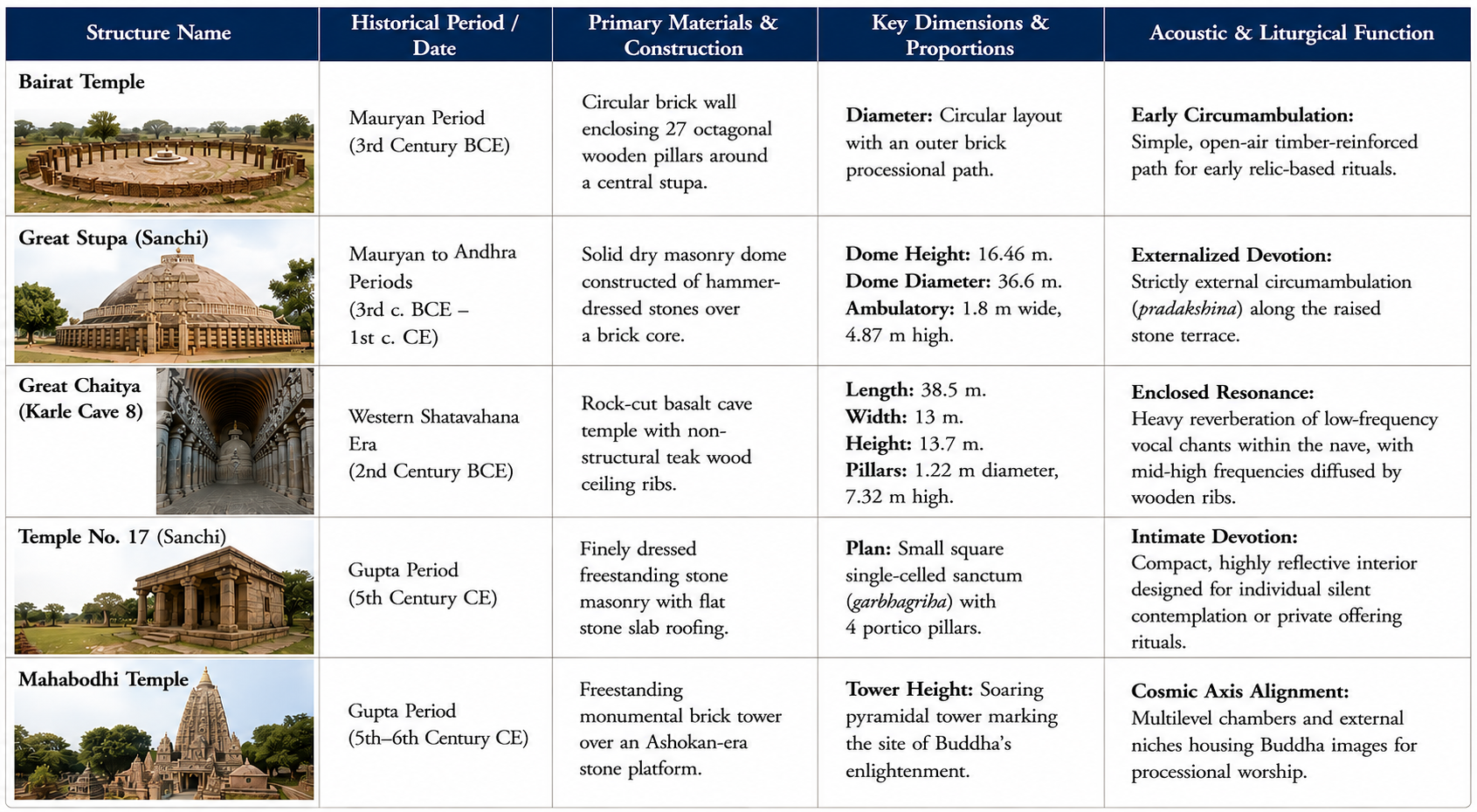
East Asian Timber-Frame Tradition and the Spatial Mechanics of the Garan
As Buddhism traveled into East Asia, it adapted to the regional timber-frame building traditions of China, Korea, and Japan. In this transition, temple layouts adopted the strict axial symmetry, courtyard configurations, and cosmological principles of traditional imperial palace design.
A prime Chinese example is the 15th-century Zhihua Temple in Beijing, which is laid out along a central north-south axis consisting of five successive quadrangular enclosures. The layout begins with the entrance gate (shanmen), flanked by the western Drum Tower and the eastern Bell Tower, which immediately frame the first preparatory courtyard.
The second courtyard contains the main Zhihua Hall 18 meters times 14.5 meters, which features a hip-and-gable roof and only four interior columns to preserve a spacious central area for congregational worship. Above this area was installed a magnificent 5 meters times 5 meters wooden coffered ceiling, designed to focus acoustic energy over the primary altar.
Directly behind stands the Sutra Hall 13.2 meters times 7.5 meters, which houses a non-revolving octagonal sutra cabinet (zhuanlun jingzang). To ensure visibility of the Vairocana Buddha statue seated on top of the cabinet, the builders removed two front interior columns, shifting the massive cabinet slightly toward the rear of the hall.
In Korea, during the Three Kingdoms period, these timber-frame systems reached massive scales. The early 7th-century Mireuksa temple complex covered 165,000 square meters and was arranged as three distinct temples in juxtaposition to represent Maitreya, the future Buddha, descending to save all living beings through three sermons.
Similarly, the 570 CE Hwangnyongsa complex covered 80,000 square meters and was centered around an 80-meter-tall, nine-story wooden pagoda with interior stairs leading to the top. These structures utilized a post-and-beam timber frame, where the heavy pitched clay tile roof served to compress the timber frame under its weight, securing the structure against earthquakes and heavy precipitation.
When these designs reached Japan, they were formalized into the Shichidō Garan (Seven-Hall Temple) layout, which underwent a notable historical evolution from the early Asuka and Nara periods to the Kamakura and Muromachi Zen eras as shown below.
In the earliest Japanese temples, such as the late 6th-century Asuka-dera, the wooden pagoda (tō) occupied the absolute center of the compound, surrounded on three sides by small main halls (kondō) to focus devotion on the physical relics of the Buddha buried at the base of the central pillar.
At Shitennō-ji in Ōsaka, the layout shifted: the single kondō occupied the central position, with the pagoda placed directly in front of it on a strict north-south axis. At Hōryū-ji, the pagoda and the kondō were placed side-by-side inside the courtyard, sharing equal spatial prominence.
By the Nara period, as exemplified by Yakushi-ji, the kondō occupied the dominant central position of the courtyard, while two pagodas were pushed to the southeast and southwest corners, signaling a transition from relic-based contemplation to iconographic liturgy and mass congregational chanting within the main hall.
This transition culminated in the Kamakura-period Zen temples (such as Kenchō-ji and Eiheiji), which omitted pagodas entirely from their core layouts. The Zen garan was organized along a strict north-south axis to emphasize spiritual progression, beginning with the Sanmon (Main Gate), and leading successively to the Butsuden (Buddha Hall), Hattō (Dharma/Lecture Hall), and Hōjō (Abbot's quarters).
To the west of this axis stood the Sōdō (Monks' meditation hall), while the Kuin (Kitchen/administrative offices) stood directly opposite to the east. This highly structured, interconnected layout utilized covered corridors to link the seven essential halls, creating a closed monastic environment where daily movements were strictly regulated.
Quantitative Sound Field Analysis of Chinese Daxiong Main Halls
To analyze the physical behavior of sound within East Asian timber-frame temple halls, researchers have conducted detailed field measurements and computer-aided ray-tracing simulations utilizing multi-physics software. The primary area of inquiry centers on the Daxiong Baodian (Great Hero Main Hall), which is traditionally divided into the Buddha Realm (the rear elevated podium housing major statuary) and the Worship Space (the front floor area occupied by the congregation and chanting monastics).
These spaces are acoustically defined by three key parameters: Reverberation Time (RT), the First Ray Arrival Time, and the Sound Pressure Level (SPL) distribution. Acoustic measurements of four major historical halls located on Mount Wutai in Shanxi, China—the Chongshan Temple Main Hall, the Xiantong Temple Main Hall, the Shuxiang Temple Manjusri Hall, and the Bodhisattva Top (Pusa Peak) Main Hall—reveal how spatial geometry and physical proportions shape their sound fields
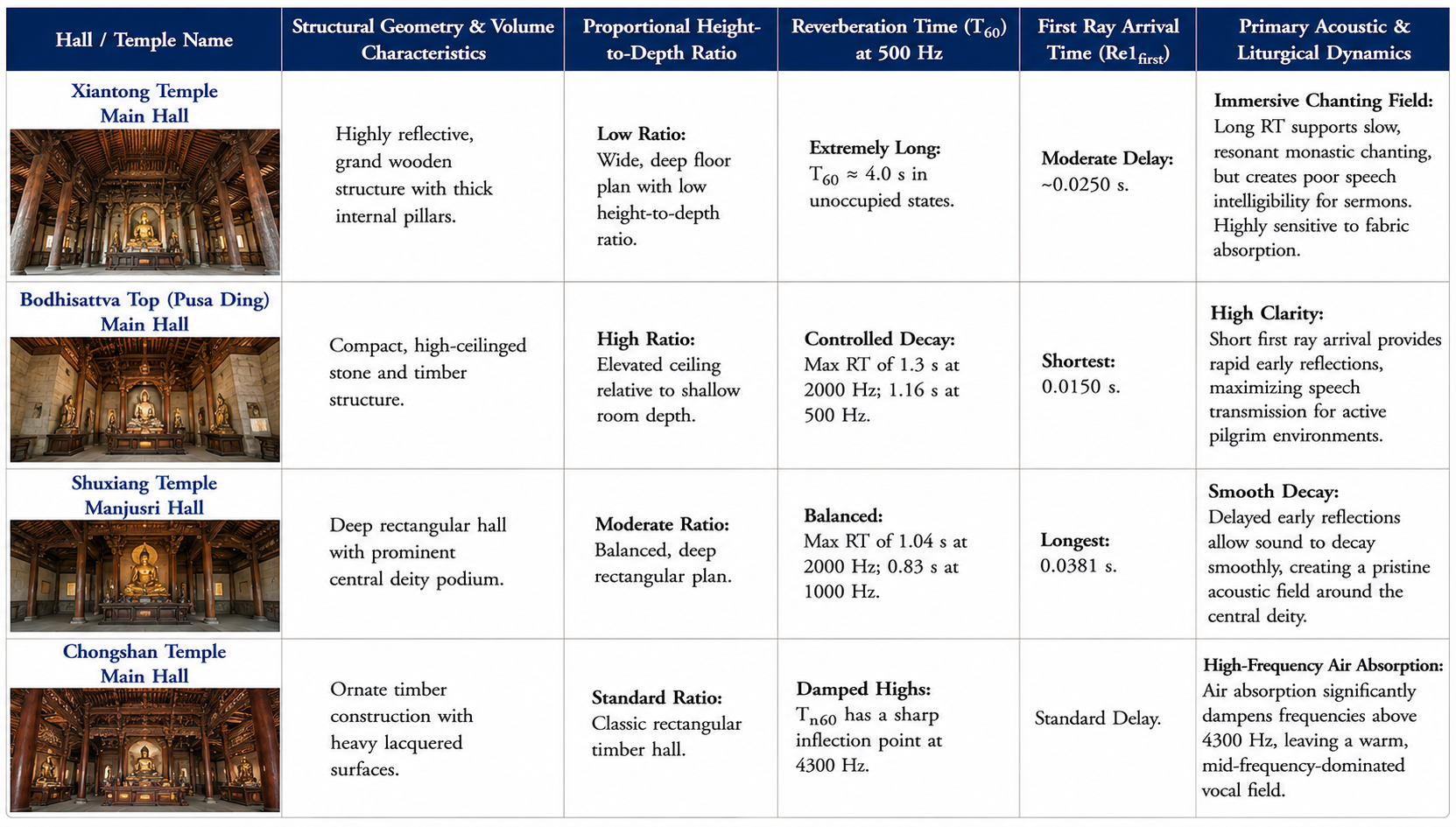
These studies reveal several critical room-acoustic behaviors within traditional timber temples:
Height-to-Depth Ratio and Early Reflections
The transmission rate of acoustic waves inside the main halls is positively correlated with the ratio of the hall's height to its depth. High-ceilinged, shallower halls (such as the Bodhisattva Top Main Hall) project direct sound waves rapidly to the rear boundaries, reducing the arrival time of the first reflected ray 0.0150 second and enhancing early acoustic energy, which supports speech clarity.
Conversely, deeper rectangular halls (such as Shuxiang Temple) delay early reflections 0.0381 second, allowing sound to decay more smoothly and creating a more diffuse, reverberant field.
The Impact of Structural Pillars
The massive timber pillars required to support the heavy roofs of these halls act as physical obstacles that block direct sound propagation. These columns create distinct "sound shadow areas" along the lateral boundaries of the worship space, causing an uneven distribution of Sound Pressure Level ($SPL$) across the floor.
This spatial irregularity must be managed by the physical arrangement of the monastics during chanting services.
The Role of Dynamic Fabric Absorption
The physical environment of a functioning temple is highly dynamic, relying on temporary interior elements to manage acoustics. Acoustic modeling of Xiantong Temple demonstrates that when traditional fabric sound absorbers—such as hanging silk banners, heavy drapes, decorative tapestries, and thick floor cushions—are removed from the hall, the mid-frequency reverberation time (RT) increases by 32.3% and the early decay time (EDT) surges by 46.8%.
These fabric elements function as porous absorbers that selectively dampen mid-to-high frequency resonances, preventing the excessive build-up of late reflections and stabilizing the room's sound field during large assemblies.
Chanting Directivity and the Speech Transmission Index
The physical orientation of the chanting monks is highly optimized for speech clarity. When monastics chant sutras in a face-to-face configuration (standing in rows perpendicular to the main altar, facing one another across the central aisle), the Speech Transmission Index (STI) is mathematically maximized.
Because human speech is highly directional at mid-to-high frequencies, this face-to-face alignment ensures that the direct acoustic energy of the voices is cross-projected and immediately mixed, minimizing the muddying effects of late reflections from the distant rear walls of the hall.
Liturgical Soundscapes: Sounding Objects (Narashimono) and Vocal Performance
While Zen Buddhism is historically associated with quietude and silent introspection, the physical reality of a Zen training monastery is characterized by a dense, highly choreographed soundscape. In these environments, spoken commands are virtually non-existent; instead, every transition in the daily schedule—from waking, washing, and meditation to eating, sutra chanting, and sleeping—is directed by a precise system of percussion instruments known as "sounding things" (narashimono).
These sounding objects serve as the sensory infrastructure of the monastery, translating temporal regulations into immediate physical actions. They are distributed throughout the Shichidō Garan to serve specific spatial and liturgical functions:
The Monumental Bell (Daishō or Ōgane): Cast from bronze and suspended in a dedicated heavy timber tower (shōrō), this massive bell is struck with a suspended wooden beam (shumoku) at dawn (gyōshō) and dusk (konshō). Its deep, low-frequency resonance travels over long distances, serving as a regional acoustic marker that mentally anchors the monastic community and the surrounding landscape to the temple's temporal cycle.
The Hall Bell (Denshō): A smaller bronze bell hung outside the main hall (hondō). Struck with a handheld wooden mallet (kizuchi), its rapid, accelerating cadences signal the gathering of monks for sutra chanting and formal services.
The Summon Bell (Kanshō): A small, high-pitched bell used to coordinate private interviews (sanzen) between individual monastic trainees and the Zen master.
The Wooden Plank (Mokuhan or Han): A thick, rectangular block of solid wood hung outside the monks' hall (sōdō). It is struck with a heavy wooden mallet to mark daily transitions, generating a sharp, dry transient sound with minimal decay, emphasizing urgency and precision.
The Cloud Plank (Unpan): A flat, bronze gong cast in the shape of a cloud, traditionally hung outside the kitchen (kuin or kuri) or refectory to signal meal times.
The Fish-Shaped Wooden Drum (Mokugyo): Carved from a hollowed block of wood with a stylized fish scale pattern, this instrument is struck continuously with a padded leather mallet during sutra chanting. The hollow chamber behaves as an acoustic Helmholtz resonator, producing a warm, deep, rhythmic pulse that synchronizes the breathing and vocalization rates of the reciting monks.
The Handbell (Inkin): A small bronze bowl bell mounted on a wooden handle with a metal rod attached by a string. Used by the session leader (Jikijitsu) inside the sōdō, its sharp, piercing metallic strike slices through the absolute silence of zazen to mark the precise beginning and end of meditation periods.
A striking philosophical and liturgical tension exists regarding the interpretation of these sounds. While scholars and lay observers frequently search for deep esoteric symbolism, cosmic matching, or theological meaning behind these instruments, Zen masters consistently reject such intellectualization. In private interviews, prominent abbots have asserted that these sounding objects possess "no special meaning" and are merely utilitarian tools to establish timing and rhythm, analogous to a starter's gun in an athletic race.
This direct, non-conceptual approach is a core characteristic of Zen training. The sounds are not intended to be analyzed as symbols of the divine; rather, they are direct physical interventions designed to bypass intellectual processing, demanding immediate, unreflective physical compliance. The ring of the Inkin or the strike of the Han does not invite contemplation about time—it is the immediate, absolute transition of the present moment, aligning the monastic's body, breath, and mind with the physical environment.
Beyond East Asian Zen contexts, Buddhist vocal performance and ritual instrumentation show highly specialized adaptations across different cultural spheres. In the Theravada tradition of Thailand, chanting is rooted in the ancient Indian gatha (narrative song or sung verse). Monks employ a range of vocal techniques—including precise cadences, sustained tones, slurs, and rhythmic chanting—to recite protective verses (parittas) and Jataka tales.
During the festival of Loy Krathong, senior monks lead the recitation of the Thet Mahachat (the Vessantara Jataka), where the sweetness, deportment, and vocal virtuosity of the chanter are considered of primary importance, serving to capture the congregation's attention and generate spiritual merit.
In the high-altitude, mountainous landscapes of Tibet and the broader Himalayan region, Vajrayana Buddhism evolved unique architectural and musical forms designed to facilitate tantric practices, visualization, and deity invocation. The primary religious structures—monasteries (gompa or lhakhang), massive fortress-monasteries (dzong), and sacred reliquaries (chorten)—are physically integrated into the rugged terrain, mirroring the structural stability of the mountains themselves.
The physical assembly halls of these monasteries, constructed with thick whitewashed stone walls, heavy timber columns, and high ceilings, provide a highly resonant, reflective acoustic chamber. Within these spaces, monks perform a highly specialized form of liturgical vocalization: multiphonic, overtone-rich "chordal" throat singing, most famously practiced by the Gelug Monks of the Gyuto and Gyume Tantric Colleges.
In this style of chanting, an individual monk produces a very low, stable fundamental drone (often in the deep bass or baritone range around 50 to 70 Hz utilizing the vocal cords, while simultaneously manipulating the vocal tract to selectively amplify higher harmonics, creating the auditory illusion of two distinct pitches being sung by a single voice.
Acoustically, this is achieved by positioning the tongue, narrowing the oral cavity, and engaging the ventricular (false) vocal folds to concentrate acoustic energy in a narrow frequency band (typically between 1 and 2 kHz, amplifying the selected overtone by 15 to 35 dB relative to adjacent harmonics. This guttural, deep style is divided into two primary lineages based on historical visions:
The Mountain-Cracking Voice (ri-bo ral-ba'i skad): A flat, powerful, and deeply grounded monotone drone designed to stabilize attention and establish absolute presence.
The Ocean-Rolling Voice (chu-gter 'khrog-pa'i skad): An undulating, highly dynamic vocalization that naturally produces prominent, ringing overtones.
Physiologically and acoustically, this multiphonic singing is highly optimized for performance within large, highly reflective stone monastic halls. In a space with a long reverberation time, standard melodic singing can quickly disintegrate into a chaotic, unintelligible wash of sound.
By grounding the chant in an extremely low, steady fundamental drone and isolating a single, highly piercing harmonic formant, the monk's voice cuts through the ambient reverberation without requiring excessive vocal strain. The low fundamental vibrates the chest and skull cavity, assisting the practitioner in achieving the deep physical relaxation and mental focus required for complex tantric visualizations.
This vocal drone is accompanied and framed by a diverse ensemble of sacred ritual instruments, each carrying profound spiritual and cosmological symbolism:
The Conch Shell (Shankha or Dungkar): An ancient wind instrument that produces a highly resonant, bright tone with a very high quality-factor, indicating a sharp, highly focused resonance. Blown to initiate ceremonies and signify the spreading of the Dharma, its tone acoustically resembles the sacred, primordial syllable OM.
The Bronze Bell (Dril-bu or Ghanta): Held in the left hand and paired with the thunderbolt sceptre (dorje) in the right, the bell represents wisdom (prajña) and the female principle, while the dorje represents skillful means (upaya) and the male principle. The bell produces a long, sustaining ringing tone that guides focus during meditation.
The Longhorn Trumpet (Dungchen): Monumental, telescoping metal horns up to three meters in length that produce a massive, low-frequency roar resembling the sacred hum of a cosmic animal, marking key transitions and structural thresholds in the liturgy.
The Femur Trumpet (Kangling): A trumpet crafted from a human femur bone, used in esoteric practices such as Chöd. The Kangling produces a high, haunting, and raw tone that visually and aurally reminds the practitioner of the absolute impermanence of life, cutting through the illusions of ego and physical attachment.
Cymbals (Rolmo and Silnyen) and Drums (Damaru and Nga): Metal cymbals and double-headed frame drums are struck with accelerating, non-metric rhythms to mark sectional divisions, disrupt linear thinking, and invoke wrathful protective deities.
Southeast Asian Cosmological Mandalas and Regional Typologies
As Buddhism traveled into Southeast Asia, it encountered diverse geographical, material, and cultural environments, resulting in highly distinct architectural typologies that physicalize Mahayana and Theravada Buddhist cosmology. These structures are not merely visual markers; they are three-dimensional, physical mandalas that guide pilgrims along highly structured physical and acoustic paths.
Borobudur (Central Java, Indonesia)
Constructed in the 9th century during the Sailendra Dynasty, Borobudur is the largest Buddhist temple in the world. Built of gray andesite stone over a dried-out paleolake on the elevated Kedu Plain, the temple consists of nine stacked platforms—six lower square galleries and three upper circular terraces—topped by a massive central dome. The entire structure is designed as a colossal step-pyramid, representing the cosmic mountain Meru. It fuses indigenous Indonesian traditions of ancestor worship and mountain glorification with the abstract Indian concept of the mandala and the pursuit of nirvana.
Pilgrims ascend the monument through an elaborate, enclosed system of stairways and corridors, performing pradakshina around 1,460 narrative relief panels that depict key Mahayana sutras, including the Lalitavistara, Jatakas, and the Gandavyuha. Acoustically, as the pilgrim moves through the narrow, high-walled open-air corridors of the lower square platforms (Rupadhatu), their steps and whispered prayers are compressed and localized, creating a sense of physical enclosure and internal focus.
Upon emerging onto the open, expansive circular upper terraces (Arupadhatu), the physical walls disappear, replaced by 72 Buddhas seated inside hollow, perforated stone stupas. Sound waves are no longer reflected or compressed; instead, they disperse freely into the vast volcanic landscape, aurally mirroring the spiritual transition from the realm of form (Rupadhatu) to the infinite, absolute silence of formlessness (Arupadhatu).
Bagan (Myanmar)
The plains of Bagan are home to thousands of brick stupas and temples constructed between the 9th and 13th centuries. The architectural masterpiece of this era is the Ananda Temple, completed in 1105 CE under King Kyansittha. Designed to mimic the cool, meditative atmosphere of the mythical Himalayan Nandamula Cave Temple, the building features a symmetrical, cruciform "Greek cross" floor plan. At the absolute center of this massive brick structure is a solid square core flanked by two concentric, vaulted processional corridors.
Inlaid into the four faces of the central core are four arched niches housing 9.5-meter-tall standing Buddha statues carved from solid teak wood, representing the four Buddhas of the present kalpa who have attained nirvana: Kassapa (South), Kakusandha (North), Konagamana (East), and Gautama (West). The building's exterior features stepped, receding terraces leading to a golden shikhara (tower) and a crowning hti (umbrella) pinnacle.
The interior acoustics of the Ananda Temple are highly specialized: the heavy brick walls and low-vaulted processional corridors act as low-pass acoustic filters, absorbing high-frequency background noise from the outside and leaving a deep, quiet, and cool acoustic background. When a devotee stands in the transverse corridors, the direct sound of chanting is channeled down the long, narrow tunnels, producing highly directional, clear reflections that draw the listener's focus forward to the massive, illuminated wooden Buddhas towering at the corridors' ends.
Thai Regional Typologies: Sukhothai, Ayutthaya, and Lanna
Thai Buddhist temple architecture is defined by a highly structured spatial division, separating the sangkhawat (monks' living quarters, containing individual kuti dwellings, kitchens, and sometimes the bell tower) from the buddhavasa (the sacred zone dedicated to religious rituals, enclosed by a gallery of Buddha images known as the phra rabeang).
Within the buddhavasa, the primary liturgical structures are the Ubosot (the highly sacred, consecrated ordination hall demarcated by eight Sema boundary stones) and the Viharn (the primary assembly and preaching hall). Throughout history, three primary regional and dynastic styles have defined this tradition:
Sukhothai Style (13th–15th c.): Characterized by bell-shaped and unique lotus bud-shaped chedi (stupa) spires, with extensive use of large clay bricks made of river bed clay mixed with rice hulls, alongside structural reddish laterite stone. The interior walls, coated with thick stucco, are embellished with tempera murals where the color red represents an empty void, creating a visually and acoustically warm, highly focused environment in the nave.
Ayutthaya Style (14th–18th c.): Noted for its adaptation of the Khmer stone prasat into the elongated, towering phra prang, and late-period curved foundations (Yon Thong Samphao). These structures feature a deliberate concave curvature of the building's base and roofline mimicking a Chinese junk hull, which alters interior acoustic wave reflection angles along the longitudinal axis.
Lanna Style (Northern Thailand): Distinguished by low, sweeping, multi-tiered roofs that telescope towards the entrance, V-shaped wooden Kalae carvings at the gables, and open-sided assembly halls (Viharn Nam Tam). The low roofs protect the teak wood carvings and create dark, cool, highly focused interiors, while the open sides connect the interior acoustic field directly with the surrounding natural geophony (wind, water, birds).
These regional styles maintain unique liturgical and spatial rules. In northern Lanna sites (such as Wat Sri Suphan or the base of Wat Chedi Luang), ancient beliefs regarding spiritual purity and the sacred talismans (takrud) buried beneath the structures prohibit women from entering the main ordination zone, preserving a strict spatial boundary around the consecrated relics.
The primary stupa (chedi or stupa) acts as the symbolic center, representing Mount Meru, the multi-layered Buddhist cosmology, and the seated body of the Buddha himself. On the corners of these chedis and along the ridges of the temple roofs, strings of small brass wind chimes (bell/chimes) are hung. In Buddhist liturgy, the sound of these chimes is considered a sacred summon that purifies the mind and dispels distraction.
Acoustically, these chimes illustrate the fundamental Buddhist doctrine of dependent origination and emptiness: their sound does not exist inherently within the metal, nor does it exist solely in the wind; rather, the clear metallic tinkling arises only through the temporary, dependent interaction of the wind, the brass, and the surrounding environment, providing monastics with a continuous sensory lesson on the nature of reality.
Contemporary Geometries and Tech-Spiritual Fusion
Since the late 20th century, a new wave of monumental Buddhist architecture has emerged across Asia, characterized by a bold synthesis of ancient sacred principles, modern building materials (such as exposed concrete, structural steel, and glass), and globalized cultural functions. These contemporary structures transition away from literal historical imitation, adopting minimalist design languages to evoke the core Buddhist concepts of emptiness (śūnyatā), impermanence, and meditative quietude.
The Hill of the Buddha (Sapporo, Japan)
Designed by the renowned architect Tadao Ando inside the Makomanai Takino Cemetery, the Hill of the Buddha is a masterclass in architectural choreography and landscape integration. The project encases a traditional, pre-existing 13.5-meter-tall stone seated Buddha statue within a massive, circular concrete rotunda.
This concrete dome is entirely buried beneath a sloping, artificial earth mound planted with 150,000 lavender plants, leaving only the very top of the Buddha's head visible from the surrounding hills.
To approach the statue, visitors must navigate a highly structured spatial path. They first pass a large, rectangular reflecting pool that purifies the mind, then enter a 40-meter-long, dimly lit tunnel constructed of raw, board-formed concrete.
As the visitor walks through this dark, compressed tunnel, the ambient sound of the exterior landscape is systematically dampened, creating a quiet, introspective acoustic shadow. At the end of the tunnel, the space opens dramatically into the soaring, open-ceiling concrete rotunda.
The visitor stands at the base of the massive statue, looking up to see the Buddha's face framed by the sky and natural light filtering down from the circular opening. This spatial sequence—moving from light to dark, acoustic compression to open-air release—physically and aurally choreographs a meditative passage from the darkness of ignorance to the illumination of awakening.
The Water-Moon Monastery (Taipei, Taiwan)
Designed by Kris Yao | Artech on the Guandu Plain, the Water-Moon Monastery reinterprets Zen Buddhist aesthetics through a Le Corbusier-influenced modernist framework. Constructed primarily of raw concrete, glass, and warm wood, the temple sits adjacent to a 260-foot-long, tranquil lotus pond that reflects the surrounding mountains and the changing sky.
The defining architectural feature of the double-height Main Hall is a vast screen wall constructed of prefabricated Glass Fiber Reinforced Concrete (GRC) panels. These panels are carved through with the characters of the Vajracchedika Prajnaparamita Sutra (The Diamond Sutra) and the Heart Sutra.
As sunlight passes through these hollow, negative character cut-outs, the sacred scriptures are printed with pure light directly onto the interior concrete floors and wooden walls. As the earth rotates, these characters move and fade across the surfaces, providing a continuous, dynamic visual sermon on the absolute impermanence and emptiness of all phenomena.
Tsz Shan Monastery (New Territories, Hong Kong)
Completed in 2015 and funded by the Li Ka Shing Foundation, Tsz Shan Monastery is dedicated to Chán Buddhist practice, education, and public spiritual reflection. The complex seamlessly integrates classical Tang Dynasty architectural proportions and wood joinery aesthetics with state-of-the-art structural steel framing, hidden climate control, and modern safety engineering.
The spatial layout features expansive, highly balanced courtyards, quiet ponds, and contemplative gravel paths, terminating in the monastery's towering icon: a colossal, 76-meter-tall bronze statue of the Bodhisattva Guan Yin (Avalokiteśvara) coated in white paint.
The statue stands as a monument to compassion, commanding the landscape while the interior houses a dedicated museum containing world-class collections of historical Buddhist art, serving to bridge ancient lineage traditions with modern public education.
Fo Guang Shan Buddha Museum (Kaohsiung, Taiwan)
Representing the globalized, highly accessible approach of Humanistic Buddhism, the Fo Guang Shan Buddha Museum is a monumental, 100-hectare sacred complex designed to integrate traditional pilgrimage with public education, modern tourism, and high-tech digital media.
The architectural layout represents a dramatic fusion of Indian, Chinese, and modern building traditions:
The Front Hall: A massive gateway structure flanked by a five-meter-tall stone lion on the left (symbolizing the roar of the Buddha's teachings) and an identical elephant on the right (symbolizing Prince Siddhartha's conception).
The Way to Buddhahood: A colossal, stone-paved ceremonial processional walkway measuring 240 meters long and 113 meters wide.
The Eight Pagodas: Flanking the processional walkway are eight identical, 38-meter-tall, seven-story Chinese-style pagodas constructed of reinforced concrete and stone, representing the Noble Eightfold Path. Each pagoda houses specialized public functions, including a library, lecture halls, transcription spaces for sutra calligraphy, and children's interactive exhibits.
The Main Hall and Stupa: Located at the end of the central axis, this 50-meter-high domed structure is inspired by the Indian Mahabodhi Temple at Bodh Gaya. Constructed with a base of Chinese sandstone and a body of Chinese granite, the hall houses the sacred Buddha Tooth Relic inside the Jade Buddha Shrine.
The Fo Guang Big Buddha: Seated atop the Main Hall is a colossal, 108-meter-tall bronze statue of Sakyamuni Buddha. The statue took over a year to cast, utilizing nearly 1,800 tons of structural metal.
The 48 Underground Palaces: Built beneath the main complex is a vast network of 48 underground reliquary chambers containing additional Buddhist relics, historic artifacts, and contemporary cultural time capsules, designed to preserve the heritage of Humanistic Buddhism for future millennia.
Nan Tien Temple (Wollongong, Australia)
Constructed as the largest Buddhist temple in the Southern Hemisphere, Nan Tien Temple illustrates the adaptation of Chinese palace-style architecture to a modern Western context. While traditional temples were constructed of timber and brick, Nan Tien utilizes modern structural steel and concrete.
However, its structural design carefully mimics traditional forms: the steel roof framing is fitted with painted end beams that extend under the eaves to replicate classical wooden bracket systems.
The exterior features red imperial columns and white concrete balustrades styled to mimic classical carved white marble. Inside, a prominent raised podium is positioned at the rear of the shrines to elevate the primary Buddha statuary, mirroring the royal audience halls of the Chinese imperial court.
The complex is laid out along a strict symmetrical axis, where a sequence of lower courtyard buildings leads progressively to the most significant Main Shrine, conceptually organizing the temple space as a seated Buddha where the Main Shrine represents the head, the surrounding wings represent the arms, and the central courtyard functions as the lap.
Conclusion: The Integrated Sensory Design of Buddhist Sacred Architecture
An integrated review of Buddhist temple architecture across time, geography, and cultural lineages demonstrates a profound, unbroken commitment to sensory and attention-shaping design. Whether analyzing the rock-cut basalt naves of early Indian chaityas, the mathematically balanced timber-frame structures of East Asian garans, the monumental stone mandalas of Southeast Asia, or the minimalist concrete sanctuaries of the contemporary era, the core spatial objective remains identical: to configure the physical environment so that it actively mirrors and supports the internal path to awakening.
Acoustically, this evolution reveals a highly sophisticated understanding of material physics and room-acoustic design. When the primary liturgical mode focused on slow, resonant chanting and solitary circumambulation, structures utilized reflective, cave-like basalt stone to compress vocal energy and maximize immersion. When the liturgy transitioned to exoteric communal preaching, mass assemblies, and rapid scripture readings, timber systems were developed to introduce porous, high-frequency sound-absorbing surfaces (such as paper panels, drapes, and wooden structures), keeping speech transmission crisp and highly intelligible.
Concurrently, the tight physical synchronization of monastic life was coordinated not by spoken words, but by a precise temporal grid of percussive sounding objects (narashimono) that directly regulated the monastic breath, posture, and collective focus. In these diverse environments, the architecture does not merely serve as a passive container for worship, it acts as an active partner to the mind, utilizing the physical properties of space, light, materials, and sound to gently guide the body and attention away from mental clutter and into a state of absolute, reflective presence.
Temple Acoustics Consultation Framework: Balancing Ritual, Contemplation, and Sacred Sound
Temples present a unique challenge in Sacred Acoustic Design because their worship experience is often centered on contemplation, chanting, ritual resonance, and the relationship between sound and silence. Unlike churches, which frequently combine music and preaching, or mosques, which focus primarily on the beauty and intelligibility of the human voice, temples often seek to cultivate mindfulness, reflection, and spiritual awareness through a carefully balanced acoustic environment.
Today, many temples serve multiple functions beyond traditional worship, including meditation retreats, Dharma teachings, community activities, cultural events, educational programs, and digital broadcasting. As a result, acoustic design must accommodate both traditional ritual practices and contemporary functional requirements while preserving the contemplative atmosphere that defines the temple experience.
The objective is not simply to amplify sound or control reverberation. The goal is to create an acoustic environment that supports inner reflection, collective ritual, spiritual focus, and meaningful human connection.
Different Temple Traditions Require Different Acoustic Environments
One of the most overlooked aspects of temple design is that there is no single acoustic model applicable to all temples. Different Buddhist traditions, cultural contexts, and ritual practices create distinct acoustic requirements.
Theravada Buddhist temples, commonly found in Thailand, Myanmar, Cambodia, Sri Lanka, and Laos, often emphasize spoken teachings, scripture recitation, monastic chanting, and meditation. Speech intelligibility is important for Dharma talks, while moderate reverberation can support chanting without overwhelming clarity. The acoustic environment is typically expected to feel calm, intimate, and conducive to contemplation.
Mahayana Buddhist temples, prevalent in China, Taiwan, Korea, Japan, and Vietnam, frequently incorporate larger ceremonial spaces, collective chanting, ritual percussion, temple bells, and congregational participation. These environments often benefit from a richer acoustic response that supports collective vocalization while maintaining clarity for teachings and ceremonial announcements.
Vajrayana Buddhist temples and monasteries, particularly in Tibetan traditions, often incorporate deep vocal chanting, ritual horns, large drums, bells, cymbals, singing bowls, and ceremonial instruments. These rituals generate a broad spectrum of frequencies and dynamic ranges, requiring an acoustic environment that can support both resonance and articulation without becoming acoustically chaotic.
Contemporary urban temples and meditation centers often serve diverse functions including meditation classes, mindfulness programs, public lectures, community activities, and hybrid digital participation. These facilities frequently require a more flexible acoustic approach that supports both contemplative silence and amplified communication.
The challenge is recognizing that each tradition uses sound differently and therefore requires a different balance between reverberation, clarity, intimacy, and ritual resonance.
Architectural Style Shapes Acoustic Character
Temple acoustics are deeply influenced by architectural form, materiality, and cultural expression.
Traditional East Asian temples frequently utilize timber structures, exposed wooden beams, layered roofs, and natural materials. Wood provides a softer acoustic response than stone or concrete, creating a warm and balanced sound environment that supports chanting and meditation while reducing harsh reflections.
Chinese and Korean temple architecture often incorporates large ceremonial halls, courtyards, decorative screens, and ornamental detailing that contribute both visual richness and acoustic diffusion. These elements help distribute sound more evenly throughout the worship space.
Japanese temples and Zen meditation halls often embrace simplicity, natural materials, and human-scaled proportions. Their acoustic environments tend to emphasize subtlety, restraint, and attentive listening. The resulting spaces often support contemplative practices through controlled reverberation and low background noise.
Contemporary minimalist temples frequently employ concrete, stone, glass, and steel alongside modern architectural forms. While visually elegant, these materials can create excessive reflections and acoustic harshness if not carefully integrated with acoustic design strategies. The challenge is maintaining architectural purity while preserving the calmness and warmth essential to contemplative practice.
In each case, architecture functions not only as a visual expression of spirituality but also as a vessel for shaping how sacred sounds are experienced.
The Acoustic Value of Silence
One of the defining characteristics of temple acoustics is the intentional use of silence.
In many religious buildings, silence is simply the absence of sound. In temples, silence often becomes an active component of the worship experience. Moments of silence may occur: Before meditation, Between chants, During prayer, Following the strike of a bell and During contemplative reflection. These pauses allow worshippers to become more aware of their surroundings, their thoughts, and their spiritual practice.
For this reason, building acoustic design becomes especially important. Mechanical noise, traffic noise, vibration, and intrusive background sounds can significantly disrupt contemplative environments. Protecting silence often becomes as important as supporting ritual sounds.
Size, Volume, and Spatial Sequence Matter
Temple acoustics are influenced not only by room size but also by the sequence of spaces through which worshippers move.
Unlike many churches and mosques that focus on a single large worship hall, temples frequently include: Courtyards, Threshold spaces, Meditation rooms, Ceremonial halls, Bell towers, Prayer pavilions and Gardens.
Each space may possess a different acoustic character that supports a different stage of the spiritual journey. A meditation hall may require exceptional quietness and intimacy. A ceremonial hall may support collective chanting and ritual percussion. An outdoor courtyard may intentionally incorporate water features, wind, and natural sounds.
This progression creates an acoustic narrative that accompanies the worshipper's movement through the sacred environment.
ALTA Integra Temple Acoustic Consultation: Integrating Building Acoustics, Architectural Acoustics, and Electroacoustics
Successful temple acoustics require the integration of multiple disciplines.
Building Acoustics protects meditation and ritual activities from unwanted environmental noise, mechanical systems, and vibration. Because temples often emphasize mindfulness and attentive listening, low background noise is particularly important.
Architectural Acoustics shapes the natural behavior of sound through geometry, material selection, room volume, reverberation control, and diffusion. The objective is to support chanting, teachings, bells, and ritual instruments while preserving calmness and acoustic comfort.
Electroacoustics provides reinforcement for Dharma teachings, ceremonies, multilingual interpretation, accessibility systems, livestreaming, and community events. Loudspeaker selection, placement, coverage, and delay optimization should remain unobtrusive and support the natural acoustic character of the space rather than dominate it.
The goal is not to transform the temple into a performance venue but to use technology in service of ritual and contemplation.
ALTA Integra Temple Acoustic Consultation: Beyond Acoustic Performance
Conventional acoustic design often focuses on measurable criteria such as reverberation time, speech intelligibility, and sound pressure level. While these metrics remain important, they do not fully describe the temple experience.
The sound of a temple bell is more than a signal. Chanting is more than speech. Silence is more than the absence of sound. These elements function as spiritual tools that shape attention, awareness, memory, and emotional experience.
Sacred Acoustic Design therefore seeks to understand not only how sound behaves physically, but also how it is perceived psychologically and experienced spiritually.
ALTA Integra Temple Acoustic Consultation: Preserving the Acoustic Identity of Temple Worship
The most successful temples are those where architecture, ritual, acoustics, and culture work together as a unified experience.
When carefully designed, chanting resonates naturally within the space, bells decay gracefully into silence, teachings remain intelligible, and worshippers experience a sense of calmness and spiritual presence.
This is the challenge—and the opportunity—of contemporary temple acoustics: preserving the unique acoustic identity of temple worship while accommodating the evolving needs of modern religious, cultural, and community life.
In Sacred Acoustic Design, the objective is not simply to make temples sound better. It is to create environments where sound, silence, architecture, and ritual come together to support contemplation, mindfulness, and spiritual transformation.Chanting and collective singing style
Collective vocalization is one of the most important acoustic behaviors in sacred architecture. Chanting and congregational singing create emotional bonding, shared rhythm, and a strong sense of participation. The architectural response should match the style of vocal production.
Where singing is sustained and harmonically rich, as in many churches, the room can afford more reverberation to support blend and warmth. Where chanting is syllabic and text-driven, as in many mosques and temples, clarity and articulation become more important. Where chanting is meditative and repetitive, the space should avoid harsh reflections and mechanical noise that interrupt vocal continuity.
The key point is that collective singing is not only heard; it is felt. The room becomes part of the instrument. That is why acoustic design must be calibrated to the actual vocal culture of the congregation, not to an abstract ideal.
Across religious traditions, collective vocalization remains one of humanity's oldest social behaviors.
Whether expressed through hymns, chants, recitations, or responsive prayer, collective sound-making creates powerful psychological and physiological effects.
Research suggests that collective singing and chanting may contribute to: Social bonding, Emotional synchronization, Shared attention, Group identity and Stress reduction.
The acoustic environment plays a crucial role in shaping these experiences. Too much reverberation can reduce clarity. Too little reverberation can diminish emotional richness.
The most successful worship spaces achieve a balance that allows worshippers to hear both themselves and the larger community.
In this sense, architecture becomes an active participant in collective worship.
Mosque Acoustics Consultation: Balancing Architecture, Quranic Recitation Prayer, and Audio Technology
Optimizing mosque acoustics requires navigating a distinct spatial-acoustic dichotomy: achieving exceptional speech intelligibility for the spoken word (Salat) while preserving a majestic acoustic spaciousness for Quranic chanting.
Historical masterworks addressed this passively; for instance, the classical Ottoman Süleymaniye Mosque integrated hollow cavity-pot resonators (Sebu) and porous linen-fiber mortar to deliver perfect clarity alongside sacred resonance.
Contemporary computer simulations (such as ray-tracing models evaluated by researchers like Adel A. Abdou) demonstrate that standard geometric forms—ranging from rectangular layouts to less acoustically favorable octagonal plans—must be precision-engineered to manage flutter echoes and spatial distribution patterns.
By strategically introducing modern electroacoustics (such as steerable line-array speakers) alongside passive boundary treatments like non-parallel sloped planes, modern consultants can successfully maintain optimal reverberation times across both empty and high-occupancy prayer states.
Mosque Acoustic Consultation Framework Development Background
Effective mosque acoustic design consultation requires a holistic framework that bridges historical sacred architecture with modern engineering. To develop this comprehensive acoustic design consulting approach, our methodology is firmly rooted in a deep exploration of architectural history, analyzing how traditional geometries and materials passively managed sound fields.
By pairing this historical context with a rigorous understanding of Islamic liturgical practices, which demand a delicate balance between crisp speech intelligibility for sermons and majestic reverberation for Quranic chanting, we map the unique acoustic signature of the space.
Ultimately, these scientific metrics are cross-examined with congregation perception, ensuring that our architectural acoustic passive design and electroacoustic technology interventions do not merely satisfy technical standards, but actively enhance the spiritual, meditative, and communal experience of the worshippers
Mosque Architecture Historical Study
Mosque architecture is not a single fixed style. It changes strongly with regional traditions, while still keeping core elements such as the prayer hall, qibla wall, mihrab, minbar, courtyard, and often minaret.
The Early Mosque: Vernacular Domesticity and the Medina Model
The historical trajectory of mosque architecture begins with a structure that was fundamentally domestic, vernacular, and multi-functional rather than monumental. The house of the Prophet Muhammad in Medina, constructed in 622 AD, is recognized as the prototypical model for early mosque architecture. This early mosque architecture was a simple mud-brick enclosure featuring living quarters arranged along one side of an enclosed rectangular courtyard. To protect congregants from the intense Arabian sun during prayer, a shaded porch or portico was constructed on the side of the courtyard facing the qibla, initially oriented toward Jerusalem and subsequently redirected toward Mecca. This portico was fabricated from local, vernacular materials, utilizing palm trunks as supportive columns and palm branches to form a rustic thatch roof.
This early structure established a flexible spatial arrangement that accommodated the spiritual and civic needs of the early Muslim community. Rather than serving solely as a sanctuary for prayer, the Prophet's house was a multi-use civic hub. It operated as a political assembly hall, a treasury, a judicial court, a military coordination point, and a social center. The architectural layout—characterized by a central open courtyard (sahn) and an adjacent covered prayer area—became the spatial foundation for the hypostyle mosque, which spread rapidly across Islamic lands during the early centuries of expansion.
The Quba Mosque, built in 622, is also recognized as the first mosque built in Islam. In 7th century mosque architecture begins to formalize. Early mosques become spaces for communal prayer, teaching, and governance, and the basic spatial vocabulary starts to stabilize around the qibla wall, mihrab, and minbar.
Imperial Consolidation and the Umayyad Structural Synthesis
Following the transition of the caliphate to Damascus under the Umayyad Dynasty in 661 AD, mosque architecture underwent a dramatic structural and symbolic transformation. Operating within a vast, newly acquired empire that annexed Byzantine and Sassanian territories, the Umayyad caliphs recognized that architecture could serve as a powerful medium for projecting political sovereignty and religious legitimacy. The simple clay-and-palm structures of early Arabia were systematically replaced by monumental stone structures designed to rival the architectural grandeur of contemporary Christian and Zoroastrian empires.
Under Umayyad patronage, specifically during the reigns of Caliphs Muawiya and Al-Walid I, the key structural and functional elements of the classical mosque were invented, adapted, and standardized. Rather than developing these elements in isolation, Umayyad builders repurposed regional Roman and Byzantine structures through a process of creative appropriation and spolia. The Great Mosque of Damascus (706–715 AD) was constructed directly over the monumental enclosure walls of the Roman Temple of Jupiter and a subsequent Christian Cathedral dedicated to John the Baptist. By dismantling and repositioning the columns and arcades of the older structure, the architects achieved a powerful symbolic assertion of Islamic hegemony over the conquered lands.
The Umayyad period introduced several architectural innovations:
The Concave Mihrab: While early prayers were oriented toward a flat wall, the concave mihrab (prayer niche) was introduced by Caliph Al-Walid I during the enlargement of the Prophet's Mosque in Medina between 707 and 709 AD. Drawing inspiration from the semi-circular apse of Byzantine Christian basilicas, the mihrab served a dual purpose: it indicated the direction of the qibla toward the Kaaba in Mecca, and it symbolized the niche containing God's divine light, marking the historical spot where the Prophet stood to lead the congregation.
The Minaret: The minaret originated during this era as a permanent, elevated tower for the call to prayer (adhan).4 Muawiya first introduced four corner projections for the adhan at the Mosque of Amr ibn al-As in Egypt in 673 AD.4 This innovation was inspired by Roman watchtowers and Syrian Christian square church towers, establishing a vertical architectural profile that became a major civic marker of Islamic cities.
The Maksurah: Following an assassination attempt on his life by a Kharijite sectary, Caliph Muawiya introduced the maksurah—a highly secured, protective wooden or stone enclosure built near the mihrab.2 This feature institutionalized a clear physical division between the ruler and the public within the communal prayer space, reflecting the shift from a highly egalitarian tribal leadership to an absolute imperial monarchy.
The Central Nave and Dome: The Umayyads modified the uniform hypostyle layout by introducing a wide central "nave" or aisle that ran perpendicular from the main entrance to the mihrab.6 This layout, modeled on Christian basilicas, culminated in a dome over the crossing directly in front of the mihrab.4 This structural feature highlighted the path of the caliph and emphasized the most sacred zone of the sanctuary.
691–715 CE the Umayyad period gives mosque architecture its first monumental expression. The Dome of the Rock in Jerusalem (691) and the Great Mosque of Damascus (705) show the early use of domes, courts, arches, mosaics, and prayer-oriented planning. The mihrab is also associated with this Umayyad phase.
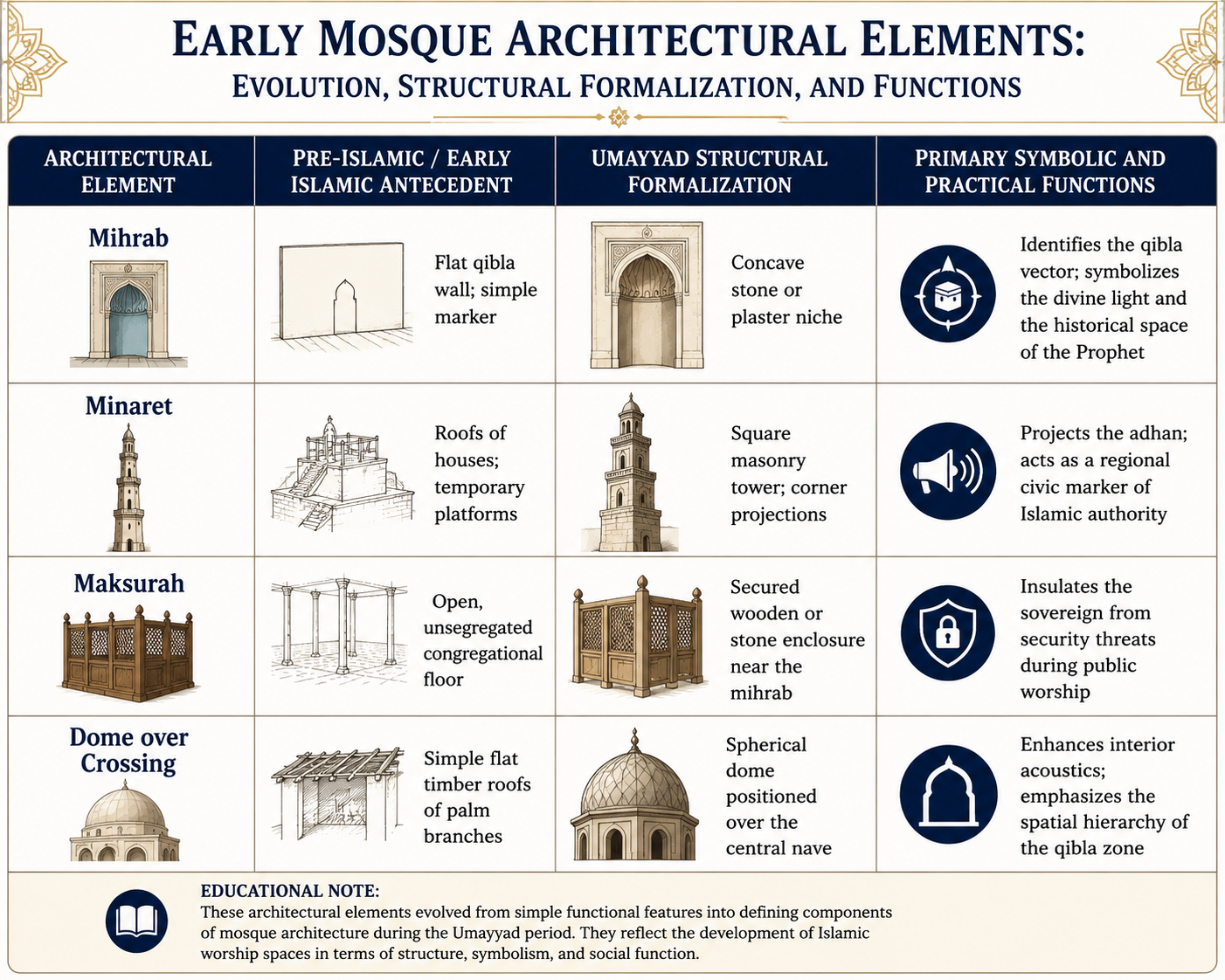
The Abbasid Classical Era and Regional Variations
The overthrow of the Umayyads in 750 AD and the subsequent rise of the Abbasid Caliphate shifted the imperial center of gravity eastward to Iraq, leading to the construction of Baghdad and Samarra. This geopolitical realignment reduced the direct influence of Byzantine Mediterranean classicism and introduced Sassanian Persian design traditions, such as extensive brick construction, vaulted halls, and stucco decoration. This period represents what architectural historians term the first "classical" moment of Islamic architecture, characterized by a highly standardized, self-referential design system that evolved from internal Islamic prototypes rather than external models.
Abbasid architectural planning standardized the hypostyle layout on an imperial scale. Instead of using stone blocks, which were scarce in the alluvial plains of Iraq, Abbasid builders turned to fired and sun-dried bricks. To embellish these brick structures, they developed highly stylized, abstract stucco carvings. The "Samarra style" of stucco relief, featuring beveled, repeating geometric and vegetal designs, gave rise to the arabesque—a stylized, interlacing motif that avoided human or animal figures to comply with the theological rejection of idolatry.
Architecturally, the Abbasids introduced the ziyada—an open, outer courtyard or buffer zone that enclosed the main mosque structure, separating the sacred precinct from the noise and activity of the surrounding city. The Great Mosque of Samarra, built by Caliph Al-Mutawakkil between 848 and 852 AD, was once the largest mosque in the world, exemplifying this monumental scale. Its most iconic feature is the Malwiya Tower, a 52-meter-high spiral minaret. Moving away from the square Syrian tower model, the Malwiya featured an external, spiraling ramp inspired by ancient Mesopotamian ziggurats, demonstrating how Abbasid architects integrated regional pre-Islamic forms into their projects.
During this classical era, several key structural elements were introduced or refined:
The Pointed Arch: Abbasid builders popularized the pointed arch, which distributed structural loads more efficiently than the semi-circular Roman arch, paving the way for taller and more spacious interior prayer halls.
The Muqarnas: Originating in Baghdad during the late 9th and early 10th centuries, muqarnas (stalactite or honeycomb vaulting) emerged as a uniquely Islamic architectural device. Used to transition smoothly from a square room to a circular dome, the muqarnas broke down solid architectural surfaces into complex, light-catching geometric facets.
Aghlabid Innovations: In the Aghlabid province of North Africa (modern Tunisia), which maintained strong ties to Abbasid Iraq while preserving older local building methods, the Great Mosque of Kairouan (c. 836–875 AD) became a model for Western Islamic architecture. The Aghlabids introduced a second dome opposite the mihrab dome, positioned at the entrance leading from the courtyard to the prayer hall, creating a balanced visual axis across the sahn. Kairouan also houses the oldest surviving wooden minbar (pulpit) and maqsura, both crafted from imported Southeast Asian teak wood carved in Baghdad and carried by camel to North Africa—illustrating the vast commercial networks of the early medieval Islamic world.
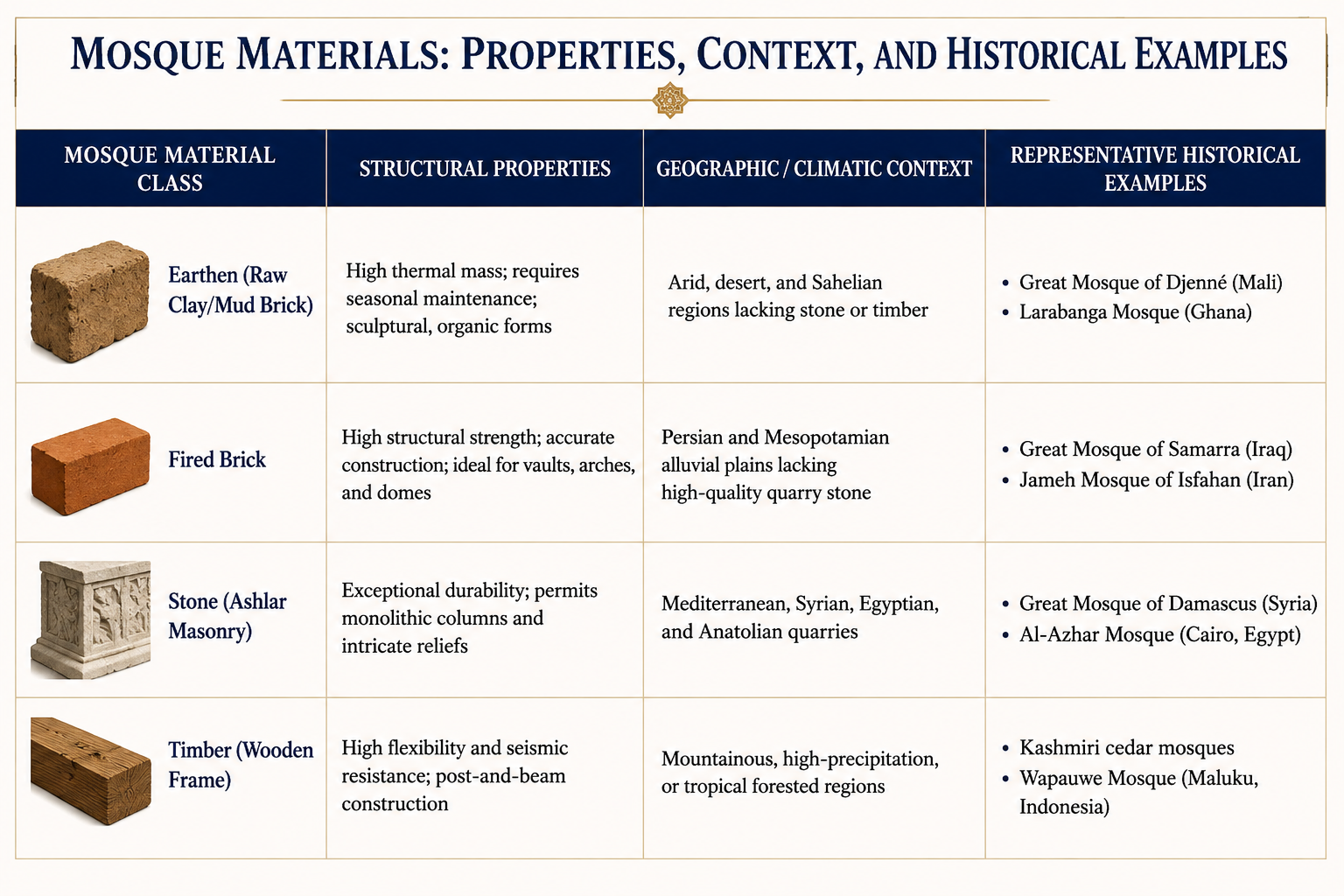
Regional Proliferation and Dynastic Idioms
As central Abbasid authority weakened, independent regional dynasties emerged across the Islamic world, leading to a diversification of mosque typologies that integrated local building materials, climates, and aesthetics.
The Hispano-Maghrebi Tradition
In the far west, encompassing Al-Andalus (Islamic Spain) and the Maghreb (North Africa), the Hispano-Maghrebi or Moorish style developed under the Umayyads of Córdoba, the Almoravids, and the Almohad dynasties. This tradition is characterized by a strong conservative focus on interior spaces rather than grand exteriors, alongside the rejection of large vaults and monumental central domes. Instead, Moorish builders utilized timber-framed roofs and highly complex, low-profile ribbed vaults.
The Great Mosque of Córdoba (8th–10th centuries) exemplifies this style, utilizing a vast forest of columns topped with double-tiered, red-and-white striped horseshoe arches to create a repeating, expansive interior space. The Almohads (1130–1269 AD) introduced a highly disciplined approach to design, reintroducing monumental square minarets with intricate decorative brickwork frames, known as lozenges, and internal ramps wide enough for horse riders to ascend. This design is visible today in the Giralda of Seville and the minarets of Marrakech and Rabat.
In Norman Sicily during the 11th and 12th centuries, a unique Arab-Norman hybrid style emerged following the conquest of the former Aghlabid and Fatimid emirates. The Cappella Palatina in Palermo (built under King Roger II in the 1130s and 1140s) stands as a prominent example of this synthesis, combining Norman portals, Byzantine dome mosaics, and Arab-Islamic pointed arches with a monumental wooden ceiling carved in intricate muqarnas—representing the largest rectangular vault of its kind.
The Persian Four-Iwan Typology
In contrast to the hypostyle halls of the Arab world, 11th-century Iran under the Seljuqs developed a new layout: the four-iwan mosque. An iwan is a vaulted, three-sided hall that is open on one end to a central courtyard. Originally developed in the monumental palace architecture of the pre-Islamic Sassanian Empire, the form was adopted by Persian builders to organize and orient religious spaces.
Under this scheme, older hypostyle mosques—such as the Jameh Mosque of Isfahan—were systematically remodeled. The flat-roofed column halls were replaced by a central open courtyard flanked on each of its four walls by a monumental iwan. The qibla iwan, which faces Mecca, was designed as the largest and most decorated of the four, typically flanked by twin minarets and topped by a monumental brick dome, creating a clear visual focus for the congregation.
The Fatimid Innovations in Cairo
In Egypt, the Shi'i Fatimid Caliphate (909–1171 AD) developed an architectural style in their new capital of Cairo that blended North African brick traditions with elegant stone carving. The Fatimids introduced several key innovations that addressed the challenges of a dense, growing urban environment:
The Offset Facade: Constructed in 1125 AD by the vizier Al-Ma'mun Al-Bata'ihi, the Al-Aqmar Mosque in Cairo was the first building in Islamic history to feature an offset facade. While the interior prayer hall had to remain oriented toward the qibla (Mecca), the exterior facade was rotated to align with the pre-existing grid of Al-Muizz Street. The architect solved this structural transition by varying the thickness of the stone walls, establishing a major precedent for urban planning in Cairo.
The Hanging Mosque: Al-Aqmar was also one of Cairo’s earliest "hanging mosques," constructed on an elevated platform above a street-level row of shops. This design maximized the use of valuable urban real estate while providing secure rental income from the shops to fund the mosque's ongoing maintenance.
Symbolic Stone Facades: The Al-Aqmar facade represents a milestone in decorative stonework. It featured fluted hoods, muqarnas panels, and a central pierced medallion containing the names of "Muhammad and Ali". This decorative program served as a public statement of Fatimid political legitimacy and Shi'i theological identity.
The Early Modern Imperial Zeniths
During the 16th and 17th centuries, the Islamic world was dominated by three powerful, competing empires: the Ottoman Empire in Anatolia and the Balkans, the Safavid Empire in Persia, and the Mughal Empire in South Asia. Each dynasty developed a highly refined, monumental style of mosque architecture that expressed its unique political ideology, administrative power, and cultural identity.
The Ottoman Centrally-Planned Dome
The Ottoman Empire (1299–1922 AD) developed an architectural style centered on the interior volume. Following the conquest of Constantinople in 1453, Ottoman architects analyzed the Hagia Sophia, the great 6th-century Byzantine cathedral. This dialogue inspired them to move away from hypostyle and four-iwan layouts, focusing instead on covering a single, vast congregational space with a monumental central dome.
This tradition culminated in the work of Mimar Sinan, the chief royal architect of the Ottoman golden age. Sinan designed a series of structures that pushed the limits of brick and stone engineering, achieving his self-proclaimed masterpiece at the Selimiye II Mosque in Edirne (1568–1574 AD). To create a spacious, uninterrupted interior, Sinan supported the massive dome on an octagonal system of eight piers embedded directly into the walls, eliminating the need for interior columns. This structural system, combined with cascading tiers of half-domes, buttresses, and tall, pencil-thin minarets, created a balanced, sculptural exterior profile that defined the skyline of Ottoman cities.
The Safavid Ceramic Monumentalism
In Persia, the Safavid Dynasty (1501–1736 AD) made the four-iwan layout the centerpiece of their imperial urban planning. Safavid mosque architecture is defined by its use of color, light, and double-domed brick engineering. Rather than relying on stone, Safavid builders constructed mosques from fired brick, wrapping both interior and exterior surfaces in vibrant, multi-colored glazed tilework (haft-rangi).
The Shah Mosque in Isfahan (begun in 1611 under Shah Abbas I) represents the peak of this style. The mosque's main entrance iwan is angled at 45 degrees to transition visitors smoothly from the public Naqsh-e Jahan Square to the qibla axis facing Mecca. The prayer hall is crowned by a bulbous double dome. This design featured an inner hemispherical dome that established appropriate interior proportions, and a taller, bulbous outer dome that projected a powerful profile across the city.
The Mughal Syncretic Synthesis
Ruling over a Hindu-majority subcontinent, the Mughal Empire (1526–1858 AD) developed a syncretic architectural style that blended Timurid Persian traditions with local Indian building methods. This synthesis integrated Persian layouts, such as the hasht bihisht (eight-paradise plan) and the iwan, with regional elements from the Delhi Sultanate, including red sandstone construction, jali (perforated stone screens), and chhatris (elevated, dome-shaped pavilions).
Mughal mosques are characterized by their formal symmetry, bulbous marble double domes, tall corner minarets, and monumental entrance gates (peshtaq). The buildings were often integrated into a char bagh (four-part garden) layout divided by water channels. Under Shah Jahan and Aurangzeb, the style achieved imperial scale with structures like the Taj Mahal and the Badshahi Mosque in Lahore. These projects juxtaposed deep red sandstone with polished white marble inlays, utilizing clean, symmetrical geometries to project imperial authority and spiritual order.
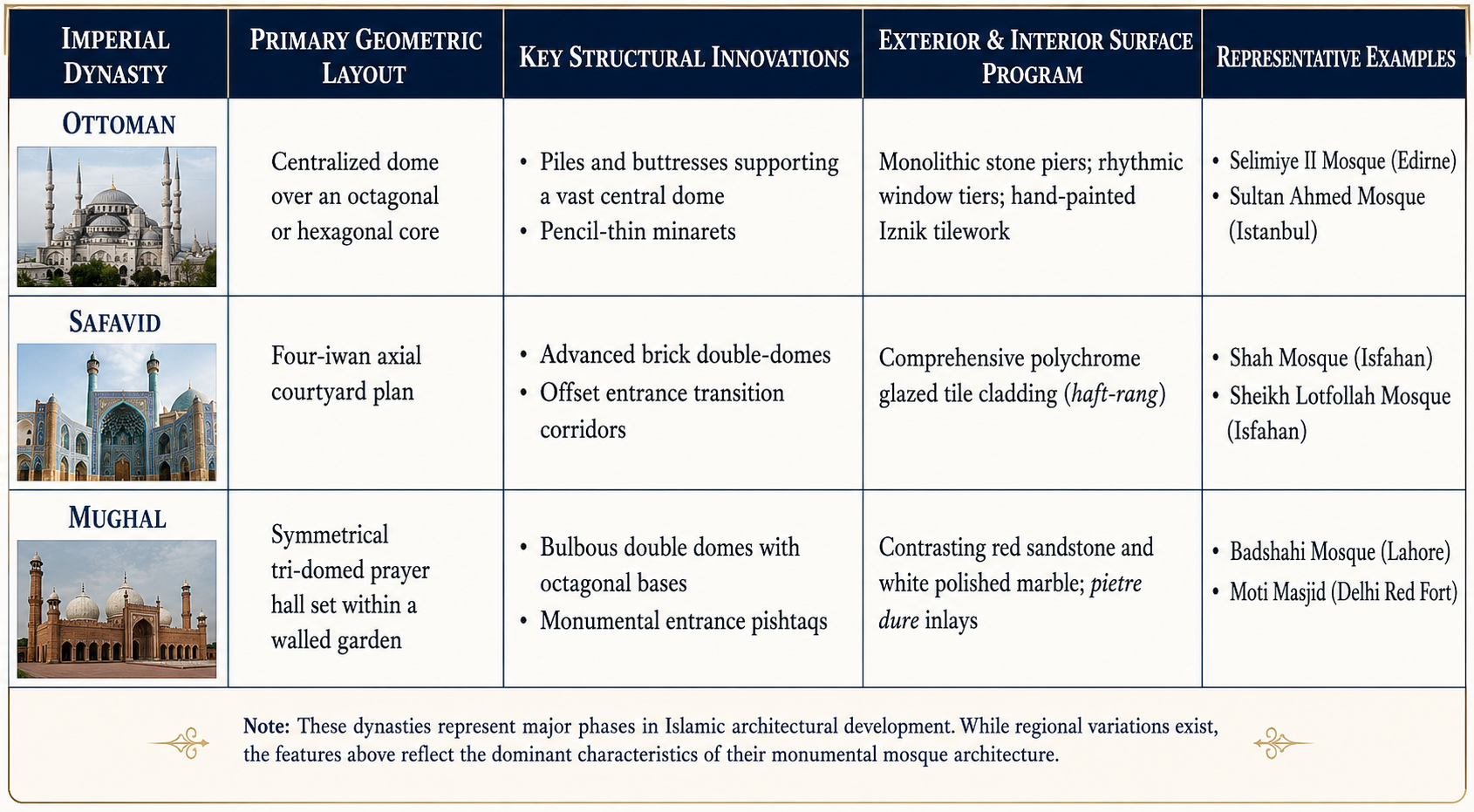
Vernacular and Syncretic Traditions on the Frontiers of Islam
While state-sponsored monuments in the Ottoman, Safavid, and Mughal courts formulated a classical architectural vocabulary, the expansion of Islam along maritime and trans-Saharan trade routes proceeded via a different mechanism. Far from the imperial centers, local builders adapted the functional requirements of the mosque to fit regional materials, climates, and pre-existing religious styles.
West African Earthen Architecture
In Sub-Saharan Africa, particularly within the Western Sudan and Sahel regions, a distinct style of earthen architecture developed under the Mali, Songhai, and Hausa states. Lacking access to stone or coal-fired brick, Sahelian builders turned to sun-dried mud bricks and adobe plaster. This choice of material required frequent, communal maintenance to prevent erosion during the brief rainy seasons.
The Sudano-Sahelian style is characterized by several unique features:
Toron Spikes: Bundles of palmyra wood beams, known as toron, project horizontally from the mud walls. These beams serve a dual purpose: they act as permanent scaffolding for the annual plastering festival, and they distribute thermal expansion across the earthen facade, reducing structural cracking.
Buttresses and Conical Pinnacles: To support heavy clay roofs without columns, builders constructed massive exterior buttresses that tapered into sharp, conical pinnacles. These elements symbolized spiritual growth while providing structural support for the walls.
The Djingarey Berre and Great Mosque of Djenné: Built in 1327 and 1907 respectively, these structures showcase the scale of this earthen style. They feature high-ceilinged hypostyle halls supported by thick earthen pillars, with small holes cut into the flat roofs to allow controlled, dramatic shafts of sunlight to illuminate the sandy floors.
On the coast of West Africa, returning descendants of freed Afro-Brazilian slaves introduced a hybrid style in the early 20th century. The Great Mosque of Porto-Novo in Benin (built 1912–1935) was modeled on the central churches of Bahia, featuring a bright yellow, green, and blue baroque facade decorated with pilasters and scrollwork. This design stands as a testament to the complex history of migration and cultural exchange in the Atlantic world.
In the 1930s, this West African earthen style was transposed to Europe through the construction of the Missiri Mosque in Fréjus, France. Built under French colonial officers Captain Abdel Kader Mademba and Colonel Lame for West African colonial soldiers stationed in the region, the structure was modeled on the Great Mosque of Djenné but fabricated from reinforced concrete with ochre pigment to withstand the temperate European climate. It integrated corner towers surmounted by concrete decorations simulating West African ostrich eggs, and painted roundels depicting camels and colonial riflemen, illustrating how vernacular styles were reinterpreted to serve military and diasporic communities.
Southeast Asian Maritime Traditions
In Maritime Southeast Asia, including Java, Melaka, and Sumatra, Islam spread gradually through merchant trade networks starting in the 13th century. Early Southeast Asian mosques did not copy Middle Eastern models; they featured neither spherical domes nor tall, candlestick-shaped minarets. Instead, local builders adapted pre-existing Hindu-Buddhist timber-frame traditions to construct sanctuaries suited to the hot, humid tropical climate.
This traditional Southeast Asian style is characterized by:
Tiered Roofs (Tajug): Traditional mosques feature multi-tiered, pyramidal timber roofs, typically with two, three, or five levels, modeled on Javanese joglo structures and Hindu meru shrines. The gaps between the stacked roof tiers allowed hot air to escape, creating natural, passive ventilation inside the prayer hall.
Timber Construction and Joinery: Early mosques, like the 15th-century Wapauwe Mosque in Maluku, were constructed from local woods using traditional mortise-and-tenon joinery without metal nails, secured with palm-fiber rope (gemutu). This flexible, light timber construction allowed the buildings to sway and withstand seismic activity in earthquake-prone regions.
Mahkota Atap (Roof Crowns): The peak of the pyramidal roof was topped by a mahkota atap or mustaka—a decorative finial often hand-molded from a mixture of sea corals and egg whites or crafted from metal. These finials combined Islamic floral motifs, such as the lotus (bunga teratai) and creeping ivy (sulur daun), with older local symbols, representing a visual fusion of pre-Islamic and Islamic beliefs.
Pagoda Minarets: Where minarets were built, they took the form of multi-tiered Chinese pagoda towers or Hindu watchtowers rather than Arab spires. The Tengkera Mosque in Melaka (built 1828) features an octagonal pagoda-style minaret, showcasing the diverse cultural influences along Southeast Asian maritime trade routes.
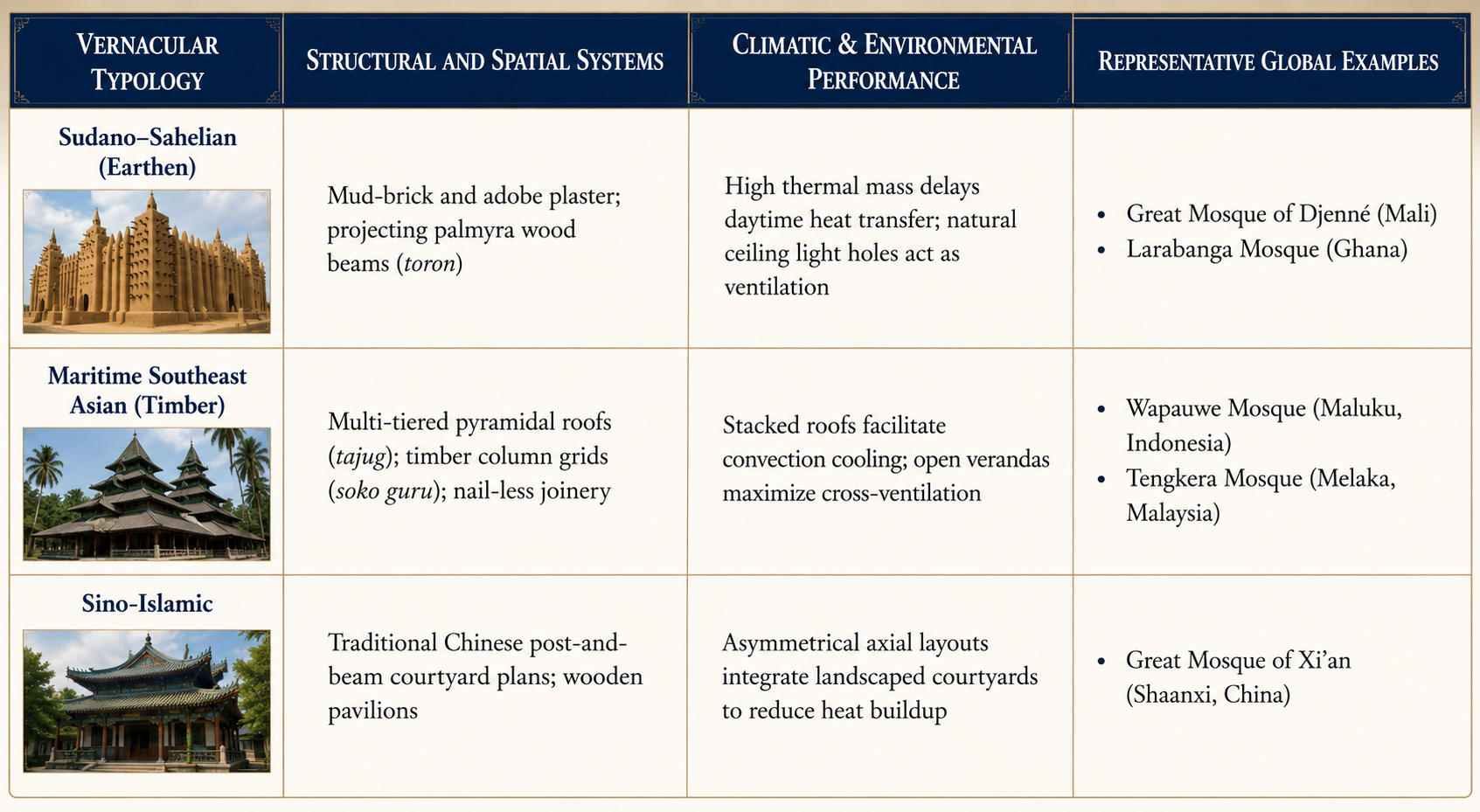
Post-Colonial Modernity, Nation-Building, and the Abstracted Sacred
The mid-20th century marked the end of Western colonial occupation and the rise of independent nation-states across Asia, Africa, and the Middle East. Newly independent, Muslim-majority countries sought to establish modern identities. Governments needed representative civic buildings that broke away from colonial styles and looked toward a modern future. Rather than relying on direct historical revivalism, state architects designed national mosques that expressed modern progress, utilizing reinforced concrete, steel spans, and simplified, abstract geometries.
This post-colonial modernism is represented by several prominent projects:
Istiqlal Mosque (Jakarta, Indonesia): Commissioned by President Sukarno to celebrate Indonesian independence, the Istiqlal (Independence) Mosque was designed by Friedrich Silaban, a Christian architect who won the national design competition in 1955. Constructed between 1961 and 1978, the mosque was built on the site of a former Dutch colonial fort next to the Ciliwung River. Silaban integrated modern European functionalism with Indonesian climate considerations, utilizing expansive covered terraces, open colonnaded corridors of over 1,800 pillars, and a massive 45-meter-diameter stainless steel dome. The number 45 represents the year of Indonesia's independence (1945), the 5 floor levels symbolize the five pillars of Islam and the state philosophy of Pancasila, and the 12 columns supporting the dome refer to the Prophet's birthday on the 12th of Rabi' al-Awwal.
King Faisal Mosque (Islamabad, Pakistan): Designed by Turkish modernist architect Vedat Dalokay and completed in 1986, the Faisal Mosque was built to serve as the national landmark for Pakistan's new capital, Islamabad. Dalokay rejected traditional spherical domes, designing instead an eight-faceted, triangular pyramidal concrete shell that abstractly references the forms of both a cubic Ka'ba and a traditional Arab Bedouin tent. The concrete shell is clad in white Turkish marble and framed by four slender, 60-meter-high pencil-shaped minarets that refer to Ottoman classicism while maintaining a modern, geometric profile.
Zagreb Islamic Center (Zagreb, Croatia): Built during the socialist Yugoslav era in 1987, the mosque was designed to symbolize the integration of the local Muslim community within a modern, multicultural state. The center features a modernist central dome and a tall, pencil-thin minaret that references the region's Ottoman past while adapting to modern construction techniques.
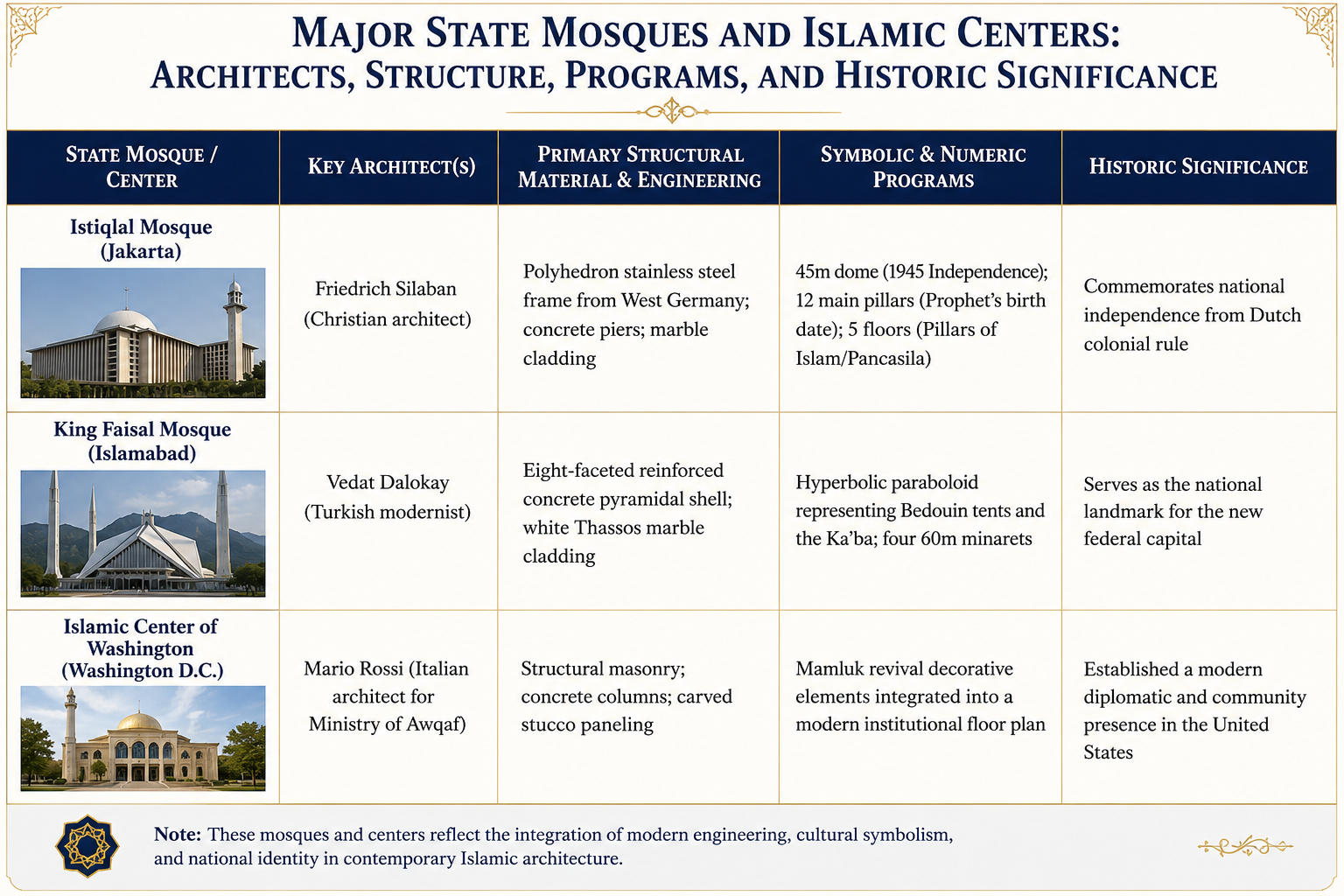
The Twenty-First Century: Sustainability, Abstraction, and the Eco-Mosque
In the 21st century, mosque design has evolved beyond historicist imitation and the grand monumentalism of post-colonial states. Contemporary architects are re-evaluating the essential purpose of the sacred space, focusing on ecological sustainability, natural light, and integration with the landscape. This shift has produced innovative designs that redefine what a mosque can look like in a globalized, eco-conscious world.
Sancaklar Mosque (Istanbul, Turkey)
Designed by Emre Arolat and built between 2011 and 2013, the Sancaklar Mosque in suburban Istanbul represents a complete departure from classical Ottoman design. Rather than building a monumental dome with tall minarets, Arolat embedded the mosque directly into the natural slope of a prairie landscape overlooking Büyükçekmece Lake. The only visible elements from the street are a horizontal courtyard wall and a single, rectangular stone minaret.
Congregants descend a series of natural stone terraces into a simple, subterranean, cave-like prayer hall. The interior is stripped of traditional ornamentation, utilizing raw, textured concrete, rough-hewn stone, and a single calligraphic letter waw painted on a black wall. The space is illuminated by natural light that filters through slits in the qibla wall. In a departure from traditional layouts that relegate women to back rooms or high, enclosed balconies, Sancaklar features an elevated, side-by-side prayer platform, allowing women to pray in the same row as men.
Cambridge Central Mosque (Cambridge, United Kingdom)
Completed in 2019 by Marks Barfield Architects, the Cambridge Central Mosque is Europe’s first purpose-built eco-mosque. The project was initiated to meet the needs of a diverse, multicultural academic community, blending traditional Islamic geometry with local English building traditions.
The defining feature of the mosque is its timber structure. Thirty column "trees" fabricated from sustainably sourced, curved spruce glulam timber reach up to support the roof, forming an interlaced, octagonal vault that evokes both traditional Islamic geometric designs and the Gothic fan vaulting of King’s College Chapel. Large glass dome skylights sit atop these timber trees, filling the prayer hall with natural light.
The building is highly sustainable, designed to achieve a near-zero carbon footprint. It is heated and cooled by basement-level air-source heat pumps, naturally ventilated through ducts integrated into the timber columns, and powered in part by roof-mounted photovoltaic solar arrays. The exterior is clad in local Cambridge "Gault" brick tiles that weave Qur'anic calligraphy into the brickwork, integrating the building into the local streetscape.
Eco-Retrofitting: The Greening of Historic Landmarks
Alongside the construction of new eco-mosques, existing national landmarks have undergone significant environmental retrofits to address climate change. In 2022, Jakarta’s historic Istiqlal Mosque became the first place of worship in the world to be awarded the final EDGE (Excellence in Design for Greater Efficiencies) certification. The retrofit, overseen by the Green Building Council of Indonesia and the Ministry of Public Works and Housing, reduced the mosque's carbon footprint through the installation of:
High-efficiency solar photovoltaics covering more than 13 percent of the building’s electricity consumption.
Water-recycling systems and low-flow fixtures that significantly decrease consumption.
Smart energy meters and reflective paint on the roof and external walls to optimize thermal performance and reduce cooling demands.
This project serves as a model for how heritage and modern religious structures can adapt to meet contemporary environmental standards.
Mosque Acoustics Historical Study
The evolution of mosque architecture is deeply intertwined with the acoustic and liturgical demands of Islamic worship. Unlike many other religious spaces, a mosque serves as a highly dynamic auditory environment where acoustic performance directly influences the liturgical quality of the service. Recent acoustic studies, utilizing modern acoustic computer simulations and in-situ field measurements, have uncovered the advanced passive engineering embedded in historic mosques, as well as the unique strategies employed in contemporary designs.
The study of mosque acoustics reveals a fascinating intersection of structural engineering and spiritual utility. Unlike Christian cathedrals designed for long, atmospheric reverberation to elevate choral music, or modern concert halls built for symphonies, historical mosque architecture evolved to serve a highly specific, word-centric sonic environment.
Liturgical Connections and the Spatial-Acoustic Dichotomy
Balancing the acoustic needs of a mosque creates a unique engineering paradox based on three core activities:
The Khutbah (Friday Sermon):
Typically occurring during Friday prayers, the congregation sits on the carpeted floor while the preacher (khatib) stands elevated on the minbar (pulpit), directly facing the audience. This mode demands maximum speech intelligibility over long distances.
Spoken-word communication delivered by the Khatib from an elevated minbar (pulpit). This requires high Speech Intelligibility. If a space is too echoey, words blend together and the congregation cannot understand the sermon.
Salah (Congregational Prayer): Led by the Imam who faces away from the congregation (toward the Qibla wall). This creates a massive directional sound challenge. Furthermore, the physical presence of the congregation in tight rows (saff) acts as a giant acoustic sponge. Acoustic simulations show that a standing worshipper absorbs significantly more sound than one in prostration, meaning the acoustic profile of the room shifts dynamically as people move through prayer positions.
Worshippers stand, bow, and prostrate in dense, well-defined rows parallel to the qibla wall. The Imam (prayer leader) stands at the front, facing away from the congregation toward the mihrab. Worshippers require absolute audibility and intelligibility of the Imam’s prayer commands and Quranic recitations to maintain communal unity. Worshippers also seek a state of deep spiritual concentration (khusyu').
The Tilawah (Quranic Recitation): A melodic, chanting-style recitation. Worshippers expect a sense of "spaciousness" and "divine majesty" (khusyu'). A completely acoustically dead room ruins the spiritual resonance, whereas a moderate, warm reverberation makes the chant sound full and otherworldly.
Architectural Elements as Acoustic Tools
Architecturally, mosques are often designed with high ceilings and monumental domes to induce a psychological feeling of "smallness" before the divine, which amplifies the spiritual majesty of the space. However, these immense volumes and curved surfaces present a severe acoustic challenge: they can trigger excessive echoes, flutter echoes, and long reverberation times that degrade speech intelligibility.
Dynamic Sound Absorption of Prayer Postures
Acoustic research has demonstrated that the human body itself acts as a major sound absorber within the mosque, and this absorption fluctuates dynamically based on liturgical postures. In-situ testing has shown that different postures yield different values of the equivalent sound absorption area per object, denoted as $A_{Obj}$.
Standing (Qiyam): Standing in well-defined rows provides the highest sound absorption, with a mean of 0.49 to 0.70 m² in the mid-frequency band.
Prostration (Sujud): Prostrating in rows brings the congregation close to the floor, reducing their exposed surface area and resulting in the lowest sound absorption, with a mean of 0.34 to 0.54 m².
Consequently, the physical acoustics of the prayer hall change dynamically as the congregation moves through the prayer cycles (rak'ah), altering the overall reverberation time of the room.
Before electronic amplification, master builders manipulated physical geometry and materials to manage sound propagation:
The Mihrab (Prayer Niche): Far from being just a visual marker for Mecca, this concave niche acts as a natural parabolic reflector. When the Imam recites facing the wall, the curved surface collects his voice and throws it back into the main prayer hall.
Muqarnas (Stalactite Vaulting): These intricate, multi-faceted geometric carvings on arches and transition zones act as high-frequency acoustic diffusers. They break up flat surfaces, scattering sound waves in multiple directions and preventing harsh, fluttering echoes.
Carpets: Heavy wool carpets cover the floor, acting as the primary passive acoustic treatment by absorbing excess high-frequency energy and stopping sound from bouncing wildly off stone floors.
Liturgical Architectural Elements as Acoustic Devices
Specific interior elements of the mosque function as highly specialized passive acoustic instruments.
The Concave Mihrab (Mihrab Mujawwaf)
First standardized in stone during the Umayyad dynasty under Caliph Al-Walid I in 706 AD, the concave mihrab (prayer niche) serves a critical acoustic purpose in congregational prayer. Because the Imam must lead the prayer facing the qibla wall (with his back to the congregation), his voice is naturally projected forward, away from the listeners.
The concave, semi-circular geometry of the mihrab acts as a parabolic acoustic reflector and resonator. It captures the Imam’s voice, prevents it from being absorbed by the surrounding masonry, and reflects the sound energy backward over his shoulders, projecting the acoustic signals into the main hall. Historical measurements of the 16th-century Babri Mosque noted that a whisper spoken inside its concave mihrab could be heard clearly up to 60 meters away at the far end of the sanctuary. Acoustic comparisons of different historical mihrab shapes have determined that the deep, semi-circular Safavid mihrab geometry provides the highest speech intelligibility, outperforming flat Almoravid or shallow Tulunid profiles.
Acoustic Archaeology of Specific Historic Mosques
The Early & Hypostyle Eras
The Great Mosque of Córdoba (Spain)
A groundbreaking spatial acoustic reconstruction by the University of Seville mapped out how the mosque’s acoustics changed over centuries of expansions. The original 8th-century mosque of Abd al-Rahman I featured an intimate hypostyle layout that provided exceptional speech intelligibility.
However, as successive rulers added deep extensions and shifted the mihrab, the space became so vast that the direct-to-reverberant sound ratio collapsed. Worshippers in the back rows were effectively left in acoustic dead zones.
The original 8th-century sanctuary founded by Abd al-Rahman I was acoustically optimized to satisfy the liturgical requirements of the early community, offering a balanced and majestic sound field.
However, as subsequent rulers (Abd al-Rahman II, Al-Hakam II, and Al-Mansur) expanded the mosque, they dramatically increased the depth of the prayer hall. This formal superposition of spaces severely degraded verbal communication in the areas furthest from the qibla wall.
The final lateral expansion by Al-Mansur decentered the mihrab, physically and acoustically segmenting the hall and causing a severe decline in acoustic quality and speech clarity.
Mosque of Ahmad Ibn Tulun (Cairo)
Built of porous red brick and stucco rather than heavy marble, this 9th-century mosque features a highly controlled reverberation field. The immense open courtyard (sahn) serves as an acoustic relief valve, allowing low-frequency sound pressure to escape into the sky instead of building up into a booming, muddy echo inside the arcades.
The Persian Safavid Innovation
Shah Mosque (Isfahan, Iran)
Engineered in the 17th century by the legendary polymath Sheikh Baha'i, this mosque features an extraordinary acoustic phenomenon driven by its 52-meter-high double-shelled dome.
The "Black Stone" Phenomenon: On the floor directly beneath the apex of the central dome sits a specific dark square stone. When the Imam stands on this exact tile and speaks, his voice hits the dome's precise geometry, bounces down, and enters an intense multi-echo loop.
This natural amplification allows a single human voice to clearly reach a congregation of up to 15,000 people without modern electronic systems. Fascinatingly, stepping just 30 centimeters off this stone completely breaks the acoustic loop, confining the extreme amplification strictly to the liturgical center stage.
The Shah Mosque (Isfahan, Iran)
Constructed under Safavid patronage, the Shah Mosque is celebrated as an extraordinary feat of mathematical and acoustic coordination overseen by the architect Ali Akbar Isfahani and the scholar-mathematician Sheikh Baha'i.
The main prayer hall features a massive double-shelled dome standing 52 meters high with a 14-meter void between the inner and outer shells. This double-shell construction was designed not only for structural stability but to function as a passive acoustic amplifier, projecting the Imam's voice to a congregation of up to 15,000 people without electronic amplification.
Under the peak of the dome, a specific square stone is marked on the floor. When a speaker stands directly on this stone, their voice produces a series of distinct, repeating echoes that propagate throughout the naves. If the speaker steps more than 30 centimeters off this marked stone, the echo effect immediately ceases, demonstrating the mathematically perfect symmetry of the dome's curvature.
The Ottoman Golden Age
The Süleymaniye and Selimiye II Mosques (Turkey)
The EU-financed CAHRISMA project ("Conservation of the Acoustical Heritage by the Revival and Identification of Sinan's Mosques' Acoustics") extensively mapped the acoustic environments of the structures designed by the legendary imperial architect Mimar Sinan. Sinan pioneered several advanced acoustic control techniques:
Dome Focus Management
In the Süleymaniye Mosque, Sinan engineered the massive central dome so that its focusing zone was located 20 meters above the floor, ensuring that harsh, concentrated sound reflections would not descend directly onto the heads of the praying congregation.
The Sebu (Cavity Resonator) Technique
In the 16th century, master architect Mimar Sinan faced a massive problem: huge central domes trap sound and create deafening, muddy echo chambers. To solve this in the Süleymaniye Mosque, Sinan embedded dozens of open-mouthed clay pots (sebu) into the masonry of the dome. These jars acted as Helmholtz resonators, specifically tuned to absorb problematic low-to-mid frequencies (63 Hz – 250 Hz) and scatter reflections evenly across the floor.
To control the excessive low-frequency reverberation inherent in monumental brick and stone volumes, Sinan embedded numerous clay and bronze pots (sebu) directly into the dome's brickwork. These hollow vessels act as Helmholtz resonators. Operating as narrow-band volume absorbers, they selectively absorb and dampen low-frequency energy (primarily in the 63 Hz to 250 Hz range) while scattering high frequencies to produce a highly diffuse and even sound field.
Surface Diffusion
Sinan intentionally fragmented flat parallel walls by integrating muqarnas (stalactite vaulting), kündekari interlocking woodwork, deep wall niches, the elevated muezzin’s mahfil (positioned in the center to optimize sound projection), and glazed ceramic tiles. These elements act as high-frequency diffusers, preventing flutter echoes.
Acoustic Plaster Material Chemistry
Sinan finished the upper walls and dome with a specialized "Horasan mortar" composed of lime, sand, hemp, and linen fibers. This porous material acted as an organic sound absorber. In tragic modern restorations, contractors scraped away this historical plaster and replaced it with hard, cement-based coatings—instantly ruining Sinan's work and causing an uncontrollable spike in reverberation that modern sound engineers are still trying to correct.
Sinan utilized a highly specialized, porous, lime-based plaster known as horasan mortar, mixed with natural hemp and linen fibers, to finish the upper walls and domes. This fibrous plaster offered exceptional sound absorption in the low-to-mid frequency range. Modern restorations that replaced this historical mortar with hard, cement-based plasters have been blamed for the excessive reverberation observed in some historical mosques today.
The Jaame Mosque of Yazd (Iran) and the Muqarnas
The acoustic influence of muqarnas decoration was evaluated in the Jaame Mosque of Yazd.
Computer simulations using EASE compared the mosque's acoustic performance with and without its decorative elements.
The study revealed that without muqarnas, the median reverberation time was an uncomfortable 4.32 seconds.
When the muqarnas, squinches under the dome, and decorative brick mortar joints were factored in, the reverberation time dropped to 3.33 seconds. The intricate geometries of the muqarnas effectively broke up the acoustic reflections, managing low-frequency build-up and distributing sound waves uniformly across the prayer hall.
The Modern Era
In modern mosque architecture era, the reliance on reinforced concrete, large steel structures, and expansive marble cladding has introduced major acoustic difficulties.
The Megastructure Challenge: The Grand Mosque of Makkah
In monumental contemporary spaces like the Grand Mosque of Makkah, which features massive open halls finished entirely in highly reflective marble, background noise levels can reach up to 90 dBA due to massive crowd sizes.
Electro-acoustic measurements (using the EASERA system) show that these highly reflective, hard surfaces delay sound energy arrival. Any sound waves arriving more than 100 ms after the direct signal create late-energy echoes that degrade the Speech Transmission Index (STI).
Rather than applying destructive or aesthetically inappropriate passive materials to historic marble, contemporary engineers utilize advanced computer software (such as EASE) to design "active" acoustic systems. Carefully calibrated column loudspeaker arrays are programmed with precise digital time delays to direct sound energy directly to the level of the worshippers, minimizing late energy arrival and raising the speech intelligibility rating to a highly functional 0.6.
The Contemporary Eco-Mosque: Cambridge Central Mosque (UK)
As Europe's first eco-mosque, its acoustics are deeply tied to sustainability (completed in 2019). The stunning timber glulam columns fan out into an interlaced octagonal lattice vault. These wooden structures act as complex geometric diffusers, breaking up sound waves rather than focusing them into hot-spots. To keep the space quiet, acoustic louvers are integrated into the fresh air intakes and roof oculi—blocking outside city noise from interrupting prayers while preventing the internal sound of the recitation from bleeding out into the surrounding residential neighborhood.
Glulam Timber Vaults: The defining feature of the mosque—its 30 tree-like spruce glulam columns that rise into interlaced octagonal fan vaults—serves an acoustic purpose. The complex, curved wooden lattice surfaces scatter and diffuse sound waves, eliminating the flutter echoes common in flat-walled or concrete-domed contemporary prayer halls.
Bespoke Roofing System: To preserve the quiet, contemplative atmosphere required for khusyu' prayer, the roof was outfitted with a custom-engineered acoustic tapered insulation scheme beneath its Paralon waterproofing system. This design dramatically reduces external environmental noise (such as rain impact and city traffic) from penetrating the sacred space.
Passive Ventilation Attenuation: The mosque relies on natural passive ventilation, drawing fresh air through grilles in the walls and exhausting warm air out of louvres in the circular roof skylights. To prevent fan and mechanical noise from entering the prayer hall, and to prevent the sound of prayers from breaking out into the quiet residential neighborhood, Skelly & Couch engineers integrated acoustic lining inside the window reveals and added acoustic attenuators and louvres directly into the air intakes and exhausts.
Perimeter Noise Management: Externally, the mosque utilizes Jakoustic Reflective timber acoustic fencing around its perimeter. This specialized fencing features flat timber profiles and interlocking "V" boards designed to reflect sound waves, creating a peaceful, quiet buffer zone for worshippers as they transition through the Islamic gardens into the sacred interior.
Sancaklar Mosque (Istanbul)
Emre Arolat’s subterranean, cave-like mosque completely discards the traditional dome. The walls are made of unpolished, rough local slate stone. This jagged, irregular texture serves as a highly effective natural acoustic diffuser, scattering mid-and-high frequencies. Combined with a sloped ceiling and floor that eliminate parallel reflective surfaces, Sancaklar creates a whisper-quiet, deeply intimate acoustic environment designed specifically to enhance khusyu' (meditative focus) through absolute stillness.
Architectural Acoustic History and Liturgical Benefit
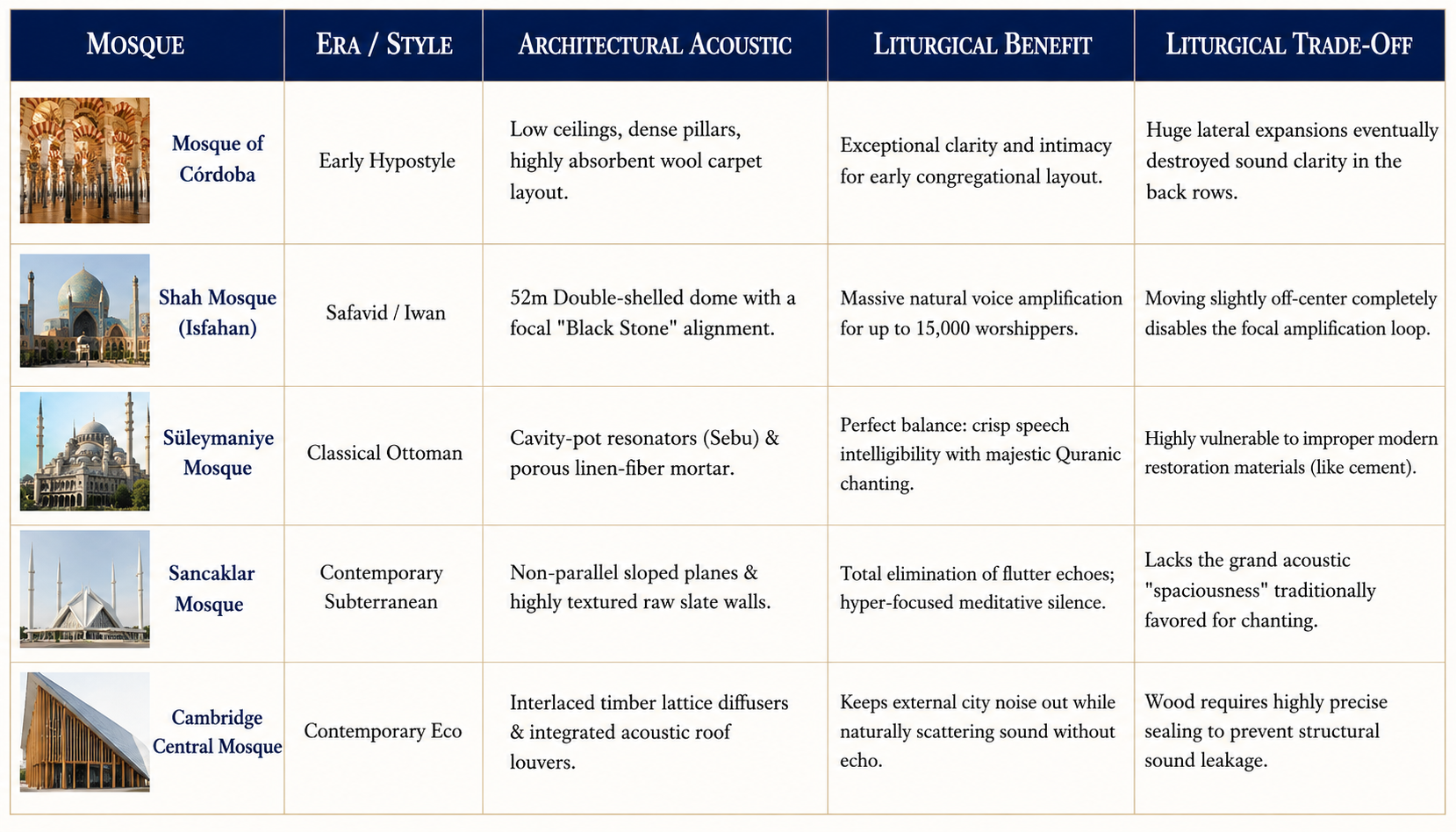
ALTA Integra Mosque Acoustics Consultation Framework
Balancing Worship Tradition, Architecture, and Technology
Mosques present a unique challenge in Sacred Acoustic Design because the worship experience is fundamentally centered on the human voice. Unlike many churches that may rely on instrumental music, choirs, or worship bands, mosque acoustics are primarily shaped by the Adhan, Quranic recitation, spoken teaching, and collective prayer. As mosques become larger, more architecturally ambitious, and increasingly integrated with digital technologies, acoustic design must balance spiritual tradition with contemporary functional requirements.
Today, many mosques accommodate not only daily prayers but also Friday sermons, religious education, community gatherings, lectures, and live broadcasts. Their acoustic requirements therefore extend beyond simple amplification. The goal is to preserve the beauty, warmth, and intelligibility of the human voice while maintaining the sense of sacred spaciousness and contemplation that worshippers expect.
Different Worship Traditions Require Different Acoustic Environments
Although all mosques share common foundations in Islamic worship, different traditions, cultural contexts, and patterns of use can result in distinct acoustic priorities.
Traditional mosques often emphasize the natural beauty of Quranic recitation and collective prayer within highly reverberant architectural settings. The acoustic environment should support vocal richness and a sense of spiritual grandeur while maintaining sufficient clarity for worshippers to understand the recitation.
Urban community mosques frequently place greater emphasis on speech intelligibility due to the increased importance of Friday sermons, religious instruction, educational activities, and multipurpose community functions. In these environments, excessive reverberation can reduce comprehension and diminish the effectiveness of communication.
Large contemporary Islamic centers often combine worship halls, classrooms, conference facilities, community spaces, and digital broadcasting infrastructure. These facilities require a more sophisticated acoustic strategy capable of supporting diverse activities while preserving the dignity and spiritual atmosphere of the prayer hall.
The challenge is recognizing that mosque acoustics are not solely about loudness or speech reinforcement. They are about preserving the spiritual and emotional qualities of Islamic worship while supporting the functional needs of modern congregational life.
Architectural Style Shapes Acoustic Character
The architectural language of a mosque has a profound influence on its acoustic character.
Traditional Ottoman mosques utilize large central domes, semi-domes, arches, and expansive prayer halls to create a sense of openness and sacred grandeur. These geometries enhance spatial impression and vocal presence but can also introduce complex reflection patterns and focusing effects.
Persian and Mughal mosque traditions often incorporate large vaulted spaces, iwans, courtyards, and richly ornamented surfaces that contribute to both visual and acoustic complexity. Decorative elements may provide beneficial diffusion, helping to break up reflections and improve spatial uniformity.
Contemporary minimalist mosques frequently employ simplified geometry, large uninterrupted surfaces, exposed concrete, stone, glass, and steel. While visually elegant, these spaces can generate excessive reflections, flutter echoes, or acoustic harshness if acoustic considerations are not integrated early in the design process.
Modern iconic mosques often feature innovative geometries, large spans, complex roof forms, and expressive architectural structures. While these designs may create powerful visual identities, they frequently present significant acoustic challenges that require detailed modeling and coordination between architects, acoustic consultants, and audiovisual specialists.
In every case, architectural form influences how worshippers perceive the reciter's voice, how sound travels throughout the prayer hall, and how sacred spaciousness is experienced.
Dome Acoustics: Opportunity and Challenge
One of the defining architectural elements of many mosques is the dome. Historically, domes have served symbolic, structural, and environmental functions while also contributing to the acoustic character of Islamic architecture. Properly designed domes can enhance the sense of spatial grandeur and reinforce vocal presence.
However, domes can also introduce several acoustic challenges: Sound focusing, Strong delayed reflections, Echo formation, Uneven sound distribution and Reduced speech intelligibility. Large reflective domes may concentrate sound energy at specific locations while creating acoustic shadows in others. As mosque sizes increase, these effects become increasingly pronounced.
Sacred Acoustic Design therefore requires careful analysis of dome geometry, material selection, diffusion strategies, and loudspeaker integration to ensure that architectural symbolism does not compromise worship experience.
Size, Volume, and Congregational Capacity Matter
Mosques vary dramatically in scale, from small neighborhood prayer halls to monumental congregational mosques serving thousands of worshippers. Smaller prayer halls often benefit from natural vocal intimacy but may become acoustically bright if excessive reflective materials are used.
Medium-sized mosques generally offer greater flexibility in balancing reverberation and speech clarity, making them well suited for both recitation and teaching activities.
Large congregational mosques present a far more complex challenge. As room volume increases, natural speech levels diminish, reflections become more pronounced, and intelligibility can vary significantly across the prayer hall. Large prayer spaces frequently require distributed sound reinforcement systems, delay loudspeakers, and advanced digital processing to maintain consistent listening conditions.
The relationship between room volume, ceiling height, prayer hall dimensions, and congregation size therefore becomes a critical component of mosque acoustic design.
ALTA Integra Mosque Acoustic Consultation: Integrating Building Acoustics, Architectural Acoustics, and Electroacoustics
Successful mosque acoustics cannot be achieved through sound systems alone. Sacred Acoustic Design integrates three complementary disciplines.
Building Acoustics protects worship from external noise intrusion, mechanical equipment noise, vibration, and sound transmission between adjacent spaces. In dense urban environments, controlling traffic and environmental noise becomes particularly important for maintaining concentration during prayer.
Architectural Acoustics shapes the natural acoustic behavior of the mosque through geometry, volume, surface materials, diffusion, reflection control, and reverberation management. The objective is to support the beauty and intelligibility of recitation while preserving sacred spaciousness.
Electroacoustics extends the architectural acoustic environment through carefully selected loudspeakers, distributed coverage systems, delay speakers, digital signal processing, assistive listening technologies, and broadcast infrastructure. Loudspeaker selection, placement, aiming, and delay coordination are critical for ensuring that every worshipper experiences consistent clarity regardless of location.
When these disciplines are coordinated from the earliest stages of design, the mosque functions as a unified acoustic environment rather than a collection of independent systems.
ALTA Integra Mosque Acoustic Consultation: Beyond Speech Intelligibility
Conventional acoustic practice often evaluates mosque performance primarily through speech intelligibility metrics. While intelligibility remains essential, it does not fully capture the experience of Islamic worship.
The Adhan is not merely an announcement. Quranic recitation is not merely speech. Collective prayer is not merely communication. Each carries emotional, cultural, and spiritual significance that extends beyond technical performance measurements.
The objective of Sacred Acoustic Design is therefore not simply to make every word understandable. It is to create an acoustic environment that preserves the beauty of recitation, supports collective devotion, reinforces spiritual presence, and strengthens the emotional connection between worshippers, community, and faith.
ALTA Integra Mosque Acoustic Consultation: Preserving the Acoustic Identity of Islamic Worship
The most successful mosques are not necessarily those with the most sophisticated sound systems or the lowest reverberation times. They are the ones that successfully align worship traditions, architectural expression, acoustic performance, and technological systems into a coherent experience.
When this balance is achieved, the mosque becomes more than a prayer hall. It becomes a resonant environment where architecture, voice, ritual, and spirituality come together to support meaningful worship.
This is the challenge—and the opportunity—of contemporary mosque acoustics: preserving the unique acoustic identity of Islamic worship while meeting the functional and technological demands of modern religious life.
Church Acoustics Consultation: Designing for Liturgy, Choir, and Worship
The acoustic design of a church influences far more than sound quality. It shapes how people pray, listen, sing, reflect, and experience the sacred. Throughout history, church architecture has evolved from the speech-focused basilicas of the Early Christian period to the highly reverberant Gothic cathedrals, emotionally immersive Baroque churches, and contemporary worship spaces designed for participation and clarity.
This article explores the relationship between architecture, liturgy, music, psychoacoustics, and building physics, examining how reverberation time, speech intelligibility, spatial geometry, and sacred soundscapes affect the worship experience. Through historical analysis and human-centered design principles, it presents a framework for creating churches that balance liturgical function, musical excellence, spiritual atmosphere, and community engagement.
When people think about church design, they often focus on architecture, stained glass, lighting, or symbolism. Yet one of the most powerful dimensions of sacred architecture is invisible: acoustics. Church acoustics determines whether a sermon is clearly understood, whether a choir feels enveloping and inspiring, and whether worshippers experience a sense of intimacy, awe, contemplation, or transcendence.
From Early Christian basilicas and Gothic cathedrals to contemporary worship centers, the evolution of church acoustics reveals how architecture has continually adapted to changing liturgical practices, musical traditions, and human needs. Understanding this relationship provides valuable insights for architects, acoustic consultants, church leaders, and worship communities seeking to create meaningful and human-centered sacred environments.
Church architecture has evolved continuously over two millennia in response to theological, liturgical, cultural, technological, and artistic developments. Simultaneously, the acoustic environment of churches has transformed from relatively intimate spaces supporting speech intelligibility to monumental reverberant volumes optimized for sacred music, before moving toward contemporary performance-driven and human-centered acoustic design.
This review examines the relationship between architectural style, spatial configuration, building materials, and liturgical practices from Early Christian basilicas through Romanesque, Gothic, Renaissance, Baroque, Neoclassical, Art Deco, Modernist, Brutalist, and Contemporary Minimalist churches. The study explores how architectural decisions influence reverberation time (RT), speech intelligibility (STI), clarity (C80), definition (D50), and the overall sacred soundscape.
1) Early Christian church (100–500 AD)
Architectural Characteristics: Rectangular nave, Side aisles , Timber roof, Semi-circular apse and Limited interior ornamentation.
Liturgical Priority: Scripture reading, Teaching and Prayer. Music remained relatively simple.
Spatial band: relatively compact to medium basilical volumes, roughly 2,000–12,000 m³; ceiling height about 8–18 m. The canonical form is the basilica: longitudinal nave, side aisles, apse, clerestory, and usually a timber roof.
Geometry: rectangular, axis-driven, processional, with strong frontal orientation toward the apse.
Acoustics: comparatively moderate RT, often better for speech than later monumental churches; the timber roof and simpler geometry reduce excessive reverberance.
STI: generally higher than in later vaulted stone churches, because early basilical spaces support direct sound and clearer speech. This is an inference from the timber-roof basilica form and the inverse RT–intelligibility relationship reported in historical church studies.
Musical suitability: strong for chant and spoken proclamation, less suited to dense polyphony or large organ sonorities.
Psychoacoustics: relatively strong intimacy and moderate presence, with lower envelopment than later cathedrals; more “addressing the assembly” than “immersing the assembly.” This is an interpretive synthesis consistent with the human-experience literature on worship-space acoustics.
Liturgical evolution: proclamation, teaching, prayer, and early chant.
Design lesson: if you want clarity, accessibility, and congregational participation, this typology shows the value of shorter paths, simpler geometry, and controlled reverberation.
Examples: Old St. Peter's Basilica, Basilica of Santa Sabina
2) Romanesque church (800–1150)
Architectural Characteristics: Massive stone walls, Barrel vaults, Rounded arches and Small windows.
Liturgical Priority: Expansion of Gregorian chant.
Spatial band: typically larger and heavier than early Christian basilicas, roughly 8,000–20,000 m³; ceiling height about 12–22 m.
Geometry: thicker masonry, round arches, barrel or groin vaults, fewer openings, and a more enclosed interior.
Acoustics: RT rises significantly, commonly into the 4–6 s band in large stone churches. That supports chant but begins to compromise spoken clarity.
STI: moderate to low for speech unless source-receiver distance is short or the room is acoustically moderated. The review literature repeatedly links longer RT with lower intelligibility.
Musical suitability: excellent for Gregorian chant and monodic ritual sound; good for organ resonance once the instrument becomes established.
Psychoacoustics: stronger awe and enclosure, with growing envelopment because of stone mass and vaulting; intimacy declines relative to Early Christian form. This is an analytical reading supported by the emotional-impact literature on worship acoustics.
Liturgical evolution: monastic and chant-centered worship begins to dominate.
Design lesson: heavier enclosure increases sacred atmosphere, but speech must be protected by geometry, shorter distances, or selective absorption.
Examples: Santiago de Compostela Cathedral, Speyer Cathedral
3) Gothic church / cathedral (1150–1500)
Architectural Characteristics: Rib vaults, Flying buttresses, Very high ceilings, Extensive stone surfaces and Large volumes.
Liturgical Priority: Gregorian chant, Polyphonic choir and Pipe Organ music
Spatial band: often 20,000–80,000+ m³; height roughly 20–40 m in major cathedrals, sometimes more.
Geometry: pointed arches, rib vaults, and flying buttresses enabled very tall structures with large windows and high verticality.
Acoustics: this is the classic long-reverberation regime, often 5–10 s, with some major examples even higher. Gothic cathedrals are regularly identified as highly reverberant with low speech intelligibility.
STI: typically low, especially for sermon-like speech. The literature treats this as one of the principal historic acoustic problems in churches.
Musical suitability: superb for chant, sustained choir, and organ; poor for fast verbal delivery.
Psychoacoustics: maximum awe, high envelopment, high transcendence, but weak intimacy and weak linguistic immediacy. In the worship-space emotion study, acoustic environment and audiovisual congruency intensified emotional impact, and “awe-inspiring” was among the reported emotional themes.
Liturgical evolution: chant and ritual spectacle dominate over speech clarity.
Design lesson: verticality and stone grandeur can generate profound sacred presence, but contemporary use requires either electroacoustics, localized absorption, or a clear distinction between music zones and speech zones.
Examples: Notre-Dame de Paris, Cologne Cathedral, Milan Cathedral
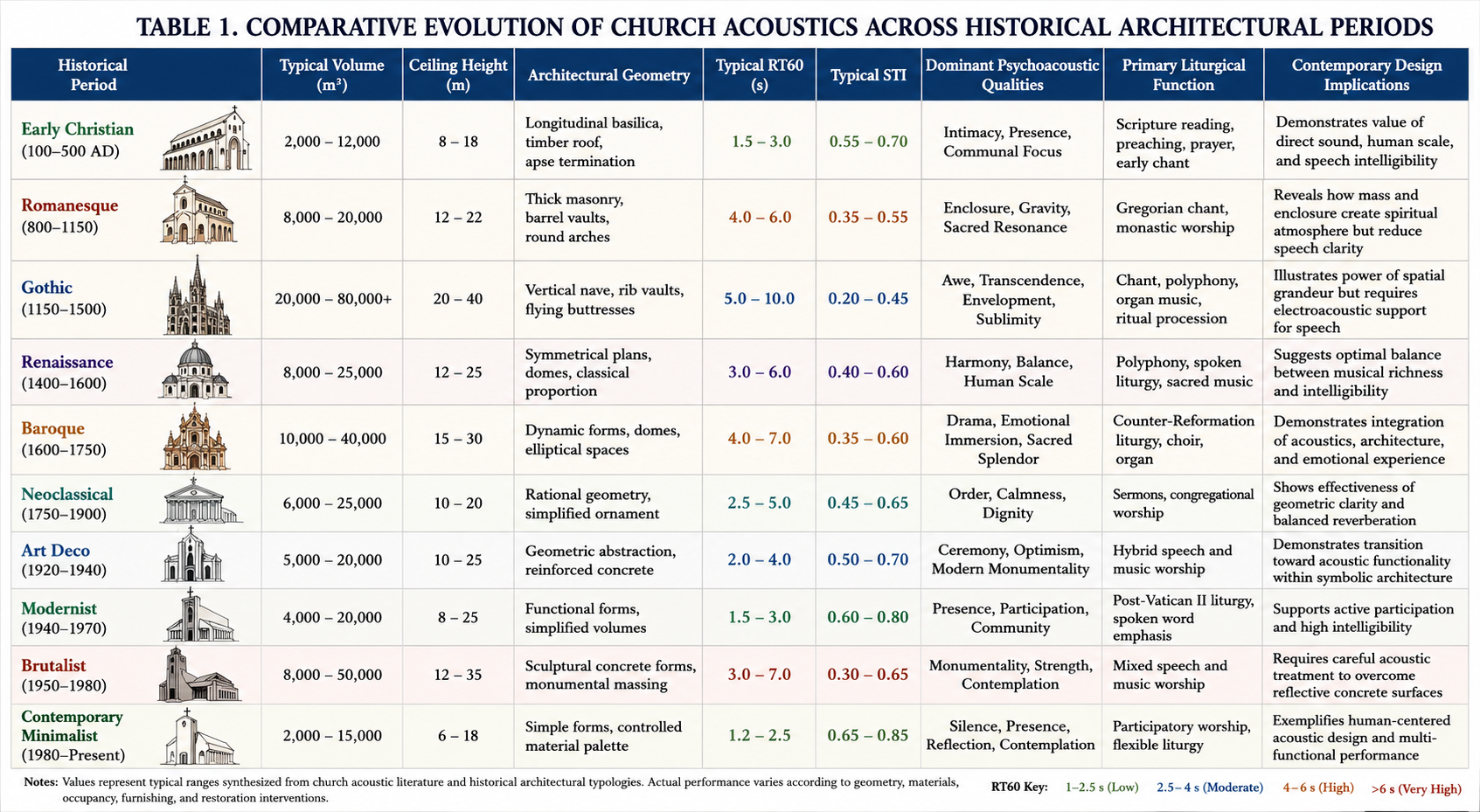
4) Renaissance church (1400–1600)
Architectural Characteristics: Influenced by, Classical proportion, Symmetry, Centralized plans and Domes.
Liturgical Priority: Balance between Human voice and Polyphonic music
Spatial band: roughly 8,000–25,000 m³; ceiling height about 12–25 m, depending on dome and nave proportions.
Geometry: symmetry, classical proportion, centralized or hybrid plans, and increased use of domes.
Acoustics: generally intermediate between Gothic and Baroque; RT often in the 3–6 s band, with clearer speech than Gothic but still strong musical support.
STI: improved relative to Gothic when the plan is more centralized and source-receiver distance is reduced. This is a reasoned inference aligned with the literature on room geometry and intelligibility.
Musical suitability: excellent for polyphony and sacred choral balance; strong compatibility with human voice.
Psychoacoustics: more balanced mix of presence, order, and awe, with better perceptual intelligibility than Gothic but less enveloping mysticism. This is an analytical synthesis.
Liturgical evolution: greater architectural balance between voice, choir, and proportioned sacred space.
Design lesson: proportionality and plan control help sacred music and speech coexist without the extreme trade-off seen in Gothic interiors.
Examples: Tempietto, Basilica of Saint Peter
5) Baroque church (1600–1750)
Architectural Characteristics: Elliptical plans, Domes, Decorative surfaces and Complex geometries
Historical Context: Counter-Reformation and Churches became theatrical instruments of persuasion.
Spatial band: roughly 10,000–40,000 m³; ceiling height about 15–30 m.
Geometry: curves, domes, theatrical spatial sequencing, and often more compact or centralized arrangements than Gothic cathedrals. Baroque architecture was explicitly associated with grandeur, movement, and awe.
Acoustics: often highly effective for sacred music while retaining better clarity than the largest Gothic spaces; some studies report Baroque churches as acoustically favorable relative to more cavernous medieval forms.
STI: moderate; often better than Gothic because of more controlled volumes and richer surface articulation, but still dependent on geometry and ornament.
Musical suitability: excellent for choir, organ, and ceremonial polyphony.
Psychoacoustics: very strong dramatic awe, high envelopment, and a “theatrical sacredness” that intensifies emotion. The emotional-experience literature on worship spaces supports the link between acoustic environment and intensified affect.
Liturgical evolution: Counter-Reformation emphasis on persuasion, beauty, and affect.
Design lesson: Baroque interiors show that sacred acoustics can be emotionally powerful without being as unintelligible as the largest Gothic halls, provided geometry and scale are controlled.
Examples: Church of San Carlo alle Quattro Fontane, San Luis de los Franceses
6) Neoclassical church (1750–1900)
Architectural Characteristics: Geometric simplicity, Rational proportion and Reduced ornament
Soundscape Identity: Voice of Enlightenment
Spatial band: roughly 6,000–25,000 m³; ceiling height about 10–20 m.
Geometry: clearer axial order, reduced ornament, and more rational spatial composition.
Acoustics: typically between 2.5–5 s, depending on volume and surface treatment, giving a better speech–music balance than many earlier monumental types.
STI: usually improved relative to very reverberant historic interiors because the forms are more legible and less acoustically chaotic. This is an inference consistent with the literature on room shape and clarity.
Musical suitability: balanced for sermon, congregational singing, and modest organ use.
Psychoacoustics: less overwhelming than Gothic or Baroque, but more orderly and calm; the dominant feeling is often one of measured dignity rather than immersion.
Liturgical evolution: a step toward rationalized worship space and clearer public speech.
Design lesson: simplicity of form can be acoustically advantageous when the goal is comprehensibility without losing ceremonial character.
Examples: La Madeleine, St Martin-in-the-Fields
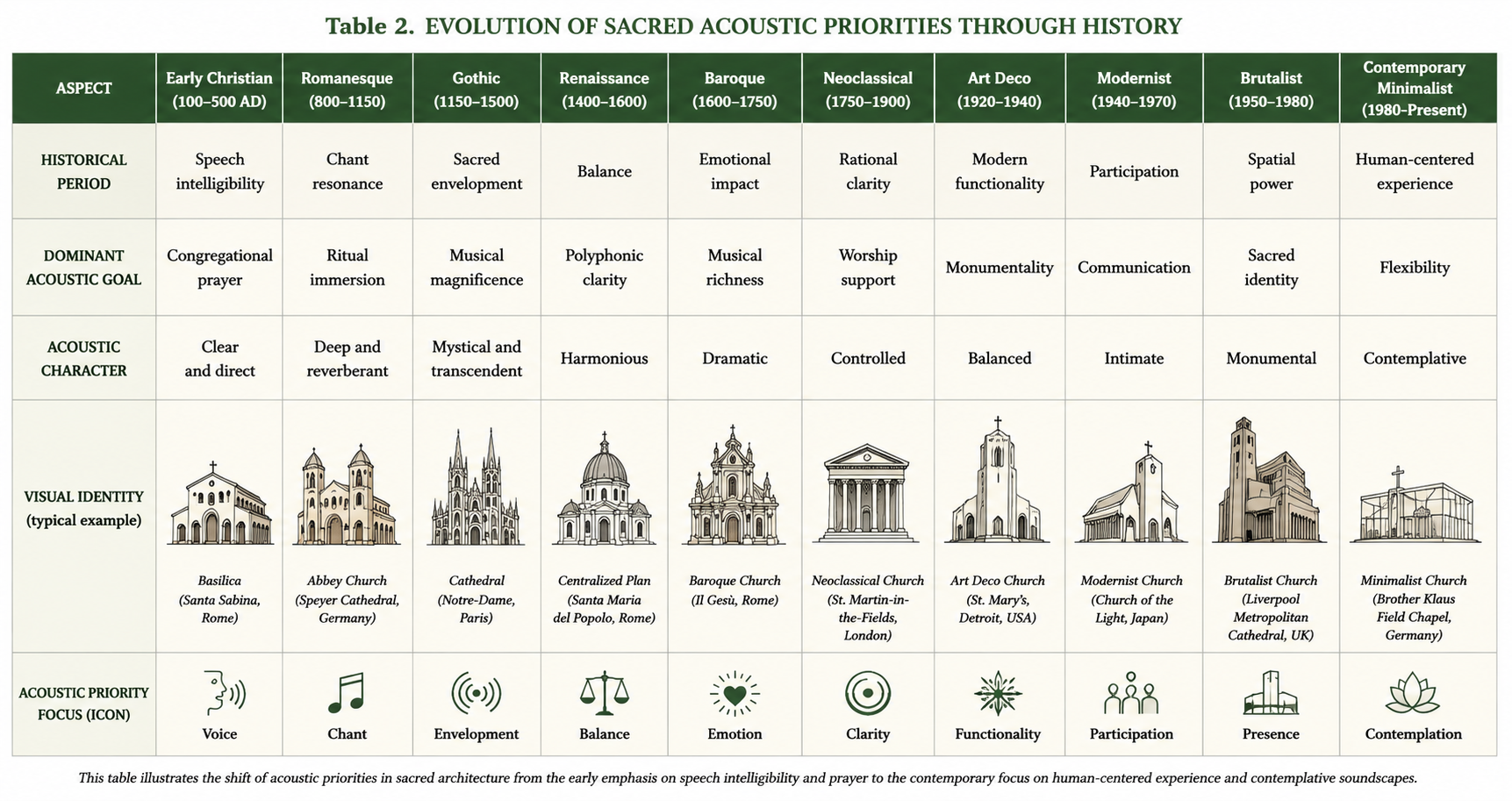
7) Art Deco church (1920–1940)
Architectural Characteristics: Geometric ornament, Reinforced concrete and Plaster surfaces.
Soundscape Identity: Voice of Modern Optimism
Spatial band: roughly 5,000–20,000 m³; ceiling height about 10–25 m.
Geometry: geometric ornament, streamlined massing, often combining older sacred planning with modern materials and visual language.
Acoustics: commonly 2–4 s in many practical cases, though this varies widely with material finish and volume.
STI: generally better than in stone cathedrals, especially when plaster, timber, and absorption are introduced; modern church acoustics papers repeatedly show that material and volume are decisive.
Musical suitability: good all-round performance for speech, hymnody, and amplified music.
Psychoacoustics: a transitional profile—less cavernous than medieval churches, but still able to support dignity and ritual emphasis.
Liturgical evolution: modernization of Catholic and Protestant worship forms while retaining symbolic monumentality.
Design lesson: Art Deco churches demonstrate that visual modernity does not need to sacrifice acoustic warmth if the interior finish is handled carefully.
Examples: Basilica of the National Shrine of the Little Flower
8) Modernist church (1940–1970)
Architectural Characteristics: Functionalism, Simplicity and New structural systems
Liturgical Influence: Following the Second Vatican Council Greater congregational participation and Increased speech importance
Soundscape Identity: Voice of Community
Spatial band: roughly 4,000–20,000 m³; ceiling height about 8–25 m.
Geometry: functionalism, simplified volume, and often reduced ornament; modern architecture relies heavily on glass, steel, and concrete, with form following function.
Acoustics: commonly pushed toward shorter RT and greater speech support, often 1.5–3 s in contemporary speech-oriented worship settings, though some modern concrete churches remain reverberant.
STI: usually high when the plan supports proximity and the interior is not excessively hard. After Vatican II, intelligibility became a primary concern in Catholic church research.
Musical suitability: excellent for amplified music and speech, variable for unamplified choral tradition.
Psychoacoustics: greater intimacy and presence, less natural envelopment than historic stone cathedrals, unless the room is deliberately tuned. The emotional literature shows that acoustic character and audiovisual congruency strongly influence worship experience.
Liturgical evolution: post-conciliar emphasis on congregational participation, intelligibility, and active liturgical engagement.
Design lesson: modern churches should not default to “dry” acoustics; they need a deliberate balance between clarity, warmth, and spiritual resonance.
Examples: Church of the Light, Notre Dame du Haut
9) Brutalist church (1950–1980)
Architectural Characteristics: Exposed concrete, Monumental mass and Sculptural geometry
Soundscape Identity: Voice of Monumentality
Spatial band: roughly 8,000–50,000 m³; ceiling height about 12–35 m.
Geometry: sculptural massing, exposed concrete, deep surfaces, and strong directional forms.
Acoustics: highly variable; can be reverberant and powerful, especially in hard concrete shells, but can also be made speech-capable with selective absorption and sound reinforcement.
STI: variable; raw concrete tends to reduce clarity unless countered by acoustic strategy.
Musical suitability: strong for organ and liturgical music; challenging for unamplified speech in large shells.
Psychoacoustics: high monumentality and often strong awe, but with risk of acoustic hardness if the surfaces are too specular.
Liturgical evolution: reflects mid-20th-century functional and symbolic experimentation.
Design lesson: Brutalism proves that mass and spiritual gravity can coexist with modern language, but acoustics must be engineered, not assumed.
Examples: Liverpool Metropolitan Cathedral, Wotruba Church
10) Contemporary minimalist church (1980–Present)
Architectural Characteristics: Simplicity, Natural light, Controlled material palette, Multimedia Technology integration
Soundscape Identity: Voice of Presence
Spatial band: roughly 2,000–15,000 m³; ceiling height about 6–18 m.
Geometry: reduced form, controlled materials, daylight-centered composition, and often a strong emphasis on silence.
Acoustics: often the most speech-intelligible end of the spectrum when thoughtfully designed, typically 1.2–2.5 s in many worship-oriented settings.
STI: usually excellent, especially with compact plan geometry and absorptive/diffusive moderation.
Musical suitability: good for spoken liturgy, acoustic ensembles, and systems-integrated worship; less naturally resonant than older monumental churches.
Psychoacoustics: strongest intimacy, cleaner presence, and a contemplative quality; the literature on worship spaces shows that emotional response is deeply shaped by acoustic environment, context, and familiarity.
Liturgical evolution: contemporary worship often privileges participation, accessibility, and flexibility.
Design lesson: minimalism can be acoustically excellent, but it must be shaped so silence, speech, and music all remain spiritually meaningful rather than merely “dry.”
Examples: Brother Klaus Field Chapel, Cardboard Cathedral
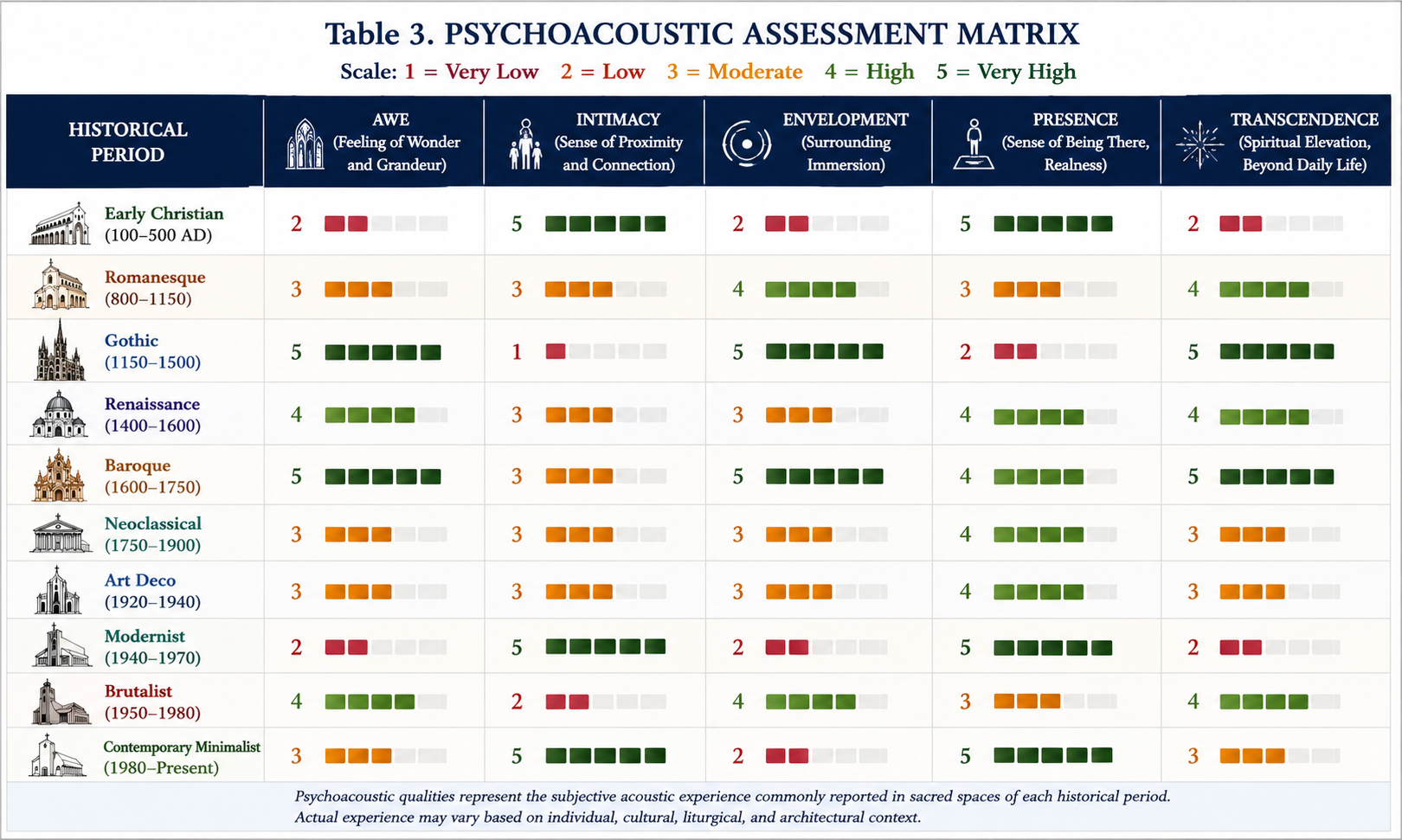
Church Acoustics: A Multi-Layered Design Challenge
Church is no longer defined solely by its architecture. It is a dynamic worship environment that may combine sermon delivery, congregational singing, choir performance, organ support, contemporary worship music, multimedia presentations, livestreaming, and digital amplification. Its acoustic requirements are therefore inherently hybrid: speech intelligibility must remain high, while musical warmth, congregational participation, emotional immersion, and spiritual atmosphere must not be lost.
Yet one of the most common misconceptions in church design is the assumption that all churches require the same acoustic environment. In reality, every church possesses its own acoustic identity, shaped by worship traditions, architectural language, congregation size, musical culture, and technological expectations. Consequently, Sacred Acoustic Design begins not with reverberation time targets or loudspeaker specifications, but with a fundamental understanding of how worship is practiced within the space.
The historical arc is not simply “short RT to long RT” or “speech to music.” It is a sequence of trade-offs between clarity, transcendence, and participation. The strongest research pattern is that larger volume, greater height, harder materials, and more reflective geometry push churches toward longer RT and lower STI, while chancel configuration, shorter source-receiver distance, and contemporary acoustic treatment improve intelligibility. Modern church acoustics increasingly treat intelligibility as a first-order requirement, especially after Vatican II, while psychoacoustic research shows that worship soundscapes also shape emotion, presence, awe, and place identity.
For a contemporary sacred project, the historical record suggests five clear lessons:
Use geometry intentionally — axial for proclamation, centralized or moderated for participation.
Match RT to liturgy — speech-led worship needs shorter RT than chant-led worship.
Treat chancel and nave as separate acoustic zones when needed; chancel availability and geometry measurably affect STI.
Balance awe with intelligibility rather than choosing one exclusively.
Design for emotional congruency: when acoustics, visuals, and ritual align, worship experience intensifies.
From Human-Centered Acoustic Design: Different Worship Traditions Require Different Acoustic Environments
Although Catholic, Protestant, and Megachurch communities all share Christian roots, their worship experiences often place different demands on the acoustic environment.
Catholic churches are typically centered on liturgy, ritual procession, sacred music, choir performance, congregational responses, and organ accompaniment. The acoustic environment is expected to support a sense of reverence, mystery, and transcendence. Moderate to longer reverberation can enrich Gregorian chant, liturgical choirs, and organ music while reinforcing the spiritual atmosphere of the space. However, contemporary Catholic worship also relies on scripture readings, homilies, and amplified speech, requiring a careful balance between reverberant richness and speech intelligibility.
Protestant churches often place greater emphasis on preaching, biblical teaching, testimony, and congregational participation. In these settings, speech clarity becomes a primary design objective because the spoken word is central to the worship experience. At the same time, congregational singing and worship music remain important components of collective worship. The acoustic challenge is to create an environment where sermons are clear and engaging while preserving sufficient warmth and support for singing.
Megachurches represent a distinctly contemporary worship model that combines large congregations, contemporary worship bands, digital media, theatrical lighting, livestreaming, and broadcast-quality production. In these spaces, electroacoustic systems play a dominant role in shaping the worship experience. Speech intelligibility, sound coverage, consistency, and technical performance become critical. Yet the challenge extends beyond technology. A successful megachurch must avoid feeling like a concert venue or auditorium by maintaining an acoustic environment that supports spiritual engagement, collective participation, and a sense of sacred identity.
The lesson is clear: there is no universal church acoustic. Every congregation requires an acoustic environment that reflects its theology, worship style, musical culture, and spiritual aspirations.
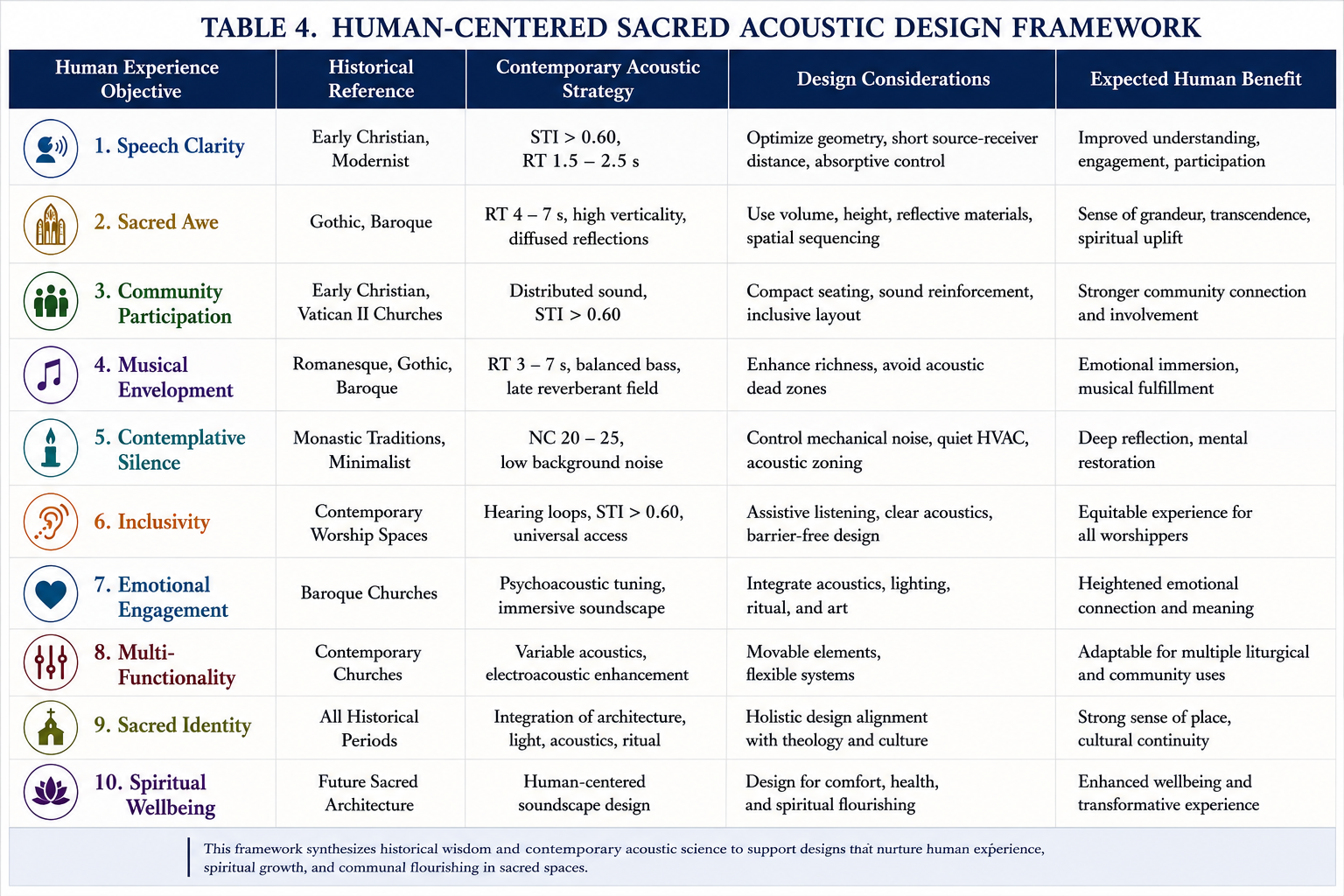
Architectural Style Shapes Acoustic Character
Church acoustics are also profoundly influenced by architecture itself. Long before loudspeakers, microphones, or acoustic treatments are introduced, the geometry, volume, and materials of the building begin shaping how sound is experienced.
A Neo-Gothic church, with its soaring ceilings, pointed arches, stone surfaces, and vertical proportions, naturally creates a reverberant acoustic environment that supports choral music, organ resonance, and a sense of sacred grandeur. These spaces often evoke awe and transcendence but may require careful acoustic intervention to preserve speech intelligibility.
A Modern Classical church often combines traditional symbolism with contemporary construction techniques. These buildings can achieve a balanced acoustic character by blending reflective and absorptive materials while retaining a sense of dignity and permanence. Such environments often provide greater flexibility in supporting both liturgical music and spoken communication.
A Minimalist church emphasizes simplicity, clean geometry, and visual restraint. While visually calm and contemplative, minimalist spaces can become acoustically problematic if large hard surfaces generate excessive reflections or if overcompensation through absorption creates an acoustically lifeless environment. The challenge lies in achieving acoustic warmth without compromising architectural simplicity.
A Brutalist church, characterized by exposed concrete, monumental forms, and powerful geometry, often creates dramatic spatial experiences but can present significant acoustic challenges. Hard surfaces and large uninterrupted volumes may generate long reverberation, flutter echoes, and sound focusing effects. In such cases, acoustic design must carefully integrate architectural modifications, diffusion strategies, and electroacoustic systems while preserving the integrity of the architectural concept.
In every case, architectural style is not merely a visual language. It is also an acoustic language. Materials, geometry, and volume directly influence how worshippers experience speech, music, ritual, and silence.
Size, Volume, and Capacity Matter
Beyond worship tradition and architectural style, the scale of the church significantly influences acoustic performance.
A small chapel serving a few dozen worshippers requires a very different acoustic strategy from a sanctuary serving several hundred people, while a megachurch accommodating thousands presents an entirely different set of challenges.
As room volume increases, sound must travel greater distances. Reverberation becomes more difficult to control, reflections arrive later, and speech intelligibility can vary significantly across the congregation. Large spaces often require carefully designed electroacoustic systems with distributed loudspeakers, delay speakers, and digital signal processing to ensure consistent coverage.
Smaller churches, on the other hand, may achieve intimacy and clarity more naturally but remain vulnerable to acoustic defects such as flutter echoes, excessive brightness, or uneven sound distribution.
The relationship between room dimensions, seating capacity, and worship activities therefore becomes a critical design consideration. A successful acoustic strategy must align spatial scale with worship behavior rather than relying on generic performance standards.
Integrating Building Acoustics, Architectural Acoustics, and Electroacoustics
The complexity of contemporary church design demonstrates why Sacred Acoustic Design cannot be reduced to reverberation targets or sound system specifications alone.
A successful worship environment requires the integration of three complementary disciplines:
Building Acoustics protects the worship experience from unwanted noise by controlling traffic noise, mechanical systems, vibration, and sound transmission between spaces.
Architectural Acoustics shapes the natural behavior of sound through room geometry, volume, material selection, reflection control, diffusion, and reverberation management.
Electroacoustics extends and reinforces the architectural acoustic environment through carefully selected loudspeakers, coverage design, distributed audio systems, delay optimization, digital signal processing, assistive listening systems, and broadcast integration.
When these disciplines are considered together from the earliest design stages, the church becomes more than a building. It becomes an instrument of worship.
Beyond Technical Performance
The ultimate goal of Sacred Acoustic Design is not simply to make speech louder or music clearer. It is to create an acoustic environment that reflects the identity of the congregation and supports meaningful human experience.
When church acoustics are thoughtfully integrated with worship traditions, architectural expression, and technological systems, sound becomes more than a performance parameter. It becomes a medium through which people listen, participate, connect, reflect, and experience the sacred.
This is the challenge—and the opportunity—of contemporary church acoustics: preserving the unique acoustic identity of worship while meeting the functional demands of modern congregational life.

Sacred Acoustic Design for Mosques, Churches & Temples
Sacred Acoustic Design is a human-centered approach to worship architecture that integrates building acoustics, architectural acoustics, electroacoustics, psychoacoustics, and ritual acoustics to support meaningful spiritual experiences.
Unlike conventional acoustic design that focuses primarily on speech intelligibility and reverberation control, Sacred Acoustic Design considers worship traditions, ritual practices, cultural identity, congregational behavior, chanting styles, musical requirements, and soundscape perception.
This article explores how churches, mosques, and temples require distinct acoustic strategies to preserve their unique sonic identities while supporting contemporary worship, communication, and community engagement.
When architects and project committees discuss a new church, mosque, or temple, the conversation often begins with form, symbolism, materials, capacity, circulation, and visual identity. Acoustic questions may appear later, frequently when an audio vendor is asked to propose a sound system.
That sequence can solve amplification requirements, but it may leave a more fundamental question unanswered:
How should this space sound in relation to its worship tradition, ritual practices, congregation, architecture, and cultural context?
A worship space is not acoustically neutral. Its sound influences whether spoken words can be followed, whether collective singing feels unified, whether recitation remains intelligible, whether ritual instruments retain their character, and whether silence can be experienced without intrusive noise. These conditions can affect participation, attention, comfort, memory, and the perceived identity of a place.
Sacred Acoustic Design is an evidence-informed framework developed by ALTA Integra for integrating building acoustics, architectural acoustics, electroacoustics, psychoacoustics, and ritual-use analysis in worship environments. It begins with the premise that an acoustic brief should respond not only to technical performance requirements, but also to the worship tradition, ritual sequence, congregation behavior, cultural context, accessibility needs, and intended character of the space.
The framework does not assume that spiritual experience can be engineered or guaranteed. Its purpose is to create acoustic conditions that support communication, participation, music, prayer, contemplation, and the community’s own understanding of sacred-space identity.
This article focuses on selected Christian church, Islamic mosque, and Buddhist temple or meditation contexts. These categories contain considerable diversity; they should not be treated as universal descriptions of all Christian, Islamic, Buddhist, or other religious traditions. Every project requires direct engagement with the people who understand and use its rituals.
Why Do Worship Spaces Need Different Acoustic Briefs?
There is no single acoustic target that defines a successful worship space.
A cathedral may need to support spoken liturgy, choir, pipe organ, congregational responses, and periods of silence within the same volume. A contemporary church may combine sermons, amplified bands, multimedia, livestreaming, and collective singing. A mosque may need to support Quranic recitation, congregational prayer, the Friday sermon, teaching, and distributed speech reinforcement. A Buddhist teaching hall may alternate among spoken instruction, chanting, bells, ritual percussion, and meditation.
Each activity places different demands on the acoustic environment. Reverberation may support musical continuity and collective resonance, yet excessive late sound can reduce speech intelligibility. Strong amplification may improve audibility, yet poor loudspeaker placement or overlapping coverage can create interference and visual intrusion. A quiet room may support contemplation, yet an acoustically over-damped room can weaken chanting or collective participation.
Research in churches illustrates this complexity. Measurements and listener evaluations in 36 Portuguese Catholic churches found relationships among architectural features, objective room-acoustic parameters, and perceived attributes such as reverberance, clarity, intimacy, envelopment, and echoes. The results also showed why one metric cannot represent the entire listening experience [Carvalho, Morgado, and Henrique, 1997]. A separate study using measured binaural responses from Italian churches found that preferred listening conditions changed with musical material: conditions preferred for choral music were not identical to those preferred for instrumental music [Martellotta, 2008].
Mosque acoustics are equally dependent on condition and use. A field investigation of 21 mosques in Saudi Arabia measured reverberation, clarity, background noise, and speech transmission with and without operating building systems and sound reinforcement. It found significant acoustic deficiencies in unoccupied conditions and materially different performance when the mosques were occupied [Abdou, 2003]. This is an important reminder that geometry, finishes, congregation, services noise, and sound reinforcement must be considered together.
Buddhist worship environments also resist generalization. Measurements and simulations of the Deekshabhoomi Buddhist monument in Nagpur found a major difference between occupied and unoccupied reverberation and examined how this related to chanting, sermons, and meditation in that particular structure [Manohare, Dongre, and Wahurwagh, 2017]. Those results describe a specific building and ritual context; they are not a universal target for Buddhist temples.
The practical conclusion is straightforward: acoustic criteria must be developed from the building’s actual program, not selected from its religious label alone.
Sacred Building Acoustic Design
A Human-Centred Acoustic Design Pathway
A four-stage framework connecting measurable acoustic conditions with perception, ritual participation, and potential human or spiritual meaning.
Conditions
Acoustic Conditions
Measurable or predictable properties of the built environment.
- Noise control & sound isolation
- Reverberation & clarity
- Sound distribution
- HVAC & background noise
- Geometry, materials & occupancy
Predicted,
Designed
Experience
Human Perception
How listeners perceive and interpret the acoustic environment.
- Audibility & intelligibility
- Loudness & balance
- Warmth & envelopment
- Spatial impression
- Acoustic comfort
Interpreted,
Experienced
Support
Ritual Participation
How acoustic conditions may support worship, ritual, and communal activity.
- Speech, recitation & music
- Chanting & collective response
- Attention & engagement
- Ritual flow & timing
- Sound-to-silence transitions
Participated,
Shared
may contribute to—
does not guarantee
Spiritual
Meaning
Potential Human &
Spiritual Meaning
Personal and communal meanings shaped by people, culture, belief, and context.
- Belonging & identity
- Reverence & reflection
- Memory & continuity
- Connection & transcendence
- Community-defined significance
Communal,
Contextual
What Shapes a Sacred Acoustic Identity?
An effective acoustic brief begins with an understanding of how architecture, people, ritual, and technology interact.
Architecture, geometry, and materials
Room volume, proportions, ceiling form, balconies, columns, domes, alcoves, surface geometry, and material assemblies influence how sound is reflected, absorbed, scattered, focused, and transmitted. Their effects arise before any loudspeaker or acoustic treatment is installed.
Large reflective volumes may create long decay and spatial envelopment, but they can also produce echoes or poor speech clarity. Domes and concave surfaces may generate focusing under some conditions. Seating, carpets, curtains, doors, openings, ornamentation, and congregation occupancy may materially change the response. The relevant question is therefore not whether a material is generally “acoustic,” but how the complete assembly, area, location, geometry, and occupancy contribute to the intended result.
Worship tradition and ritual sequence
The acoustic requirements of a space change throughout a service or ceremony. A design team should map who speaks, sings, chants, plays, listens, or moves; where each source and listener is located; and how the sequence changes over time.
In a church, the source may move among altar, lectern, pulpit, choir, organ, musicians, and congregation. Measurements in Japanese churches have demonstrated that source location and direction can affect room-acoustic parameters and speech intelligibility, reinforcing the need to study the actual liturgical arrangement rather than a generic source position [Soeta et al., 2012].
The same principle applies in mosques, where the locations and functions of the imam, khatib, reciter, congregation, and loudspeaker system may vary. Parametric research on contemporary mosque configurations has shown how geometry, surface area, volume, and finishes affect predicted acoustic performance [Ismail, 2013]. In temples and meditation environments, teaching, chanting, bells, ritual percussion, procession, and silence may each require a different balance of audibility, decay, intimacy, and environmental control.
Within the Sacred Acoustic Design framework, Ritual Acoustics refers to this analysis of sound sources, listeners, movement, participation, timing, and spatial use throughout a worship sequence. It is a project-analysis layer rather than a claim that spiritual meaning can be reduced to acoustic physics.
Cultural memory and meaningful sound
Religious communities often recognize particular sounds as part of the identity of a place: bells, hymns, organ music, the Adhan, Quranic recitation, chanting, gongs, ritual drums, water, wind, birds, or collective responses. The appropriate design question is not simply how to suppress sound, but which sounds should be protected, supported, moderated, or excluded.
Soundscape research emphasizes that sound is experienced in context. ISO 12913-1 defines soundscape through human perception of the acoustic environment in context, making activity, place, expectation, and interpretation relevant to assessment [ISO 12913-1:2014]. A study using social surveys and soundwalks at Myeong-dong Cathedral and Bongeun Buddhist Temple in Seoul also found that soundscape and spatial context contributed differently to how tranquility and religious-space functions were perceived at the two sites [Jeon, Hwang, and Hong, 2014].
These findings do not allow a consultant to define sacredness on behalf of a community. They support a participatory process in which clergy, ritual leaders, musicians, worshippers, architects, operators, and accessibility representatives help define which acoustic qualities matter.
Congregation, inclusion, and accessibility
People do not experience the same room in the same way. Age, hearing ability, language, familiarity with the ritual, seating position, and assistive technology can affect whether speech and music are accessible.
An inclusive brief should consider:
Speech intelligibility across representative seating locations
Assistive-listening requirements
Multilingual interpretation or translation
Audibility for elderly worshippers and people with hearing loss
Visual integration of loudspeakers and user devices
Appropriate sound levels without unnecessary exposure
Clear emergency and operational communication
Broadcast and livestream requirements that may differ from the in-room experience
Technology and environmental context
Electroacoustic systems should be coordinated with the architecture and room response. Their purpose is not merely to increase level, but to provide appropriate coverage, intelligibility, tonal balance, timing, and reliability while respecting sightlines, heritage, ritual focus, and visual character.
Open or semi-open worship spaces introduce another layer. Wind, water, traffic, aircraft, nearby activity, and building services may contribute either valued context or unwanted masking. Natural sound should not automatically be romanticized, just as environmental sound should not automatically be eliminated. Its role must be evaluated under actual operating conditions.
A Context-Based Comparison of Worship-Space Priorities
The following matrix is intentionally qualitative. It illustrates the questions that should inform a project brief; it does not prescribe universal reverberation-time or intelligibility targets.
| Worship-space context | Dominant activities | Desired acoustic qualities | Common risks | Questions for the project brief |
|---|---|---|---|---|
| Liturgical church or cathedral | Spoken liturgy, scripture, choir, organ, and congregational responses | Speech clarity, musical support, spatial envelopment, and continuity of reverberant character | Excessive late energy, poor speech intelligibility, uneven reinforcement, and visual intrusion | Which services, musical traditions, occupancy states, and source positions must be supported? |
| Contemporary or evangelical church | Sermon, amplified band, congregational singing, multimedia, and broadcast | Intelligibility, tonal balance, controlled low frequencies, and consistent coverage | Stage spill, excessive level, poor isolation, feedback, and conflict between broadcast and room sound | Is the room primarily speech-led, music-led, or genuinely multipurpose? |
| Mosque prayer hall | Quranic recitation, khutbah, congregational prayer, and teaching | Vocal clarity, warmth, appropriate reverberance, and spatial continuity | Dome focusing, echoes, HVAC noise, long source–listener distances, and uneven coverage | How do prayer mode, occupancy, source position, and reinforcement change during use? |
| Buddhist meditation or teaching hall | Dharma teaching, chanting, bells, ritual percussion, and silence | Calmness, intimacy, intelligibility, controlled decay, and acoustic comfort | Intrusive services noise, external noise, disruptive reflections, and excessive deadness | What balance is required among teaching, chanting, ritual sound, and silence? |
| Ceremonial temple environment | Chanting, bells, gongs, drums, prayer, procession, and indoor–outdoor transition | Ritual presence, temporal definition, spatial identity, and continuity with place | Generalizing across traditions, uncontrolled reflections, and environmental masking | Which tradition, ritual sequence, instruments, movement patterns, and soundmarks are involved? |
This matrix is intentionally qualitative. It identifies questions for developing a project-specific acoustic brief; it does not prescribe universal reverberation-time or intelligibility targets.
Final criteria should identify the measurement or prediction condition, including occupancy, frequency range, building-services operation, sound-reinforcement state, source positions, receiver positions, and intended activity. ISO 3382-1 provides methods for measuring room-acoustic parameters in performance spaces; it should not be treated as a source of universal worship-space target values [ISO 3382-1:2009]. Where speech transmission is assessed, IEC 60268-16 defines STI methods and their limitations, but it does not create one pass/fail criterion for every worship application [IEC 60268-16:2020].
The Five Layers of Sacred Acoustic Design
The framework organizes the design process into five connected professional layers. Architecture and cultural context provide the inputs; measurement, simulation, commissioning, and stakeholder feedback provide validation; and the intended worship experience provides direction.
Building Acoustics: protecting the acoustic environment
Building acoustics controls unwanted sound entering, leaving, or moving within the building. Its scope may include:
Traffic, aircraft, railway, and neighborhood noise
Façade and roof sound insulation
Sound transmission between worship, teaching, community, and service spaces
Mechanical, electrical, plumbing, and HVAC noise
Vibration and structure-borne sound
Rain noise and other climate-related sources
Acoustic privacy and operational separation
In worship environments, low background noise may support speech, prayer, recording, contemplation, and subtle ritual sounds. The required condition should nevertheless be defined from use, site exposure, ventilation strategy, and operational feasibility rather than from an abstract expectation of total silence.
Architectural Acoustics: shaping sound within the room
Architectural acoustics coordinates room volume, form, geometry, materials, surface treatment, seating, and occupancy to shape the interior sound field. Depending on the project, analysis may address:
Reverberation and early decay
Speech clarity and definition
Musical clarity and support
Early reflections
Echoes and focusing
Sound diffusion
Spatial envelopment
Variation between listening positions
Changes between empty and occupied conditions
The objective is not always to minimize reverberation. It is to provide a response appropriate to the activities that matter. Studies of speech and singing in historic churches, for example, have used multiple parameters and receiver locations because highly reverberant buildings cannot be characterized responsibly by one average value [Zamarreño, Girón, and Galindo, 2008].
Electroacoustics: extending the architectural voice
Electroacoustic design connects loudspeakers, signal processing, microphones, control, recording, streaming, and assistive listening to the room’s natural response and architectural constraints.
Its scope may include:
Loudspeaker type, placement, orientation, and mounting
Coverage and level consistency
Delay and signal alignment
Direct-to-reverberant balance
Feedback management
Digital signal processing and control
Microphone strategy
Assistive-listening systems
Recording, broadcast, and livestream integration
Reliability, maintainability, and operator usability
More loudspeakers do not automatically produce better performance. The design should provide adequate direct sound and coverage while controlling overlapping fields, excessive level, visual clutter, and operational complexity.
Psychoacoustics and Perceptual Criteria: understanding the listener
Measurements describe physical conditions; people experience perceptual qualities such as clarity, warmth, intimacy, spaciousness, loudness, envelopment, and comfort. These domains are related, but they are not interchangeable.
Perceptual criteria should therefore be developed alongside technical criteria. Depending on the project, evaluation may use listening tests, auralization, structured interviews, surveys, soundwalks, expert review, or post-occupancy assessment. A technically compliant result should not automatically be described as emotionally or spiritually successful without corresponding human evidence.
Ritual-Use Analysis: supporting the worship sequence
The fifth layer connects technical design with actual worship behavior. It examines:
Ritual sequence and timing
Spoken, sung, chanted, instrumental, and environmental sources
Movement of leaders, musicians, and congregation
Participation and call-and-response patterns
Moments requiring clarity, resonance, privacy, or silence
Changes in occupancy and room configuration
Unamplified, amplified, recorded, and streamed modes
Cultural expectations and meaningful soundmarks
This layer turns a general acoustic ambition into an operational brief. Its validity depends on participation by the community and project stakeholders; it should not be inferred from building type alone.
Five Layers of Sacred Acoustic Design
Five coordinated disciplines connect architectural, ritual, cultural, and community inputs with validation and the intended directions of communication, participation, music, prayer, and contemplation.
Building
Acoustics
Protect the acoustic environment
- Noise & vibration
- Sound isolation
- Building-services noise
Architectural
Acoustics
Shape sound within the room
- Reverberation & clarity
- Reflections & diffusion
- Spatial variation & occupancy
Electro Acoustics
Extend the architectural voice
- Coverage & intelligibility
- Loudspeakers & signal alignment
- Assistive listening & media
Psycho Acoustics
& Perceptual
Criteria
Understand the listener
- Warmth, intimacy & spaciousness
- Loudness & comfort
- Listening tests & auralization
Ritual-Use
Analysis
Support the worship sequence
- Sources, listeners & movement
- Participation & response
- Transitions between sound & silence
From Performance Metrics to Human Experience
Sacred Acoustic Design distinguishes four levels of outcome.
Technical performance includes measurable or predictable conditions such as background noise, sound isolation, reverberation, clarity, speech transmission, coverage, and level.
Perceptual experience includes attributes such as warmth, intimacy, spaciousness, loudness, envelopment, and acoustic comfort. These require human evaluation as well as physical data.
Ritual support concerns whether people can follow spoken content, coordinate collective responses, hear ritual leaders, participate in music or chanting, and experience intended transitions between sound and silence.
Spiritual meaning includes personal and communal experiences such as belonging, reverence, transcendence, and connection to the divine. Acoustic design may contribute to the conditions in which such experiences occur, but it cannot guarantee, measure, or define them on behalf of a religious community.
This distinction protects both technical rigor and the dignity of worship. It allows the consultant to take human experience seriously without turning spiritual life into an engineering claim.
An Iterative Sacred Acoustic Design Workflow
The framework becomes useful when translated into a repeatable project process.
Phase 1: Understand context and stakeholders
Confirm the worship tradition, community, project stage, architectural intent, heritage considerations, governance, budget, schedule, and decision-makers. Identify the people who understand the ritual, music, operation, accessibility, and cultural meaning of the space.
Phase 2: Map activities and ritual sequences
Document speech, recitation, music, chanting, silence, procession, congregation response, teaching, broadcast, and community use. Map source and listener positions, movement, occupancy, and changes in configuration.
Phase 3: Establish the acoustic brief
Translate the program into perceptual qualities, technical criteria, operating scenarios, applicable standards, and verification methods. State whether each target will be calculated, simulated, measured, commissioned, or evaluated by users.
Phase 4: Develop integrated design strategies
Coordinate site-noise control, sound isolation, building-services noise, room volume, geometry, materials, surface treatments, loudspeakers, audiovisual systems, assistive listening, and architectural integration.
Phase 5: Predict, review, and iterate
Use calculations, room-acoustic simulation, electroacoustic modeling, and auralization where proportionate to project risk. Review the implications with architects, project leaders, ritual stakeholders, and operators. Revise the brief or design when conflicts become visible.
Phase 6: Verify construction and commission systems
Review construction quality, material substitutions, acoustic assemblies, equipment installation, and control configuration. Measure and commission the installed result under stated conditions. Document deviations and corrective actions.
Phase 7: Evaluate operation and learn
Observe real use, collect structured stakeholder feedback, and conduct post-occupancy evaluation where appropriate. Measurement establishes physical performance; user evaluation establishes whether the environment supports the intended activities and perceptual qualities.
The workflow is iterative. Results from simulation, stakeholder review, commissioning, or post-occupancy use may require the team to revisit earlier decisions.
Seven-Phase Sacred Acoustic Design Process
A seven-phase process beginning with context and stakeholder understanding, followed by ritual mapping, acoustic briefing, integrated strategy development, prediction and review, commissioning, and post-occupancy learning.
-
Phase 1:
Understand Context & Stakeholders
- Worship tradition
- Community priorities
- Architectural constraints
-
Phase 2:
Map Activities & Ritual Sequences
- Speech
- Prayer
- Music
- Chanting
- Movement
- Silence
-
Phase 3:
Establish the Acoustic Brief
- Measurable criteria
- Listening priorities
- Inclusive access
-
Phase 4:
Develop Integrated Strategies
- Building acoustics
- Architectural acoustics
- Electroacoustics
-
Phase 5:
Predict, Review & Iterate
- Modelling
- Auralization
- Stakeholder review
-
Phase 6:
Verify & Commission
- Measurements
- System tuning
- Operational checks
-
Phase 7:
Evaluate & Learn
- Post-occupancy feedback
- Adjustment
- Lessons for future use
Designing for Contemporary Worship
Worship buildings increasingly support more than one mode of use. A single project may accommodate liturgy, teaching, music, meditation, community events, recording, multilingual communication, livestreaming, and hybrid participation.
Technology can help, but it can also add visual clutter, operational complexity, maintenance burden, cybersecurity dependencies, and conflicts between in-room and broadcast sound. Immersive or spatial audio should therefore be adopted only when its purpose, content, user benefit, and operational model are clear.
The most resilient designs begin with human and ritual requirements, then select the simplest technology capable of meeting them. Acoustic design should be integrated early enough to influence form, volume, construction, services, interiors, and audiovisual coordination—not introduced after those decisions have already fixed the problem.
Readers who want a more tradition-specific sacred acoustic discussion can continue with:
Mosque Acoustics
Balancing Quranic Recitation, Prayer, and Modern Technology
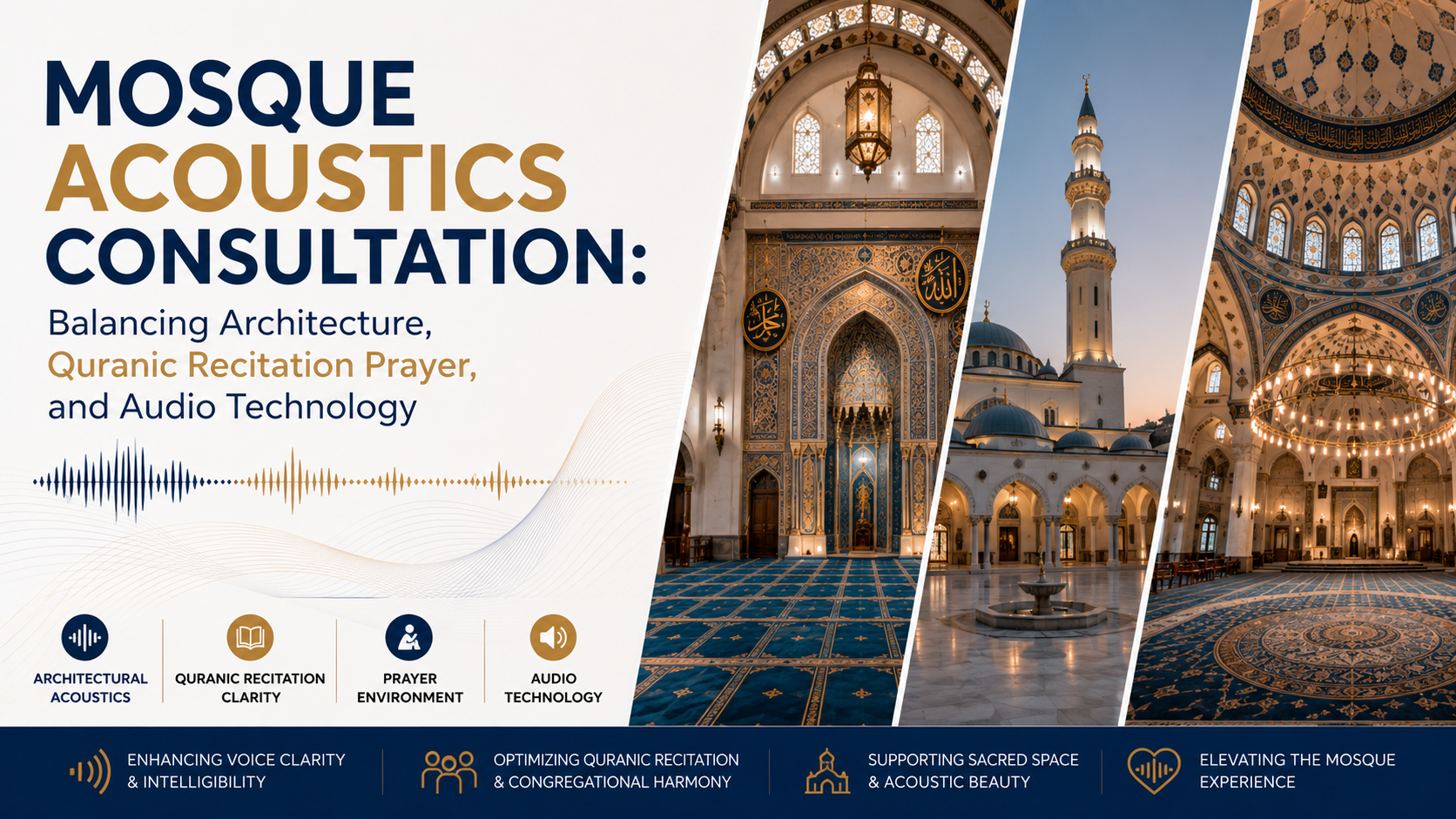


Selected Project Applications
The following examples describe how the framework informed design decisions in three different worship contexts. They explain project intent and strategy; claims of measured or post-occupancy improvement should be added only where corresponding records are available.
Jakarta Cathedral: communication without erasing reverberant identity
Jakarta Cathedral presented a familiar but complex question: how could spoken liturgy and scripture be supported without treating the building’s reverberant Neo-Gothic character as a defect to be removed?
Its large volume, reflective surfaces, vertical proportions, choir, and organ traditions contribute to an acoustic identity associated with Catholic worship. At the same time, sermons, readings, and liturgical communication require intelligible direct sound at congregation locations.
ALTA Integra’s design approach focused on electroacoustic coordination rather than simply increasing loudspeaker quantity. Loudspeaker selection, placement, orientation, coverage, delay, and signal alignment were considered in relation to the cathedral’s geometry and visual character. The intent was to provide clearer, more controlled direct sound while limiting overlapping coverage and unnecessary visual intrusion.
This approach illustrates an important principle: preservation and intelligibility are not automatically opposing goals. They can be addressed as a coordinated design problem when natural room response, reinforcement, heritage, and sightlines are considered together. Any published performance claim should nevertheless distinguish design prediction from commissioning measurement and congregation feedback.
Jakarta Floating Mosque, Ancol: worship within an open environmental context
The Jakarta Floating Mosque in Ancol required a different acoustic response. Its relationship to the waterfront, open circulation, exposed materials, weather, and environmental sound meant that the acoustic brief could not be developed as though the worship space were a sealed auditorium.
In this context, wind, water, nearby activity, and changing background conditions form part of the site experience, but they may also mask speech or recitation. The design strategy therefore treated the waterfront soundscape as a condition to be understood rather than either romanticized or eliminated.
ALTA Integra’s electroacoustic approach was developed to support Quranic recitation, prayer, and spoken communication while remaining coordinated with the architecture and variable environmental conditions. Loudspeaker distribution, directivity, level, timing, and visual integration were considered as part of the spatial experience. Where the term “immersive audio” is used, it should refer to a clearly defined reproduction, coverage, or spatial-design strategy rather than a general promise of emotional immersion.
The project demonstrates how Sacred Acoustic Design can extend beyond the interior room response. In open or semi-open worship environments, meaningful design depends on the relationship among architecture, reinforcement, weather, environmental sound, operation, and place.
Yayasan Borobudur Medan: differentiated criteria across a Buddhist campus
The Yayasan Borobudur complex in Medan includes multiple teaching and prayer environments within one Buddhist campus. Its design challenge was not to impose one acoustic solution across all spaces, but to understand how the function of each hall changed the brief.
Spaces used primarily for Dharma teaching may prioritize speech intelligibility and controlled background noise. Halls supporting chanting or ceremonial activities may require a different balance of resonance, warmth, clarity, and collective participation. Meditation-related use may place greater emphasis on building-services noise, external intrusion, subtle sound, and acoustic calm.
ALTA Integra’s approach considered room volume, geometry, materials, reverberation, source and congregation positions, and electroacoustic requirements for each hall. The resulting design strategies were differentiated according to intended use rather than copied from one room to another.
This example expresses the core principle of the framework: a religious label does not determine an acoustic solution. The design must respond to the particular ritual, activity, space, and community.
What a Sacred Acoustic Design Consultation May Include
Depending on the project stage, worship program, building type, and technical requirements, a consultation may include:
Review of worship tradition, ritual sequence, congregation behavior, music, recitation, speech, and contemplative requirements
Stakeholder workshops with project leaders, architects, ritual representatives, musicians, operators, and audiovisual teams
Assessment of environmental noise, sound isolation, building-services noise, and vibration risk
Development of project-specific room-acoustic and electroacoustic criteria
Review of room form, volume, geometry, materials, and surface treatments
Acoustic calculations, simulations, and auralization where appropriate
Sound-reinforcement, assistive-listening, recording, streaming, and audiovisual-system coordination
Design reviews during architectural and interior development
Construction-stage inspections and technical coordination
Acoustic measurements, sound-system commissioning, and post-occupancy evaluation
The scope should be proportionate to the project. A preliminary review may identify principal risks, information gaps, and the minimum analysis required. A full engagement can carry the acoustic strategy from stakeholder briefing and design criteria through construction, commissioning, and evaluation.
Sound as Part of Worship Architecture
Sacred architecture is shaped not only by what people see, but also by what they hear, understand, perform, remember, and share.
Technical performance remains essential. Speech must be evaluated where speech matters. Noise must be controlled where it disrupts prayer, teaching, recording, or contemplation. Room response must be shaped in relation to music, recitation, chanting, participation, and occupancy. Electroacoustic systems must be coordinated with the architecture and operated reliably.
But no single acoustic metric can define whether a worship space is appropriate. Measurements and simulations establish physical performance. Listening and user evaluation reveal perception. Engagement with the religious community establishes ritual and cultural relevance.
Sacred Acoustic Design brings these forms of knowledge together. Its goal is not to engineer spirituality. Its goal is to help project teams create acoustic environments that are technically responsible, culturally attentive, accessible, and aligned with the worship life they are intended to support.
About the Author
Herwin Gunawan is Principal Consultant of ALTA Integra and an Architectural Building Physics and Technology Consultant specializing in acoustics, lighting, audiovisual systems, passive design, smart-building integration, and human-centered environmental performance. His work examines how technical building performance can be integrated with architecture, operation, perception, and human experience.
References
Abdou, A. A. (2003). Measurement of acoustical characteristics of mosques in Saudi Arabia. The Journal of the Acoustical Society of America, 113(3), 1505–1517.
Carvalho, A. P. O., Morgado, A. E. J., & Henrique, L. (1997). Relationships between subjective and objective acoustical measures in churches. Building Acoustics, 4(1), 1–20.
International Electrotechnical Commission. (2020). IEC 60268-16:2020, Sound system equipment—Part 16: Objective rating of speech intelligibility by speech transmission index.
International Organization for Standardization. (2009). ISO 3382-1:2009, Acoustics—Measurement of room acoustic parameters—Part 1: Performance spaces.
International Organization for Standardization. (2014). ISO 12913-1:2014, Acoustics—Soundscape—Part 1: Definition and conceptual framework.
International Organization for Standardization. (2018). ISO/TS 12913-2:2018, Acoustics—Soundscape—Part 2: Data collection and reporting requirements.
International Organization for Standardization. (2025). ISO/TS 12913-3:2025, Acoustics—Soundscape—Part 3: Data analysis.
Ismail, M. R. (2013). A parametric investigation of the acoustical performance of contemporary mosques. Frontiers of Architectural Research, 2(1), 30–41.
Jeon, J. Y., Hwang, I. H., & Hong, J. Y. (2014). Soundscape evaluation in a Catholic cathedral and Buddhist temple precincts through social surveys and soundwalks. The Journal of the Acoustical Society of America, 135(4), 1863–1874.
Manohare, M., Dongre, A., & Wahurwagh, A. (2017). Acoustic characterization of the Buddhist temple of Deekshabhoomi in Nagpur, India. Building Acoustics, 24(3), 193–215.
Martellotta, F. (2008). Subjective study of preferred listening conditions in Italian Catholic churches. Journal of Sound and Vibration, 317(1–2), 378–399.
Soeta, Y., Ito, K., Shimokura, R., Sato, S., Ohsawa, T., & Ando, Y. (2012). Effects of sound source location and direction on acoustic parameters in Japanese churches. The Journal of the Acoustical Society of America, 131(2), 1206–1220.
Zamarreño, T., Girón, S., & Galindo, M. (2008). Assessing the intelligibility of speech and singing in Mudejar-Gothic churches. Applied Acoustics, 69(3), 242–254.

Sound Pollution From Auditory Discomfort to Cardiovascular Mortality
Environmental noise is no longer just a comfort issue. Research now shows that chronic exposure to poor acoustic environments contributes to stress dysregulation, cognitive fatigue, sleep fragmentation, cardiovascular disease, and premature mortality. This article explores the pathophysiological relationship between sound, the nervous system, and human health — and why acoustic design must become a core pillar of healthy, human-centered, and sustainable building design.

Why Acoustic Design Is a Public Health Imperative
The physical parameters of building acoustics and environmental noise do not merely govern comfort; they act as potent modulators of human physiology [1]. While historical regulations focused almost exclusively on preventing direct, energy-dependent auditory damage, contemporary environmental medicine recognizes a continuous, multi-system pathological spectrum [1]. This spectrum begins with localized sensory discomfort and speech interference, escalates through neuroendocrine and autonomic dysregulation, and ultimately contributes to chronic systemic illnesses and premature mortality [1].
To systematically analyze these human responses, environmental and architectural research maps the relationships between physical building parameters and physiological outcomes [1]. A critical visual and conceptual framework for this analysis is established by the matrix mapping building physics to human health responses [6].
By examining how specific acoustic parameters such as sound level, frequency, duration, absorption, and sound insulation interact with broader environmental conditions such as air pollution concentration, researchers can trace the causal pathways through which physical acoustic parameters translate into chronic illness and death [1].
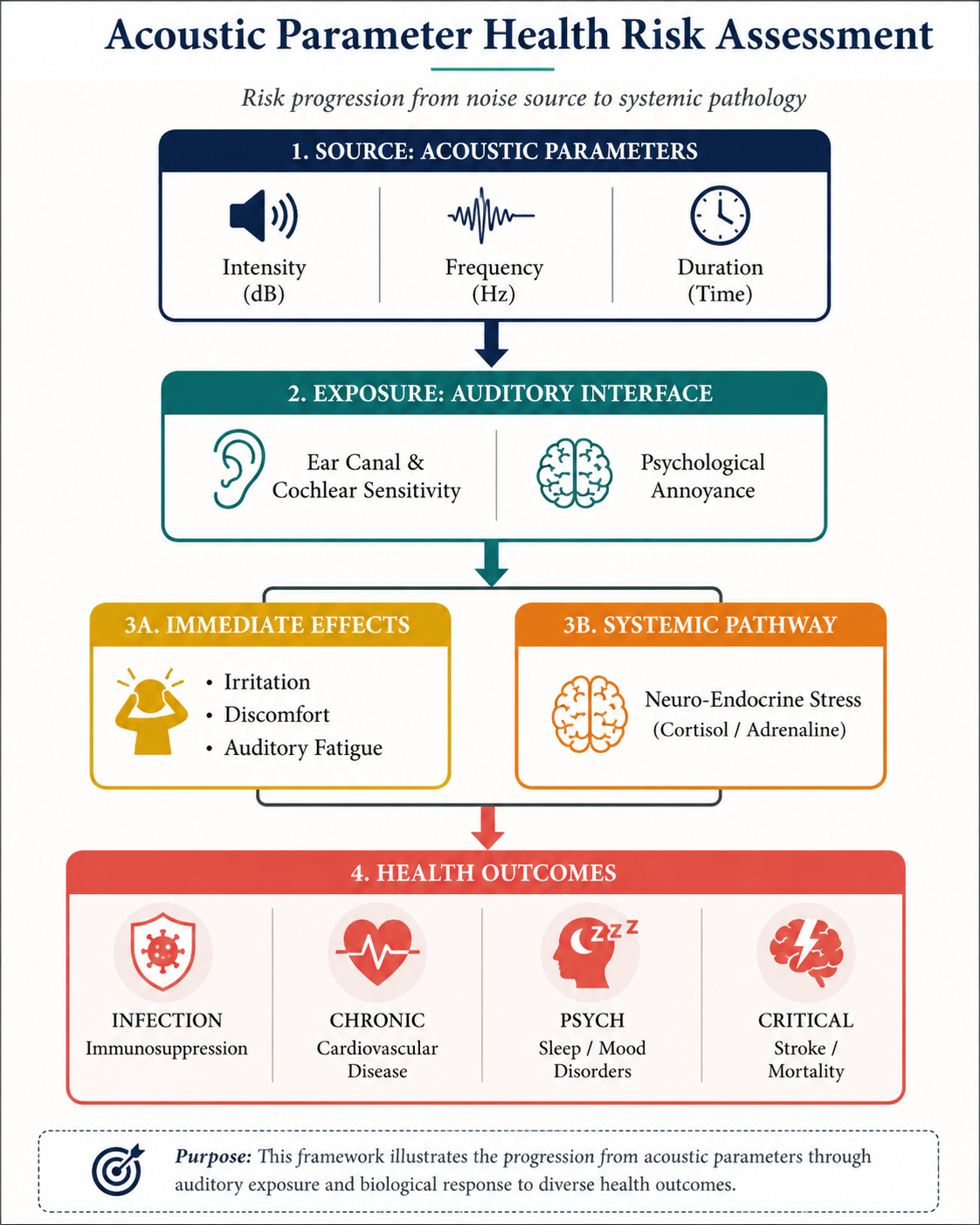
Physical Parameters of Building Acoustics and Human Health
Human responses to the indoor environment are dictated by a matrix of physical parameters within the domain of building physics [1]. These parameters do not operate in isolation; rather, their combinations govern both the energy load on the auditory apparatus and the degree of psychological and physiological stress experienced by occupants [1].
Sound Levels, Frequencies, and Durations
The amplitude or sound level of an acoustic stressor determines whether its impact is primarily mechanical or metabolic[9]. High-decibel exposures are categorized into chronic exposures (such as prolonged occupational noise between 80dBA and 100 dBA and acute impulse exposures such as blasts or gunfire exceeding 140 dB lasting less than 0.2 second [8].
The human ear exhibits frequency-dependent sensitivity, with the highest vulnerability located in the 2kHz to 5kHz range [10]. High-intensity acoustic energy concentrated in this frequency band causes localized lesions on the basilar membrane [9].
In contrast, low-frequency noise typically spanning 0.5 to 200 Hz or lower possesses long wavelengths that easily bypass standard architectural barriers [11]. Low-frequency sound waves travel deep into the inner ear, where they cause mechanical shear stress on both the auditory hair cells and the vestibular otolith organs the saccule and utricle, leading to concurrent balance and hearing deficits [11].
Absorption, Sound Insulation, and Reverberation Time
The physical configuration of indoor spaces dictates the behavior of sound waves.1 Sound insulation parameters determine the attenuation of external noise penetrating the building envelope, while the absorption characteristics of internal boundaries regulate the decay of acoustical energy [1].
When sound insulation is poor, or internal boundaries lack sufficient absorption, spaces suffer from elevated background noise and prolonged reverberation times (RT) [15]. A high RT creates a persistent diffuse sound field where reflected acoustic energy overlaps with direct speech signals [15]. This temporal and spectral smearing masks high-frequency consonants, which are critical for speech intelligibility, thereby increasing the listening effort required by occupants [15].
Structural Vibration and Annoyance
Acoustic energy can couple with building elements to cause structural vibration. These low-frequency physical oscillations are felt directly through somatic tissue and are registered by mechanoreceptors throughout the body [1].
Structural vibration amplifies the subjective degree of annoyance, transforming a physical acoustic parameter into a chronic psychological stressor [1]. This persistent annoyance is not merely a quality-of-life issue; it acts as a primary trigger for the sub-cognitive stress pathways that drive long-term cardiovascular pathology [16].
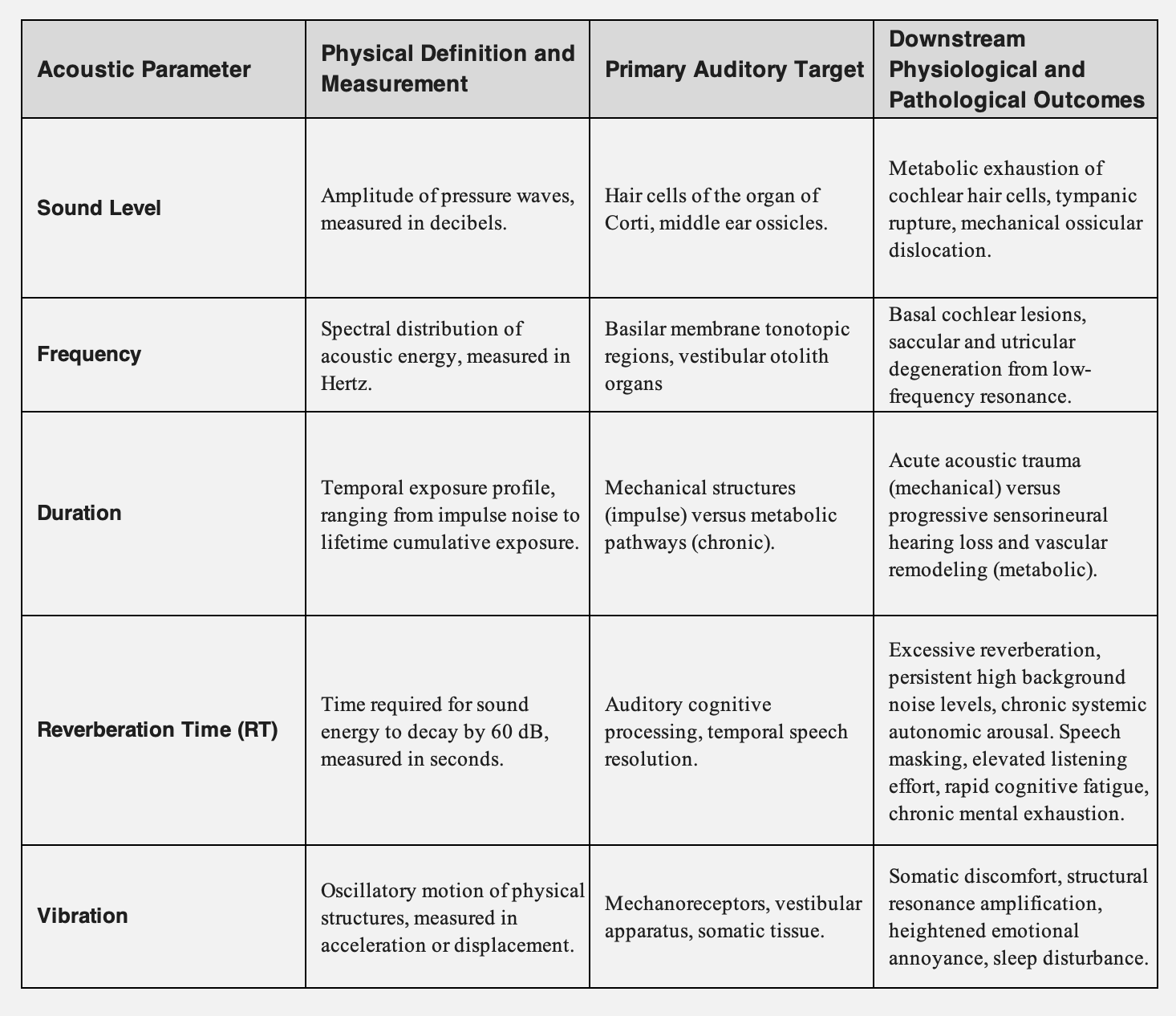
Interactions with Pollution Sources and Air Concentration
A major advancement in indoor environmental quality (IEQ) research is the recognition that acoustic parameters interact dynamically with air pollution concentration [1]. In poorly ventilated modern buildings, chemical pollutants such as formaldehyde and volatile organic compounds and biological pollutants such as mold spores and dust mite allergens accumulate to high concentrations [1]. These airborne pollutants cause physical irritation, mucosal swelling, and chronic inflammatory changes in the respiratory tract and nasal passages [1].
At the human level, these stress factors interact synergistically [1]. High concentrations of chemical pollutants irritate the upper respiratory mucosa, causing localized inflammation and congestion of the Eustachian tube [1]. This congestion compromises middle ear ventilation, altering the impedance of the tympanic membrane and increasing the vulnerability of the middle ear to acoustic stress [23].
Furthermore, laboratory experiments demonstrate that when humans are exposed to concurrent stressors such as background noise combined with high concentrations of chemical pollutants the central nervous system integrates these inputs, resulting in a heightened perception of both acoustic annoyance and mucosal irritation [7].
The Pathological Hierarchy of Human Acoustic Responses
The human body's response to acoustic parameters operates as a pathological hierarchy [1]. Each stage of this hierarchy corresponds to distinct physical thresholds, cellular mechanisms, and clinical endpoints [1].
Auditory Discomfort: Speech Interference, Annoyance, and Cognitive Overload
At the base of the pathological hierarchy lies auditory discomfort, clinically characterized by localized disturbance, speech interference, and heightened annoyance.1 In learning and working environments, background noise (dB) and reverberation time (second) dictate the severity of this discomfort [15].
When RT in a classroom or office exceeds 0.6 seconds, the diffuse, reverberant speech energy overlaps with the direct voice signal [15]. This creates temporal masking, requiring listeners to exert high cognitive effort to filter out background noise and reconstruct masked phonemes [18].
To compensate for this degraded signal, the brain's prefrontal cortex must recruit working memory resources [18]. This continuous cognitive load limits the mental resources available for high-level tasks like reading comprehension, mathematical reasoning, and spatial memory [19].
Clinical Cohorts - TTTS Prevalence - Acoustic Shock - Otological Symptoms
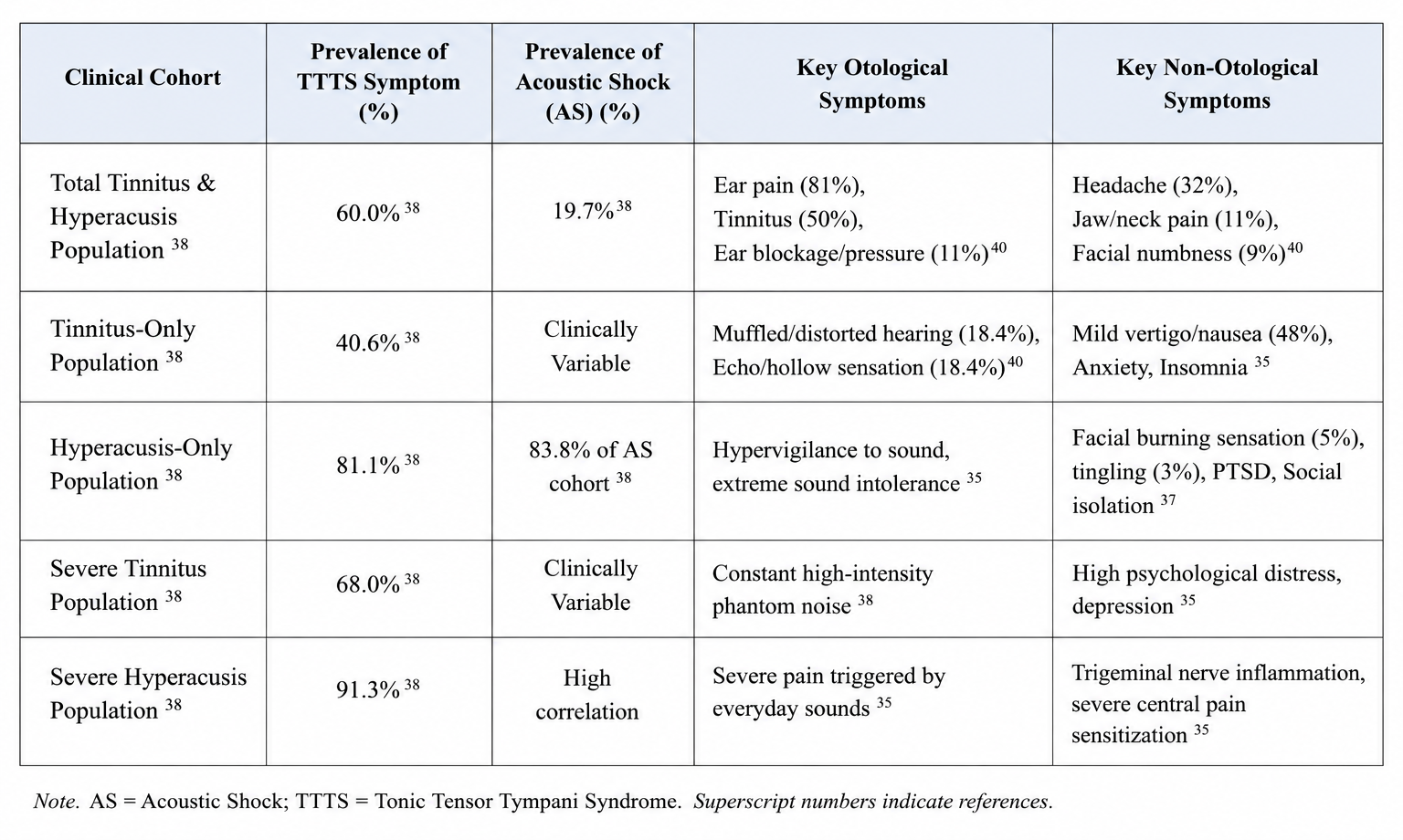
In children, whose top-down language processing and auditory pathways are still maturing, the presence of elevated background noise exceeding the recommended standard of 30 dBA significantly hinders learning progress [15]. In adults, teaching or working in rooms with poor acoustics high RT ranging from 0.6 to 1.0 causes early fatigue, sleepiness, loss of motivation, and a statistically significant drop in job satisfaction [17].
Systemic Effects: Tiredness, Sleep Fragmentation, and Vestibular Degradation
When exposure to acoustic parameters is chronic, localized discomfort escalates into systemic physiological consequences, clinically presenting as chronic "tiredness" and autonomic fatigue [1]. This systemic degradation is mediated by the autonomic nervous system (ANS) and the endocrine system [16].
Chronic noise exposure activates the hypothalamic-pituitary-adrenal (HPA) axis and the sympathetic nervous system (SNS) [28]. The amygdala detects acoustic energy as an environmental threat, bypassing conscious cognitive processing, and triggers the following pathways 16:
● The Sympathetic Pathway: Stimulates the adrenal medulla to release catecholamines, namely epinephrine (adrenaline) and norepinephrine, into the bloodstream within seconds [29]. These hormones bind to cardiovascular (Beta) adrenergic receptors, driving rapid vasoconstriction, elevating heart rate, and increasing blood pressure [28].
● The Endocrine Pathway: Prompts the hypothalamus to release corticotropin-releasing hormone (CRH), driving the anterior pituitary to secrete adrenocorticotropic hormone (ACTH) [29]. ACTH stimulates the adrenal cortex to synthesize and release the glucocorticoid cortisol [29]. Cortisol raises blood glucose levels through gluconeogenesis, alters immune cell distribution, and enhances vascular sensitivity to catecholamine-induced constriction [29].
Under continuous environmental or nocturnal noise exposure, this fight-or-flight response remains active, causing a state of chronic autonomic arousal [31]. Nocturnal transport noise is particularly destructive [2]. Even when noise levels do not fully awaken an individual, exposure to levels exceeding 40 dBA - 45 dBA causes autonomic micro-arousals [2]. These micro-arousals disrupt deep sleep stages, trigger spikes in stress hormones, and prevent the natural nocturnal blood pressure "dipping" process, leaving the cardiovascular system under continuous strain [2].
Concurrently, chronic noise exposure can cause progressive degradation of the peripheral vestibular system [11]. Saccular and utricular hair cells, which are sensitive to low-frequency acoustic vibrations, can undergo structural damage under continuous acoustic overstimulation [11].
This damage is marked by a loss of calretinin-positive calyces within the striolar region of the vestibular otolith organs [12]. Electrophysiologically, this degradation manifests as prolonged latencies and reduced wave amplitudes in cervical vestibular evoked myogenic potentials (cVEMP) and vestibular short-latency evoked potentials (VsEP) [12] Clinically, this vestibular loss presents as balance deficits, spatial disorientation, unsteadiness, and vertigo, significantly elevating the risk of falls [12].
Irritant Reactions: Tonic Tensor Tympani Syndrome and Sterile Inflammation
At the mid-level of the pathological hierarchy, intense or sudden acoustic parameters generate direct physiological irritation within the auditory and somatic nervous systems [1]. This sensory irritation is driven by two key pathways: neuropathic muscle spasms and cellular sterile inflammation [35].

At the neuropathic level, sudden, unexpected, and high-pitched acoustic events (such as feedback screeches, alarms, or public address system squeals) trigger Acoustic Shock ().35 The physiological basis of AS is Tonic Tensor Tympani Syndrome ().38 The tensor tympani is a middle ear muscle innervated by the mandibular branch of the trigeminal nerve ().23 Under normal conditions, it contracts to support the ossicular chain.23
However, under high psychological stress or during an unexpected acoustic incident, the threshold for this reflex is reduced, causing persistent, involuntary contractions and muscle spasms.23
These chronic muscle spasms cause physical tension on the tympanic membrane, altering middle ear ventilation and causing a sensation of ear blockage, pressure, and tympanic flutter.35
Furthermore, the hyper-contraction of the tensor tympani directly irritates and inflames the trigeminal nerve endings.35 This irritation triggers severe neuropathic ear pain, often described as a sharp, stabbing sensation resembling an electric shock, alongside localized burning, numbness, and tingling around the ear, cheek, jaw, and neck.35
At the cellular level, intense noise overexposure damages the cochlea, which triggers a sterile inflammatory response.36 Tearing of the organ of Corti and damage to the sensory hair cells releases intracellular molecules that act as damage-associated molecular patterns ().9 These DAMPs bind to innate immune receptors (such as Toll-like and NOD-like receptors) on surrounding supporting cells and fibrocytes, activating inflammatory cell stress pathways.36
This pathway drives the transcription and release of pro-inflammatory cytokines, specifically tumor necrosis factor-alpha () and interleukin-1 beta (), as well as chemokines like CCL2.36 These chemical signals recruit circulating monocytes and pro-inflammatory macrophages into the scala tympani, spiral ligament, and lateral wall.36 This inflammatory cascade can cause further hair cell death and accelerate progressive sensorineural hearing loss.36
Infectious Diseases: Tympanic Perforation, Eustachian Dysfunction, and Secondary Otitis
When acoustic parameters reach extreme physical energy levels—such as blast overpressures or high-intensity impulse noise exceeding SPL—the human ear is subjected to severe structural trauma.8
At these decibel levels, the mechanical force of the pressure wave exceeds the tissue elasticity of the middle ear.9 This force causes physical tearing, resulting in tympanic membrane perforation, and can fracture or dislocate the middle ear ossicular chain (the malleus, incus, and stapes).8
This mechanical trauma removes the primary physical and immunological barrier of the middle ear.9 Normally, an intact tympanic membrane isolates the mucosal middle ear cavity, maintaining a sterile environment.9
Once this barrier is ruptured, the sterile middle ear space is directly exposed to external biological contaminants, including opportunistic bacteria (such as Streptococcus pneumoniae and Pseudomonas aeruginosa) and fungi.1
This microbial invasion can lead to acute otitis media (middle ear infection), presenting with severe earache, fever, throbbing pressure, and purulent fluid discharge.47
If middle ear ventilation is also compromised by concurrent Eustachian tube dysfunction (which is common following structural ear trauma), the infection can become chronic.23 The inflammatory process can then spread into the surrounding temporal bone, causing:
Acute Mastoiditis: The infection spreads into the mastoid air cells, causing severe retroauricular pain, redness, swelling, bone destruction, and high fever.47
Labyrinthitis (Inner Ear Infection): Pathogens or toxic inflammatory byproducts pass through the round or oval windows, directly infecting the fluid-filled cavities of the cochlea and vestibular apparatus.46 This causes severe inner ear inflammation, presenting with vertigo, loss of balance, nausea, vomiting, and permanent sensorineural hearing loss.46
Toxic Chronic Effects: Apoptosis, eNOS Uncoupling, and Arterial Remodeling
At the level of chronic effects, long-term exposure to acoustic parameters generates permanent, irreversible damage to both the auditory cells and the vascular system [1].
In the auditory system, chronic noise overexposure () causes progressive sensorineural hearing loss () [9]. This toxic chronic effect is driven by metabolic exhaustion within the cochlea.9 The continuous energy load drives mitochondria to overproduce reactive oxygen and nitrogen species (/), causing chronic oxidative stress [10].
This oxidative stress damages intracellular proteins, lipids, and DNA, activating caspase-dependent and caspase-independent apoptotic pathways.20 This results in the death of outer hair cells in the basal turn of the cochlea, leading to a permanent reduction in hearing sensitivity centered around the frequency [9].
In the cardiovascular system, chronic exposure to environmental noise () drives vascular remodeling through systemic oxidative stress and endothelial dysfunction [2].
The chronic, sub-cognitive activation of the axis and stimulates vascular NADPH oxidase, causing the overproduction of superoxide anions () in vascular tissue [13]. These superoxide radicals react with vascular nitric oxide (), forming peroxynitrite () and reducing bioavailability [2].
Peroxynitrite then oxidizes tetrahydrobiopterin (), an essential cofactor for endothelial nitric oxide synthase () [2]. Deprived of , eNOS undergoes uncoupling, shifting from producing vasodilatory nitric oxide to generating superoxide radicals, which further amplifies vascular oxidative stress [2].
This state of uncoupled eNOS and chronic vascular oxidative stress promotes:
● Vascular Inflammation: Upregulates adhesion molecules like VCAM-1, recruiting pro-inflammatory macrophages into the vascular intima.50
● Atherosclerosis: Accelerates the oxidation of low-density lipoproteins () and the formation of foam cells, leading to plaque accumulation in the coronary and cerebral arteries [13].
● Systemic Arterial Hypertension: Chronic vasoconstriction and vascular remodeling permanently raise peripheral vascular resistance [2].
Cardiovascular Mortality and Critical Exposure Thresholds
The terminal endpoint of the acoustic pathological hierarchy is cardiovascular mortality.2 Chronic exposure to transportation and environmental noise acts as an independent risk factor for major adverse cardiovascular events (), including fatal myocardial infarction (heart attack) and ischemic stroke [2].
Epidemiological Burden and Exposure-Response Relationships
Epidemiological and public health data demonstrate a clear relationship between environmental noise exposure and cardiovascular mortality [2]. According to the European Environment Agency () 2025 report, chronic transportation noise exposure contributes to:
● Premature Deaths: At least premature deaths annually in Europe.4
● Ischemic Heart Disease: Approximately new cases of ischemic heart disease () annually [4].
● Type 2 Diabetes: At least newly attributed cases of type 2 diabetes annually, driven by chronic cortisol-induced insulin resistance [4].
● Total Disease Burden: Over disability-adjusted life years () lost annually in Europe due to environmental noise [54].
The World Health Organization () Environmental Noise Guidelines establish specific exposure-response thresholds where the risk of cardiometabolic disease increases significantly 2:
● Road Traffic Noise: Risk of ischemic heart disease () increases by for every increase in starting at an exposure threshold of [58]
● Overall Transport Noise: A combined meta-analysis demonstrates that for every increase in , the risk of developing heart attack, stroke, or heart failure rises by [5].
● Nocturnal Noise: To prevent sleep fragmentation and vascular damage, the WHO recommends that nocturnal noise exposure () from road traffic does not exceed [2].
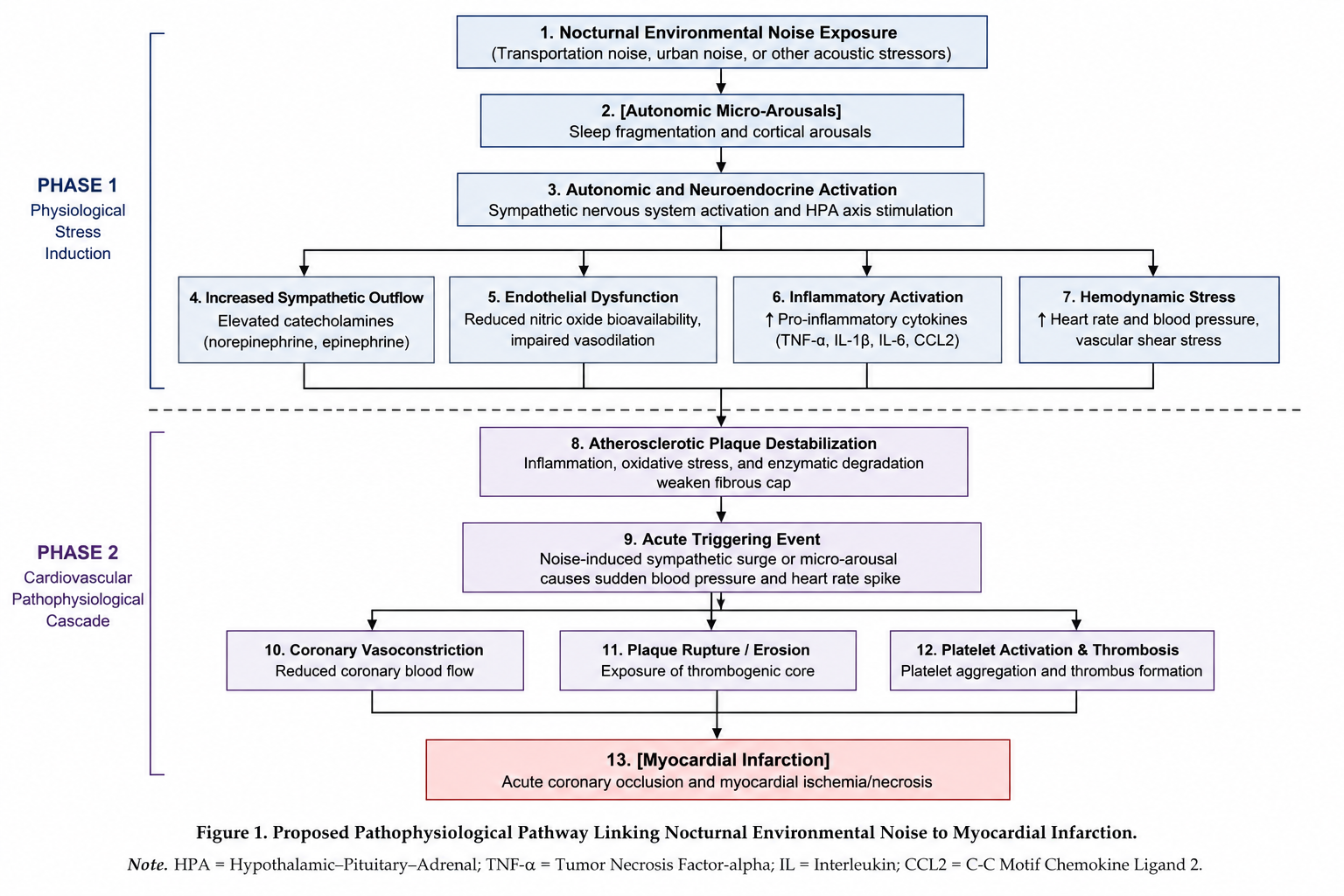
Acute Triggering of Fatal Events
In addition to driving chronic vascular damage, environmental noise can trigger acute, fatal cardiovascular events [2]. In patients with pre-existing atherosclerosis, a sudden, loud nocturnal noise event or persistent sleep disruption can trigger a massive surge of catecholamines [2]. This spike in epinephrine causes a rapid increase in blood pressure, heart rate, and coronary vasoconstriction [28]. The resulting mechanical shear stress can rupture unstable plaques in the coronary arteries [52].
Plaque rupture triggers rapid platelet aggregation and thrombosis, completely blocking coronary blood flow and causing a fatal acute myocardial infarction [2].
Furthermore, sudden, intense emotional or physical acoustic stress can trigger Takotsubo cardiomyopathy stress-induced cardiomyopathy or neurogenic stunning of the heart [30]. This condition is driven by a profound surge of catecholamines that stuns the myocardium, presenting with severe chest pain, acute left ventricular dysfunction, heart failure, and fatal ventricular arrhythmias [30].
Noise Control as Preventative Strategies
Mitigating the physiological effects of acoustic parameters requires combining source-level noise control with occupant-centric building design [1]. These approaches are categorized into acoustical control, passive noise control, and active noise control [6].
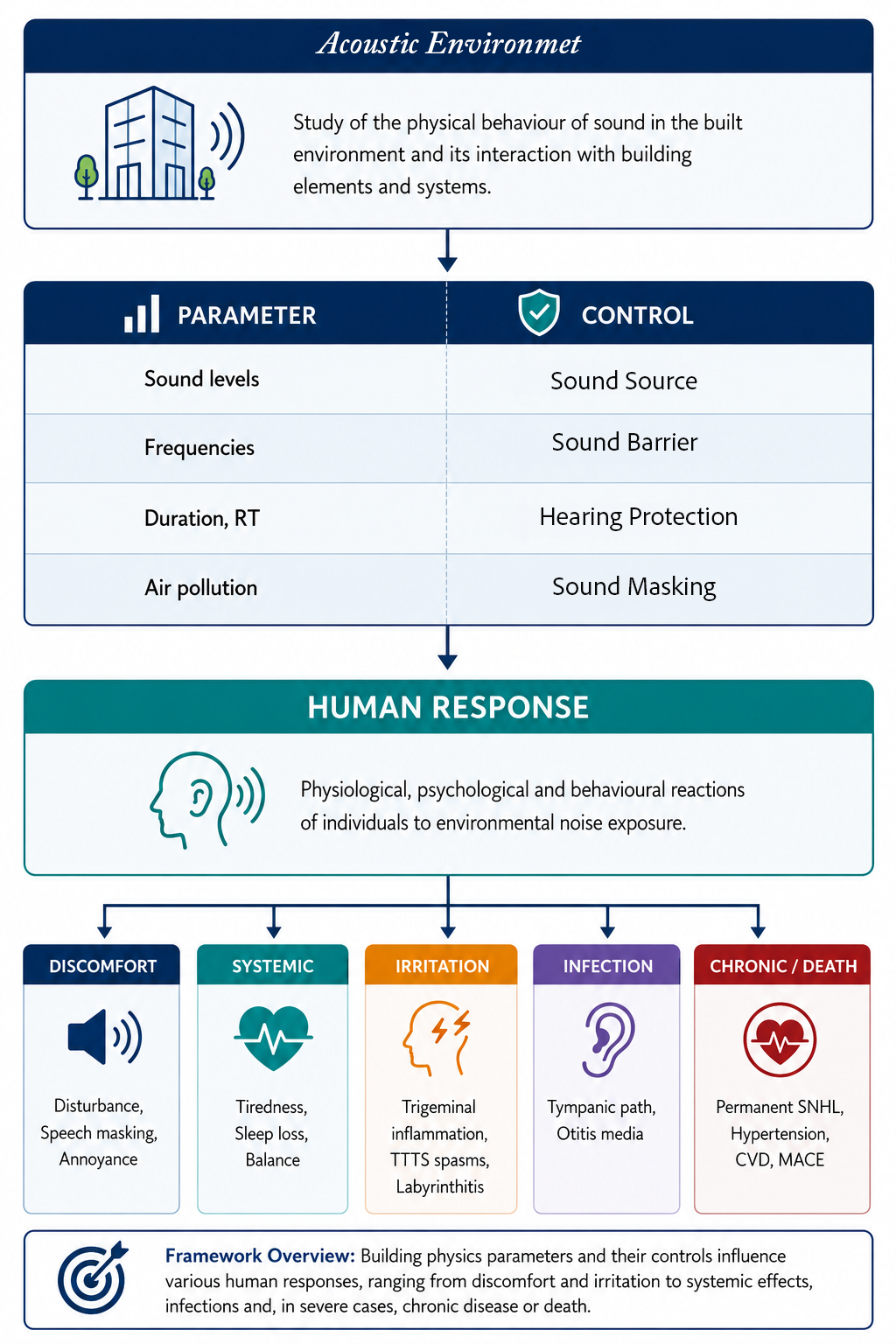
Sound Source Control
The primary line of defense is acoustical control at the source, which aims to reduce noise emissions before they enter the human environment [58]. At the municipal level, this includes implementing low-noise asphalt road surfaces, regulating quiet vehicle tires, establishing urban speed limits, and restricting nighttime flights over residential areas [58]. Controlling these parameters helps keep residential exposure levels below the and targets required to protect long-term cardiovascular health [4]
Noise Insulation - Barrier Control
Passive noise control focuses on architectural path attenuation.14 This includes increasing the sound insulation of the building envelope using heavy, double- or triple-glazed windows, and placing structural vibration isolation dampers under mechanical equipment.1 Internally, passive control involves installing sound-absorbing ceiling panels to reduce the reverberation time () [17].
Personal Sound Control - Hearing Protection
Additionally, passive Acoustic Personalized Environmental Control Systems ()—such as desk-mounted sound-absorbing canopies, passive earplugs, or earmuffs—can be used to reduce localized sound levels.14 These passive systems lower background noise, improve speech intelligibility, and reduce the cognitive load on occupants [18].
Active Noise Control - Sound Masking
Active noise control utilizes electronic systems to generate out-of-phase sound waves that cancel out target sound fields.14 This is implemented through active noise-canceling () headphones, earbuds, or active localized loudspeaker arrays that create sound-masking zones in open-plan offices [14].
These systems are highly effective at neutralizing low-frequency noise (), which is difficult to block with passive architectural barriers.11 Active noise control helps lower the acoustic startle reflex, prevents involuntary middle ear muscle spasms, and dampens systemic autonomic stress responses [14].
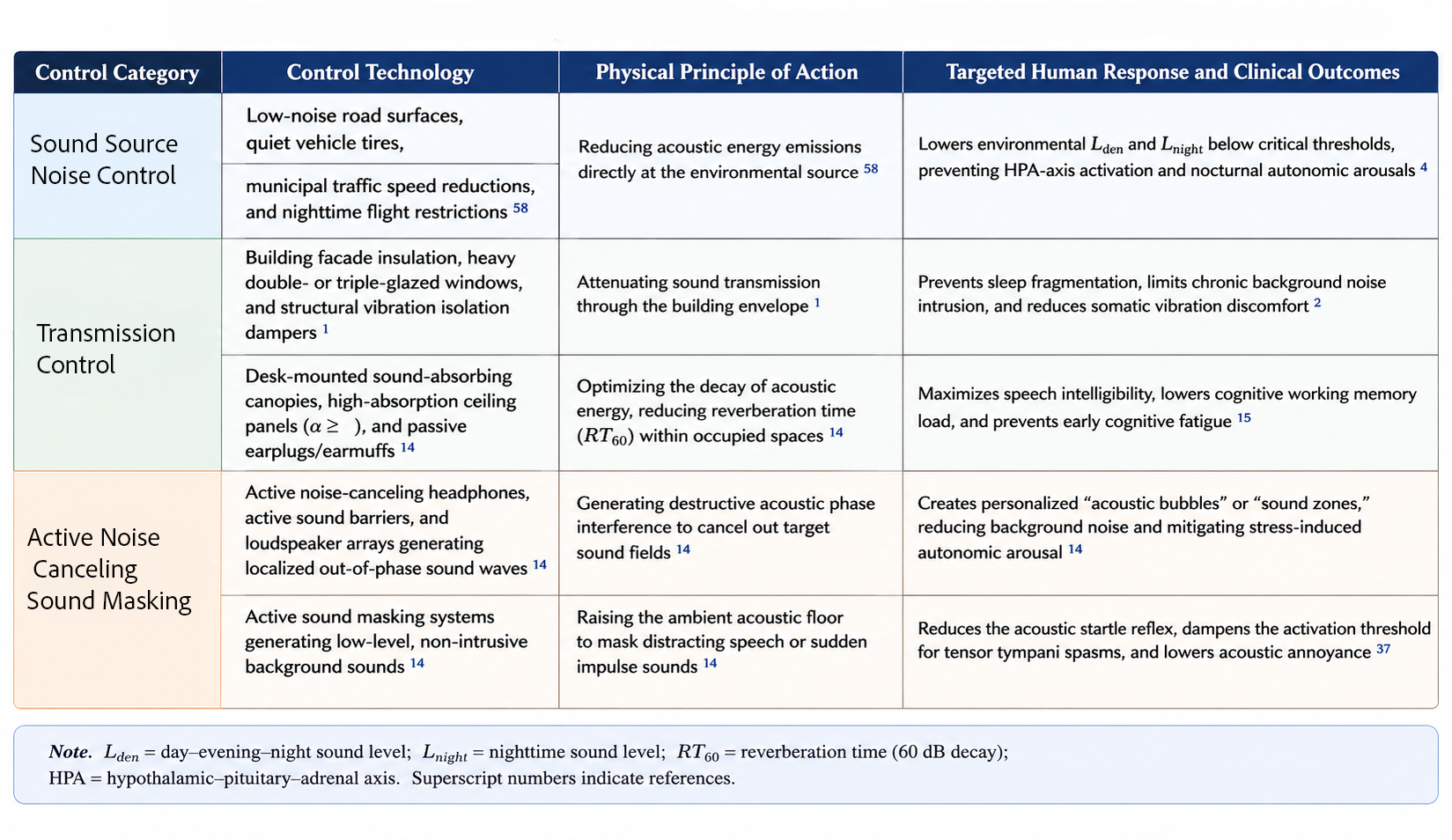
Conclusions
Acoustic parameters operate on a continuous pathological spectrum that directly affects human health [1]. While elevated background noise and prolonged reverberation times cause localized discomfort, speech interference, and early cognitive fatigue, chronic exposure to low-to-moderate environmental noise 50 dBA - 60 dBA triggers systemic stress pathways [2]. This chronic neuroendocrine activation drives arterial hypertension, endothelial dysfunction, eNOS uncoupling, and progressive vascular remodeling, significantly elevating the risk of cardiovascular mortality [2]. At higher physical intensities, sudden acoustic events cause acute neuropathic irritation (Acoustic Shock and Tonic Tensor Tympani Syndrome) or structural middle ear trauma, which predisposes the ear to secondary pathogenic infections like acute otitis media and labyrinthitis [8].
Protecting human health requires moving beyond traditional regulatory frameworks that only address direct hearing loss.1 Modern public health policy and architectural engineering must treat environmental and transport noise as a major modifiable cardiovascular and metabolic risk factor [4]. Facade insulation, localized sound absorption, and active noise control are critical to keeping cumulative exposures below WHO guidelines [4].
Furthermore, integrating acoustic control with indoor air quality management is essential [1]. This dual approach prevents the mucosal congestion and Eustachian tube inflammation that can compromise middle ear mechanics and exacerbate acoustic stress [1]. Ultimately, environmental noise mitigation must be treated as a central pillar of preventative medicine and sustainable urban design to reduce the global burden of cardiometabolic disease and prevent premature mortality [4].
References
1. Understand Indoor Envrionment Quality.pdf
2. Transportation Noise Pollution and Cardiovascular Health | Circulation Research
3. Noise and air pollution as risk factors for hypertension: part II – pathophysiologic insight
4. New EEA 2025 Noise Report Confirms: Environmental Noise is a Medical Emergency
5. Traffic noise, a novel risk factor for cardiovascular diseases
6. uploaded:Screenshot 2026-05-27 at 11.29.44.png-48e61f47-4bbc-4654-96f6-e15406f0f270
7. How different sounds affect bodily responses and the perception of odour, light and temperature - Taylor & Francis
8. Acute Acoustic Trauma: Symptoms, Causes, and Treatments - Audibel
9. Previous Chapter: Case Study 52: Behavioral and Audiologic Manifestations of Noise-Induced Hearing Loss - National Academies of Sciences, Engineering, and Medicine
10. Acute Acoustic Trauma - StatPearls - NCBI Bookshelf
11. Noise-induced vestibular dysfunction in rats: longitudinal assessment using cVEMP and behavioral testing after low-frequency acoustic trauma - PMC
12. David S. Bauer's research works | University of Michigan and other places - ResearchGate,
13. Environmental Noise and the Cardiovascular System - PubMed,
14. (PDF) Introducing the concept of Acoustic Personalised Environmental Control systems (Acoustic PECS) within the framework of IEA EBC Annex 87 - ResearchGate,
15. Life Cycle Value Tradeoff of Noise Mitigating Measures Using BIM-Simulation and Multi-Criteria Decision Modeling - IFMA Knowledge Library,
16. Transportation Noise and Cardiovascular Health: Evidence, Mechanisms, and Policy Imperatives The Anatolian Journal of Cardiology,
17. Effects of Classroom Acoustics and Self-Reported Noise Exposure on Teachers' Well-Being,
18. Effects of reverberation time on the cognitive load in speech communication: Theoretical considerations | Request PDF - ResearchGate,
19. The effects of classroom acoustic quality on student perception and wellbeing: a systematic review across educational levels - PMC,
20. Noise reaction scheme explaining the adverse cardiovascular effects of... - ResearchGate, accessed May 27, 2026.
21. Noise annoyance and cardiovascular disease risk: results from a 10-year follow-up study, accessed May 27, 2026.
22. Improving indoor air quality and aesthetics in an economical and environment-friendly way by utilizing decorative indoor plants - ResearchGate
23. Tonic tensor tympani syndrome - Wikipedia
24. Vestibular Findings Associated with Chronic Noise Induced Hearing Impairment
25. Tensor Tympani Syndrome - StatPearls - NCBI Bookshelf - NIH
26. Influence of Classroom Acoustics on Noise Disturbance and Well-Being for First Graders
27. [PDF] The Indoor Environment Handbook by Philomena Bluyssen | 9781136544811 - Perlego
28. Heart Problems: Scary Stress Responses Known - Liv Hospital, accessed May 27, 2026
29. Understanding the stress response - Harvard Health
30. The effects of stress on the heart | Prevention Observatory of the Montreal Heart Institute
31. Chronic stress puts your health at risk - Mayo Clinic
32. Noise-induced Vestibular Dysfunction: An Unexplored Entity | Request PDF - ResearchGate
33. The effect of noise exposure on vestibular function - White Rose eTheses Online,
34. Association between Simultaneous Occurrence of Occupational Noise-Induced Hearing Loss and Noise-Induced Vestibular Dysfunction: A Systematic Review - PMC
35. Acoustic Shock and Tensor Tympani Syndrome (TTS) - DWM Audiolog
36. Inflammation associated with noise-induced hearing loss - PMC - NIH,
37. Acoustic Shock - The Royal Victorian Eye and Ear Hospital
38. Tonic tensor tympani syndrome in tinnitus and hyperacusis patients: A multi-clinic prevalence study - Macquarie University
39. Tonic tensor tympani syndrome in tinnitus and hyperacusis patients: a multi-clinic prevalence study - PubMed,
40. Acoustic Shock Disorder | The Hyperacusis Network
41. A Beginner's Guide To Tensor Tympani Syndrome - Treble Health, accessed May 27, 2026
42. Tonic Tensor Tympani Syndrome - AVI New England
43. Acoustic Shock | Canadian Audiologist,
44. Acoustic Trauma: Signs of Long-Term Risks and Ear Ache | The Harley Street ENT Clinic
45. Tensor Tympani Syndrome (TTS) - DWM Audiology
46. Inner Ear Trauma | Suarez Physical Therapy,
47. Ear Problems: Causes, Symptoms & Treatment Options - The MED-EL Blog
48. Adenosine and the Auditory System - PMC
49. The relationship between noise pollution and cardiovascular diseases: an umbrella review on meta-analyses - PMC
50. An underestimated danger: Noise and air pollution are new and important cardiovascular risk factors
51. Long-Term Effects of Aircraft Noise Exposure on Vascular Oxidative Stress, Endothelial Function and Blood Pressure: No Evidence for Adaptation or Tolerance Development - Frontiers
52. Yes, Stress Can Hurt Your Heart: 3 Things to Know | News - Yale Medicine,
53. Circulation Research, https://www.pleanala.ie/publicaccess/314485%20-%20Case%20Documentation/314485/Responses/Responses%20&%20Submissions%20to%20Draft%20Order/Liam%20O'Gradaigh%2023.12/Liam%20O'Gradaigh%20Part%204%2023.12.pdf
54. Transportation noise pollution as a cardiovascular risk factor: from epidemiological evidence to mechanistic insights - PMC
55. Longevity and Environmental Perception: Introducing Life Years Without Pollution or Noise Across Europe - EPC2026
56. Environmental noise in Europe - 2025
57. Revisiting the association between transportation noise and heart disease reported in the World Health Organization Environmental Noise Guidelines for the European Region: a systematic review and meta-analysis - PubMed,
58. Effects of noise exposure on the cardiovascular system. - Medizinonline
59. Environmental Impacts on Cardiovascular Health and Biology: An Overview - PMC - NIH,
60. Noise | In-depth topics | European Environment Agency (EEA)
61. Optimum acoustic conditions for a speaker as a function of the... | Download Scientific Diagram - ResearchGate

LEED vs EDGE vs Green Globes: Which Green Building Certification Is Right for South East Asia?
For many property owners, the challenge is no longer whether to pursue a green building certification, but which certification delivers the greatest value. This article explores the strengths, limitations, and market relevance of LEED, EDGE, and Green Globes to help decision-makers align sustainability goals with business objectives, project budgets, and regional market expectations.

A Strategic Comparison for Sustainable, High-Performance, and Human-Centered Buildings
As sustainability, ESG compliance, operational efficiency, and occupant wellness become increasingly important in modern development, green building certifications have evolved into critical strategic tools for architects, developers, investors, and building owners.
Among the most recognized certification systems globally are LEED, EDGE, and Green Globes. Each certification framework offers a different philosophy, technical methodology, implementation complexity, and market positioning.
Understanding the differences between these systems is essential for selecting the right certification strategy based on project type, budget, sustainability goals, investor expectations, operational performance targets, and market positioning.
At HerwinGunawan.Work, we provide integrated building performance consultancy covering sustainability, acoustics, lighting, audiovisual technology, smart building systems, environmental quality, and human-centered design strategies to support healthier and higher-performing built environments.
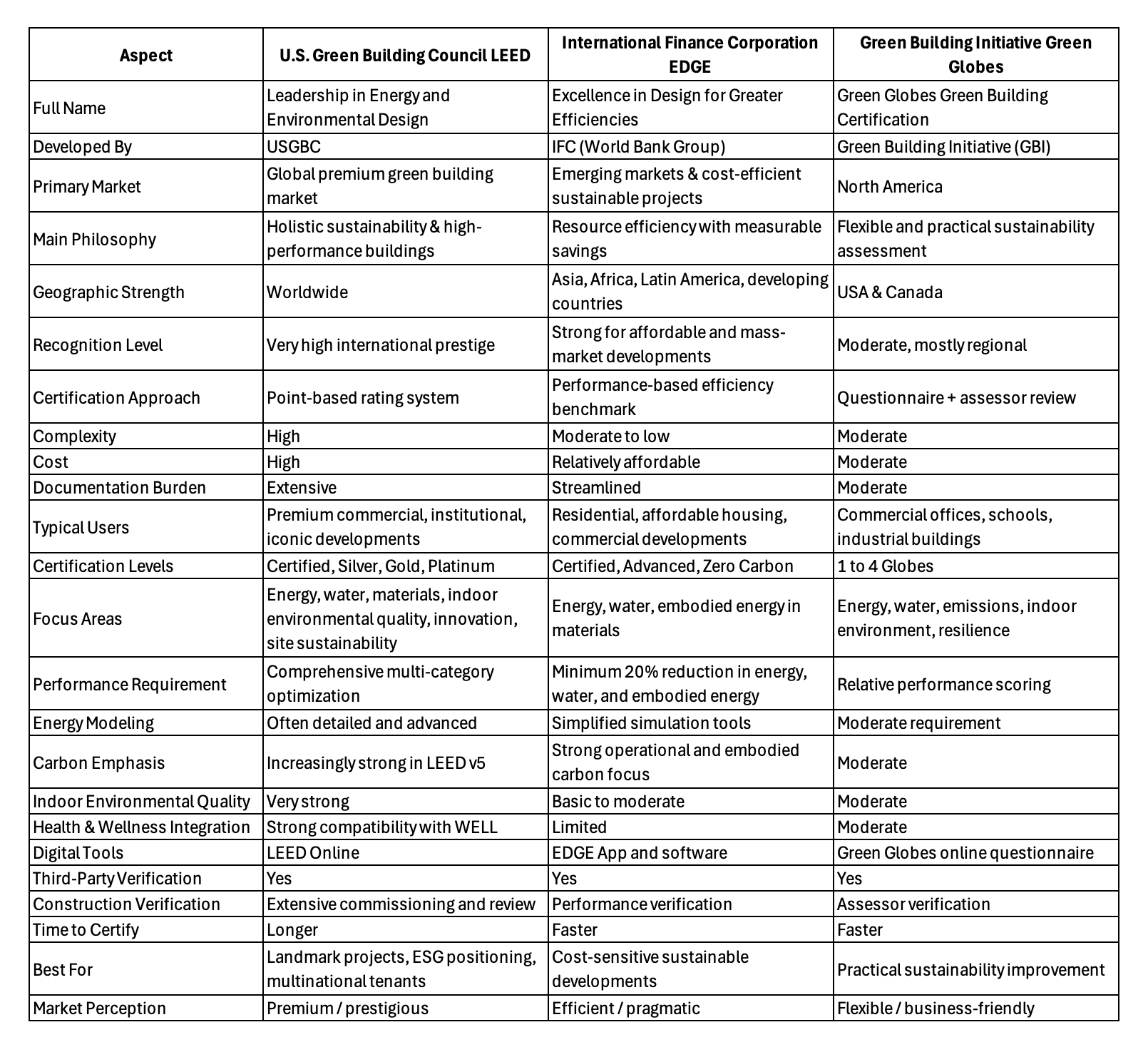
What Is LEED Certification?
LEED by USGBC is one of the world’s most recognized green building certification systems developed by the U.S. Green Building Council (USGBC). LEED provides a comprehensive sustainability framework covering energy efficiency, water conservation, indoor environmental quality, sustainable materials, site sustainability, carbon reduction, and innovation.
LEED certification is widely associated with premium commercial developments, institutional buildings, international hospitality projects, airports, mixed-use developments, and ESG-driven real estate portfolios.
LEED certification levels include:
Certified
Silver
Gold
Platinum
The system uses a point-based methodology that evaluates building performance across multiple sustainability categories.
According to USGBC, LEED is the world’s leading green building rating system and provides a globally recognized framework for healthy, efficient, and cost-effective buildings. (usgbc.org)
LEED Advantages and Limitations
Advantages of LEED
Strongest international sustainability branding
High credibility with multinational tenants and institutional investors
Strong alignment with ESG reporting and carbon reduction strategies
Comprehensive approach to building performance
Excellent integration with WELL and human-centered design strategies
Strong focus on indoor environmental quality and occupant wellness
Limitations of LEED
Higher certification and consultancy cost
Extensive documentation requirements
Longer certification timeline
Intensive coordination across multidisciplinary teams
LEED is often most suitable for landmark projects where sustainability branding and international market positioning are important.
What Is EDGE Certification?
EDGE Buildings is a green building certification system developed by the International Finance Corporation (IFC), a member of the World Bank Group.
EDGE stands for Excellence in Design for Greater Efficiencies and focuses on measurable reductions in:
Energy consumption
Water consumption
Embodied carbon in materials
To achieve EDGE certification, projects must demonstrate at least 20% savings in energy, water, and embodied energy in materials compared to local baseline buildings. (edgebuildings.com)
EDGE is designed to be simpler, faster, and more cost-effective compared to more documentation-intensive certification systems. It has become particularly popular in emerging markets, including Indonesia, Southeast Asia, Africa, and Latin America.
EDGE certification levels include:
EDGE Certified
EDGE Advanced
EDGE Zero Carbon
The system is highly attractive for developers pursuing scalable sustainability strategies, green financing, operational savings, and portfolio-level implementation.
EDGE Advantages and Limitations
Advantages of EDGE
Faster and more affordable certification process
Simplified implementation workflow
Strong operational savings focus
Effective for large-scale residential and commercial developments
Attractive for green financing and sustainable investment strategies
Strong emerging market compatibility
Limitations of EDGE
Less comprehensive than LEED
Limited emphasis on wellness and placemaking
Fewer innovation and environmental categories
Lower prestige for premium international branding
EDGE is particularly effective for developers prioritizing scalable sustainability implementation with measurable ROI.
What Is Green Globes?
Green Globes by GBI is a flexible sustainability assessment and certification system developed by the Green Building Initiative (GBI).
Green Globes emphasizes a more collaborative and practical certification process using:
Online questionnaires
Third-party assessors
Flexible compliance pathways
Simplified documentation workflows
The system is widely used in North America for commercial buildings, educational facilities, healthcare projects, industrial buildings, and renovation projects.
Green Globes certification is generally perceived as more flexible and less administratively intensive compared to LEED. (thegbi.org)
Green Globes Advantages and Limitations
Advantages of Green Globes
Flexible certification methodology
Lower administrative burden
Practical and collaborative assessment process
Suitable for renovation and existing building projects
Faster certification process
Limitations of Green Globes
Lower international recognition
Limited adoption outside North America
Less commonly required by institutional investors
Reduced global branding value compared to LEED
Green Globes is generally preferred for projects seeking pragmatic sustainability improvements without highly intensive certification processes.
Technical Requirement
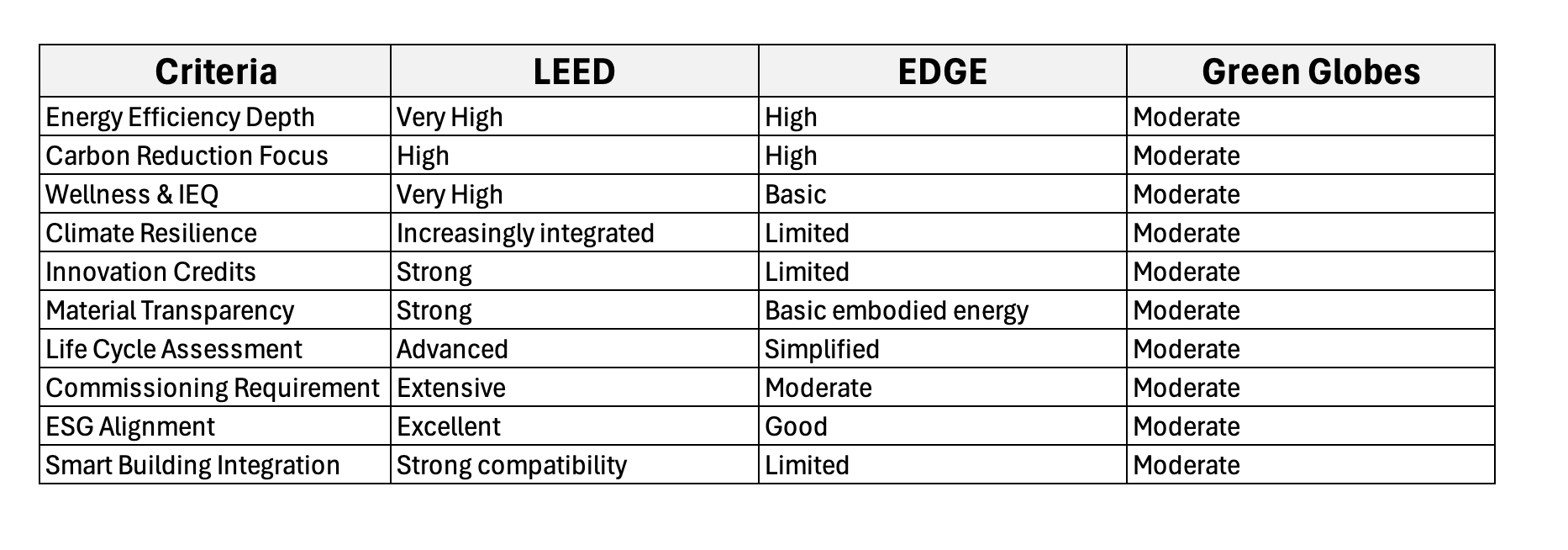
Which Green Building Certification Is Best for South East Asia?
In Indonesia and Southeast Asia, LEED and EDGE are currently the most relevant international certification systems.
LEED in South East Asia
LEED is commonly used for:
Premium office towers
International hospitality developments
Mixed-use commercial developments
Airports and transportation infrastructure
Corporate headquarters
ESG-focused real estate portfolios
LEED provides strong international branding value and is often preferred by multinational tenants and institutional investors.
EDGE in South East Asia
EDGE is rapidly growing due to:
Lower certification cost
Faster implementation
Simpler compliance process
Strong compatibility with residential and mixed-use developments
Green financing alignment
EDGE is especially attractive for:
Residential developers
Industrial developments
Mid-market commercial buildings
Large development portfolios
Green Globes in South East Asia
Green Globes currently has limited market adoption in Indonesia and is less commonly requested by local developers or tenants.
Beyond Certification: The Importance of Human-Centered Building Performance
While sustainability certifications are important, truly high-performance buildings require more than energy efficiency alone.
Modern buildings must also address:
Acoustic comfort
Human-centric lighting
Indoor environmental quality
Thermal comfort
Smart building integration
Audiovisual and communication systems
Occupant wellness and productivity
Biophilic and sensory experience
Integrated building performance design creates environments that are not only sustainable, but also healthier, more productive, emotionally engaging, and operationally efficient.
This is increasingly important as developers, investors, and occupants shift toward:
ESG-driven development
Wellness-focused workplaces
Sustainable hospitality
Smart buildings
Human experience-centered architecture
Our Approach to Sustainable and Human-Centered Building Performance
We provide integrated consultancy services combining:
Sustainable building strategy
Green building certification support
Acoustic consultancy
Architectural lighting design
Audiovisual and ICT systems design
Smart building integration
Indoor environmental quality optimization
Human-centered environmental experience design
Our approach integrates environmental performance with human experience to help create buildings that are:
Sustainable
Healthy
Efficient
Comfortable
Technologically integrated
Operationally optimized
Future-ready
Consultant Requirement and Cost
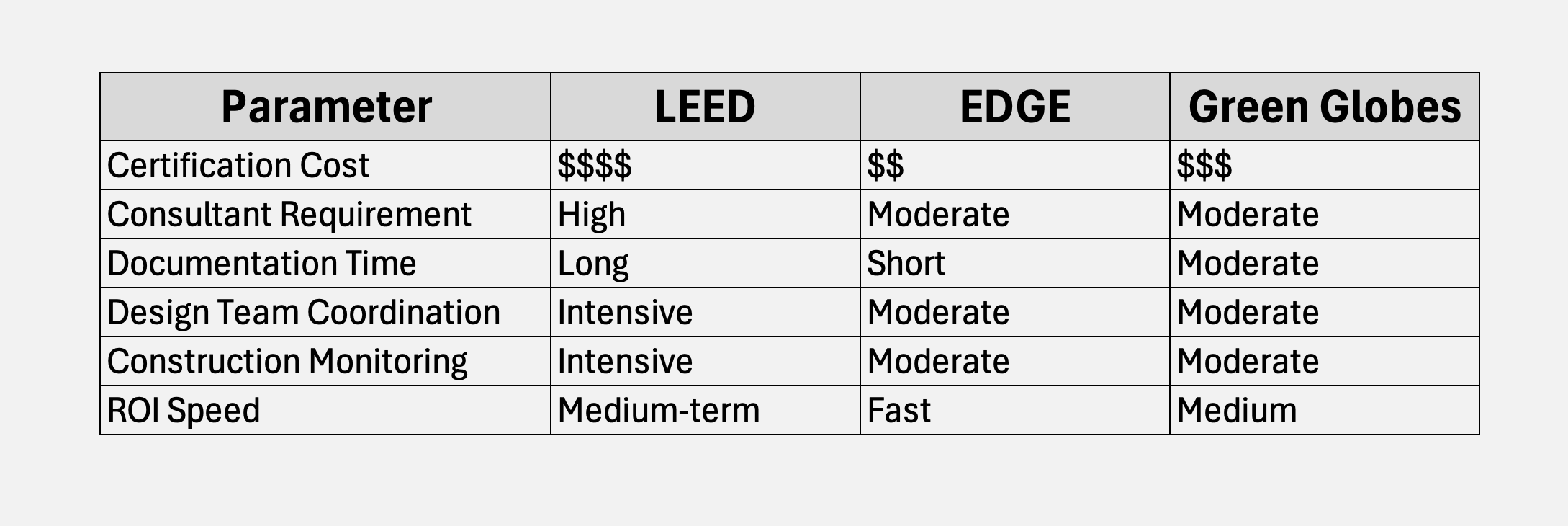
Conclusion
Choosing between LEED, EDGE, and Green Globes depends on your project objectives, sustainability ambitions, operational targets, market positioning, and investment strategy.
Choose LEED if:
You need strong international prestige
ESG positioning is critical
The project targets multinational tenants
Wellness and premium sustainability positioning are priorities
Choose EDGE if:
Cost efficiency is important
You need scalable sustainability implementation
The project is residential or mixed-use
Fast certification and measurable resource savings are priorities
Choose Green Globes if:
Practical flexibility is more important than global prestige
The project is in North America
Existing building optimization is the main objective
As sustainability evolves beyond compliance into holistic human-centered building performance, successful projects increasingly require integrated expertise across environmental design, wellness, technology, acoustics, lighting, and smart systems.
References
USGBC LEED Rating System (usgbc.org)
EDGE Buildings Certification (edgebuildings.com)
Green Building Initiative – Green Globes (thegbi.org)

AV Vendor vs AV System Integrator vs Audiovisual Consultant: What Is the Difference?
Many project owners still think AV Vendor, AV System Integrator, and Audiovisual Consultant provide the same service. In reality, each role has very different objectives, workflows, and project responsibilities. This article explains how vendors focus on products, integrators focus on functionality, and audiovisual consultants focus on performance, experience, operational workflow, and long-term building integration for modern human-centric environments.
Modern buildings increasingly depend on audiovisual systems to support communication, collaboration, entertainment, education, hospitality, and operational performance. However, many project owners still misunderstand the difference between an AV Vendor, AV System Integrator, and Audiovisual Consultant.

Understanding these differences is important because each role contributes differently to the success of a project. In premium architecture and high-performance buildings, choosing the right audiovisual approach can significantly affect: User Experience, Operational Efficiency, Building performance, Technology Scalability, Architectural Integration, Long-term project value.
What Is an Audiovisual Vendor?
An Audiovisual Vendor is a company or supplier that primarily sells audiovisual products or equipment.
Their business usually focuses on:
Product distribution
Brand representation
Hardware sales
Equipment packages
Product recommendations
AV vendors typically begin the design process from the products they already sell or distribute.
Because of this, proposed solutions may be influenced by: available inventory, referred brands, existing supplier ecosystems and product availability.
AV vendors are important for procurement and equipment sourcing, but their role is generally product-oriented.

What Is an AV System Integrator?
An AV System Integrator focuses on combining multiple technologies into a functional audiovisual system. Unlike vendors, AV integrators usually begin by understanding: client operational requirements, functional needs, room usage, technical compatibility and budget considerations.
After evaluating those requirements, the integrator selects and integrates products that can achieve the desired functions effectively.
Typical responsibilities include: system installation, equipment integration, programming and configuration, testing and commissioning, user training and technical troubleshooting.
AV system integrators are primarily function-oriented. Their goal is ensuring the system operates properly and meets functional expectations.

What Is an Audiovisual Consultant?
An Audiovisual Consultant works from a broader and more strategic perspective. Instead of starting from products or equipment, audiovisual consultants begin by analyzing: desired user experience, performance expectations, operational workflow, standard operating procedure, architectural and interior design conditions, acoustic and environmental considerations, building systems coordination, future scalability and long-term operational flexibility.
After understanding those factors, the audiovisual consultant develops: system concepts, performance strategies, technical design criteria, product-neutral recommendations, multiple product alternatives, tender documentation, construction drawings and coordination during tender and construction phases.
An audiovisual consultant acts as an independent advisor focused on aligning: Technology, Architecture, Environmental Performance, Human Sensory, Human Behavior and Operational needs into one cohesive system.

What Is the Main Difference Between Vendor, Integrator, and Consultant?
The differences can be summarized simply: AV Vendor Product-Oriented, AV System Integrator Function-Oriented, Audiovisual Consultant Performance & Experience-Oriented. Each role serves different project objectives and responsibilities.

Why Is Audiovisual Consultancy Important in Modern Buildings?
Modern architecture increasingly depends on integrated technology systems. Audiovisual systems now influence: Communication Quality, Workplace Collaboration, Hospitality Experience, Educational Effectiveness, Entertainment Environments, Hybrid Meeting Performance, User Interaction and Smart building Functionality.
Poor audiovisual planning can create: Operational Inefficiency, Poor User Experience, Architectural Conflicts, Acoustic Problems, Technology Redundancy, Difficult Maintenance, Future Scalability Limitations. This is why early audiovisual consultancy is becoming increasingly important in high-performance buildings.
When Should an Audiovisual Consultant Be Engaged?
The ideal time to engage an audiovisual consultant is during the early design stages. Early involvement helps: Improve coordination with architecture and MEP systems. Prevent costly redesigns and optimize user experience. Align AV systems with operational goals. Improve acoustic and environmental integration. Support long-term flexibility and scalability.
Projects that commonly require audiovisual consultants include:
Corporate headquarters
Hybrid workplaces
Auditoriums
Convention centers
Hospitality projects
Educational facilities
Houses of worship
Entertainment venues
Smart buildings
Mixed-use developments
How Does an Audiovisual Consultant Support Architects and Developers?
Our Audiovisual consultants help bridge the gap between technology and architecture. We work closely with: architects, interior designers, MEP engineers, lighting designer, acoustic consultants, IT consultants, operators, contractors and facility management teams.
The objective is ensuring audiovisual systems integrate naturally into the building without compromising: architectural aesthetics, spatial quality, user experience, operational efficiency and environmental performance. Good audiovisual design should feel intuitive, seamless, and human-centric.
Why Are Human-Centric AV Systems Becoming More Important?
As buildings become more experience-driven, audiovisual systems are increasingly part of:
Human-centric design
Smart building strategy
Environmental experience
Workplace wellbeing
Hybrid collaboration
Brand perception
The best AV systems are not necessarily the most expensive.
They are the systems that successfully align:
Technology
Human behavior
Operational workflow
Architectural intent
Long-term building performance
into one cohesive user experience.
Choosing the Right Audiovisual Approach
Selecting the right audiovisual partner depends on project goals.
If the priority is:
Equipment procurement → Vendor
Functional system installation → Integrator
Long-term performance strategy and experience integration → Audiovisual Consultant
For premium architecture and complex developments, many projects benefit from involving audiovisual consultants early to guide the overall system strategy before procurement and installation begin.

Audiovisual Consultancy by Herwin Gunawan – ALTA Integra
At Herwin Gunawan – ALTA Integra, audiovisual consultancy is approached as part of integrated human-centric building performance.
The focus is not only on equipment selection, but on creating audiovisual environments that support: communication clarity, workplace productivity, hospitality quality, architectural integration, acoustic, lighting, electrical coordination, user experience and long-term operational performance
Through multidisciplinary coordination between acoustics, architecture, lighting, and building technology, audiovisual systems can become a meaningful part of high-performance building environments.
Explore more: Audiovisual & Building Performance Consultancy

The Psychophysiological Impact of Soundscape Exposure on Human Hormones Response
Emerging research in neuroscience and environmental psychology reveals that soundscape exposure can influence human emotional regulation, stress response, cognitive recovery, and hormonal balance. From dopamine and oxytocin to serotonin and endorphins, auditory environments play a significant role in shaping how people feel, connect, and perform. This article explores the psychophysiological relationship between soundscape design, auditory sensory processing, and human well-being within architecture and the built environment.

In contemporary architecture and urban development, environmental quality is often measured through visual aesthetics, thermal comfort, lighting performance, and indoor air quality. However, one critical sensory dimension is frequently underestimated despite its profound influence on human wellbeing: sound.
Traditionally, acoustic design has focused on controlling unwanted noise and meeting technical compliance standards. Yet emerging interdisciplinary research in neuroscience, environmental psychology, psychoacoustics, and human-centric design reveals that sound environments influence far more than auditory comfort. Soundscape exposure can directly affect emotional states, cognitive performance, stress response, social behavior, and even neurochemical regulation within the human body.
This growing field of research introduces a transformative perspective for architects, engineers, urban designers, and wellness consultants: the built environment does not merely shape how spaces look, but also how people physiologically and psychologically feel.
Understanding Soundscape Beyond Noise
The term “soundscape” refers to the acoustic environment as perceived and experienced by people within a specific context. Unlike traditional noise control, which primarily evaluates sound pressure levels and decibel reduction, soundscape design considers human perception, emotional interpretation, cultural meaning, and biological response.
Not all sounds are inherently negative. In fact, certain sound environments may contribute positively to psychological restoration and emotional well-being.
Examples include: flowing water, birdsong, rustling leaves, moderate social ambience, soft music, acoustically balanced interior environments.
Conversely, poorly designed auditory environments such as excessive traffic noise, mechanical hum, uncontrolled reverberation, or chaotic urban sound may increase stress, fatigue, irritation, and cognitive overload.
The distinction lies not only in sound intensity, but in how humans perceive and emotionally process auditory information.
The Auditory System and Human Hormones
Unlike vision, which can be voluntarily closed, the auditory sensory system continuously processes environmental stimuli, even during sleep. Sound signals travel rapidly through the auditory cortex and limbic system, influencing areas of the brain associated with emotion, memory, attention, and autonomic nervous system regulation.
This psychophysiological relationship explains why certain environments instantly feel calming, energizing, restorative, or stressful. Research indicates that positive soundscape exposure may influence several important neurochemicals associated with emotional regulation and human well-being.
Sound influences hormonal and neurochemical activity via complex neural pathways. Auditory signals ascend from the ear through brainstem to auditory cortex and limbic regions (amygdala, hippocampus), engaging the hypothalamus and reward circuits. These pathways modulate the hypothalamic–pituitary–adrenal (HPA) axis (stress hormones), the mesolimbic dopamine system (pleasure), oxytocin and endogenous opioid systems (social bonding, analgesia), and the autonomic nervous system (vagal tone).
Physiological and neurological pathways activated by a sound stimulus
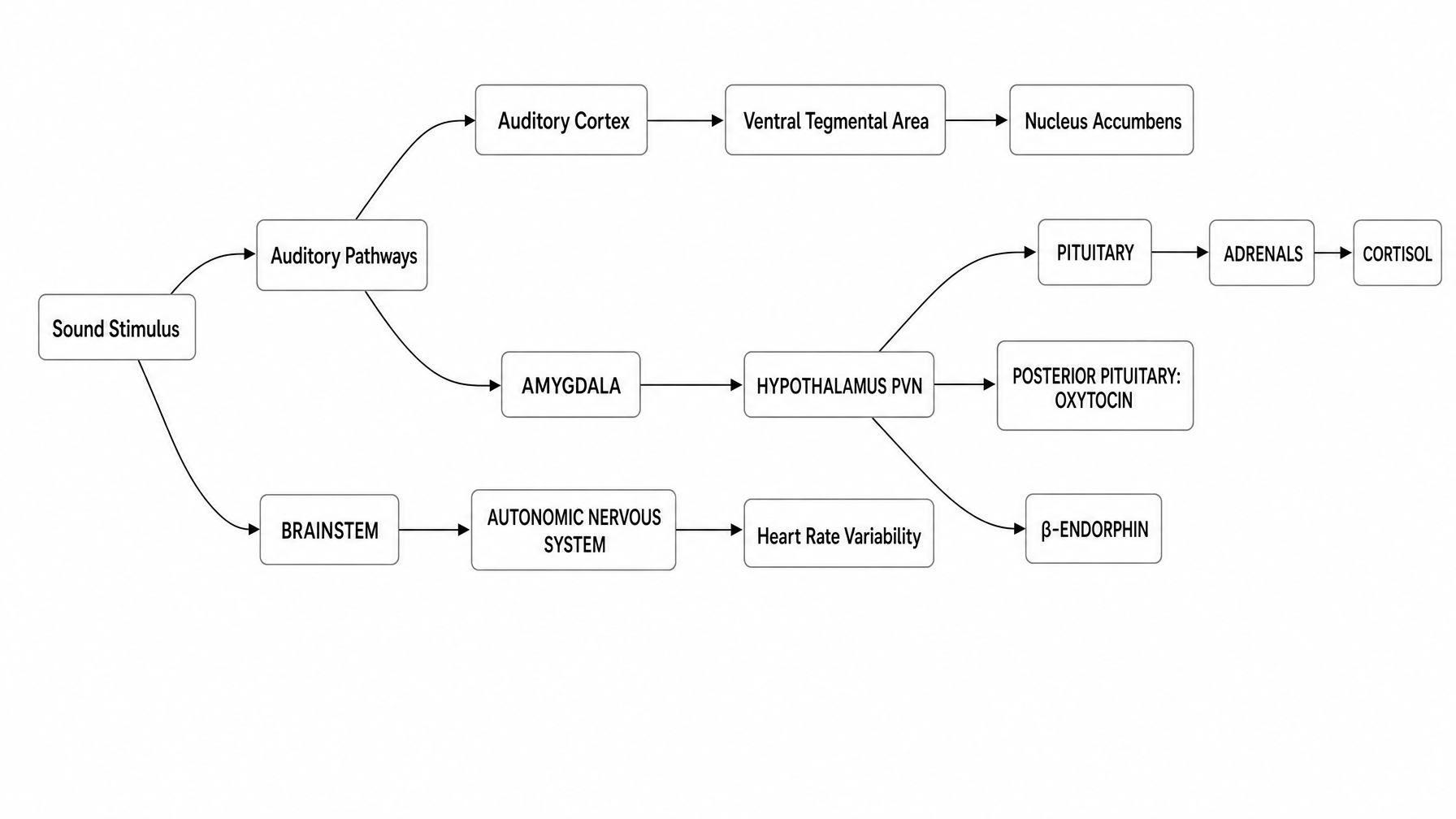
Recent studies show that listening to music and natural sounds can alter biomarkers: for example, pleasurable music elicits striatal dopamine release, slow-tempo music raises oxytocin and heart-rate variability (parasympathetic tone) while fast music lowers cortisol, and “happy” (major-key) music reduces cortisol more than “sad” (minor-key) music. Active, preferred music typically produces stronger effects than passive or mismatched sounds.
Clinically, music therapy and therapeutic soundscapes in hospitals, workplaces or urban design have been shown to reduce stress, anxiety, pain and even influence immune markers. For example, perioperative music lowers cortisol and preserves NK-cell counts, and live music therapy can markedly dampen sympathetic tone in palliative care. Based on the evidence, design guidelines emphasize slow tempos, consonant harmony, inclusion of natural sound elements, and user choice to maximize beneficial hormone responses.
However, many studies are small or heterogeneous, and long-term hormonal effects are under-studied. Key research gaps include standardized protocols, individual differences (expectancy/placebo), and mapping exact neural-hormonal mechanisms. This report surveys the neural mechanisms (auditory cortex → limbic/hypothalamus → endocrine), summarizes human/animal evidence (music vs. noise, biomarkers), and gives practical soundscape design recommendations with citations to recent primary studies and reviews.
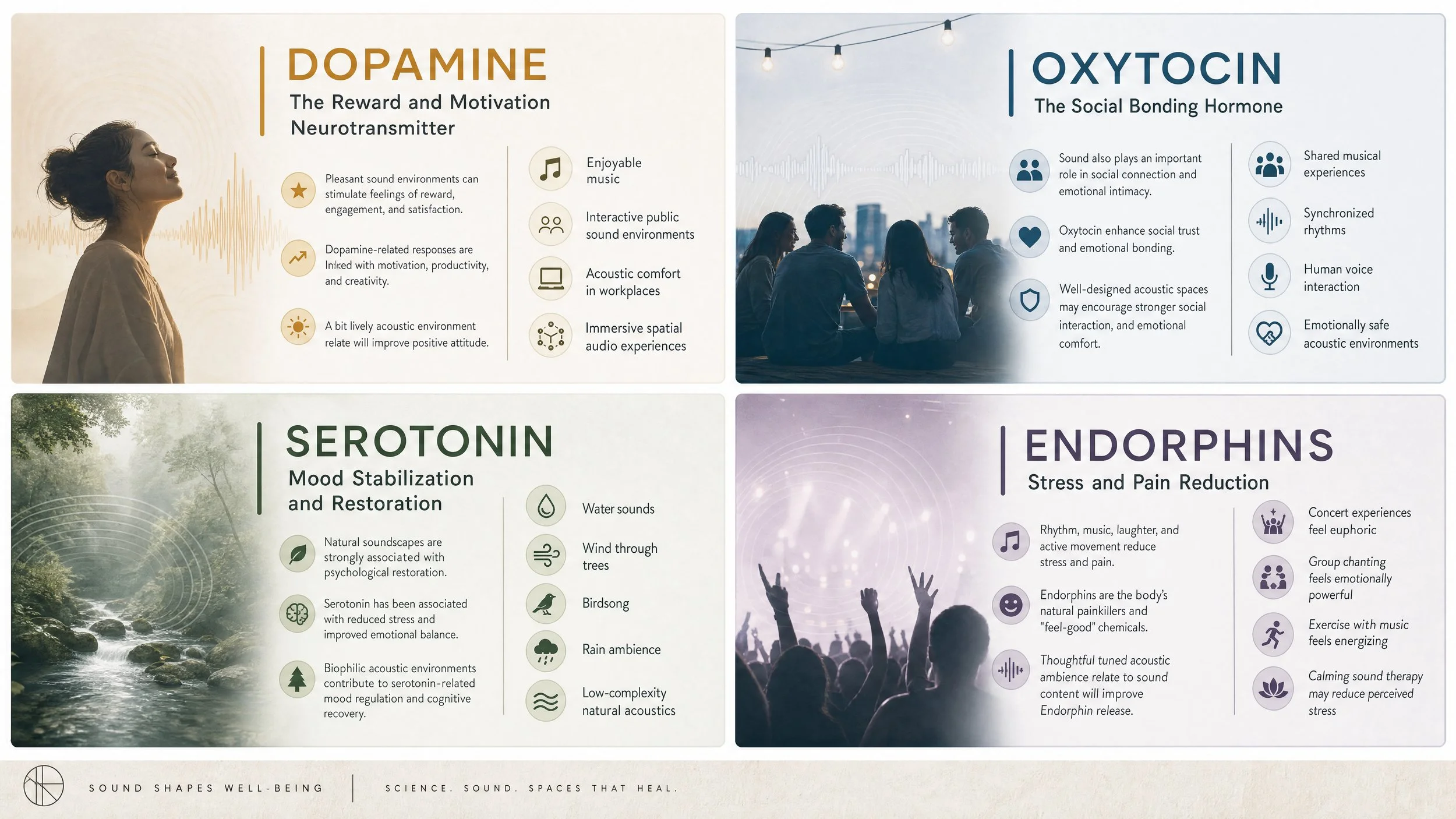
Dopamine and Motivational Sound Environments
Dopamine is often associated with motivation, reward, engagement, and anticipation. Pleasant and stimulating sound environments may encourage dopamine-related responses that support productivity, creativity, and positive emotional states.
Highly pleasurable music elevates dopamine. Using PET, Salimpoor et al. (2011) observed endogenous dopamine release in human striatum during peak “chills” in music. This was paralleled by other imaging studies showing nucleus accumbens activation to anticipated and received musical reward. Such dopamine release links music to reward and learning, explaining its motivational impact.
Examples include:
enjoyable music
immersive spatial audio experiences
lively but comfortable café ambience
acoustically optimized collaborative workplaces
Moderately dynamic sound environments can create psychological stimulation without causing stress overload. In workplace design, this balance may contribute to higher engagement, improved concentration, and enhanced user experience.
For commercial and hospitality environments, carefully curated auditory atmospheres can also influence emotional perception and customer behavior.
Oxytocin and Social Acoustic Interaction
Oxytocin is commonly referred to as the “bonding hormone” because of its role in social trust, emotional connection, and interpersonal comfort.
Music and social sound engagement often boost oxytocin (a “bonding” neuropeptide). In one study, listening to a slow-tempo (relaxing) music sequence for 20 min significantly raised salivary oxytocin. By contrast, fast-tempo (arousing) music primarily lowered cortisol. Similarly, reviews note that gentle music or group singing elevates oxytocin, fostering social connectedness. A recent review (Chu & Tsai, 2026) finds that short-term music sessions often produce detectable oxytocin spikes, whereas long-term therapy does not change baseline oxytocin. For example, listening to calming music raised oxytocin without changing self-reported mood, implying a neuroendocrine relaxation effect. Group singing studies (Kreutz 2004 etc.) similarly report salivary oxytocin increases
Sound plays a significant role in human social interaction. Shared musical experiences, synchronized rhythms, clear speech communication, and emotionally safe acoustic environments can encourage stronger social engagement and collective emotional response.
Examples include:
concert experiences
communal worship spaces
collaborative work environments
educational settings
acoustically comfortable public spaces
Poor speech intelligibility and excessive reverberation often reduce communication quality and increase cognitive fatigue. In contrast, well-designed acoustic environments can strengthen inclusivity, social participation, and emotional comfort.
This is particularly relevant in healthcare, hospitality, workplace, and educational design where human interaction becomes a critical component of well-being.
Serotonin, Restoration, and Biophilic Soundscape
Natural soundscapes are strongly associated with psychological restoration and stress recovery. Exposure to water sounds, wind through trees, rainfall ambience, and birdsong has been linked to improved emotional balance and reduced mental fatigue.
Evidence is mixed. Serotonin (5-HT) is a mood/stress mediator, but few studies directly measure it after sound. One early experiment (Evers & Suhr, 2000) used platelet 5-HT as a proxy and found that unpleasant music caused increased release of serotonin (platelet 5-HT fell). Pleasant music kept platelet 5-HT higher. In short, aversive sounds can trigger serotonin release (possibly as stress response). However, other studies note only subtle or transient serotonin changes. Overall, the psychophysiological review on music & pain concludes that music’s influence on serotonin is variable and context-dependent. More research is needed on how different sounds (e.g. relaxing vs irritating) affect serotonin.
These restorative qualities align closely with biophilic design principles, which seek to reconnect humans with natural systems and sensory experiences.
Biophilic acoustic environments may support serotonin-related mood stabilization by:
reducing stress perception
improving relaxation
supporting cognitive recovery
enhancing perceived environmental quality
In urban environments increasingly dominated by mechanical noise and digital overstimulation, integrating natural sound elements may become an important strategy for improving mental wellness and environmental satisfaction.
Endorphins and Positive Emotional Activation
Endorphins are natural neurochemicals associated with pleasure, stress reduction, and pain relief. Rhythm, music, movement, and emotionally engaging auditory experiences may stimulate endorphin release and improve emotional resilience.
Endogenous opioids modulate pain and mood. Direct blood measurements are rare, but behavioral proxies are used. Multiple studies report that group music-making raises pain thresholds, implying endogenous opioid release. For instance, choral singing and rhythmic dance both increased participants’ pain tolerance (measured by, e.g., pressure algometry). These activities are known to induce social bonding and positive affect, consistent with release of β-endorphin (an analgesic peptide produced in the hypothalamus/pituitary). Neuroimaging shows μ-opioid receptor involvement in music-induced pleasure. Overall, music (especially synchronized group music) appears to engage the endogenous opioid system, though measuring circulating β-endorphin in humans is challenging
Examples include:
live music events
rhythmic group activities
exercise accompanied by music
calming sound therapy environments
This explains why certain acoustic experiences feel emotionally uplifting, immersive, and physically energizing. In wellness-oriented architecture, thoughtfully designed sound environments can therefore contribute to both emotional comfort and physiological relaxation.
Cortisol and Stress Hormones
Cortisol (in humans) or corticosterone (rodents) reliably drops with calming sound and rises with loud noise. Ooishi et al. (2017) showed that 20 min of slow music decreased salivary cortisol, while fast music lowered it even more (fast tempo raised arousal). In a stress-recovery trial, Radstaak et al. (2014) found that listening to several genres of relaxing music significantly reduced cortisol and systolic BP, while adding nature sounds further lowered diastolic BP. White noise or harsh noise, by contrast, generally fails to reduce cortisol or may even maintain stress levels: Sokhadze (2007) reported that both pleasant and sad music aided cardiovascular recovery after stress, whereas white noise did not improve recovery. In perioperative settings, music interventions yield clear hormonal effects. Leardi et al. (2007) observed that patients listening to music during surgery had lower plasma cortisol than silent controls; importantly, those allowed to choose their own music had even lower postoperative cortisol than those assigned music. Likewise, music therapy studies often report cortisol reductions and lower heart rate/pressure relative to control. For example, Ugras et al. (2018) found that various music types lowered anxiety and cortisol in patients, with both Turkish classical and Western music outperforming silence.
Other Biomarkers
Sound exposure also influences other stress and immune markers. For instance, Calamassi et al. (2022) found that listening to 432 Hz music (vs 440 Hz) during a break significantly reduced anxiety and even lowered blood pressure. Warth et al. (2016) reported that live music in palliative care increased heart rate variability (parasympathetic) more than recorded relaxation. In chemotherapy patients, music therapy reduced subjective anxiety more than guided relaxation, though objective biomarkers (skin temperature) also improved. Overall, sound interventions often decrease sympathetic biomarkers (blood pressure, heart rate, catecholamines) and can modulate immune indices (e.g. natural killer cells)
Sound Types and Listening Context
Studies highlight that the characteristics of sound critically shape hormonal outcomes:
Tempo and Energy: Slow, low-arousal music promotes parasympathetic responses and relaxation. Ooishi et al. (2017) found slow-tempo music increased oxytocin and vagal tone, whereas fast-tempo (upbeat) music was linked to cortisol suppression and higher arousal. Similarly, Sharma et al. (2021) reported that music with gradual tempo variations induced calmer brainwaves and lower anxiety than monotonous music.
Harmony and Mode: Consonance and “happy” modes yield stronger stress relief. Suda et al. (2008) showed major-key music reduced cortisol more than minor-key. Pleasant, familiar harmonies tend to engage reward circuits more fully. In contrast, dissonant or jarring sounds (e.g. random noise, heavy metal) can elevate stress hormones. Sound interventions using consonant intervals and simple structures (e.g. ambient piano) generally have more soothing effects.
Sound Source – Natural vs Mechanical: Nature soundscapes (birds, rain, running water) often produce beneficial effects. For example, adding water/forest sounds to hospital environments has been associated with lower stress measures (blood pressure, cortisol) than noisy urban sounds. In Uğraş et al. (2018), even passive nature sounds alongside music significantly lowered diastolic BP. By contrast, continuous mechanical or white noise yields little benefit: Sokhadze (2007) found that both pleasant and sad music aided stress recovery after a negative task, whereas white noise did not improve physiological recovery.
Volume/Intensity: Moderate volume is key. Too-soft music may not engage the brain effectively, whereas loud noise (above ~85–90 dB) is recognized as a stressor that triggers HPA activation. Many studies therefore use comfortable listening levels (around 60–70 dB). In practice, maintaining sound levels that do not startle or fatigue listeners is recommended to avoid cortisol spikes.
Exposure Duration and Timing: Both the length and timing of exposure matter. Short sessions (5–30 min) are often sufficient to see immediate hormone shifts, but effects may be transient. Chu & Tsai (2026) note that short-term music interventions reliably raised oxytocin, whereas long-term therapy (weeks of music sessions) did not change baseline oxytocin. This suggests most hormonal responses reflect acute changes rather than lasting endocrine reprogramming. Repeated or continuous exposures might lead to habituation if not varied. Some studies (e.g. Tang et al., 2009) show short-term BP reductions with both relaxing audio and music that dissipate over months, indicating primarily transient relief.
Active vs. Passive Listening: Engagement and choice amplify effects. When participants actively select or attend to the music, hormonal changes are generally larger than under passive or background conditions. Leardi et al. (2007) found that patients choosing their own music during surgery had greater cortisol reductions than those given standard “new age” music. Similarly, Singh et al. (2009) reported that hospitalized patients who listened to self-selected music experienced larger drops in anxiety and breathing rate than those doing guided relaxation. Attending to music (vs ignoring it) engages limbic reward and emotional circuits more fully. Thus preferred and personally meaningful music yields stronger neuroendocrine effects. Active engagement (e.g. singing, dancing) further boosts endorphins and oxytocin compared to passive listening.
Contextual Factors: The listener’s context and emotional state modulate outcomes. For instance, music during a stressful procedure can offset anxiety, whereas the same music might simply energize a listener at rest. Some studies (Lunde et al., 2022) even show that expectancy (belief in benefit) partly determines music’s effect on pain. In general, matching the music style and timing to the situation (e.g. calming music for stress-reduction, upbeat music for motivation) enhances beneficial hormone responses.
Design Applications
Music Therapy: Clinicians exploit these effects to improve health outcomes. Music therapy – structured interventions by certified therapists – is used in hospitals, clinics and community settings to reduce stress and pain. Systematic reviews report that music therapy significantly reduces anxiety, depression, and pain in patients with cancer, dementia, and undergoing surgery. For example, Leiardi et al. (2007) showed that perioperative music lowered patient cortisol and preserved immune NK-cells. In pain management, music can reduce opioid use: a review notes that music-based interventions diminish the need for pain medication, likely via endogenous endorphin and dopamine mechanisms. In rehabilitation (stroke, Parkinson’s), rhythmic auditory cues have improved motor recovery, potentially through dopamine release.
Healthcare Soundscape Design: Beyond therapy sessions, hospital and clinic soundscapes are being redesigned for health. Soothing ambient music and nature sounds in waiting rooms or patient rooms have been associated with lower stress and better patient satisfaction. For instance, playing gentle classical or nature sounds in dental or ophthalmology waiting areas has been shown to reduce patient anxiety and blood pressure. Conversely, noisy hospital environments (alarms, machinery) elevate cortisol and impede healing. Hospital designers now recommend “quiet hours”, noise-reducing materials, and curated calming soundtracks to promote recovery. Although direct citations in this report are limited, the same physiological principles apply: built environments that minimize intrusive noise and incorporate pleasant natural audio cues can attenuate HPA-axis activation and enhance comfort.
Workplace and Urban Planning: The insights extend to workplaces and cities. In offices or open-plan environments, well-chosen background music or sound masking (e.g. low-level natural sounds) can reduce stress and improve focus, whereas disruptive noise (traffic, construction) raises cortisol and fatigue. Urban planners use “soundscape” design by preserving quiet natural areas, incorporating green space with bird habitat, and installing water features that produce calming sounds. Studies have found that access to natural soundscapes (parks with bird songs, streams) correlates with lower stress biomarkers in residents. Noise mitigation (sound barriers on highways, regulations on nightlife noise) similarly prevents chronic stress responses. While controlled studies in real-world settings are fewer, the laboratory evidence on how sound modulates hormones provides a strong rationale for these applications.
Key Studies of Sound Effects on Hormones and Biomarkers
Selected examples are summarized below.
BNP: blood pressure, NK: natural killer cells.
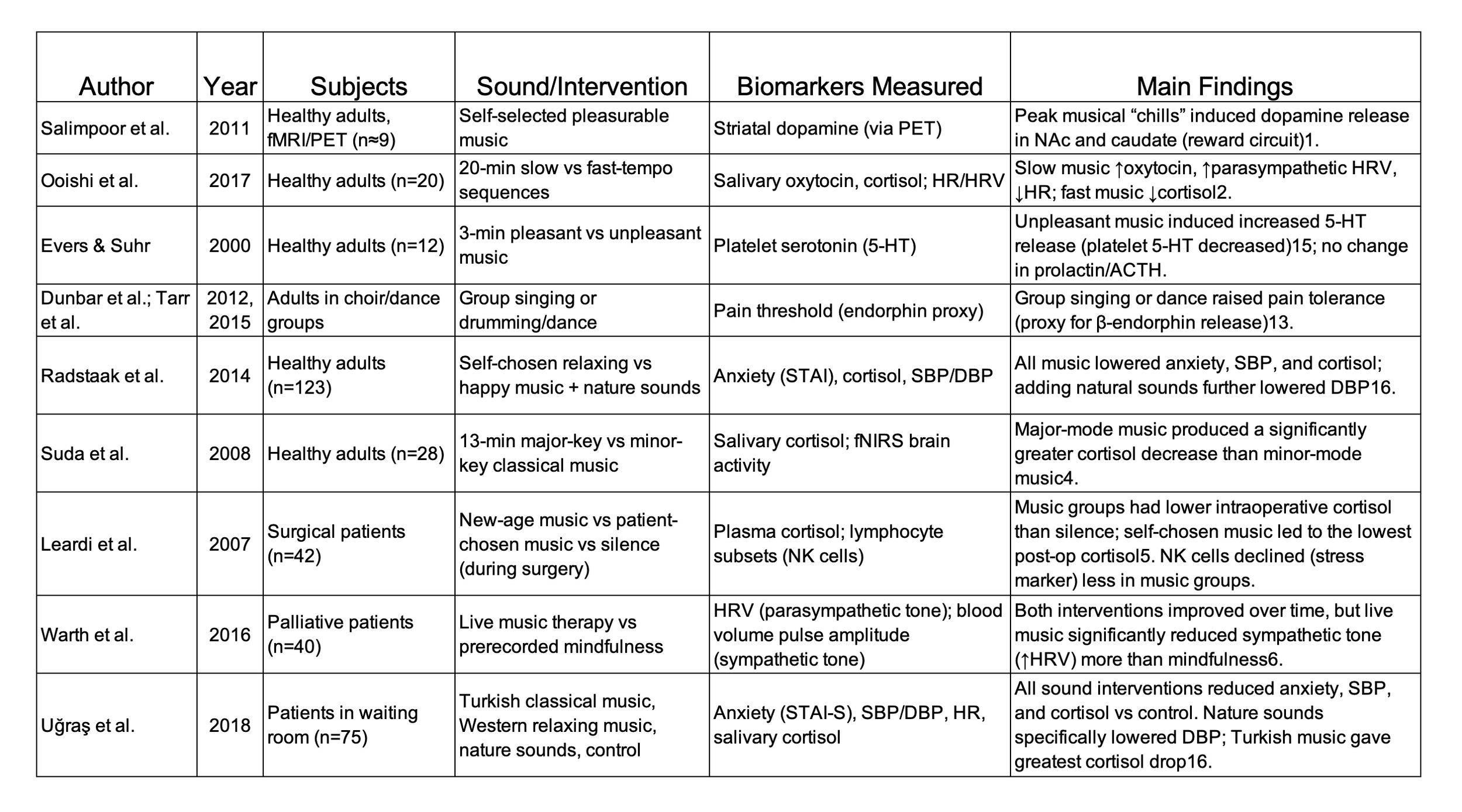
Implications for Human-Centric Environmental Design
The future of acoustic consultancy is evolving from simple noise mitigation toward human-centric soundscape design. This emerging approach integrates: acoustics, neuroscience, environmental psychology, architecture, urban ecology, wellness-centered development.
Future healthy buildings may intentionally optimize not only: architecture, interior, thermal comfort, lighting quality, air quality and energy efficiency but also auditory wellbeing and emotional restoration.
Potential strategies include:
integrating water features
preserving biodiversity sound
creating quiet restorative zones
improving speech comfort
reducing mechanical noise stress
designing acoustically supportive social environments
As cities become denser and more technologically complex, the quality of auditory experience may become one of the defining factors of healthy and emotionally sustainable environments.
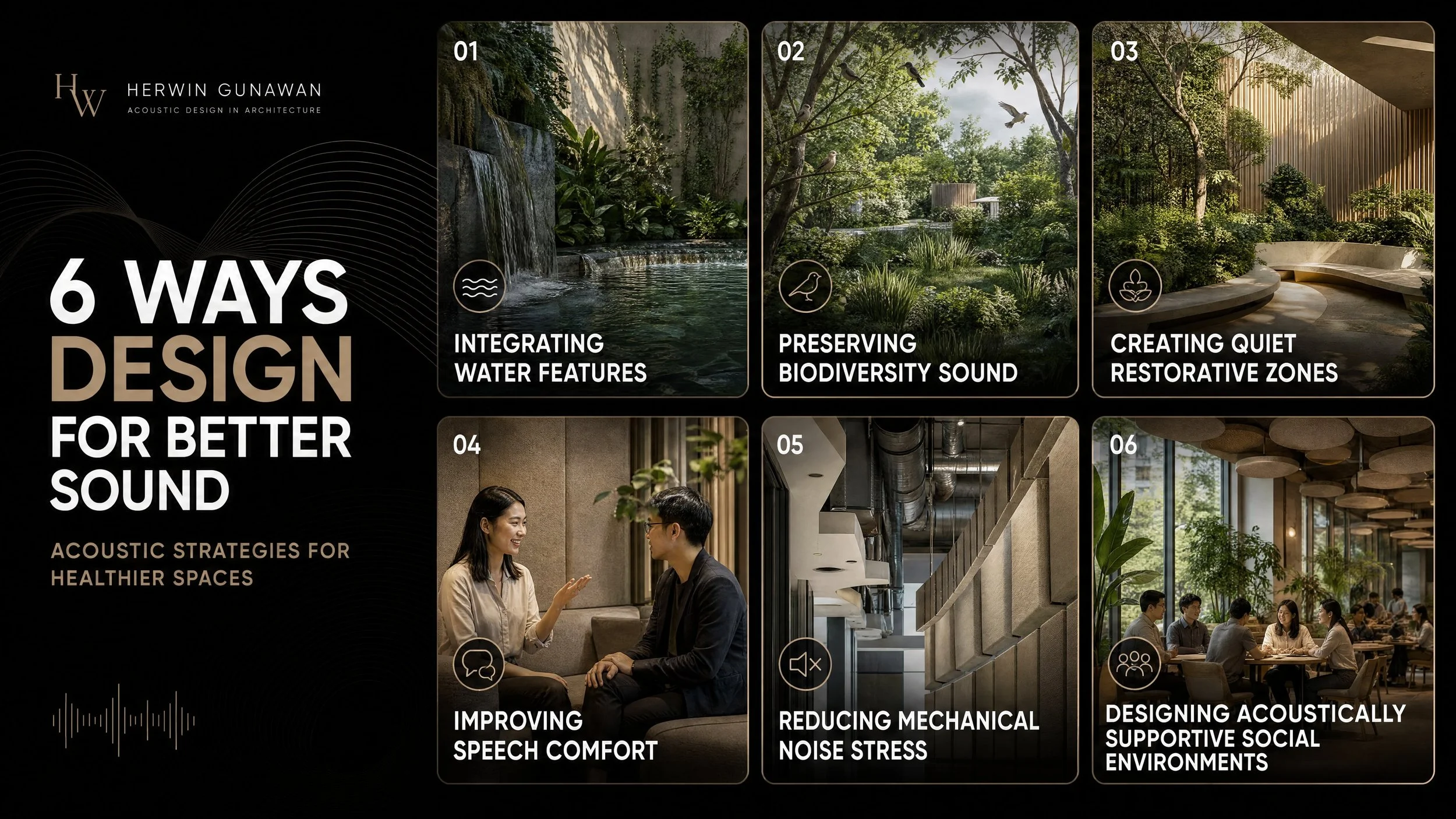
Conclusion
Soundscape is no longer merely an acoustic background condition. It is a biological, emotional, and psychological component of human experience.
Emerging research suggests that auditory environments may influence hormonal balance, emotional regulation, cognitive performance, stress recovery, and social interaction. This understanding challenges architects, engineers, designers, and urban planners to rethink the role of sound within the built environment.
The future of healthy building design may depend not only on what people see, but also on what they hear — and how those sounds shape human well-being from both psychological and physiological perspectives.
In summary, an evidence-based approach to sound design—grounded in neuroendocrinology—can promote mental health and physiological balance. Future research should continue to refine our understanding of how to best “tune” auditory environments for hormonal health, addressing the noted limitations and targeting understudied areas (long-term effects, serotonin, individual variability).

Building Performance Modeling Trainee

Are you the right person?
ALTA Integra a Multi-Discipline Building Physics Engineering Design is seeking a Building Performance Modeling Trainee to work in our office in Jakarta. We seek someone who understands the fundamentals of building physics (acoustic, lighting, thermal, and air quality) and is also creative and proficient in management.
Job description
Supports the consultant team during the design phase by conducting various simulations for acoustic, acoustic, lighting, thermal, and air quality project
Organizing and arranging the engineering design report based on the given content
Qualifications
Bachelor's Degree or Master's Degree in architecture/engineering physics/related engineering field ·
Understands the fundamentals of building physics (acoustic, lighting, thermal, and air quality) ·
Willing to learn the workflow of building physics software such as EASE/CATT, Dialux EVO, and Energy Plus (proficient in it will be a plus point!) ·
Creative and able to arrange an engineering design report ·
The ability to effectively coordinate with internal engineering team members is required. ·
Excellent communication and interpersonal skills ·
Must display enthusiasm, motivation, and be goal-oriented
Submit your CV and Cover Letter
through email hrd@altaintegra.com
Subject : 2022 Building Performance Modeling Trainee - (Your Name)
For more info, visit our website at altaintegra.com

How to Improve Speech Intelligibility in a Poor Acoustic Room Without Spending a Fortune

You've just finished building your nice meeting room. After you try you realize that the meeting room has a bad acoustic sound but you do not want to spend more money.
The Bad Acoustic Room Situation
You have finally completed your dream space—whether it's an auditorium, meeting room, classroom, lecture hall, house of worship, restaurant, multipurpose hall, or any other gathering space. The architecture is impressive. The interior is beautifully finished. The furniture is premium. The LED video wall is crystal clear, and the audiovisual system features the latest technology.
Everything looks perfect.
Then the first presentation, meeting, sermon, lecture, or event begins.
The room sounds terrible.
People struggle to understand the speaker. Conversations become exhausting to follow. Voices echo throughout the room, important words are lost, and online participants complain that the audio is unclear. Instead of supporting communication, the room becomes a barrier to it.
If this sounds familiar, don't panic—and don't rush to spend a fortune on acoustic panels or a completely new sound system.
Many speech intelligibility problems can be solved through smart engineering rather than a larger budget. By identifying the real cause—whether it's excessive reverberation, background noise, poor loudspeaker coverage, or room geometry—you can often achieve significant improvements with simple, targeted, and cost-effective solutions before considering major renovations.
What should you do, if you don’t have any luxuries to do big renovation?
You can try Lombard Speech. Lombard Speech is the speaking technic that produces better intelligibility speech than normal speech. The differences between Lombard Speech and Normal Speech are:
increase in phonetic fundamental frequencies
the shift in energy from low-frequency bands to middle or high bands
increase in sound intensity
increase in vowel duration
spectral tilting
the shift in formant center frequencies for F1 (mainly) and F2
the duration of content words are prolonged to a greater degree in noise than function words
greater lung volumes are used,
it is accompanied by larger facial movements, though these do not aid as much as sound changes
Lombard's speech technic was developed from the Lombard reflex. The Lombard reflex or Lombard effect was discovered in 1909 by Etienne Lombard, a French otolaryngologist. Lombard effect is the involuntary tendency of speakers to increase their vocal effort when speaking in loud noise to enhance the audibility of their voice. This change includes not only loudness but also other acoustic features such as pitch, rate, and duration of syllables. This compensation effect maintains the auditory signal-to-noise ratio of the speaker's spoken words.

The human brain automatically changes speech made in the noisy space through a process called the Lombard Effect. This happens because humans want to hear their own speech with their ears. Such speech has increased intelligibility compared to normal speech. It is not only louder but the frequencies of its phonetic fundamental are increased and the duration of its vowels are prolonged. People also tend to make more noticeable facial movements.
According to the researchers below listeners hear a Lombard Speech recorded with background noise better than they hear a Normal Speech which has been recorded in quiet with masking noise applied afterward.
Junqua JC on his publication tittle “The Lombard reflex and its role on human listener and automatic speech recognizer” in January 1993, and Summers WV, Pisoni DB, Bernacki RH, Pedlow RI, Stokes MA (September 1988). “Effect of noise on speech production: acoustic and perceptual analyses” in September 1988.
In a typical office, people usually have to raise their voices when they speak in bad sound situations. This is because of the bad acoustic design in your room.
With our experience and expertise, we will be able to help you create an amazing sound in your space. No matter if it's just one classroom or entire university campus! Our services include acoustic measurement & problem analysis, acoustic modeling, recommendation design, hand-over testing commissioning and occupants pre & post-construction satisfaction survey! You can contact us by clicking the contact us button above, so we can discuss how much money you could save by using our services instead of asking multiple contractors separately!

Six speech types that humans decide to do while talking in a noisy or reverberant environment or with a listener with a hearing impaired

According to various studies, people psychologically will change their voice level, voice tonality, vowel duration, and interval tempo to improve their speech intelligibility in a bad listening situation. What are those bad listening situations?
First, there are two technical factors that reduce speech intelligibility and word recognition: (i) the quality of the acoustic environments such as background noise and reverberation time of the space, (ii) the quality of the sound system. Second, there are two human factors that reduce speech intelligibility and word recognition: (i) the speakers’ speech quality such as low voice level, bad phonetic, muddy tonality, or talk too fast (ii) the hearing quality of the listeners.
To improve speech intelligibility and words recognition, there are six speech types that humans decide to do while talking in a bad acoustical situation or bad sounding sound system or while talking to a human with hearing impaired. In a bad technical situation such as acoustic or sound system, there are the three types of speech that people usually do in order to increase their speech intelligibility.
Lombard speech
The human brain automatically changes speech made in noise through a process called the Lombard Effect. Such speech has increased intelligibility compared to normal speech. It is not only louder but the frequencies of its phonetic fundamental are increased and the duration of its vowels are prolonged. People also tend to make more noticeable facial movements.
Hyperspace speech
Hyperspace speech, also known as the hyperspace effect, occurs when people are misled about the presence of environmental noise. It involves modifying the F1 and F2 of phonetic vowel targets to ease perceived difficulties on the part of the listener in recovering information from the acoustic signal.
Screaming speech
Shouted speech is less intelligible than Lombard speech because increased vocal energy produces decreased phonetic information. However, "infinite peak clipping of shouted speech makes it almost as intelligible as normal speech."

The human brain automatically instruct our mouth to speak louder in the noisy environment
And when speaking to elder people that have a hearing impaired there are the three types of speech that people usually do in order to increase their speech intelligibility to improve the listener word recognition.
Clear speech
Clear speech is used when talking to a person with a hearing impairment. It is characterized by a slower speaking rate, more and longer pauses, elevated speech intensity, increased word duration, "targeted" vowel formants, increased consonant intensity compared to adjacent vowels, and a number of phonological changes (including fewer reduced vowels and more released stop bursts).
Infant-directed speech
Infant-directed speech — or baby talk — uses a simplified syntax and a small and easier-to-understand vocabulary than speech directed to adults. Compared to adult-directed speech, it has a higher fundamental frequency, exaggerated pitch range, and slower rate.
Citation speech
Citation speech occurs when people engage self-consciously in spoken language research. It has a slower tempo and fewer connected speech processes (e.g., shortening of nuclear vowels, devoicing of word-final consonants) than normal speech.

We tend to change our voice while talk to elder people with hearing impaired
Do you want to improve your communication quality, and do not know where to start?
We’re ALTA Integra, a team of acoustic and audio experts who are dedicated to helping people with a bad technical listening situation. Our mission is to help people hear better in every situation. If you have trouble understanding what others are saying because of noise, echo, bad sound system we can help!
We offer a range of products that will make it easier for you to communicate clearly in any environment. Whether it’s at home, work, school, or worship hall – our services will give you back the ability to understand what’s being said around you so that life becomes more enjoyable again. Nobody shouldn’t have to feel missed out because of a bad sound situation! Let us show you how much better life can be when you can bring communication back to life again. It's time for change - let's get started today!
Click the contact button on the upper right now and schedule an appointment with one of our team today!

What is STIPA or Speech Transmission Index for Public Address
Learn what STIPA (Speech Transmission Index for Public Address) is, how it measures speech intelligibility, and why it is essential for public address systems, voice alarm systems, airports, schools, hospitals, houses of worship, and other buildings where clear communication is critical for safety and occupant experience.
Inclusivity Design Principle, every one is included.
“It is important to have good speech intelligibility in order for everyone to feel involved.”
Whether you design a meeting room, worship hall, auditorium and etc, considering Speech Transmission Index for Public Address (STIPA) is a must, before it's too late. And If you want people to be able to hear your voice from the back row of a room, then you have to read this.

Whether in a classroom, seminar, or worship place when someone has trouble hearing you, they will stop listening and become distracted by other things such as speak to someone sitting beside them, boring, sleepy, or do something with their smartphone.
Intelligibility
In speech communication, intelligibility is a measure of how well-received and understood your words are. It's affected by the quality of the speech signal of the normal voice level you put in when speaking as well as any background noise and reverberation from within a space where people will be listening. And, for speech over communication devices, the properties of the communication system.
The concept of speech intelligibility is relevant to the multi-discipline fields, including phonetics, human factor, acoustical engineering, audio engineering (for electronic amplification), and audiometry.
Understanding Speech Intelligibility in Modern Buildings
In airports, railway stations, houses of worship, classrooms, conference halls, transportation hubs, hospitals, and emergency evacuation systems, speech clarity is not simply an acoustic luxury — it is a critical performance requirement. Even the most advanced public address (PA) system can fail if occupants cannot clearly understand spoken announcements.
This is where STIPA (Speech Transmission Index for Public Address) becomes essential.
STIPA is an internationally recognized acoustic measurement method used to evaluate how intelligible speech is within a space through a public address or voice alarm system. It quantifies how clearly speech signals are transmitted from a loudspeaker system to listeners in real acoustic environments.
Speech Intelligibility Rating in simple method
Speech Intelligibility is a rating of the proportion of speech that is understood. For example, if the speaker says 100 words and we can hear 90 words out of 100 words clearly then we can say the speech intelligibility is 90 percent. The problem with this method is the measuring time will consume a lot of time. For example, if we want to measure the very long speech consist 10,000 or 100,000 words it will take forever.
Why Speech Intelligibility Matters
In many buildings, poor speech intelligibility can lead to:
Miscommunication
Occupant confusion
Reduced learning performance
Worship experience degradation
Operational inefficiency
Safety risks during emergency evacuation
A sound system may be loud enough, but still unintelligible because of:
Excessive reverberation
Background noise
Echoes
Poor loudspeaker placement
Distortion
Inadequate room acoustics
STIPA helps identify these issues scientifically and quantitatively.
What Does STIPA Mean?
STIPA stands for: Speech Transmission Index for Public Address. It is a simplified and faster version of the broader STI (Speech Transmission Index) methodology defined in the international standard: IEC 60268-16. The method was specifically developed to assess speech intelligibility in electro-acoustic systems such as:
Public Address Systems
Voice Alarm Systems
Emergency Evacuation Systems
Transportation Announcement Systems
Auditorium Sound Reinforcement
Worship Space Audio Systems
Educational and Corporate Communication Systems
Unlike subjective listening tests, STIPA provides an objective and repeatable numerical value that predicts how understandable speech will be to occupants within a space.
Video Explain: Why Rooms and Spaces Often Struggle With Speech Clarity? What is Speech Intelligibility? What is STIPA?
How STIPA Works
STIPA evaluates how speech modulation is preserved as sound travels through a transmission path consisting of:
Loudspeakers
Amplifiers
Digital signal processors
Room acoustics
Ambient noise conditions
The method uses a specialized test signal that simulates the modulation characteristics of human speech. The received signal is then analyzed to determine how much speech information has been degraded.
STI / STIPA Rating Scale
The IEC 60268-16 standard generally classifies STIPA/STI performance as table below.
Where: 0.00 = Completely unintelligible, 1.00 = Perfect speech intelligibility.
For most public buildings and emergency systems, a minimum target of STI is above 0.50.

Speech Transmission Index value to Percentage of Phonetic Balance (PB) word score
Factors That Affect STIPA Performance
Several architectural and electro-acoustic factors directly influence speech intelligibility:
1. Reverberation Time
Excessive reverberation causes syllables to overlap, reducing speech clarity.
2. Background Noise
HVAC systems, traffic noise, crowd noise, and mechanical equipment can mask speech information.
3. Loudspeaker Design & Placement
Incorrect speaker coverage or excessive spacing creates uneven intelligibility.
4. Echo & Reflections
Strong delayed reflections reduce articulation and comprehension.
5. Signal Processing
Improper equalization, delay settings, or dynamic processing may degrade intelligibility.
6. Room Geometry & Materials
Highly reflective surfaces often reduce speech definition.
STIPA vs STI
Although closely related, STIPA and full STI are not identical. STIPA was developed specifically to provide rapid and reliable field measurements for installed public address systems.
What is STI? (Speech Transmission Index)
In order to have the objective method of prediction and measurement of Speech Intelligibility, Tammo Houtgast and Herman Steeneken were tasked to carry out a very lengthy series of dull speech intelligibility measurements for the Netherlands Armed Forces. In 1971 they introduced The Speech Transmission Index and was accepted by The Acoustical Society of America in 1980. Their Speech Transmission Index (STI) calculation for prediction and measurement method is a much quicker objective method to the predecessor method.
What is STIPA? (Speech Transmission Index for Public Address Systems)
STIPA is a condensed and approximate version of the Speech Transmission Index (STI) measurement method for Public Address systems. Within the STIPA signal, each octave band is modulated simultaneously with two modulation frequencies. The modulation frequencies are spread among the octave bands in a balanced way, making it possible to obtain a reliable STI measurement based on a sparsely sampled Modulation Transfer Function matrix. Although initially designed for Public Address systems (and similar installations, such as Voice Evacuation Systems and Mass Notification Systems), STIPA can also be used for a variety of other applications.
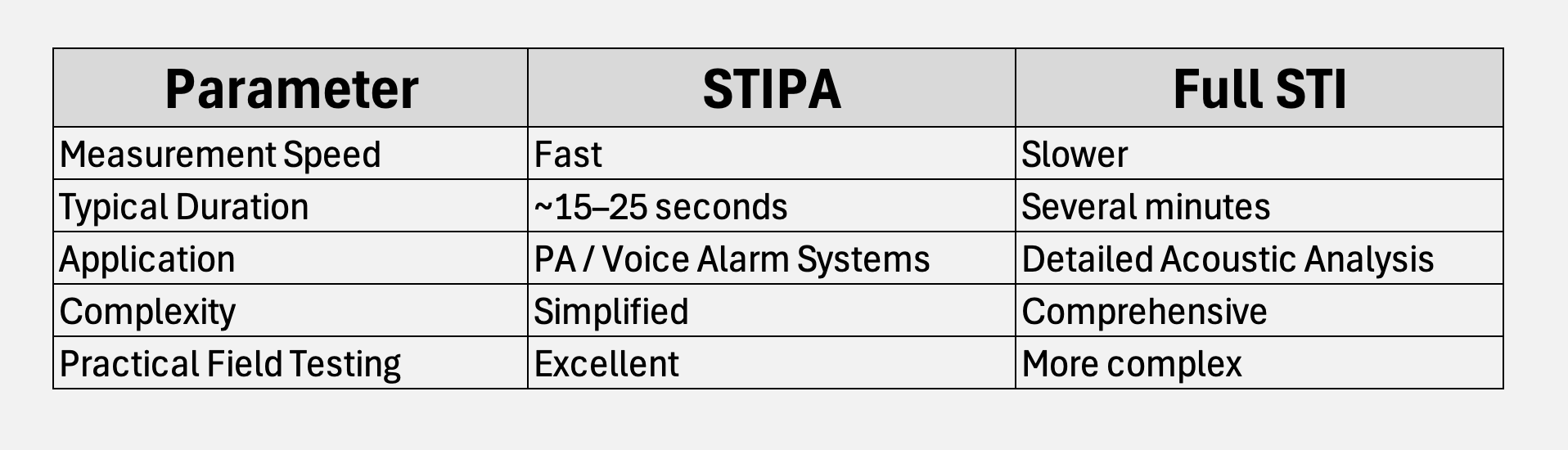
International Standards Related to STIPA
STIPA measurements are widely referenced in international acoustic and life-safety standards, including:
IEC 60268-16
ISO 7240-24
NFPA 72
BS 5839-8
EN 54
ANSI/ASA acoustic standards
These standards are particularly important for:
Emergency communication systems
Fire alarm voice evacuation systems
Transportation facilities
Educational environments
Large public venues
Typical Applications of STIPA
Transportation Facilities
Airports, railway stations, and transit terminals require clear announcements for operational efficiency and safety.
Worship Spaces
Churches, mosques, and temples often struggle with long reverberation times that reduce sermon intelligibility.
Educational Buildings
Speech intelligibility directly affects learning performance and listener fatigue.
Corporate & Conference Facilities
Clear communication improves collaboration and speech privacy management.
Emergency Evacuation Systems
Life-safety announcements must remain intelligible during emergencies and high-noise conditions.
STIPA Measurement Process
A professional STIPA assessment generally includes:
Acoustic site survey
Background noise measurement
Calibration of test equipment
STIPA signal playback through the PA system
Multi-point intelligibility measurements
Acoustic analysis and mapping
Optimization recommendations
Compliance verification reporting
Modern STIPA measurement systems follow IEC 60268-16 procedures and typically recommend multiple averaged measurements for reliable results.

Our Acoustic and Audio Engineering team did STIPA measurement at Indonesia Stock Exchange Hall
The Role of Acoustic Consultancy in STIPA Optimization
Achieving high speech intelligibility requires more than selecting loudspeakers. It demands integrated coordination between:
Architectural acoustics
Electro-acoustic system design
Noise control
Reverberation management
Loudspeaker modeling
Signal processing optimization
Professional acoustic consultants can simulate and optimize speech intelligibility performance during the design stage, reducing costly post-construction corrections.
Conclusion
STIPA has become one of the most important objective metrics for evaluating speech intelligibility in modern buildings. As architecture becomes increasingly complex and communication-critical environments continue to grow, intelligible sound systems are no longer optional — they are essential components of safety, functionality, and human experience.
By combining acoustic science, electro-acoustic engineering, and architectural integration, STIPA enables designers and consultants to create environments where speech is not only heard, but clearly understood.
References
IEC 60268-16 Standard
NTi Audio – Speech Intelligibility STI Guide
Svantek – STIPA Overview
Wikipedia – Speech Transmission Index
ALTA Integra Acoustic and Audio Engineering Design Team will ensure your room not only can be used for its purpose but is also an enjoyable experience. Our STIPA (speech transmission index for public address) prediction and measurement method allows you to design a room where people are comfortable enough with the conversation, yet loud enough from speakers still being audible from blocks away."
There's no such thing as an insignificant detail in the world of acoustic and audio engineering design. This is why we at ALTA Integra take great pride in helping architects and other design professionals prevent hearing occupants from having to endure inadequate acoustics while listening or speaking, distracting echoes, or just experiencing something that sounds wrong for one reason or another.
#speech #intelligibility #public-address #soundsystem #audiosystem #speaker #architectural-acoustic #room-acoustics

How to design a better-sounding audio system in the reverberant room - so our ear can hear word by word?

After reading this article you will understand:
Architectural Acoustics and Audio System is one close system
A common misconception between Sabine Reverberation Time and Reverberant Sound Level
How to design a better-sounding audio system in a reverberant room, without redesign architectural acoustic.

Assume we sit in the back of the hall as shown in the picture above, and we barely hear the spoken word by word clearly because the reverberant sound level is bigger than the direct sound level. As we can see on the bar chart above if we sit at the front row the direct sound level is bigger than the reverberant sound level, in the middle part we might hear the balance of direct and reverberant sound.
Usually, in this situation, we always think it happens due to the longer Sabine Reverberation Time of the room, or the loudspeakers is too far so we need to add more loudspeakers at the back of the hall so the people can hear the speech more clearly.
This statement is not 100% correct.
Let’s analyze Hopkins and Stryker Equation as follow:

From the two equation above we know that there is a unbroken correlation between Architectural Acoustic Parameter such as Absorptoon Modifier (Ma), Total Acoustic Absorption in the room (Sa) and the Audio System Parameter such as Loudspeaker Directivity Index (DI), Number of Loudspeaker (N) and so on.
What should you know about designing a intelligibility sound system and room?
To increase speech intelligibility our goal is to make the direct sound level ratio is bigger than the reverberant level. As from the equation above, there are four things we have to be aware of if we want to increase the direct level while lowering the reverberant level.
(1) From the Direct Level Equation below we understand that if we want to increase the direct level, we can increase loudspeaker output level (Lw) and/or the Directivity Index (DI).

(2) But if we look at both equation Ld (direct level) and Lr (reverberant level) increasing loudspeaker output level (LW) will increase both LD and LR.

(3) From the Reverberant Level (Lr) equation, we also understand that quantity of loudspeakers (N) will affect the reverberant sound level (Lr). If we increase the number of loudspeakers (N) it means we increase the reverberant sound level (Lr).
(4) Directivity Index (DI) of Loudspeakers is accounted for Absortion Modifier (Ma) term in the LR formula. If the DI confines the energy to a specific area with a very reflective and reverberant room (RT60), then the Reverberant Level (LR) is reduced because the lower surface area that reflecting the direct sound of the loudspeakers.
To prove point number 2 above we make two (2) sound auralization in the hall comparing six (6) undelayed loudspeakers configuration versus four (4) delayed loudspeakers configuration as below.
Auralization & Animation Electro-Acoustic Software Modeling - 6 Undelayed Distributed Loudspeakers
Auralization & Animation Electro-Acoustic Software Modeling - 4 Delayed Distributed Loudspeakers
From the two auralization above we can conclude beside the importance of architectural acoustic design, to increase speech intelligibility we have to design simultaneously architectural acoustic and loudspeakers configuration as well as microphone position.
If you are facing a problem with lower speech intelligibility in your room, which makes your audience struggling to understand every word said.
If you have tried to solve the problem by buying better loudspeakers and it does not solve the problem.
If you want to improve speech intelligibility so your audience can hear better word by word spoken.
Our proven Architectural-Acoustic-Audio-System design methodology will help you get rid of this problem. We have a proven track record of helping companies solve their acoustical problems while saving money and time. Hit the Contact Us button below to discuss how we can help you.
#sound #sounddesign #acoustics #architecturalacoustic #audio #audiodesign #loudspeaker

Light reveals the original beauty of Saint Mary Assumption Cathedral Jakarta

What do Lighting Designer do?
The exterior of Saint Mary's Cathedral Church in Jakarta is a work of art. Our lighting designers want to bring back the original architectural beauty of this Neo-Gothic Cathedral in Jakarta.
Thanks to LED light technology now we can witness this magnificent church that can rightfully be called home to someone’s heart forevermore. The bright colors and intricate designs bring joy to the eyes.
New light technology gives a brighter light, better color rendering, and much lower energy consumption. It is giving us lights with a more colorful and bright appearance, as well as the ability to flood The Facade of The Saint Mary Cathedral Jakarta in colors that were never before possible.

Lighting designers verified their design concept with false color light mapping with Lighting Software Modeling such as DIALux
As Nikola Tesla once said “The scientific man doesn’t aim at an immediate result. He doesn’t expect that his advanced ideas will be readily taken up. His work is like that of the planter - for the future. His duty is to lay the foundation for those who are to come, and point the way.”
ALTA Integra is a multi-discipline building physics engineer designer such as acoustics sound, lights, thermal, air quality, and etc. Research agreed that the built environment is affecting the sensor, emotion, behavior, and biology of humans and other living objects.
Our mission is to create a greener, healthier, more beautiful, and happier life.
#light #beauty #church #cathedral #jakarta #science #technology

What is Human-Centered Built-Environment System-Integration Design?
Human-Centered Design
Human-Centered Design (HCD) is an approach to problem-solving, commonly used in design and management frameworks that develops solutions to problems by involving the human perspective in all steps of the problem-solving process. Human involvement typically takes place in observing the problem within context, brainstorming, conceptualizing, developing, and implementing the solution.
Human-Centered Design according to ISO 9241-210:2019 is an approach to interactive systems development that aims to make systems usable and useful by focusing on the users, their needs and requirements, and by applying human factors, and usability knowledge and techniques. This approach enhances effectiveness and efficiency, improves human well-being, user satisfaction, accessibility, and sustainability; and counteracts possible adverse effects of use on human health, safety, and performance.
Human-Centered Design has its origins at the intersection of numerous fields including engineering, psychology, anthropology, and the arts. As an approach to creative problem-solving in technical and business fields its origins are often traced to the founding of the Standford University Design Program in 1958 by Professor John E. Arnold who first proposed the idea that engineering design should be human-centered. This work coincided with the rise of creativity techniques and the subsequent design methods movement in the 1960s. Since then, as creative design processes and methods have been increasingly popularized for business purposes, human-centered design is increasingly referred to simply as "Design Thinking".

Life cycle of the built environment quantitative and qualitative analyses aspects.
Built-Environment
The term built environment refers to the human-made surroundings that provide the setting for human activity, ranging in scale from buildings and parks or green space to neighborhoods and cities that can often include their supporting infrastructure, such as water supply or energy networks. The built environment is a material, spatial, and cultural product of human labor that combines physical elements and energy in forms for living, working, and playing. It has been defined as “the human-made space in which people live, work, and recreate on a day-to-day basis”. (wikipedia)
The “built environment encompasses places and spaces created or modified by people including buildings, parks, and transportation systems.” In recent years, public health research has expanded the definition of built environment to include healthy food access, community gardens, walkability, and bikability. (IELTS International.com)
A built environment is developed in order to satisfy residents' requirements. Human needs can be physiological or social and are related to security, respect, and self-expression. People want their built environment to be aesthetically attractive and to be in an accessible place with a well-developed infrastructure, convenient communication access, and good roads, and the dwelling should also be comparatively cheap, comfortable, with low maintenance costs, and have sound and thermal insulation of walls. People are also interested in ecologically clean and almost noiseless environments, with sufficient options for relaxation, shopping, fast access to work or other destinations, and good relationships with neighbors.

System-Integration
System Integration is defined in engineering as the process of bringing together the component sub-system into one system (an aggregation of subsystems cooperating so that the system is able to deliver the overarching functionality) and ensuring that the subsystems function together as a system, and in Information Communication Technology as the process of linking together different computing systems and software application physically or functionally, to act as a coordinated whole.
The ICT system integrator integrates discrete systems utilizing a variety of techniques such as computer networking, enterprise application integration, business process management or manual programming.
System integration involves integrating existing, often disparate systems in such a way "that focuses on increasing value to the customer" (e.g., improved product quality and performance) while at the same time providing value to the company (e.g., reducing operational costs and improving response time). In the modern world connected by Internet, the role of system integration engineers is important: more and more systems are designed to connect, both within the system under construction and to systems that are already deployed.

Areas of practice of energy-efficient built environment
Potential applications of the IoT for the built environment are many and various, fitting into almost all activities done by persons, organizations, and the community as a whole. Libelium (2014) has released the document “Top 50 Internet of Things Applications”. Based on Libelium (2014), here is an overview of the applications used in the built environment:
Domotic and home automation: Energy and water use (energy and water supply consumption monitoring to obtain advice on how to save cost and resources), remote control appliances (switching on and off appliances remotely to avoid accidents and save energy), intrusion detection systems (detection of window and door openings and violations to prevent intruders), art and goods preservation (monitoring of conditions inside museums and art warehouses).
Smart cities: Smart parking (monitoring of parking spaces availability in the city), structural health (monitoring of vibrations and material conditions in buildings, bridges, and historical monuments), noise urban maps (sound monitoring in bar areas and centric zones in real-time), electromagnetic field levels (measurement of the energy radiated by cell stations and WiFi routers), traffic congestion (monitoring of vehicles and pedestrian levels to optimize driving and walking routes), smart lighting (intelligent and weather-adaptive lighting in street lights), waste management (detection of rubbish levels in containers to optimize the trash collection routes), smart roads (intelligent highways with warning messages and diversions according to climate conditions and unexpected events like accidents or traffic jams).
Smart environment: Forest fire detection (monitoring of combustion gases and preemptive fire conditions to define alert zones), air pollution (control of CO2 emissions of factories, pollution emitted by cars), snow level monitoring (snow level measurement to know in real time the quality of ski tracks and allow security corps avalanche prevention), landslide and avalanche prevention (monitoring of soil moisture, vibrations, and earth density to detect dangerous patterns in land conditions), earthquake early detection (distributed control in specific places of tremors).
Smart water: Potable water monitoring (monitor the quality of tap water in cities), chemical leakage detection in rivers (detect leakages and wastes of factories in rivers), swimming pool remote measurement (control remotely the swimming pool conditions), pollution levels in the sea (control real-time leakages and wastes in the sea), water leakages (detection of liquid presence outside tanks and pressure variations along pipes), river floods (monitoring of water level variations in rivers, dams, and reservoirs).
Smart metering: Smart grid (energy consumption monitoring and management), tank level (monitoring of water, oil, and gas levels in storage tanks and cisterns), photovoltaic installations (monitoring and optimization of performance in solar energy plants), water flow (measurement of water pressure in water transportation systems), silos stock calculation (measurement of emptiness level and weight of the goods).
Security and emergencies: Perimeter access control (access control to restricted areas and detection of people in nonauthorized areas), liquid presence (liquid detection in data centers, warehouses, and sensitive building grounds to prevent breakdowns and corrosion), radiation levels (distributed measurement of radiation levels in nuclear power stations surroundings to generate leakage alerts), explosive and hazardous gases (detection of gas levels and leakages in industrial environments, surroundings of chemical factories, and inside mines).
Retail: Supply-chain control (monitoring of storage conditions along the supply chain and product tracking for traceability purposes), NFC payment (payment processing based on location or activity duration for public transport, gyms, theme parks, etc.), intelligent shopping applications (getting advice in the point of sale according to customer habits, preferences, presence of allergic components for them, or expiring dates), smart product management (control of rotation of products in shelves and warehouses to automate restocking processes).
References
Wikipedia, Human-Centered Design
ISO 9241-210:2019, Ergonomics of human-system interaction Human-centred design for interactive systems
Institute for Human Rights and Business, Framework for Dignity in Built Environment
Wikipedia, System Integration
A. Kaklauskas, R. Gudauskas, Start-Up Creation, 2016, Intelligent decision-support systems and the Internet of Things for the smart built environment

Three Concepts of Sustainable Acoustics Design

The world is currently facing a very big problem, namely Pollution and Global Warming. One of the causes of air pollution and global warming is the use of energy that produces carbon dioxide (CO2) emissions. According to data, the energy consumed by the construction and building sectors is about 40% of the world's total air pollution, and the remaining 60% is consumed by the transportation and production sectors. To reduce air pollution and global warming, one of the things we can do together is to reduce the use of energy that produces carbon dioxide emissions. For example, the rise of electric car innovation in the transportation sector as an effort to reduce carbon dioxide emissions
As we all know, all the activities we do require energy. Therefore currently, all countries in the world are working hard to reduce energy use, especially the use of energy that produces carbon dioxide (CO2) emissions. For this reason, we as an acoustic consultant who cares about the environment, we always propose Three Sustainable Acoustic Design Concepts, to reducing the use of acoustic materials that have a negative impact on Pollution and Global Warming in each of our projects but still maintaining the best acoustic performance as follows:
Design charette and think innovation in design to use less acoustics material as possible. Less is better. By utilize the architectural geometry or cooperate with the architect or interior designer to choose the material that can achieve acoustics standard design.
Think innovation in reuse pre-production waste material, post-consumed material, or organic material to improve the acoustic environment.
Design and specify acoustic material that meet green and health building requirement.
ALTA Integra is a multi-discipline building physics engineer designer such as acoustics sound, lights, thermal, air quality, and etc. Research agreed that the built environment is affecting the sensor, emotion, behavior, and biology of humans and other living objects.
To achieve targeted acoustics parameters with the most sustainable acoustics design, we work closely with the project owners, users, designers, engineers, and all stakeholders. Our mission is to create a greener, healthier, beauty and comfort to lives in.

Wireless Communication Technology from Electromagnetism Theory
With the publication of “A Dynamical Theory of Electromagnetic Field" in 1865, Maxwell demonstrated that electric and magnetic fields travel through space as electromagnetic waves moving at the speed of light. James Clerk Maxwell was a Scottish scientist in the field of mathematics and mathematical physics. Maxwell’s theory and equation about Electromagnetic have been called the "second great unification in physics” where the first one had been realized by Isaac Newton.

In 1885, Heinrich Rudolf Hertz, a German physicist was the first one who conclusively proved the existence of the electromagnetic wave which was theorized by James Clerk Maxwell 20 years back. Hertz also well known as the frequency unit (cycles per second) in honoring his work.

After success with his innovation of Alternating Current Power House, Nikola Tesla has a dream that people can communicate in real-time wirelessly from one part of the earth to the opposite part through electromagnetic waves. To realize his dream he built an experimental wireless tower in Shoreham, New York. The test facility was intended to be a transatlantic radiotelegraphy station and wireless power transmitter but was never completed due to funding drying up.

In the year 1900, Tesla claimed that there would be the precise wireless transmission of signals that would be received by devices no larger than a watch.

Tesla's Wardenclyffe wireless station, located in Shoreham, New York, was seen in 1904. Source: Wikimedia
A person who actually succeeds in making an engineering and commercial success of radio by innovating the work of Maxwell’s theory and Hertz experiment is Guglielmo Marconi. This was not a new idea; numerous investigators and inventors had been exploring wireless telegraph technologies and even building systems using electric conduction, electromagnetic induction, and optical (light) signaling for over 50 years, but none had proven technically and commercially successful.

Supported by his father, Marconi continued to read through the literature and picked up on the ideas of physicists who were experimenting with radio waves. Finally, In December 1894, Marconi demonstrated a radio transmitter and receiver to his mother, a set-up that made a bell ring on the other side of the room by pushing a telegraphic button on a bench. The role played by Marconi Co. wireless in maritime rescues raised public awareness of the value of radio and brought fame to Marconi, particularly the sinking of the RMS Titanic on 15 April 1912 and the RMS Lusitania on 7 May 1915.
After many reports began to appear about the success Guglielmo Marconi was having in developing a practical system of transmitting and receiving radio signals, then commonly known as "wireless telegraphy". Reginald Fessenden has no electricity knowledge but has a passion to become an electricity inventor. With help from an ex-assistant tester for Edison Machine Works, began limited radio experimentation and soon came to the conclusion that he could develop a far more efficient system than the spark-gap transmitter and coherer-receiver which had been created by Oliver Lodge and Marconi.

By 1899 he was able to send radiotelegraph messages between Pittsburgh and Allegheny City, using a receiver of his own design. In 1928, as part of a lecture reviewing "The Early History of Radio in the United States", H. P. Davis, commenting on entertainment offerings, asserted that "Reginald Fessenden, probably the first to attempt this, broadcast a program Christmas Eve 1906".
Nowadays, along with the development of audiovisual and digital technology, we know many wireless telecommunication and broadcast systems such as radio, television, and mobile phone. Thanks to James Clerk Maxwell a man who introduced his first theory of electromagnetism.

Acousticians & Audio Engineers on Sound Performance in a Room
What ACOUSTICIANS and AUDIO ENGINEERS said about RELATIONSHIP between ROOM DESIGN and AUDIO PERFORMANCE?
Produce or listening music with a realistic sound performance is a dream of every musicians, sound engineers and music or audio lover.

“Although it has been traditional to consider the loudspeaker and room as separate entities, this approach is no longer justified. The loudspeakers, room and listener comprise a system within which the sounds and spatial illusions of stereo are decoded, and they must be considered together.”


Jan Abildgaard Pedersen, 1994
Bang & Olufsen, DynAudio
Increasing the reverberation time tends to decrease the position sensitivity, especially at higher frequencies. This is, as expected, due to the fact that the sound field becomes more diffuse when the reverberation time increases. The sound pressure amplitude does not depend on the position in a perfectly diffuse sound field.

David Griesinger, 1998
Lexicon
In rooms where low-frequency envelopment is perceptible, low-frequency instruments in classical music are often perceived as external, while Iow-frequencies in popular music are often "in the head". Low-frequency instruments in popular music, such as the kick drum and the bass guitar, are almost always perceived as coming from inside the head.

Avis, Fazenda, Davies, 2007 Salford University
Given the suggestion that the high-frequency reverberation time may help “mask” low-frequency problems.
“Remember, dollar for dollar the acoustical treatment of your room will make more of an audible difference than any piece of electronic hardware, speaker, or cable.”
ALTA Integra is a multi-discipline building physics engineer designer such as acoustics sound, lights, thermal, air quality, and etc. Research agreed that the built environment is affecting the sensor, emotion, behavior, and biology of humans and other living objects. Our mission is to create a greener, healthier, beauty and comfort to lives in.
#acousticsdesign #roomacoustics #sounds #sound #musicstudio #audioroom

Air Quality in the Cities - Air Pollution or Healthy Air

The World Health Organisation recently released its most detailed study on global pollution to date and the results are over 90% of the population lives in places where air pollution exceeds safe limits. Three million people are reportedly dying every year as a result of tiny particulates in the air – solid and liquid matter that is suspended in the air we breathe, and arrives there from a wide range of human-made sources, from car fumes and power plants.
In 2013, birds started falling from the skies in Singapore because of smog that had formed as a result of forest fires. Multiple studies have shown that birds respond to environmental change before humans can even notice it. This is why birds are invaluable indicators of the health of our environment. Everyone who is familiar with the story of the canary in the coal mine will know that when birds begin to disappear there’s something nasty in the air.
Ozone, a gas that occurs in nature, is also produced by human activities, including by power plants and cars. A layer of ozone in the upper atmosphere protects the Earth from the harmful ultraviolet rays of the sun. But ground-level ozone is hazardous and is the main pollutant in smog.

To examine the relationship between bird abundance and air pollution, the researchers used models that combined bird observations from the Cornell Lab of Ornithology’s eBird program with ground-level pollution data and existing regulations. They tracked monthly changes in bird abundance, air quality, and regulation status for 3,214 U.S. counties over a span of 15 years.
The team focused on a regulation called the NOx (nitrogen oxide) Budget Trading Program, which was implemented by the U.S. Environmental Protection Agency to protect human health by limiting summertime emissions of ozone precursors from large industrial sources.
The findings suggest that ozone pollution is most detrimental to the small migratory birds – such as sparrows, warblers, and finches – that make up 86% of all North American land-bird species. Ozone pollution directly harms birds by damaging their respiratory systems and indirectly harms their food sources.
“Not only can ozone cause direct physical damage to birds, but it also can compromise plant health and reduce numbers of the insects that birds consume,” said study co-author Amanda Rodewald, Garvin Professor of Ornithology in the Department of Natural Resources and the Environment in the College of Agriculture and Life Sciences, and director of the Center for Avian Population Studies at the Cornell Lab of Ornithology.

“Not surprisingly,” Rodewald said, “birds that cannot access high-quality habitat or food resources are less likely to survive or reproduce successfully. The good news here is that environmental policies intended to protect human health return important benefits for birds too.”
Last year, a separate study by the Cornell Lab of Ornithology showed that North American bird populations have declined by nearly 3 billion birds since 1970. This new study shows that without the regulations and ozone-reduction efforts of the Clean Air Act, the loss of birdlife may have been 1.5 billion birds more.
What should we do?
Reduce the source of air pollution because of combustion such as reduce the number of trips you take in your car, reduce building combustion equipment, avoid burning leaves, trash, and other materials. Reduce construction or production activity air pollution. Reduce source of air pollution because of HVAC by banning the production of CFC by 2010 dan HCFC by 2030 globally.

ALTA Integra is a multi-discipline building physics engineer designer such as acoustics sound, lights, thermal, air quality, and etc. Research agreed that the built environment is affecting the sensor, emotion, behavior, and biology of humans and other living objects. Our mission is to create a greener, healthier, beauty and comfort to lives in.
#wildlife #human #health #people #city #airpollution #airquality #design