
Human-Centered
Building Performance
Consultant
From Environmental Influences to Human-Centered Performance
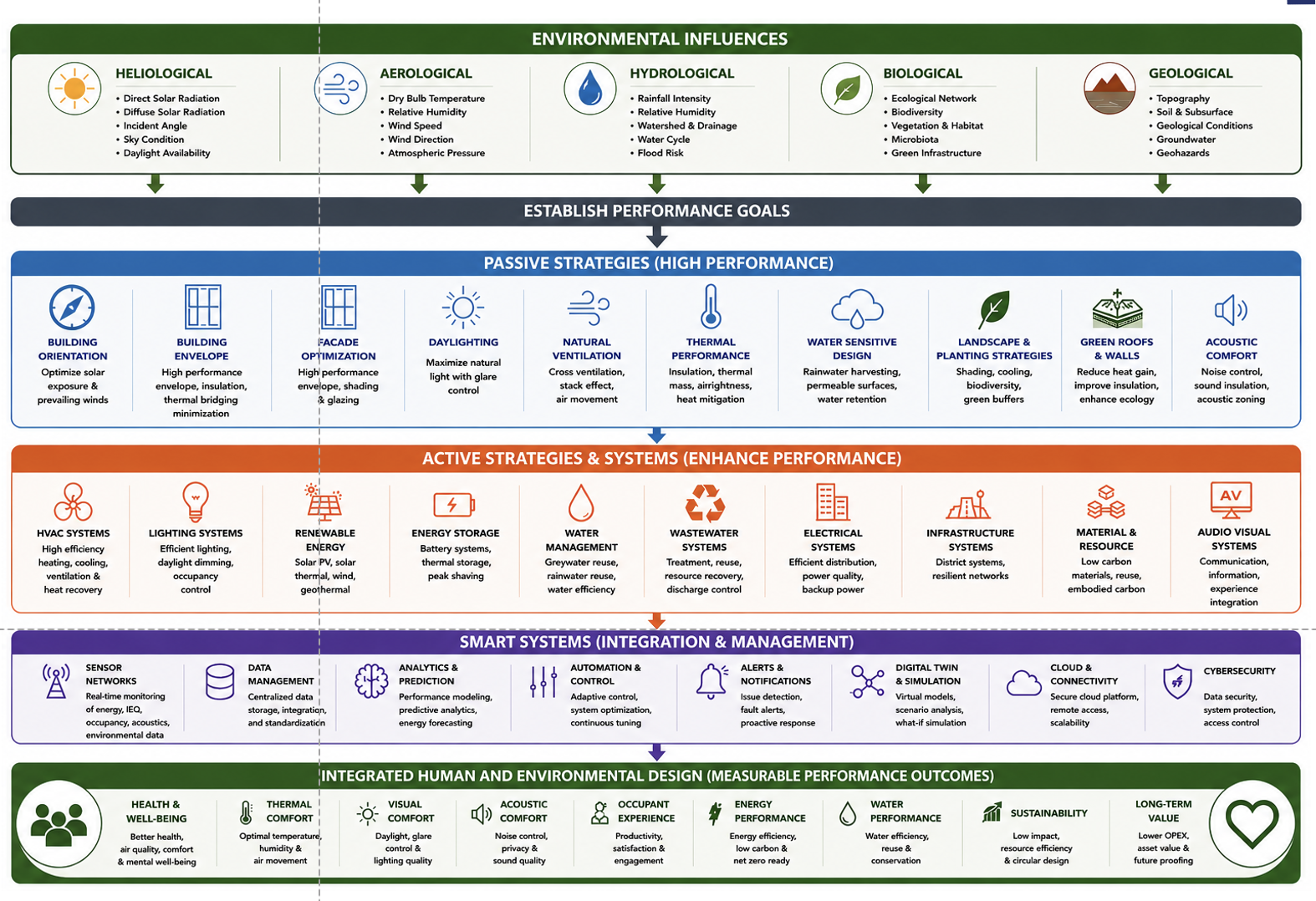
A systems-thinking framework: Environmental Influences → Performance Goals → Passive Design Strategies → Active Systems → Smart Building Integration → Human-Centered Design → Measurable Human and Environmental Outcomes.
Why this matters for owners, developers, architects, engineers, and investors seeking long-term value creation.
Introduction: Beyond Sustainable Buildings
The evolution of building design from energy efficiency toward integrated environmental and human performance.
Why high-performing buildings must respond simultaneously to climate, ecology, technology, economics, and human experience.
The limitations of fragmented design approaches.
A Building Science Framework for Creating High-Performance, Resilient, and Human-Centered Buildings
Understanding Environmental Influences as the Foundation of Building Performance
The Building Site as the Starting Point of Design
One of the most common mistakes in modern building development is treating the site as an empty canvas. In reality, every site already possesses its own environmental characteristics, opportunities, and constraints long before the first sketch is drawn. Climate, solar exposure, prevailing winds, rainfall patterns, vegetation, topography, and geological conditions are continuously interacting with the site. Successful buildings do not fight these conditions; they work with them.
As a building performance consultant, I often tell project teams that the most important design decisions are frequently made before discussing HVAC systems, façade materials, or smart technologies. Understanding the environmental context of a site can significantly reduce energy consumption, improve occupant comfort, enhance resilience, and lower operational costs throughout the building's life.
Historically, architecture evolved as a direct response to environmental conditions. Traditional tropical houses in Southeast Asia were elevated to improve airflow and protect against flooding. Courtyard houses in hot climates provided shading and passive cooling. Thick masonry walls in desert regions moderated indoor temperatures. Long before mechanical systems existed, builders understood how to work with nature rather than against it.
Today, modern technology often allows us to compensate for poor environmental decisions. However, compensation is rarely as effective—or as sustainable—as environmental responsiveness from the beginning.
Human-Centered Building Performance starts with understanding how environmental influences shape building performance and human experience.
Heliological Factors: Designing with the Sun
The sun is perhaps the most powerful environmental influence affecting building performance. It provides daylight, heat, energy, and visual connection to the natural world. Yet without careful management, it can also contribute to overheating, glare, excessive cooling loads, and occupant discomfort.
Heliological factors include:
Direct solar radiation
Diffuse solar radiation
Solar angles and seasonal variation
Sky conditions
Daylight availability
These variables change throughout the day and throughout the year, influencing how buildings receive light and heat.
Solar Heat Gain Management
One of the primary goals of solar-responsive design is controlling unwanted heat gain while maximizing beneficial daylight. In tropical climates, excessive solar radiation can significantly increase cooling demand and reduce occupant comfort.
For example, a fully glazed west-facing façade may look impressive architecturally, but it often creates substantial afternoon heat gain and glare problems. Occupants may respond by closing blinds, increasing air conditioning, and turning on artificial lighting—essentially defeating the original design intent.
Effective strategies include:
Building orientation optimization
External shading devices
High-performance glazing
Façade articulation
Solar control systems
The objective is not to eliminate sunlight but to use it intelligently.
Daylight Optimization
Natural daylight remains one of the most valuable environmental resources available to designers.
Numerous studies have demonstrated that access to daylight can improve mood, productivity, learning outcomes, and occupant satisfaction. Research conducted in educational environments has found that students in classrooms with better daylight access often demonstrate improved academic performance compared to those in poorly daylit spaces.
In workplace environments, daylight has been associated with increased employee satisfaction, reduced absenteeism, and enhanced cognitive performance.
The challenge lies in balancing daylight quantity and quality.
Glare Control
Anyone who has attempted to work in front of a computer while facing an unshaded window understands the impact of glare. Excessive brightness contrasts force the visual system to work harder, leading to discomfort, reduced productivity, and visual fatigue.
Human-centered daylighting design seeks to maximize useful daylight while minimizing glare through:
Window placement
Shading systems
Light shelves
Interior surface reflectance
Dynamic façade technologies
Renewable Energy Opportunities
The sun is also an important energy resource. Solar photovoltaic systems can transform roofs and façades into power-generating assets, reducing dependence on external energy sources and contributing to long-term sustainability goals.
As renewable energy technologies become more efficient and affordable, solar-responsive design is increasingly becoming both an environmental and economic strategy.
Aerological Factors: Designing with Air and Climate
Air is invisible, but its impact on building performance is profound.
Aerological factors include:
Air temperature
Relative humidity
Wind speed
Wind direction
Atmospheric pressure
These variables directly influence thermal comfort, indoor environmental quality, energy consumption, and occupant wellbeing.
Natural Ventilation
For centuries, buildings relied on natural ventilation to provide cooling and fresh air. Side Ventilation, cross ventilation, stack ventilation, and wind-driven airflow remain highly effective strategies, particularly in tropical and subtropical climates.
I often encounter buildings where natural ventilation opportunities were overlooked during design. Later, significant resources are spent on mechanical cooling systems that could have been partially reduced through better orientation, window placement, and airflow planning.
When properly integrated, natural ventilation can:
Improve indoor air quality
Reduce energy consumption
Increase occupant satisfaction
Strengthen connections to outdoor environments
Thermal Comfort
Human comfort is influenced by much more than air temperature alone. Thermal comfort depends on the interaction between:
Air temperature
Relative humidity
Air velocity
Radiant temperature
Clothing levels
Activity levels
A space maintained at 24°C can feel comfortable or uncomfortable depending on humidity, airflow, and radiant heat conditions. Human-centered thermal design focuses on creating environments that support comfort while minimizing unnecessary energy use.
Urban Heat Mitigation
Urbanization often creates heat islands where cities become significantly warmer than surrounding rural areas. Dark surfaces, limited vegetation, and dense construction can elevate local temperatures and increase cooling demand. Strategies such as:
Green roofs
Urban tree planting
Reflective materials
Shaded public spaces
help reduce heat accumulation and improve outdoor comfort.
Passive Cooling Potential
Before adding mechanical cooling systems, designers should evaluate passive cooling opportunities. These may include:
Building orientation
Solar shading
Thermal mass
Natural ventilation
Landscape cooling
Evaporative cooling
Reducing cooling demand at the source is typically more effective than compensating with larger HVAC systems later.
Hydrological Factors: Designing with Water
Water shapes both environmental performance and resilience. Hydrological considerations include:
Rainfall patterns
Watersheds
Site drainage
Flood risk
Water cycles
As climate change increases the frequency of extreme weather events, water-sensitive design is becoming increasingly important.
Water-Sensitive Urban Design
Traditional development often treats stormwater as a waste product that must be removed as quickly as possible. Modern water-sensitive design takes a different approach by viewing water as a valuable resource. Strategies may include:
Bioswales
Rain gardens
Retention ponds
Permeable pavements
Green infrastructure
These systems reduce flooding while improving ecological performance and site resilience.
Rainwater Harvesting
Rainwater harvesting systems can capture, store, and reuse water for:
Irrigation
Toilet flushing
Cooling systems
Landscape maintenance
In regions with high rainfall, these systems can significantly reduce potable water demand.
Stormwater Management
Effective stormwater management protects both the site and surrounding communities. Poor drainage design can lead to flooding, erosion, infrastructure damage, and increased maintenance costs. Integrated stormwater strategies improve resilience while supporting environmental sustainability.
Climate Resilience
Resilience is becoming a critical performance metric for modern developments. Buildings must increasingly prepare for:
Intense rainfall
Flooding
Water scarcity
Changing weather patterns
Designing for resilience today reduces risk tomorrow.
Biological Factors: Designing with Living Systems
Buildings do not exist separately from nature. Every development influences and is influenced by surrounding ecosystems. Biological factors include:
Biodiversity
Ecological networks
Vegetation
Habitat quality
For many years, development was viewed primarily as a process of replacing natural systems with built systems. Today, leading projects recognize that environmental and human performance often improve when natural systems are preserved and integrated.
Biophilic Design
Biophilic design seeks to strengthen connections between people and nature. This may include:
Natural daylight
Vegetation
Water features
Natural materials
Outdoor views
Research has consistently shown that exposure to nature can reduce stress, improve mood, enhance cognitive performance, and support overall wellbeing.
Ecosystem Services
Healthy ecosystems provide valuable services including:
Air purification
Stormwater management
Temperature moderation
Carbon sequestration
Habitat support
Preserving these functions can improve both environmental and building performance.
Environmental Resilience
Biodiversity and ecological integration help create more resilient developments capable of adapting to changing environmental conditions. Nature is often one of the most effective performance systems available.
Geological Factors: Designing with the Land
The ground beneath a building is just as important as the environment surrounding it. Geological factors include:
Topography
Soil conditions
Subsurface characteristics
Groundwater conditions
Geological hazards
These factors influence safety, performance, constructability, and long-term durability.
Site Planning
Topography affects:
Building placement
Drainage
Solar access
Views
Construction costs
Rather than forcing a site to conform to a design concept, successful projects often allow the site to inform the design.
Foundation Optimization
Understanding soil and subsurface conditions allows engineers to select appropriate foundation systems while minimizing unnecessary material use and construction costs.
Good geotechnical understanding supports both safety and sustainability.
Resource Efficiency
Working with existing land conditions often reduces earthworks, excavation requirements, material consumption, and environmental disturbance.
The most sustainable solution is frequently the one that respects existing site conditions.
Disaster Resilience
Geological assessment is essential for understanding risks associated with:
Earthquakes
Landslides
Soil instability
Subsidence
Flooding
Resilient developments begin with a thorough understanding of the ground on which they are built.
Establishing Building Performance Goals
Defining Success Before Designing Solutions
One of the most common reasons buildings fail to achieve their full potential is surprisingly simple: project teams start designing solutions before clearly defining success.
Many projects begin with discussions about façades, HVAC systems, lighting fixtures, renewable energy technologies, or certification targets. While these are important considerations, they are ultimately tools—not objectives. Without a clear understanding of what the building is trying to achieve, even the most sophisticated technologies can become expensive features rather than meaningful performance strategies.
As a building performance consultant, I often ask clients a question early in a project:
"Five years after occupancy, how will you know this building is successful?"
The answers are rarely about equipment efficiency or technical specifications. Owners talk about tenant satisfaction. Developers talk about market differentiation. Employers talk about employee productivity and wellbeing. Universities talk about learning outcomes. Hospitals talk about recovery rates and patient experience.
The challenge is that many of these desired outcomes are not traditionally included in design briefs.
Human-Centered Building Performance begins by defining performance goals before design solutions. Rather than asking, "What systems should we install?", project teams should first ask, "What outcomes are we trying to achieve?"
Only then can design decisions be aligned with measurable objectives.
Why Performance Goals Should Drive Design Decisions
Every design decision influences performance outcomes.
The orientation of a building affects energy use, thermal comfort, daylight quality, and occupant wellbeing. The selection of glazing influences glare, heat gain, visual comfort, and energy consumption. Acoustic treatments affect communication, concentration, and learning effectiveness. Ventilation strategies influence indoor air quality, health, and cognitive performance.
When performance goals are established early, these decisions become easier to evaluate. For example, imagine a workplace project where one of the primary objectives is to improve employee wellbeing and productivity. The design team can then establish measurable targets such as:
Enhanced daylight access
Improved acoustic comfort
Better indoor air quality
Optimized thermal comfort
Increased occupant satisfaction
Every design decision can then be evaluated against these objectives. Without clear goals, projects often default to minimum code compliance. While compliance is necessary, it does not necessarily create a high-performing building. Meeting code requirements does not automatically mean people will enjoy working, learning, healing, or living in the space.
Aligning Stakeholder Objectives with Measurable Outcomes
Modern building projects involve a diverse group of stakeholders, each with different priorities.
Owners Want Long-Term Value
Owners are often focused on asset performance, operational efficiency, tenant retention, and long-term resilience. Their questions may include:
How can operating costs be reduced?
How can asset value be increased?
How can future risks be minimized?
How can the building remain competitive?
Developers Want Market Advantage
Developers often focus on differentiation, branding, marketability, and financial performance. Their priorities may include:
Faster leasing
Higher occupancy rates
Premium rental values
Stronger project identity
Architects Want Design Excellence
Architects seek to create environments that are functional, beautiful, and meaningful. Their objectives often include:
User experience
Spatial quality
Architectural expression
Environmental responsiveness
Occupants Want Better Experiences
Occupants are typically concerned with how the building feels and functions in daily use. They care about:
Comfort
Health
Productivity
Convenience
Wellbeing
Human-Centered Building Performance helps bridge these perspectives by translating aspirations into measurable outcomes.
Performance Objectives for Modern Developments
A truly high-performing building balances three categories of objectives:
Environmental Objectives
Human Objectives
Business Objectives
The most successful projects recognize that these objectives are interconnected rather than competing priorities.
Environmental Objectives
Energy Efficiency
Energy efficiency remains one of the most important performance goals in modern development. Reducing energy demand lowers operational costs, reduces environmental impact, and supports long-term sustainability goals. However, energy efficiency should not come at the expense of occupant comfort or wellbeing.
For example, reducing lighting power density may save energy, but if visual comfort suffers, productivity and occupant satisfaction may decline. Successful projects seek balance rather than optimization of a single metric.
Carbon Reduction
The industry is increasingly focused on reducing both operational carbon and embodied carbon. Operational carbon refers to emissions associated with building operation, including heating, cooling, lighting, and equipment use. Embodied carbon includes emissions associated with:
Material extraction
Manufacturing
Transportation
Construction
Leading developers are now evaluating whole-life carbon performance rather than focusing solely on operational energy.
Water Conservation
Water is becoming an increasingly valuable resource, particularly in rapidly urbanizing regions and climate-sensitive locations. Water performance objectives may include:
Reduced potable water consumption
Rainwater harvesting
Greywater reuse
Efficient fixtures
Landscape water management
Water conservation contributes not only to sustainability but also to operational resilience.
Resource Efficiency
Modern buildings consume significant quantities of materials and resources throughout their lifecycle. Resource-efficient developments seek to:
Minimize waste
Reduce material consumption
Support circular economy principles
Extend building lifespan
Resource efficiency increasingly influences both environmental performance and financial performance.
Human Objectives
While environmental goals have become common in modern development, human outcomes are often less clearly defined. Yet buildings exist primarily to serve people. Human-Centered Building Performance places these objectives at the center of project decision-making.
Health
Healthy buildings support physical wellbeing by optimizing:
Indoor air quality
Thermal comfort
Daylight access
Water quality
Material health
The COVID-19 pandemic accelerated awareness of the relationship between buildings and health, making healthy building design a growing priority across all sectors.
Wellbeing
Wellbeing extends beyond the absence of illness. It includes how occupants feel physically, mentally, emotionally, and socially within a space. Features that support wellbeing may include:
Access to nature
Acoustic comfort
Circadian lighting
Social spaces
Restorative environments
A building can be technically efficient yet still fail to support wellbeing.
Comfort
Comfort remains one of the most powerful indicators of building performance. When occupants are comfortable, they can focus on their work, learning, recovery, or daily activities rather than adapting to environmental discomfort.
Comfort includes:
Thermal comfort
Visual comfort
Acoustic comfort
Ergonomic comfort
Psychological comfort
Interestingly, comfort complaints are among the most common operational issues reported in commercial buildings.
Productivity
In workplace environments, people are often the organization's most valuable asset. Even small improvements in productivity can generate economic value that far exceeds building operating costs.
Research has shown that factors such as:
Air quality
Daylight access
Acoustic conditions
Thermal comfort
can significantly influence cognitive performance and productivity.
Learning
Educational facilities exist to support learning. Research consistently demonstrates that environmental conditions influence:
Speech intelligibility
Concentration
Memory retention
Academic performance
A classroom designed for learning performs differently from a classroom designed only to meet code requirements.
Rest, Sleep and Recovery
Healthcare environments provide a compelling example of human-centered performance. Numerous studies have demonstrated that environmental factors such as:
Noise control
Access to daylight
Views of nature
Indoor air quality
can influence patient recovery, stress levels, and overall experience. Buildings can actively support healing.
Occupant Satisfaction
Perhaps the most direct measure of human-centered performance is occupant satisfaction. Ultimately, a building may achieve every technical target yet still be considered unsuccessful if occupants dislike using it. Post-occupancy evaluations increasingly reveal that occupant perceptions often provide insights that technical metrics alone cannot capture.
Business Objectives
Environmental and human outcomes ultimately influence business performance. This is one of the reasons Human-Centered Building Performance is gaining attention among developers and investors.
Asset Value
High-performing buildings increasingly command higher market value. Investors recognize that buildings offering superior environmental and occupant performance are often more resilient, attractive, and future-ready. Buildings that support health, wellbeing, and sustainability are becoming valuable long-term assets.
Operational Efficiency
Operational efficiency extends beyond energy savings. It includes:
Maintenance optimization
Equipment reliability
Resource efficiency
Facility management effectiveness
Smart operational strategies improve both environmental and financial performance.
Tenant Retention
For commercial property owners, retaining tenants is often more cost-effective than acquiring new ones. Comfortable, healthy, and enjoyable environments contribute directly to:
Tenant satisfaction
Lease renewal rates
Occupancy levels
People tend to remain in buildings that support their needs.
Brand Differentiation
Increasingly, buildings are becoming part of organizational identity. A workplace reflects company culture. A hotel reflects brand values. A university reflects educational aspirations. A healthcare facility reflects patient-centered care. Human-Centered Building Performance provides a powerful opportunity for differentiation by creating environments that people remember, value, and recommend.
Passive Design Strategies – The First Layer of High Performance
Why Passive Design Should Always Come Before Technology
One of the most important lessons in building science is surprisingly simple: The best energy-saving technology is often good design.
Yet many projects still approach sustainability backwards. They begin by asking which HVAC system, solar panel, building automation platform, or renewable energy technology should be installed. While these technologies can play an important role, they should not be the starting point.
The first question should always be: How can the building itself reduce environmental loads before mechanical systems are required?
This is the fundamental principle behind passive design.
Passive design uses the natural characteristics of climate, site, building form, and materials to create comfortable, efficient, and resilient environments with minimal reliance on active systems. It is often the most cost-effective and durable approach to building performance because passive strategies continue working throughout the life of the building without requiring complex controls, maintenance contracts, software updates, or energy consumption.
I often tell clients that passive design is like improving a person's health through good nutrition and exercise before prescribing medication. Technology can certainly help, but the strongest foundation comes from addressing root causes rather than symptoms.
The Hierarchy of Building Performance
A useful way to think about high-performance design is as a hierarchy.
Understand environmental influences.
Optimize passive design strategies.
Add efficient active systems.
Integrate smart controls and monitoring.
Continuously optimize performance.
Unfortunately, many projects jump directly to step three. When passive opportunities are ignored, designers are often forced to compensate later with larger HVAC systems, more artificial lighting, additional shading devices, or expensive technology upgrades.
Reducing Demand Before Adding Systems
The most efficient HVAC system is often a smaller HVAC system. The most efficient lighting system is one that operates less frequently because daylight is available. The most efficient water system is one that requires less water in the first place. Passive design focuses on reducing demand before supplying resources.
This approach delivers multiple benefits:
Lower capital costs
Reduced operational costs
Improved resilience
Enhanced occupant comfort
Reduced carbon emissions
Greater long-term value
The Most Sustainable Energy Is the Energy Never Consumed
This phrase is widely used in building science because it captures a fundamental truth. Every kilowatt-hour avoided through passive design is more valuable than a kilowatt-hour generated later through technology.
A building that naturally stays cool requires less air conditioning. A building that effectively uses daylight requires less electric lighting. A building that manages solar heat gain requires less cooling energy. The most sustainable building is not necessarily the one with the largest renewable energy system. Often, it is the building that needs the least energy to begin with.
Building Orientation
Let the Site Work for You
Building orientation is one of the earliest and most influential design decisions. Once a building is constructed, orientation is virtually impossible to change, making it one of the highest-value passive design strategies available. Orientation affects: Solar exposure, Daylight quality, Heat gain, Wind access, Views and Outdoor comfort. A well-oriented building can significantly reduce energy demand while improving occupant experience.
Optimizing Solar Exposure
In tropical climates, east and west façades often receive the most challenging solar exposure due to low-angle morning and afternoon sun. Reducing unnecessary east-west exposure can significantly lower cooling loads and improve thermal comfort. For example, many high-performance office buildings position their longer façades toward north and south orientations, where solar radiation is easier to control through shading strategies.
Harnessing Prevailing Winds
Natural airflow begins with understanding local wind patterns. Strategically orienting buildings to capture prevailing winds can improve ventilation, reduce cooling demand, and enhance occupant comfort. Traditional tropical architecture has been using this strategy for centuries. Many vernacular buildings throughout Southeast Asia demonstrate how effective orientation can create comfortable environments without mechanical cooling.
Reducing Unwanted Heat Gain
Poor orientation often creates problems that must later be solved through larger cooling systems and higher operating costs. Good orientation allows the building to avoid excessive heat gain from the start.
High-Performance Building Envelope
The Building's Environmental Filter
The building envelope acts as the interface between indoor and outdoor environments. It regulates:
Heat flow
Air movement
Moisture
Daylight
Noise
A high-performance envelope allows beneficial environmental conditions to enter while minimizing unwanted impacts.
Thermal Insulation
Thermal Insulation slows heat transfer between indoor and outdoor environments. While thermal insulation is often associated with cold climates, it is equally important in hot climates where reducing heat gain improves thermal comfort and reduces cooling demand.
Airtightness
Uncontrolled air leakage can significantly affect energy performance and comfort. An airtight building envelope allows designers to control ventilation intentionally rather than relying on random infiltration.
This improves:
Energy efficiency
Indoor air quality
Thermal comfort
Moisture management
Noise Insulation
Thermal Bridge Control
Thermal bridges occur when conductive materials create pathways for heat transfer through the building envelope. Common examples include:
Structural steel
Concrete slabs
Metal framing
Controlling thermal bridges reduces unwanted heat gain and improves occupant comfort near building surfaces.
Envelope Optimization
The highest-performing envelopes integrate multiple strategies simultaneously. Successful envelope design balances:
Thermal performance
Daylighting
Views
Acoustic performance
Moisture control
Durability
Façade Optimization: The Façade as a Performance System
Modern façades do far more than define architectural appearance. They are environmental control systems that influence energy use, comfort, and occupant experience.
Window-to-Wall Ratios
More glass does not automatically create a better building. Excessive glazing often increases:
Heat gain
Glare
Cooling demand
The most effective façade design carefully balances daylight access with thermal performance.
External Shading
External shading is often more effective than internal blinds because it blocks solar radiation before it enters the building. Common strategies include:
Horizontal louvers
Vertical fins
Brise-soleil
Deep overhangs
These solutions can dramatically reduce cooling loads while maintaining daylight and views.
Dynamic Façades
Emerging façade technologies allow buildings to adapt to changing environmental conditions Examples include:
Automated shading systems
Electrochromic glazing
Responsive façade elements
These systems help balance daylight, views, comfort, and energy performance throughout the day.
Spectrally Selective Glazing
Advanced glazing technologies can admit visible daylight while reducing unwanted solar heat gain. This allows buildings to benefit from daylight without suffering excessive thermal penalties.
Daylighting Design: Designing with Natural Light
Daylight is one of the most valuable environmental resources available to architects. When properly integrated, daylight can improve both environmental and human performance.
Maximizing Useful Daylight
The goal is not simply to maximize daylight quantity. The goal is to maximize useful daylight. Good daylight design creates spaces that are bright, comfortable, and visually balanced throughout the day.
Reducing Artificial Lighting Demand
Lighting can represent a significant portion of building energy consumption. Effective daylighting reduces the need for artificial lighting while improving occupant satisfaction.
Supporting Circadian Health
Human beings evolved under natural daylight cycles. Exposure to daylight influences:
Circadian rhythms
Sleep quality
Alertness
Mood
Cognitive performance
Human-centered daylighting design recognizes that light is not only a visual resource but also a biological one.
Natural Ventilation: Working with Air Rather Than Against It
Natural ventilation remains one of the most effective passive design strategies available.
Cross Ventilation
Cross ventilation occurs when air enters from one side of a building and exits through another. This strategy can significantly improve comfort in suitable climates.
Stack Ventilation
Warm air naturally rises. Stack ventilation uses this principle to create airflow through vertical spaces such as atriums, stairwells, and ventilation shafts.
Mixed-Mode Strategies
Many modern buildings combine natural ventilation with mechanical systems. These mixed-mode approaches provide flexibility while reducing energy demand.
Thermal Performance: Designing for Comfort First
Thermal comfort is one of the most important factors affecting occupant satisfaction.
Thermal Mass
Materials such as concrete, brick, and stone can absorb and release heat over time. When properly used, thermal mass can moderate indoor temperature fluctuations.
Passive Cooling
Passive cooling strategies may include:
Solar shading
Natural ventilation
Reflective materials
Landscape cooling
Building orientation
Passive Heating
Although less critical in tropical climates, passive heating remains important in temperate and cold regions.
Thermal Comfort Optimization
The ultimate goal is not achieving a specific temperature. The goal is creating environments where occupants feel comfortable and productive.
Water-Sensitive Design: Managing Water as a Resource
Water should be viewed as a valuable asset rather than a problem to be removed.
Rainwater Harvesting
Rainwater can be captured and reused for:
Irrigation
Toilet flushing
Cooling systems
Landscape maintenance
Permeable Landscapes
Permeable surfaces allow water to infiltrate naturally into the ground.
Benefits include:
Reduced flooding
Groundwater recharge
Improved site resilience
Water Retention Systems
Retention ponds, bioswales, and rain gardens help manage stormwater while creating ecological and aesthetic value.
Landscape and Planting Strategies: Nature as Building Performance Infrastructure
Landscape should not be considered decoration. It is a performance system.
Shading
Trees can significantly reduce solar heat gain on buildings and outdoor spaces.
Urban Heat Reduction
Vegetation helps cool urban environments through evapotranspiration and shading.
Biodiversity Enhancement
Thoughtful planting strategies support ecological health while improving environmental resilience.
Outdoor Comfort
Well-designed landscapes create usable outdoor spaces that encourage social interaction and connection with nature.
Green Roofs and Green Walls: Bringing Nature Back into the Built Environment
Green roofs and green walls provide multiple environmental and human benefits.
Heat Mitigation
Vegetation reduces surface temperatures and helps combat urban heat island effects.
Stormwater Management
Green roofs absorb rainfall and reduce stormwater runoff.
Ecological Benefits
Green infrastructure supports biodiversity, habitat creation, and environmental resilience.
Acoustic Comfort by Design: Designing Quiet Before Adding Treatments
Acoustic performance is often addressed too late in the design process. However, some of the most effective acoustic strategies are passive.
Site Planning
Locating sensitive spaces away from noise sources can significantly improve acoustic performance.
Noise Buffering
Landscapes, setbacks, berms, and building massing can help reduce environmental noise exposure.
Building Zoning
Separating noisy and quiet functions improves occupant comfort and reduces conflicts.
Façade Acoustic Performance
High-performance façades provide protection from traffic noise, aircraft noise, rail systems, and urban activity while maintaining daylight and views.
Active Systems – Enhancing Building Performance
When Technology Becomes Necessary
In Part 3, we explored how passive design strategies establish the foundation of a high-performance building. Building orientation, façade design, daylighting, natural ventilation, thermal performance, and landscape integration can dramatically reduce environmental loads while improving occupant comfort and wellbeing.
However, even the best passive design has limits.
A hospital operating room cannot rely solely on natural ventilation. A data center cannot depend entirely on passive cooling. A high-rise office building in a dense urban environment may require mechanical systems to maintain consistent comfort and indoor air quality throughout the year.
This is where active systems become essential.
The goal of Human-Centered Building Performance is not to eliminate technology. The goal is to use technology intelligently. Passive strategies should reduce demand first. Active systems should then efficiently provide the remaining performance requirements. The result is a building that is both environmentally responsible and capable of delivering superior human outcomes.
Technology Should Support People
One of the biggest shifts occurring in the building industry is moving from technology-centered design toward human-centered technology. Historically, building systems were often evaluated based on engineering efficiency alone:
Does the HVAC system meet cooling loads?
Does the lighting system achieve target illuminance?
Does the electrical system provide adequate capacity?
These questions remain important, but Human-Centered Building Performance asks additional questions:
Does the HVAC system improve comfort and health?
Does the lighting system support circadian rhythms and wellbeing?
Does technology simplify user experience?
Does the building help occupants perform better?
Technology should not merely operate buildings. Technology should support people.
High-Efficiency HVAC Systems: The Hidden System That Shapes Human Experience
Most occupants rarely think about HVAC systems unless something goes wrong. Yet HVAC systems influence nearly every aspect of indoor environmental quality.
They affect:
Thermal comfort
Indoor air quality
Humidity control
Energy consumption
Occupant satisfaction
Cognitive performance
In many ways, HVAC systems are the invisible backbone of building performance.
Thermal Comfort
Thermal comfort remains one of the strongest predictors of occupant satisfaction. Research consistently shows that even small deviations from comfort conditions can affect productivity, concentration, and wellbeing.
Human-centered HVAC design considers:
Operative temperature
Relative humidity
Air speed
Radiant temperature
Occupant activity levels
Rather than simply maintaining a fixed temperature, modern systems increasingly seek to provide adaptive comfort that responds to actual occupant needs.
Indoor Air Quality
Indoor air quality has become one of the most important performance considerations in modern buildings. Research from institutions such as the Harvard T.H. Chan School of Public Health has demonstrated links between indoor air quality and cognitive performance, decision-making, and wellbeing.
Key considerations include:
Ventilation effectiveness
CO₂ concentration
PM2.5 control
VOC reduction
Filtration performance
Clean air is not simply a health issue. It is a human performance issue.
Energy Optimization
Modern HVAC systems increasingly integrate:
Variable speed equipment
Demand-controlled ventilation
Heat recovery systems
Predictive controls
Occupancy-based operation
These technologies improve efficiency while maintaining comfort and air quality. The objective is not merely to save energy. It is to optimize environmental performance while supporting occupants.
Human-Centered Lighting Systems: Beyond Illuminance
For decades, lighting design focused primarily on visibility. Today, we understand that lighting influences much more than visual tasks.
Light affects:
Circadian rhythms
Sleep quality
Mood
Alertness
Cognitive performance
Emotional wellbeing
Human-centered lighting design acknowledges both the visual and biological effects of light.
Circadian Lighting
Human biology evolved under natural daylight cycles. Exposure to bright, blue-rich light during the day supports alertness and healthy circadian rhythms, while reduced light exposure in the evening supports sleep. Modern circadian lighting systems attempt to mimic these natural patterns indoors.
Applications include:
Offices
Healthcare facilities
Educational environments
Residential developments
Studies increasingly suggest that circadian-supportive lighting can improve sleep quality, alertness, and occupant wellbeing.
Daylight Harvesting
Daylight harvesting systems automatically adjust electric lighting based on available daylight. Benefits include:
Reduced energy consumption
Improved visual comfort
Enhanced connection to natural light
I often find that occupants prefer environments where electric lighting subtly responds to daylight conditions rather than maintaining a static lighting level throughout the day.
Adaptive Controls
Modern lighting systems allow:
Occupancy sensing
Scene selection
Personalized control
Time-based scheduling
These features help align lighting conditions with occupant activities and preferences.
Renewable Energy Systems: Producing Energy Responsibly
After reducing demand through passive design and efficient systems, renewable energy becomes the next step toward sustainable building performance.
Solar Photovoltaic Systems
Solar photovoltaic systems convert sunlight directly into electricity.
Applications include:
Rooftop arrays
Building-integrated photovoltaics
Carport structures
Façade systems
Many projects now use solar energy not only to reduce operating costs but also to support net-zero carbon strategies.
Solar Thermal Systems
Solar thermal technologies capture solar energy for heating water and supporting thermal systems. Common applications include:
Hotels
Residential developments
Healthcare facilities
Sports facilities
Wind Energy
In suitable locations, wind energy can supplement building energy needs. While less common in dense urban environments, wind systems may contribute to campus-scale and district-scale developments.
Geothermal Applications
Geothermal systems leverage stable underground temperatures to improve heating and cooling efficiency. Although initial investment may be higher, geothermal solutions often provide long-term energy and carbon benefits.
Energy Storage Solutions: Managing Energy More Intelligently
As renewable energy adoption increases, energy storage becomes increasingly important. Storage helps balance energy production and demand.
Battery Systems
Battery systems allow buildings to:
Store excess renewable energy
Reduce peak demand charges
Improve resilience during outages
Thermal Storage
Thermal storage systems store cooling or heating energy for later use. Examples include:
Chilled water storage
Ice storage
Phase-change materials
These strategies help reduce peak energy demand and improve system efficiency.
Demand Management
Modern energy management systems can adjust loads dynamically based on:
Utility pricing
Occupancy patterns
Renewable energy availability
This creates more flexible and resilient energy systems.
Water Management Systems: Closing the Water Loop
Water is becoming one of the most critical resources in urban development. Human-centered buildings increasingly treat water as a valuable resource rather than a disposable utility.
Greywater Reuse
Greywater systems capture water from:
Sinks
Showers
Wash basins
and reuse it for:
Irrigation
Toilet flushing
Cooling systems
Rainwater Reuse
Rainwater harvesting systems can supplement potable water supplies while reducing stormwater runoff.
Water Treatment
Advanced treatment technologies support:
Water quality
Resource conservation
Operational resilience
Future developments will increasingly integrate decentralized water strategies into overall building performance planning.
Electrical and Infrastructure Systems: The Backbone of Building Operations
Reliable electrical infrastructure is essential for both occupant experience and operational continuity.
Reliable Power Distribution
Power systems support:
HVAC
Lighting
Communications
Security
Life safety systems
Reliability is especially critical in healthcare, mission-critical facilities, and high-performance commercial developments.
Resilience
Recent events worldwide have highlighted the importance of resilient infrastructure.
Strategies include:
Backup power
Microgrids
Renewable integration
Energy storage
Future Readiness
Buildings must accommodate future technologies that may not yet exist. Flexible infrastructure helps protect long-term asset value.
Materials and Resource Systems: Looking Beyond Operational Performance
Historically, sustainability focused primarily on operational energy. Today, embodied carbon and material impacts are receiving increased attention.
Low-Carbon Materials
Examples include:
Low-carbon concrete
Mass timber
Recycled materials
Regionally sourced materials
Circular Economy Strategies
Circular design seeks to:
Reduce waste
Extend material lifespans
Enable reuse and recycling
Embodied Carbon Reduction
Reducing embodied carbon is increasingly recognized as a major opportunity for lowering the environmental footprint of new developments.
Audiovisual and Communication Systems: Technology for Human Connection
One of the most visible examples of human-centered technology is audiovisual design. Modern buildings increasingly support:
Hybrid work
Hybrid learning
Digital collaboration
Information sharing
The quality of communication infrastructure directly influences user experience.
Hybrid Collaboration
The workplace has changed dramatically. Meeting rooms must now support both in-person and remote participants equally.
Successful hybrid environments require:
Clear audio
Effective video
Intuitive controls
Reliable connectivity
Information Delivery
Digital signage, presentation systems, wayfinding tools, and communication platforms help occupants navigate and interact with buildings more effectively.
User Experience
The best technology is often invisible. Occupants should not need extensive training to use meeting rooms, classrooms, auditoriums, or collaboration spaces. Human-centered audiovisual design focuses on simplicity, reliability, accessibility, and ease of use.
From Smart Buildings to Intuitive Buildings
Why Smart Buildings Must Become Human-Centered
Over the past two decades, the building industry has invested heavily in smart technologies. Buildings are now equipped with sensors, automation systems, artificial intelligence, cloud platforms, digital twins, and advanced analytics. Yet despite these technological advances, many occupants still complain about uncomfortable temperatures, poor meeting room experiences, confusing controls, and frustrating user interfaces.
This raises an important question: If buildings are becoming smarter, why don't they always feel better?
The answer is that many smart buildings have been designed primarily around technology and operational efficiency rather than human experience. In some cases, technology intended to improve performance actually increases complexity and frustration for occupants.
I often encounter highly sophisticated buildings where occupants struggle to operate meeting rooms, override temperature settings, or understand lighting controls. Meanwhile, some of the most successful environments are not necessarily the most technologically advanced. They are the ones where technology quietly supports people without demanding their attention.
This is where Human-Centered Building Performance introduces a critical shift in thinking. The goal is no longer simply to create smart buildings. The goal is to create intuitive buildings—buildings that understand, anticipate, and respond to human needs while remaining largely invisible to the people they serve.
Technology Should Support People, Not Burden Them
The best technology is often the technology occupants barely notice. Think about a well-designed hotel room. Guests should not need a training manual to adjust the lighting, operate the curtains, control the temperature, or connect to the internet. Everything should feel natural and intuitive.
Unfortunately, many buildings still require users to adapt to technology rather than having technology adapt to users. Human-centered smart buildings reverse this relationship. They prioritize:
Simplicity
Usability
Accessibility
Personalization
Comfort
Reliability
Technology becomes a silent partner that supports human activities rather than a system that demands constant interaction.
The Evolution from Automation to Intelligence
The first generation of building automation focused on controlling equipment. Building Management Systems (BMS) automated HVAC, lighting, and electrical systems according to predefined schedules. The second generation introduced optimization through sensors, analytics, and centralized monitoring. The next generation goes further.
Intelligent buildings do not simply automate processes. They learn from data, understand occupant behavior, predict future conditions, and continuously optimize performance. The future of building technology is not about controlling buildings. It is about understanding people.
Sensor Networks: Making Buildings Aware: Buildings Cannot Respond to What They Cannot Measure
Before a building can become intelligent, it must first become aware. Sensors function as the sensory organs of a smart building, providing real-time information about environmental conditions, occupancy patterns, and system performance. Just as humans rely on sensory systems to understand their surroundings, buildings increasingly rely on sensor networks to understand what is happening within them.
Occupancy Monitoring
Traditional buildings often operate according to fixed schedules regardless of whether spaces are occupied. This frequently results in wasted energy and poor user experience. Modern occupancy sensing technologies can monitor:
Presence
Movement
Occupancy density
Space utilization
Traffic patterns
For example, a meeting room reserved for ten people may only contain three occupants. Intelligent systems can adjust ventilation, lighting, and temperature based on actual occupancy rather than assumptions. Many workplace developers are now using occupancy analytics to better understand how employees use office spaces and to optimize workplace design accordingly.
Environmental Monitoring
Environmental sensors continuously measure conditions such as:
Temperature
Humidity
Air velocity
Noise levels
Light levels
Carbon dioxide concentrations
This information provides valuable insight into how occupants are likely experiencing the environment. Rather than relying on occasional complaints, facility managers can proactively identify issues before they affect occupants.
Indoor Environmental Quality (IEQ) Monitoring
One of the most exciting developments in Human-Centered Building Performance is the ability to continuously monitor Indoor Environmental Quality. Modern IEQ platforms can track:
CO₂
PM2.5
VOCs
Temperature
Relative humidity
Illuminance
Acoustic conditions
In the future, occupants may have access to real-time environmental quality dashboards that provide transparency and confidence regarding the health and performance of their environment.
Building Data Platforms: Turning Information into Insight
Sensors alone do not create intelligence. The true value emerges when information from multiple systems is integrated into a unified platform.
Data Integration
Modern buildings generate enormous amounts of information. Data may originate from:
HVAC systems
Lighting systems
Energy meters
Security systems
Occupancy sensors
Indoor air quality sensors
Audiovisual systems
Historically, these systems operated independently. Today's building data platforms bring them together into a single operational ecosystem. This integration allows project teams to understand relationships that would otherwise remain hidden.
For example:
How occupancy affects indoor air quality.
How daylight influences lighting energy use.
How thermal comfort affects workspace utilization.
How environmental conditions influence occupant satisfaction.
Real-Time Performance Visibility
Building operators can now observe building performance in real time. Dashboards may display:
Energy consumption
Water usage
Carbon emissions
Indoor environmental quality
Space utilization
Occupant comfort indicators
This level of visibility enables proactive decision-making rather than reactive troubleshooting.
Analytics and Predictive Intelligence: Moving from Data to Foresight
Collecting information is valuable. Predicting future outcomes is transformative.
Predictive Maintenance
Traditional maintenance strategies are often reactive. Equipment fails. Occupants complain. Repairs are made. Predictive maintenance uses data analytics to identify potential problems before failures occur.
Benefits include:
Reduced downtime
Lower maintenance costs
Improved reliability
Longer equipment lifespan
A hospital, for example, cannot afford unexpected HVAC failures in critical care areas. Predictive maintenance helps reduce these risks.
Performance Forecasting
Advanced analytics can forecast future performance under varying conditions. Examples include:
Energy demand forecasting
Occupancy forecasting
Carbon performance forecasting
Thermal comfort prediction
These capabilities support more informed operational decisions.
Energy Optimization
Artificial intelligence is increasingly capable of optimizing energy consumption dynamically. Rather than operating according to static schedules, systems continuously respond to:
Weather conditions
Occupancy patterns
Utility pricing
Renewable energy availability
The result is improved efficiency without compromising occupant comfort.
Adaptive Automation and Controls: Buildings That Respond in Real Time
Traditional automation follows predefined instructions. Adaptive automation learns and responds.
Occupancy-Responsive Systems
Occupancy-responsive systems automatically adjust:
Lighting
Ventilation
Temperature
Energy consumption
based on actual space utilization. This improves both environmental performance and occupant experience.
Personalized Environmental Control
Not everyone experiences comfort in the same way. Some people prefer cooler temperatures. Others prefer brighter workspaces. Future buildings will increasingly provide personalized environmental settings through mobile applications, smart workstations, and adaptive controls. This represents a major shift from designing for the average occupant toward designing for individual occupants.
Digital Twins and Simulation: Creating a Living Virtual Building
One of the most exciting developments in the industry is the emergence of digital twins. A digital twin is a dynamic virtual representation of a physical building that continuously receives real-world operational data.
Real-Time Virtual Building Models
Digital twins allow operators to visualize:
Environmental conditions
Energy flows
Occupancy patterns
System performance
in real time. This provides unprecedented insight into how buildings actually function after occupancy.
Scenario Testing
Digital twins can also simulate future scenarios. Questions such as:
What happens if occupancy increases by 20%?
How will a heat wave affect performance?
What are the energy implications of operational changes?
can be explored before implementation.
Continuous Optimization
Unlike traditional commissioning, which occurs at a single point in time, digital twins support ongoing performance improvement throughout the building's life cycle. This transforms building performance from a static achievement into a continuous process.
Cloud Connectivity and Cybersecurity: The Invisible Infrastructure of Smart Buildings
As buildings become increasingly connected, cloud infrastructure becomes essential.
Secure Building Operation
Building systems now rely heavily on cloud-based platforms for:
Monitoring
Analytics
Remote management
Data storage
Cybersecurity therefore becomes a critical component of building performance. A truly smart building must also be a secure building.
Scalability
Cloud platforms allow building systems to scale as organizational needs evolve. New sensors, systems, and analytics tools can be added without major infrastructure upgrades.
Future Adaptability
The pace of technological change is accelerating. Buildings designed today must remain relevant for decades. Flexible digital infrastructure allows future innovations to be integrated without requiring complete system replacement.
The Shift from Smart Buildings to Intuitive Buildings: Buildings That Anticipate Occupant Needs
The next generation of buildings will not simply react to conditions. They will anticipate them. Imagine arriving at your workplace and finding that:
Your preferred workspace has already been prepared.
Lighting conditions are optimized for your tasks.
Ventilation responds to occupancy levels automatically.
Meeting rooms configure themselves before meetings begin.
Indoor environmental conditions adapt continuously throughout the day.
The building becomes an active partner in supporting human performance.
Buildings That Continuously Learn and Adapt
Just as people learn from experience, future buildings will learn from operational data. Machine learning systems will identify patterns and continuously improve performance based on actual occupant behavior and preferences. Over time, buildings will become increasingly personalized, efficient, and responsive.
Buildings That Optimize Both Environmental and Human Performance
Historically, smart building technologies focused heavily on energy efficiency and operational optimization. The future expands this objective. The next generation of intelligent buildings will optimize:
Energy performance
Carbon performance
Water efficiency
Indoor environmental quality
Occupant comfort
Health and wellbeing
Productivity
Learning outcomes
User experience
This represents the convergence of building science, human-centered design, artificial intelligence, and environmental sustainability.
Human-Centered Design
What is Human-Centered Design?
Human-Centered Design is a problem-solving and design approach that puts the needs, behaviors, experiences, and goals of the people who will use a product, service, or system at the center of the design process. Instead of starting with technology, business requirements, or assumptions, designers start by understanding the people they are designing for.
Principles of Human-Centered Design
At its core, Human-Centered Design begins with a simple but often overlooked idea: the people who use a space should be at the center of every design decision. While this concept sounds obvious, many projects still prioritize technology, aesthetics, budgets, or operational requirements before fully understanding how people will actually experience the environment.
In the building industry, this can lead to spaces that perform well on paper but fail to support the people who occupy them every day. A workspace may meet all technical standards yet remain uncomfortable and distracting. A school may have excellent energy performance but poor speech intelligibility that hinders learning. A worship space may be visually stunning but acoustically unsuitable for prayer, music, or spoken word.
Human-Centered Design seeks to avoid these outcomes by focusing first on people—their needs, behaviors, preferences, and aspirations—and then shaping buildings around those insights.
Empathy: Understanding People Before Designing for Them
The first principle of Human-Centered Design is empathy. Before proposing solutions, designers must understand the people they are designing for.
This involves observing how people use spaces, conducting interviews, gathering feedback, and studying behavioral patterns. The goal is not simply to ask occupants what they want, but to understand what they truly need, including needs they may not be able to articulate themselves.
I have often seen project teams spend months discussing technical specifications while dedicating very little time to understanding the daily experiences of the people who will occupy the building. Yet some of the most valuable project insights come from simple conversations with users.
For example, during the design of educational and worship facilities, users frequently highlight issues that never appear in technical briefs—difficulty hearing a speaker from the back of a room, discomfort caused by glare during certain times of day, or the inability to find a quiet space for reflection. These seemingly small observations often reveal opportunities for significant improvements in human experience.
Empathy transforms design from a process of assumption into a process of understanding.
User Involvement: Designing With People, Not Just For Them
Human-Centered Design recognizes that users should not only be consulted at the beginning of a project; they should remain involved throughout the design process.
Too often, building projects are developed by experts making decisions on behalf of future occupants with limited user engagement. While professional expertise remains essential, the people who will ultimately use the building possess valuable knowledge about their daily activities, challenges, and expectations.
User involvement can take many forms, including workshops, focus groups, surveys, stakeholder interviews, mock-ups, and post-occupancy evaluations. These interactions help project teams test assumptions and ensure that design decisions align with actual user needs.
When users become active participants in the design process, projects are more likely to achieve meaningful outcomes rather than simply meeting technical requirements.
Iterative Design: Testing, Learning, and Improving
One of the greatest misconceptions in design is the belief that the best solution emerges fully formed from the first concept.
In reality, successful design is iterative.
Human-Centered Design encourages teams to develop ideas, test them, gather feedback, and refine them repeatedly. This process reduces risk and increases the likelihood of achieving successful outcomes.
In building projects, iteration may involve lighting mock-ups, acoustic simulations, virtual reality walkthroughs, façade performance studies, user experience testing, or pilot installations.
For example, during lighting projects for heritage and religious buildings, mock-up testing often reveals important findings that cannot be fully predicted through calculations alone. Light levels that appear appropriate on paper may feel too bright, too dramatic, or insufficient when experienced in the actual space. Through testing and refinement, the final solution becomes more aligned with the intended human experience.
Iteration allows projects to evolve from assumptions into evidence-based solutions.
Focus on Real Needs: Solving the Right Problem
One of the most common reasons projects underperform is that they solve the wrong problem. A Human-Centered Design approach challenges teams to look beyond symptoms and identify underlying needs.
For example, a client may request a more powerful sound system because occupants cannot hear presentations clearly. However, the real issue may not be insufficient amplification but excessive reverberation, poor room acoustics, or intrusive background noise.
Similarly, occupants may complain about temperature discomfort, leading to larger HVAC systems, when the root cause is actually solar heat gain through the building envelope or poor air distribution.
Human-Centered Design encourages project teams to ask deeper questions:
What problem are we actually trying to solve?
What are people experiencing?
Why are they experiencing it?
What outcome are we trying to achieve?
By focusing on genuine human needs rather than assumptions, projects can achieve more effective and sustainable solutions.
Accessibility and Usability: Designing for Everyone
A truly human-centered building must be accessible, usable, and inclusive. Accessibility extends beyond regulatory compliance. It involves creating environments that can be comfortably used by people with diverse physical, sensory, cognitive, and cultural needs.
Similarly, usability focuses on making spaces intuitive and easy to navigate. Occupants should not need special instructions to find a meeting room, adjust lighting controls, use audiovisual systems, or access building services. This principle becomes increasingly important as buildings become more technologically sophisticated. Smart buildings should simplify user experiences, not complicate them.
The most successful building technologies are often the ones occupants barely notice because they work seamlessly in the background. Inclusive design creates environments where everyone feels welcomed, supported, and able to participate fully. Human-Centered Design Process are:
Understand the users and their context.
Define the problem from the user's perspective.
Ideate possible solutions.
Prototype promising ideas.
Test with users and refine.
Implement the final solution.
Human-Centered Design as a Foundation for Human-Centered Building Performance
Human-Centered Design forms the foundation of Human-Centered Building Performance by shifting the focus of building success from energy consumption, code compliance, and equipment efficiency toward a more meaningful question:
How does the building affect the people inside it?
By applying the principles of empathy, user involvement, iterative design, real-world problem solving, accessibility, and usability, project teams can create buildings that do more than function efficiently—they can create environments that actively support health, comfort, wellbeing, learning, productivity, collaboration, and meaningful human experiences. This people-first approach consistently delivers higher user satisfaction, improved usability and accessibility, reduced development and operational risk, greater occupant engagement, and solutions that better reflect the realities of how spaces are actually used.
Widely adopted across workplaces, educational facilities, healthcare environments, public services, product development, ux/ui design, and engineering disciplines, human-centered design has proven its ability to improve both human outcomes and project performance.
While it shares common ground with Design Thinking as a broader innovation methodology, Human-Centered Design places particular emphasis on understanding and responding to the needs, behaviors, and experiences of the people affected by the solution. Ultimately, because buildings exist to serve people, Human-Centered Design ensures that human needs remain at the center of every decision—from the earliest concept and design strategy to construction, operation, and long-term building performance.
What is Human-Centered Building Performance?
Human-Centered Building Performance is an approach to building design, engineering, and operation that evaluates a building's success based on how well it supports human health, comfort, wellbeing, productivity, social interaction, and overall experience, rather than focusing solely on energy efficiency, cost, or technical compliance.
In traditional building performance, the primary questions are:
How much energy does the building consume?
Does the building's acoustic performance meet project requirements and applicable standards?
Is the HVAC system efficient?
Are the acoustic and lighting criteria compliant?
In Human-Centered Building Performance, the primary questions become:
How do occupants feel in the space?
Can they communicate clearly?
Can they concentrate and perform effectively?
Do they feel comfortable, healthy, safe, and connected?
Does the environment support their physical, mental, social, and spiritual wellbeing?
Human-Centered Building Performance is increasingly being delivered through specialized Human-Centered Building Performance Consultants who integrate building physics, environmental engineering, occupant experience, and building technology to optimize how people interact with the built environment.
Unlike traditional engineering disciplines that primarily focus on system efficiency and technical compliance, a Human-Centered Building Performance Consultant evaluates how acoustics, lighting, thermal comfort, indoor environmental quality, spatial design, and technology influence occupant wellbeing, productivity, learning, collaboration, and overall human performance.
This multidisciplinary approach brings together building physics, sustainability, healthy building design, occupant experience, and building technology to create environments that enhance human performance while supporting long-term operational and environmental goals.
What Does a Human-Centered Building Performance Consultant Do?
A Human-Centered Building Performance Consultant acts as the bridge between architecture, engineering, sustainability, and human experience. By combining expertise in building physics, indoor environmental quality (IEQ), healthy building design, human-centered design, and building performance optimization, the consultant helps project teams create environments that support both organizational objectives and human outcomes.
This role often involves coordinating acoustics, lighting, audiovisual systems, smart building technologies, passive environmental strategies, LEED certification, WELL certification, and post-occupancy evaluation to ensure that buildings perform not only as intended by designers and engineers but also as experienced by occupants.
Throughout the project lifecycle, a Human-Centered Building Performance Consultant may support project visioning, design guidelines, performance target development, simulation and modeling, interdisciplinary coordination, certification strategies, construction reviews, commissioning support, and post-occupancy evaluation. By aligning technical building performance with occupant needs and organizational objectives, the consultant helps deliver high-performance buildings that are healthier, more sustainable, more resilient, and more responsive to human experience.
A Human-Centered Building Performance Consultant also applies occupant-centric design and evidence-based design methodologies to ensure that building decisions are informed by both scientific research and real-world user needs. By evaluating occupant experience, user behavior, environmental performance, and post-occupancy feedback, the consultant helps project teams create buildings that are not only technically successful but also intuitive, engaging, and supportive of long-term human wellbeing. This approach enables owners, developers, architects, and engineers to make informed decisions that improve occupant satisfaction, operational effectiveness, and overall building value.
Human-Centered Building Performance Consultant helps owners, developers, architects, designers, engineers, contractors, and facility operators create buildings that optimize both environmental performance and human outcomes. Services typically include pre-design visioning, Human-Centered Building Performance assessments, building physics analysis, acoustic noise and vibration control, specialized lighting design, passive building design, audio visual system, information technology, and LEED and WELL certification, including indoor environmental quality (IEQ) optimization, thermal comfort analysis, indoor air quality assessment, smart building integration, commissioning support, and post-occupancy evaluation. Through the integration of building physics, healthy building principles, occupant-centered design, sustainability, and smart technologies, a Human-Centered Building Performance Consultant helps project teams create healthier, more comfortable, more productive, and more resilient environments that enhance occupant wellbeing, organizational performance, asset value, and long-term building success.
The Pillars of Human-Centered Building Performance
Human-Centered Building Performance is the science and practice of designing, evaluating, and optimizing buildings to enhance human experience, health, wellbeing, and performance through the integrated management of environmental, technological, and spatial conditions.
Acoustic and Audio Performance
Acoustic performance plays a critical role in shaping how people communicate, concentrate, maintain privacy, and emotionally experience a space. The quality of the acoustic environment is influenced by factors such as speech intelligibility (STI), reverberation time (RT60), background noise levels measured through Noise Criteria (NC), and sound insulation performance represented by STC and Rw ratings.
When these acoustic parameters are carefully designed and optimized, buildings can support clear communication, minimize distractions, protect speech privacy, and create environments that are comfortable and emotionally appropriate for their intended use.
High-performing acoustic environments contribute to reduced stress, improved learning outcomes, enhanced workplace productivity, and more meaningful worship, cultural, and community experiences. Beyond technical compliance, acoustic design directly influences how people perceive, interact with, and perform within a space, making it a fundamental component of Human-Centered Building Performance.
Lighting and Visual Performance
Lighting performance significantly influences how people see, feel, think, and respond to their environment by affecting visual comfort, circadian rhythm regulation, mood, and spatial perception. The quality of a lighting environment can be evaluated through metrics such as illuminance, daylight autonomy, Unified Glare Rating (UGR), and Melanopic Equivalent Daylight Illuminance (EDI), which collectively measure the adequacy of light for visual tasks, access to natural daylight, glare control, and biological effectiveness in supporting human circadian systems.
When lighting is thoughtfully integrated through a balance of daylight and electric lighting, it enhances visibility, supports natural sleep-wake cycles, and creates environments that are visually comfortable and emotionally engaging.
High-performing lighting environments contribute to better concentration, improved sleep quality, reduced eye strain, and enhanced emotional wellbeing, while also strengthening the architectural character and experiential quality of a space. As a fundamental component of Human-Centered Building Performance, lighting design extends beyond illumination to actively support human health, productivity, comfort, and overall quality of life.
Technological Performance
Technology performance focuses on how building systems support occupants in their daily activities by making environments more intuitive, connected, efficient, and responsive to human needs. This includes the thoughtful integration of audiovisual systems, ICT infrastructure, building automation systems, and smart building interfaces that enhance communication, collaboration, information access, environmental control, and operational convenience.
Rather than introducing complexity or creating barriers to use, human-centered technology design prioritizes simplicity, reliability, and seamless interaction, ensuring that technology remains a supportive tool rather than a source of frustration.
When properly integrated, these systems enable occupants to communicate more effectively, access information effortlessly, and interact with their environment in a natural and intuitive manner.
The result is greater ease of use, improved communication, enhanced productivity, and a superior overall user experience, allowing buildings to function not only as physical spaces but also as intelligent environments that actively support human performance and wellbeing.
Passive Building Performance
Passive Building Performance focuses on creating comfortable, healthy, and energy-efficient environments by working with climate and natural environmental conditions before relying on mechanical systems. Through the optimization of building orientation, envelope design, solar control, daylight access, natural ventilation, thermal comfort, and overall environmental responsiveness, buildings can significantly reduce energy demand while enhancing occupant wellbeing.
Thermal performance plays a central role in this process by influencing how occupants perceive temperature, humidity, radiant heat, and airflow within a space. Human thermal comfort is commonly evaluated through metrics such as Predicted Mean Vote (PMV), Predicted Percentage of Dissatisfied (PPD), operative temperature, relative humidity, and air speed, which together provide a comprehensive understanding of indoor environmental conditions.
When these factors are carefully balanced, buildings can minimize discomfort, prevent overheating or excessive cooling, and accommodate a wide range of occupant needs and activities.
In parallel, passive design strategies support healthier indoor environmental quality through improved ventilation, access to daylight, and stronger connections to natural systems. The result is an environment that reduces physical fatigue, supports concentration and cognitive performance, improves thermal comfort, lowers energy consumption, and enhances resilience and sustainability. As a fundamental pillar of Human-Centered Building Performance, passive building design extends beyond efficiency metrics to create indoor environments that actively support human health, comfort, wellbeing, and long-term quality of life.
Indoor Air Quality Performance
Indoor Air Quality (IAQ) Performance focuses on creating healthy indoor environments that support occupant health, comfort, cognitive function, and overall wellbeing. Factors such as ventilation effectiveness, carbon dioxide (CO₂) concentration, particulate matter (PM2.5), volatile organic compounds (VOCs), humidity control, and filtration performance significantly influence how people feel and perform within a building. Poor indoor air quality has been linked to reduced concentration, increased fatigue, respiratory discomfort, and lower occupant satisfaction. By integrating healthy building design principles, ventilation strategies, passive design measures, and performance monitoring systems, Human-Centered Building Performance Consultants help create healthier indoor environments that improve cognitive performance, support wellbeing, reduce health risks, and enhance the overall occupant experience.
Spatial and Behavioral Performance
Spatial performance influences how people move through, understand, and interact within the built environment, shaping their ability to navigate spaces comfortably, participate in activities, and connect with others. Key considerations include accessibility that enables equitable use for people of all ages and abilities, intuitive wayfinding that reduces confusion and cognitive effort, occupancy patterns that support efficient use of space, and opportunities for social interaction that encourage collaboration and community engagement.
When these factors are thoughtfully integrated into the design process, buildings become more inclusive, functional, and responsive to human behavior.
Well-designed spatial environments foster a sense of welcome and belonging, support meaningful social connections, and enable individuals and groups to interact more effectively. As a result, spatial performance contributes to greater inclusion, stronger collaboration, and a deeper sense of belonging, transforming buildings into environments that support both individual needs and collective human experiences.
Human-Centered Building Performance vs Traditional Building Performance and Its Relationship to Building Physics
Human-Centered Building Performance can be viewed as the evolution of Building Physics. Traditional Building Physics studies: Light, Sound, Thermal, Airflow, Moisture, while Human-Centered Building Performance asks: "How do heat, light, sound, air, and technology influence human physical, mental, social, and spiritual outcomes?" This transforms environmental engineering from a discipline focused on building systems into one focused on human outcomes.
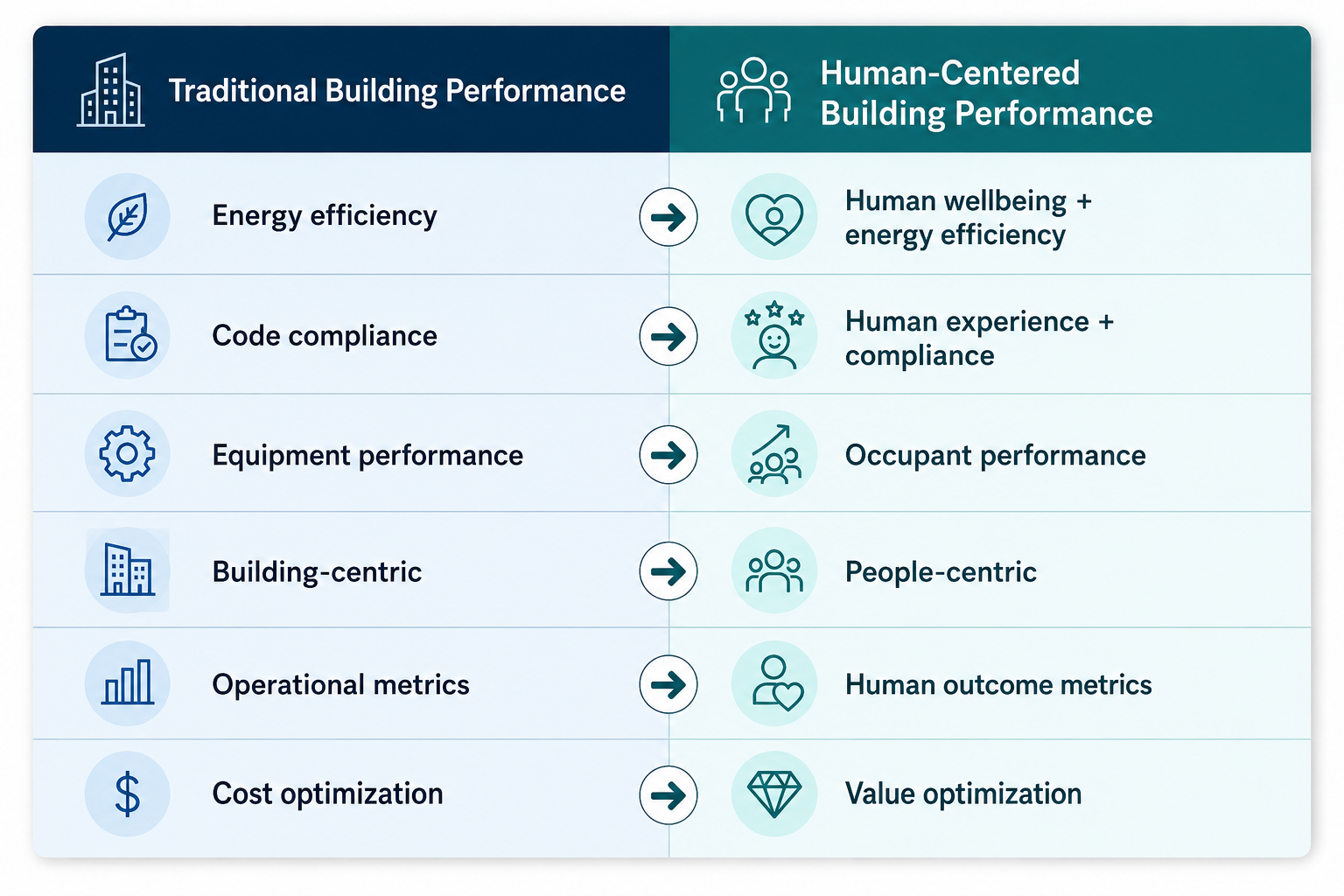
Why It Matters
Research across environmental psychology, neuroscience, building science, and occupational health consistently demonstrates that indoor environmental quality has a profound influence on human outcomes.
This growing body of evidence has led to the emergence of Human-Centered Building Performance Consulting as a specialized field focused on improving occupant experience, workplace wellbeing, learning effectiveness, patient recovery, customer satisfaction, and overall quality of life through evidence-based design and building performance engineering. Rather than measuring success solely through operational metrics, this approach evaluates how buildings influence human outcomes and long-term organizational performance.
The conditions people experience within buildings including acoustics, lighting, thermal comfort, air quality, spatial design, and access to technology can significantly affect productivity, learning performance, cognitive function, sleep quality, recovery and healing, stress levels, mental health, communication effectiveness, social behavior, spiritual transcendence, and overall satisfaction and wellbeing.
Because people spend approximately 90 percent of their lives indoors, buildings are not merely shelters or workplaces; they are environments that shape how individuals think, feel, interact, perform, and thrive. As a result, optimizing building performance around human needs creates substantial value for individuals, organizations, and communities by enhancing health, wellbeing, engagement, and long-term quality of life.
“For owners, developers, and architects, this approach is not just theoretical – it offers an evidence-based roadmap to measurable outcomes. Rather than relying only on checklists, teams use performance targets (like target IEQ levels or occupant satisfaction scores) derived from research to improve health, productivity, and satisfaction. In practice, even small gains in worker focus or absenteeism reductions often outweigh the incremental consulting costs, since people are typically an organization’s greatest asset.”
The ALTA Integra 5+7 Human-Centered Building Performance Framework™
Five Building Physics Design Elements + Seven Sensory Integration Systems
This Human-Centered Building Performance Framework is built upon the relationship between Five Building Physics Design Elements—Light, Sound, Air, Water, and Material—and 7 Sensory Integration systems consisting of Visual, Auditory, Tactile, Olfactory, Gustatory, Vestibular, and Proprioceptive perception. By understanding how environmental inputs are processed through human sensory systems and translated into biological, psychological, social, and spiritual responses, designers can create buildings that actively support human health, wellbeing, performance, and quality of life.
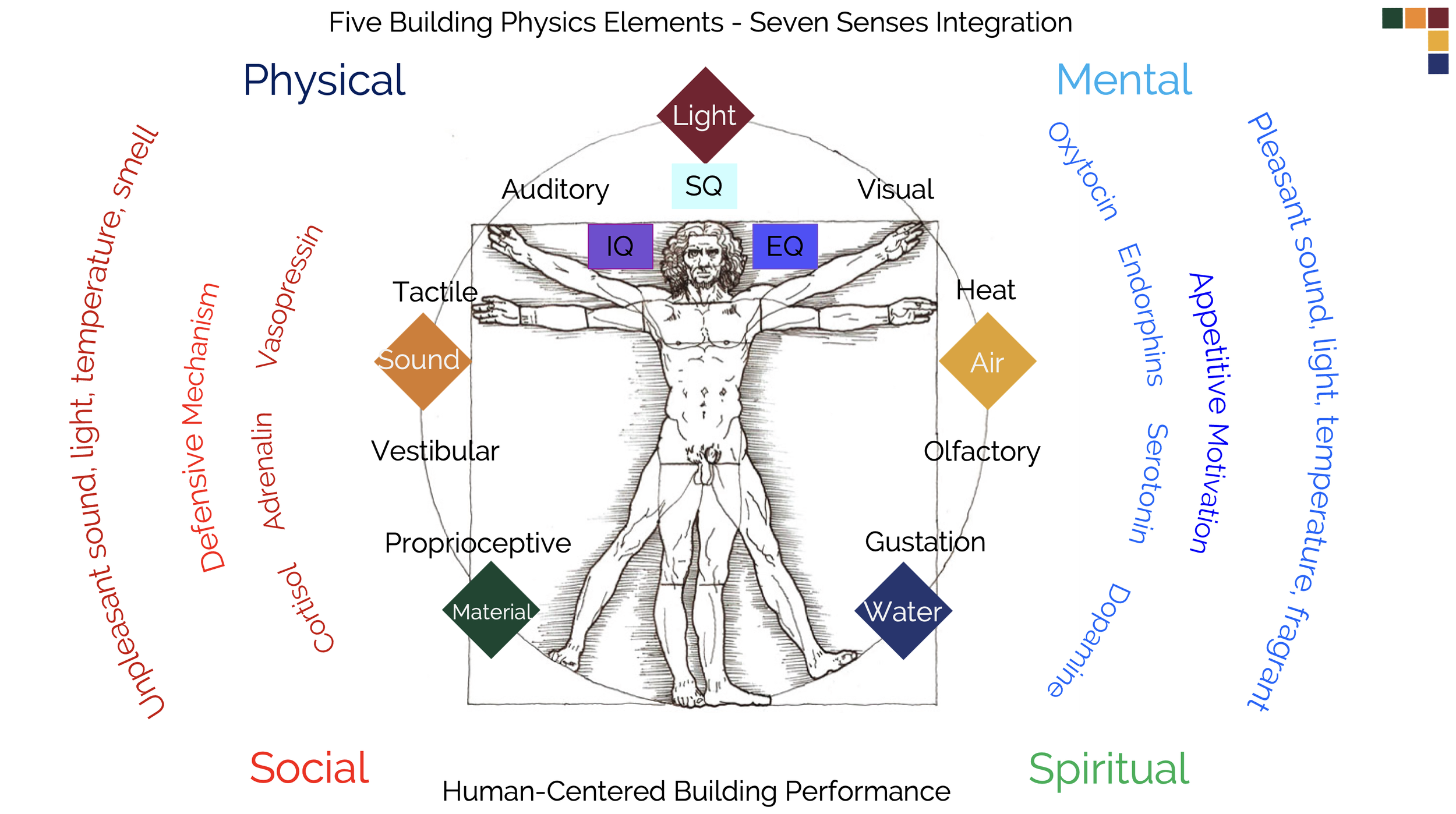
At the heart of Human-Centered Building Performance is the relationship between the physical environment and human perception. Every building communicates with its occupants through five fundamental building physics elements: light, sound, air, water, and material. These elements shape the environmental conditions people experience every moment they occupy a space. Light influences what we see and how our circadian rhythms function; sound affects communication, concentration, and emotional response; air impacts comfort, health, and cognitive performance; water contributes to thermal comfort, sensory experience, and wellbeing; while materials influence touch, acoustics, visual perception, and emotional connection to place. Together, these elements form the environmental language of a building.
What makes this relationship even more fascinating is how humans perceive these environmental conditions. Most people are familiar with the five traditional senses—visual, auditory, tactile, olfactory, and gustatory—but neuroscience tells us that human perception is far more sophisticated. We also rely on the vestibular system, which governs balance and spatial orientation, and the proprioceptive system, which allows us to sense the position and movement of our bodies in space. These seven sensory systems continuously gather information from the environment and send signals to the brain for interpretation, often without our conscious awareness.
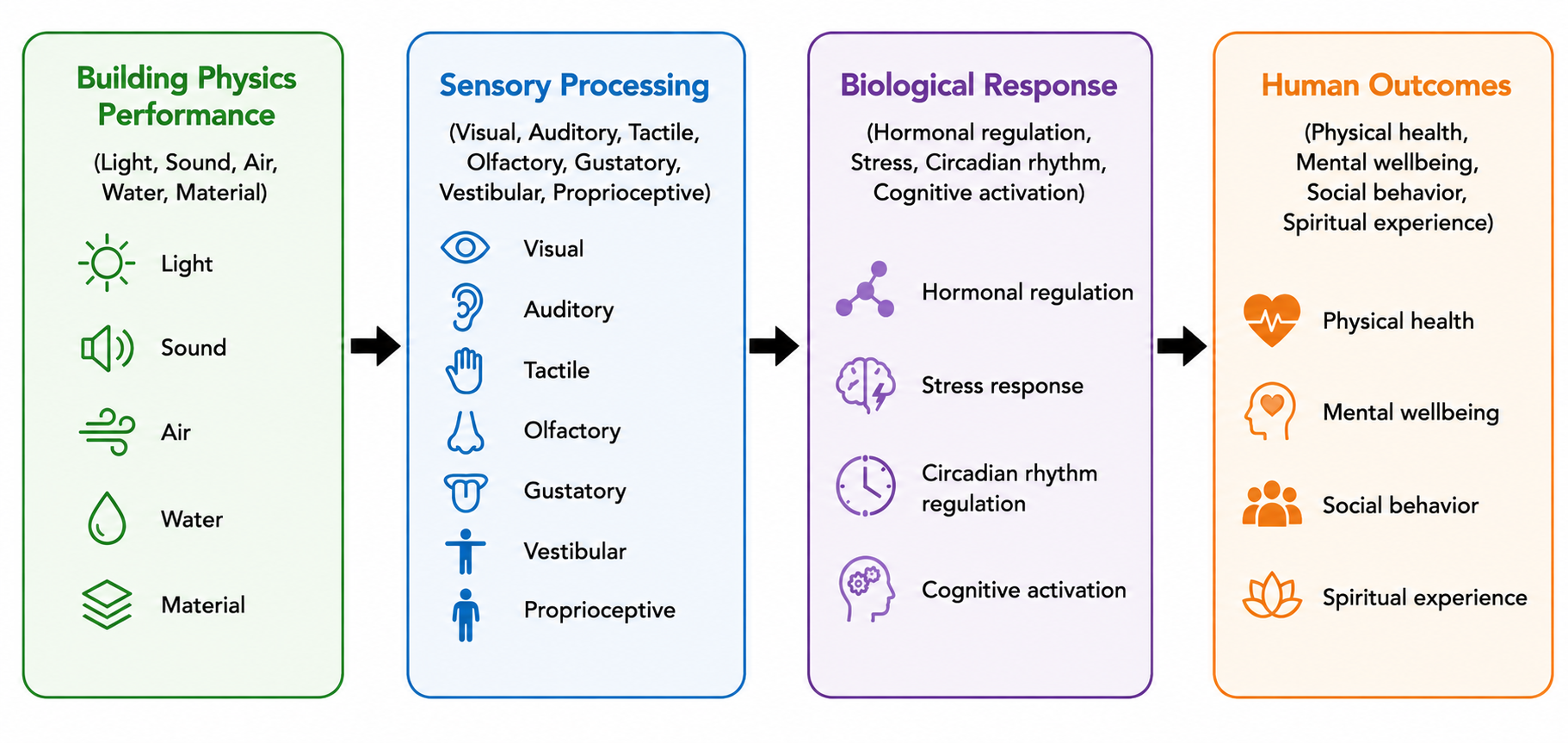
I often explain this to clients by saying that every building is constantly having a conversation with its occupants. Long before someone consciously decides whether they like a space, their sensory systems are already collecting information and their brain is already forming impressions. The quality of daylight entering a room, the reverberation of sound in a meeting space, the freshness of the air, the texture of materials under hand, or the feeling of moving through a well-proportioned corridor all contribute to how people experience a place. In this sense, buildings are never silent. Every space is continuously "speaking" to the human body and mind through the interaction of building physics and sensory perception.
When these environmental signals are thoughtfully designed and aligned with human needs, buildings can support comfort, wellbeing, productivity, social interaction, and even moments of inspiration or reflection. When they are neglected, the same sensory systems may perceive discomfort, confusion, stress, or fatigue. Understanding the relationship between the five building physics elements and the seven human sensory systems provides a powerful framework for designing environments that truly support people, transforming buildings from passive structures into active contributors to human experience and performance.
The Five Building Physics Design Elements and 7 Sensory Integration Framework provides a practical model for understanding how buildings influence human experience. By linking environmental conditions to sensory perception, biological responses, and human outcomes, the framework helps owners, developers, architects, designers, and engineers make more informed decisions about how buildings affect health, wellbeing, productivity, behavior, and quality of life.
The Brain's First Question: Am I Safe?
One of the most overlooked aspects of building design is that people begin responding to a space long before they consciously think about it. Before we notice the architecture, admire the interior design, or evaluate whether a space is beautiful, our brain performs a rapid and largely unconscious assessment:
"Am I safe here?"
This question is deeply embedded within the human nervous system. For hundreds of thousands of years, survival depended on our ability to quickly identify potential threats in our environment. While modern buildings rarely present life-threatening dangers, the biological mechanisms that evolved to protect us remain very much active today.
Every space we enter is continuously being evaluated by the brain through a stream of environmental signals. The quality of light, sound, air, temperature, materials, spatial organization, and even subtle sensory cues all contribute to our perception of safety, comfort, and control.
The brain constantly interprets conditions such as: Excessive noise, Poor lighting, Stuffy air, Uncomfortable temperatures, Unpleasant odors, Visual clutter, Confusing wayfinding and Overcrowding. Most people assume these are simply comfort issues. In reality, they are biological signals that influence how the nervous system responds to the environment.
I often notice this when walking into different buildings. Some spaces immediately feel calm, welcoming, and intuitive. Others create a subtle sense of tension that is difficult to explain. You may not consciously identify the cause, but your brain has already begun processing the environmental information and determining whether the space feels supportive or threatening.
When environmental conditions communicate safety, comfort, and predictability, the nervous system can relax. When conditions communicate uncertainty, discomfort, or potential threat, the body shifts into a more defensive state.
This distinction has profound consequences for human health, wellbeing, and performance.
Bad Design Triggers Defensive Biology
When people are repeatedly exposed to poor environmental conditions, the brain interprets these signals as stressors. Although the individual triggers may seem small, their cumulative effect can be significant.
Examples include: Constant background noise in open-plan offices, Excessive reverberation in classrooms and meeting rooms, Glare from poorly designed lighting systems, Overheated conference spaces, Poor indoor air quality, Crowded circulation areas and Harsh, sterile, or psychologically uncomfortable environments.
Many of these conditions do not create immediate discomfort severe enough for occupants to complain. Instead, they generate a persistent low-level stress response that gradually affects mood, cognition, and behavior throughout the day.
From a biological perspective, the body interprets these environmental signals as indicators that something is not quite right. In response, protective physiological mechanisms begin to activate. Stress-related hormones and neurochemical responses may increase, including: Cortisol, Adrenaline and Vasopressin.
The nervous system becomes more vigilant and allocates greater resources toward monitoring the environment. While this response is beneficial during genuine threats, it becomes problematic when maintained for extended periods within workplaces, schools, healthcare facilities, or homes.
Instead of directing energy toward creativity, learning, collaboration, or problem-solving, the brain diverts resources toward managing environmental stress. The consequences can include: Mental fatigue, Reduced concentration, Irritability, Anxiety, Reduced collaboration, Poor decision-making, Lower learning effectiveness, Decreased productivity and Reduced occupant satisfaction.
I have encountered projects where organizations invested heavily in productivity software, communication platforms, and management training while overlooking fundamental environmental problems. Employees struggled to focus, meetings were less effective, and collaboration suffered. Yet the underlying issue was not organizational culture or technology—it was the building itself. Excessive noise, poor acoustics, inadequate ventilation, and uncomfortable thermal conditions were continuously placing occupants into a mild but persistent defensive state.
The same phenomenon can occur in schools. A classroom may have highly qualified teachers and motivated students, but excessive reverberation and poor speech intelligibility force students to work harder simply to understand what is being said. Cognitive resources that should be used for learning are instead consumed by listening effort and environmental adaptation.
Similarly, in healthcare environments, environmental stressors can affect not only staff performance but also patient recovery and wellbeing. Research increasingly shows that noise, lighting, thermal discomfort, and poor air quality can influence healing outcomes, stress levels, and overall patient experience.
Good Design Supports Restorative Biology
The opposite is also true. When buildings provide environmental conditions that support human comfort and wellbeing, the nervous system interprets the environment as safe. Examples include: Comfortable thermal conditions, Clear speech intelligibility, Access to daylight, Pleasant soundscapes, Fresh air, Natural materials, Meaningful views and Intuitive spatial organization.
Under these conditions, the body can shift from defense toward restoration and engagement. Positive neurochemical responses may be supported through the release of hormones and neurotransmitters associated with wellbeing, including: Dopamine, Serotonin, Oxytocin and Endorphins. These responses contribute to: Motivation, Learning, Social connection, Emotional resilience, Creativity, Cognitive performance and Sense of wellbeing. The building becomes a silent partner in supporting human potential.
From Environmental Inputs to Human Outcomes
One of the central ideas behind Human-Centered Building Performance is that buildings influence people through a chain reaction that begins with the physical environment and ultimately shapes human health, wellbeing, behavior, and experience. What may appear to be a simple design decision—such as selecting a lighting system, choosing wall materials, controlling background noise, or designing ventilation strategies—can have far-reaching consequences on how people feel, think, interact, and perform. Human-Centered Building Performance can therefore be understood as a sequence of interconnected relationships: Environmental Inputs → Sensory Processing → Biological Response → Human Outcomes.
Environmental Inputs: The Building's Conversation with Occupants
Every building communicates with its occupants through five fundamental building physics elements: light, sound, air, water, and material. These environmental inputs define the conditions people experience every moment they occupy a space. Light influences visibility, circadian rhythms, and emotional perception. Sound affects communication, concentration, privacy, and emotional response. Air influences comfort, health, and cognitive performance. Water contributes to thermal comfort, sensory experience, and psychological restoration. Materials influence touch, acoustics, visual character, and emotional connection to place. Together, these elements create the environmental conditions that shape daily human experience.
Sensory Processing: How People Experience Buildings
Humans experience buildings through seven sensory systems: visual, auditory, tactile, olfactory, gustatory, vestibular, and proprioceptive. The visual system interprets light, color, movement, and spatial relationships. The auditory system processes speech, music, noise, and environmental soundscapes. The tactile system interprets texture, temperature, pressure, and physical contact with surfaces. The olfactory system detects odors and airborne chemical signals that influence memory and emotion. The gustatory system, although less directly involved in architecture, contributes to environmental experiences associated with food, hospitality, and cultural activities. The vestibular system governs balance, orientation, and movement through space, while the proprioceptive system allows people to sense their body's position and movement within the environment.
Most occupants are unaware of how much information these sensory systems process every second. Yet long before someone consciously decides whether they like a building, their sensory systems have already gathered environmental information and delivered it to the brain for interpretation. Every space is continuously communicating with the human nervous system.
The concept of 7 Sensory Integration recognizes that people do not experience buildings through a single sense in isolation. Instead, the brain continuously combines visual, auditory, tactile, olfactory, gustatory, vestibular, and proprioceptive information into a unified perception of the environment. Human-Centered Building Performance seeks to optimize this sensory integration process so that environmental conditions support comfort, orientation, safety, wellbeing, and positive human experiences.
Biological Response: Where Buildings Meet Human Physiology
Once environmental information is processed through the senses, the brain begins coordinating biological responses that influence health, comfort, and performance. Environmental conditions affect hormonal regulation, influencing the release of hormones associated with stress, motivation, relaxation, and social connection. They affect the body's stress response, determining whether occupants feel calm and comfortable or vigilant and defensive. Environmental conditions also influence circadian rhythm regulation, which affects sleep quality, alertness, and overall wellbeing. At the same time, the brain adjusts levels of cognitive activation, influencing concentration, learning, memory, creativity, and decision-making.
This biological response explains why some buildings feel energizing while others feel exhausting. The difference often lies not in aesthetics alone, but in how the environment interacts with the body's physiological systems.
Human Outcomes: The Ultimate Measure of Building Performance
The final outcome of this chain reaction appears in the form of human experience. Environmental conditions and biological responses ultimately influence four broad dimensions of human life: physical health, mental wellbeing, social behavior, and spiritual experience. These outcomes represent the true purpose of Human-Centered Building Performance. Rather than focusing solely on building systems, the goal is to understand how buildings affect the people who occupy them.
This framework helps explain why two buildings with similar functions may produce dramatically different outcomes. One environment may leave occupants feeling healthy, engaged, productive, and inspired, while another may contribute to stress, fatigue, frustration, and disengagement.
The Physical Dimension
At the most fundamental level, buildings influence human physiology. Every day, the human body responds to environmental conditions that affect thermal comfort, sleep quality, respiratory health, fatigue levels, visual comfort, acoustic comfort, and physical recovery. These physiological responses occur continuously, whether occupants are consciously aware of them or not.
Thermal comfort affects how efficiently the body regulates temperature and energy expenditure. Sleep quality can be influenced by access to daylight, circadian lighting, noise control, and thermal conditions. Respiratory health depends heavily on indoor air quality, ventilation effectiveness, and pollutant control. Visual comfort affects eye strain, headaches, and fatigue. Acoustic comfort influences listening effort, communication effectiveness, and stress levels. Recovery from physical and mental exertion is often enhanced by environments that provide comfort, calmness, and sensory balance.
Research consistently demonstrates that poor indoor environmental quality can contribute to discomfort, headaches, fatigue, respiratory irritation, sleep disruption, and reduced performance. Conversely, well-designed environments support healthier biological functioning, improved physical wellbeing, and a higher quality of life.
I often find that occupants become accustomed to poor environmental conditions and assume that feeling tired, distracted, or uncomfortable is simply part of daily life. Yet when building performance improvements are implemented—better acoustics, improved daylighting, enhanced ventilation, or more comfortable thermal conditions—people frequently report significant improvements in comfort and wellbeing without realizing how much the environment had previously affected them.
The Mental Dimension
Buildings directly influence how people think, feel, and perform mentally. Acoustics affect concentration, attention, memory, and learning effectiveness. Lighting influences circadian rhythms, mood, alertness, and emotional wellbeing. Air quality affects cognitive performance, decision-making, and mental clarity. Spatial organization influences stress levels, mental workload, and the ease with which people navigate and understand their surroundings.
Most people have experienced entering a space and immediately feeling calm, focused, energized, or inspired without fully understanding why. Similarly, many have entered environments that feel stressful, chaotic, or mentally exhausting despite appearing attractive on the surface. These reactions occur because the environment influences the brain long before conscious awareness catches up.
The brain is constantly interpreting environmental information and making judgments about safety, comfort, predictability, and control. When environmental conditions support these needs, cognitive resources can be directed toward learning, creativity, collaboration, and problem-solving. When environmental conditions create discomfort or uncertainty, cognitive resources are diverted toward adaptation and stress management.
This is why Human-Centered Building Performance places such strong emphasis on environmental quality. Mental performance is not solely a human factor. It is also a building factor.
The Social Dimension
Buildings influence how people interact, communicate, collaborate, and build relationships with one another. The physical environment can either support social connection or create barriers that weaken communication and engagement.
Poor acoustics can discourage conversation by making speech difficult to understand. Confusing layouts can reduce opportunities for interaction and collaboration. Overcrowded environments can increase frustration, stress, and social withdrawal. Spaces that feel uncomfortable, noisy, or visually overwhelming may discourage people from remaining in communal areas.
Conversely, environments that support comfort, communication, accessibility, and inclusivity can strengthen collaboration, trust, community, engagement, and a sense of belonging. Meeting spaces with excellent speech intelligibility encourage productive discussions. Educational environments with comfortable acoustics and lighting support learning and participation. Hospitality environments with thoughtful sensory design encourage social interaction and positive experiences. Community and religious spaces that feel welcoming and inclusive foster stronger social bonds.
In workplaces, schools, religious facilities, hospitality environments, healthcare settings, and public spaces, social outcomes are often heavily influenced by environmental conditions. People connect more effectively when buildings support human interaction.
The Spiritual Dimension
Perhaps the least discussed, yet most profound, dimension of building performance is spirituality. Throughout history, architecture has been used not only to shelter people but also to create experiences of meaning, reflection, connection, awe, and transcendence.
Many of the world's most memorable sacred spaces intentionally use environmental elements to shape human experience. Daylight filtering through stained glass can create a sense of wonder and contemplation. The reverberation of sacred music can evoke emotional and spiritual responses. The scent of natural materials, incense, or timber can strengthen memory and connection to place. The stillness of a contemplative environment can support reflection and inner awareness. The movement of air and light can create a dynamic sense of life and presence within a space.
These sensory experiences influence emotional and spiritual perception in ways that extend far beyond technical building performance metrics. Whether in churches, mosques, temples, memorial spaces, meditation rooms, cultural institutions, or simply environments designed for quiet reflection, buildings have the capacity to support experiences of meaning, connection, awe, and transcendence.
Final Thought
Viewed holistically, Human-Centered Building Performance can be understood as the interaction between Five Building Physics Design Elements and 7 Sensory Integration systems. The quality of light, sound, air, water, and material determines the environmental signals occupants receive, while the sensory systems determine how those signals are interpreted by the brain and body. The resulting biological responses ultimately shape physical health, mental wellbeing, social behavior, and spiritual experience. This framework provides a practical and evidence-based approach for owners, developers, architects, engineers, and designers seeking to create environments that truly perform for people.
Human-Centered Building Performance recognizes that people are not only physical and cognitive beings. They are also emotional, social, and spiritual beings. A truly successful building supports all dimensions of human experience, helping people not only function efficiently but also feel connected—to themselves, to others, to nature, and to something greater than themselves.
Viewed holistically, the Five Building Physics Design Elements and 7 Sensory Integration Framework demonstrates how Human-Centered Building Performance extends beyond traditional building physics and engineering. It provides a human-focused lens for evaluating how light, sound, air, water, and material interact with sensory perception to influence biological responses and ultimately shape physical health, mental wellbeing, social behavior, and spiritual experience.
Integrating the Pillars: Why Buildings Must Be Designed as Systems
One of the most common mistakes in building design is treating each performance discipline as an isolated problem. Acoustics, lighting, thermal comfort, indoor air quality, technology, sustainability, and architecture are often designed independently and then combined later in the project. In reality, occupants do not experience buildings in separate disciplines. They experience the building as a single integrated environment.
Human-Centered Building Performance recognizes that every environmental factor influences and interacts with others. A decision made to improve one aspect of building performance may inadvertently affect another. This is why buildings must be designed as interconnected systems rather than collections of individual components.
The Interdependence of Environmental Factors
Successful building performance requires understanding how environmental factors influence one another and how they collectively shape human experience.
For example, maximizing daylight can reduce energy consumption and improve occupant wellbeing, but without proper glare control it may also create visual discomfort, eye strain, and reduced productivity. Similarly, increasing natural ventilation can improve indoor air quality and thermal comfort, yet open windows may introduce unwanted environmental noise that compromises acoustic performance.
I often encounter projects where a solution that appears beneficial from one discipline creates challenges in another. Large glass façades may provide spectacular views and daylight access, but they can also introduce solar heat gain, glare, thermal discomfort, and acoustic issues if not carefully designed. Likewise, highly absorptive acoustic treatments may improve speech intelligibility but must be coordinated with aesthetics, maintenance requirements, and lighting integration.
Technology integration provides another example. Advanced smart building systems can enhance comfort, efficiency, and operational performance, but overly complex interfaces may frustrate occupants and reduce usability. Sustainability strategies may reduce energy consumption, yet they must also support occupant comfort, health, and experience rather than simply optimizing building metrics.
The most successful buildings balance these competing priorities through integrated design. Rather than asking how each system performs independently, Human-Centered Building Performance asks how all systems work together to support people.
The Importance of Early Interdisciplinary Collaboration
Because building performance is interconnected, successful projects depend on early collaboration among multiple disciplines.
Human-Centered Building Performance is not the responsibility of a single consultant or design team member. It requires alignment between owners, developers, architects, engineers, interior designers, contractors, and facility managers from the earliest stages of a project.
Owners establish the vision, priorities, and performance goals that define project success. Developers balance market expectations, financial objectives, and long-term value creation. Architects shape spatial experiences, form, and user interaction. Engineers optimize environmental performance, comfort, and technical systems. Interior designers influence sensory experiences, materiality, and occupant engagement. Contractors ensure that design intent is successfully translated into built reality. Facility managers play a critical role in maintaining performance throughout the building's operational life.
When these stakeholders collaborate early, potential conflicts can be identified before they become costly problems. More importantly, opportunities for innovation emerge that may not have been discovered through a traditional siloed design process.
Human-Centered Building Performance is ultimately a team effort.
Part 7: Measuring Human Experience Satisfaction and Building Performance Improvement
Moving Beyond Traditional Building Metrics
For much of modern building history, performance has been measured using technical and operational indicators. Building owners, engineers, and facility managers have traditionally focused on metrics such as energy consumption, HVAC efficiency, utility costs, carbon emissions, equipment reliability, and regulatory compliance. These indicators remain important because they help ensure buildings operate efficiently, sustainably, and economically.
However, there is a fundamental question that these metrics alone cannot answer:
How does the building actually affect the people inside it?
A building can achieve an excellent energy rating, exceed sustainability targets, and comply with every applicable standard while still creating an environment that occupants find uncomfortable, stressful, distracting, or uninspiring. Conversely, a building with only moderate energy performance may be highly valued by its occupants because it supports comfort, wellbeing, productivity, learning, collaboration, and overall quality of life.
This realization is driving a significant shift in building science and environmental engineering. Human-Centered Building Performance expands the definition of success beyond technical efficiency and environmental responsibility to include measurable human outcomes.
Instead of evaluating buildings solely as machines that consume resources, Human-Centered Building Performance evaluates buildings as environments that influence human health, wellbeing, cognition, behavior, and experience.
Ultimately, the purpose of a building is not simply to conserve energy or satisfy compliance requirements. Its purpose is to support the people who occupy it.
Why Human Outcomes Matter
Consider two office buildings with identical energy consumption and HVAC performance. Both maintain acceptable indoor temperatures. Both meet sustainability certification requirements. Both achieve similar operational costs. Yet employees in one building report feeling energized, comfortable, productive, and satisfied, while occupants in the other frequently complain about noise, glare, poor air quality, and discomfort.
Traditional building performance metrics might classify both buildings as equally successful. Human-Centered Building Performance would not. The difference lies in how environmental conditions influence human experience.
Research from environmental psychology, neuroscience, occupational health, and building science consistently demonstrates that indoor environmental quality influences:
Productivity
Learning performance
Cognitive function
Stress levels
Mental wellbeing
Sleep quality
Recovery and healing
Communication effectiveness
Social behavior
Overall satisfaction
Since people spend approximately 90% of their time indoors, understanding and measuring these impacts becomes critically important.
Measuring Human-Centered Building Performance: Measuring the Physical Environment
The first layer of Human-Centered Building Performance involves measuring environmental conditions that influence human experience.
Acoustic Performance Metrics
Sound affects communication, concentration, privacy, learning effectiveness, and emotional wellbeing.
In my own consulting experience, I have encountered numerous projects where occupants initially blamed poor productivity on management issues or workplace culture, only to discover that excessive background noise and poor speech privacy were major contributing factors.
To evaluate acoustic performance, engineers commonly use metrics such as:
Speech Transmission Index (STI)
STI measures speech intelligibility and evaluates how clearly spoken communication can be understood within a space.
This metric is particularly important in:
Classrooms
Meeting rooms
Auditoriums
Religious facilities
Healthcare environments
Reverberation Time (RT60)
RT60 measures how long sound persists after the sound source stops. Excessive reverberation can lead to:
Poor communication
Listening fatigue
Reduced learning effectiveness
Increased cognitive effort
Noise Criteria (NC)
NC evaluates background noise levels generated by mechanical systems and environmental sources.
Sound Insulation Performance
Metrics such as STC (Sound Transmission Class) and Rw (Weighted Sound Reduction Index) assess how effectively sound is isolated between spaces. These measurements help ensure acoustic privacy and occupant comfort.
Lighting Performance Metrics
Light influences much more than visibility. Modern research shows that lighting affects:
Circadian rhythms
Sleep quality
Mood
Alertness
Cognitive performance
Emotional wellbeing
Key lighting performance metrics include:
Illuminance
Measures the amount of light reaching a working surface.
Daylight Autonomy
Evaluates how frequently a space can meet lighting requirements using daylight rather than electric lighting.
Unified Glare Rating (UGR)
Measures the likelihood of visual discomfort caused by glare.
Melanopic Equivalent Daylight Illuminance (EDI)
One of the most important emerging metrics in healthy building design.
Melanopic EDI evaluates the biological effectiveness of light and its impact on circadian rhythm regulation.
As Human-Centered Building Performance evolves, melanopic metrics are becoming increasingly important because they directly connect lighting design to human health outcomes.
Thermal Comfort Metrics
Temperature alone does not determine comfort.
Human thermal perception is influenced by multiple environmental variables interacting simultaneously.
Key metrics include:
Predicted Mean Vote (PMV)
PMV predicts how occupants are likely to perceive thermal conditions.
Predicted Percentage of Dissatisfied (PPD)
PPD estimates the percentage of occupants likely to feel thermally uncomfortable.
Operative Temperature
Combines air temperature and radiant temperature to provide a more comprehensive measure of thermal experience.
Relative Humidity
Humidity strongly affects both comfort and perceived temperature.
Air Movement
Air speed influences heat transfer and can significantly improve comfort, particularly in warm climates.
Together, these metrics provide a more complete understanding of thermal performance than temperature alone.
Indoor Air Quality Metrics
Indoor air quality has emerged as one of the most important aspects of Human-Centered Building Performance. Research increasingly demonstrates links between air quality and:
Cognitive function
Decision-making
Productivity
Health outcomes
Occupant satisfaction
Key measurements include:
Carbon Dioxide (CO₂)
Often used as an indicator of ventilation effectiveness and occupancy density.
Particulate Matter (PM2.5)
Fine airborne particles associated with respiratory and cardiovascular health impacts.
Volatile Organic Compounds (VOCs)
Chemical pollutants emitted by materials, furnishings, cleaning products, and building activities.
Ventilation Effectiveness
Measures how effectively fresh air reaches occupants throughout the space. These metrics help quantify one of the most important but often invisible aspects of building performance.
Measuring Human Experience: Beyond Environmental Sensors
One of the most important lessons learned from decades of building research is that objective measurements alone do not tell the full story. Two spaces may have identical environmental conditions, yet occupants may perceive them very differently.
Human perception matters. This is why Human-Centered Building Performance incorporates subjective evaluation alongside physical measurements.
Occupant Satisfaction Surveys
Surveys help evaluate how occupants perceive:
Comfort
Productivity
Health
Wellbeing
Learning effectiveness
Workplace satisfaction
These insights often reveal issues that sensor data alone cannot identify.
User Experience Assessments
User experience evaluations explore how people interact with the building itself. Questions may include:
Is wayfinding intuitive?
Are controls easy to use?
Do occupants feel comfortable?
Does the space support their activities?
These evaluations help translate technical performance into human outcomes.
Post-Occupancy Evaluation (POE)
One of the most powerful tools in Human-Centered Building Performance is Post-Occupancy Evaluation (POE). Traditionally, many buildings are evaluated extensively during design and commissioning, but relatively little attention is given to performance after occupants move in. POE closes this gap.
In our own methodology, we combine objective environmental measurements with occupant feedback to create a comprehensive picture of building performance. Environmental sensors may continuously monitor:
CO₂ concentrations
PM2.5 levels
Temperature
Relative humidity
Illuminance
Noise levels (dBA)
At the same time, occupants provide feedback regarding:
Thermal comfort
Acoustic comfort
Lighting satisfaction
Indoor air quality perception
Overall user experience
This mixed-methods approach is increasingly supported by research because it allows project teams to validate design decisions using both hard data and human feedback.
A sensor may indicate acceptable thermal conditions, but occupants may still report discomfort due to air movement, radiant heat, or individual preferences. Conversely, surveys may identify concerns that can then be investigated using objective measurements.
The combination of both perspectives creates a far more accurate understanding of performance.
Data-Driven Building Performance: From Static Design to Continuous Optimization
Perhaps the most exciting development in Human-Centered Building Performance is the ability to continuously measure and improve performance throughout a building's lifecycle.
Historically, building performance assessments occurred at specific milestones:
Design phase
Construction phase
Commissioning phase
After occupancy, performance often became largely invisible.
Today, advances in digital technology are changing that reality.
Building Analytics Platforms
Modern analytics platforms can integrate information from multiple building systems and transform raw data into actionable insights.
These systems help identify:
Energy inefficiencies
Comfort issues
Maintenance needs
Environmental performance trends
Smart Building Monitoring
Smart buildings increasingly use sensor networks to continuously monitor:
Occupancy patterns
Indoor environmental quality
Energy use
Water consumption
Equipment performance
This allows operators to proactively manage building performance rather than reactively responding to complaints.
Digital Twins
Digital twins create virtual representations of physical buildings that update continuously using real-world data.
These models allow project teams to:
Visualize performance
Test scenarios
Predict future conditions
Optimize operations
This shift from static design toward continuous optimization represents one of the most significant transformations in modern building performance engineering.
Technical Obstacles and Future Engineering Horizons: Interoperability and Schematization Challenges
Despite tremendous progress, Human-Centered Building Performance still faces significant implementation challenges. One of the largest obstacles is interoperability. Most Building Automation Systems (BAS) were developed as proprietary ecosystems with customized control logic, sensor configurations, and equipment interfaces.
As a result, deploying advanced machine-learning-based occupant behavior models across multiple buildings often requires extensive manual programming.
Researchers are addressing this issue through the development of semantic metadata frameworks such as the Brick Schema. These frameworks create standardized digital descriptions of building assets, systems, and relationships, making it easier for software applications to exchange information.
At the same time, technologies such as Occupant Behavior Functional Mock-up Units (obFMUs) are enabling co-simulation between physical building models and occupant behavior models. These innovations may eventually allow behavioral intelligence to be transferred across different software platforms without extensive reprogramming.
Subjective Key Performance Indicators (SKPIs)
Another emerging frontier involves integrating subjective occupant feedback directly into building operations. Traditionally, building controls respond to physical measurements such as:
Temperature
Humidity
CO₂
Occupancy
However, these parameters do not always predict how people actually feel. Researchers are therefore developing Subjective Key Performance Indicators (SKPIs), which integrate real-time occupant feedback into control systems.
Examples include:
Mobile comfort surveys
Touchscreen feedback stations
Occupant satisfaction apps
AI-based analysis of user comments
Imagine a building that learns not only from sensors, but also from people. If occupants consistently report discomfort in a particular area, the building can automatically adjust environmental conditions and evaluate whether satisfaction improves.
This creates the foundation for truly adaptive, self-learning buildings. Of course, challenges remain.
Organizations must address:
Data privacy
User participation rates
Feedback quality
Regulatory compliance
Cybersecurity
Nevertheless, SKPIs may become one of the most important tools in future Human-Centered Building Performance systems.
Human-Centered Building Performance Across Project Sector
Although the principles remain consistent, Human-Centered Building Performance manifests differently depending on the project type and the needs of occupants.
Workplace and Corporate Buildings
In workplace environments, the primary objective is often to support productivity, collaboration, employee wellbeing, and organizational performance.
Acoustic privacy, speech intelligibility, thermal comfort, lighting quality, indoor air quality, and technology integration all influence how effectively employees perform their work. Organizations increasingly recognize that workplace performance is not determined solely by talent or technology; it is also influenced by the environment in which people work.
Human-centered workplaces help employees concentrate, communicate effectively, collaborate comfortably, and maintain long-term wellbeing.
Hospitality and Mixed-Use Developments
In hospitality environments, guest experience becomes a key performance metric.
Hotels, resorts, restaurants, and mixed-use developments rely heavily on sensory experiences to create memorable impressions and differentiate themselves within competitive markets. Acoustics, lighting, materiality, thermal comfort, scent, views, and technology integration all contribute to how guests perceive a space.
A positive guest experience can strengthen brand loyalty, increase repeat visits, improve online reviews, and ultimately contribute to revenue optimization. In this context, Human-Centered Building Performance becomes a business strategy as much as a design strategy.
Educational Facilities
Educational environments directly influence learning outcomes.
Students learn more effectively when classrooms provide clear speech intelligibility, comfortable environmental conditions, good indoor air quality, and access to appropriate daylight. Teachers also benefit from environments that reduce vocal strain and support sustained concentration.
Acoustic performance is particularly important. Even minor reductions in speech clarity can significantly affect comprehension, memory retention, and learning effectiveness. Human-Centered Building Performance helps create educational environments that support both academic achievement and student wellbeing.
Healthcare Facilities
Healthcare buildings have a unique responsibility because the occupants are often at their most vulnerable.
Patients require environments that support recovery, reduce stress, and promote comfort. Healthcare professionals require environments that support concentration, communication, and effective decision-making.
Noise control, circadian lighting, indoor air quality, thermal comfort, and intuitive wayfinding all contribute to better patient experiences and improved healthcare outcomes. A well-designed healthcare environment can support healing in ways that extend beyond medical treatment alone.
Residential Developments
People spend a significant portion of their lives at home, making residential performance especially important.
Human-Centered Building Performance in residential environments focuses on comfort, wellness, lifestyle quality, and long-term occupant satisfaction. Good daylight, healthy indoor air quality, acoustic privacy, thermal comfort, and meaningful connections to nature contribute to healthier and more enjoyable living environments.
Increasingly, homeowners are seeking residences that support wellbeing rather than simply providing shelter.
Cultural, Religious, and Civic Buildings
Cultural, religious, and civic buildings often serve purposes that extend beyond functionality.
These environments support community engagement, cultural identity, social interaction, education, reflection, and spiritual experience. Their success is frequently measured by the quality of human experiences they enable rather than by purely operational metrics.
Whether designing a church, mosque, temple, museum, cultural center, or civic institution, Human-Centered Building Performance helps create spaces that foster connection, belonging, inspiration, and meaning.
The Business Value of Human-Centered Building Performance
For Building Owners
For building owners, Human-Centered Building Performance can contribute to higher asset value, reduced operational risk, and increased tenant retention. Buildings that support occupant wellbeing often command stronger market demand and maintain long-term competitiveness.
For Developers
For developers, Human-Centered Building Performance provides meaningful market differentiation. As expectations for health, wellbeing, sustainability, and occupant experience continue to grow, projects that prioritize human outcomes can strengthen brand positioning and create long-term project value.
For Occupiers
For organizations occupying buildings, the benefits are often even more direct. Improved environmental conditions can enhance employee performance, increase occupant satisfaction, reduce absenteeism, support talent attraction and retention, and contribute to stronger organizational outcomes.
In many cases, investments in human-centered design generate returns that far exceed the cost of implementation because people are typically the most valuable asset within any organization.
“In fact, many organizations now view Human-Centered Building Performance consulting as a strategic investment. Enhancing acoustic comfort, lighting quality, air purity, and thermal comfort can boost employee well-being and productivity – for example, better acoustics improves communication and reduced noise stress, while high-quality daylighting supports alertness and circadian health. These gains translate into higher tenancy, faster learning outcomes in schools, or even better healing in healthcare settings.”
The Future of Human-Centered Building Performance Consulting
The building industry has made significant progress in sustainability over the past two decades. The next evolution is moving beyond environmental performance alone toward the integration of environmental performance and human outcomes. As the industry evolves beyond energy efficiency and sustainability, Human-Centered Building Performance Consulting is becoming an increasingly important discipline for owners, developers, architects, designers, engineers, and facility operators.
The Next Generation of Building Performance
Future high-performance buildings will be judged not only by how efficiently they consume resources, but also by how effectively they support human health, wellbeing, productivity, learning, recovery, collaboration, and overall occupant experience. By integrating building physics, indoor environmental quality, healthy building principles, occupant-centric design, evidence-based design, smart technologies, LEED certification, WELL certification, and building performance optimization strategies, Human-Centered Building Performance Consultants help create buildings that perform for people as effectively as they perform for systems.
Buildings will become increasingly responsive, adaptive, measurable, and personalized. Advances in sensing technologies, artificial intelligence, building analytics, digital twins, and occupant feedback systems will enable environments that continuously learn from and respond to occupant needs. The future of building performance is not simply about making buildings smarter—it is about making buildings more human.
Future projects will increasingly emphasize wellness-focused development, smart and adaptive buildings, neuroarchitecture, data-driven environmental optimization, and human-centered ESG strategies. Rather than asking only how buildings affect the planet, project teams will increasingly ask how buildings affect people.
Conclusion: Great Buildings Serve Both People and Planet
For decades, the building industry has focused on energy efficiency, sustainability, and environmental responsibility. These goals remain essential. However, a truly successful building must do more than reduce its impact on the planet—it must actively support the people who occupy it.
Human-Centered Building Performance represents the convergence of building physics, environmental engineering, sustainability, architecture, neuroscience, and technology into a unified approach that places human experience at the center of every design decision. It recognizes that the true measure of a building's success is not only how efficiently it operates, but also how effectively it supports physical health, mental wellbeing, social connection, and spiritual fulfillment.
The most successful buildings of the future will not merely be efficient, sustainable, or technologically advanced. They will be environments that help people thrive physically, mentally, socially, and spiritually, creating lasting value for individuals, organizations, communities, economies, cultures, and future generations.
FAQs
Human-Centered Building Performance Consulting
What is Human-Centered Building Performance?
1
Human-Centered Building Performance is an approach to building design, engineering, and operation that evaluates success based on how effectively a building supports human health, wellbeing, comfort, productivity, learning, communication, and overall occupant experience while maintaining environmental and operational performance.
What does a Human-Centered Building Performance Consultant do?
2
A Human-Centered Building Performance Consultant integrates building physics, environmental engineering, healthy building design, sustainability, and building technology to optimize how people experience and perform within buildings. Services may include acoustic design, lighting design, indoor environmental quality assessment, passive design strategies, smart building integration, LEED certification, WELL certification, and post-occupancy evaluation.
8
What is the difference between traditional building performance and Human-Centered Building Performance?
3
Traditional building performance focuses primarily on energy efficiency, equipment operation, operating costs, and regulatory compliance. Human-Centered Building Performance expands this approach by evaluating how environmental conditions influence occupant health, wellbeing, comfort, productivity, learning, recovery, collaboration, and overall human experience.
Why is Human-Centered Building Performance important?
4
Research from environmental psychology, neuroscience, building science, and occupational health demonstrates that indoor environmental quality directly affects cognitive performance, learning outcomes, communication effectiveness, stress levels, sleep quality, health, and occupant satisfaction. Because people spend approximately 90% of their time indoors, building performance has a significant influence on human outcomes.
Human-Centered Building Performance aligns closely with both WELL Building Standard and LEED Certification by optimizing indoor environmental quality, occupant comfort, lighting, acoustics, thermal performance, air quality, water quality, and overall building sustainability. The approach helps project teams achieve certification goals while enhancing occupant experience.
Human-Centered Building Performance Consulting can benefit workplaces, corporate offices, educational facilities, healthcare environments, hospitality developments, mixed-use projects, residential developments, cultural facilities, religious buildings, auditoriums, public buildings, and community spaces where occupant experience is a critical project objective.
Performance can be measured through environmental metrics such as Speech Transmission Index (STI), Reverberation Time (RT60), Noise Criteria (NC), illuminance, daylight autonomy, melanopic EDI, thermal comfort metrics (PMV/PPD), indoor air quality indicators, occupant satisfaction surveys, post-occupancy evaluations, and smart building analytics.
6
7
What are the Five Building Physics Design Elements and Seven Sensory Integration Systems?
The Human-Centered Building Performance Framework evaluates how five environmental elements—Light, Sound, Air, Water, and Material—interact with seven human sensory systems: Visual, Auditory, Tactile, Olfactory, Gustatory, Vestibular, and Proprioceptive. These interactions influence biological responses that ultimately affect physical health, mental wellbeing, social behavior, and spiritual experience.
How does Human-Centered Building Performance support WELL and LEED Certification?
5
What project types benefit from Human-Centered Building Performance Consulting?
How is Human-Centered Building Performance measured?
Why Work With a Human-Centered Building Performance Consultant?
Building performance challenges are often addressed independently through separate acoustic consultants, lighting consultants, sustainability consultants, audiovisual consultants, and building systems engineers. Human-Centered Building Performance Consulting integrates these disciplines into a unified strategy that aligns environmental performance, human wellbeing, occupant experience, and business objectives. This integrated approach helps owners, developers, architects, and engineers make better decisions earlier in the design process while reducing operational risk and improving long-term project value.
Contact us to discuss how Human-Centered Building Performance can enhance the value, resilience, sustainability, and occupant experience of your next project.
Human-Centered Building Performance Consulting
ALTA Integra provides Human-Centered Building Performance Consulting services for owners, developers, architects, designers, engineers, contractors, and facility operators, across Indonesia, Southeast Asia, Asia-Pacific, and selected international markets.
Our multidisciplinary approach integrates acoustics, lighting, audiovisual systems, information technology, passive design, indoor environmental quality, sustainability, LEED certification, WELL certification, and building performance engineering to create environments that support both environmental and human outcomes.