
Acoustic Consultant
Indonesia
As Principal Consultant of ALTA Integra, I lead a comprehensive, performance-driven, multidisciplinary acoustic design approach that integrates Building Acoustics, Architectural Acoustics, Electro-Acoustics, MEP Noise Control, Environmental Noise Mitigation, Vibration Control, Psychoacoustic Analysis, and Soundscape Strategy to create human-centered auditory environments that are comfortable, productive, memorable, and emotionally engaging across diverse architectural and built environments.
What Does a Human-Centered Acoustic Vibration and Noise Control Consultant Do?
An acoustic consultant analyzes and controls sound and vibration within and around buildings to improve comfort, ensure regulatory compliance, and enhance speech intelligibility through design, modeling, and material strategies.
At ALTA Integra, we provide integrated acoustic vibration and noise control consultancy services for architecture, interior, infrastructure, commercial, hospitality, educational, worship, entertainment, industrial, and urban development projects across Indonesia and international markets.
Modern acoustic engineering is no longer only about reducing noise. Today, it plays a critical role in human wellbeing, workplace productivity, learning performance, hospitality branding, urban livability, and immersive user experience.
Why Acoustic Design Matters?
Poor acoustic environments can significantly affect the quality, performance, and perception of a built environment. Excessive noise, uncontrolled reverberation, and inadequate sound insulation may reduce workplace productivity, increase stress and fatigue, disturb sleep quality in hospitality and residential settings, weaken communication clarity, and negatively impact learning performance within educational environments. Over time, unresolved acoustic issues often lead to occupant complaints, operational disruption, costly retrofit interventions, and diminished perception of property quality and brand value.
In contrast, high-performance acoustic environments contribute meaningfully to occupant wellbeing, cognitive performance, communication effectiveness, and overall environmental comfort. Thoughtfully integrated acoustic design enhances hospitality experience, supports worship and cultural engagement, strengthens spatial identity, and improves the emotional and sensory quality of architecture. Acoustic performance also plays an increasingly important role in ESG-oriented developments, wellness-focused environments, and premium user experience strategies.
Today, acoustic design is no longer considered an optional enhancement within premium architecture and high-performance buildings. It has become a strategic component of human-centered environmental design, sustainable development, operational quality, and long-term asset value.
Integrity, creativity, and empathy shape the way we work. These aren't just words—they’re the foundation of everything we build. We believe in doing great work, building real relationships, and making it easy for you to get the results you’re looking for.
What Sets Us Apart
Human-Centered Approach
Everything we do is built around understanding your needs, how people response to built-environment and helping you succeed — because when you thrive, so do we.
A Focus on Performance
We hold our work to high standards. We focus on sustainable results built on smart strategy and real insight.

Seamless Integration
We follow through every detail integration, meet deadlines, and show up when it matters. Consistency is part of our promise.
Responsive & Adaptive
We bring structure where it counts and adaptability where it matters. Our methods are clear, but always responsive.
ALTA Integra: Acoustic Vibration Noise Control Consultant
Our acoustic consulting services include acoustic feasibility studies, acoustic due diligence, initial design evaluation, acoustic design prediction, acoustic performance optimization, forensic acoustic investigation, acoustic retrofit strategies, acoustic measurement and commissioning. This includes controlling unwanted noise, improving speech intelligibility, enhancing sound quality, mitigating vibration transmission, and designing healthier auditory environments.
Architectural Acoustic Design: Electroacoustic & Room Acoustic Integration Design
Building Acoustic Design: Facade acoustic engineering, sound insulation, vibration assessment, vibration damping engineering
MEP Noise & Vibration Control: HVAC noise, Plumbing Noise, Mechanical Noise and Vibration
Environmental Noise: Noise Assessment and Compliance
Soundscape & Psychoacoustic Design: Sustainability and Wellness Performance Design
We support project stakeholders from early concept design through construction review, testing, commissioning, and post-occupancy troubleshooting.
Clients and Project Sector We Serve
As a building acoustic consultant, architectural acoustic consultant, and acoustic engineering consultant in Indonesia, we provide comprehensive acoustics, vibration, and noise control consultancy for a wide range of project sectors . We partner closely with building professionals—from architects and specialist consultants to contractors—while also providing acoustic optimization for product development.
Our Project Sectors Include
Community Center : Sports stadiums, houses of worship, cultural buildings, and performing arts venues.
Workspace, Education, and Healthcare: Corporate offices, educational facilities, research institutions, laboratories, and healthcare facilities.
Hospitality, Retail, and Residential: Hotels, convention exhibition, apartments, shopping malls, mixed-use developments, retail environments and residential developments.
Entertainment and Media Production: Entertainment venues, theme park, cinemas, television studios, recording studios, broadcasting facilities, and immersive media environments.
Industrial, Mining, and Logistic: Industrial facilities, manufacturing plants, mining operations, logistics facilities, and infrastructure projects.
Cities and Communities: Urban developments, transportation infrastructure, public spaces, civic facilities, and community projects.
We provide acoustic consultancy services throughout Indonesia, Singapore, Malaysia, Thailand, the Philippines, Vietnam, Cambodia, Myanmar, Laos, and other Southeast Asian and Asia Pacific markets while also supporting international projects worldwide. Our acoustic consulting team collaborates with project owners, construction managers, project managers, architects, engineers, specialist consultants, suppliers, contractors, operators, and facility managers to deliver integrated, high-performance, human-centered acoustic environments that support occupant comfort, speech privacy, speech intelligibility, regulatory compliance, sustainability, wellness, and international project standards.
SHAU
Mmoser
GardeTokyo
Gensler
AndraMatin
PDW
Hanawal
GeniusLoci
ACG
Aboday
PTI
Hawawinata
dpi
Metaphor
CDA
Inspiral
Ong&Ong
DCM
Canang
JAP
BlueAntz
SHAU Mmoser GardeTokyo Gensler AndraMatin PDW Hanawal GeniusLoci ACG Aboday PTI Hawawinata dpi Metaphor CDA Inspiral Ong&Ong DCM Canang JAP BlueAntz
JP Morgan
Bank of America
DBS
Bank Indonesia
Mandiri
ByteDance
Meta
Spotify
Nokia
Astra Zeneca
GBK IMS
Jakarta International Stadium
Agung Sedayu
Agung Podomoro
Paramount
Shimizu
Takenaka
Western Sydney University
Tzu Chi School
Katedral Jakarta
Katedral Makassar
JP Morgan Bank of America DBS Bank Indonesia Mandiri ByteDance Meta Spotify Nokia Astra Zeneca GBK IMS Jakarta International Stadium Agung Sedayu Agung Podomoro Paramount Shimizu Takenaka Western Sydney University Tzu Chi School Katedral Jakarta Katedral Makassar
Building Acoustic Consultant
Building Structure Noise Mitigation
We provide building acoustic consultancy for apartments and residential towers, hotels and hospitality projects, offices and workplaces, hospitals and healthcare facilities, educational buildings, mixed-use developments, as well as data centers and technical facilities requiring high-performance acoustic comfort, privacy, and environmental noise control.
Building acoustics focuses on controlling sound transmission between spaces to ensure privacy, occupant comfort, and regulatory compliance through strategies including airborne sound insulation, structure-borne noise control, floor impact noise mitigation, wall and façade acoustic performance optimization, acoustic zoning strategy, vibration isolation systems, and building envelope acoustic optimization for high-performance built environments.
Building Acoustic Modeling
We provide building acoustic modeling consultancy for residential developments, hospitality projects, corporate workplaces, educational facilities, healthcare buildings, mixed-use developments, performance venues, and high-performance architecture across Indonesia and international markets.
Our predictive simulation and optimization services include Sound Transmission Class (STC) analysis, Impact Insulation Class (IIC) modeling, Level Difference (Ld / DnT / LnT) evaluation, façade acoustic performance simulation, floor-ceiling acoustic insulation analysis, partition wall sound isolation assessment, flanking transmission analysis, structure-borne noise prediction, acoustic material performance evaluation, building envelope optimization, and acoustic compliance assessment using advanced simulation platforms including INSUL, SonArchitect, and CadnaB.
Our modeling workflow references internationally recognized acoustic standards including ASTM E90 and ASTM E413 for airborne sound insulation and STC evaluation, ASTM E492 and ASTM E989 for impact sound insulation and IIC assessment, ISO 10140 for laboratory measurement of sound insulation of building elements, ISO 717-1 and ISO 717-2 for airborne and impact sound insulation rating.
Building Acoustic Measurement & Commissioning
Building acoustic measurement is the process of evaluating real-world sound insulation and vibration performance within built environments to verify design quality, identify acoustic transmission problems, validate construction performance, and support commissioning or troubleshooting workflows.
Using professional acoustic measurement systems such as NTi Audio XL2, NTi Audio XL3, NTi Audio M2210, we conduct precise building acoustic measurements and sound insulation verification for residential developments, hospitality projects, workplaces, healthcare facilities, educational buildings, mixed-use developments, and technical environments in accordance with internationally recognized standards including ASTM E336 and ISO 16283 for field measurement of airborne sound insulation, ASTM E1007 and ISO 16283-2 for field measurement of impact sound insulation, ASTM E413 and ISO 717-1 for Air-borne Sound Insulation rating (STC, Rw), ASTM E989 and ISO 717-2 for Impact Sound Insulation rating (IIC, Ln,w) as well as IEC 61672 Class 1 requirements for precision acoustic measurement instrumentation.
We use Sorama Acoustic Camera for advanced acoustic visualization and sound transmission diagnostics to identify hidden sound leakage, flanking transmission paths, structural vibration transfer, mechanical noise leakage, façade acoustic defects, and partition acoustic weaknesses within complex built environments. Acoustic imaging workflows significantly improve troubleshooting efficiency, enabling faster identification and resolution of concealed building acoustic problems that are often difficult to detect using conventional measurement methods alone.
Architectural Acoustic Consultant
Designing Better Sound Experience Inside Spaces
We provide architectural acoustic consultancy for auditoriums, theaters, worship facilities, lecture halls, studios, corporate spaces, hospitality venues, performance environments, and immersive media spaces across Indonesia and International Markets.
Architectural acoustics focuses on how sound behaves within a room or spatial environment. Proper acoustic design enhances speech intelligibility, musical clarity, occupant comfort, and overall sensory experience. We optimize room shaping, geometry, and dimensional proportions for diverse functional uses, define appropriate reverberation time targets from both acoustic and psychoacoustic perspectives, establish suitable background noise criteria, and improve speech intelligibility for communication-focused environments. Our consultancy also develops acoustic absorption strategies, sound diffusion approaches, and material acoustic performance integrated seamlessly with architectural and interior design objectives to create human-centered, immersive, and high-performance acoustic environments.
Architectural Acoustic Modeling & Auralization
Our architectural acoustic simulation and optimization services include Reverberation Time (RT60) analysis, Speech Transmission Index (STI) modeling, Music Clarity (C50/C80) evaluation, Bass Ratio analysis, echo and reflection assessment, acoustic material performance evaluation, room geometry acoustic analysis, and performance venue acoustic optimization using advanced modeling platforms such as CATT-Acoustic and EASE 5.8 AURA + EARS to support high-performance and human-centered acoustic environments.
Our simulation workflow references internationally recognized acoustic standards and methodologies including ISO 3382 for room acoustic parameter analysis, IEC 60268-16 for Speech Transmission Index (STI/STIPA), ISO 18233 for application of new acoustic measurement and simulation methods in building and room acoustics, and AES recommendations for electroacoustic system evaluation, while following geometrical acoustic prediction principles and hybrid image source/ray tracing methodologies commonly implemented within CATT-Acoustic and EASE simulation environments for professional room acoustic and electroacoustic modeling.
Loudspeaker + Acoustic Modeling & Auralization
We provide loudspeaker + room acoustic interaction simulation and optimization services such as: electroacoustic system simulation, loudspeaker optimization, immersive audio environment simulation including Direct Sound Pressure Level (SPL) Distribution, Loudspeaker Overlap using advanced modeling platforms such as EASE Focus and EASE 5.8 EARS AURA+EARS to support high-performance and human-centered acoustic environments.
Architectural Acoustic Measurement & Commissioning
Architectural acoustic measurement is the process of evaluating real-world acoustic performance within built environments to verify design quality, identify acoustic problems, optimize user experience, and support commissioning or troubleshooting workflows. Using professional measurement systems such as NTi Audio XL2, NTi Audio XL3, NTi Audio M2210, and Sorama Acoustic Camera,
We conduct precise acoustic measurements and performance verification in accordance with internationally recognized standards including ISO 3382 for room acoustic measurement, IEC 60268-16 for Speech Transmission Index (STI/STIPA), ISO 16283 for field sound insulation measurement, and IEC 61672 Class 1 requirements for sound level measurement instrumentation.
We provide architectural acoustic measurement and commissioning consultancy across Indonesia and international markets to help project stakeholders validate acoustic quality, improve speech communication, optimize music performance, and ensure acoustic environments align with operational and human-centered performance objectives.
MEP Noise Control Consultant
HVAC Acoustic Measurement
HVAC noise measurement is the process of evaluating real-world operational noise and vibration performance generated by mechanical systems within built environments to verify design quality, identify mechanical noise transmission problems, validate installation performance, and support commissioning or troubleshooting workflows.
Using professional acoustic measurement systems such as NTi Audio XL2, NTi Audio XL3, and NTi Audio M2210, we conduct precise HVAC noise and vibration measurements for air handling units (AHU), fan coil units (FCU), chillers, cooling towers, pumps, duct systems, generators, and mechanical plant rooms within residential developments, hospitality projects, workplaces, healthcare facilities, educational buildings, mixed-use developments, and technical environments.
Our measurement workflow references internationally recognized standards and guidelines including ASHRAE HVAC Applications Handbook for Sound & Vibration Control, ANSI S12 Series for environmental and occupational noise assessment, ISO 3740 Series for sound power level determination, ISO 11690 for workplace noise control, AHRI sound rating standards for HVAC equipment, SMACNA HVAC Sound & Vibration Manual, as well as NC (Noise Criteria), RC (Room Criteria), and IEC 61672 Class 1 requirements for precision acoustic instrumentation.
We also use Sorama Acoustic Camera for advanced acoustic visualization and HVAC noise diagnostics to identify hidden mechanical noise leakage, duct breakout noise, vibration transfer paths, equipment noise radiation, airflow turbulence issues, and acoustic weaknesses within complex MEP systems. Acoustic imaging workflows significantly improve troubleshooting efficiency, enabling faster identification and resolution of concealed HVAC acoustic problems that are often difficult to detect using conventional measurement methods alone.
Mechanical, Electrical & Plumbing Noise Mitigation
Mechanical systems are among the largest sources of indoor environmental noise problems in buildings. We provide MEP acoustic engineering services including HVAC noise control, chiller and cooling tower noise mitigation, generator noise control, pump vibration isolation, duct breakout noise reduction, pipe vibration control, AHU and FCU acoustic treatment, equipment enclosure design, floating floor systems, and resilient mounting systems. Our consultancy works closely with mechanical and electrical engineers to reduce operational noise and structure-borne vibration without compromising system performance, operational reliability, occupant comfort, or energy efficiency.performance or energy efficiency.
Proper MEP noise and vibration control enhances occupant comfort, workplace productivity, and overall environmental quality while supporting better sleep performance in hospitality and residential environments. A well-engineered acoustic strategy also minimizes vibration-related complaints, improves operational reliability, supports compliance with local and international acoustic standards, and significantly reduces the risk of costly post-construction corrective works and retrofit interventions.
HVAC Acoustic Prediction
Our HVAC acoustic modeling workflow combines engineering calculations with professional HVAC equipment noise libraries to predict operational acoustic performance before construction begins. We evaluate fan noise generation, airflow turbulence noise, duct attenuation performance, terminal device noise, mechanical equipment sound power levels, room acoustic interaction, and sound propagation through HVAC distribution systems to understand how mechanical infrastructure affects indoor environmental comfort and acoustic quality.
Our modeling methodology references internationally recognized standards and guidelines including the ASHRAE Chapter 48 HVAC Applications Handbook for Sound & Vibration Control, ANSI S12 Series for environmental and occupational noise standards, ISO 3740 Series for sound power level determination, ISO 11690 for workplace noise control, AHRI standards for HVAC equipment sound rating, SMACNA HVAC Sound & Vibration Manual, as well as NC (Noise Criteria) and RC (Room Criteria) guidelines to support performance-based acoustic engineering and environmental comfort optimization.
Using predictive simulation and performance-based analysis, we support mechanical system optimization, acoustic attenuation design, equipment selection strategy, duct silencer sizing, acoustic lining optimization, and overall noise mitigation coordination. This integrated workflow allows acoustic strategies to be aligned closely with architectural, interior, and MEP design objectives without compromising operational efficiency or energy performance.
By identifying potential HVAC noise risks during early design stages, this simulation-driven process significantly reduces the likelihood of post-construction acoustic failures, occupant complaints, operational disruption, and costly retrofit interventions while supporting quieter, healthier, and more refined building environments.
Environmental Noise Consultant
Environmental Noise Assessment & Urban Noise Mitigation
Environmental noise control evaluates how external sound sources affect buildings, communities, and urban environments through environmental noise surveys, noise mapping and simulation, traffic noise assessment, railway and transportation noise analysis, industrial noise assessment, construction noise management, façade acoustic design, noise barrier engineering, and urban environmental acoustic strategy.
Because environmental noise pollution can negatively impact physical and mental wellbeing, cognitive performance, environmental comfort, and long-term health, we help project owners, architects, and developers create balanced environments that support urban activity while maintaining human comfort and sustainable environmental quality.
Environmental Acoustic Modeling
Environmental acoustic modeling is a simulation-based engineering process used to predict, visualize, analyze, and mitigate environmental noise propagation from transportation systems, urban infrastructure, industrial facilities, mechanical equipment, entertainment venues, and building developments. Using advanced environmental acoustic simulation platforms such as CadnaA, CadnaB, and SonArchitect, we evaluate how environmental noise interacts with buildings, occupants, and surrounding communities to support sustainable and human-centered environmental acoustic strategies.
Our environmental acoustic modeling workflow includes environmental noise mapping, traffic and transportation noise analysis, industrial noise prediction, façade acoustic exposure evaluation, outdoor sound propagation analysis, community noise impact assessment, and environmental noise mitigation design for commercial developments, hospitality projects, residential environments, healthcare facilities, educational campuses, mixed-use developments, transportation infrastructure, and urban planning projects.
Predictive simulation workflows help identify environmental noise risks during early design stages, enabling better coordination between architecture, urban planning, landscape design, façade engineering, and environmental comfort strategy while reducing the risk of post-construction noise complaints and mitigation costs.
Our modeling methodology references internationally recognized environmental acoustic standards and guidelines including ISO 9613 for outdoor sound propagation and attenuation, ISO 1996 for description, measurement, and assessment of environmental noise, CNOSSOS-EU environmental noise calculation methodology, FHWA Traffic Noise Model guidelines, WHO Environmental Noise Guidelines, BS 4142 for industrial and commercial sound assessment, and local environmental noise regulations and urban acoustic criteria. These standards support performance-based environmental acoustic engineering, sustainable urban development, and long-term human wellbeing within complex built environments.
Using predictive environmental acoustic simulation, we help project stakeholders optimize façade acoustic performance, noise barrier design, building orientation strategy, outdoor environmental comfort, and urban acoustic integration to create healthier, quieter, and more balanced environments that support both urban activity and human experience.
Environmental Acoustic Measurement: Environmental Noise
Environmental noise measurement is the process of evaluating real-world environmental sound and vibration conditions within urban and built environments to verify environmental acoustic quality, identify noise pollution sources, assess community noise impact, validate mitigation performance, and support environmental compliance or troubleshooting workflows.
Using professional acoustic measurement systems such as NTi Audio XL2, NTi Audio XL3, and NTi Audio M2210, we conduct precise environmental noise measurements and acoustic impact assessments for transportation infrastructure, commercial developments, hospitality projects, residential environments, healthcare facilities, educational campuses, mixed-use developments, industrial facilities, and urban environments.
We follow internationally recognized standards including ISO 1996 for description, measurement, and assessment of environmental noise, ISO 9612 for occupational noise exposure evaluation, IEC 61672 Class 1 requirements for precision acoustic instrumentation, WHO Environmental Noise Guidelines, as well as local environmental noise regulations and urban acoustic criteria.
We also use Sorama Acoustic Camera for advanced environmental acoustic visualization and noise diagnostics to identify hidden environmental noise sources, transportation noise propagation paths, mechanical noise radiation, façade acoustic leakage, urban reflection effects, and environmental sound transmission behavior within complex built environments. Acoustic imaging workflows significantly improve environmental noise troubleshooting efficiency, enabling faster identification and mitigation of concealed environmental acoustic problems that are often difficult to detect using conventional measurement methods alone.
Soundscape Design & Psychoacoustics Consultant
Beyond Noise Control — Designing Human Experience Through Sound
Soundscape design extends beyond conventional noise reduction by shaping meaningful auditory experiences that support human wellbeing, emotional comfort, spatial identity, and environmental quality. Rather than pursuing silence alone, contemporary soundscape strategy considers how people psychologically and emotionally perceive sound within architecture, urban environments, hospitality spaces, workplaces, cultural settings, and public realms.
Our human-centered soundscape consultancy integrates psychoacoustic analysis, auditory comfort strategy, sound identity development, biophilic sound integration, wellness-oriented acoustic environments, urban soundscape planning, and experiential acoustic branding to create acoustically balanced and contextually appropriate environments. This multidisciplinary approach combines environmental acoustics, architecture, landscape strategy, behavioral understanding, and sensory experience design to enhance the relationship between people and place.
Soundscape strategy is increasingly important for public spaces, parks and urban developments, hospitality projects, retail environments, wellness facilities, cultural and spiritual spaces, corporate workplaces, and mixed-use environments where user perception and emotional experience are integral to project value. A successful environment is not necessarily silent — it is acoustically balanced, psychologically comfortable, emotionally engaging, and meaningfully connected to its context and function.
Industrial Machinery Monitoring
Vibration monitoring, acoustic camera analysis
Industrial vibration monitoring is a predictive maintenance and performance optimization strategy used to evaluate the mechanical condition, operational stability, and long-term reliability of rotating equipment and industrial systems. By continuously analyzing vibration behavior from motors, pumps, fans, compressors, chillers, generators, turbines, and other critical machinery, vibration monitoring helps identify early signs of imbalance, misalignment, looseness, bearing wear, resonance, and mechanical deterioration before failures occur. This proactive engineering approach supports operational continuity, reduces downtime risk, and improves equipment lifecycle performance within industrial and technical environments.
We provide industrial vibration monitoring consultancy for industrial facilities, manufacturing plants, data centers, infrastructure projects, commercial buildings, energy facilities, and mission-critical environments. Our workflow combines vibration measurement, frequency spectrum analysis, operational diagnostics, and performance trending to evaluate machine condition, structural vibration behavior, and environmental impact on surrounding spaces.
Using professional vibration analysis instrumentation and predictive monitoring methodologies, we help project owners, facility operators, engineers, and maintenance teams identify hidden operational risks and optimize system reliability before failures escalate into costly disruptions. Our vibration monitoring methodology references internationally recognized standards and guidelines including ISO 10816 and ISO 20816 for mechanical vibration evaluation, ISO 13373 for condition monitoring and diagnostics, ASHRAE vibration guidelines for building mechanical systems, and predictive maintenance best practices for rotating machinery analysis. Beyond equipment protection, our consultancy also considers human comfort, environmental vibration transfer, and building performance integration to support quieter, safer, and more resilient operational environments.
Acoustic Consultancy for Product Research & Development
Acoustic product research and development focuses on the engineering, optimization, and performance enhancement of products that influence sound, vibration, comfort, and human auditory experience across architectural, industrial, consumer, and mobility applications.
We provide multidisciplinary acoustic R&D consultancy for acoustic materials, furniture systems, consumer electronics, electro-acoustic products, automotive environments, and integrated noise and vibration control solutions. Our consultancy supports manufacturers, technology companies, product designers, architects, and industry partners in developing acoustically refined products that balance technical performance, user experience, manufacturability, sustainability, and market differentiation.
Our Acoustic Consultancy Process
1. Discovery & Design Review
Review project objectives, architectural design, operational requirements, and potential acoustic risks to establish the overall acoustic strategy.
2. Acoustic Criteria Definition
Define acoustic performance targets including reverberation time, speech intelligibility, sound insulation, background noise, and vibration criteria based on project function and applicable standards.
3. Simulation & Modeling
Perform predictive acoustic simulation and analysis to evaluate room acoustics, building acoustics, environmental noise, and MEP noise performance before construction.
4. Design Coordination
Coordinate acoustic strategies with architecture, interior design, MEP systems, structure, façade, and audiovisual systems to ensure integrated performance.
5. Tender Documentation and Evaluation
Prepare acoustic specifications and quantity, term of reference, and tender drawing, while supporting tender review and technical evaluation of materials, systems, vendors, and contractor submissions.
6. Construction Review
Review material submissions, shop drawings, installation quality, and site conditions to maintain acoustic design integrity during construction.
7. Measurement & Commissioning
Conduct acoustic measurements and performance verification including RT60, STI, STC, IIC, background noise, and vibration assessment to validate project performance.
8. Post-Occupancy Optimization
Provide troubleshooting, tuning, and performance optimization after occupancy to improve long-term acoustic comfort and operational quality.
Why Choose ALTA Integra Acoustic Consultant?
At ALTA Integra, we approach acoustics not as an isolated technical discipline, but as an integral component of human-centered environmental performance. Our consultancy integrates architectural acoustics, building acoustics, lighting design, audiovisual systems, passive environmental strategies, smart building technology, and sustainability frameworks to create holistic environments that are technically rigorous, experientially refined, and operationally resilient. Every project is approached with deep respect for the original architectural vision while ensuring acoustic performance is seamlessly integrated into the overall spatial experience.
Our methodology combines engineering rigor, performance-based analysis, psychoacoustic understanding, ESG and sustainability alignment, and multidisciplinary coordination to deliver measurable environmental quality without compromising architectural integrity or design intent. We believe high-performance acoustic environments should not only satisfy technical standards, but also enhance wellbeing, communication clarity, emotional comfort, cultural engagement, and long-term asset value.
We collaborate closely with architects, interior designers, developers, MEP consultants, contractors, manufacturers, operators, and facility owners from early concept development through commissioning and post-occupancy evaluation. This integrated consultancy approach enables us to deliver acoustically refined environments that support premium user experience, operational excellence, and sustainable building performance across hospitality, workplace, cultural, educational, healthcare, entertainment, and mixed-use developments.
ALTA Integra, who we are?
ALTA Integra, how we deliver performance?
ALTA Integra, why choose us?
FAQs
What is the difference between building acoustics and architectural acoustics?Building acoustics focuses on sound isolation and vibration transmission between spaces, while architectural acoustics focuses on sound quality and auditory experience within a room.
Why is MEP noise control important?Mechanical systems can significantly affect occupant comfort and productivity. Proper MEP acoustic design minimizes operational noise and vibration before construction problems occur.
Can acoustic consultants help after construction?We provide troubleshooting, measurement, commissioning, retrofit strategy, and forensic acoustic assessment for existing buildings and operational issues.
Why hire acoustic consultants early?Post-construction acoustic retrofit costs can reach 50%–150% of the affected construction cost, while acoustic consultancy typically represents less than 5% of the total project cost.
What is soundscape design?Soundscape design is the strategic shaping of auditory environments to improve emotional comfort, wellness, and experiential quality rather than only reducing noise.
Human-Centered Acoustic Vibration & Noise Control Consultant
Our human-centered acoustic vibration & noise control design process is thoughtful yet accountable.
-
We deliver building acoustic design solutions addressing airborne and structure-borne noise, sound insulation, and vibration control to achieve regulatory compliance and occupant comfort.
-
We design architectural acoustics by controlling reverberation, sound diffusion, and sound absorption to achieve optimal speech intelligibility and acoustic performance.
-
MEP noise control services minimize noise and vibration from mechanical, electrical, and plumbing systems to ensure quiet, comfortable, and compliant environments.
-
We analyze and control environmental noise through modeling, barrier design, and site planning strategies to reduce noise transmission between external environments and buildings.
-
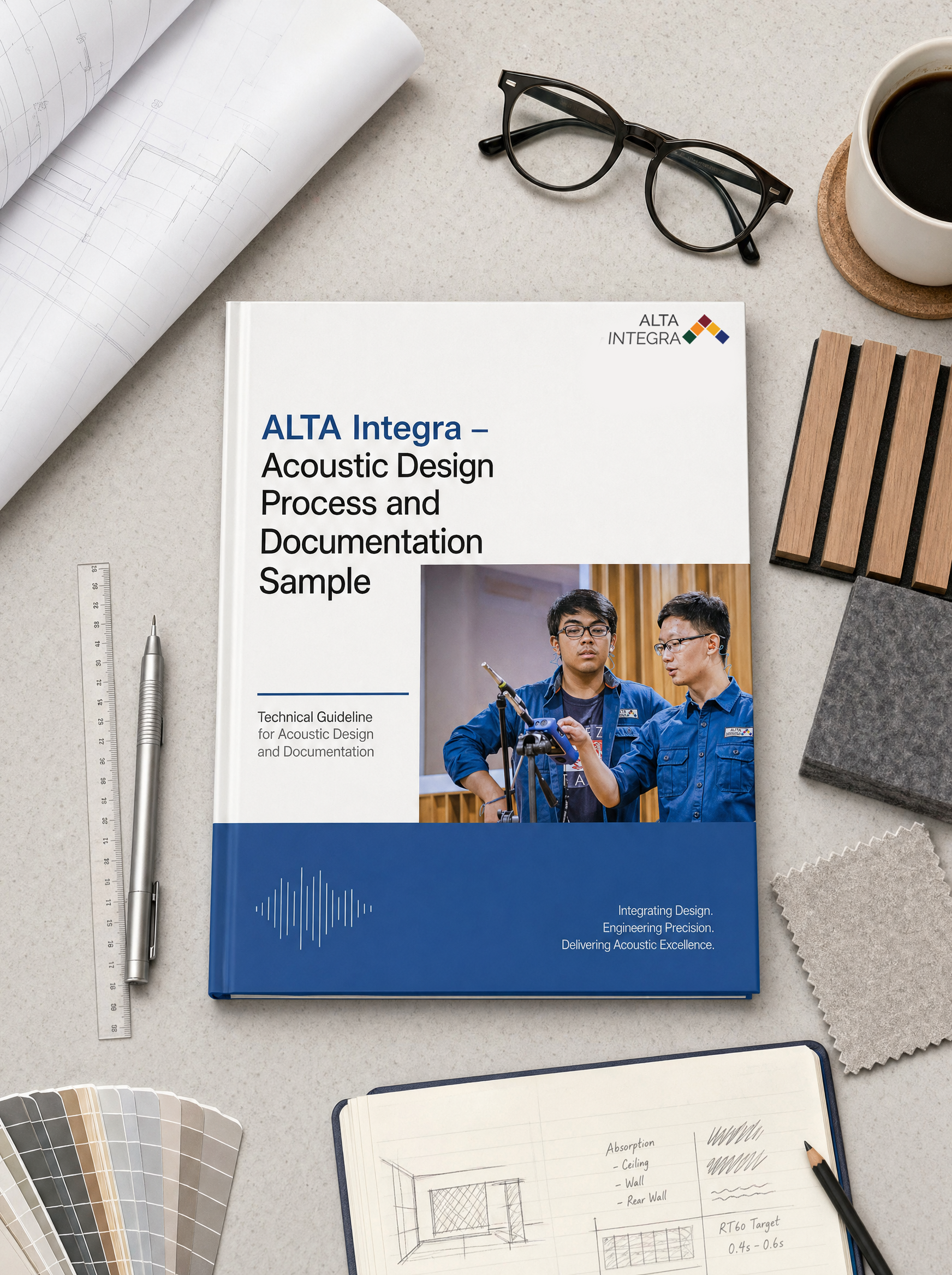
Download our acoustic & noise control design process and documentation samples to help you move forward with confidence.
Big Ideas, Real Impact.
Download ALTA Integra Company Profile, Driven by curiosity and built on purpose, this is where bold thinking meets thoughtful execution.
Let’s Create Human-Centered Acoustic Environments
Whether you are designing a workplace, hospitality venue, worship facility, urban development, performance venue, or mixed-use project, our acoustic vibration and noise control consultancy helps create environments that perform technically while enhancing human experience.
Explore our acoustic consultancy services at:
Acoustic Vibration & Noise Control Consultant
Learn more about our integrated building performance consultancy at:
Herwin Gunawan Work Official Website