Mosque Acoustics Consultation: Balancing Architecture, Quranic Recitation Prayer, and Audio Technology
Mosque Acoustic Consultation Framework Development Background
Effective mosque acoustic design consultation requires a holistic framework that bridges historical sacred architecture with modern engineering. To develop this comprehensive acoustic design consulting approach, our methodology is firmly rooted in a deep exploration of architectural history, analyzing how traditional geometries and materials passively managed sound fields.
By pairing this historical context with a rigorous understanding of Islamic liturgical practices, which demand a delicate balance between crisp speech intelligibility for sermons and majestic reverberation for Quranic chanting, we map the unique acoustic signature of the space.
Ultimately, these scientific metrics are cross-examined with congregation perception, ensuring that our architectural acoustic passive design and electroacoustic technology interventions do not merely satisfy technical standards, but actively enhance the spiritual, meditative, and communal experience of the worshippers
Mosque Architecture Historical Study
Mosque architecture is not a single fixed style. It changes strongly with regional traditions, while still keeping core elements such as the prayer hall, qibla wall, mihrab, minbar, courtyard, and often minaret.
The Early Mosque: Vernacular Domesticity and the Medina Model
The historical trajectory of mosque architecture begins with a structure that was fundamentally domestic, vernacular, and multi-functional rather than monumental. The house of the Prophet Muhammad in Medina, constructed in 622 AD, is recognized as the prototypical model for early mosque architecture. This early mosque architecture was a simple mud-brick enclosure featuring living quarters arranged along one side of an enclosed rectangular courtyard. To protect congregants from the intense Arabian sun during prayer, a shaded porch or portico was constructed on the side of the courtyard facing the qibla, initially oriented toward Jerusalem and subsequently redirected toward Mecca. This portico was fabricated from local, vernacular materials, utilizing palm trunks as supportive columns and palm branches to form a rustic thatch roof.
This early structure established a flexible spatial arrangement that accommodated the spiritual and civic needs of the early Muslim community. Rather than serving solely as a sanctuary for prayer, the Prophet's house was a multi-use civic hub. It operated as a political assembly hall, a treasury, a judicial court, a military coordination point, and a social center. The architectural layout—characterized by a central open courtyard (sahn) and an adjacent covered prayer area—became the spatial foundation for the hypostyle mosque, which spread rapidly across Islamic lands during the early centuries of expansion.
The Quba Mosque, built in 622, is also recognized as the first mosque built in Islam. In 7th century mosque architecture begins to formalize. Early mosques become spaces for communal prayer, teaching, and governance, and the basic spatial vocabulary starts to stabilize around the qibla wall, mihrab, and minbar.
Imperial Consolidation and the Umayyad Structural Synthesis
Following the transition of the caliphate to Damascus under the Umayyad Dynasty in 661 AD, mosque architecture underwent a dramatic structural and symbolic transformation. Operating within a vast, newly acquired empire that annexed Byzantine and Sassanian territories, the Umayyad caliphs recognized that architecture could serve as a powerful medium for projecting political sovereignty and religious legitimacy. The simple clay-and-palm structures of early Arabia were systematically replaced by monumental stone structures designed to rival the architectural grandeur of contemporary Christian and Zoroastrian empires.
Under Umayyad patronage, specifically during the reigns of Caliphs Muawiya and Al-Walid I, the key structural and functional elements of the classical mosque were invented, adapted, and standardized. Rather than developing these elements in isolation, Umayyad builders repurposed regional Roman and Byzantine structures through a process of creative appropriation and spolia. The Great Mosque of Damascus (706–715 AD) was constructed directly over the monumental enclosure walls of the Roman Temple of Jupiter and a subsequent Christian Cathedral dedicated to John the Baptist. By dismantling and repositioning the columns and arcades of the older structure, the architects achieved a powerful symbolic assertion of Islamic hegemony over the conquered lands.
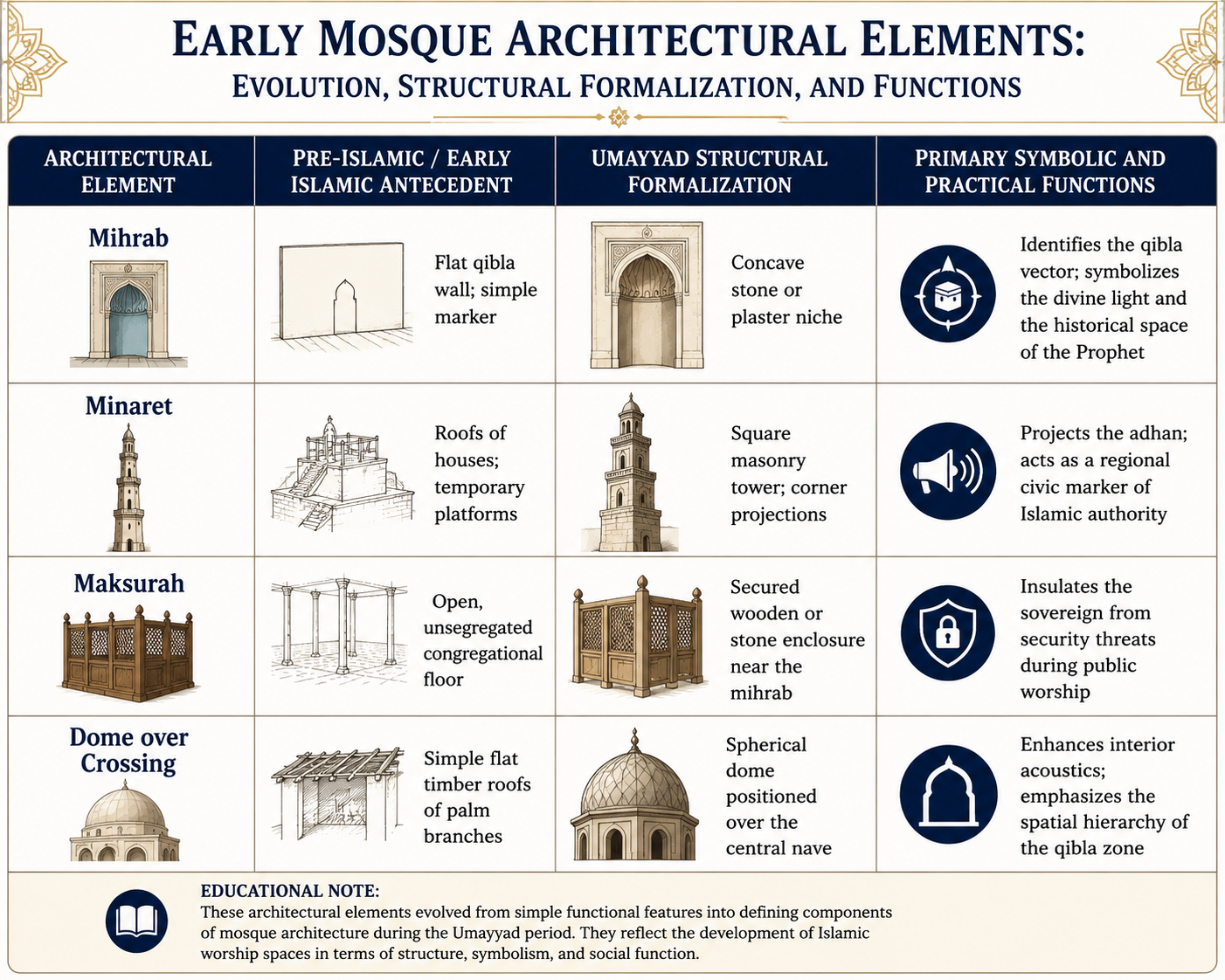
The Umayyad period introduced several architectural innovations:
The Concave Mihrab: While early prayers were oriented toward a flat wall, the concave mihrab (prayer niche) was introduced by Caliph Al-Walid I during the enlargement of the Prophet's Mosque in Medina between 707 and 709 AD. Drawing inspiration from the semi-circular apse of Byzantine Christian basilicas, the mihrab served a dual purpose: it indicated the direction of the qibla toward the Kaaba in Mecca, and it symbolized the niche containing God's divine light, marking the historical spot where the Prophet stood to lead the congregation.
The Minaret: The minaret originated during this era as a permanent, elevated tower for the call to prayer (adhan).4 Muawiya first introduced four corner projections for the adhan at the Mosque of Amr ibn al-As in Egypt in 673 AD.4 This innovation was inspired by Roman watchtowers and Syrian Christian square church towers, establishing a vertical architectural profile that became a major civic marker of Islamic cities.
The Maksurah: Following an assassination attempt on his life by a Kharijite sectary, Caliph Muawiya introduced the maksurah—a highly secured, protective wooden or stone enclosure built near the mihrab.2 This feature institutionalized a clear physical division between the ruler and the public within the communal prayer space, reflecting the shift from a highly egalitarian tribal leadership to an absolute imperial monarchy.
The Central Nave and Dome: The Umayyads modified the uniform hypostyle layout by introducing a wide central "nave" or aisle that ran perpendicular from the main entrance to the mihrab.6 This layout, modeled on Christian basilicas, culminated in a dome over the crossing directly in front of the mihrab.4 This structural feature highlighted the path of the caliph and emphasized the most sacred zone of the sanctuary.
691–715 CE the Umayyad period gives mosque architecture its first monumental expression. The Dome of the Rock in Jerusalem (691) and the Great Mosque of Damascus (705) show the early use of domes, courts, arches, mosaics, and prayer-oriented planning. The mihrab is also associated with this Umayyad phase.
The Abbasid Classical Era and Regional Variations
The overthrow of the Umayyads in 750 AD and the subsequent rise of the Abbasid Caliphate shifted the imperial center of gravity eastward to Iraq, leading to the construction of Baghdad and Samarra. This geopolitical realignment reduced the direct influence of Byzantine Mediterranean classicism and introduced Sassanian Persian design traditions, such as extensive brick construction, vaulted halls, and stucco decoration. This period represents what architectural historians term the first "classical" moment of Islamic architecture, characterized by a highly standardized, self-referential design system that evolved from internal Islamic prototypes rather than external models.
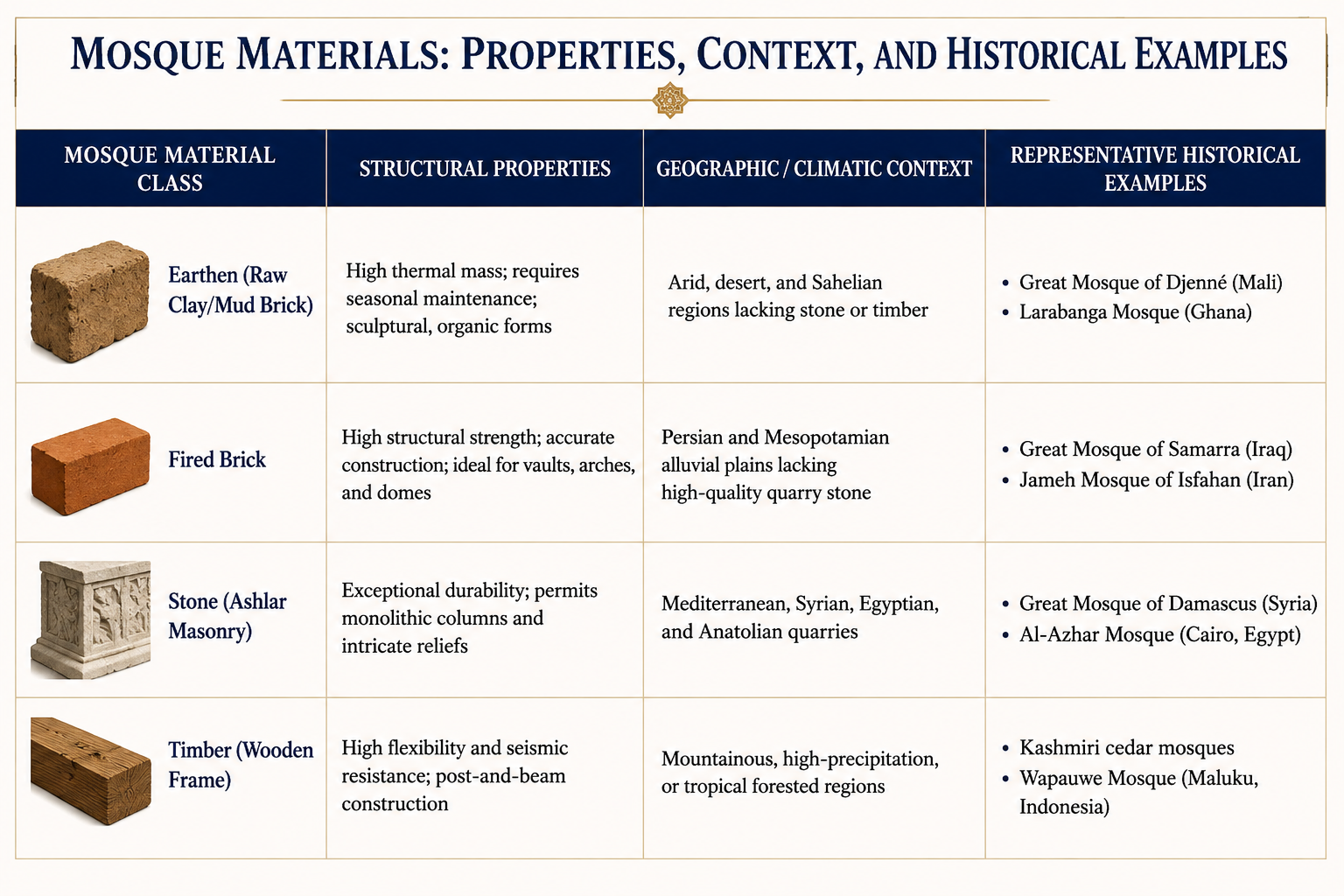
Abbasid architectural planning standardized the hypostyle layout on an imperial scale. Instead of using stone blocks, which were scarce in the alluvial plains of Iraq, Abbasid builders turned to fired and sun-dried bricks. To embellish these brick structures, they developed highly stylized, abstract stucco carvings. The "Samarra style" of stucco relief, featuring beveled, repeating geometric and vegetal designs, gave rise to the arabesque—a stylized, interlacing motif that avoided human or animal figures to comply with the theological rejection of idolatry.
Architecturally, the Abbasids introduced the ziyada—an open, outer courtyard or buffer zone that enclosed the main mosque structure, separating the sacred precinct from the noise and activity of the surrounding city. The Great Mosque of Samarra, built by Caliph Al-Mutawakkil between 848 and 852 AD, was once the largest mosque in the world, exemplifying this monumental scale. Its most iconic feature is the Malwiya Tower, a 52-meter-high spiral minaret. Moving away from the square Syrian tower model, the Malwiya featured an external, spiraling ramp inspired by ancient Mesopotamian ziggurats, demonstrating how Abbasid architects integrated regional pre-Islamic forms into their projects.
During this classical era, several key structural elements were introduced or refined:
The Pointed Arch: Abbasid builders popularized the pointed arch, which distributed structural loads more efficiently than the semi-circular Roman arch, paving the way for taller and more spacious interior prayer halls.
The Muqarnas: Originating in Baghdad during the late 9th and early 10th centuries, muqarnas (stalactite or honeycomb vaulting) emerged as a uniquely Islamic architectural device. Used to transition smoothly from a square room to a circular dome, the muqarnas broke down solid architectural surfaces into complex, light-catching geometric facets.
Aghlabid Innovations: In the Aghlabid province of North Africa (modern Tunisia), which maintained strong ties to Abbasid Iraq while preserving older local building methods, the Great Mosque of Kairouan (c. 836–875 AD) became a model for Western Islamic architecture. The Aghlabids introduced a second dome opposite the mihrab dome, positioned at the entrance leading from the courtyard to the prayer hall, creating a balanced visual axis across the sahn. Kairouan also houses the oldest surviving wooden minbar (pulpit) and maqsura, both crafted from imported Southeast Asian teak wood carved in Baghdad and carried by camel to North Africa—illustrating the vast commercial networks of the early medieval Islamic world.
Regional Proliferation and Dynastic Idioms
As central Abbasid authority weakened, independent regional dynasties emerged across the Islamic world, leading to a diversification of mosque typologies that integrated local building materials, climates, and aesthetics.
The Hispano-Maghrebi Tradition
In the far west, encompassing Al-Andalus (Islamic Spain) and the Maghreb (North Africa), the Hispano-Maghrebi or Moorish style developed under the Umayyads of Córdoba, the Almoravids, and the Almohad dynasties. This tradition is characterized by a strong conservative focus on interior spaces rather than grand exteriors, alongside the rejection of large vaults and monumental central domes. Instead, Moorish builders utilized timber-framed roofs and highly complex, low-profile ribbed vaults.
The Great Mosque of Córdoba (8th–10th centuries) exemplifies this style, utilizing a vast forest of columns topped with double-tiered, red-and-white striped horseshoe arches to create a repeating, expansive interior space. The Almohads (1130–1269 AD) introduced a highly disciplined approach to design, reintroducing monumental square minarets with intricate decorative brickwork frames, known as lozenges, and internal ramps wide enough for horse riders to ascend. This design is visible today in the Giralda of Seville and the minarets of Marrakech and Rabat.
In Norman Sicily during the 11th and 12th centuries, a unique Arab-Norman hybrid style emerged following the conquest of the former Aghlabid and Fatimid emirates. The Cappella Palatina in Palermo (built under King Roger II in the 1130s and 1140s) stands as a prominent example of this synthesis, combining Norman portals, Byzantine dome mosaics, and Arab-Islamic pointed arches with a monumental wooden ceiling carved in intricate muqarnas—representing the largest rectangular vault of its kind.
The Persian Four-Iwan Typology
In contrast to the hypostyle halls of the Arab world, 11th-century Iran under the Seljuqs developed a new layout: the four-iwan mosque. An iwan is a vaulted, three-sided hall that is open on one end to a central courtyard. Originally developed in the monumental palace architecture of the pre-Islamic Sassanian Empire, the form was adopted by Persian builders to organize and orient religious spaces.
Under this scheme, older hypostyle mosques—such as the Jameh Mosque of Isfahan—were systematically remodeled. The flat-roofed column halls were replaced by a central open courtyard flanked on each of its four walls by a monumental iwan. The qibla iwan, which faces Mecca, was designed as the largest and most decorated of the four, typically flanked by twin minarets and topped by a monumental brick dome, creating a clear visual focus for the congregation.
The Fatimid Innovations in Cairo
In Egypt, the Shi'i Fatimid Caliphate (909–1171 AD) developed an architectural style in their new capital of Cairo that blended North African brick traditions with elegant stone carving. The Fatimids introduced several key innovations that addressed the challenges of a dense, growing urban environment:
The Offset Facade: Constructed in 1125 AD by the vizier Al-Ma'mun Al-Bata'ihi, the Al-Aqmar Mosque in Cairo was the first building in Islamic history to feature an offset facade. While the interior prayer hall had to remain oriented toward the qibla (Mecca), the exterior facade was rotated to align with the pre-existing grid of Al-Muizz Street. The architect solved this structural transition by varying the thickness of the stone walls, establishing a major precedent for urban planning in Cairo.
The Hanging Mosque: Al-Aqmar was also one of Cairo’s earliest "hanging mosques," constructed on an elevated platform above a street-level row of shops. This design maximized the use of valuable urban real estate while providing secure rental income from the shops to fund the mosque's ongoing maintenance.
Symbolic Stone Facades: The Al-Aqmar facade represents a milestone in decorative stonework. It featured fluted hoods, muqarnas panels, and a central pierced medallion containing the names of "Muhammad and Ali". This decorative program served as a public statement of Fatimid political legitimacy and Shi'i theological identity.
The Early Modern Imperial Zeniths
During the 16th and 17th centuries, the Islamic world was dominated by three powerful, competing empires: the Ottoman Empire in Anatolia and the Balkans, the Safavid Empire in Persia, and the Mughal Empire in South Asia. Each dynasty developed a highly refined, monumental style of mosque architecture that expressed its unique political ideology, administrative power, and cultural identity.
The Ottoman Centrally-Planned Dome
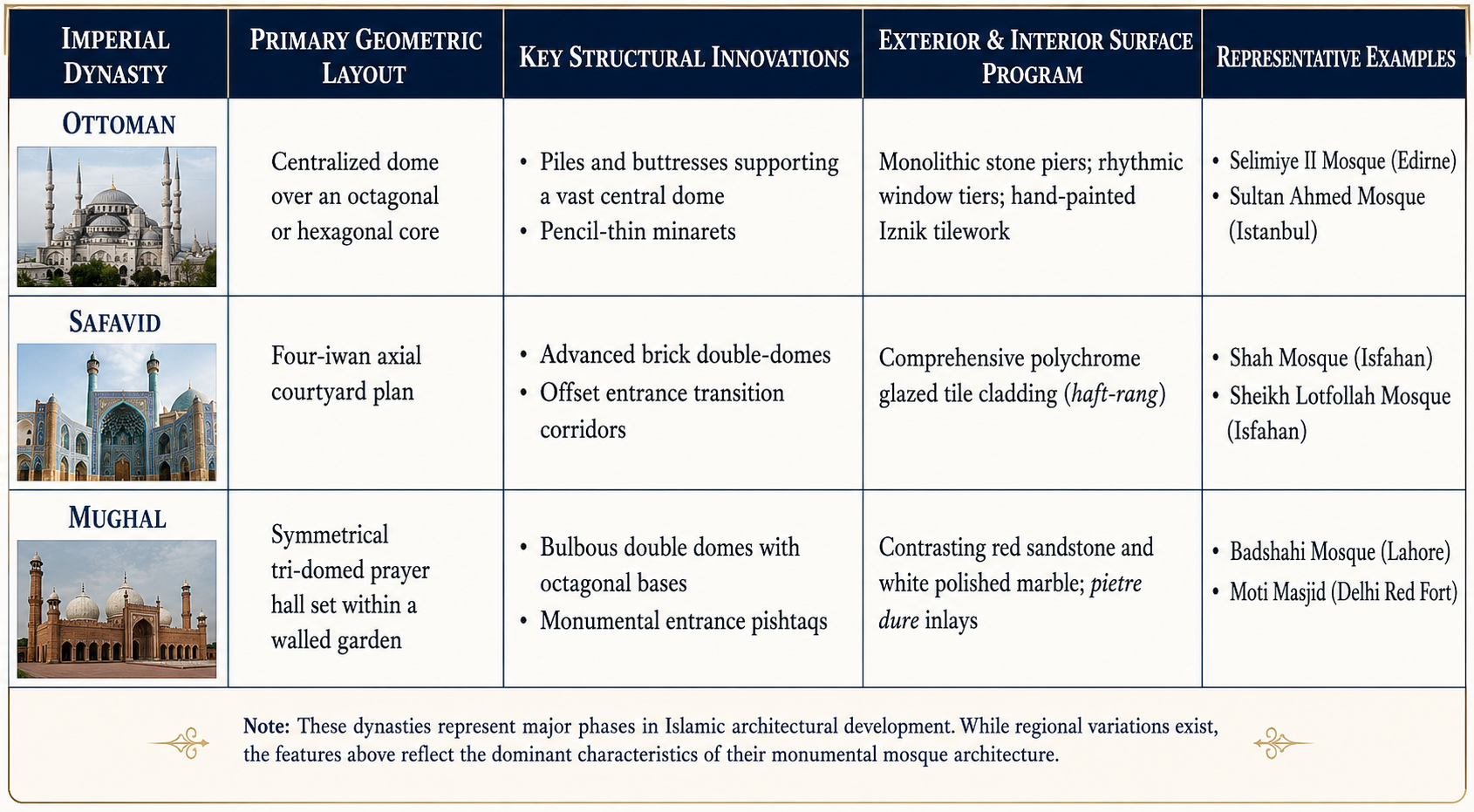
The Ottoman Empire (1299–1922 AD) developed an architectural style centered on the interior volume. Following the conquest of Constantinople in 1453, Ottoman architects analyzed the Hagia Sophia, the great 6th-century Byzantine cathedral. This dialogue inspired them to move away from hypostyle and four-iwan layouts, focusing instead on covering a single, vast congregational space with a monumental central dome.
This tradition culminated in the work of Mimar Sinan, the chief royal architect of the Ottoman golden age. Sinan designed a series of structures that pushed the limits of brick and stone engineering, achieving his self-proclaimed masterpiece at the Selimiye II Mosque in Edirne (1568–1574 AD). To create a spacious, uninterrupted interior, Sinan supported the massive dome on an octagonal system of eight piers embedded directly into the walls, eliminating the need for interior columns. This structural system, combined with cascading tiers of half-domes, buttresses, and tall, pencil-thin minarets, created a balanced, sculptural exterior profile that defined the skyline of Ottoman cities.
The Safavid Ceramic Monumentalism
In Persia, the Safavid Dynasty (1501–1736 AD) made the four-iwan layout the centerpiece of their imperial urban planning. Safavid mosque architecture is defined by its use of color, light, and double-domed brick engineering. Rather than relying on stone, Safavid builders constructed mosques from fired brick, wrapping both interior and exterior surfaces in vibrant, multi-colored glazed tilework (haft-rangi).
The Shah Mosque in Isfahan (begun in 1611 under Shah Abbas I) represents the peak of this style. The mosque's main entrance iwan is angled at 45 degrees to transition visitors smoothly from the public Naqsh-e Jahan Square to the qibla axis facing Mecca. The prayer hall is crowned by a bulbous double dome. This design featured an inner hemispherical dome that established appropriate interior proportions, and a taller, bulbous outer dome that projected a powerful profile across the city.
The Mughal Syncretic Synthesis
Ruling over a Hindu-majority subcontinent, the Mughal Empire (1526–1858 AD) developed a syncretic architectural style that blended Timurid Persian traditions with local Indian building methods. This synthesis integrated Persian layouts, such as the hasht bihisht (eight-paradise plan) and the iwan, with regional elements from the Delhi Sultanate, including red sandstone construction, jali (perforated stone screens), and chhatris (elevated, dome-shaped pavilions).
Mughal mosques are characterized by their formal symmetry, bulbous marble double domes, tall corner minarets, and monumental entrance gates (peshtaq). The buildings were often integrated into a char bagh (four-part garden) layout divided by water channels. Under Shah Jahan and Aurangzeb, the style achieved imperial scale with structures like the Taj Mahal and the Badshahi Mosque in Lahore. These projects juxtaposed deep red sandstone with polished white marble inlays, utilizing clean, symmetrical geometries to project imperial authority and spiritual order.
Vernacular and Syncretic Traditions on the Frontiers of Islam
While state-sponsored monuments in the Ottoman, Safavid, and Mughal courts formulated a classical architectural vocabulary, the expansion of Islam along maritime and trans-Saharan trade routes proceeded via a different mechanism. Far from the imperial centers, local builders adapted the functional requirements of the mosque to fit regional materials, climates, and pre-existing religious styles.
West African Earthen Architecture
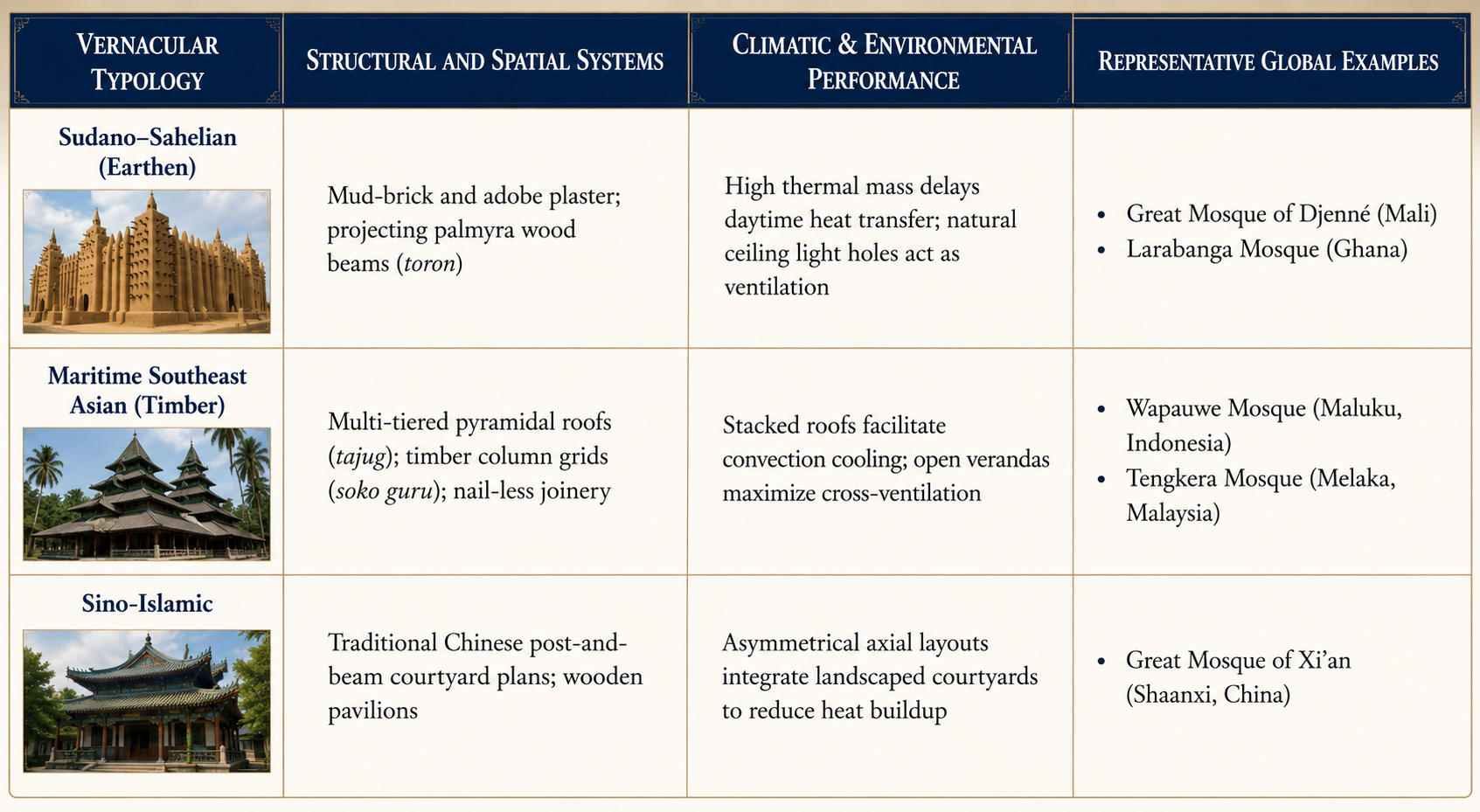
In Sub-Saharan Africa, particularly within the Western Sudan and Sahel regions, a distinct style of earthen architecture developed under the Mali, Songhai, and Hausa states. Lacking access to stone or coal-fired brick, Sahelian builders turned to sun-dried mud bricks and adobe plaster. This choice of material required frequent, communal maintenance to prevent erosion during the brief rainy seasons.
The Sudano-Sahelian style is characterized by several unique features:
Toron Spikes: Bundles of palmyra wood beams, known as toron, project horizontally from the mud walls. These beams serve a dual purpose: they act as permanent scaffolding for the annual plastering festival, and they distribute thermal expansion across the earthen facade, reducing structural cracking.
Buttresses and Conical Pinnacles: To support heavy clay roofs without columns, builders constructed massive exterior buttresses that tapered into sharp, conical pinnacles. These elements symbolized spiritual growth while providing structural support for the walls.
The Djingarey Berre and Great Mosque of Djenné: Built in 1327 and 1907 respectively, these structures showcase the scale of this earthen style. They feature high-ceilinged hypostyle halls supported by thick earthen pillars, with small holes cut into the flat roofs to allow controlled, dramatic shafts of sunlight to illuminate the sandy floors.
On the coast of West Africa, returning descendants of freed Afro-Brazilian slaves introduced a hybrid style in the early 20th century. The Great Mosque of Porto-Novo in Benin (built 1912–1935) was modeled on the central churches of Bahia, featuring a bright yellow, green, and blue baroque facade decorated with pilasters and scrollwork. This design stands as a testament to the complex history of migration and cultural exchange in the Atlantic world.
In the 1930s, this West African earthen style was transposed to Europe through the construction of the Missiri Mosque in Fréjus, France. Built under French colonial officers Captain Abdel Kader Mademba and Colonel Lame for West African colonial soldiers stationed in the region, the structure was modeled on the Great Mosque of Djenné but fabricated from reinforced concrete with ochre pigment to withstand the temperate European climate. It integrated corner towers surmounted by concrete decorations simulating West African ostrich eggs, and painted roundels depicting camels and colonial riflemen, illustrating how vernacular styles were reinterpreted to serve military and diasporic communities.
Southeast Asian Maritime Traditions
In Maritime Southeast Asia, including Java, Melaka, and Sumatra, Islam spread gradually through merchant trade networks starting in the 13th century. Early Southeast Asian mosques did not copy Middle Eastern models; they featured neither spherical domes nor tall, candlestick-shaped minarets. Instead, local builders adapted pre-existing Hindu-Buddhist timber-frame traditions to construct sanctuaries suited to the hot, humid tropical climate.
This traditional Southeast Asian style is characterized by:
Tiered Roofs (Tajug): Traditional mosques feature multi-tiered, pyramidal timber roofs, typically with two, three, or five levels, modeled on Javanese joglo structures and Hindu meru shrines. The gaps between the stacked roof tiers allowed hot air to escape, creating natural, passive ventilation inside the prayer hall.
Timber Construction and Joinery: Early mosques, like the 15th-century Wapauwe Mosque in Maluku, were constructed from local woods using traditional mortise-and-tenon joinery without metal nails, secured with palm-fiber rope (gemutu). This flexible, light timber construction allowed the buildings to sway and withstand seismic activity in earthquake-prone regions.
Mahkota Atap (Roof Crowns): The peak of the pyramidal roof was topped by a mahkota atap or mustaka—a decorative finial often hand-molded from a mixture of sea corals and egg whites or crafted from metal. These finials combined Islamic floral motifs, such as the lotus (bunga teratai) and creeping ivy (sulur daun), with older local symbols, representing a visual fusion of pre-Islamic and Islamic beliefs.
Pagoda Minarets: Where minarets were built, they took the form of multi-tiered Chinese pagoda towers or Hindu watchtowers rather than Arab spires. The Tengkera Mosque in Melaka (built 1828) features an octagonal pagoda-style minaret, showcasing the diverse cultural influences along Southeast Asian maritime trade routes.
Post-Colonial Modernity, Nation-Building, and the Abstracted Sacred
The mid-20th century marked the end of Western colonial occupation and the rise of independent nation-states across Asia, Africa, and the Middle East. Newly independent, Muslim-majority countries sought to establish modern identities. Governments needed representative civic buildings that broke away from colonial styles and looked toward a modern future. Rather than relying on direct historical revivalism, state architects designed national mosques that expressed modern progress, utilizing reinforced concrete, steel spans, and simplified, abstract geometries.
This post-colonial modernism is represented by several prominent projects:
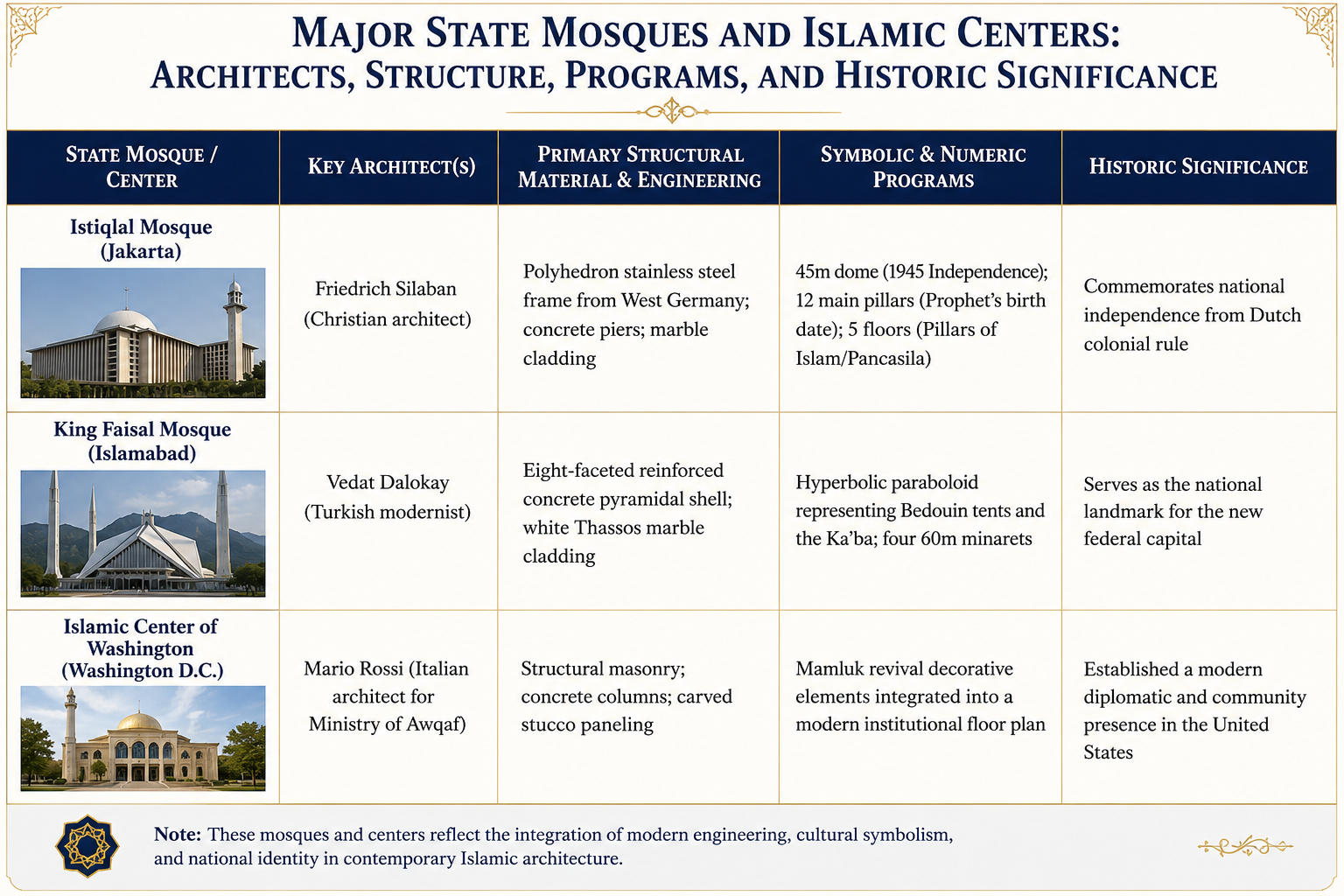
Istiqlal Mosque (Jakarta, Indonesia): Commissioned by President Sukarno to celebrate Indonesian independence, the Istiqlal (Independence) Mosque was designed by Friedrich Silaban, a Christian architect who won the national design competition in 1955. Constructed between 1961 and 1978, the mosque was built on the site of a former Dutch colonial fort next to the Ciliwung River. Silaban integrated modern European functionalism with Indonesian climate considerations, utilizing expansive covered terraces, open colonnaded corridors of over 1,800 pillars, and a massive 45-meter-diameter stainless steel dome. The number 45 represents the year of Indonesia's independence (1945), the 5 floor levels symbolize the five pillars of Islam and the state philosophy of Pancasila, and the 12 columns supporting the dome refer to the Prophet's birthday on the 12th of Rabi' al-Awwal.
King Faisal Mosque (Islamabad, Pakistan): Designed by Turkish modernist architect Vedat Dalokay and completed in 1986, the Faisal Mosque was built to serve as the national landmark for Pakistan's new capital, Islamabad. Dalokay rejected traditional spherical domes, designing instead an eight-faceted, triangular pyramidal concrete shell that abstractly references the forms of both a cubic Ka'ba and a traditional Arab Bedouin tent. The concrete shell is clad in white Turkish marble and framed by four slender, 60-meter-high pencil-shaped minarets that refer to Ottoman classicism while maintaining a modern, geometric profile.
Zagreb Islamic Center (Zagreb, Croatia): Built during the socialist Yugoslav era in 1987, the mosque was designed to symbolize the integration of the local Muslim community within a modern, multicultural state. The center features a modernist central dome and a tall, pencil-thin minaret that references the region's Ottoman past while adapting to modern construction techniques.
The Twenty-First Century: Sustainability, Abstraction, and the Eco-Mosque
In the 21st century, mosque design has evolved beyond historicist imitation and the grand monumentalism of post-colonial states. Contemporary architects are re-evaluating the essential purpose of the sacred space, focusing on ecological sustainability, natural light, and integration with the landscape. This shift has produced innovative designs that redefine what a mosque can look like in a globalized, eco-conscious world.
Sancaklar Mosque (Istanbul, Turkey)
Designed by Emre Arolat and built between 2011 and 2013, the Sancaklar Mosque in suburban Istanbul represents a complete departure from classical Ottoman design. Rather than building a monumental dome with tall minarets, Arolat embedded the mosque directly into the natural slope of a prairie landscape overlooking Büyükçekmece Lake. The only visible elements from the street are a horizontal courtyard wall and a single, rectangular stone minaret.
Congregants descend a series of natural stone terraces into a simple, subterranean, cave-like prayer hall. The interior is stripped of traditional ornamentation, utilizing raw, textured concrete, rough-hewn stone, and a single calligraphic letter waw painted on a black wall. The space is illuminated by natural light that filters through slits in the qibla wall. In a departure from traditional layouts that relegate women to back rooms or high, enclosed balconies, Sancaklar features an elevated, side-by-side prayer platform, allowing women to pray in the same row as men.
Cambridge Central Mosque (Cambridge, United Kingdom)
Completed in 2019 by Marks Barfield Architects, the Cambridge Central Mosque is Europe’s first purpose-built eco-mosque. The project was initiated to meet the needs of a diverse, multicultural academic community, blending traditional Islamic geometry with local English building traditions.
The defining feature of the mosque is its timber structure. Thirty column "trees" fabricated from sustainably sourced, curved spruce glulam timber reach up to support the roof, forming an interlaced, octagonal vault that evokes both traditional Islamic geometric designs and the Gothic fan vaulting of King’s College Chapel. Large glass dome skylights sit atop these timber trees, filling the prayer hall with natural light.
The building is highly sustainable, designed to achieve a near-zero carbon footprint. It is heated and cooled by basement-level air-source heat pumps, naturally ventilated through ducts integrated into the timber columns, and powered in part by roof-mounted photovoltaic solar arrays. The exterior is clad in local Cambridge "Gault" brick tiles that weave Qur'anic calligraphy into the brickwork, integrating the building into the local streetscape.
Eco-Retrofitting: The Greening of Historic Landmarks
Alongside the construction of new eco-mosques, existing national landmarks have undergone significant environmental retrofits to address climate change. In 2022, Jakarta’s historic Istiqlal Mosque became the first place of worship in the world to be awarded the final EDGE (Excellence in Design for Greater Efficiencies) certification. The retrofit, overseen by the Green Building Council of Indonesia and the Ministry of Public Works and Housing, reduced the mosque's carbon footprint through the installation of:
High-efficiency solar photovoltaics covering more than 13 percent of the building’s electricity consumption.
Water-recycling systems and low-flow fixtures that significantly decrease consumption.
Smart energy meters and reflective paint on the roof and external walls to optimize thermal performance and reduce cooling demands.
This project serves as a model for how heritage and modern religious structures can adapt to meet contemporary environmental standards.
Mosque Acoustics Historical Study
The evolution of mosque architecture is deeply intertwined with the acoustic and liturgical demands of Islamic worship. Unlike many other religious spaces, a mosque serves as a highly dynamic auditory environment where acoustic performance directly influences the liturgical quality of the service. Recent acoustic studies, utilizing modern acoustic computer simulations and in-situ field measurements, have uncovered the advanced passive engineering embedded in historic mosques, as well as the unique strategies employed in contemporary designs.
The study of mosque acoustics reveals a fascinating intersection of structural engineering and spiritual utility. Unlike Christian cathedrals designed for long, atmospheric reverberation to elevate choral music, or modern concert halls built for symphonies, historical mosque architecture evolved to serve a highly specific, word-centric sonic environment.
Liturgical Connections and the Spatial-Acoustic Dichotomy
Balancing the acoustic needs of a mosque creates a unique engineering paradox based on three core activities:
The Khutbah (Friday Sermon):
Typically occurring during Friday prayers, the congregation sits on the carpeted floor while the preacher (khatib) stands elevated on the minbar (pulpit), directly facing the audience. This mode demands maximum speech intelligibility over long distances.
Spoken-word communication delivered by the Khatib from an elevated minbar (pulpit). This requires high Speech Intelligibility. If a space is too echoey, words blend together and the congregation cannot understand the sermon.
Salah (Congregational Prayer): Led by the Imam who faces away from the congregation (toward the Qibla wall). This creates a massive directional sound challenge. Furthermore, the physical presence of the congregation in tight rows (saff) acts as a giant acoustic sponge. Acoustic simulations show that a standing worshipper absorbs significantly more sound than one in prostration, meaning the acoustic profile of the room shifts dynamically as people move through prayer positions.
Worshippers stand, bow, and prostrate in dense, well-defined rows parallel to the qibla wall. The Imam (prayer leader) stands at the front, facing away from the congregation toward the mihrab. Worshippers require absolute audibility and intelligibility of the Imam’s prayer commands and Quranic recitations to maintain communal unity. Worshippers also seek a state of deep spiritual concentration (khusyu').
The Tilawah (Quranic Recitation): A melodic, chanting-style recitation. Worshippers expect a sense of "spaciousness" and "divine majesty" (khusyu'). A completely acoustically dead room ruins the spiritual resonance, whereas a moderate, warm reverberation makes the chant sound full and otherworldly.
Architectural Elements as Acoustic Tools
Architecturally, mosques are often designed with high ceilings and monumental domes to induce a psychological feeling of "smallness" before the divine, which amplifies the spiritual majesty of the space. However, these immense volumes and curved surfaces present a severe acoustic challenge: they can trigger excessive echoes, flutter echoes, and long reverberation times that degrade speech intelligibility.
Dynamic Sound Absorption of Prayer Postures
Acoustic research has demonstrated that the human body itself acts as a major sound absorber within the mosque, and this absorption fluctuates dynamically based on liturgical postures. In-situ testing has shown that different postures yield different values of the equivalent sound absorption area per object, denoted as $A_{Obj}$.
Standing (Qiyam): Standing in well-defined rows provides the highest sound absorption, with a mean of 0.49 to 0.70 m² in the mid-frequency band.
Prostration (Sujud): Prostrating in rows brings the congregation close to the floor, reducing their exposed surface area and resulting in the lowest sound absorption, with a mean of 0.34 to 0.54 m².
Consequently, the physical acoustics of the prayer hall change dynamically as the congregation moves through the prayer cycles (rak'ah), altering the overall reverberation time of the room.
Before electronic amplification, master builders manipulated physical geometry and materials to manage sound propagation:
The Mihrab (Prayer Niche): Far from being just a visual marker for Mecca, this concave niche acts as a natural parabolic reflector. When the Imam recites facing the wall, the curved surface collects his voice and throws it back into the main prayer hall.
Muqarnas (Stalactite Vaulting): These intricate, multi-faceted geometric carvings on arches and transition zones act as high-frequency acoustic diffusers. They break up flat surfaces, scattering sound waves in multiple directions and preventing harsh, fluttering echoes.
Carpets: Heavy wool carpets cover the floor, acting as the primary passive acoustic treatment by absorbing excess high-frequency energy and stopping sound from bouncing wildly off stone floors.
Liturgical Architectural Elements as Acoustic Devices
Specific interior elements of the mosque function as highly specialized passive acoustic instruments.
The Concave Mihrab (Mihrab Mujawwaf)
First standardized in stone during the Umayyad dynasty under Caliph Al-Walid I in 706 AD, the concave mihrab (prayer niche) serves a critical acoustic purpose in congregational prayer. Because the Imam must lead the prayer facing the qibla wall (with his back to the congregation), his voice is naturally projected forward, away from the listeners.
The concave, semi-circular geometry of the mihrab acts as a parabolic acoustic reflector and resonator. It captures the Imam’s voice, prevents it from being absorbed by the surrounding masonry, and reflects the sound energy backward over his shoulders, projecting the acoustic signals into the main hall. Historical measurements of the 16th-century Babri Mosque noted that a whisper spoken inside its concave mihrab could be heard clearly up to 60 meters away at the far end of the sanctuary. Acoustic comparisons of different historical mihrab shapes have determined that the deep, semi-circular Safavid mihrab geometry provides the highest speech intelligibility, outperforming flat Almoravid or shallow Tulunid profiles.
Acoustic Archaeology of Specific Historic Mosques
The Early & Hypostyle Eras
The Great Mosque of Córdoba (Spain)
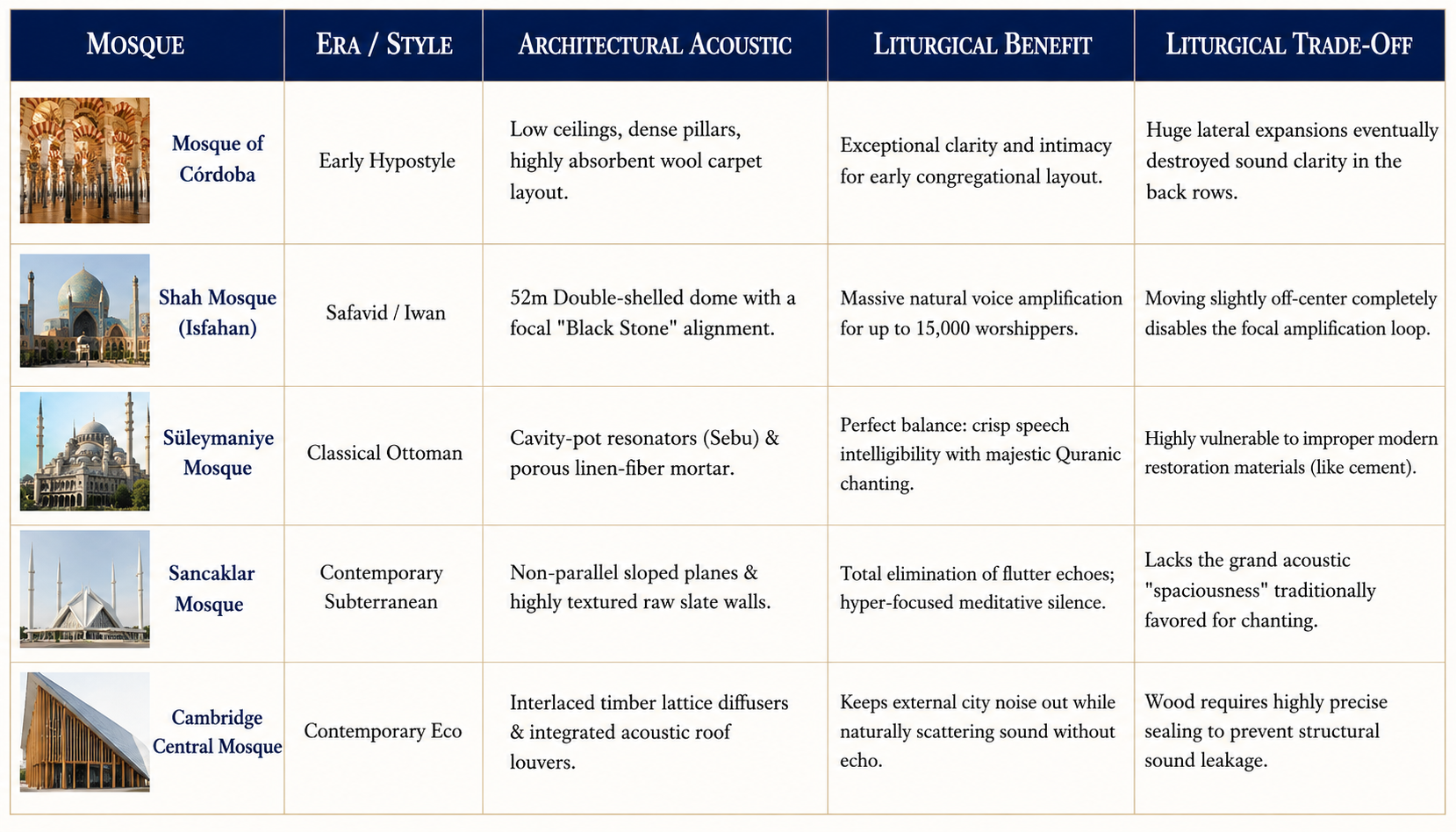
A groundbreaking spatial acoustic reconstruction by the University of Seville mapped out how the mosque’s acoustics changed over centuries of expansions. The original 8th-century mosque of Abd al-Rahman I featured an intimate hypostyle layout that provided exceptional speech intelligibility.
However, as successive rulers added deep extensions and shifted the mihrab, the space became so vast that the direct-to-reverberant sound ratio collapsed. Worshippers in the back rows were effectively left in acoustic dead zones.
The original 8th-century sanctuary founded by Abd al-Rahman I was acoustically optimized to satisfy the liturgical requirements of the early community, offering a balanced and majestic sound field.
However, as subsequent rulers (Abd al-Rahman II, Al-Hakam II, and Al-Mansur) expanded the mosque, they dramatically increased the depth of the prayer hall. This formal superposition of spaces severely degraded verbal communication in the areas furthest from the qibla wall.
The final lateral expansion by Al-Mansur decentered the mihrab, physically and acoustically segmenting the hall and causing a severe decline in acoustic quality and speech clarity.
Mosque of Ahmad Ibn Tulun (Cairo)
Built of porous red brick and stucco rather than heavy marble, this 9th-century mosque features a highly controlled reverberation field. The immense open courtyard (sahn) serves as an acoustic relief valve, allowing low-frequency sound pressure to escape into the sky instead of building up into a booming, muddy echo inside the arcades.
The Persian Safavid Innovation
Shah Mosque (Isfahan, Iran)
Engineered in the 17th century by the legendary polymath Sheikh Baha'i, this mosque features an extraordinary acoustic phenomenon driven by its 52-meter-high double-shelled dome.
The "Black Stone" Phenomenon: On the floor directly beneath the apex of the central dome sits a specific dark square stone. When the Imam stands on this exact tile and speaks, his voice hits the dome's precise geometry, bounces down, and enters an intense multi-echo loop.
This natural amplification allows a single human voice to clearly reach a congregation of up to 15,000 people without modern electronic systems. Fascinatingly, stepping just 30 centimeters off this stone completely breaks the acoustic loop, confining the extreme amplification strictly to the liturgical center stage.
The Shah Mosque (Isfahan, Iran)
Constructed under Safavid patronage, the Shah Mosque is celebrated as an extraordinary feat of mathematical and acoustic coordination overseen by the architect Ali Akbar Isfahani and the scholar-mathematician Sheikh Baha'i.
The main prayer hall features a massive double-shelled dome standing 52 meters high with a 14-meter void between the inner and outer shells. This double-shell construction was designed not only for structural stability but to function as a passive acoustic amplifier, projecting the Imam's voice to a congregation of up to 15,000 people without electronic amplification.
Under the peak of the dome, a specific square stone is marked on the floor. When a speaker stands directly on this stone, their voice produces a series of distinct, repeating echoes that propagate throughout the naves. If the speaker steps more than 30 centimeters off this marked stone, the echo effect immediately ceases, demonstrating the mathematically perfect symmetry of the dome's curvature.
The Ottoman Golden Age
The Süleymaniye and Selimiye II Mosques (Turkey)
The EU-financed CAHRISMA project ("Conservation of the Acoustical Heritage by the Revival and Identification of Sinan's Mosques' Acoustics") extensively mapped the acoustic environments of the structures designed by the legendary imperial architect Mimar Sinan. Sinan pioneered several advanced acoustic control techniques:
Dome Focus Management
In the Süleymaniye Mosque, Sinan engineered the massive central dome so that its focusing zone was located 20 meters above the floor, ensuring that harsh, concentrated sound reflections would not descend directly onto the heads of the praying congregation.
The Sebu (Cavity Resonator) Technique
In the 16th century, master architect Mimar Sinan faced a massive problem: huge central domes trap sound and create deafening, muddy echo chambers. To solve this in the Süleymaniye Mosque, Sinan embedded dozens of open-mouthed clay pots (sebu) into the masonry of the dome. These jars acted as Helmholtz resonators, specifically tuned to absorb problematic low-to-mid frequencies (63 Hz – 250 Hz) and scatter reflections evenly across the floor.
To control the excessive low-frequency reverberation inherent in monumental brick and stone volumes, Sinan embedded numerous clay and bronze pots (sebu) directly into the dome's brickwork. These hollow vessels act as Helmholtz resonators. Operating as narrow-band volume absorbers, they selectively absorb and dampen low-frequency energy (primarily in the 63 Hz to 250 Hz range) while scattering high frequencies to produce a highly diffuse and even sound field.
Surface Diffusion
Sinan intentionally fragmented flat parallel walls by integrating muqarnas (stalactite vaulting), kündekari interlocking woodwork, deep wall niches, the elevated muezzin’s mahfil (positioned in the center to optimize sound projection), and glazed ceramic tiles. These elements act as high-frequency diffusers, preventing flutter echoes.
Acoustic Plaster Material Chemistry
Sinan finished the upper walls and dome with a specialized "Horasan mortar" composed of lime, sand, hemp, and linen fibers. This porous material acted as an organic sound absorber. In tragic modern restorations, contractors scraped away this historical plaster and replaced it with hard, cement-based coatings—instantly ruining Sinan's work and causing an uncontrollable spike in reverberation that modern sound engineers are still trying to correct.
Sinan utilized a highly specialized, porous, lime-based plaster known as horasan mortar, mixed with natural hemp and linen fibers, to finish the upper walls and domes. This fibrous plaster offered exceptional sound absorption in the low-to-mid frequency range. Modern restorations that replaced this historical mortar with hard, cement-based plasters have been blamed for the excessive reverberation observed in some historical mosques today.
The Jaame Mosque of Yazd (Iran) and the Muqarnas
The acoustic influence of muqarnas decoration was evaluated in the Jaame Mosque of Yazd.
Computer simulations using EASE compared the mosque's acoustic performance with and without its decorative elements.
The study revealed that without muqarnas, the median reverberation time was an uncomfortable 4.32 seconds.
When the muqarnas, squinches under the dome, and decorative brick mortar joints were factored in, the reverberation time dropped to 3.33 seconds. The intricate geometries of the muqarnas effectively broke up the acoustic reflections, managing low-frequency build-up and distributing sound waves uniformly across the prayer hall.
The Modern Era
In modern mosque architecture era, the reliance on reinforced concrete, large steel structures, and expansive marble cladding has introduced major acoustic difficulties.
The Megastructure Challenge: The Grand Mosque of Makkah
In monumental contemporary spaces like the Grand Mosque of Makkah, which features massive open halls finished entirely in highly reflective marble, background noise levels can reach up to 90 dBA due to massive crowd sizes.
Electro-acoustic measurements (using the EASERA system) show that these highly reflective, hard surfaces delay sound energy arrival. Any sound waves arriving more than 100 ms after the direct signal create late-energy echoes that degrade the Speech Transmission Index (STI).
Rather than applying destructive or aesthetically inappropriate passive materials to historic marble, contemporary engineers utilize advanced computer software (such as EASE) to design "active" acoustic systems. Carefully calibrated column loudspeaker arrays are programmed with precise digital time delays to direct sound energy directly to the level of the worshippers, minimizing late energy arrival and raising the speech intelligibility rating to a highly functional 0.6.
The Contemporary Eco-Mosque: Cambridge Central Mosque (UK)
As Europe's first eco-mosque, its acoustics are deeply tied to sustainability (completed in 2019). The stunning timber glulam columns fan out into an interlaced octagonal lattice vault. These wooden structures act as complex geometric diffusers, breaking up sound waves rather than focusing them into hot-spots. To keep the space quiet, acoustic louvers are integrated into the fresh air intakes and roof oculi—blocking outside city noise from interrupting prayers while preventing the internal sound of the recitation from bleeding out into the surrounding residential neighborhood.
Glulam Timber Vaults: The defining feature of the mosque—its 30 tree-like spruce glulam columns that rise into interlaced octagonal fan vaults—serves an acoustic purpose. The complex, curved wooden lattice surfaces scatter and diffuse sound waves, eliminating the flutter echoes common in flat-walled or concrete-domed contemporary prayer halls.
Bespoke Roofing System: To preserve the quiet, contemplative atmosphere required for khusyu' prayer, the roof was outfitted with a custom-engineered acoustic tapered insulation scheme beneath its Paralon waterproofing system. This design dramatically reduces external environmental noise (such as rain impact and city traffic) from penetrating the sacred space.
Passive Ventilation Attenuation: The mosque relies on natural passive ventilation, drawing fresh air through grilles in the walls and exhausting warm air out of louvres in the circular roof skylights. To prevent fan and mechanical noise from entering the prayer hall, and to prevent the sound of prayers from breaking out into the quiet residential neighborhood, Skelly & Couch engineers integrated acoustic lining inside the window reveals and added acoustic attenuators and louvres directly into the air intakes and exhausts.
Perimeter Noise Management: Externally, the mosque utilizes Jakoustic Reflective timber acoustic fencing around its perimeter. This specialized fencing features flat timber profiles and interlocking "V" boards designed to reflect sound waves, creating a peaceful, quiet buffer zone for worshippers as they transition through the Islamic gardens into the sacred interior.
Sancaklar Mosque (Istanbul)
Emre Arolat’s subterranean, cave-like mosque completely discards the traditional dome. The walls are made of unpolished, rough local slate stone. This jagged, irregular texture serves as a highly effective natural acoustic diffuser, scattering mid-and-high frequencies. Combined with a sloped ceiling and floor that eliminate parallel reflective surfaces, Sancaklar creates a whisper-quiet, deeply intimate acoustic environment designed specifically to enhance khusyu' (meditative focus) through absolute stillness.
Architectural Acoustic History and Liturgical Benefit
ALTA Integra Mosque Acoustics Consultation Framework
Balancing Worship Tradition, Architecture, and Technology
Mosques present a unique challenge in Sacred Acoustic Design because the worship experience is fundamentally centered on the human voice. Unlike many churches that may rely on instrumental music, choirs, or worship bands, mosque acoustics are primarily shaped by the Adhan, Quranic recitation, spoken teaching, and collective prayer. As mosques become larger, more architecturally ambitious, and increasingly integrated with digital technologies, acoustic design must balance spiritual tradition with contemporary functional requirements.
Today, many mosques accommodate not only daily prayers but also Friday sermons, religious education, community gatherings, lectures, and live broadcasts. Their acoustic requirements therefore extend beyond simple amplification. The goal is to preserve the beauty, warmth, and intelligibility of the human voice while maintaining the sense of sacred spaciousness and contemplation that worshippers expect.
Different Worship Traditions Require Different Acoustic Environments
Although all mosques share common foundations in Islamic worship, different traditions, cultural contexts, and patterns of use can result in distinct acoustic priorities.
Traditional mosques often emphasize the natural beauty of Quranic recitation and collective prayer within highly reverberant architectural settings. The acoustic environment should support vocal richness and a sense of spiritual grandeur while maintaining sufficient clarity for worshippers to understand the recitation.
Urban community mosques frequently place greater emphasis on speech intelligibility due to the increased importance of Friday sermons, religious instruction, educational activities, and multipurpose community functions. In these environments, excessive reverberation can reduce comprehension and diminish the effectiveness of communication.
Large contemporary Islamic centers often combine worship halls, classrooms, conference facilities, community spaces, and digital broadcasting infrastructure. These facilities require a more sophisticated acoustic strategy capable of supporting diverse activities while preserving the dignity and spiritual atmosphere of the prayer hall.
The challenge is recognizing that mosque acoustics are not solely about loudness or speech reinforcement. They are about preserving the spiritual and emotional qualities of Islamic worship while supporting the functional needs of modern congregational life.
Architectural Style Shapes Acoustic Character
The architectural language of a mosque has a profound influence on its acoustic character.
Traditional Ottoman mosques utilize large central domes, semi-domes, arches, and expansive prayer halls to create a sense of openness and sacred grandeur. These geometries enhance spatial impression and vocal presence but can also introduce complex reflection patterns and focusing effects.
Persian and Mughal mosque traditions often incorporate large vaulted spaces, iwans, courtyards, and richly ornamented surfaces that contribute to both visual and acoustic complexity. Decorative elements may provide beneficial diffusion, helping to break up reflections and improve spatial uniformity.
Contemporary minimalist mosques frequently employ simplified geometry, large uninterrupted surfaces, exposed concrete, stone, glass, and steel. While visually elegant, these spaces can generate excessive reflections, flutter echoes, or acoustic harshness if acoustic considerations are not integrated early in the design process.
Modern iconic mosques often feature innovative geometries, large spans, complex roof forms, and expressive architectural structures. While these designs may create powerful visual identities, they frequently present significant acoustic challenges that require detailed modeling and coordination between architects, acoustic consultants, and audiovisual specialists.
In every case, architectural form influences how worshippers perceive the reciter's voice, how sound travels throughout the prayer hall, and how sacred spaciousness is experienced.
Dome Acoustics: Opportunity and Challenge
One of the defining architectural elements of many mosques is the dome. Historically, domes have served symbolic, structural, and environmental functions while also contributing to the acoustic character of Islamic architecture. Properly designed domes can enhance the sense of spatial grandeur and reinforce vocal presence.
However, domes can also introduce several acoustic challenges: Sound focusing, Strong delayed reflections, Echo formation, Uneven sound distribution and Reduced speech intelligibility. Large reflective domes may concentrate sound energy at specific locations while creating acoustic shadows in others. As mosque sizes increase, these effects become increasingly pronounced.
Sacred Acoustic Design therefore requires careful analysis of dome geometry, material selection, diffusion strategies, and loudspeaker integration to ensure that architectural symbolism does not compromise worship experience.
Size, Volume, and Congregational Capacity Matter
Mosques vary dramatically in scale, from small neighborhood prayer halls to monumental congregational mosques serving thousands of worshippers. Smaller prayer halls often benefit from natural vocal intimacy but may become acoustically bright if excessive reflective materials are used.
Medium-sized mosques generally offer greater flexibility in balancing reverberation and speech clarity, making them well suited for both recitation and teaching activities.
Large congregational mosques present a far more complex challenge. As room volume increases, natural speech levels diminish, reflections become more pronounced, and intelligibility can vary significantly across the prayer hall. Large prayer spaces frequently require distributed sound reinforcement systems, delay loudspeakers, and advanced digital processing to maintain consistent listening conditions.
The relationship between room volume, ceiling height, prayer hall dimensions, and congregation size therefore becomes a critical component of mosque acoustic design.
ALTA Integra Mosque Acoustic Consultation: Integrating Building Acoustics, Architectural Acoustics, and Electroacoustics
Successful mosque acoustics cannot be achieved through sound systems alone. Sacred Acoustic Design integrates three complementary disciplines.
Building Acoustics protects worship from external noise intrusion, mechanical equipment noise, vibration, and sound transmission between adjacent spaces. In dense urban environments, controlling traffic and environmental noise becomes particularly important for maintaining concentration during prayer.
Architectural Acoustics shapes the natural acoustic behavior of the mosque through geometry, volume, surface materials, diffusion, reflection control, and reverberation management. The objective is to support the beauty and intelligibility of recitation while preserving sacred spaciousness.
Electroacoustics extends the architectural acoustic environment through carefully selected loudspeakers, distributed coverage systems, delay speakers, digital signal processing, assistive listening technologies, and broadcast infrastructure. Loudspeaker selection, placement, aiming, and delay coordination are critical for ensuring that every worshipper experiences consistent clarity regardless of location.
When these disciplines are coordinated from the earliest stages of design, the mosque functions as a unified acoustic environment rather than a collection of independent systems.
ALTA Integra Mosque Acoustic Consultation: Beyond Speech Intelligibility
Conventional acoustic practice often evaluates mosque performance primarily through speech intelligibility metrics. While intelligibility remains essential, it does not fully capture the experience of Islamic worship.
The Adhan is not merely an announcement. Quranic recitation is not merely speech. Collective prayer is not merely communication. Each carries emotional, cultural, and spiritual significance that extends beyond technical performance measurements.
The objective of Sacred Acoustic Design is therefore not simply to make every word understandable. It is to create an acoustic environment that preserves the beauty of recitation, supports collective devotion, reinforces spiritual presence, and strengthens the emotional connection between worshippers, community, and faith.
ALTA Integra Mosque Acoustic Consultation: Preserving the Acoustic Identity of Islamic Worship
The most successful mosques are not necessarily those with the most sophisticated sound systems or the lowest reverberation times. They are the ones that successfully align worship traditions, architectural expression, acoustic performance, and technological systems into a coherent experience.
When this balance is achieved, the mosque becomes more than a prayer hall. It becomes a resonant environment where architecture, voice, ritual, and spirituality come together to support meaningful worship.
This is the challenge—and the opportunity—of contemporary mosque acoustics: preserving the unique acoustic identity of Islamic worship while meeting the functional and technological demands of modern religious life.