Buddhist Temple Acoustic Consultation Framework Development
Buddhist temple architecture has evolved over millennia as a physical manifestation of humanity’s search for transcendence, embodying cultural beliefs, ritual practices, and sacred cosmologies. From the cave temples of India, the Buddhist stupas of Southeast Asia, and the intricate temple complexes of East Asia, sacred spaces were carefully shaped not only through visual symbolism but also through acoustic experience. Temple acoustic consultation helps architects, temple communities, and heritage organizations understand how sound influences worship, meditation, chanting, ritual performance, and spiritual perception within sacred environments.
Recent developments in archaeological acoustics have revealed that many historical buddhist temples possessed distinctive acoustic signatures that amplified chants, prayers, ritual music, and communal worship, suggesting that sound was an intentional component of sacred architecture rather than a by-product of construction. These findings demonstrate that the spatial characteristics of reverberation, resonance, sound diffusion, and auditory intimacy contributed significantly to the perception of spirituality, collective memory, and emotional engagement within sacred environments.
Building upon lessons from architectural history, archaeological acoustics, liturgical traditions, and contemporary building physics, ALTA Integra has developed a Buddhist Temple Acoustic Consultation Framework to guide the design, restoration, and modernization of sacred spaces. This temple acoustic consultation framework supports new temple developments, heritage conservation projects, meditation halls, vihara facilities, and worship environments seeking to balance acoustic performance with spiritual experience.
Professional temple acoustic consultation integrates Building Acoustics, Architectural Acoustics, Electroacoustics, Psychoacoustics, and Ritual Acoustics to create sacred soundscapes that support chanting clarity, contemplative silence, speech intelligibility, musical performance, and cultural preservation. The objective is not merely to achieve technical acoustic targets, but to strengthen the spiritual identity and worship experience of each temple community.
Temple Architecture Historical Study
The Genesis of Buddhist Sacred Space
Ashokan Monolithic Monuments and the Early Indian Stupa
The architectural lineage of Buddhism originated in the third century BCE under the patronage of the Mauryan Emperor Ashoka, who transformed Buddhism from a regional monastic sect into a state-sanctioned institutional religion. Prior to this imperial intervention, the material culture of Buddhism was primarily ephemeral. Ashoka reportedly initiated a monumental building campaign, commissioning approximately 84,000 brick stupas across the Indian subcontinent to distribute and venerate the bodily relics (sarira) of the historical Buddha.
To mark these sacred deposits and assert imperial-religious authority, Ashoka erected monolithic stone pillars (stambhas) along major trade routes and pilgrimage sites. The Ashokan pillar at Sanchi demonstrates the high level of Mauryan craftsmanship. Carved from a single block of Chunar sandstone transported hundreds of miles from regional quarries, the pillar stood approximately 42 feet high. It featured a slightly tapering round shaft finished with a highly reflective, glass-like "Mauryan polish," surmounted by a bell-shaped lotus capital, an abacus, and a crowning sculpture of four addorsed lions.
Concurrently, the stupa evolved from an ancient, pre-Buddhist earthen burial mound into a highly stylized cosmic symbol. This architectural form is epitomized by the Great Stupa (Stupa No. 1) at Sanchi, which began as a simple, hemispherical brick dome under Ashoka and was subsequently expanded and encased in stone during the Shunga and Andhra periods (second to first centuries BCE).
The structural anatomy of the developed Sanchi stupa represents a complex, multi-layered cosmological map:
The Medhi: A raised terrace 4.87 meters above the ground, which served as an upper ambulatory (pradakshina) pathway. This upper terrace, measuring 1.8 meters wide, was accessed on the southern side by a double staircase equipped with high stone balustrades.
The Vedika: A massive stone railing standing 3.35 meters high that enclosed the ground-level ambulatory path, separating the sacred precinct from the secular world.
The Toranas: Four monumental stone gateways positioned at the cardinal points of the compass. These gateways were slightly staggered from the main circular railing, forcing pilgrims to enter the circumambulation path in a clockwise direction. The gateways were carved with detailed reliefs depicting scenes from the Buddha's life and his past incarnations (Jatakas), utilizing a style derived from traditional wooden carpentry.
The Harmika: A square railing or pedestal atop the hemispherical dome (anda) that enclosed the sacred relic casket buried at the dome’s center.
The Chattra: A triple-tiered stone parasol mounted on a central shaft (yasti) rising from the harmika, symbolizing high spiritual rank, the Three Refuges (the Buddha, the Dharma, and the Sangha), and the path to liberation.
The physical components of the stupa were aligned with a five-element cosmic system: the square base represented earth; the hemispherical dome represented water; the conical spire represented fire; the upper crescent and parasol represented air; and the crowning pinnacle represented the infinite element of space. This architectural design served to direct the observer’s eye upward toward the apex, symbolizing the ultimate Buddhist goal of nirvana.
Early stupas like the Bharhut Stupa (second century BCE) utilized similar stone railings and gateways to display narrative reliefs, providing a visual teaching tool for a largely illiterate laity 1 . The Sanchi complex highlights the long-term architectural development of the stupa, preserving a sequence of structural modifications that spanned more than thirteen hundred years 2 .
Subterranean Devotion
The Rock-Cut Caves of the Western Deccan
Between 100 BCE and 900 CE, the monastic community (sangha) developed a parallel architectural tradition carved directly into the basalt cliffs of the Western Deccan region. These rock-cut cave complexes, numbering over 1,200 across India, were excavated at sites like Ajanta, Ellora, Bhaja, Karle, and Aurangabad.
The rock-cut caves were divided into two main functional typologies: the chaitya (worship hall) and the vihara (monastery). These subterranean spaces replicated the layouts and details of earlier wooden structures, preserving architectural forms that have otherwise been lost to decay.
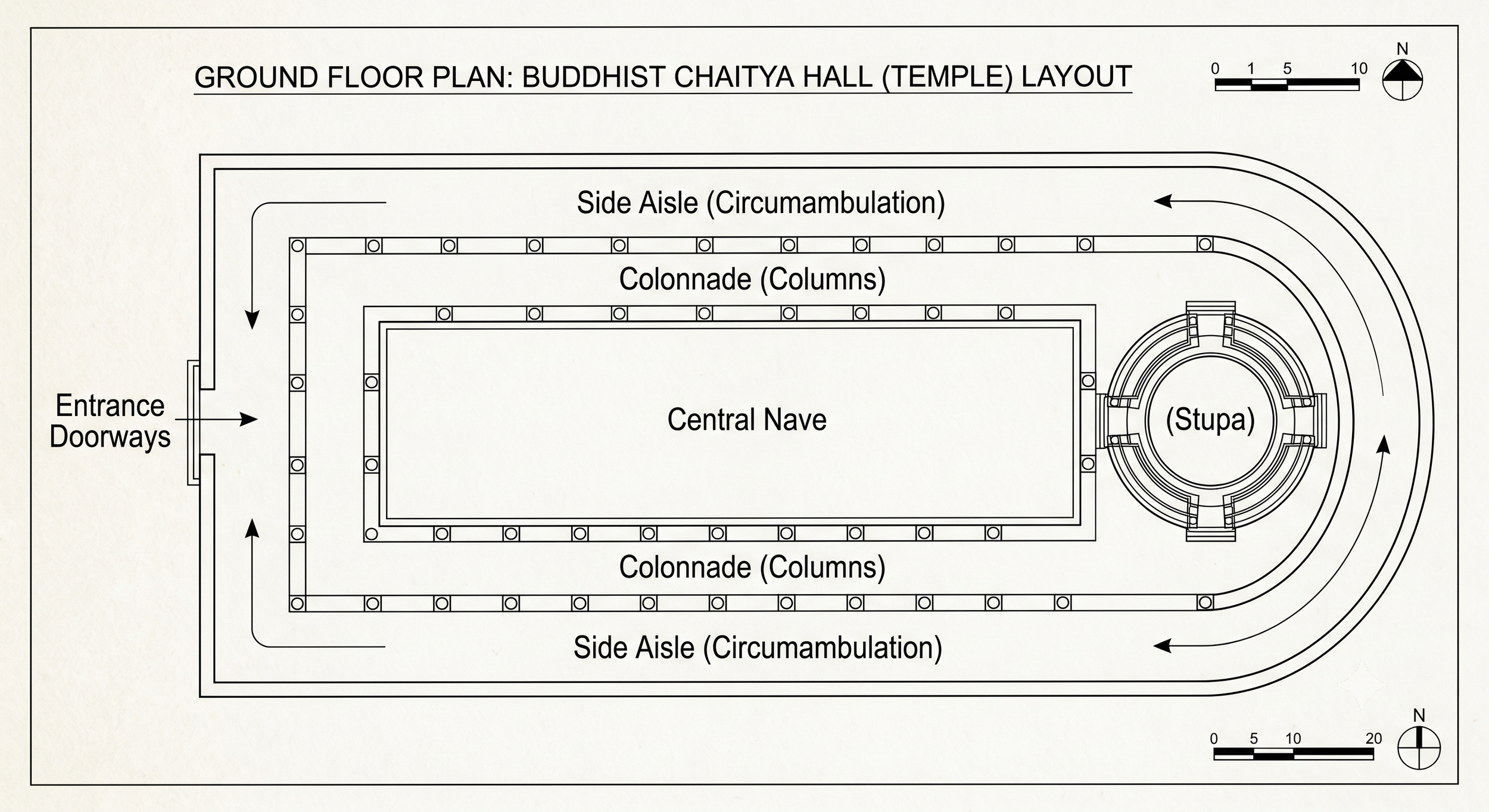
The rock-cut chaitya hall functioned as a congregational prayer space centered on a stupa. The earliest surviving rock-cut chaitya is found at the Bhaja Caves, dating to the second century BCE. The Bhaja chaitya features an apsidal plan with a central nave and flanking side aisles separated by a row of octagonal columns.
To replicate timber framing, the stone columns slope inward, copy-modeling the structural angles necessary to support a real wooden roof. The ceiling is barrel-vaulted and embedded with actual ancient wooden ribs, and the hall was originally fronted by an elaborate wooden facade that has since perished.
The architectural layout of these Western Deccan caves was derived from early rock-cut prototypes like the Barabar Caves (specifically the Lomas Rishi and Sudama Caves), which were excavated during the reign of Ashoka for the Ajivikas. These early models featured a circular inner relic chamber connected to an outer rectangular congregational hall, a layout that was eventually unified into the classic apsidal rock-cut chaitya hall.
The Great Chaitya at Karle (Karli), excavated in the second century CE, represents the peak of this typological development. The hall measures 38.5 meters long, 13 meters wide, and rises to a height of 13.7 meters under a vaulted ceiling fitted with closely spaced wooden ribs. The central nave is separated from the side aisles by two rows of columns.
Each column measures 1.22 meters in diameter and stands 7.32 meters high, featuring a vase-shaped base, an octagonal shaft, and a bell-shaped capital. The capitals support pairs of kneeling elephants carrying male and female riders, backed by sculptures of horses and tigers.
At the far end of the nave sits a solid, rock-cut stupa crowned by a wooden umbrella and an inverted stepped pyramid (tee). The entrance to the Karli chaitya is fronted by a stone screen and a free-standing pillar (lat) surmounted by four addorsed lions, establishing a formal boundary between the secular exterior and the dim, cavernous interior.
While the chaitya served as the temple space, the vihara functioned as the residential and educational monastery. The typical rock-cut vihara layout was organized around a central, square courtyard surrounded by small, individual cells where the monks resided. Each cell was carved with a stone bed, a stone pillow, and small niches and peg-holes for personal belongings.
At the Ajanta Caves, a complex of 30 hewn excavations along the Waghora River, the chronological development of the vihara is visible. Early viharas were purely residential, but later excavations dating from the fifth century CE, such as Cave 1 and Cave 17 integrated sacred shrines into the center of their rear walls.
These shrines housed carved stone Buddha images, transforming the monastery into a multifunctional space for living, study, and daily worship. The walls of these later viharas were decorated with detailed tempera murals depicting Bodhisattvas, scenes from the Buddha’s life, and Jataka tales, illustrating the integration of art and architecture to foster meditative focus.
The Classical Transition
Kushan and Gupta Free-Standing Shrines
The transition from subterranean rock carving to structural, free-standing stone and brick masonry occurred during the Kushan first to fourth centuries CE and Gupta fourth to sixth centuries CE eras. Under the Kushans, the traditional sculptural schools of Mathura and Gandhara developed distinct anthropomorphic representations of the Buddha.
The Gandhara school integrated Hellenistic stylistic elements, such as flowing drapery, with Buddhist themes. The Mathura school utilized local mottled red sandstone to sculpt robust, broad-shouldered figures.
Under the succeeding Gupta Empire, these regional styles merged into a highly refined, classical aesthetic centered at Sarnath. The Sarnath standing Buddha is characterized by delicate hair curls, meditative downcast eyes, an elaborately carved halo featuring floral and gem motifs, and thin, diaphanous robes that cling to the body.
This artistic refinement was accompanied by the development of free-standing temple architecture. This transition is epitomized by Temple No. 17 at Sanchi, a fifth-century CE structure that stands as one of the earliest surviving examples of a structural stone temple in India.
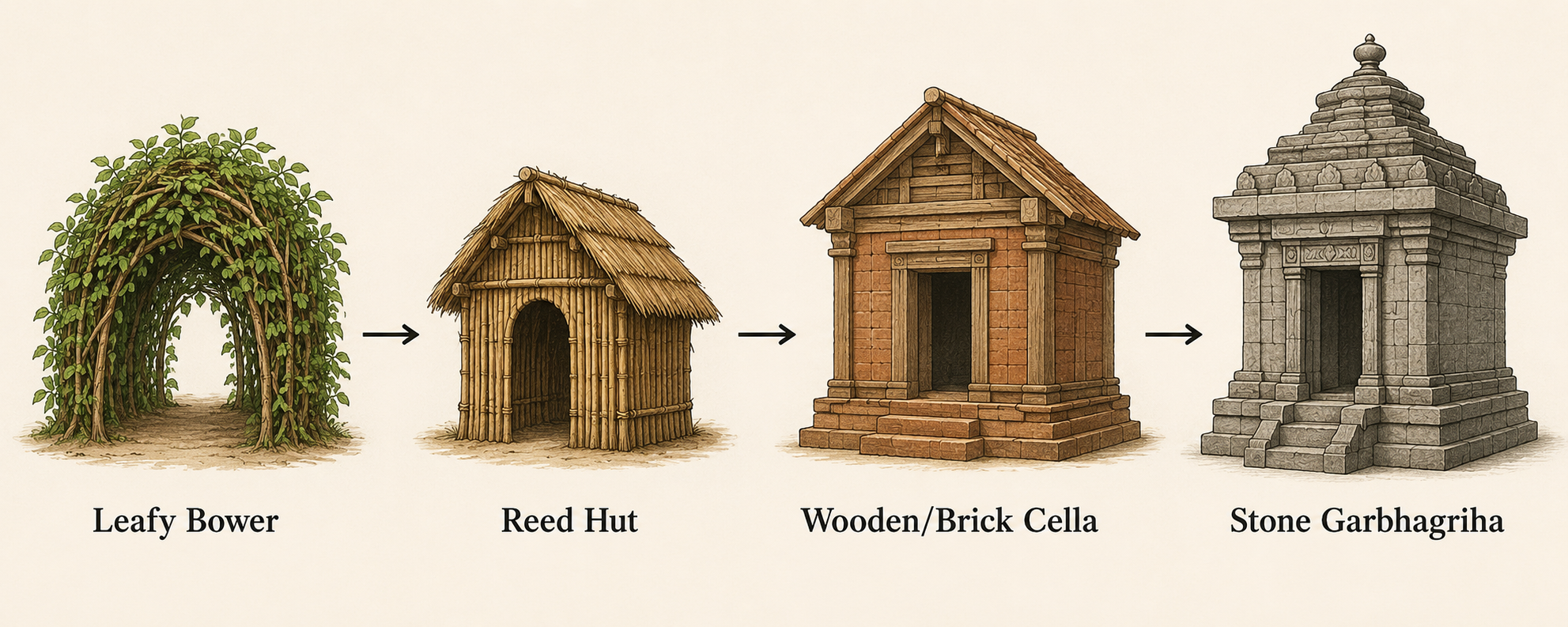
Temple No. 17 is characterized by structural simplicity and classical proportions, consisting of a single-chambered, flat-roofed sanctum (garbhagriha) fronted by a four-pillared portico (mandapa) 1 . This layout represents an architectural transition from earlier temporary shrines 2 as image below.
The structural features of Temple No. 17 include:
The Garbhagriha: A small, square sanctum with plain, unadorned interior and exterior walls, designed to house a singular image of the Buddha.
The Mandapa: A shallow portico supported by four stone columns. The columns feature square bases, transition to octagonal and sixteen-sided shafts, and are topped by capitals carved with inverted lotuses and small lions.
The Intercolumniation: The distance between the two central pillars of the portico is wider than the outer intervals, creating a visual emphasis on the entrance axis.
The Architrave: The stone architrave continues as a prominent string course around the entire perimeter of the building, unifying the portico with the sanctum.
Near Temple No. 17 sits Temple No. 18, a larger fifth-century structure built on a horseshoe-shaped plan that originally contained a central stupa, demonstrating that structural chaitya halls were built alongside flat-roofed image shrines.
Other structural innovations of the Gupta period include the Chejarla Kapoteswara temple, which demonstrates that free-standing brick chaitya halls with barrel-vaulted roofs were built in durable materials.
This era also witnessed the construction of towering brick monuments, most notably the Mahabodhi Temple at Bodh Gaya. Originally founded by Ashoka in the third century BCE, the temple was rebuilt during the fifth to sixth centuries CE as a tall, straight-sided pyramidal tower (sikhara) made of brick and coated with stucco.
Marking the exact spot of the Buddha’s enlightenment under the Bodhi Tree, the Mahabodhi Temple introduced a soaring verticality to Buddhist architecture, establishing a design that was copied by later kingdoms across Asia.
Sinicization and East Asian Systems
The Multi-Tiered Pagoda and Courtyard Axial Order
The transmission of Buddhism along the Silk Road to China during the Han Dynasty (first century CE) and subsequently to Korea (fourth century CE) and Japan (sixth century CE) required the adaptation of Indian architectural forms to match East Asian timber-frame engineering and Confucian spatial layouts. The primary result of this synthesis was the evolution of the Indian stupa into the East Asian pagoda.
The early Chinese pagoda combined the vertical, umbrella-capped spire of the Indian stupa with the design of native Han Dynasty multi-storied watchtowers and residential apartments. During the Southern and Northern Dynasties, pagodas were constructed primarily of wood and served as the physical and ritual center of the temple complex.
However, because wood was highly susceptible to rot, insect damage, and fire, architects began experimenting with brick and stone masonry during the Northern Wei and Sui dynasties. The Songyue Pagoda (built in 523 CE) is the oldest surviving brick pagoda in China. It features a dodecagonal plan, a hollow interior, and fifteen tiers of closely spaced brick eaves that mimic wooden support structures, illustrating an early transition from timber to brick engineering.
During the Tang (618–907 CE) and Song (960–1279 CE) dynasties, the architectural design of the pagoda stabilized into two dominant typologies:
The Multi-Eaved Style: Characterized by closely spaced exterior brick or stone eaves wrapping around a solid or restricted interior core, designed primarily as a vertical marker of the sacred, as seen in the Small Wild Goose Pagoda.
The Pavilion Style: Featuring accessible interior stories with functional staircases, wooden balustrades, and external balconies supported by complex wooden or brick brackets, as exemplified by the Giant Wild Goose Pagoda (originally built in 652 CE).
During the Song, Liao, and Jin dynasties, pagoda design transitioned from a four-sided square plan to hexagonal and octagonal geometries. This modification improved the seismic resistance of the tall structures by distributing horizontal forces more evenly.
Architects also developed hybrid construction systems that combined a load-bearing brick inner core with external timber eaves, galleries, and interlocking wooden brackets (dougong), such as the Liuhe (Six Harmonies) Pagoda in Hangzhou (rebuilt in 1156 CE) and the wood-and-brick Lingxiao Pagoda (built in 1045 CE).
The Yingxian Pagoda of Fogong Temple (built in 1056 CE during the Liao Dynasty) stands as the oldest fully wooden pagoda surviving in China, rising 67.31 meters without the use of nails or concrete, relying on a complex system of interlocking timber joints to withstand earthquakes and weathering.
The physical structure of the Chinese pagoda was organized into four distinct anatomical parts:
The Underground Palace: A brick- or stone-lined vault buried beneath the foundation, used to hold sacred relics, cremated remains, and scriptures inside nested caskets of precious metals and stone.
The Base: An elevated, decorated stone platform or pedestal that supported the main body.
The Body: The main multi-story tower, which transitioned from square to octagonal plans.
The Steeple: A metal spire crowning the apex, consisting of a base, a crescent moon, a series of dew basins (chattras), and a sacred bottle-shaped pinnacle.
In tandem with these structural changes, the overall layout of Chinese Buddhist temples shifted. In early Chinese temples (from the Eastern Han to the Northern and Southern Dynasties), the pagoda was placed at the absolute center of the temple courtyard.
However, as Confucian ideals of hierarchical order and imperial authority influenced monastic design, the layout shifted to a strict north-to-south axial symmetry modeled on imperial palace architecture. The central axis was dominated by sequential courtyards forming "quadrangular enclosures" leading to successive halls as image below.
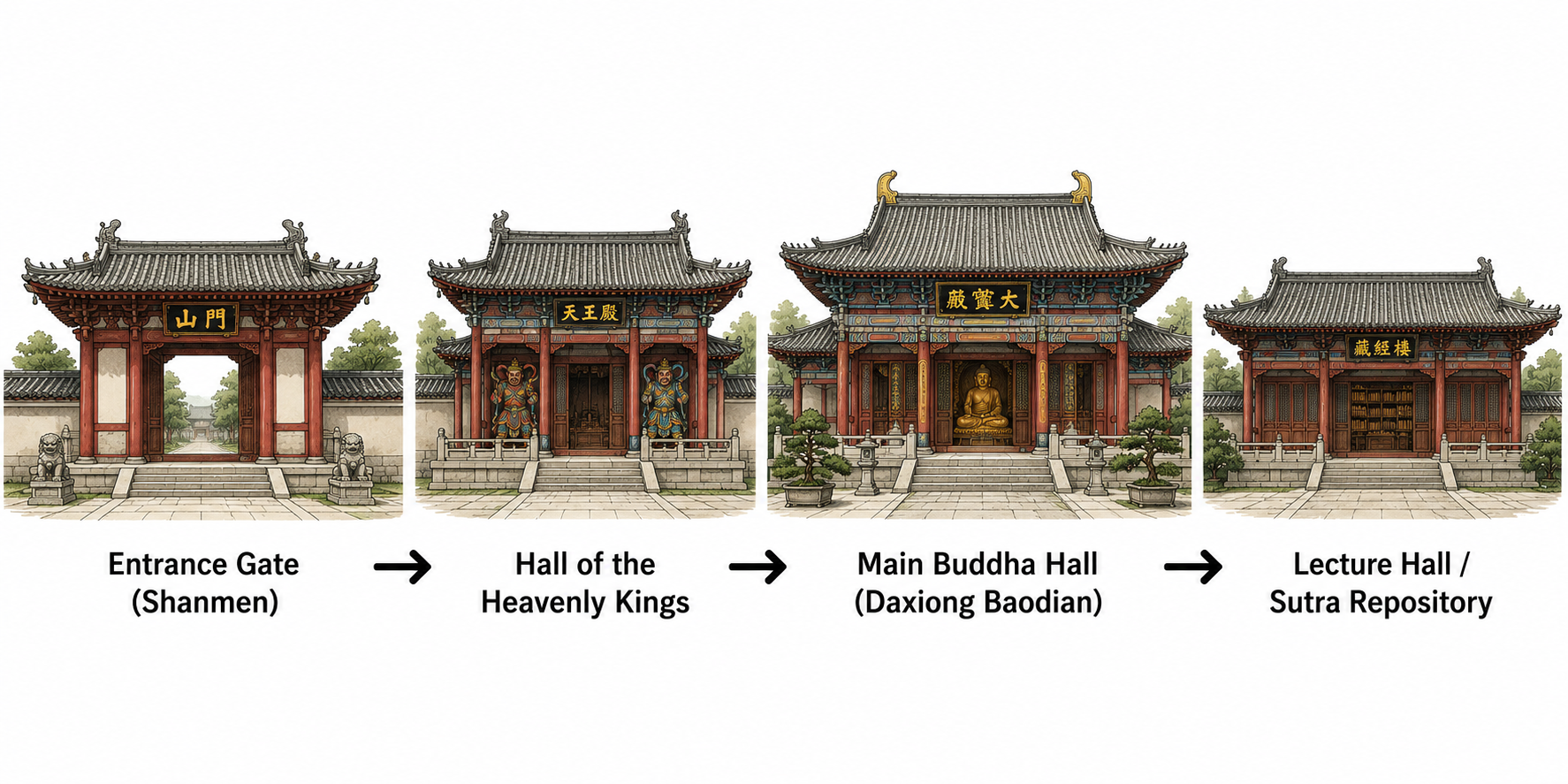
In this layout, the pagoda was either relegated to the rear of the complex, placed in an independent side courtyard, or built outside the city walls to avoid competition with imperial drum and gate towers.
Korean and Japanese Refinements
Buddhism was transmitted to the Korean peninsula in the fourth century CE, where it was adopted as a state religion by the kingdoms of Goguryeo, Baekje, and Silla. Early Korean temples of the Three Kingdoms period were built on a grand scale.
Excavations at Goguryeo sites, such as the Cheongam-ri and Sango-ri temple complexes, reveal a unique layout centered around an octagonal wooden pagoda flanked by three golden halls (geumdang) to the east, west, and north, all enclosed by a roofed corridor.
The early seventh-century Mireuksa (built by the Baekje Kingdom) was a massive monastic complex covering 165,000 square meters. Its layout consisted of three adjacent temples arranged side-by-side, representing the future Buddha Maitreya's three saving sermons.
Silla’s Hwangnyongsa (founded in 570 CE) featured a massive 80-meter-tall, nine-story wooden pagoda with interior staircases leading to the top floor, symbolizing the kingdom’s spiritual and political authority.
Korean Buddhist architecture developed a sophisticated timber-frame system designed to support heavy clay-tiled roofs over wide interior spaces:
The Stone Base: A raised, rammed-earth platform lined with dressed stone blocks to prevent ground moisture from rotting the timber columns.
The Timber Columns: Heavy wooden pillars placed on stone foundation pads, connected by horizontal lintels to form the structural skeleton of the walls.
The Brackets: Complex wooden brackets placed on top of column heads to distribute the heavy weight of the roof to the pillars.
The Roof System: A sloping roof with deep, overhanging eaves that curved upward at the corners to allow natural light to penetrate the interior during winter while blocking high-angle summer sun. The roof was finished with alternating rows of concave and convex clay tiles, and the ends of the eaves were capped with decorated tile ends stamped with Buddhist symbols like the lotus and the phoenix.
Dancheong: A system of decorative painting using bright red, blue, green, yellow, and white pigments to protect the wooden structures from moisture and rot while adding symbolic beauty.
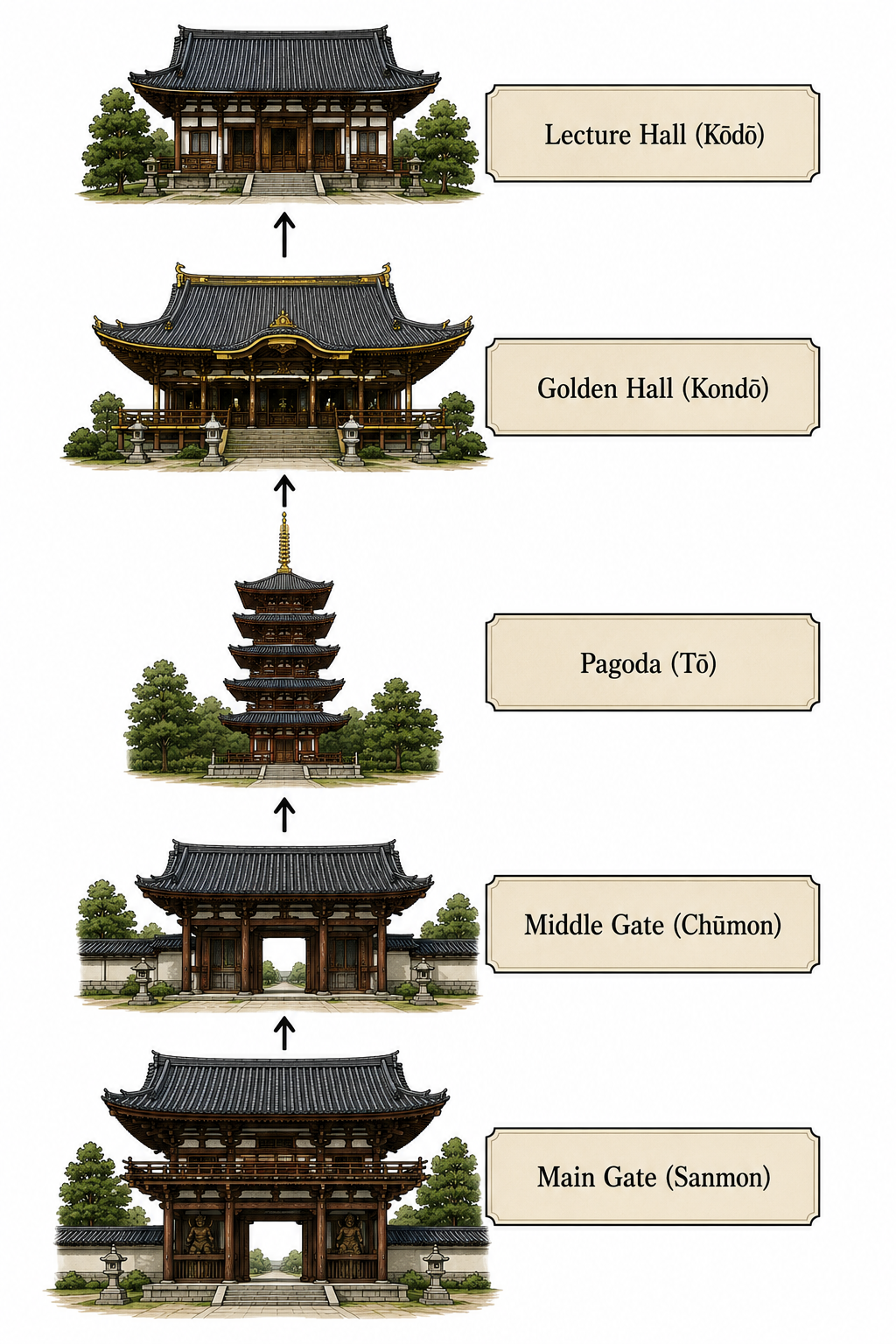
In Japan, where Buddhism arrived via Korea in the sixth century, early temples reproduced continental styles. The spatial arrangement of the Japanese temple complex, known as the Garan or Shichidō Garan (Seven-Hall Garan), underwent a chronological evolution from the Asuka and Nara periods to the Kamakura period, characterized by a steady decline in the importance of the pagoda and the reorganization of the central axis.
Typological Reorganization of Japanese Garan Layouts (6th to 13th Century CE)
The evolution of the Japanese Garan layout illustrates the shift in ritual focus from relic veneration (centered on the pagoda) to icon worship (centered on the Golden Hall).
In the Nara period, the traditional shichidō (seven elements) of a temple stabilized to support scriptural study, comprising the Hon-dō (Main Hall), Tō (Pagoda), Kō-dō (Lecture Hall), Shōrō (Belfry), Jiki-dō (Refectory), Sōbō (Monks' Quarters), and Kyōzō (Sutra Repository).
With the later introduction of Zen (Chan) Buddhism during the Kamakura and Muromachi periods, the Shichidō Garan was reorganized to support daily meditation practice and administrative efficiency.
The Zen layout aligned its principal structures on a strict north-to-south axis: the Sanmon (Main Gate), Butsuden (Buddha Hall), Hattō (Dharma Hall), and Hōjō (Abbot’s Residence). To the west of this axis sat the Sōdō (Monks’ meditation hall), and to the east sat the Kuin (Kitchen and administrative office).
Structurally, Zen temples utilized unpainted cypress timber, heavy curved roofs supported by complex bracket systems (tokyō), and bell-shaped windows (katōmado). The interiors of Zen halls were paved with square stone or ceramic tiles laid at a 45-degree angle to the walls, a traditional practice known as shihanjiki (diagonal tiling). This layout minimized visual clutter to support meditative focus, illustrating how spatial design was used to guide monastic attention.
Southeast Asian Monumentalism and Regional Fusion
The expansion of Theravada and Mahayana Buddhism into Southeast Asia generated a wave of temple building between the ninth and eighteenth centuries CE. Rather than merely importing Indian styles, the builders of Java, Myanmar, and Thailand adapted these templates to match indigenous religious concepts and local environmental challenges.
Borobudur (Java, Indonesia)
Constructed in the ninth century under the Sailendra Dynasty in Central Java, Candi Borobudur is the world's largest Buddhist temple. Built using gray volcanic andesite stone, the monument is designed as a colossal, three-dimensional mandala representing Mahayana Buddhist cosmology. Borobudur features a stepped-pyramid layout consisting of nine stacked platforms: six square base platforms representing the realms of desire (Kamadhatu) and form (Rupadhatu), topped by three circular platforms representing the realm of formlessness (Arupadhatu).
The circular terraces are ringed by 72 bell-shaped, perforated stone stupas, each housing a seated Buddha image, and are crowned by a massive, solid central stupa symbolizing the ultimate state of Nirvana. This design synthesizes Indian Gupta art with the indigenous Javanese custom of constructing megalithic stepped mounds for ancestor worship, creating an architectural path for pilgrims to navigate.
Bagan (Myanmar)
The Kingdom of Bagan witnessed a monumental building boom from the eleventh to the thirteenth centuries, initiated by King Anawrahta’s adoption of Theravada Buddhism. The Ananda Temple (completed in 1105 CE) stands as Bagan's architectural masterpiece. Built on a massive cruciform plan with four projecting brick porches, the temple's central core contains a large square block housing four colossal, 9.5-meter-tall standing teakwood Buddhas facing the cardinal directions.
The exterior of the temple features white stucco walls topped by several terraces, a gilded North Indian-style tower (shikhara), and a crowning umbrella-shaped spire (hti). The interior is defined by a system of concentric corridors that regulate natural light, casting a subtle illumination on the golden Buddhas and directing the physical movement of worshippers.
The Evolution of Thai Temple Architecture
Thai Buddhist architecture is characterized by clear regional and chronological variations, shaped by the historical rise and fall of its major kingdoms.
The physical layout of the Thai Wat (temple complex) is divided into two distinct zones enclosed by a whitewashed brick wall: the Buddhavasa (the sacred zone dedicated to the Buddha and monastic rituals) and the Sangkhawat (the residential zone containing the monks’ living quarters, or Kuti).
Morphological Elements of Thai Buddhavasa Architecture
The structures within the Buddhavasa are organized to facilitate daily worship, monastic ordination, and relic veneration.
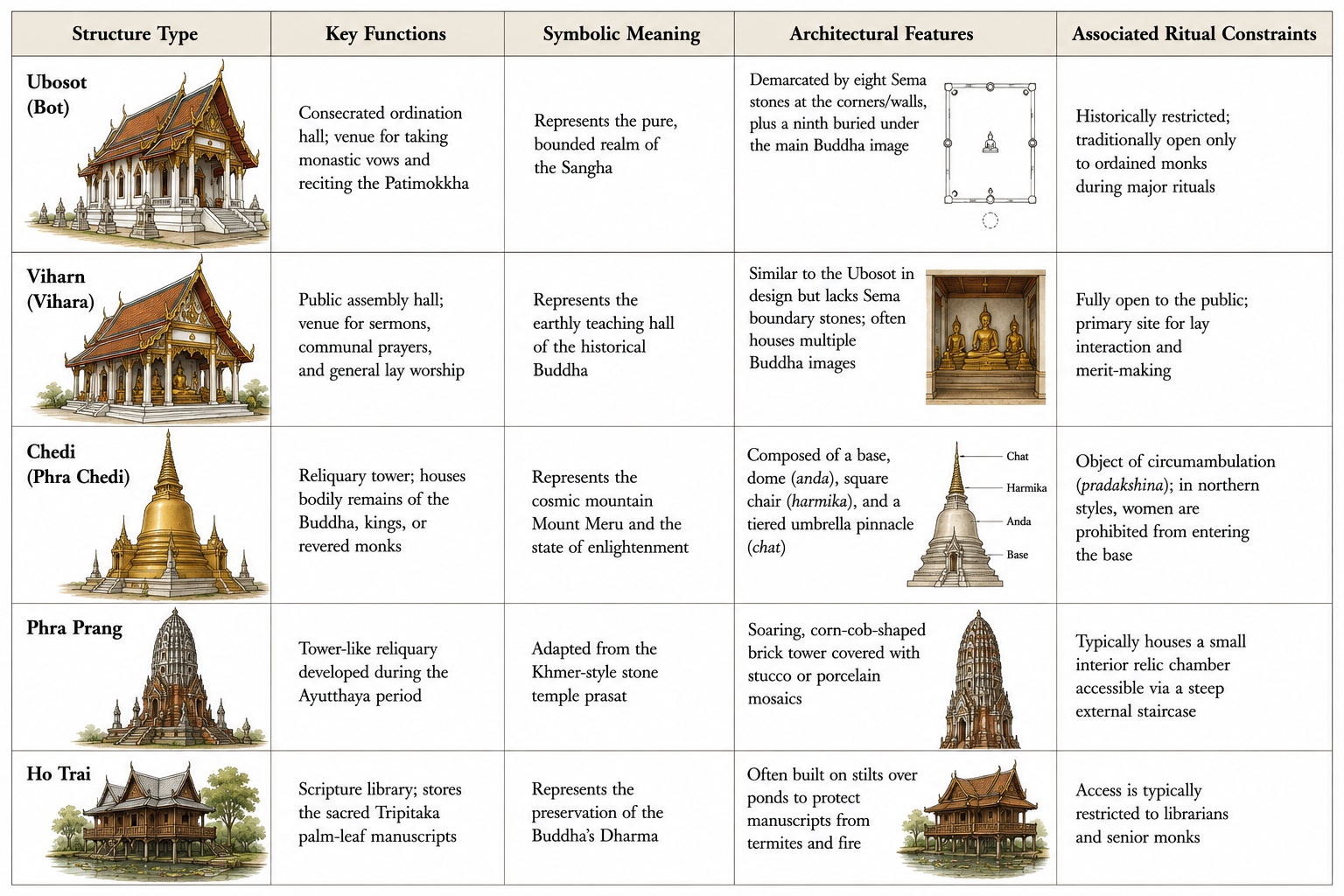
Thai temple architecture is also characterized by its decorative roof forms. The roofs of the Ubosot and Viharn are constructed with multiple, overlapping tiers designed to lighten the visual weight of the large structures.
The edge of the roof is trimmed with the Lamyong, an ornamental bargeboard shaped like the undulating body of the sacred serpent Naga. The scales of the Naga project upward as blade-like fins (Bai Raka), and the lower end of the bargeboard terminates in a stylized Naga head (Hang Hong).
The peak of the roof is crowned by the Chofah ("sky cluster"), a horn-like finial resembling the beak of the mythical bird Garuda, which symbolically holds the tail of the Naga that flows down the bargeboard. This decorative program represents the cosmic struggle between the Garuda and the Naga in Buddhist mythology, transforming the roofline into a visual narrative of protective spiritual forces.
Himalayan Vajrayana Fortification and Mandala Spaces
In the rugged, high-altitude landscapes of Tibet, Bhutan, and Ladakh, Vajrayana Buddhism developed a unique architectural language characterized by thick, sloping masonry walls, fortress-monasteries, and highly detailed visual representations of tantric cosmology.
The earliest phase of Buddhist temple construction in the Himalayas is associated with the seventh-century Tibetan King Songtsen Gampo. According to historical chronicles, Songtsen Gampo commissioned a network of 108 temples across the region (including the Jambay Lhakhang in Bumthang and the Kyichu Lhakhang in Paro).
These temples were strategically sited according to geomantic principles to symbolically "pin down" a massive, malevolent demoness who lay across the Himalayan landscape, with each temple pinning down a specific joint or organ to pacify local spirits and allow the spread of the Dharma.
In Bhutan, the seventeenth-century Dzong emerged as the defining architectural typology of Vajrayana Buddhism, developed under the political and religious leadership of Zhabdrung Ngawang Namgyal. Dzongs are massive fortress-monasteries that integrate religious and administrative functions within a single fortified complex.
Designed to withstand both military invasions and the harsh alpine climate, Dzongs are characterized by:
Sloping Masonry Walls: Heavy, inward-sloping walls built of rammed earth or stone, whitewashed and tapered to provide structural stability and defensive strength.
The Kem: A broad, red ochre band painted near the top of the white walls, identifying the building as a sacred structure.
Multi-Tiered Roofs: Timber roofs built with large overhangs to protect the earthen walls from heavy rains and snow.
The Utse: A towering central keep housing the main temple shrines, surrounded by stone courtyards that host administrative offices, monastic quarters, and public religious festivals.
Spirit Houses: Small, stand-alone shrines (lu khang) built within the complex to honor local earth deities and unseen spirits, illustrating the integration of local animistic traditions with Vajrayana practice.
Himalayan stupas, known as chortens, serve as symbolic models of Vajrayana cosmology and are typically solid structures composed of five geometric elements as image below.
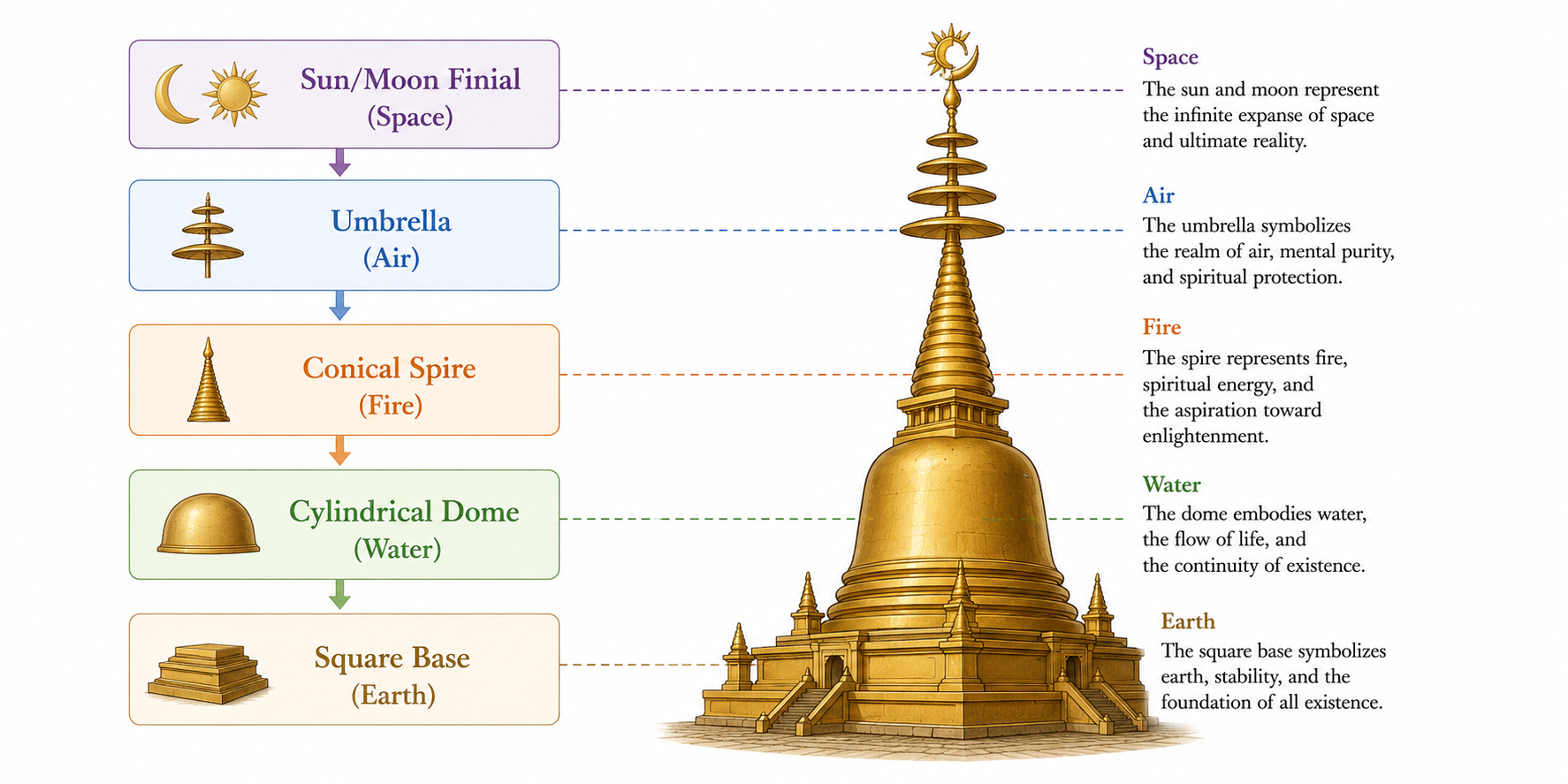
Chortens are built in three primary regional styles: Nepalese-style (featuring large domes and painted eyes), Tibetan-style (with flared bases and wooden superstructures), and indigenous Bhutanese-style (characterized by square stone pillars topped by solar and lunar symbols).
The eight classical chortens commemorate the eight miracles of the Buddha's life, including his birth at Lumbini, his enlightenment at Bodh Gaya, his first sermon at Sarnath, and his parinirvana at Kushinagar.
A unique variation is the Tashi Gomang ("many-doored") chorten, of which the Gyantse Kumbum (built in 1427 CE) is the premier example. The Kumbum features an eight-story layout with seventy-three interior chapels housing more than 20,000 images and deities, functioning as a physical path through the Tantric mandala.
Himalayan cave shrines, such as the Luri cave in Mustang, contain highly polished central chortens decorated with Esoteric Buddhist murals (including the Akshobhya mandala and the five Esoteric Buddhas on the harmika, with Vairochana facing east), demonstrating the integration of art and architecture to support advanced tantric practice.
Modern and Contemporary Paradigms
Contemporary Buddhist architecture balances historical continuity with modern materials like concrete, steel, and glass. Rather than relying on historical replication, modern architects utilize clean lines and minimalist geometries to express classical Buddhist concepts of emptiness (Sunyata), light, and impermanence.
In Sapporo, Japan, the Hill of the Buddha (designed by Tadao Ando) reinterprets the traditional temple approach. Ando encased a pre-existing 13.5-meter-tall stone seated Buddha within a massive, hollow concrete dome covered by a landscaped hill planted with 150,000 lavender plants.
To view the Buddha, visitors must navigate a 135-meter-long, dimly lit concrete tunnel that opens into a sky-lit circular chamber. Only the top of the Buddha's head is visible from the outside, and the transition from the dark tunnel to the light of the central hall serves as a physical metaphor for the transition from ignorance to awakening.
In Taipei, Taiwan, the Water-Moon Monastery (designed by Kris Yao of Artech) uses clean geometric forms and a 260-foot-long reflective lotus pond to mirror the concrete facade, emphasizing the concepts of illusion and impermanence.
The double-height main hall features prefabricated glass-reinforced concrete (GRC) panels carved with the Chinese characters of the Heart Sutra and the Diamond Sutra. As sunlight filters through the voids in the panels, the scriptures are projected onto the interior concrete floors and columns, dynamically changing throughout the day.
In Kaohsiung, Taiwan, the Fo Guang Shan Buddha Museum (completed in 2011) represents Humanistic Buddhism. Spanning over 100 hectares, the complex is built in the shape of a lotus petal across five mountain peaks, modeled after the Four Sacred Mountains of Chinese Buddhism.
Five-Peak Spatial Layout of Fo Guang Shan Temple
The architecture of Fo Guang Shan is organized across five peaks to support monastic living, public education, and spiritual practice.
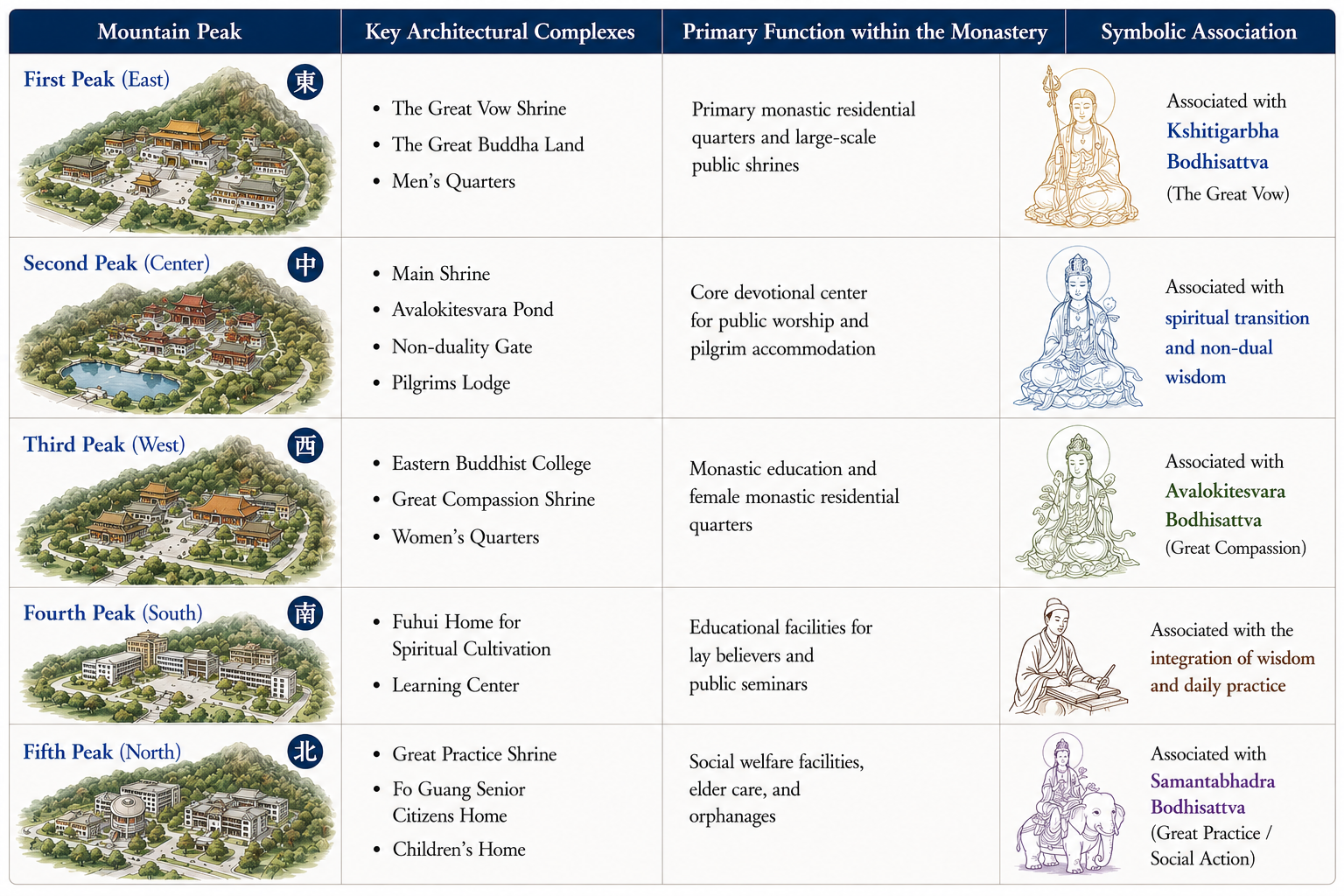
The main axis of the Fo Guang Shan Buddha Museum begins with the Front Hall, flanked by the Gate of Perfect Ease and the Gate of Liberation. Worshippers walk along the 240-meter-long Way to Buddhahood flanked by eight 38-meter-tall pagodas representing the Noble Eightfold Path, such as the Six Perfections Pagoda.
At the Bodhi Wisdom Concourse, eighteen Arhat statues are erected, uniquely containing three female arhats to showcase equal gender rights within modern Humanistic Buddhism.
The path terminates at a 50-meter-tall sandstone-clad Main Hall (housing the sacred Buddha Tooth Relic in the Jade Buddha Shrine) and the 108-meter bronze Fo Guang Big Buddha.
Other global projects demonstrate similar structural adaptations:
Tsz Shan Monastery (Hong Kong): Features a 76-meter-tall outdoor bronze statue of the Bodhisattva Guan Yin, supported by a heavy steel structure. The surrounding Dharma halls and courtyards use clean, symmetrical layouts that reference the aesthetics of the Tang Dynasty. However, the traditional timber joinery is replaced by a modern steel structural frame, clad in African zevil wood to maintain a warm, meditative atmosphere.
Wat Rong Khun (Chiang Rai, Thailand): Designed by Chalermchai Kositpipat, this contemporary Thai temple is built entirely of white plaster inset with pieces of mirrored glass. The white color symbolizes the purity of the Buddha, while the reflective glass represents his wisdom. The architecture updates traditional northern Thai lamyong bargeboards and chofah roof finials with highly stylized, flame-like details and modern allegorical carvings, creating a distinct contemporary interpretation of Thai cosmology.
Ekoin Nenbutsudo (Tokyo, Japan): Designed with features that include a bamboo forest and a Swarovski crystal facade, this temple was "stacked" to build upon a limited urban site.
The Upper Cloister (Jinshan, China): A minimalist steel meditation hall perched on a rugged mountain pass, utilizing a light structure that barely touches the ground to harmonize with the natural setting.
The Buddhist Retreat Centre (Netherlands): Combines a traditional Western Mansard roof with western red cedar and corrugated steel, showing how Buddhist spatial concepts can be integrated with Western building forms.
Conclusion
The structural trajectory of Buddhist architecture highlights a dynamic tension between cosmological continuity and local adaptation. Across two millennia, the basic components of the early stupa—the base, dome, spire, and umbrella—have been systematically adapted to match the materials and styles of different cultures.
In China and Japan, this process transformed the hemispherical stupa into the vertical, multi-tiered pagoda. In Southeast Asia, it led to the creation of stepped stone monuments like Borobudur. In the Himalayas, it produced the fortified, sloping walls of the Dzong.
This evolution was also driven by a theological shift from relic circumambulation to image veneration. The physical relocation of the reliquary (stupa/pagoda) from the center of the temple layout to its periphery or outer courtyards reflects the rise of Mahayana and Zen doctrines, which prioritized the Buddha image (Kondo/Butsuden) and active meditation spaces (Sodo) over the historical remains of the Buddha.
Finally, the contemporary era highlights how Buddhist architecture can adapt to modern environments while maintaining its core focus. By using materials like concrete, steel, and glass, modern architects are able to express classical Buddhist concepts of emptiness and light.
These clean, geometric, and light-filled structures serve to organize human movement and focus attention, demonstrating that the primary function of the Buddhist temple is to act as an architectural tool to calm the mind and facilitate introspection.
The Acoustic Ecology and Liturgical Spatialization of Buddhist Temple Architecture: A Historical, Structural, and Archaeoacoustic Analysis
Introduction: Redirection of the Research Paradigm and the Architecture of Attention
In analyzing the structural development of historical worship spaces, researchers must decouple physical forms from general assumptions and anchor their inquiries in the precise theological and liturgical frameworks of the studied faith. In correcting previous research plans that mistakenly focused on Islamic mosque architecture, this study centers exclusively on the spatial, material, and acoustic evolution of Buddhist architecture. While Islamic acoustics prioritize the speech intelligibility of horizontal congregations facing a single wall (qibla) and the vocal clarity of spoken sermons (khutba), the Buddhist spatial tradition is built upon the architecture of attention, designed to shape contemplative movement, guide ritual circumambulation, and establish a physical feedback loop between the practitioner and the sacred environment.
The fundamental purpose of a Buddhist temple is to act as a quiet partner to the meditating mind, employing structural elements to slow down physical movements, lower vocal volume, and minimize external sensory stimulation. The transition through physical thresholds—from open courtyards to progressively darker, more enclosed chambers—is designed to transition the mind from the scattered nature of the mundane world to a centered state of introspection. This sensory transition is reinforced by the unique soundscapes of Buddhist ritual practice, which rely on the acoustic properties of materials and geometries to amplify low-frequency chanting, diffuse the complex transients of metallic and wooden sounding objects, and symbolize core doctrinal tenets through the physics of sound.
The Rock-Cut Genesis: Archaeoacoustics of early Western Ghats Caves
The transition of Buddhist sanctuaries from temporary monsoon retreats built of perishable timber, bamboo, and thatch to permanent, monumental complexes occurred through rock-cut excavations carved into the solid basalt cliffs of the Western Ghats in India between the 2nd century BCE and the 5th century CE. Supported by wealthy merchant guilds and royal patrons, ancient builders carved entire monastic complexes directly into the hillsides, establishing a functional division between the vihara (monastery), consisting of small residential cells arranged around a central square courtyard, and the chaitya (worship hall), which housed a votive stupa at its curved end.
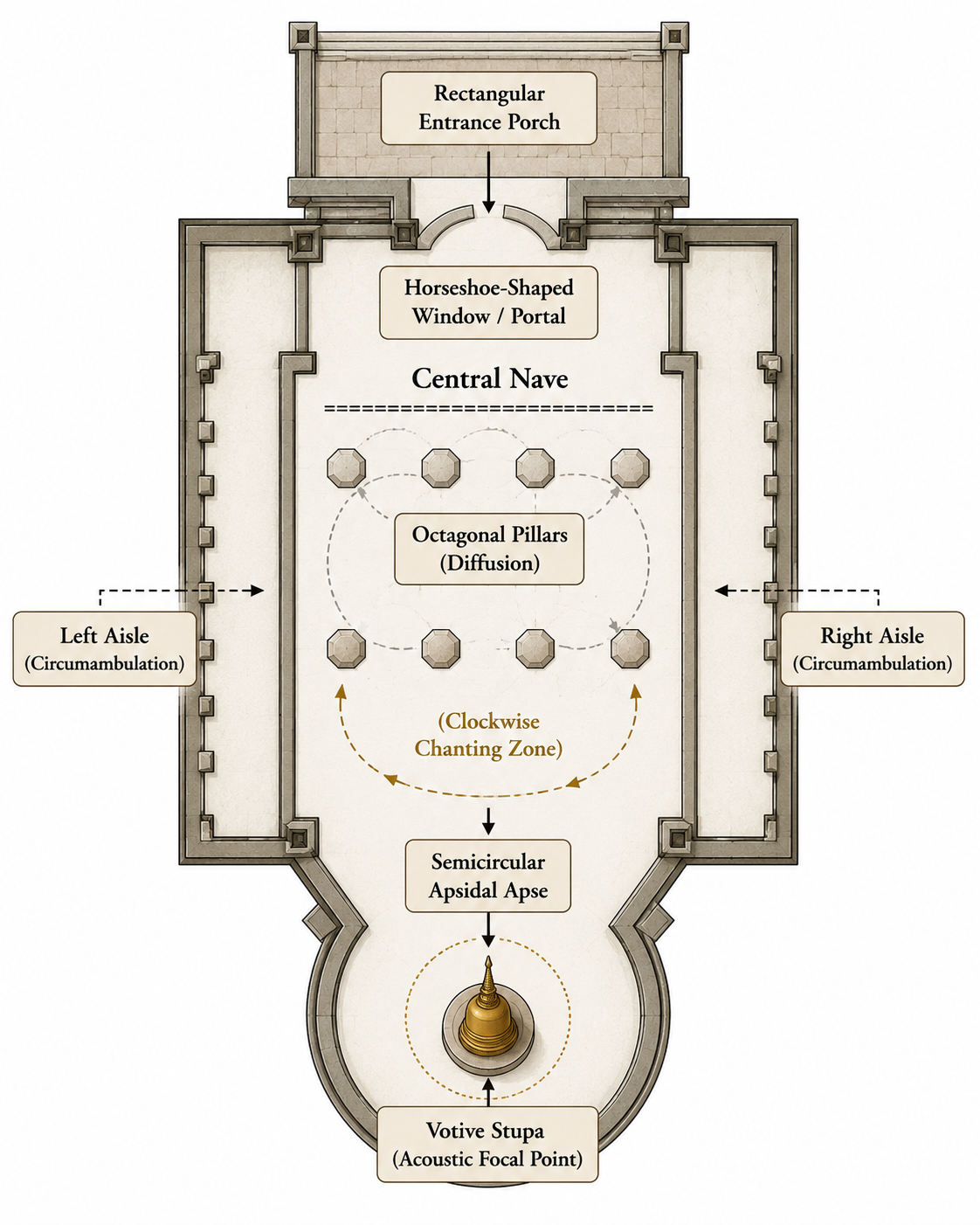
The structural design of the chaitya hall—exemplified by Cave 8 at the Karla Caves and the early halls at Bhaja, Ajanta, and Ellora—features a rectangular nave separated from narrower side aisles by rows of octagonal columns, terminating in a semicircular, apsidal apse containing the carved stupa. To maintain a symbolic connection with earlier freestanding timber prototypes, these rock-cut halls meticulously recreated decorative elements of wooden design, such as curved, barrel-vaulted ceiling ribs and inward-sloping pillars. At Bhaja and the "Great Chaitya" of the Karla Caves, actual ancient teak wood ribs survive, fitted directly into the carved stone vaulting of the ceiling.
These structural details establish a highly specialized acoustic environment. Unpolished, raw basalt is an exceptionally dense, non-porous rock with negligible sound absorption alpha 0.02, which would normally produce harsh flutter echoes and late, chaotic reflections. However, the geometric proportions of the chaitya act as a natural acoustic processor:
Diffusive Ribbing: The closely spaced wooden or stone ceiling ribs function as an acoustic scattering system, diffusing high-frequency sounds and preventing the build-up of flutter echoes along the vault.
Columnar Scattering: The octagonal shafts of the columns measuring 1.22 meter in diameter and 7.32 meters in height at Karla act as lateral scattering bodies, scattering sound waves as they pass between the nave and the side aisles.
Apsidal Focusing: The semicircular curve of the apse and the hemispherical dome of the stupa function as a concave acoustic reflector, focusing low-frequency energy from chanting monastics directly back into the nave.
This spatial-acoustic setup supports the primary liturgical activity of the chaitya: clockwise circumambulation (pradakshina) around the stupa. As monastics walk along the side aisles, their voices are acoustically compressed within the narrower corridors, while the central nave acts as a highly resonant chamber that sustains the fundamental frequencies of the chant. This combination creates a majestic, enveloping sound field that lowers the vocal effort of the chanter and reinforces the transition from the mundane exterior to the sacred interior of the hall.
Structural Evolution of the Stupa and the Freestanding Cella
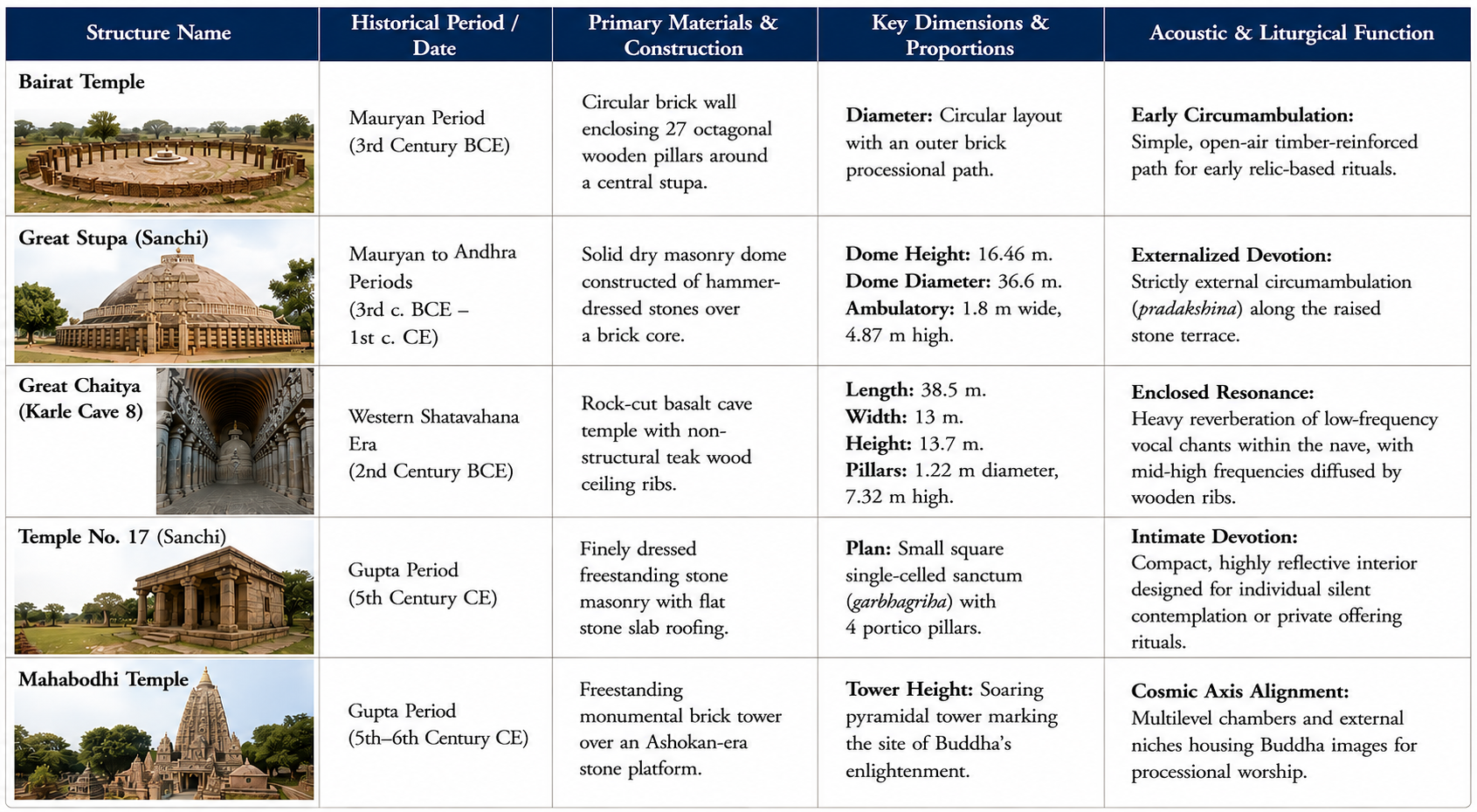
As Buddhism expanded beyond rock-cut cliffs into open plains, the stupa evolved from an ancient pre-Buddhist earth burial mound into a highly decorated, freestanding cosmic monument representing the Buddha's enlightenment, the three-fold Eightfold Path, and the primordial elements of the universe. The architectural evolution of these structures is documented in the transition from early, simple brick mounds to complex stone complexes, and ultimately to the earliest freestanding stone devotional shrines.
The Great Stupa at Sanchi, originally commissioned by Emperor Ashoka in the 3rd century BCE and expanded during the Shunga and Andhra periods, illustrates the classic elements of this monumental style. Its nucleus, a simple brick hemisphere containing sacred relics of the Buddha within a central chamber, was encased in a stone dome and topped by a triple-tiered umbrella (chattra) representing high rank and the Three Refuges.
To facilitate the ritual of circumambulation, the builders raised a stone-dressed ambulatory terrace 4.87 meters above the ground, providing a 1.8 meter-wide upper pathway reached by a double staircase. The entire base was enclosed by a massive stone railing (vedika) standing 3.35 meters high, accessed through four highly decorated, slightly offset gateways (toranas) positioned at the cardinal points of the compass.
Nearby, the Ashokan monolithic sandstone pillar stood 12.8 meters high and weighed nearly 40 tons. Carved from the quarries of Chunar several hundred miles away, its polished, tapering shaft was topped by a bell-shaped capital supporting four back-to-back lions, displaying the exceptional logistical capability and masonry skill of the Mauryan period.
During the 5th-century Gupta period, a major structural transition occurred: the development of the earliest freestanding, single-celled stone shrines, exemplified by Temple No. 17 at Sanchi. Built near the Great Stupa, Temple 17 represents a shift away from massive, communal rock-cut excavations toward intimate, private devotional practices.
This tetrastyle prostyle temple consists of a simple, flat-roofed, square sanctum (garbhagriha) with a shallow, pillared portico in front supported by four carved stone pillars. The interior walls of the garbhagriha are perfectly plain, contrasted with the richly carved exterior doorway and columns.
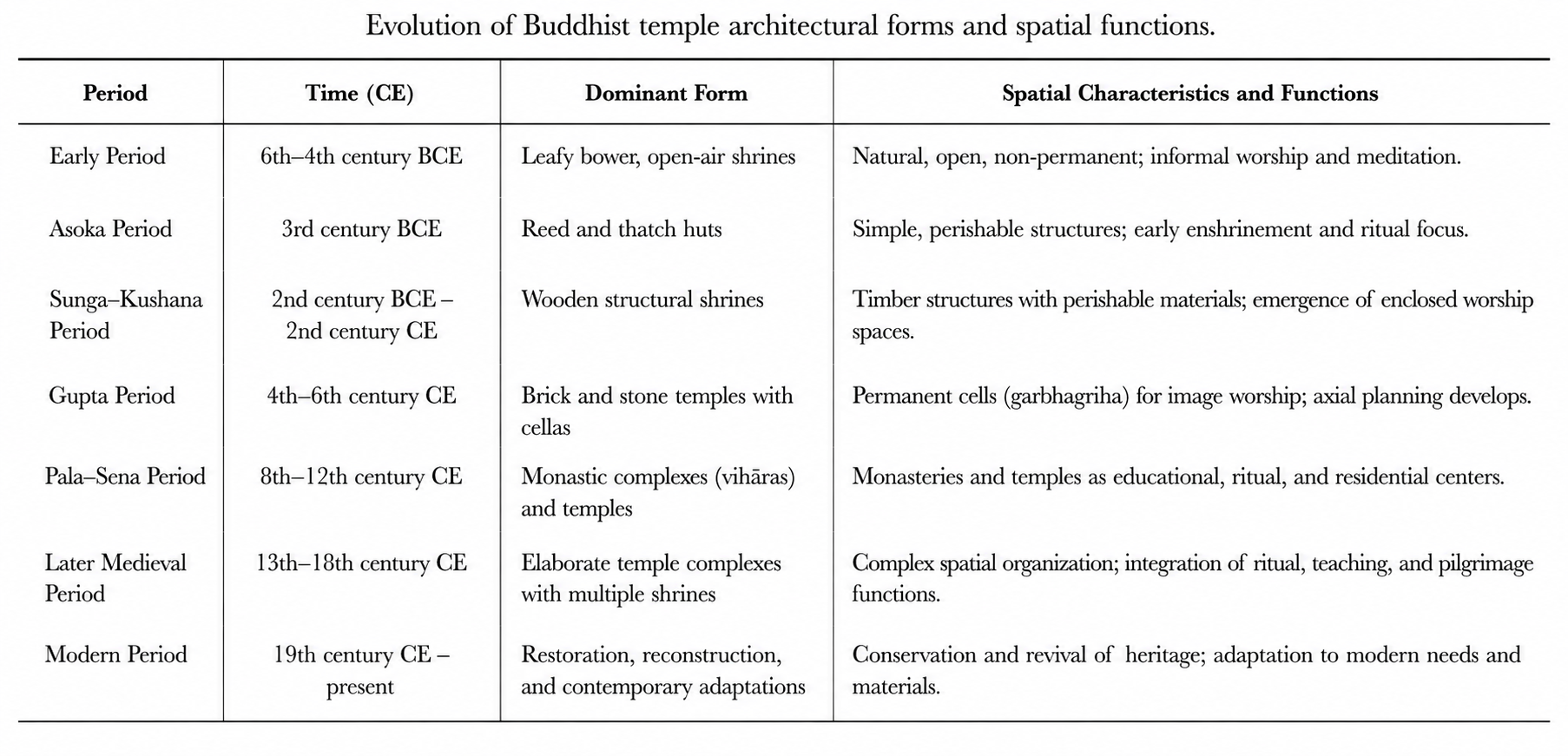
This layout represents a clear evolutionary link, showing how early, impermanent shelters (such as leafy bowers, reed huts, and wooden shrines) were translated into structural stone. The design of Sanchi Temple 17 established several key architectural principles—including the square plan, the plain interior, the decorated doorway, and the pillared portico—that were later adopted into early Hindu temple architecture.
East Asian Timber-Frame Tradition and the Spatial Mechanics of the Garan
As Buddhism traveled into East Asia, it adapted to the regional timber-frame building traditions of China, Korea, and Japan. In this transition, temple layouts adopted the strict axial symmetry, courtyard configurations, and cosmological principles of traditional imperial palace design.
A prime Chinese example is the 15th-century Zhihua Temple in Beijing, which is laid out along a central north-south axis consisting of five successive quadrangular enclosures. The layout begins with the entrance gate (shanmen), flanked by the western Drum Tower and the eastern Bell Tower, which immediately frame the first preparatory courtyard.
The second courtyard contains the main Zhihua Hall 18 meters times 14.5 meters, which features a hip-and-gable roof and only four interior columns to preserve a spacious central area for congregational worship. Above this area was installed a magnificent 5 meters times 5 meters wooden coffered ceiling, designed to focus acoustic energy over the primary altar.
Directly behind stands the Sutra Hall 13.2 meters times 7.5 meters, which houses a non-revolving octagonal sutra cabinet (zhuanlun jingzang). To ensure visibility of the Vairocana Buddha statue seated on top of the cabinet, the builders removed two front interior columns, shifting the massive cabinet slightly toward the rear of the hall.
In Korea, during the Three Kingdoms period, these timber-frame systems reached massive scales. The early 7th-century Mireuksa temple complex covered 165,000 square meters and was arranged as three distinct temples in juxtaposition to represent Maitreya, the future Buddha, descending to save all living beings through three sermons.
Similarly, the 570 CE Hwangnyongsa complex covered 80,000 square meters and was centered around an 80-meter-tall, nine-story wooden pagoda with interior stairs leading to the top. These structures utilized a post-and-beam timber frame, where the heavy pitched clay tile roof served to compress the timber frame under its weight, securing the structure against earthquakes and heavy precipitation.
When these designs reached Japan, they were formalized into the Shichidō Garan (Seven-Hall Temple) layout, which underwent a notable historical evolution from the early Asuka and Nara periods to the Kamakura and Muromachi Zen eras as shown below.
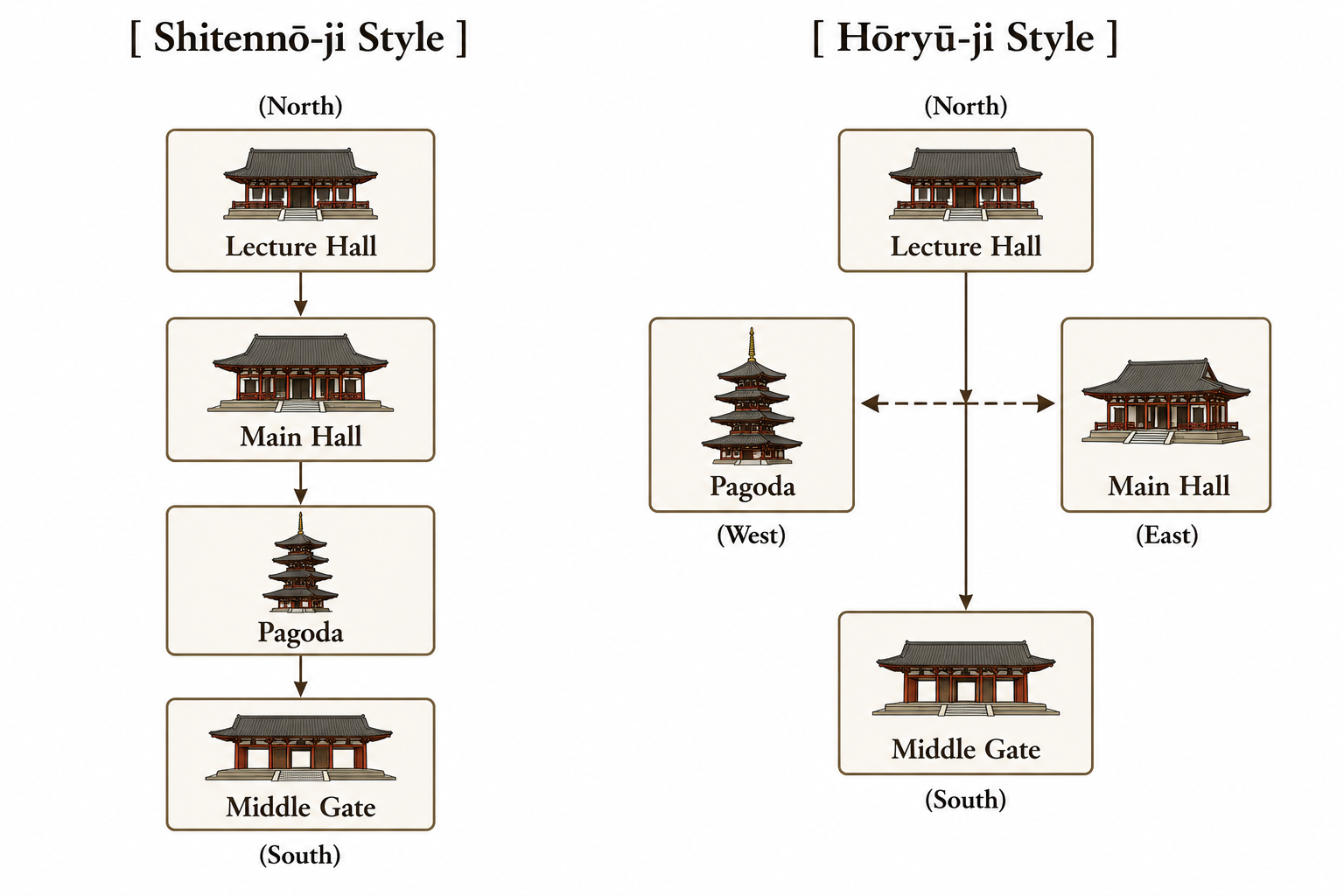
In the earliest Japanese temples, such as the late 6th-century Asuka-dera, the wooden pagoda (tō) occupied the absolute center of the compound, surrounded on three sides by small main halls (kondō) to focus devotion on the physical relics of the Buddha buried at the base of the central pillar.
At Shitennō-ji in Ōsaka, the layout shifted: the single kondō occupied the central position, with the pagoda placed directly in front of it on a strict north-south axis. At Hōryū-ji, the pagoda and the kondō were placed side-by-side inside the courtyard, sharing equal spatial prominence.
By the Nara period, as exemplified by Yakushi-ji, the kondō occupied the dominant central position of the courtyard, while two pagodas were pushed to the southeast and southwest corners, signaling a transition from relic-based contemplation to iconographic liturgy and mass congregational chanting within the main hall.
This transition culminated in the Kamakura-period Zen temples (such as Kenchō-ji and Eiheiji), which omitted pagodas entirely from their core layouts. The Zen garan was organized along a strict north-south axis to emphasize spiritual progression, beginning with the Sanmon (Main Gate), and leading successively to the Butsuden (Buddha Hall), Hattō (Dharma/Lecture Hall), and Hōjō (Abbot's quarters).
To the west of this axis stood the Sōdō (Monks' meditation hall), while the Kuin (Kitchen/administrative offices) stood directly opposite to the east. This highly structured, interconnected layout utilized covered corridors to link the seven essential halls, creating a closed monastic environment where daily movements were strictly regulated.
Quantitative Sound Field Analysis of Chinese Daxiong Main Halls
To analyze the physical behavior of sound within East Asian timber-frame temple halls, researchers have conducted detailed field measurements and computer-aided ray-tracing simulations utilizing multi-physics software. The primary area of inquiry centers on the Daxiong Baodian (Great Hero Main Hall), which is traditionally divided into the Buddha Realm (the rear elevated podium housing major statuary) and the Worship Space (the front floor area occupied by the congregation and chanting monastics).
These spaces are acoustically defined by three key parameters: Reverberation Time (RT), the First Ray Arrival Time, and the Sound Pressure Level (SPL) distribution. Acoustic measurements of four major historical halls located on Mount Wutai in Shanxi, China—the Chongshan Temple Main Hall, the Xiantong Temple Main Hall, the Shuxiang Temple Manjusri Hall, and the Bodhisattva Top (Pusa Peak) Main Hall—reveal how spatial geometry and physical proportions shape their sound fields
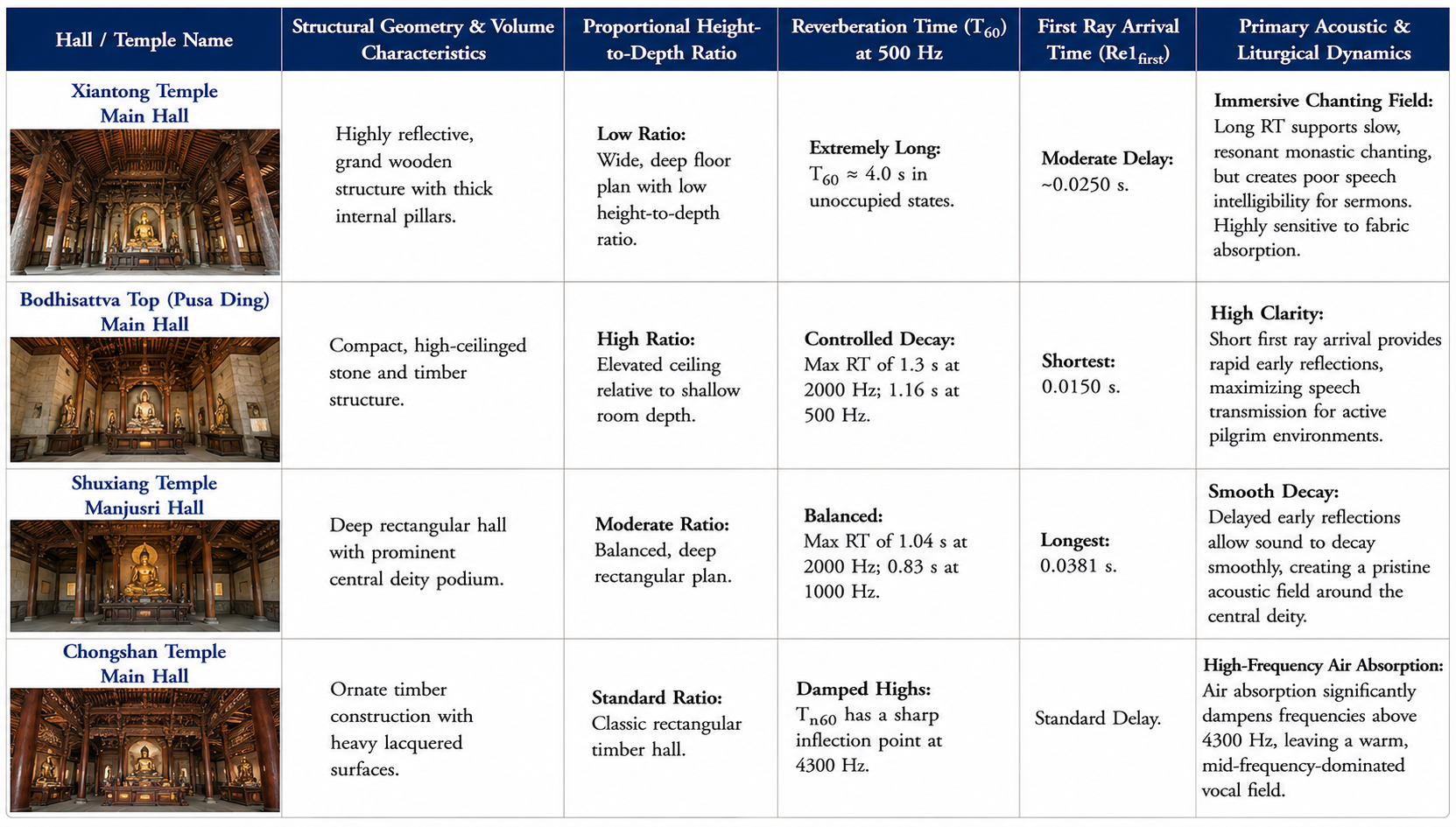
These studies reveal several critical room-acoustic behaviors within traditional timber temples:
Height-to-Depth Ratio and Early Reflections
The transmission rate of acoustic waves inside the main halls is positively correlated with the ratio of the hall's height to its depth. High-ceilinged, shallower halls (such as the Bodhisattva Top Main Hall) project direct sound waves rapidly to the rear boundaries, reducing the arrival time of the first reflected ray 0.0150 second and enhancing early acoustic energy, which supports speech clarity.
Conversely, deeper rectangular halls (such as Shuxiang Temple) delay early reflections 0.0381 second, allowing sound to decay more smoothly and creating a more diffuse, reverberant field.
The Impact of Structural Pillars
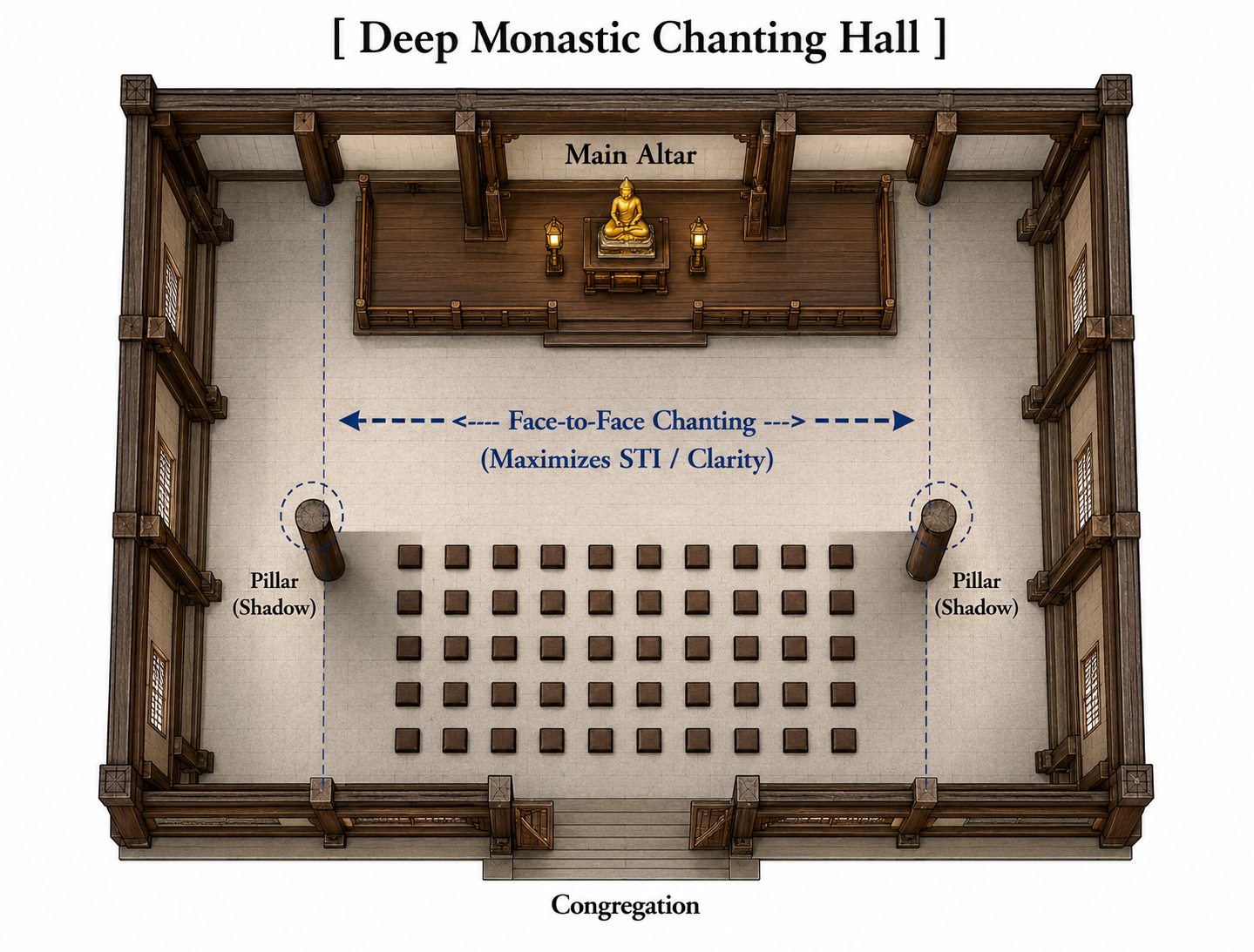
The massive timber pillars required to support the heavy roofs of these halls act as physical obstacles that block direct sound propagation. These columns create distinct "sound shadow areas" along the lateral boundaries of the worship space, causing an uneven distribution of Sound Pressure Level ($SPL$) across the floor.
This spatial irregularity must be managed by the physical arrangement of the monastics during chanting services.
The Role of Dynamic Fabric Absorption
The physical environment of a functioning temple is highly dynamic, relying on temporary interior elements to manage acoustics. Acoustic modeling of Xiantong Temple demonstrates that when traditional fabric sound absorbers—such as hanging silk banners, heavy drapes, decorative tapestries, and thick floor cushions—are removed from the hall, the mid-frequency reverberation time (RT) increases by 32.3% and the early decay time (EDT) surges by 46.8%.
These fabric elements function as porous absorbers that selectively dampen mid-to-high frequency resonances, preventing the excessive build-up of late reflections and stabilizing the room's sound field during large assemblies.
Chanting Directivity and the Speech Transmission Index
The physical orientation of the chanting monks is highly optimized for speech clarity. When monastics chant sutras in a face-to-face configuration (standing in rows perpendicular to the main altar, facing one another across the central aisle), the Speech Transmission Index (STI) is mathematically maximized.
Because human speech is highly directional at mid-to-high frequencies, this face-to-face alignment ensures that the direct acoustic energy of the voices is cross-projected and immediately mixed, minimizing the muddying effects of late reflections from the distant rear walls of the hall.
Liturgical Soundscapes: Sounding Objects (Narashimono) and Vocal Performance
While Zen Buddhism is historically associated with quietude and silent introspection, the physical reality of a Zen training monastery is characterized by a dense, highly choreographed soundscape. In these environments, spoken commands are virtually non-existent; instead, every transition in the daily schedule—from waking, washing, and meditation to eating, sutra chanting, and sleeping—is directed by a precise system of percussion instruments known as "sounding things" (narashimono).
These sounding objects serve as the sensory infrastructure of the monastery, translating temporal regulations into immediate physical actions. They are distributed throughout the Shichidō Garan to serve specific spatial and liturgical functions:
The Monumental Bell (Daishō or Ōgane): Cast from bronze and suspended in a dedicated heavy timber tower (shōrō), this massive bell is struck with a suspended wooden beam (shumoku) at dawn (gyōshō) and dusk (konshō). Its deep, low-frequency resonance travels over long distances, serving as a regional acoustic marker that mentally anchors the monastic community and the surrounding landscape to the temple's temporal cycle.
The Hall Bell (Denshō): A smaller bronze bell hung outside the main hall (hondō). Struck with a handheld wooden mallet (kizuchi), its rapid, accelerating cadences signal the gathering of monks for sutra chanting and formal services.
The Summon Bell (Kanshō): A small, high-pitched bell used to coordinate private interviews (sanzen) between individual monastic trainees and the Zen master.
The Wooden Plank (Mokuhan or Han): A thick, rectangular block of solid wood hung outside the monks' hall (sōdō). It is struck with a heavy wooden mallet to mark daily transitions, generating a sharp, dry transient sound with minimal decay, emphasizing urgency and precision.
The Cloud Plank (Unpan): A flat, bronze gong cast in the shape of a cloud, traditionally hung outside the kitchen (kuin or kuri) or refectory to signal meal times.
The Fish-Shaped Wooden Drum (Mokugyo): Carved from a hollowed block of wood with a stylized fish scale pattern, this instrument is struck continuously with a padded leather mallet during sutra chanting. The hollow chamber behaves as an acoustic Helmholtz resonator, producing a warm, deep, rhythmic pulse that synchronizes the breathing and vocalization rates of the reciting monks.
The Handbell (Inkin): A small bronze bowl bell mounted on a wooden handle with a metal rod attached by a string. Used by the session leader (Jikijitsu) inside the sōdō, its sharp, piercing metallic strike slices through the absolute silence of zazen to mark the precise beginning and end of meditation periods.
A striking philosophical and liturgical tension exists regarding the interpretation of these sounds. While scholars and lay observers frequently search for deep esoteric symbolism, cosmic matching, or theological meaning behind these instruments, Zen masters consistently reject such intellectualization. In private interviews, prominent abbots have asserted that these sounding objects possess "no special meaning" and are merely utilitarian tools to establish timing and rhythm, analogous to a starter's gun in an athletic race.
This direct, non-conceptual approach is a core characteristic of Zen training. The sounds are not intended to be analyzed as symbols of the divine; rather, they are direct physical interventions designed to bypass intellectual processing, demanding immediate, unreflective physical compliance. The ring of the Inkin or the strike of the Han does not invite contemplation about time—it is the immediate, absolute transition of the present moment, aligning the monastic's body, breath, and mind with the physical environment.
Beyond East Asian Zen contexts, Buddhist vocal performance and ritual instrumentation show highly specialized adaptations across different cultural spheres. In the Theravada tradition of Thailand, chanting is rooted in the ancient Indian gatha (narrative song or sung verse). Monks employ a range of vocal techniques—including precise cadences, sustained tones, slurs, and rhythmic chanting—to recite protective verses (parittas) and Jataka tales.
During the festival of Loy Krathong, senior monks lead the recitation of the Thet Mahachat (the Vessantara Jataka), where the sweetness, deportment, and vocal virtuosity of the chanter are considered of primary importance, serving to capture the congregation's attention and generate spiritual merit.
In the high-altitude, mountainous landscapes of Tibet and the broader Himalayan region, Vajrayana Buddhism evolved unique architectural and musical forms designed to facilitate tantric practices, visualization, and deity invocation. The primary religious structures—monasteries (gompa or lhakhang), massive fortress-monasteries (dzong), and sacred reliquaries (chorten)—are physically integrated into the rugged terrain, mirroring the structural stability of the mountains themselves.
The physical assembly halls of these monasteries, constructed with thick whitewashed stone walls, heavy timber columns, and high ceilings, provide a highly resonant, reflective acoustic chamber. Within these spaces, monks perform a highly specialized form of liturgical vocalization: multiphonic, overtone-rich "chordal" throat singing, most famously practiced by the Gelug Monks of the Gyuto and Gyume Tantric Colleges.
In this style of chanting, an individual monk produces a very low, stable fundamental drone (often in the deep bass or baritone range around 50 to 70 Hz utilizing the vocal cords, while simultaneously manipulating the vocal tract to selectively amplify higher harmonics, creating the auditory illusion of two distinct pitches being sung by a single voice.
Acoustically, this is achieved by positioning the tongue, narrowing the oral cavity, and engaging the ventricular (false) vocal folds to concentrate acoustic energy in a narrow frequency band (typically between 1 and 2 kHz, amplifying the selected overtone by 15 to 35 dB relative to adjacent harmonics. This guttural, deep style is divided into two primary lineages based on historical visions:
The Mountain-Cracking Voice (ri-bo ral-ba'i skad): A flat, powerful, and deeply grounded monotone drone designed to stabilize attention and establish absolute presence.
The Ocean-Rolling Voice (chu-gter 'khrog-pa'i skad): An undulating, highly dynamic vocalization that naturally produces prominent, ringing overtones.
Physiologically and acoustically, this multiphonic singing is highly optimized for performance within large, highly reflective stone monastic halls. In a space with a long reverberation time, standard melodic singing can quickly disintegrate into a chaotic, unintelligible wash of sound.
By grounding the chant in an extremely low, steady fundamental drone and isolating a single, highly piercing harmonic formant, the monk's voice cuts through the ambient reverberation without requiring excessive vocal strain. The low fundamental vibrates the chest and skull cavity, assisting the practitioner in achieving the deep physical relaxation and mental focus required for complex tantric visualizations.
This vocal drone is accompanied and framed by a diverse ensemble of sacred ritual instruments, each carrying profound spiritual and cosmological symbolism:
The Conch Shell (Shankha or Dungkar): An ancient wind instrument that produces a highly resonant, bright tone with a very high quality-factor, indicating a sharp, highly focused resonance. Blown to initiate ceremonies and signify the spreading of the Dharma, its tone acoustically resembles the sacred, primordial syllable OM.
The Bronze Bell (Dril-bu or Ghanta): Held in the left hand and paired with the thunderbolt sceptre (dorje) in the right, the bell represents wisdom (prajña) and the female principle, while the dorje represents skillful means (upaya) and the male principle. The bell produces a long, sustaining ringing tone that guides focus during meditation.
The Longhorn Trumpet (Dungchen): Monumental, telescoping metal horns up to three meters in length that produce a massive, low-frequency roar resembling the sacred hum of a cosmic animal, marking key transitions and structural thresholds in the liturgy.
The Femur Trumpet (Kangling): A trumpet crafted from a human femur bone, used in esoteric practices such as Chöd. The Kangling produces a high, haunting, and raw tone that visually and aurally reminds the practitioner of the absolute impermanence of life, cutting through the illusions of ego and physical attachment.
Cymbals (Rolmo and Silnyen) and Drums (Damaru and Nga): Metal cymbals and double-headed frame drums are struck with accelerating, non-metric rhythms to mark sectional divisions, disrupt linear thinking, and invoke wrathful protective deities.
Southeast Asian Cosmological Mandalas and Regional Typologies
As Buddhism traveled into Southeast Asia, it encountered diverse geographical, material, and cultural environments, resulting in highly distinct architectural typologies that physicalize Mahayana and Theravada Buddhist cosmology. These structures are not merely visual markers; they are three-dimensional, physical mandalas that guide pilgrims along highly structured physical and acoustic paths.
Borobudur (Central Java, Indonesia)
Constructed in the 9th century during the Sailendra Dynasty, Borobudur is the largest Buddhist temple in the world. Built of gray andesite stone over a dried-out paleolake on the elevated Kedu Plain, the temple consists of nine stacked platforms—six lower square galleries and three upper circular terraces—topped by a massive central dome. The entire structure is designed as a colossal step-pyramid, representing the cosmic mountain Meru. It fuses indigenous Indonesian traditions of ancestor worship and mountain glorification with the abstract Indian concept of the mandala and the pursuit of nirvana.
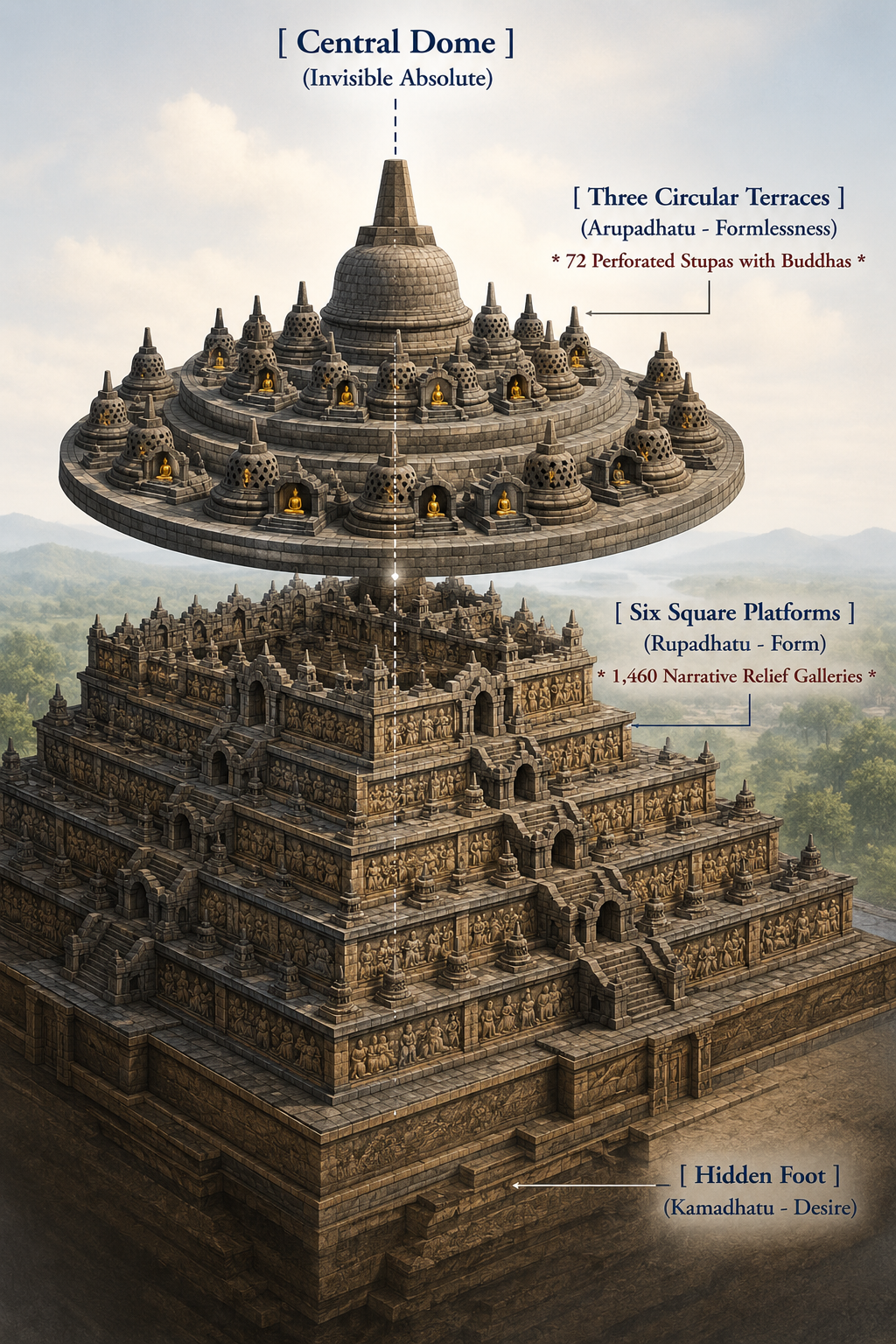
Pilgrims ascend the monument through an elaborate, enclosed system of stairways and corridors, performing pradakshina around 1,460 narrative relief panels that depict key Mahayana sutras, including the Lalitavistara, Jatakas, and the Gandavyuha. Acoustically, as the pilgrim moves through the narrow, high-walled open-air corridors of the lower square platforms (Rupadhatu), their steps and whispered prayers are compressed and localized, creating a sense of physical enclosure and internal focus.
Upon emerging onto the open, expansive circular upper terraces (Arupadhatu), the physical walls disappear, replaced by 72 Buddhas seated inside hollow, perforated stone stupas. Sound waves are no longer reflected or compressed; instead, they disperse freely into the vast volcanic landscape, aurally mirroring the spiritual transition from the realm of form (Rupadhatu) to the infinite, absolute silence of formlessness (Arupadhatu).
Bagan (Myanmar)
The plains of Bagan are home to thousands of brick stupas and temples constructed between the 9th and 13th centuries. The architectural masterpiece of this era is the Ananda Temple, completed in 1105 CE under King Kyansittha. Designed to mimic the cool, meditative atmosphere of the mythical Himalayan Nandamula Cave Temple, the building features a symmetrical, cruciform "Greek cross" floor plan. At the absolute center of this massive brick structure is a solid square core flanked by two concentric, vaulted processional corridors.
Inlaid into the four faces of the central core are four arched niches housing 9.5-meter-tall standing Buddha statues carved from solid teak wood, representing the four Buddhas of the present kalpa who have attained nirvana: Kassapa (South), Kakusandha (North), Konagamana (East), and Gautama (West). The building's exterior features stepped, receding terraces leading to a golden shikhara (tower) and a crowning hti (umbrella) pinnacle.
The interior acoustics of the Ananda Temple are highly specialized: the heavy brick walls and low-vaulted processional corridors act as low-pass acoustic filters, absorbing high-frequency background noise from the outside and leaving a deep, quiet, and cool acoustic background. When a devotee stands in the transverse corridors, the direct sound of chanting is channeled down the long, narrow tunnels, producing highly directional, clear reflections that draw the listener's focus forward to the massive, illuminated wooden Buddhas towering at the corridors' ends.
Thai Regional Typologies: Sukhothai, Ayutthaya, and Lanna
Thai Buddhist temple architecture is defined by a highly structured spatial division, separating the sangkhawat (monks' living quarters, containing individual kuti dwellings, kitchens, and sometimes the bell tower) from the buddhavasa (the sacred zone dedicated to religious rituals, enclosed by a gallery of Buddha images known as the phra rabeang).
Within the buddhavasa, the primary liturgical structures are the Ubosot (the highly sacred, consecrated ordination hall demarcated by eight Sema boundary stones) and the Viharn (the primary assembly and preaching hall). Throughout history, three primary regional and dynastic styles have defined this tradition:
Sukhothai Style (13th–15th c.): Characterized by bell-shaped and unique lotus bud-shaped chedi (stupa) spires, with extensive use of large clay bricks made of river bed clay mixed with rice hulls, alongside structural reddish laterite stone. The interior walls, coated with thick stucco, are embellished with tempera murals where the color red represents an empty void, creating a visually and acoustically warm, highly focused environment in the nave.
Ayutthaya Style (14th–18th c.): Noted for its adaptation of the Khmer stone prasat into the elongated, towering phra prang, and late-period curved foundations (Yon Thong Samphao). These structures feature a deliberate concave curvature of the building's base and roofline mimicking a Chinese junk hull, which alters interior acoustic wave reflection angles along the longitudinal axis.
Lanna Style (Northern Thailand): Distinguished by low, sweeping, multi-tiered roofs that telescope towards the entrance, V-shaped wooden Kalae carvings at the gables, and open-sided assembly halls (Viharn Nam Tam). The low roofs protect the teak wood carvings and create dark, cool, highly focused interiors, while the open sides connect the interior acoustic field directly with the surrounding natural geophony (wind, water, birds).
These regional styles maintain unique liturgical and spatial rules. In northern Lanna sites (such as Wat Sri Suphan or the base of Wat Chedi Luang), ancient beliefs regarding spiritual purity and the sacred talismans (takrud) buried beneath the structures prohibit women from entering the main ordination zone, preserving a strict spatial boundary around the consecrated relics.
The primary stupa (chedi or stupa) acts as the symbolic center, representing Mount Meru, the multi-layered Buddhist cosmology, and the seated body of the Buddha himself. On the corners of these chedis and along the ridges of the temple roofs, strings of small brass wind chimes (bell/chimes) are hung. In Buddhist liturgy, the sound of these chimes is considered a sacred summon that purifies the mind and dispels distraction.
Acoustically, these chimes illustrate the fundamental Buddhist doctrine of dependent origination and emptiness: their sound does not exist inherently within the metal, nor does it exist solely in the wind; rather, the clear metallic tinkling arises only through the temporary, dependent interaction of the wind, the brass, and the surrounding environment, providing monastics with a continuous sensory lesson on the nature of reality.
Contemporary Geometries and Tech-Spiritual Fusion
Since the late 20th century, a new wave of monumental Buddhist architecture has emerged across Asia, characterized by a bold synthesis of ancient sacred principles, modern building materials (such as exposed concrete, structural steel, and glass), and globalized cultural functions. These contemporary structures transition away from literal historical imitation, adopting minimalist design languages to evoke the core Buddhist concepts of emptiness (śūnyatā), impermanence, and meditative quietude.
The Hill of the Buddha (Sapporo, Japan)
Designed by the renowned architect Tadao Ando inside the Makomanai Takino Cemetery, the Hill of the Buddha is a masterclass in architectural choreography and landscape integration. The project encases a traditional, pre-existing 13.5-meter-tall stone seated Buddha statue within a massive, circular concrete rotunda.
This concrete dome is entirely buried beneath a sloping, artificial earth mound planted with 150,000 lavender plants, leaving only the very top of the Buddha's head visible from the surrounding hills.
To approach the statue, visitors must navigate a highly structured spatial path. They first pass a large, rectangular reflecting pool that purifies the mind, then enter a 40-meter-long, dimly lit tunnel constructed of raw, board-formed concrete.
As the visitor walks through this dark, compressed tunnel, the ambient sound of the exterior landscape is systematically dampened, creating a quiet, introspective acoustic shadow. At the end of the tunnel, the space opens dramatically into the soaring, open-ceiling concrete rotunda.
The visitor stands at the base of the massive statue, looking up to see the Buddha's face framed by the sky and natural light filtering down from the circular opening. This spatial sequence—moving from light to dark, acoustic compression to open-air release—physically and aurally choreographs a meditative passage from the darkness of ignorance to the illumination of awakening.
The Water-Moon Monastery (Taipei, Taiwan)
Designed by Kris Yao | Artech on the Guandu Plain, the Water-Moon Monastery reinterprets Zen Buddhist aesthetics through a Le Corbusier-influenced modernist framework. Constructed primarily of raw concrete, glass, and warm wood, the temple sits adjacent to a 260-foot-long, tranquil lotus pond that reflects the surrounding mountains and the changing sky.
The defining architectural feature of the double-height Main Hall is a vast screen wall constructed of prefabricated Glass Fiber Reinforced Concrete (GRC) panels. These panels are carved through with the characters of the Vajracchedika Prajnaparamita Sutra (The Diamond Sutra) and the Heart Sutra.
As sunlight passes through these hollow, negative character cut-outs, the sacred scriptures are printed with pure light directly onto the interior concrete floors and wooden walls. As the earth rotates, these characters move and fade across the surfaces, providing a continuous, dynamic visual sermon on the absolute impermanence and emptiness of all phenomena.
Tsz Shan Monastery (New Territories, Hong Kong)
Completed in 2015 and funded by the Li Ka Shing Foundation, Tsz Shan Monastery is dedicated to Chán Buddhist practice, education, and public spiritual reflection. The complex seamlessly integrates classical Tang Dynasty architectural proportions and wood joinery aesthetics with state-of-the-art structural steel framing, hidden climate control, and modern safety engineering.
The spatial layout features expansive, highly balanced courtyards, quiet ponds, and contemplative gravel paths, terminating in the monastery's towering icon: a colossal, 76-meter-tall bronze statue of the Bodhisattva Guan Yin (Avalokiteśvara) coated in white paint.
The statue stands as a monument to compassion, commanding the landscape while the interior houses a dedicated museum containing world-class collections of historical Buddhist art, serving to bridge ancient lineage traditions with modern public education.
Fo Guang Shan Buddha Museum (Kaohsiung, Taiwan)
Representing the globalized, highly accessible approach of Humanistic Buddhism, the Fo Guang Shan Buddha Museum is a monumental, 100-hectare sacred complex designed to integrate traditional pilgrimage with public education, modern tourism, and high-tech digital media.
The architectural layout represents a dramatic fusion of Indian, Chinese, and modern building traditions:
The Front Hall: A massive gateway structure flanked by a five-meter-tall stone lion on the left (symbolizing the roar of the Buddha's teachings) and an identical elephant on the right (symbolizing Prince Siddhartha's conception).
The Way to Buddhahood: A colossal, stone-paved ceremonial processional walkway measuring 240 meters long and 113 meters wide.
The Eight Pagodas: Flanking the processional walkway are eight identical, 38-meter-tall, seven-story Chinese-style pagodas constructed of reinforced concrete and stone, representing the Noble Eightfold Path. Each pagoda houses specialized public functions, including a library, lecture halls, transcription spaces for sutra calligraphy, and children's interactive exhibits.
The Main Hall and Stupa: Located at the end of the central axis, this 50-meter-high domed structure is inspired by the Indian Mahabodhi Temple at Bodh Gaya. Constructed with a base of Chinese sandstone and a body of Chinese granite, the hall houses the sacred Buddha Tooth Relic inside the Jade Buddha Shrine.
The Fo Guang Big Buddha: Seated atop the Main Hall is a colossal, 108-meter-tall bronze statue of Sakyamuni Buddha. The statue took over a year to cast, utilizing nearly 1,800 tons of structural metal.
The 48 Underground Palaces: Built beneath the main complex is a vast network of 48 underground reliquary chambers containing additional Buddhist relics, historic artifacts, and contemporary cultural time capsules, designed to preserve the heritage of Humanistic Buddhism for future millennia.
Nan Tien Temple (Wollongong, Australia)
Constructed as the largest Buddhist temple in the Southern Hemisphere, Nan Tien Temple illustrates the adaptation of Chinese palace-style architecture to a modern Western context. While traditional temples were constructed of timber and brick, Nan Tien utilizes modern structural steel and concrete.
However, its structural design carefully mimics traditional forms: the steel roof framing is fitted with painted end beams that extend under the eaves to replicate classical wooden bracket systems.
The exterior features red imperial columns and white concrete balustrades styled to mimic classical carved white marble. Inside, a prominent raised podium is positioned at the rear of the shrines to elevate the primary Buddha statuary, mirroring the royal audience halls of the Chinese imperial court.
The complex is laid out along a strict symmetrical axis, where a sequence of lower courtyard buildings leads progressively to the most significant Main Shrine, conceptually organizing the temple space as a seated Buddha where the Main Shrine represents the head, the surrounding wings represent the arms, and the central courtyard functions as the lap.
Conclusion: The Integrated Sensory Design of Buddhist Sacred Architecture
An integrated review of Buddhist temple architecture across time, geography, and cultural lineages demonstrates a profound, unbroken commitment to sensory and attention-shaping design. Whether analyzing the rock-cut basalt naves of early Indian chaityas, the mathematically balanced timber-frame structures of East Asian garans, the monumental stone mandalas of Southeast Asia, or the minimalist concrete sanctuaries of the contemporary era, the core spatial objective remains identical: to configure the physical environment so that it actively mirrors and supports the internal path to awakening.
Acoustically, this evolution reveals a highly sophisticated understanding of material physics and room-acoustic design. When the primary liturgical mode focused on slow, resonant chanting and solitary circumambulation, structures utilized reflective, cave-like basalt stone to compress vocal energy and maximize immersion. When the liturgy transitioned to exoteric communal preaching, mass assemblies, and rapid scripture readings, timber systems were developed to introduce porous, high-frequency sound-absorbing surfaces (such as paper panels, drapes, and wooden structures), keeping speech transmission crisp and highly intelligible.
Concurrently, the tight physical synchronization of monastic life was coordinated not by spoken words, but by a precise temporal grid of percussive sounding objects (narashimono) that directly regulated the monastic breath, posture, and collective focus. In these diverse environments, the architecture does not merely serve as a passive container for worship, it acts as an active partner to the mind, utilizing the physical properties of space, light, materials, and sound to gently guide the body and attention away from mental clutter and into a state of absolute, reflective presence.
Temple Acoustics Consultation Framework: Balancing Ritual, Contemplation, and Sacred Sound
Temples present a unique challenge in Sacred Acoustic Design because their worship experience is often centered on contemplation, chanting, ritual resonance, and the relationship between sound and silence. Unlike churches, which frequently combine music and preaching, or mosques, which focus primarily on the beauty and intelligibility of the human voice, temples often seek to cultivate mindfulness, reflection, and spiritual awareness through a carefully balanced acoustic environment.
Today, many temples serve multiple functions beyond traditional worship, including meditation retreats, Dharma teachings, community activities, cultural events, educational programs, and digital broadcasting. As a result, acoustic design must accommodate both traditional ritual practices and contemporary functional requirements while preserving the contemplative atmosphere that defines the temple experience.
The objective is not simply to amplify sound or control reverberation. The goal is to create an acoustic environment that supports inner reflection, collective ritual, spiritual focus, and meaningful human connection.
Different Temple Traditions Require Different Acoustic Environments
One of the most overlooked aspects of temple design is that there is no single acoustic model applicable to all temples. Different Buddhist traditions, cultural contexts, and ritual practices create distinct acoustic requirements.
Theravada Buddhist temples, commonly found in Thailand, Myanmar, Cambodia, Sri Lanka, and Laos, often emphasize spoken teachings, scripture recitation, monastic chanting, and meditation. Speech intelligibility is important for Dharma talks, while moderate reverberation can support chanting without overwhelming clarity. The acoustic environment is typically expected to feel calm, intimate, and conducive to contemplation.
Mahayana Buddhist temples, prevalent in China, Taiwan, Korea, Japan, and Vietnam, frequently incorporate larger ceremonial spaces, collective chanting, ritual percussion, temple bells, and congregational participation. These environments often benefit from a richer acoustic response that supports collective vocalization while maintaining clarity for teachings and ceremonial announcements.
Vajrayana Buddhist temples and monasteries, particularly in Tibetan traditions, often incorporate deep vocal chanting, ritual horns, large drums, bells, cymbals, singing bowls, and ceremonial instruments. These rituals generate a broad spectrum of frequencies and dynamic ranges, requiring an acoustic environment that can support both resonance and articulation without becoming acoustically chaotic.
Contemporary urban temples and meditation centers often serve diverse functions including meditation classes, mindfulness programs, public lectures, community activities, and hybrid digital participation. These facilities frequently require a more flexible acoustic approach that supports both contemplative silence and amplified communication.
The challenge is recognizing that each tradition uses sound differently and therefore requires a different balance between reverberation, clarity, intimacy, and ritual resonance.
Architectural Style Shapes Acoustic Character
Temple acoustics are deeply influenced by architectural form, materiality, and cultural expression.
Traditional East Asian temples frequently utilize timber structures, exposed wooden beams, layered roofs, and natural materials. Wood provides a softer acoustic response than stone or concrete, creating a warm and balanced sound environment that supports chanting and meditation while reducing harsh reflections.
Chinese and Korean temple architecture often incorporates large ceremonial halls, courtyards, decorative screens, and ornamental detailing that contribute both visual richness and acoustic diffusion. These elements help distribute sound more evenly throughout the worship space.
Japanese temples and Zen meditation halls often embrace simplicity, natural materials, and human-scaled proportions. Their acoustic environments tend to emphasize subtlety, restraint, and attentive listening. The resulting spaces often support contemplative practices through controlled reverberation and low background noise.
Contemporary minimalist temples frequently employ concrete, stone, glass, and steel alongside modern architectural forms. While visually elegant, these materials can create excessive reflections and acoustic harshness if not carefully integrated with acoustic design strategies. The challenge is maintaining architectural purity while preserving the calmness and warmth essential to contemplative practice.
In each case, architecture functions not only as a visual expression of spirituality but also as a vessel for shaping how sacred sounds are experienced.
The Acoustic Value of Silence
One of the defining characteristics of temple acoustics is the intentional use of silence.
In many religious buildings, silence is simply the absence of sound. In temples, silence often becomes an active component of the worship experience. Moments of silence may occur: Before meditation, Between chants, During prayer, Following the strike of a bell and During contemplative reflection. These pauses allow worshippers to become more aware of their surroundings, their thoughts, and their spiritual practice.
For this reason, building acoustic design becomes especially important. Mechanical noise, traffic noise, vibration, and intrusive background sounds can significantly disrupt contemplative environments. Protecting silence often becomes as important as supporting ritual sounds.
Size, Volume, and Spatial Sequence Matter
Temple acoustics are influenced not only by room size but also by the sequence of spaces through which worshippers move.
Unlike many churches and mosques that focus on a single large worship hall, temples frequently include: Courtyards, Threshold spaces, Meditation rooms, Ceremonial halls, Bell towers, Prayer pavilions and Gardens.
Each space may possess a different acoustic character that supports a different stage of the spiritual journey. A meditation hall may require exceptional quietness and intimacy. A ceremonial hall may support collective chanting and ritual percussion. An outdoor courtyard may intentionally incorporate water features, wind, and natural sounds.
This progression creates an acoustic narrative that accompanies the worshipper's movement through the sacred environment.
ALTA Integra Temple Acoustic Consultation: Integrating Building Acoustics, Architectural Acoustics, and Electroacoustics
Successful temple acoustics require the integration of multiple disciplines.
Building Acoustics protects meditation and ritual activities from unwanted environmental noise, mechanical systems, and vibration. Because temples often emphasize mindfulness and attentive listening, low background noise is particularly important.
Architectural Acoustics shapes the natural behavior of sound through geometry, material selection, room volume, reverberation control, and diffusion. The objective is to support chanting, teachings, bells, and ritual instruments while preserving calmness and acoustic comfort.
Electroacoustics provides reinforcement for Dharma teachings, ceremonies, multilingual interpretation, accessibility systems, livestreaming, and community events. Loudspeaker selection, placement, coverage, and delay optimization should remain unobtrusive and support the natural acoustic character of the space rather than dominate it.
The goal is not to transform the temple into a performance venue but to use technology in service of ritual and contemplation.
ALTA Integra Temple Acoustic Consultation: Beyond Acoustic Performance
Conventional acoustic design often focuses on measurable criteria such as reverberation time, speech intelligibility, and sound pressure level. While these metrics remain important, they do not fully describe the temple experience.
The sound of a temple bell is more than a signal. Chanting is more than speech. Silence is more than the absence of sound. These elements function as spiritual tools that shape attention, awareness, memory, and emotional experience.
Sacred Acoustic Design therefore seeks to understand not only how sound behaves physically, but also how it is perceived psychologically and experienced spiritually.
ALTA Integra Temple Acoustic Consultation: Preserving the Acoustic Identity of Temple Worship
The most successful temples are those where architecture, ritual, acoustics, and culture work together as a unified experience.
When carefully designed, chanting resonates naturally within the space, bells decay gracefully into silence, teachings remain intelligible, and worshippers experience a sense of calmness and spiritual presence.
This is the challenge—and the opportunity—of contemporary temple acoustics: preserving the unique acoustic identity of temple worship while accommodating the evolving needs of modern religious, cultural, and community life.
In Sacred Acoustic Design, the objective is not simply to make temples sound better. It is to create environments where sound, silence, architecture, and ritual come together to support contemplation, mindfulness, and spiritual transformation.Chanting and collective singing style
Collective vocalization is one of the most important acoustic behaviors in sacred architecture. Chanting and congregational singing create emotional bonding, shared rhythm, and a strong sense of participation. The architectural response should match the style of vocal production.
Where singing is sustained and harmonically rich, as in many churches, the room can afford more reverberation to support blend and warmth. Where chanting is syllabic and text-driven, as in many mosques and temples, clarity and articulation become more important. Where chanting is meditative and repetitive, the space should avoid harsh reflections and mechanical noise that interrupt vocal continuity.
The key point is that collective singing is not only heard; it is felt. The room becomes part of the instrument. That is why acoustic design must be calibrated to the actual vocal culture of the congregation, not to an abstract ideal.
Across religious traditions, collective vocalization remains one of humanity's oldest social behaviors.
Whether expressed through hymns, chants, recitations, or responsive prayer, collective sound-making creates powerful psychological and physiological effects.
Research suggests that collective singing and chanting may contribute to: Social bonding, Emotional synchronization, Shared attention, Group identity and Stress reduction.
The acoustic environment plays a crucial role in shaping these experiences. Too much reverberation can reduce clarity. Too little reverberation can diminish emotional richness.
The most successful worship spaces achieve a balance that allows worshippers to hear both themselves and the larger community.
In this sense, architecture becomes an active participant in collective worship.