LEED vs EDGE vs Green Globes: Which Green Building Certification Is Right for South East Asia?

A Strategic Comparison for Sustainable, High-Performance, and Human-Centered Buildings
As sustainability, ESG compliance, operational efficiency, and occupant wellness become increasingly important in modern development, green building certifications have evolved into critical strategic tools for architects, developers, investors, and building owners.
Among the most recognized certification systems globally are LEED, EDGE, and Green Globes. Each certification framework offers a different philosophy, technical methodology, implementation complexity, and market positioning.
Understanding the differences between these systems is essential for selecting the right certification strategy based on project type, budget, sustainability goals, investor expectations, operational performance targets, and market positioning.
At HerwinGunawan.Work, we provide integrated building performance consultancy covering sustainability, acoustics, lighting, audiovisual technology, smart building systems, environmental quality, and human-centered design strategies to support healthier and higher-performing built environments.
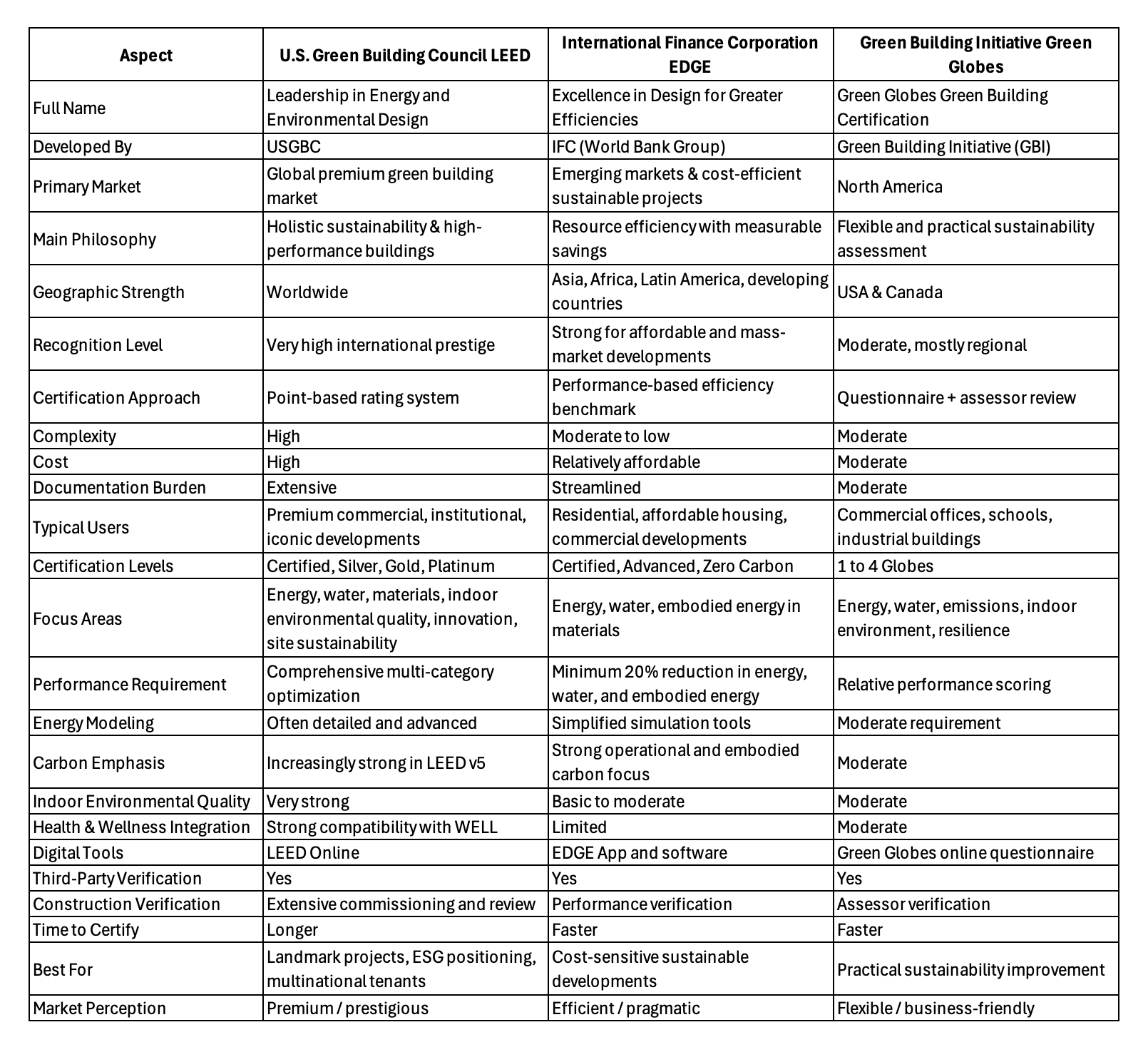
What Is LEED Certification?
LEED by USGBC is one of the world’s most recognized green building certification systems developed by the U.S. Green Building Council (USGBC). LEED provides a comprehensive sustainability framework covering energy efficiency, water conservation, indoor environmental quality, sustainable materials, site sustainability, carbon reduction, and innovation.
LEED certification is widely associated with premium commercial developments, institutional buildings, international hospitality projects, airports, mixed-use developments, and ESG-driven real estate portfolios.
LEED certification levels include:
Certified
Silver
Gold
Platinum
The system uses a point-based methodology that evaluates building performance across multiple sustainability categories.
According to USGBC, LEED is the world’s leading green building rating system and provides a globally recognized framework for healthy, efficient, and cost-effective buildings. (usgbc.org)
LEED Advantages and Limitations
Advantages of LEED
Strongest international sustainability branding
High credibility with multinational tenants and institutional investors
Strong alignment with ESG reporting and carbon reduction strategies
Comprehensive approach to building performance
Excellent integration with WELL and human-centered design strategies
Strong focus on indoor environmental quality and occupant wellness
Limitations of LEED
Higher certification and consultancy cost
Extensive documentation requirements
Longer certification timeline
Intensive coordination across multidisciplinary teams
LEED is often most suitable for landmark projects where sustainability branding and international market positioning are important.
What Is EDGE Certification?
EDGE Buildings is a green building certification system developed by the International Finance Corporation (IFC), a member of the World Bank Group.
EDGE stands for Excellence in Design for Greater Efficiencies and focuses on measurable reductions in:
Energy consumption
Water consumption
Embodied carbon in materials
To achieve EDGE certification, projects must demonstrate at least 20% savings in energy, water, and embodied energy in materials compared to local baseline buildings. (edgebuildings.com)
EDGE is designed to be simpler, faster, and more cost-effective compared to more documentation-intensive certification systems. It has become particularly popular in emerging markets, including Indonesia, Southeast Asia, Africa, and Latin America.
EDGE certification levels include:
EDGE Certified
EDGE Advanced
EDGE Zero Carbon
The system is highly attractive for developers pursuing scalable sustainability strategies, green financing, operational savings, and portfolio-level implementation.
EDGE Advantages and Limitations
Advantages of EDGE
Faster and more affordable certification process
Simplified implementation workflow
Strong operational savings focus
Effective for large-scale residential and commercial developments
Attractive for green financing and sustainable investment strategies
Strong emerging market compatibility
Limitations of EDGE
Less comprehensive than LEED
Limited emphasis on wellness and placemaking
Fewer innovation and environmental categories
Lower prestige for premium international branding
EDGE is particularly effective for developers prioritizing scalable sustainability implementation with measurable ROI.
What Is Green Globes?
Green Globes by GBI is a flexible sustainability assessment and certification system developed by the Green Building Initiative (GBI).
Green Globes emphasizes a more collaborative and practical certification process using:
Online questionnaires
Third-party assessors
Flexible compliance pathways
Simplified documentation workflows
The system is widely used in North America for commercial buildings, educational facilities, healthcare projects, industrial buildings, and renovation projects.
Green Globes certification is generally perceived as more flexible and less administratively intensive compared to LEED. (thegbi.org)
Green Globes Advantages and Limitations
Advantages of Green Globes
Flexible certification methodology
Lower administrative burden
Practical and collaborative assessment process
Suitable for renovation and existing building projects
Faster certification process
Limitations of Green Globes
Lower international recognition
Limited adoption outside North America
Less commonly required by institutional investors
Reduced global branding value compared to LEED
Green Globes is generally preferred for projects seeking pragmatic sustainability improvements without highly intensive certification processes.
Technical Requirement
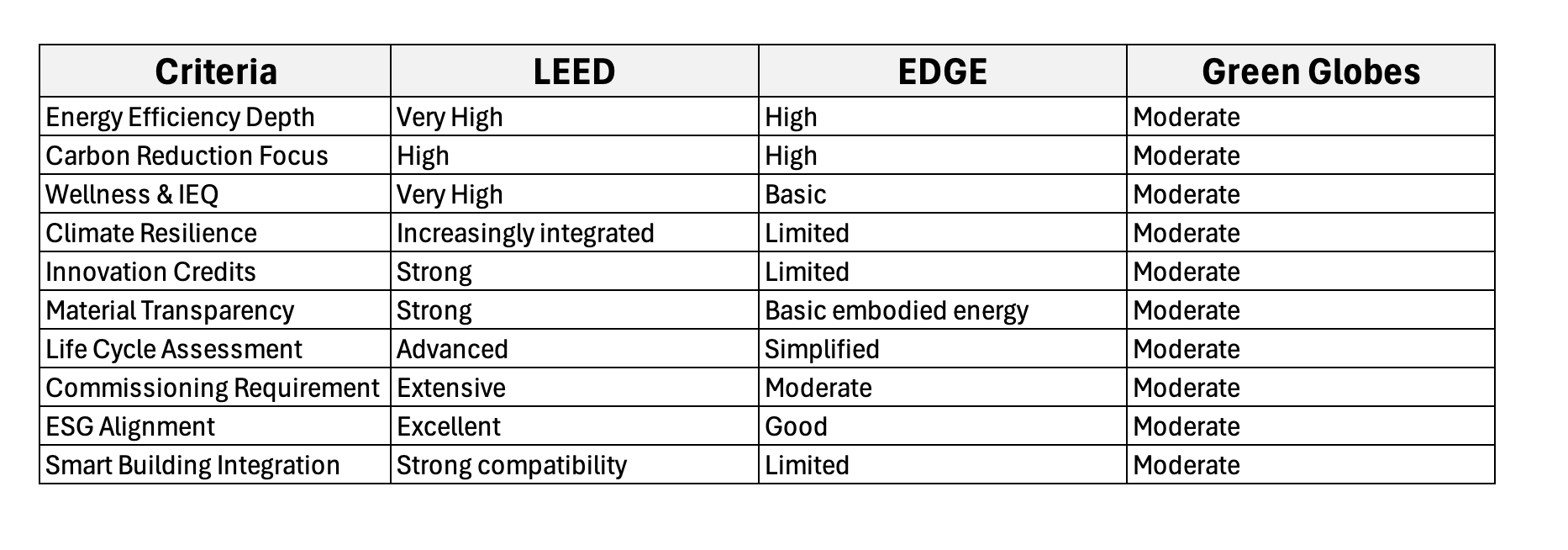
Which Green Building Certification Is Best for South East Asia?
In Indonesia and Southeast Asia, LEED and EDGE are currently the most relevant international certification systems.
LEED in South East Asia
LEED is commonly used for:
Premium office towers
International hospitality developments
Mixed-use commercial developments
Airports and transportation infrastructure
Corporate headquarters
ESG-focused real estate portfolios
LEED provides strong international branding value and is often preferred by multinational tenants and institutional investors.
EDGE in South East Asia
EDGE is rapidly growing due to:
Lower certification cost
Faster implementation
Simpler compliance process
Strong compatibility with residential and mixed-use developments
Green financing alignment
EDGE is especially attractive for:
Residential developers
Industrial developments
Mid-market commercial buildings
Large development portfolios
Green Globes in South East Asia
Green Globes currently has limited market adoption in Indonesia and is less commonly requested by local developers or tenants.
Beyond Certification: The Importance of Human-Centered Building Performance
While sustainability certifications are important, truly high-performance buildings require more than energy efficiency alone.
Modern buildings must also address:
Acoustic comfort
Human-centric lighting
Indoor environmental quality
Thermal comfort
Smart building integration
Audiovisual and communication systems
Occupant wellness and productivity
Biophilic and sensory experience
Integrated building performance design creates environments that are not only sustainable, but also healthier, more productive, emotionally engaging, and operationally efficient.
This is increasingly important as developers, investors, and occupants shift toward:
ESG-driven development
Wellness-focused workplaces
Sustainable hospitality
Smart buildings
Human experience-centered architecture
Our Approach to Sustainable and Human-Centered Building Performance
We provide integrated consultancy services combining:
Sustainable building strategy
Green building certification support
Acoustic consultancy
Architectural lighting design
Audiovisual and ICT systems design
Smart building integration
Indoor environmental quality optimization
Human-centered environmental experience design
Our approach integrates environmental performance with human experience to help create buildings that are:
Sustainable
Healthy
Efficient
Comfortable
Technologically integrated
Operationally optimized
Future-ready
Consultant Requirement and Cost
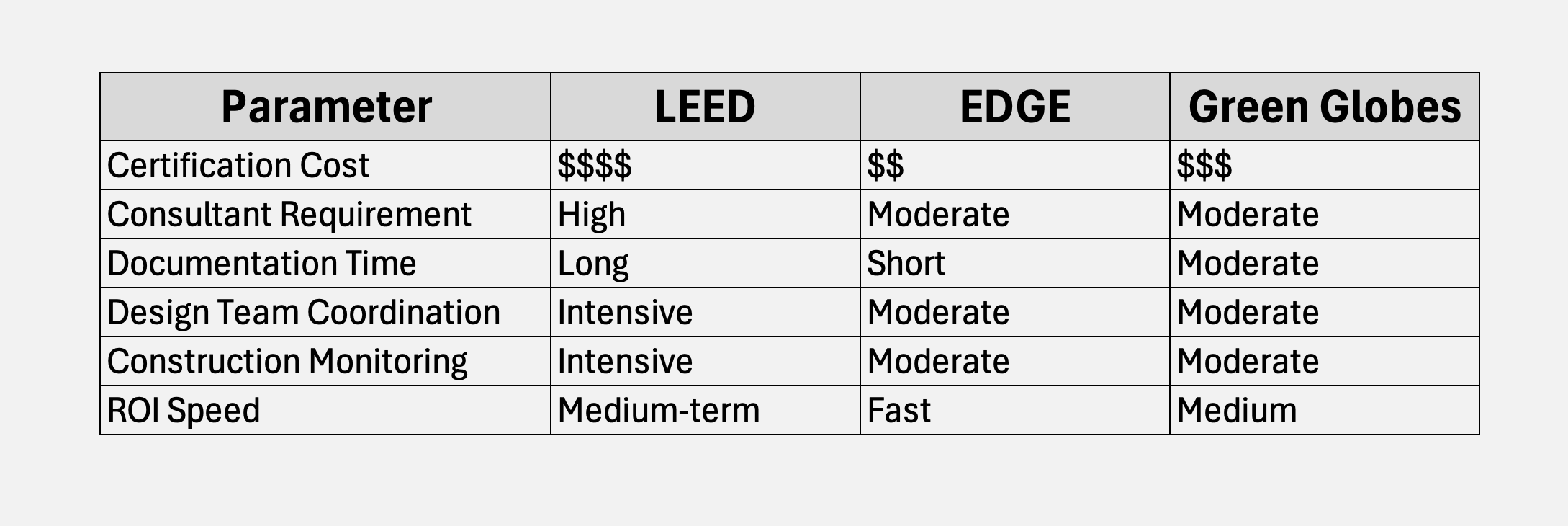
Conclusion
Choosing between LEED, EDGE, and Green Globes depends on your project objectives, sustainability ambitions, operational targets, market positioning, and investment strategy.
Choose LEED if:
You need strong international prestige
ESG positioning is critical
The project targets multinational tenants
Wellness and premium sustainability positioning are priorities
Choose EDGE if:
Cost efficiency is important
You need scalable sustainability implementation
The project is residential or mixed-use
Fast certification and measurable resource savings are priorities
Choose Green Globes if:
Practical flexibility is more important than global prestige
The project is in North America
Existing building optimization is the main objective
As sustainability evolves beyond compliance into holistic human-centered building performance, successful projects increasingly require integrated expertise across environmental design, wellness, technology, acoustics, lighting, and smart systems.
References
USGBC LEED Rating System (usgbc.org)
EDGE Buildings Certification (edgebuildings.com)
Green Building Initiative – Green Globes (thegbi.org)