When architects and project committees discuss a new church, mosque, or temple, the conversation often begins with form, symbolism, materials, capacity, circulation, and visual identity. Acoustic questions may appear later, frequently when an audio vendor is asked to propose a sound system.
That sequence can solve amplification requirements, but it may leave a more fundamental question unanswered:
How should this space sound in relation to its worship tradition, ritual practices, congregation, architecture, and cultural context?
A worship space is not acoustically neutral. Its sound influences whether spoken words can be followed, whether collective singing feels unified, whether recitation remains intelligible, whether ritual instruments retain their character, and whether silence can be experienced without intrusive noise. These conditions can affect participation, attention, comfort, memory, and the perceived identity of a place.
Sacred Acoustic Design is an evidence-informed framework developed by ALTA Integra for integrating building acoustics, architectural acoustics, electroacoustics, psychoacoustics, and ritual-use analysis in worship environments. It begins with the premise that an acoustic brief should respond not only to technical performance requirements, but also to the worship tradition, ritual sequence, congregation behavior, cultural context, accessibility needs, and intended character of the space.
The framework does not assume that spiritual experience can be engineered or guaranteed. Its purpose is to create acoustic conditions that support communication, participation, music, prayer, contemplation, and the community’s own understanding of sacred-space identity.
This article focuses on selected Christian church, Islamic mosque, and Buddhist temple or meditation contexts. These categories contain considerable diversity; they should not be treated as universal descriptions of all Christian, Islamic, Buddhist, or other religious traditions. Every project requires direct engagement with the people who understand and use its rituals.
Why Do Worship Spaces Need Different Acoustic Briefs?
There is no single acoustic target that defines a successful worship space.
A cathedral may need to support spoken liturgy, choir, pipe organ, congregational responses, and periods of silence within the same volume. A contemporary church may combine sermons, amplified bands, multimedia, livestreaming, and collective singing. A mosque may need to support Quranic recitation, congregational prayer, the Friday sermon, teaching, and distributed speech reinforcement. A Buddhist teaching hall may alternate among spoken instruction, chanting, bells, ritual percussion, and meditation.
Each activity places different demands on the acoustic environment. Reverberation may support musical continuity and collective resonance, yet excessive late sound can reduce speech intelligibility. Strong amplification may improve audibility, yet poor loudspeaker placement or overlapping coverage can create interference and visual intrusion. A quiet room may support contemplation, yet an acoustically over-damped room can weaken chanting or collective participation.
Research in churches illustrates this complexity. Measurements and listener evaluations in 36 Portuguese Catholic churches found relationships among architectural features, objective room-acoustic parameters, and perceived attributes such as reverberance, clarity, intimacy, envelopment, and echoes. The results also showed why one metric cannot represent the entire listening experience [Carvalho, Morgado, and Henrique, 1997]. A separate study using measured binaural responses from Italian churches found that preferred listening conditions changed with musical material: conditions preferred for choral music were not identical to those preferred for instrumental music [Martellotta, 2008].
Mosque acoustics are equally dependent on condition and use. A field investigation of 21 mosques in Saudi Arabia measured reverberation, clarity, background noise, and speech transmission with and without operating building systems and sound reinforcement. It found significant acoustic deficiencies in unoccupied conditions and materially different performance when the mosques were occupied [Abdou, 2003]. This is an important reminder that geometry, finishes, congregation, services noise, and sound reinforcement must be considered together.
Buddhist worship environments also resist generalization. Measurements and simulations of the Deekshabhoomi Buddhist monument in Nagpur found a major difference between occupied and unoccupied reverberation and examined how this related to chanting, sermons, and meditation in that particular structure [Manohare, Dongre, and Wahurwagh, 2017]. Those results describe a specific building and ritual context; they are not a universal target for Buddhist temples.
The practical conclusion is straightforward: acoustic criteria must be developed from the building’s actual program, not selected from its religious label alone.
Sacred Building Acoustic Design
A Human-Centred Acoustic Design Pathway
A four-stage framework connecting measurable acoustic conditions with perception, ritual participation, and potential human or spiritual meaning.
Conditions
Acoustic Conditions
Measurable or predictable properties of the built environment.
- Noise control & sound isolation
- Reverberation & clarity
- Sound distribution
- HVAC & background noise
- Geometry, materials & occupancy
Predicted,
Designed
Experience
Human Perception
How listeners perceive and interpret the acoustic environment.
- Audibility & intelligibility
- Loudness & balance
- Warmth & envelopment
- Spatial impression
- Acoustic comfort
Interpreted,
Experienced
Support
Ritual Participation
How acoustic conditions may support worship, ritual, and communal activity.
- Speech, recitation & music
- Chanting & collective response
- Attention & engagement
- Ritual flow & timing
- Sound-to-silence transitions
Participated,
Shared
may contribute to—
does not guarantee
Spiritual
Meaning
Potential Human &
Spiritual Meaning
Personal and communal meanings shaped by people, culture, belief, and context.
- Belonging & identity
- Reverence & reflection
- Memory & continuity
- Connection & transcendence
- Community-defined significance
Communal,
Contextual
What Shapes a Sacred Acoustic Identity?
An effective acoustic brief begins with an understanding of how architecture, people, ritual, and technology interact.
Architecture, geometry, and materials
Room volume, proportions, ceiling form, balconies, columns, domes, alcoves, surface geometry, and material assemblies influence how sound is reflected, absorbed, scattered, focused, and transmitted. Their effects arise before any loudspeaker or acoustic treatment is installed.
Large reflective volumes may create long decay and spatial envelopment, but they can also produce echoes or poor speech clarity. Domes and concave surfaces may generate focusing under some conditions. Seating, carpets, curtains, doors, openings, ornamentation, and congregation occupancy may materially change the response. The relevant question is therefore not whether a material is generally “acoustic,” but how the complete assembly, area, location, geometry, and occupancy contribute to the intended result.
Worship tradition and ritual sequence
The acoustic requirements of a space change throughout a service or ceremony. A design team should map who speaks, sings, chants, plays, listens, or moves; where each source and listener is located; and how the sequence changes over time.
In a church, the source may move among altar, lectern, pulpit, choir, organ, musicians, and congregation. Measurements in Japanese churches have demonstrated that source location and direction can affect room-acoustic parameters and speech intelligibility, reinforcing the need to study the actual liturgical arrangement rather than a generic source position [Soeta et al., 2012].
The same principle applies in mosques, where the locations and functions of the imam, khatib, reciter, congregation, and loudspeaker system may vary. Parametric research on contemporary mosque configurations has shown how geometry, surface area, volume, and finishes affect predicted acoustic performance [Ismail, 2013]. In temples and meditation environments, teaching, chanting, bells, ritual percussion, procession, and silence may each require a different balance of audibility, decay, intimacy, and environmental control.
Within the Sacred Acoustic Design framework, Ritual Acoustics refers to this analysis of sound sources, listeners, movement, participation, timing, and spatial use throughout a worship sequence. It is a project-analysis layer rather than a claim that spiritual meaning can be reduced to acoustic physics.
Cultural memory and meaningful sound
Religious communities often recognize particular sounds as part of the identity of a place: bells, hymns, organ music, the Adhan, Quranic recitation, chanting, gongs, ritual drums, water, wind, birds, or collective responses. The appropriate design question is not simply how to suppress sound, but which sounds should be protected, supported, moderated, or excluded.
Soundscape research emphasizes that sound is experienced in context. ISO 12913-1 defines soundscape through human perception of the acoustic environment in context, making activity, place, expectation, and interpretation relevant to assessment [ISO 12913-1:2014]. A study using social surveys and soundwalks at Myeong-dong Cathedral and Bongeun Buddhist Temple in Seoul also found that soundscape and spatial context contributed differently to how tranquility and religious-space functions were perceived at the two sites [Jeon, Hwang, and Hong, 2014].
These findings do not allow a consultant to define sacredness on behalf of a community. They support a participatory process in which clergy, ritual leaders, musicians, worshippers, architects, operators, and accessibility representatives help define which acoustic qualities matter.
Congregation, inclusion, and accessibility
People do not experience the same room in the same way. Age, hearing ability, language, familiarity with the ritual, seating position, and assistive technology can affect whether speech and music are accessible.
An inclusive brief should consider:
Speech intelligibility across representative seating locations
Assistive-listening requirements
Multilingual interpretation or translation
Audibility for elderly worshippers and people with hearing loss
Visual integration of loudspeakers and user devices
Appropriate sound levels without unnecessary exposure
Clear emergency and operational communication
Broadcast and livestream requirements that may differ from the in-room experience
Technology and environmental context
Electroacoustic systems should be coordinated with the architecture and room response. Their purpose is not merely to increase level, but to provide appropriate coverage, intelligibility, tonal balance, timing, and reliability while respecting sightlines, heritage, ritual focus, and visual character.
Open or semi-open worship spaces introduce another layer. Wind, water, traffic, aircraft, nearby activity, and building services may contribute either valued context or unwanted masking. Natural sound should not automatically be romanticized, just as environmental sound should not automatically be eliminated. Its role must be evaluated under actual operating conditions.
A Context-Based Comparison of Worship-Space Priorities
The following matrix is intentionally qualitative. It illustrates the questions that should inform a project brief; it does not prescribe universal reverberation-time or intelligibility targets.
| Worship-space context | Dominant activities | Desired acoustic qualities | Common risks | Questions for the project brief |
|---|---|---|---|---|
| Liturgical church or cathedral | Spoken liturgy, scripture, choir, organ, and congregational responses | Speech clarity, musical support, spatial envelopment, and continuity of reverberant character | Excessive late energy, poor speech intelligibility, uneven reinforcement, and visual intrusion | Which services, musical traditions, occupancy states, and source positions must be supported? |
| Contemporary or evangelical church | Sermon, amplified band, congregational singing, multimedia, and broadcast | Intelligibility, tonal balance, controlled low frequencies, and consistent coverage | Stage spill, excessive level, poor isolation, feedback, and conflict between broadcast and room sound | Is the room primarily speech-led, music-led, or genuinely multipurpose? |
| Mosque prayer hall | Quranic recitation, khutbah, congregational prayer, and teaching | Vocal clarity, warmth, appropriate reverberance, and spatial continuity | Dome focusing, echoes, HVAC noise, long source–listener distances, and uneven coverage | How do prayer mode, occupancy, source position, and reinforcement change during use? |
| Buddhist meditation or teaching hall | Dharma teaching, chanting, bells, ritual percussion, and silence | Calmness, intimacy, intelligibility, controlled decay, and acoustic comfort | Intrusive services noise, external noise, disruptive reflections, and excessive deadness | What balance is required among teaching, chanting, ritual sound, and silence? |
| Ceremonial temple environment | Chanting, bells, gongs, drums, prayer, procession, and indoor–outdoor transition | Ritual presence, temporal definition, spatial identity, and continuity with place | Generalizing across traditions, uncontrolled reflections, and environmental masking | Which tradition, ritual sequence, instruments, movement patterns, and soundmarks are involved? |
This matrix is intentionally qualitative. It identifies questions for developing a project-specific acoustic brief; it does not prescribe universal reverberation-time or intelligibility targets.
Final criteria should identify the measurement or prediction condition, including occupancy, frequency range, building-services operation, sound-reinforcement state, source positions, receiver positions, and intended activity. ISO 3382-1 provides methods for measuring room-acoustic parameters in performance spaces; it should not be treated as a source of universal worship-space target values [ISO 3382-1:2009]. Where speech transmission is assessed, IEC 60268-16 defines STI methods and their limitations, but it does not create one pass/fail criterion for every worship application [IEC 60268-16:2020].
The Five Layers of Sacred Acoustic Design
The framework organizes the design process into five connected professional layers. Architecture and cultural context provide the inputs; measurement, simulation, commissioning, and stakeholder feedback provide validation; and the intended worship experience provides direction.
Building Acoustics: protecting the acoustic environment
Building acoustics controls unwanted sound entering, leaving, or moving within the building. Its scope may include:
Traffic, aircraft, railway, and neighborhood noise
Façade and roof sound insulation
Sound transmission between worship, teaching, community, and service spaces
Mechanical, electrical, plumbing, and HVAC noise
Vibration and structure-borne sound
Rain noise and other climate-related sources
Acoustic privacy and operational separation
In worship environments, low background noise may support speech, prayer, recording, contemplation, and subtle ritual sounds. The required condition should nevertheless be defined from use, site exposure, ventilation strategy, and operational feasibility rather than from an abstract expectation of total silence.
Architectural Acoustics: shaping sound within the room
Architectural acoustics coordinates room volume, form, geometry, materials, surface treatment, seating, and occupancy to shape the interior sound field. Depending on the project, analysis may address:
Reverberation and early decay
Speech clarity and definition
Musical clarity and support
Early reflections
Echoes and focusing
Sound diffusion
Spatial envelopment
Variation between listening positions
Changes between empty and occupied conditions
The objective is not always to minimize reverberation. It is to provide a response appropriate to the activities that matter. Studies of speech and singing in historic churches, for example, have used multiple parameters and receiver locations because highly reverberant buildings cannot be characterized responsibly by one average value [Zamarreño, Girón, and Galindo, 2008].
Electroacoustics: extending the architectural voice
Electroacoustic design connects loudspeakers, signal processing, microphones, control, recording, streaming, and assistive listening to the room’s natural response and architectural constraints.
Its scope may include:
Loudspeaker type, placement, orientation, and mounting
Coverage and level consistency
Delay and signal alignment
Direct-to-reverberant balance
Feedback management
Digital signal processing and control
Microphone strategy
Assistive-listening systems
Recording, broadcast, and livestream integration
Reliability, maintainability, and operator usability
More loudspeakers do not automatically produce better performance. The design should provide adequate direct sound and coverage while controlling overlapping fields, excessive level, visual clutter, and operational complexity.
Psychoacoustics and Perceptual Criteria: understanding the listener
Measurements describe physical conditions; people experience perceptual qualities such as clarity, warmth, intimacy, spaciousness, loudness, envelopment, and comfort. These domains are related, but they are not interchangeable.
Perceptual criteria should therefore be developed alongside technical criteria. Depending on the project, evaluation may use listening tests, auralization, structured interviews, surveys, soundwalks, expert review, or post-occupancy assessment. A technically compliant result should not automatically be described as emotionally or spiritually successful without corresponding human evidence.
Ritual-Use Analysis: supporting the worship sequence
The fifth layer connects technical design with actual worship behavior. It examines:
Ritual sequence and timing
Spoken, sung, chanted, instrumental, and environmental sources
Movement of leaders, musicians, and congregation
Participation and call-and-response patterns
Moments requiring clarity, resonance, privacy, or silence
Changes in occupancy and room configuration
Unamplified, amplified, recorded, and streamed modes
Cultural expectations and meaningful soundmarks
This layer turns a general acoustic ambition into an operational brief. Its validity depends on participation by the community and project stakeholders; it should not be inferred from building type alone.
Five Layers of Sacred Acoustic Design
Five coordinated disciplines connect architectural, ritual, cultural, and community inputs with validation and the intended directions of communication, participation, music, prayer, and contemplation.
Building
Acoustics
Protect the acoustic environment
- Noise & vibration
- Sound isolation
- Building-services noise
Architectural
Acoustics
Shape sound within the room
- Reverberation & clarity
- Reflections & diffusion
- Spatial variation & occupancy
Electro Acoustics
Extend the architectural voice
- Coverage & intelligibility
- Loudspeakers & signal alignment
- Assistive listening & media
Psycho Acoustics
& Perceptual
Criteria
Understand the listener
- Warmth, intimacy & spaciousness
- Loudness & comfort
- Listening tests & auralization
Ritual-Use
Analysis
Support the worship sequence
- Sources, listeners & movement
- Participation & response
- Transitions between sound & silence
From Performance Metrics to Human Experience
Sacred Acoustic Design distinguishes four levels of outcome.
Technical performance includes measurable or predictable conditions such as background noise, sound isolation, reverberation, clarity, speech transmission, coverage, and level.
Perceptual experience includes attributes such as warmth, intimacy, spaciousness, loudness, envelopment, and acoustic comfort. These require human evaluation as well as physical data.
Ritual support concerns whether people can follow spoken content, coordinate collective responses, hear ritual leaders, participate in music or chanting, and experience intended transitions between sound and silence.
Spiritual meaning includes personal and communal experiences such as belonging, reverence, transcendence, and connection to the divine. Acoustic design may contribute to the conditions in which such experiences occur, but it cannot guarantee, measure, or define them on behalf of a religious community.
This distinction protects both technical rigor and the dignity of worship. It allows the consultant to take human experience seriously without turning spiritual life into an engineering claim.
An Iterative Sacred Acoustic Design Workflow
The framework becomes useful when translated into a repeatable project process.
Phase 1: Understand context and stakeholders
Confirm the worship tradition, community, project stage, architectural intent, heritage considerations, governance, budget, schedule, and decision-makers. Identify the people who understand the ritual, music, operation, accessibility, and cultural meaning of the space.
Phase 2: Map activities and ritual sequences
Document speech, recitation, music, chanting, silence, procession, congregation response, teaching, broadcast, and community use. Map source and listener positions, movement, occupancy, and changes in configuration.
Phase 3: Establish the acoustic brief
Translate the program into perceptual qualities, technical criteria, operating scenarios, applicable standards, and verification methods. State whether each target will be calculated, simulated, measured, commissioned, or evaluated by users.
Phase 4: Develop integrated design strategies
Coordinate site-noise control, sound isolation, building-services noise, room volume, geometry, materials, surface treatments, loudspeakers, audiovisual systems, assistive listening, and architectural integration.
Phase 5: Predict, review, and iterate
Use calculations, room-acoustic simulation, electroacoustic modeling, and auralization where proportionate to project risk. Review the implications with architects, project leaders, ritual stakeholders, and operators. Revise the brief or design when conflicts become visible.
Phase 6: Verify construction and commission systems
Review construction quality, material substitutions, acoustic assemblies, equipment installation, and control configuration. Measure and commission the installed result under stated conditions. Document deviations and corrective actions.
Phase 7: Evaluate operation and learn
Observe real use, collect structured stakeholder feedback, and conduct post-occupancy evaluation where appropriate. Measurement establishes physical performance; user evaluation establishes whether the environment supports the intended activities and perceptual qualities.
The workflow is iterative. Results from simulation, stakeholder review, commissioning, or post-occupancy use may require the team to revisit earlier decisions.
Seven-Phase Sacred Acoustic Design Process
A seven-phase process beginning with context and stakeholder understanding, followed by ritual mapping, acoustic briefing, integrated strategy development, prediction and review, commissioning, and post-occupancy learning.
-
Phase 1:
Understand Context & Stakeholders
- Worship tradition
- Community priorities
- Architectural constraints
-
Phase 2:
Map Activities & Ritual Sequences
- Speech
- Prayer
- Music
- Chanting
- Movement
- Silence
-
Phase 3:
Establish the Acoustic Brief
- Measurable criteria
- Listening priorities
- Inclusive access
-
Phase 4:
Develop Integrated Strategies
- Building acoustics
- Architectural acoustics
- Electroacoustics
-
Phase 5:
Predict, Review & Iterate
- Modelling
- Auralization
- Stakeholder review
-
Phase 6:
Verify & Commission
- Measurements
- System tuning
- Operational checks
-
Phase 7:
Evaluate & Learn
- Post-occupancy feedback
- Adjustment
- Lessons for future use
Designing for Contemporary Worship
Worship buildings increasingly support more than one mode of use. A single project may accommodate liturgy, teaching, music, meditation, community events, recording, multilingual communication, livestreaming, and hybrid participation.
Technology can help, but it can also add visual clutter, operational complexity, maintenance burden, cybersecurity dependencies, and conflicts between in-room and broadcast sound. Immersive or spatial audio should therefore be adopted only when its purpose, content, user benefit, and operational model are clear.
The most resilient designs begin with human and ritual requirements, then select the simplest technology capable of meeting them. Acoustic design should be integrated early enough to influence form, volume, construction, services, interiors, and audiovisual coordination—not introduced after those decisions have already fixed the problem.
Readers who want a more tradition-specific sacred acoustic discussion can continue with:
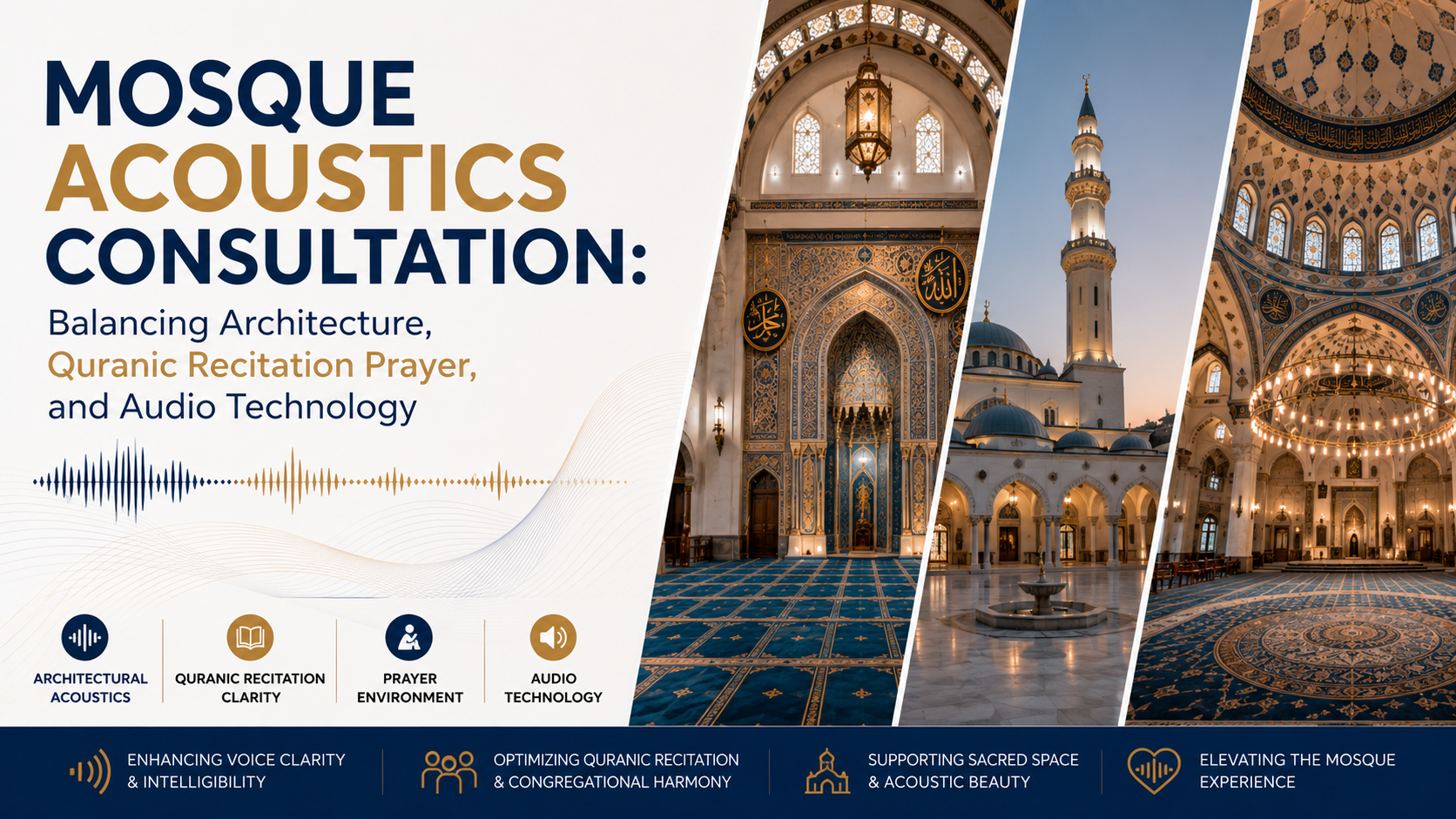
Mosque Acoustics
Balancing Quranic Recitation, Prayer, and Modern Technology


Selected Project Applications
The following examples describe how the framework informed design decisions in three different worship contexts. They explain project intent and strategy; claims of measured or post-occupancy improvement should be added only where corresponding records are available.
Jakarta Cathedral: communication without erasing reverberant identity
Jakarta Cathedral presented a familiar but complex question: how could spoken liturgy and scripture be supported without treating the building’s reverberant Neo-Gothic character as a defect to be removed?
Its large volume, reflective surfaces, vertical proportions, choir, and organ traditions contribute to an acoustic identity associated with Catholic worship. At the same time, sermons, readings, and liturgical communication require intelligible direct sound at congregation locations.
ALTA Integra’s design approach focused on electroacoustic coordination rather than simply increasing loudspeaker quantity. Loudspeaker selection, placement, orientation, coverage, delay, and signal alignment were considered in relation to the cathedral’s geometry and visual character. The intent was to provide clearer, more controlled direct sound while limiting overlapping coverage and unnecessary visual intrusion.
This approach illustrates an important principle: preservation and intelligibility are not automatically opposing goals. They can be addressed as a coordinated design problem when natural room response, reinforcement, heritage, and sightlines are considered together. Any published performance claim should nevertheless distinguish design prediction from commissioning measurement and congregation feedback.
Jakarta Floating Mosque, Ancol: worship within an open environmental context
The Jakarta Floating Mosque in Ancol required a different acoustic response. Its relationship to the waterfront, open circulation, exposed materials, weather, and environmental sound meant that the acoustic brief could not be developed as though the worship space were a sealed auditorium.
In this context, wind, water, nearby activity, and changing background conditions form part of the site experience, but they may also mask speech or recitation. The design strategy therefore treated the waterfront soundscape as a condition to be understood rather than either romanticized or eliminated.
ALTA Integra’s electroacoustic approach was developed to support Quranic recitation, prayer, and spoken communication while remaining coordinated with the architecture and variable environmental conditions. Loudspeaker distribution, directivity, level, timing, and visual integration were considered as part of the spatial experience. Where the term “immersive audio” is used, it should refer to a clearly defined reproduction, coverage, or spatial-design strategy rather than a general promise of emotional immersion.
The project demonstrates how Sacred Acoustic Design can extend beyond the interior room response. In open or semi-open worship environments, meaningful design depends on the relationship among architecture, reinforcement, weather, environmental sound, operation, and place.
Yayasan Borobudur Medan: differentiated criteria across a Buddhist campus
The Yayasan Borobudur complex in Medan includes multiple teaching and prayer environments within one Buddhist campus. Its design challenge was not to impose one acoustic solution across all spaces, but to understand how the function of each hall changed the brief.
Spaces used primarily for Dharma teaching may prioritize speech intelligibility and controlled background noise. Halls supporting chanting or ceremonial activities may require a different balance of resonance, warmth, clarity, and collective participation. Meditation-related use may place greater emphasis on building-services noise, external intrusion, subtle sound, and acoustic calm.
ALTA Integra’s approach considered room volume, geometry, materials, reverberation, source and congregation positions, and electroacoustic requirements for each hall. The resulting design strategies were differentiated according to intended use rather than copied from one room to another.
This example expresses the core principle of the framework: a religious label does not determine an acoustic solution. The design must respond to the particular ritual, activity, space, and community.
What a Sacred Acoustic Design Consultation May Include
Depending on the project stage, worship program, building type, and technical requirements, a consultation may include:
Review of worship tradition, ritual sequence, congregation behavior, music, recitation, speech, and contemplative requirements
Stakeholder workshops with project leaders, architects, ritual representatives, musicians, operators, and audiovisual teams
Assessment of environmental noise, sound isolation, building-services noise, and vibration risk
Development of project-specific room-acoustic and electroacoustic criteria
Review of room form, volume, geometry, materials, and surface treatments
Acoustic calculations, simulations, and auralization where appropriate
Sound-reinforcement, assistive-listening, recording, streaming, and audiovisual-system coordination
Design reviews during architectural and interior development
Construction-stage inspections and technical coordination
Acoustic measurements, sound-system commissioning, and post-occupancy evaluation
The scope should be proportionate to the project. A preliminary review may identify principal risks, information gaps, and the minimum analysis required. A full engagement can carry the acoustic strategy from stakeholder briefing and design criteria through construction, commissioning, and evaluation.
Sound as Part of Worship Architecture
Sacred architecture is shaped not only by what people see, but also by what they hear, understand, perform, remember, and share.
Technical performance remains essential. Speech must be evaluated where speech matters. Noise must be controlled where it disrupts prayer, teaching, recording, or contemplation. Room response must be shaped in relation to music, recitation, chanting, participation, and occupancy. Electroacoustic systems must be coordinated with the architecture and operated reliably.
But no single acoustic metric can define whether a worship space is appropriate. Measurements and simulations establish physical performance. Listening and user evaluation reveal perception. Engagement with the religious community establishes ritual and cultural relevance.
Sacred Acoustic Design brings these forms of knowledge together. Its goal is not to engineer spirituality. Its goal is to help project teams create acoustic environments that are technically responsible, culturally attentive, accessible, and aligned with the worship life they are intended to support.
About the Author
Herwin Gunawan is Principal Consultant of ALTA Integra and an Architectural Building Physics and Technology Consultant specializing in acoustics, lighting, audiovisual systems, passive design, smart-building integration, and human-centered environmental performance. His work examines how technical building performance can be integrated with architecture, operation, perception, and human experience.
References
Abdou, A. A. (2003). Measurement of acoustical characteristics of mosques in Saudi Arabia. The Journal of the Acoustical Society of America, 113(3), 1505–1517.
Carvalho, A. P. O., Morgado, A. E. J., & Henrique, L. (1997). Relationships between subjective and objective acoustical measures in churches. Building Acoustics, 4(1), 1–20.
International Electrotechnical Commission. (2020). IEC 60268-16:2020, Sound system equipment—Part 16: Objective rating of speech intelligibility by speech transmission index.
International Organization for Standardization. (2009). ISO 3382-1:2009, Acoustics—Measurement of room acoustic parameters—Part 1: Performance spaces.
International Organization for Standardization. (2014). ISO 12913-1:2014, Acoustics—Soundscape—Part 1: Definition and conceptual framework.
International Organization for Standardization. (2018). ISO/TS 12913-2:2018, Acoustics—Soundscape—Part 2: Data collection and reporting requirements.
International Organization for Standardization. (2025). ISO/TS 12913-3:2025, Acoustics—Soundscape—Part 3: Data analysis.
Ismail, M. R. (2013). A parametric investigation of the acoustical performance of contemporary mosques. Frontiers of Architectural Research, 2(1), 30–41.
Jeon, J. Y., Hwang, I. H., & Hong, J. Y. (2014). Soundscape evaluation in a Catholic cathedral and Buddhist temple precincts through social surveys and soundwalks. The Journal of the Acoustical Society of America, 135(4), 1863–1874.
Manohare, M., Dongre, A., & Wahurwagh, A. (2017). Acoustic characterization of the Buddhist temple of Deekshabhoomi in Nagpur, India. Building Acoustics, 24(3), 193–215.
Martellotta, F. (2008). Subjective study of preferred listening conditions in Italian Catholic churches. Journal of Sound and Vibration, 317(1–2), 378–399.
Soeta, Y., Ito, K., Shimokura, R., Sato, S., Ohsawa, T., & Ando, Y. (2012). Effects of sound source location and direction on acoustic parameters in Japanese churches. The Journal of the Acoustical Society of America, 131(2), 1206–1220.
Zamarreño, T., Girón, S., & Galindo, M. (2008). Assessing the intelligibility of speech and singing in Mudejar-Gothic churches. Applied Acoustics, 69(3), 242–254.