A guide for building owners, developers and project teams planning offices, auditoriums, education facilities, hospitality venues and other technology-rich spaces.
Table of Contents
Introduction: AV Is Now Part of the Building
The Project Team at a Glance
The AV Consultant: Role and Responsibilities
The AV Integrator: Role and Responsibilities
Side by Side: Consultant vs Integrator
How AV Coordinates with Every Other Discipline
Choosing the Right Delivery Model
Seven Common Pitfalls (and How to Avoid Them)
How ALTA Integra Works on Your Project
Frequently Asked Questions
Closing Thoughts and References
Introduction: AV Is Now Part of the Building
Picture three scenes that happen far too often.
A new boardroom opens. Afternoon sunlight hits the main display, and the CFO's spreadsheet becomes unreadable. In an auditorium, a 400-seat hall that cost billions of rupiah to build, the audience in the back rows can't follow the speaker. In a video-conference room, remote participants keep asking people to repeat themselves because the air-conditioning diffuser sits right above the ceiling microphone.
None of these is an equipment failure. The display, the loudspeakers and the microphone may all be excellent products. Each one is a coordination failure: a decision the architect, interior designer, MEP consultant, contractor and AV team should have made together, early, and didn't.
AV used to be something you bought once the building was finished: a projector on a trolley, a pair of speakers on the wall. Today's audiovisual systems are built into the architecture. They depend on ceiling heights and sightlines, room acoustics, lighting, clean power, cooling, structural support, cable pathways and the IT network. Increasingly they are also how organisations work: hybrid meetings, training, events, digital signage and building-wide communication.
That's why one question comes up again and again from new clients:
"I already have an architect, an MEP consultant and a main contractor. So who is actually responsible for making the AV work?"
The answer is that responsibility is shared, but it shouldn't be vague. This article explains the roles of the AV consultant and the AV integrator, how they work alongside the rest of the project team, where the critical coordination points are, and how to choose the delivery model that fits your project.
The Project Team at a Glance
Before looking at AV specifically, it helps to see the whole team. On a typical building project, participants fall into four groups.
The Owner Team
This is the organisation buying and ultimately using the building and its systems. It may include:
End-users, in two kinds. Technical end-users, such as the IT or AV team, operate, maintain and support the systems. Non-technical end-users are the presenters, teachers, executives and meeting participants the systems exist for.
Facility manager, who cares about space standards, cabling standards, maintenance and keeping operations running.
IT/AV manager, who often sets the organisation's technology standards and is usually the AV team's most important point of contact.
Building committee, on larger or multi-department projects. We strongly recommend a small technical sub-committee so IT, AV and facilities speak with one voice.
Procurement, which manages tenders, contracts and payments.
The Design Team
This group turns the owner's requirements into drawings and specifications:
Architect
Interior designer
Mechanical, electrical and plumbing (MEP) consultants
Structural engineer
Lighting consultant
Acoustic consultant
IT/ICT consultant
Security consultant
Fire and life safety consultant
AV system design consultant
The Construction Team
This group builds and installs what the design team documented:
Main contractor
MEP contractor and other specialist subcontractors
Joinery, millwork and furniture contractors
AV System Integrator (sometimes called the AV contractor)
AV control system programmer, often part of the integrator's team
The Management Team
These are the professionals who manage the project on the owner's behalf:
Developer
Project manager or construction manager (in Indonesia often a PMC or Manajemen Konstruksi, MK)
Building management
Others Who Shape the Outcome
Telecom and internet providers, whose lines and services must be active in time for testing video conferencing and remote monitoring.
Commissioning agents, increasingly appointed to verify building systems.
Local authorities, who review designs and inspect the building through the permitting process, from building approval (PBG) to the certificate of fitness for use (SLF).
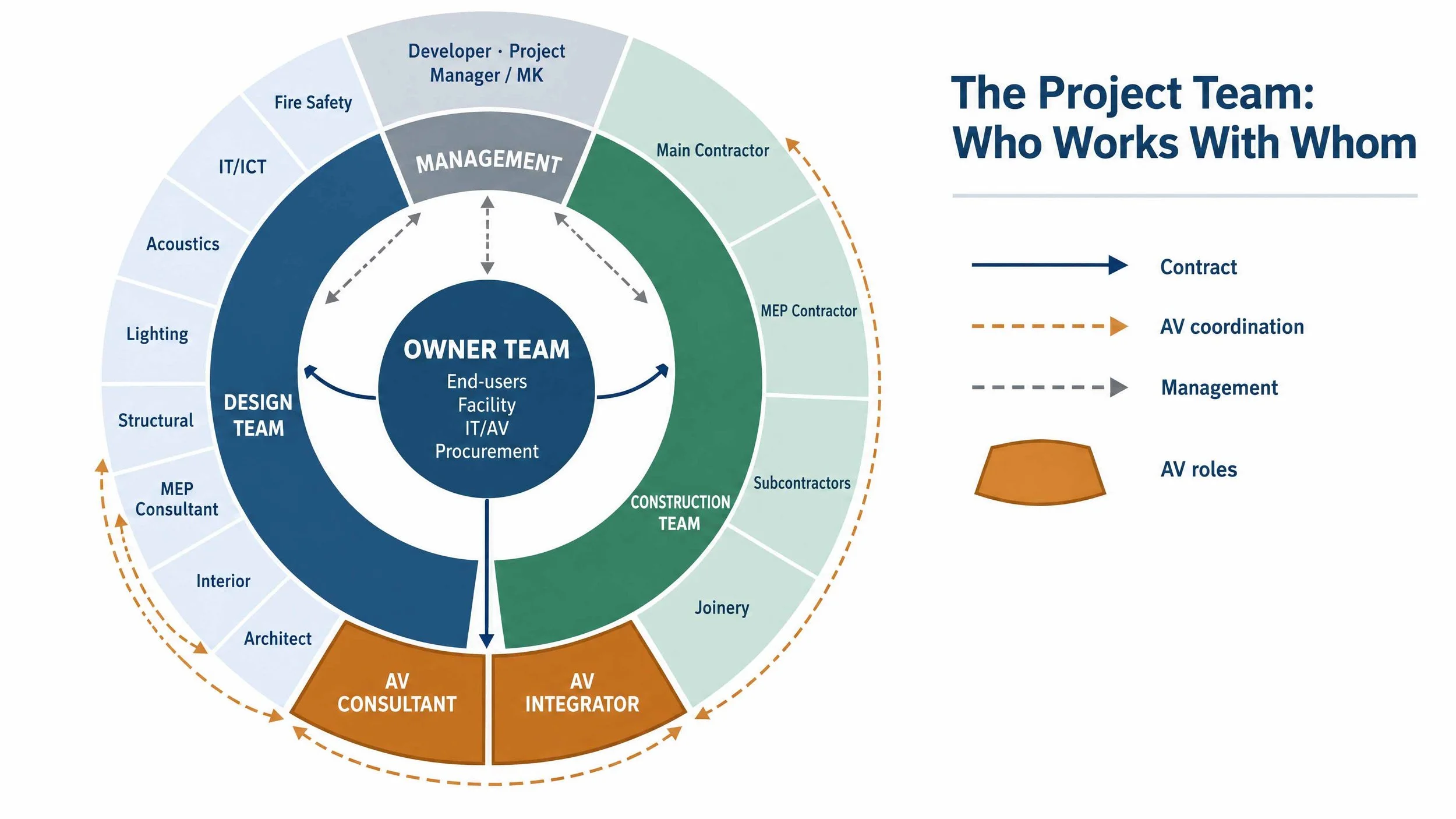
The key point is that AV touches almost every one of these parties. That's why AV needs a clearly defined owner on the design side and a clearly defined owner on the installation side.
The AV Consultant: Role and Responsibilities
What an Independent AV Consultant Is
An independent AV consultant works much like your mechanical or electrical engineer. They analyse needs, design systems, write specifications and oversee installation, but they don't sell or install equipment. Their fee is for professional services, not for equipment margin.
That independence is the main value. The consultant represents the owner's technical interests, recommends solutions based on performance rather than sales targets, and gives you a fair basis for tendering the installation competitively.
Responsibilities Through the Project Lifecycle
Briefing and needs analysis. The consultant starts by understanding how people will actually use the spaces. That means interviews with end-users and the IT team, a review of existing systems and standards, and a room-by-room functional brief: what each space must do, for how many people, and how it should feel to use.
Concept and schematic design. Once the needs are clear, the consultant translates them into what the building needs: room sizes and proportions, ceiling heights, viewing distances and sightlines, space for control rooms, equipment rooms and projection booths, and an early AV budget. These decisions shape the architecture, so they have to arrive while the architecture can still change.
Design development. At this stage the consultant feeds AV infrastructure requirements into the architect's and engineers' drawings: conduit and cable containment, floor boxes and back boxes, power, data outlets, cooling for equipment, and structural loads and fixing points. This is the "invisible" part of AV, and it's the part that's hardest to fix later.
Detailed design and tender. The consultant produces the full system design: signal-flow schematics, equipment layouts, rack elevations, performance specifications, a bill of quantities and a cost estimate. Specifications are performance-based and list equivalent products, so several qualified integrators can compete fairly. The consultant then helps evaluate tenders, checking not just price but technical compliance and the integrator's capability.
Construction. Once an integrator is appointed, the consultant becomes the owner's technical eyes on site. They review shop drawings and material submittals, answer technical queries, and inspect infrastructure at the right moments. Back boxes and conduits, for example, must be checked before walls are boarded.
Testing, commissioning and handover. At the end, the consultant verifies that the installed system performs as designed, using a structured verification process such as ANSI/AVIXA 10:2013 (Audiovisual Systems Performance Verification). They issue punch lists, witness user and technical training, and review as-built documentation before handover.
The Standards Behind Our Designs
Good AV design is measurable. Instead of relying on personal preference or a manufacturer’s recommendations, an independent AV consultant designs to recognised national and international standards. These define how large a display should be for its audience, how evenly sound should reach every seat, how cabling and pathways are installed and labelled, and how a finished system is verified before handover. Designing to standards gives the owner clear performance criteria in the contract, a fair basis for comparing integrator tenders, and an objective benchmark to test against at commissioning. ALTA Integra designs to the current edition of each standard below across four areas: building electrical, audiovisual, information and communication technology, and inclusive design.
ALTA Integra's audiovisual and ICT designs are developed with reference to the following national and international standards and guidelines, using the current edition of each at the time of design.
ABuilding Electrical
| SNI 04-0227-1994 | Standard Voltages |
|---|---|
| SNI 0225:2020 (PUIL 2020) | General Requirements for Electrical InstallationsSupersedes PUIL 2000 and PUIL 2011 |
| IEEE C2-2023 | National Electrical Safety Code (NESC) |
| IEEE 3003 Series | Recommended Practices for Grounding of Industrial and Commercial Power SystemsSuccessor to IEEE Std 142 (“Green Book”) |
| ANSI/TIA-607-E | Generic Telecommunications Bonding and Grounding (Earthing) for Customer Premises |
BAudiovisual
| AVIXA S601.01:2021 | Energy Management for Audiovisual SystemsFormerly ANSI/INFOCOMM 4:2012 |
|---|---|
| ANSI/AVIXA V201.01:2021 | Image System Contrast Ratio (projected and direct-view displays)Supersedes ANSI/INFOCOMM 3M-2011 and V201.01:2015 |
| ANSI/AVIXA D402.02:2013 (R2024) | Audiovisual Systems Performance VerificationFormerly ANSI/INFOCOMM 10:2013 |
| ANSI/AVIXA V202.01 | Display Image Size for 2D Content in Audiovisual Systems (DISCAS) |
| ANSI/AVIXA A102.01:2022 | Audio Coverage Uniformity in Listener Areas |
| ANSI/AVIXA D401.01:2023 | Documentation Requirements for Audiovisual SystemsFormerly INFOCOMM 2M-2010 |
| ANSI/BICSI 001-2017 | Information and Communication Technology Systems Design and Implementation Best Practices for Educational Institutions and Facilities |
CInformation and Communication Technology
| ANSI/TIA-568.0-E | Generic Telecommunications Cabling for Customer Premises |
|---|---|
| ANSI/TIA-568.1-E | Commercial Building Telecommunications Infrastructure Standard |
| ANSI/TIA-568.2-E | Balanced Twisted-Pair Telecommunications Cabling and Components Standard |
| ANSI/TIA-568.3-E | Optical Fiber Cabling and Components Standard |
| ANSI/TIA-568.4-D | Broadband Coaxial Cabling and Components Standard |
| ANSI/TIA-569-E | Telecommunications Pathways and Spaces |
| ANSI/TIA-598-D | Optical Fiber Cable Color Coding |
| ANSI/TIA-606-D | Administration Standard for Telecommunications Infrastructure |
| ANSI/TIA-758-B | Customer-Owned Outside Plant Telecommunications Infrastructure Standard |
| ANSI/TIA-526-7-A | Measurement of Optical Power Loss of Installed Single-Mode Fiber Cable Plant |
| ANSI/TIA-526-14-C | Optical Power Loss Measurement of Installed Multimode Fiber Cable Plant |
| ASHRAE TC 9.9 (5th Ed., 2021) | Thermal Guidelines for Data Processing Environments |
DInclusive Design
| CBC 2025, Section 11B-706 | California Building Code: Assistive Listening Systems |
|---|---|
| ADA (2010 Standards) | Americans with Disabilities Act: 2010 ADA Standards for Accessible Design |
InfoComm International is now AVIXA (Audiovisual and Integrated Experience Association); legacy ANSI/INFOCOMM standards have been redesignated under AVIXA.
Where projects pursue WELL or GREENSHIP certification, acoustic performance criteria also come into play. Coordinating these early keeps the AV, acoustic and sustainability goals aligned rather than in conflict.
The Integrated Advantage
AV performance depends on more than AV equipment. A loudspeaker can only be as intelligible as the room's acoustics allow. A camera can only be as good as the lighting on the participants' faces. A streaming system can only be as reliable as the network behind it.
When acoustics, lighting, IT and AV are designed by separate parties, every interface between them is a possible gap. When one integrated consultant designs them together, those interfaces become internal decisions, resolved before they ever reach the client or the contractor.
The AV Integrator: Role and Responsibilities
If the consultant is the designer and owner's representative, the AV integrator is the builder. The integrator turns the design into a working system.
Core Responsibilities
Supply, installation and configuration. The integrator supplies and installs all AV equipment: displays and LED walls, projectors and screens, loudspeakers and amplifiers, microphones and digital signal processors, cameras, conferencing platforms (such as Microsoft Teams Rooms or Zoom Rooms), wireless presentation systems, and control systems.
Dedicated AV cabling. The integrator pulls, terminates, tests and labels the AV-specific cabling (audio, video, control and loudspeaker cables) and builds and wires the equipment racks.
Control programming and user interface. Modern AV systems are run through touch panels, keypads or software interfaces. The programmer writes the logic behind every button, from "start meeting" to automatic shutdown and remote monitoring alerts. This is critical work. A technically perfect system with a confusing interface will be underused, worked around or abandoned. A good integrator treats interface design as seriously as hardware.
Shop drawings, submittals and mock-ups. Before installation, the integrator prepares detailed shop drawings and submits equipment data, samples and sometimes mock-ups for review by the consultant and the owner.
Site coordination and sequencing. AV installation depends heavily on timing. Cables need to be pulled while ceilings are still open. Built-in items such as screen boxes, projector mounts, loudspeaker brackets and flush-mounted back boxes often have to reach the main contractor early so other trades can install them. Delicate electronics need to arrive late and be stored somewhere clean, dry and secure, away from construction dust.
Network integration. As AV moves onto the network (AV-over-IP, cloud-managed devices, remote monitoring), the integrator works with the client's IT team on network configuration, VLANs, quality-of-service settings and cybersecurity requirements.
Testing, documentation, training and support. At completion, the integrator tests and commissions the system, provides as-built drawings and operation and maintenance manuals, trains users and technical staff, and supports the system under warranty and, ideally, a service agreement.
When Integrators Also Design
In a design-build arrangement, the integrator's own design team does the design work a consultant would otherwise do. This can work very well for simpler or faster projects. The single point of responsibility is attractive, and integrators bring strong hands-on product knowledge.
The question to ask is whether the integrator has the expertise and time for the building infrastructure side of design: acoustics, lighting coordination, space planning, structural and MEP coordination. That work is often needed one or two years before any equipment is sold. Some integrators are well set up for it; many are not.
AV Consultant vs AV Integrator Comparison Tables
The AV consultant and the AV integrator are both essential to a successful AV project, but they play very different parts. One defines what the building and its systems must achieve and protects the owner’s interests. The other turns that design into a working, warranted installation. The table below compares the two roles across what matters most to a client: when each is appointed, who they answer to, how they are paid, what they deliver, and what they are ultimately accountable for.
| Aspect | AV Consultant | AV Integrator |
|---|---|---|
| Core role | Designs the system and represents the owner’s technical interests | Supplies, installs, programs and commissions the system |
| When appointed | Early: briefing or concept stage | After tender, typically mid-construction (earlier in design-build) |
| Typically contracted to | The owner (common in Indonesia) or the architect | The main contractor, or directly to the owner |
| How they are paid | Professional fee | Equipment, labour and installation contract |
| Key deliverables | Needs analysis, infrastructure requirements, design drawings, specifications, BOQ, tender evaluation, site reviews, verification reports | Shop drawings, installed system, programming, test results, as-builts, O&M manuals, training, warranty |
| Independence | Vendor-neutral, sells no equipment | Brand partnerships and supply relationships |
| Responsible for | Design adequacy and performance criteria | Installation quality, workmanship and equipment warranty |
Knowing what each role is responsible for is only half the picture. The other half is knowing when each party steps in and how responsibility shifts as the project moves from briefing to handover. The matrix below maps every key stage against the six main parties, showing who does the work (Responsible), who approves it (Accountable), who gives input (Consulted), and who is kept informed (Informed). Notice how the AV consultant leads the early design stages, while the AV integrator takes over once installation begins. Both meet at testing and commissioning: one verifies, the other performs.
| Stage | Owner | Architect | MEP Consultant | Main Contractor | AV Consultant | AV Integrator |
|---|---|---|---|---|---|---|
| Needs analysis and AV brief | A | C | I | – | R | – |
| AV space and sightline requirements | A | R | C | – | R | – |
| AV infrastructure (power, containment, cooling) | I | C | R | – | R | – |
| AV system design and specification | A | I | C | – | R | – |
| Tender and integrator selection | A | C | – | C | R | – |
| Infrastructure installation | I | I | C | R | C | C |
| Shop drawings and submittals | I | I | C | C | A | R |
| AV equipment installation and programming | I | – | – | C | C | R |
| Testing and commissioning | A | I | C | C | R (verify) | R (perform) |
| Training and handover | A | – | – | C | C | R |
The AV consultant and the AV integrator are complementary, not competing. The consultant makes sure the right system is designed and that the building can support it. The integrator makes sure it is built, programmed and delivered properly. On complex projects you need both roles filled well, and each one clearly defined in the contracts.
How AV Coordinates with Every Other Discipline
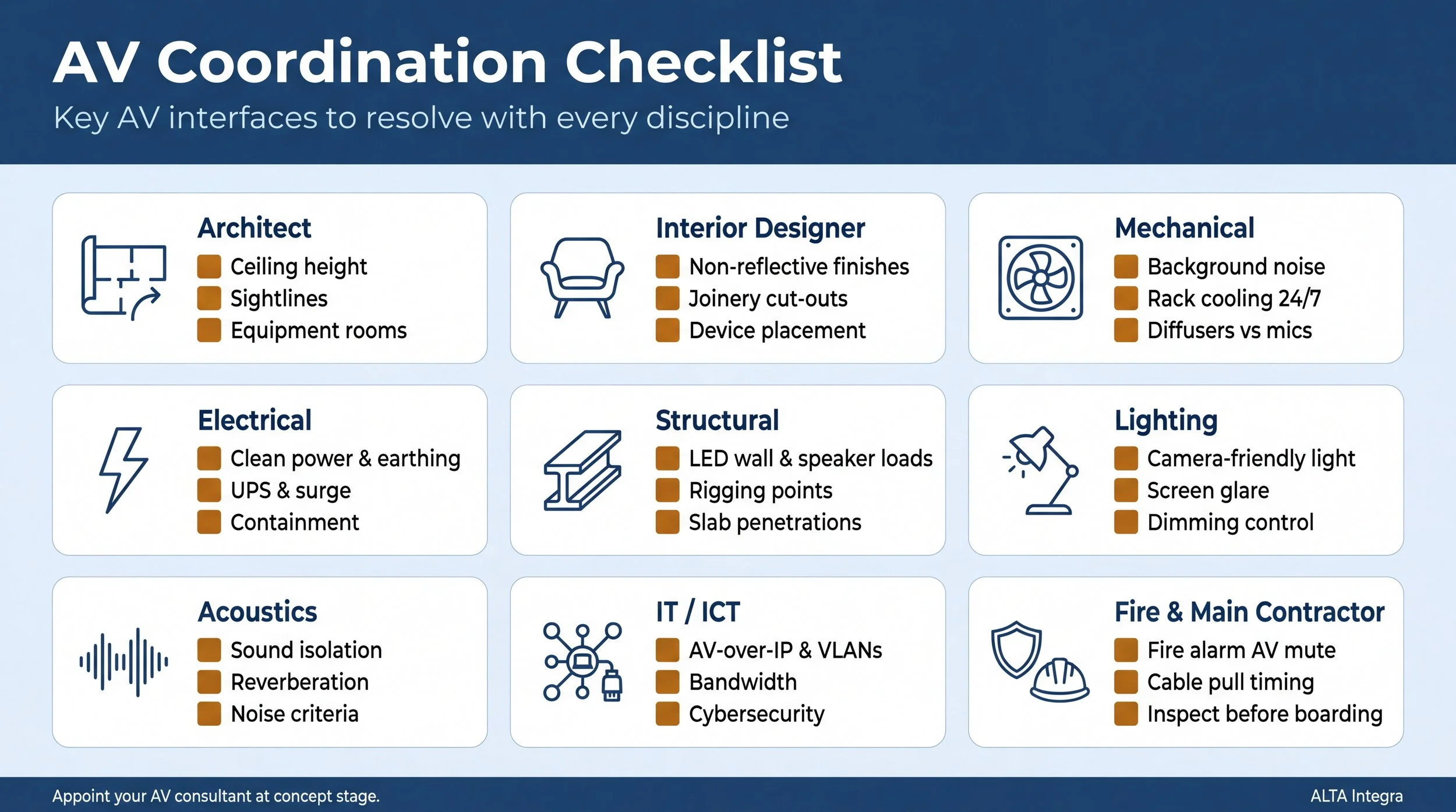
This is where most AV projects succeed or fail. Below are the key interfaces between AV and each discipline, with what goes wrong when they're missed.
Architect
What AV needs: suitable room proportions, enough ceiling height, clear sightlines, and space for control rooms, equipment rooms, projection booths and risers.
What the architect needs from AV: early, firm requirements, especially for large venues where image size and viewing angles may affect floor-to-floor height or even the overall building height.
If missed: displays too small for the room, columns blocking views, no space for equipment, and costly redesign after the structure is fixed.
Interior Designer
What AV needs: finishes that support good acoustics and visibility, and joinery and furniture designed to hold devices: cut-outs, cable ports, ventilation and access for maintenance.
What the interior designer needs from AV: exact device sizes, locations and mounting details, plus guidance on how to blend technology into the design without compromising performance.
If missed: glossy surfaces reflecting light onto screens, hard finishes making rooms echo, beautiful custom tables with no way to route cables, and visible devices that spoil the design intent.
Mechanical (HVAC)
What AV needs: low background noise in critical rooms, adequate cooling for equipment racks (often 24/7), and diffusers placed away from microphones and projectors.
What the mechanical engineer needs from AV: equipment heat loads, operating hours and room noise criteria.
If missed: noisy rooms that make conference calls tiring, overheating racks that shorten equipment life, and air turbulence affecting microphones.
Electrical
What AV needs: dedicated clean power, proper earthing (and isolated earthing where specified), surge protection, UPS for critical systems, correctly placed outlets, and containment and cable trays for low-voltage cabling.
What the electrical engineer needs from AV: power loads, outlet schedules, containment routes and reliability requirements.
If missed: hum and buzz in the audio, damage from power surges, systems that shut down during short outages, and nowhere to run AV cables.
Structural
What AV needs: capacity and fixing points for heavy elements such as LED walls, loudspeaker arrays, projectors, motorised screens and lifts, and approved penetrations through slabs and walls.
What the structural engineer needs from AV: equipment weights, dynamic loads and fixing locations.
If missed: expensive secondary steel added late, restricted equipment positions, or safety concerns.
Lighting
What AV needs: good facial lighting for cameras, controlled light on display and projection surfaces, suitable colour temperature, and integration of dimming, scenes and motorised blinds into the AV control system.
What the lighting designer needs from AV: display and camera positions, presentation modes and control interface requirements.
If missed: washed-out projection, poorly lit participants on video calls, and users juggling separate control panels for lights and AV.
Acoustics
What AV needs: suitable sound isolation between rooms, controlled reverberation, and background noise levels appropriate to each space.
What the acoustic consultant needs from AV: room functions, loudspeaker and microphone strategies, and equipment noise sources.
If missed: poor speech intelligibility, confidential discussions overheard next door, and sound systems working against the room instead of with it.
On projects targeting WELL or GREENSHIP certification, acoustic criteria add another reason to coordinate early. At ALTA Integra, AV and acoustics are designed by the same team.
IT and ICT
What AV needs: network capacity and architecture for AV-over-IP, VLANs and quality-of-service settings, fibre backbone, internet access for cloud services and remote monitoring, and Wi-Fi capacity for wireless presentation.
What the IT team needs from AV: device counts, bandwidth requirements, ports and protocols, and security requirements.
If missed: video that stutters, devices blocked by firewall policies, and conferencing systems that can't connect on handover day.
Security, Fire and Life Safety
What AV needs: coordination of public address and voice evacuation interfaces, automatic muting of AV audio when the fire alarm activates, and alignment where cameras, microphones, intercoms or displays cross over with security systems.
What the life safety consultant needs from AV: system locations, audio zones and interface points.
If missed: emergency announcements drowned out by programme audio, which is a serious safety and compliance issue, especially in assembly spaces.
Main Contractor
What AV needs: a realistic place in the master schedule, timely site access, early installation of built-in items, inspections at the right time, and clean, secure areas for equipment.
What the main contractor needs from AV: a clear list of AV-related items to install, delivery dates, and the integrator's installation programme.
If missed: ceilings closed before cables are pulled, back boxes buried in walls before inspection, damaged equipment, and late, rushed commissioning.
Choosing the Right Delivery Model
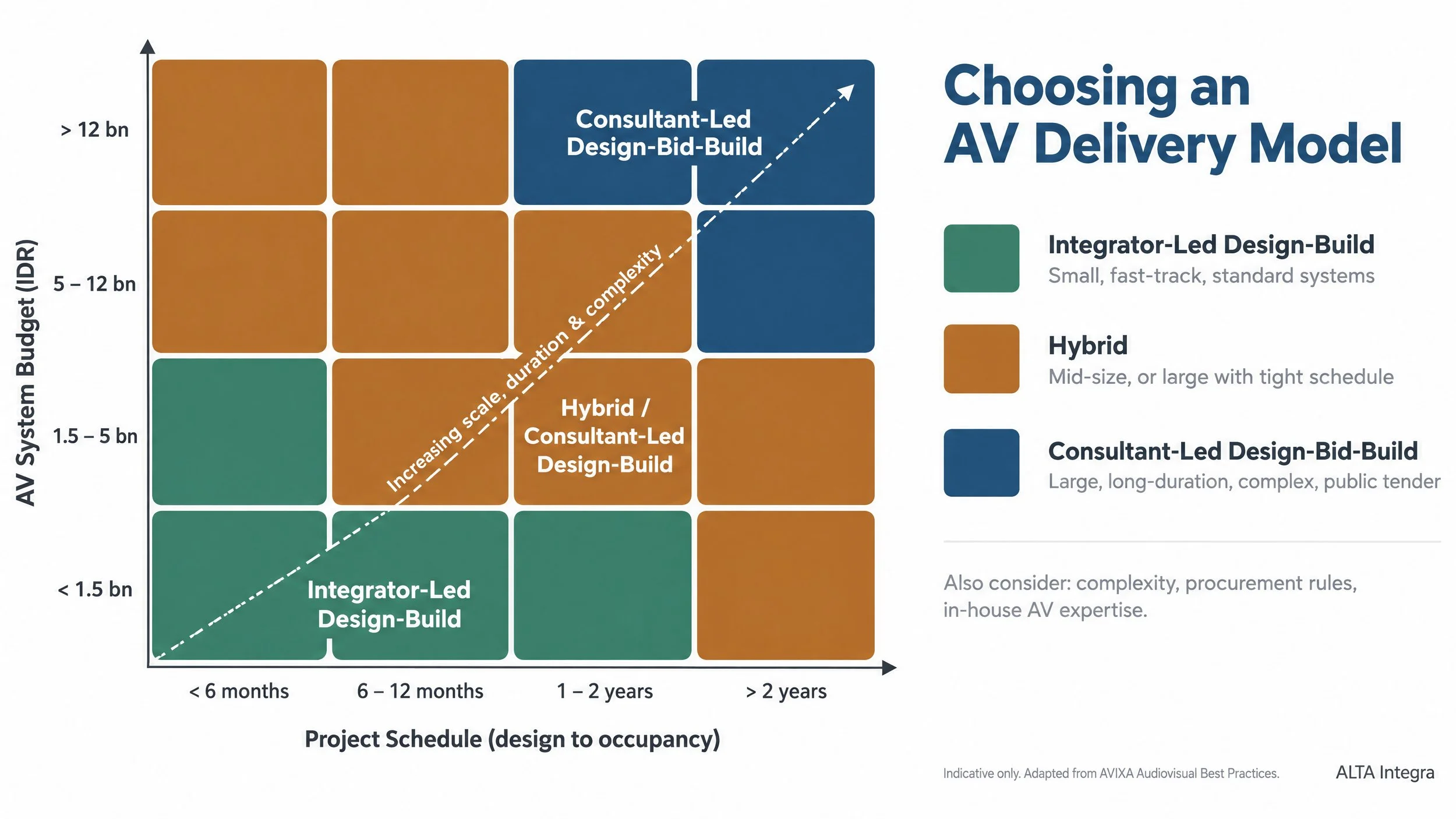
How you procure AV services is, according to industry best practice, the single most important decision in an AV project. There are two main models and several variations.
Model 1: Consultant-Led Design-Bid-Build
An independent AV consultant designs the infrastructure and systems as part of the design team. The installation is then tendered to qualified integrators, and the consultant oversees construction and commissioning as the owner's technical representative.
Best for: large new buildings, long schedules, complex or unusual systems, and projects that require competitive tendering, such as government, state-owned enterprise and many institutional projects.
Pros:
Independent technical representation for the owner throughout
Deep coordination with the architectural and engineering team
Continuity from briefing through commissioning
Competitive tendering for equipment and installation
Cons:
Longer process, less suited to small or fast-track projects
Depending on contracts, responsibility for design and installation sits with different parties
Key risk: the quality of every party matters. One weak consultant, integrator or contractor puts strain on the whole process.
Model 2: Integrator-Led Design-Build
One AV integrator handles both design and installation.
Best for: smaller projects, fast-track schedules, standard technology, and owners with a trusted integrator relationship and in-house technical knowledge.
Pros:
Single point of responsibility
Final costs established earlier
Strong practical product knowledge
Faster delivery
Cons:
More owner involvement needed to check designs and costs
Designs may lean toward the brands the integrator sells
Key risk: many integrators are set up for short project cycles and may not have the time or expertise for infrastructure design during the base-building design stages of a large project.
Hybrid and Alternative Models
Consultant-led design-build: an independent consultant handles needs analysis, infrastructure requirements and oversight, while the integrator develops detailed designs and installs. It's flexible, works for many project sizes, and adds independent quality control to fast-track projects.
Consultant and integrator team: the two form a joint team, contracted as one entity but keeping distinct roles.
Owner-furnished equipment: the owner buys equipment directly, either to reuse existing systems or for budget reasons, and an integrator or in-house team installs it. Useful in specific cases, but it can complicate warranties and design integrity.
What Should Drive Your Choice?
Schedule: how long from design start to occupancy?
AV budget: how large is the AV investment?
Complexity: standard rooms, or unique, mission-critical spaces?
Procurement rules: does your organisation require competitive tendering?
In-house expertise: do you have experienced AV or IT staff to evaluate designs and manage an integrator?
As a rough guide, adapted from industry practice:
Smaller AV budgets with short schedules usually suit integrator-led design-build.
Larger AV budgets with design-and-construction periods of more than six months to two years usually suit consultant-led design-bid-build.
Projects in between need a careful look at complexity, schedule and in-house capability. This is often where hybrid models work best.
A Note on the Indonesian Context
Two local practices deserve attention:
AV consultants are usually appointed directly by the owner rather than as sub-consultants to the architect. This can work well, as long as the consultant's scope and coordination duties with the architect and MEP consultants are clearly written into the contracts.
AV is often bundled into the ME contractor's package. It may look simpler on paper, but it frequently causes problems: AV becomes a low-priority sub-subcontract, coordination lines get longer, and accountability blurs. We recommend tendering AV as a separate package, or at least as a nominated subcontract with direct lines of communication to the consultant and owner.
Seven Common Pitfalls (and How to Avoid Them)
1. Bringing AV in too late.
By the time many owners think about AV, ceiling heights, room layouts and structure are already fixed. Avoid it: appoint your AV consultant at the concept or schematic stage, alongside the MEP and acoustic consultants.
2. Treating AV as furniture or loose equipment.
Putting permanently installed AV under the FF&E (furniture, fixtures and equipment) budget often leaves it underfunded and treated as an afterthought. Avoid it: treat integrated AV systems as part of the capital building budget, like electrical or fire systems. Keep only portable equipment under FF&E.
3. Burying the AV integrator under the ME contractor.
When the integrator is a sub-subcontractor, communication slows and responsibility gets unclear. Avoid it: contract the integrator directly with the owner or main contractor, with clear communication lines to the AV consultant.
4. Specifying equipment too early.
Large projects can take years, and AV technology moves fast. Equipment specified at the start may be obsolete or discontinued by installation. Avoid it: design infrastructure early, and finalise the electronics specification as late as the schedule safely allows.
5. "Shopping" one integrator's design.
Taking a design developed by one integrator under design-build and sending it to competitors for pricing undermines trust and the process. Avoid it: decide your procurement model at the start. If you want competitive tendering, use a consultant-led approach.
6. Forgetting about operations.
Many sophisticated systems underperform because the organisation hasn't planned for operators, training or support. Avoid it: budget for user and technical training, support staff or outsourced support, and a maintenance agreement from day one.
7. Commissioning without clear performance criteria.
Without measurable targets, "done" becomes a matter of opinion. Avoid it: define performance criteria in the design stage (image size, audio coverage, background noise, system functions) and verify against them at handover.
How ALTA Integra Works on Your Project
Since 2010, ALTA Integra has worked as a multi-discipline building physics and technology consultancy, with more than 200 projects delivered across Southeast Asia and internationally, alongside architecture practices from local studios to global firms.
What sets our approach apart is integration. Our services cover audiovisual system design, acoustics and noise control, specialist lighting design, building IT, passive design, and LEED/WELL certification support. In practice, that means:
Fewer handoffs, fewer gaps. Interfaces between AV, acoustics, lighting and IT are resolved inside our team before they reach your architect or contractor.
Independent advice. We don't sell equipment. Our recommendations are based on your needs and on performance.
Full-lifecycle support. From the first briefing workshop to tender evaluation, site reviews, verification and training.
Speaking the design team's language. We work naturally within the architectural process, so AV requirements arrive in the right format at the right time.
Case Study: Nusantara International Convention Exhibition (NICE) PIK 2, Jakarta
NICE PIK 2 is described as Indonesia’s largest and most modern MICE venue, with 130,000 m² of event space on a site of more than 40 hectares in Jakarta’s Pantai Indah Kapuk 2 district. The challenge was to serve public areas, commercial zones and event halls with one unified AV architecture that balances performance, flexibility and ease of operation.
Acting as the independent AV consultant, ALTA Integra designed a building-wide AV-over-IP system that replaces traditional matrix-based routing with network-based distribution. The design provides a network-based AV backbone intended to support flexible routing, future expansion and centralised operation. This approach required early coordination with the venue’s IT network and building infrastructure.
Case Study: Western Sydney University
When Western Sydney University set up its Surabaya campus, it needed learning spaces where students in the room and lecturers teaching remotely from Australia could engage as equals. Common problems in hybrid classrooms were the starting brief: remote lecturers who are hard to hear, content that isn’t visible from every seat, and AV systems installed without proper spatial or acoustic integration.
As the AV consultant, ALTA Integra designed a campus-wide education AV-over-IP system following WSU’s own AV Guidelines and Pedagogy, with Zoom-enabled video conferencing, clear audio capture with even sound coverage, and wireless BYOM presentation. The design works as one flexible system for lectures, discussions and collaborative sessions.
ALTA Integra supported the project from concept design through final commissioning. The system was designed to improve communication between participants in Surabaya and remote lecturers in Australia, supporting lectures, discussions and collaborative learning.
Closing Thoughts and References
Successful AV projects aren't built on the best equipment alone. They're built on clear roles, early involvement and disciplined coordination across the whole project team. When the owner knows who is responsible for what, when the AV consultant and integrator each have a clearly defined scope, and when AV requirements reach the architect and engineers at the right time, the result is a building where technology simply works.
Planning a project with significant AV?
The earlier we're involved, the more value we can add and the more cost we can help you avoid.
Frequently Asked Questions
Do I need an AV consultant if I already have an MEP consultant?
In most cases, yes. MEP consultants design the power, cooling and containment that support AV, but they generally don't design the AV systems or define AV performance requirements. An AV consultant tells the MEP team what the AV needs, and makes sure the systems themselves are right for how your organisation works.
Can the AV integrator design the system for me?
Yes. This is the design-build model, and it suits smaller, faster or standard projects well. For large, complex or long-duration projects, or where you need competitive tendering and independent oversight, a consultant-led approach is usually safer.
When should an AV consultant be appointed?
Ideally at the concept or schematic design stage, alongside the other building consultants. At that point AV requirements can still shape room sizes, ceiling heights and infrastructure without costly redesign.
Who is responsible if the system doesn't perform at handover?
It depends on the contract structure, which is exactly why roles must be defined early. Generally the integrator is responsible for installation quality, workmanship and equipment, and the consultant is responsible for design adequacy and for verifying performance against the agreed criteria. In design-build, the integrator holds both.
Is AV part of the ME contract or a separate package?
In Indonesia, AV is often bundled into the ME package, but we recommend a separate AV package or a nominated subcontract. That keeps accountability clear and lets a specialist integrator work directly with the AV consultant and the owner.
How much does an AV consultant cost?
Consultancy fees depend on project size, complexity and scope of services. Independent design and oversight typically pays for itself by preventing redesign, change orders, over-specification and poorly performing systems. Contact us for a scope-based proposal.
References
AVIXA (formerly InfoComm International / ICIA), Audiovisual Best Practices: The Design and Integration Process for the AV and Construction Industries.
ANSI/AVIXA D401.01:2023, Documentation Requirements for Audiovisual Systems (formerly INFOCOMM 2M-2010).
ANSI/AVIXA D402.02:2013 (R2024), Audiovisual Systems Performance Verification (formerly INFOCOMM 10:2013).
ANSI/AVIXA V202.01:2026, Display Image Size for 2D Content in Audiovisual Systems.
ANSI/AVIXA A102.01:2022, Audio Coverage Uniformity in Listener Areas.
AVIXA F501.01:2015, Cable Labeling for Audiovisual Systems.