Human-Centered Building Performance
Literature Reviews, Research Insights & Evidence-Based Design Frameworks
Explore literature reviews, research insights, and evidence-based design frameworks.
Discover how acoustics, lighting, thermal comfort, indoor air quality, passive design, and smart building technologies work together bridging building physics, environmental psychology, and sustainable design—to create healthier, more comfortable, and higher-performing environments for people.

Acousticians & Audio Engineers on Sound Performance in a Room
What ACOUSTICIANS and AUDIO ENGINEERS said about RELATIONSHIP between ROOM DESIGN and AUDIO PERFORMANCE?
Produce or listening music with a realistic sound performance is a dream of every musicians, sound engineers and music or audio lover.

“Although it has been traditional to consider the loudspeaker and room as separate entities, this approach is no longer justified. The loudspeakers, room and listener comprise a system within which the sounds and spatial illusions of stereo are decoded, and they must be considered together.”


Jan Abildgaard Pedersen, 1994
Bang & Olufsen, DynAudio
Increasing the reverberation time tends to decrease the position sensitivity, especially at higher frequencies. This is, as expected, due to the fact that the sound field becomes more diffuse when the reverberation time increases. The sound pressure amplitude does not depend on the position in a perfectly diffuse sound field.

David Griesinger, 1998
Lexicon
In rooms where low-frequency envelopment is perceptible, low-frequency instruments in classical music are often perceived as external, while Iow-frequencies in popular music are often "in the head". Low-frequency instruments in popular music, such as the kick drum and the bass guitar, are almost always perceived as coming from inside the head.

Avis, Fazenda, Davies, 2007 Salford University
Given the suggestion that the high-frequency reverberation time may help “mask” low-frequency problems.
“Remember, dollar for dollar the acoustical treatment of your room will make more of an audible difference than any piece of electronic hardware, speaker, or cable.”
ALTA Integra is a multi-discipline building physics engineer designer such as acoustics sound, lights, thermal, air quality, and etc. Research agreed that the built environment is affecting the sensor, emotion, behavior, and biology of humans and other living objects. Our mission is to create a greener, healthier, beauty and comfort to lives in.
#acousticsdesign #roomacoustics #sounds #sound #musicstudio #audioroom

Sounds of the City - Between Noise Pollution and Beautiful Soundscape?
“Have you ever wonder, where have all the birds gone? ”
In Jakarta city nowadays we hardly see birds nesting, flying, or looking for food. Some research says that nature soundscape such as the sound of running water, or birds singing will improve mental health. However, due to the increasing noise pollution, the sound of birds became the sound of machinery.

Loud sound can have a serious impact on human health as well as on ecosystems. The effects of noise pollution on birds have been a key subject of study for scientists and conservationists over the last decade. Researchers suggest that noise pollution affects their behavior, fitness, breeding, and growth, and often leads to chronic stress.
Scientists say that constant noise may form an acoustic blanket muffling the audio cues birds rely on to detect predators, competitors, and their species. Noise pollution delayed nesting for birds whose songs are at a lower frequency and thus more difficult to hear through low-frequency human noise. When considering noise pollution, results showed that birds living in forested environments tend to be more sensitive to noise than birds in open environments.
You may have noticed that many birds around us sing at different pitches or volumes in response to noise. One well-known example is Robins, which sing at quieter times of the day or night. This could be seen as an adaptation, but the problem is that this change can disrupt mating and affect breeding success in such birds.
For birds, hearing is second in importance only to vision for monitoring the world around them. Avian hearing is most sensitive to sounds from about 1 to 4 kHz, although they can hear higher and lower frequencies. No species of bird has shown sensitivity to ultrasonic frequencies (>20 kHz). Sensitivity to frequencies below 20 Hz (infrasound) has not received much attention; however, pigeons and a few other species have shown behavioral and physiological responses to these low frequencies. In general, frequency discrimination in birds is only about one-half or one-third as good it is for humans within the 1 - 4 kHz range.

A problem that birds suffer that is similar to humans is damage to the auditory receptors (hair cells) from loud noises. The sound intensity that produces damage and the amount of damage produced differ depending on the species. Birds residing in the active areas of airports might be constantly subjected to sound pressure levels that damage their hearing. Thus, to effectively disperse birds using sound, auditory alerts must be at frequencies that can be detected by the damaged auditory receptors. Although some if not all species of birds have the ability to repair damaged hair cells, continued exposure to loud noises would prevent recovery of their hearing.
ALTA Integra is a multi-discipline building physics engineer designer such as acoustics sound, lights, thermal, air quality, and etc. Research agreed that the built environment is affecting the sensor, emotion, behavior, and biology of humans and other living objects. Our mission is to create a greener, healthier, beauty and comfort to lives in.
#sounddesign #sounddesigner #soundscape #acoustics #birds #nature #health #mentalhealth #noisepollution #cityscape

Psychoacoustic survey guitar violin live recording
Psychoacoustics survey of three live recording microphone location:
1. Near microphone
2. Near-Far microphone
3. Far microphone
Question:
1. Which recording has the most blending sound between guitar and violin?
2. Which recording has the most tonality balance between low and high frequency?
3. Which recording is the nicest sound attack and decay?
Please leave your answer on HerwinGunawanWork YouTube Channel
Thank you for participating.
#music #sound #sounddesign #design #psychoanalysis #humancentric #acoustics
Urban Noise Control: Designing Acoustic Barriers & Building Facades
How do we create healthy, quiet indoor environments amidst extreme urban traffic noise, without disrupting local culture? This case study explores how advanced 3D acoustic modeling (DataKustik CadnaA) is used to design optimized noise barriers and high-performance architectural facades. Discover how data-driven building physics can mitigate 85 dB of vehicular noise, ensuring optimal acoustic comfort without compromising natural daylighting, thermal insulation, or architectural beauty.
How do we assist owners, architects, and facade designers in creating a healthy indoor acoustic environment amidst noisy road traffic, without disrupting the Sunmori tradition?
Executive Summary
Mitigating extreme urban traffic noise requires more than standard building materials; it demands precise acoustic engineering. This case study details how integrating 3D acoustic modeling (DataKustik CadnaA) with architectural facade design successfully mitigated 100 dB of big motorcycle traffic noise for a residential project on Jalan Patiunus, Jakarta. By employing a data-driven methodology, the design team optimized noise barriers and Outside-Inside Transmission Class (OITC) facade specifications while maintaining natural daylighting, thermal insulation, and aesthetic vision.
The Challenge: The Acoustic Impact of "Sunmori"
In Jakarta, "Sunmori" (Sunday Morning Ride) is a popular weekly event where large motorcycle communities gather and ride together from 7:00 AM to 10:00 AM. While it is a celebrated urban culture, the routes—particularly around Senayan City Mall and Jalan Patiunus—generate severe environmental noise pollution.

Senayan City merupakan titik kumpul komunitas motor besar saat Sunmori
For a homeowner residing on Jalan Patiunus, the low-frequency rumble and high-decibel exhaust noise disrupted early morning rest and degraded indoor acoustic comfort. The objective was clear: engineer a building envelope and perimeter defense capable of blocking extreme vehicular noise without compromising the home's architectural integrity.
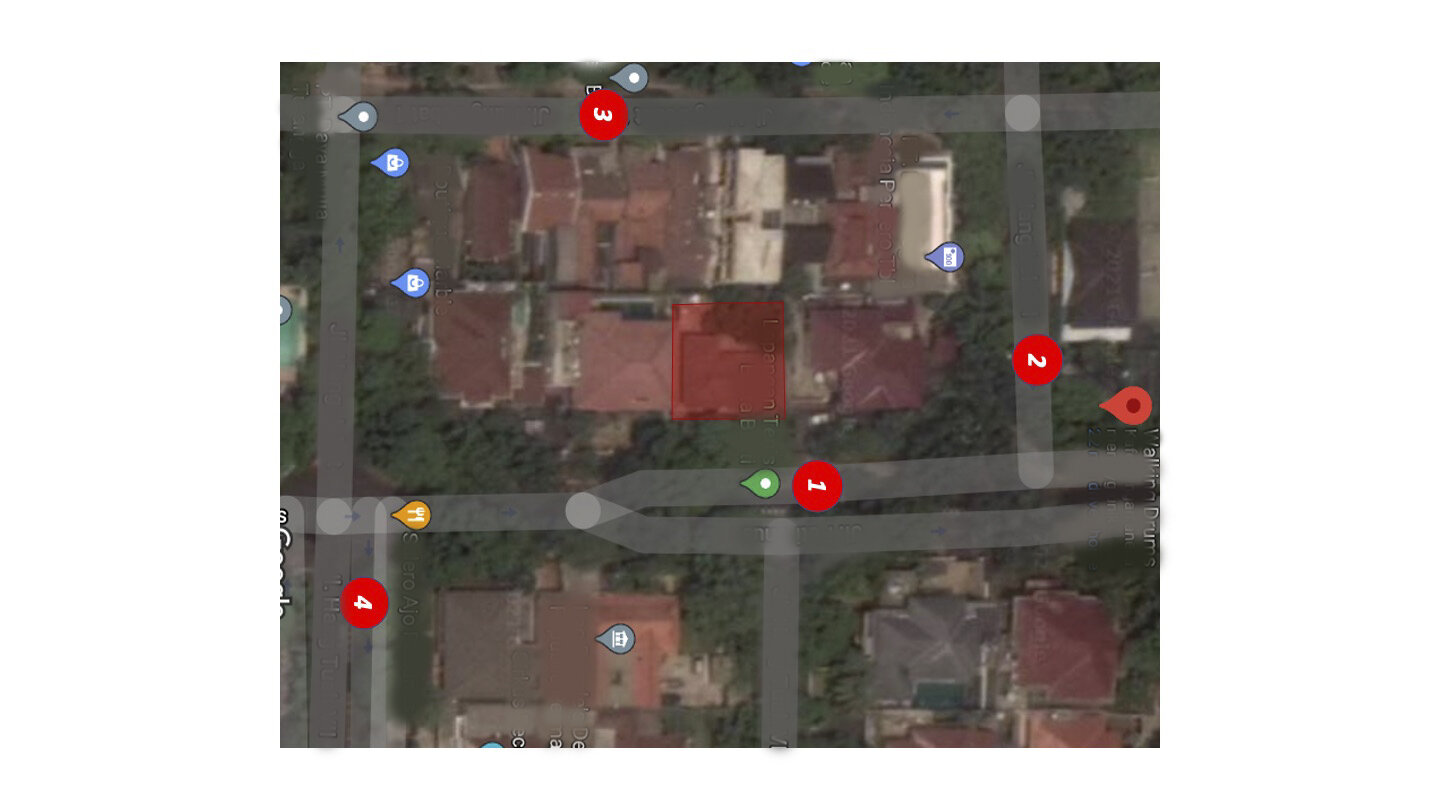
Google Maps view displaying environmental noise measurement points for field data verification.
The Methodology: Data-Driven Acoustic Engineering
To assist the property owner, architect, and facade designer in creating a healthy indoor acoustic environment, a rigorous, four-step building physics methodology was deployed.

Constructing the 3D acoustic model of the site using DataKustik CadnaA software.
Verification Through On-Site Measurement and Topography
The process begins at the macro level. Using Google Maps to establish the geographical and topographical context, exact noise measurement points are determined. Field engineers conduct on-site acoustical measurements during peak Sunmori hours to capture the exact decibel levels and frequency spectrums of the motorcycle exhausts, establishing an accurate baseline for the digital model.
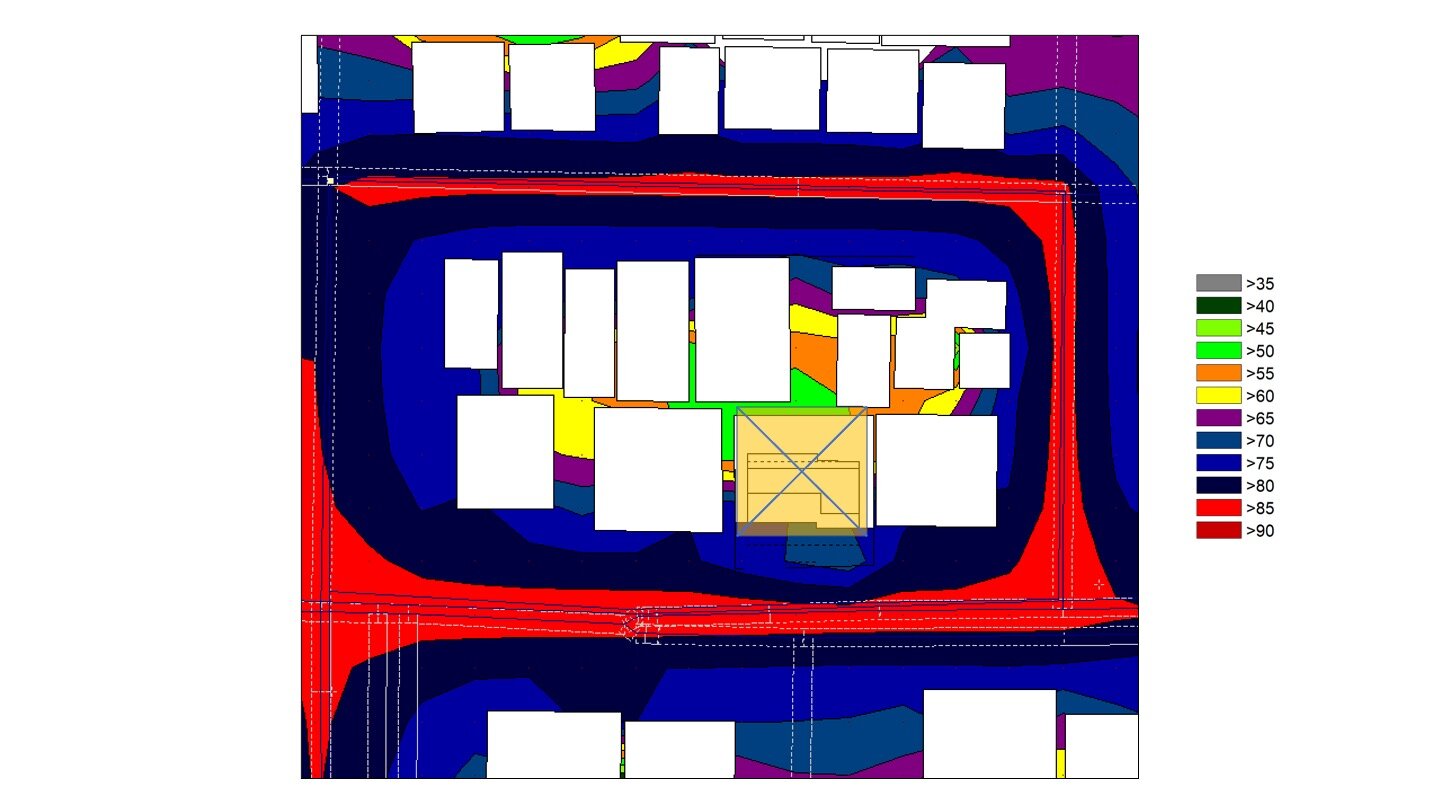
Predictive noise mapping around the project site, with red zones indicating peak noise levels of 85 dB
3D Acoustic Modeling with DataKustik CadnaA
Relying on guesswork for acoustic mitigation often leads to costly architectural failures. Using DataKustik CadnaA, a highly advanced noise prediction software, a 3D acoustic model of the site and surrounding urban geometry is constructed.
This software generates a comprehensive noise map of the property. The simulation visually highlights the most vulnerable areas of the building envelope, with red zones explicitly indicating areas subjected to peak noise levels of 85 dB—a threshold that severely impacts human health and comfort.

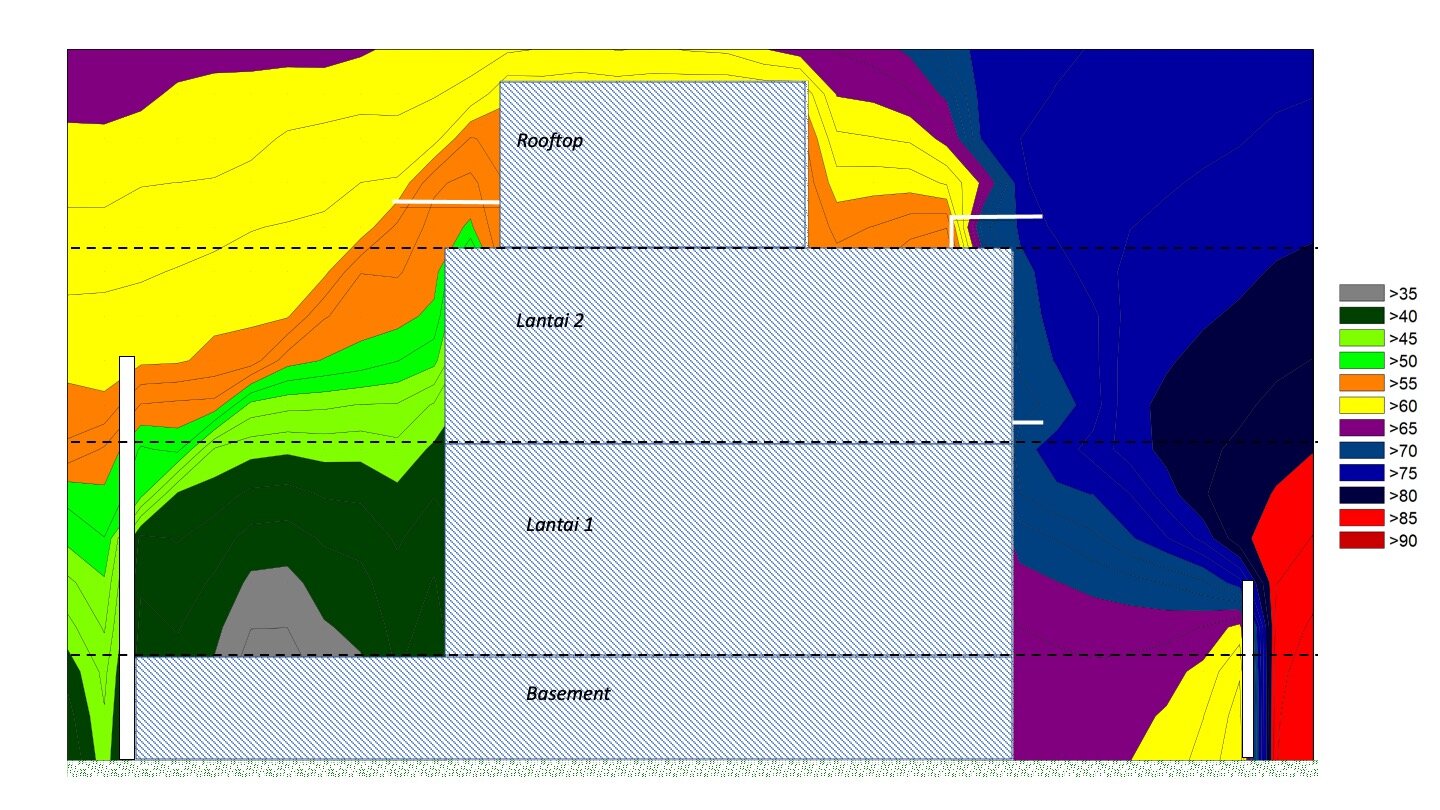
Cross-sectional acoustic prediction of traffic noise impacting the building facade and residential complex (Design A).
Predictive Analysis of Noise Barrier Designs
Before finalizing the building's exterior, the focus shifts to the property perimeter. The acoustic model tests various structural interventions:
Design A: Analyzing the acoustic shadow cast by a specific wall height and material density.
Design B: Modifying the angle, height, or acoustic absorption coefficient of the barrier. This comparative modeling allows the design team to view cross-sectional predictions of how sound waves diffract over and around the barriers, identifying the most effective geometry to protect the lower levels of the facade.

Cross-sectional acoustic prediction showing improved noise mitigation on the building facade (Design B).
Material Specification and OITC Facade Engineering
With the exterior barrier optimized, the remaining noise load hitting the facade is calculated. The engineering focus shifts to the Outside-Inside Transmission Class (OITC) ratings of the building materials. Predictive acoustic performance modeling is applied to every element of the envelope:
Glazing: Specifying asymmetrical double-glazed windows with acoustic PVB interlayers to break low-frequency resonance.
Walls & Roof: Enhancing the mass and isolation of the solid partitions.
Doors & Seals: Ensuring airtight seals to eliminate flanking paths where sound can leak through microscopic gaps.
The Synergy of Architecture, Acoustics Engineering and Building Physics
Applying a scientific methodology ensures that noise prediction at the residential complex and specific building facades is highly accurate. This data-driven approach empowers owners, architects, and facade designers to visually compare the acoustic performance of multiple design alternatives before construction begins.
Ultimately, it facilitates optimal decision-making, allowing the project team to perfectly balance aesthetic beauty, exterior views, natural daylighting, thermal insulation, and strict acoustic control.
Human quality of life is deeply tethered to the physical environment—specifically sound, light, air, and temperature. By seamlessly integrating building physics into architectural design, we construct high-performance environments that protect human health and elevate the daily living experience.
About the Author Herwin Gunawan is a Human-Centered Building Performance Consultant and the Principal Consultant at ALTA Integra. Operating out of Jakarta, Indonesia, he specializes in architectural acoustics, environmental noise control, and lighting design. By leveraging advanced simulation tools and aligning with global sustainability frameworks like LEED and WELL, ALTA Integra engineers optimized physical environments that enhance human well-being and building performance.