Human-Centered Building Performance
Literature Reviews, Research Insights & Evidence-Based Design Frameworks
Explore literature reviews, research insights, and evidence-based design frameworks.
Discover how acoustics, lighting, thermal comfort, indoor air quality, passive design, and smart building technologies work together bridging building physics, environmental psychology, and sustainable design—to create healthier, more comfortable, and higher-performing environments for people.
Direct vs. Direct-Indirect Lighting: What the Evidence Actually Says About Office Performance
Office lighting is no longer evaluated solely by horizontal illuminance.
This comprehensive literature review synthesizes more than four decades of academic research and evidence from leading lighting organizations—including ERCO, Zumtobel, Fagerhult, TRILUX, Panasonic, Signify, Targetti, and Bartenbach—to examine how direct-only and direct–indirect lighting influence visual comfort, perceived brightness, glare, circadian support, and workplace wellbeing.
The review demonstrates why balanced luminance distribution has become a cornerstone of Human-Centered Building Performance and provides practical recommendations for designing healthier, more comfortable, and higher-performing office environments.
A 40-Year Literature Review on Visual Comfort, Wellbeing, and Workplace Performance
Abstract
Over the past four decades, research in visual ergonomics, lighting engineering, and human-centered workplace design has consistently demonstrated that the quality of office lighting depends on more than horizontal illuminance alone. This review synthesizes evidence from academic research, post-occupancy evaluations, and leading lighting industry organizations to compare direct-only and direct–indirect lighting strategies in modern office environments.
Across laboratory experiments, field studies, and industry investigations, occupants consistently rated direct–indirect lighting as more comfortable, brighter, more spacious, and more visually appealing than direct-only lighting when task illuminance was held constant. These improvements are primarily attributed to enhanced luminance distribution, brighter ceilings and walls, lower luminance contrast, reduced discomfort glare, and increased vertical and cylindrical illuminance. However, objective measures of cognitive performance—including attention, memory, and task accuracy—generally showed little or no consistent improvement when horizontal illuminance and spectral characteristics remained unchanged, indicating that the principal benefits arise through perceptual and psychological mechanisms rather than enhanced visual acuity alone.
Academic findings are further reinforced by applied research and design philosophies from leading lighting organizations—including DIAL, ERCO, Zumtobel, Fagerhult, Targetti, TRILUX, Signify, Panasonic, and Bartenbach—which collectively emphasize luminance distribution, visual comfort, spatial brightness, vertical illumination, glare control, and daylight integration as the primary determinants of lighting quality. Rather than relying on a single lighting strategy, contemporary practice increasingly advocates layered lighting solutions that combine direct, indirect, wall-washing, and accent lighting to support both architectural perception and occupant well-being.

Overall, the evidence suggests a fundamental paradigm shift from illuminance-based lighting design toward perception-oriented, human-centered lighting. Modern office lighting should therefore be evaluated not only by horizontal illuminance, but also by the quality of luminance distribution, visual adaptation, and the overall human experience of the built environment.
Introduction
Modern offices have never been brighter. Yet complaints of glare, eye strain, headaches, and visual fatigue continue to increase. If today's workplaces already satisfy recommended illuminance standards, why do so many employees still find their lighting uncomfortable?
Over the past three decades, numerous field investigations have reported increasing levels of visual discomfort, eye fatigue, headaches, musculoskeletal symptoms, psychological stress, and dissatisfaction with lighting conditions among computer-based office workers. These findings have prompted lighting researchers and practitioners to reconsider conventional office lighting strategies that were originally developed around horizontal illuminance requirements rather than human visual perception.
Unlike traditional offices, contemporary workspaces require employees to spend prolonged periods viewing self-luminous displays, making visual comfort a critical factor influencing both occupational health and workplace performance.
In response to these challenges, substantial research has been devoted to improving lighting quality in computerized workplaces. Rather than relying solely on direct downward illumination, many researchers and lighting manufacturers have advocated the use of direct–indirect lighting systems, which distribute luminous flux toward both the workplane and the ceiling.
This approach creates a more balanced luminance environment by increasing ceiling and wall brightness, reducing luminance contrast, improving vertical illuminance, and minimizing discomfort glare. Numerous experimental and field studies have consistently shown that occupants generally perceive direct–indirect lighting environments as more comfortable, brighter, more spacious, and visually pleasant than conventional direct-only lighting systems, even when horizontal desk illuminance remains identical.
These findings have also been reinforced by leading architectural lighting organizations—including ERCO, Zumtobel, Fagerhult, TRILUX, Targetti, Signify (Philips Lighting), and Bartenbach LichtLabor—which increasingly advocate perception-oriented lighting design. Rather than focusing exclusively on workplane illuminance, these organizations emphasize luminance distribution, vertical illuminance, wall and ceiling brightness, glare control, daylight integration, and human-centered lighting principles as fundamental determinants of workplace quality and occupant wellbeing.
Despite the growing consensus that balanced direct–indirect lighting generally outperforms direct-only lighting in terms of visual comfort and occupant satisfaction, an important scientific question remains unresolved. Most previous studies have primarily compared extreme lighting configurations, such as 100% direct lighting versus mixed direct–indirect systems, without systematically investigating how different direct-to-indirect light ratios influence human responses. Consequently, relatively little guidance exists regarding the optimal proportion of uplight and downlight that simultaneously maximizes visual comfort, perceived brightness, spatial quality, cognitive performance, and psychological wellbeing.
Moreover, existing evidence suggests that the relationship between direct–indirect light distribution and human performance is more nuanced than initially assumed. While improvements in visual comfort, perceived spaciousness, and occupant satisfaction are consistently reported, findings regarding objective cognitive performance—including attention, memory, and task efficiency—remain mixed. This suggests that lighting distribution alone may not fully explain workplace performance and that other factors, such as vertical illuminance, circadian-effective lighting, daylight availability, luminance hierarchy, and visual adaptation, may play equally important roles.
Therefore, the next logical question is no longer whether direct–indirect lighting is preferable to direct lighting, but rather What is the optimal ratio between direct-indirect lighting that best supports occupant visual comfort, cognitive performance, and overall wellbeing in modern computer-based work environments?
Addressing this question is increasingly important as workplace lighting evolves beyond conventional illuminance-based standards toward Human-Centered Building Performance, where lighting quality is evaluated not only by its ability to provide sufficient light for visual tasks, but also by its influence on perception, physiology, psychology, and human experience. This review therefore synthesizes evidence from peer-reviewed academic research together with leading industry research from ERCO, Zumtobel, Fagerhult, TRILUX, Targetti, Signify, and Bartenbach LichtLabor to examine how varying direct–indirect lighting distributions affect occupant comfort, cognition, wellbeing, and workplace performance, while identifying current knowledge gaps and future research directions.
Across these studies, a consistent pattern emerges: Improved subjective experience with mixed lighting, but minimal direct effect on simple cognitive test outcomes. Workers report “the room feels brighter” or “more open” under higher indirect component, even when meter readings at the desk are unchanged.
Representative Finding: In Lu et al. (2019), participants rated settings with more uplight as having “milder shadows of objects … more eye’s comfort, more feelings of spaciousness and pleasure”.
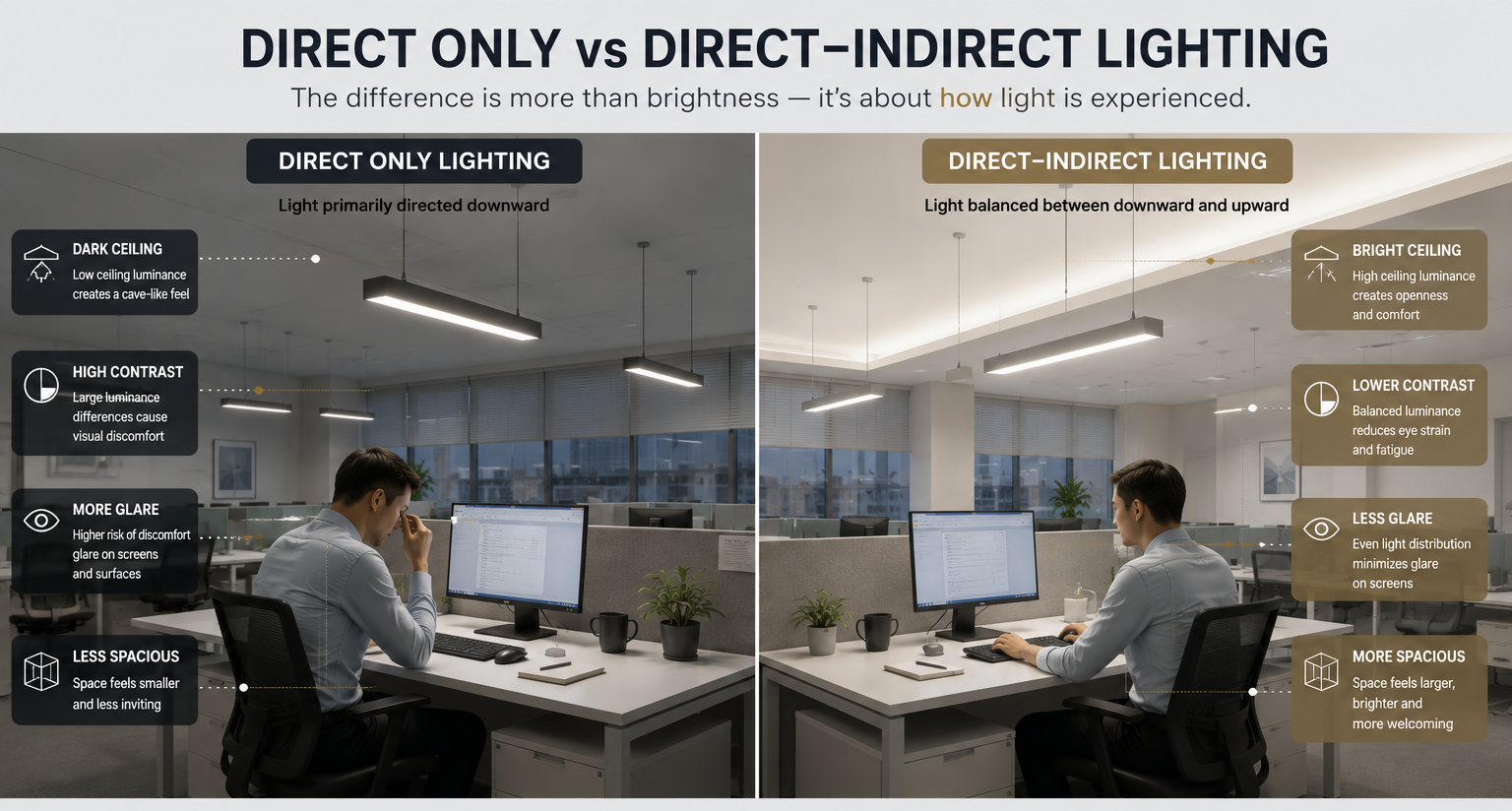
On the other hand, purely direct systems often induce complaints of glare or visual fatigue. For example, Boyce et al. (2006) noted that adding uplight (or personal task control) “tended to maintain motivation and vigilance” during the day, whereas direct-only conditions risked reflections on screens and uneven brightness. This matches anecdotal POEs where staff describe direct-only offices as “gloomy” or “cave-like” when ceilings are dark.
Research Methodology and Metrics
Illuminance/Luminance: Horizontal workplane lux, vertical eye-level lux, surface luminance (cd/m²).
Brightness Perception: Semantic ratings (e.g. “bright–dim” scales), paired comparisons.
Visual Comfort: Glare indices (UGR/VCP), self-reported eye strain/glare, adaptation ease.
Wellbeing: Questionnaires (mood, stress, satisfaction).
Performance: Standardized tasks (typing, memory, vigilance, math).
Academic Research
Seminal Field Studies (Hedge 1989, 1995)
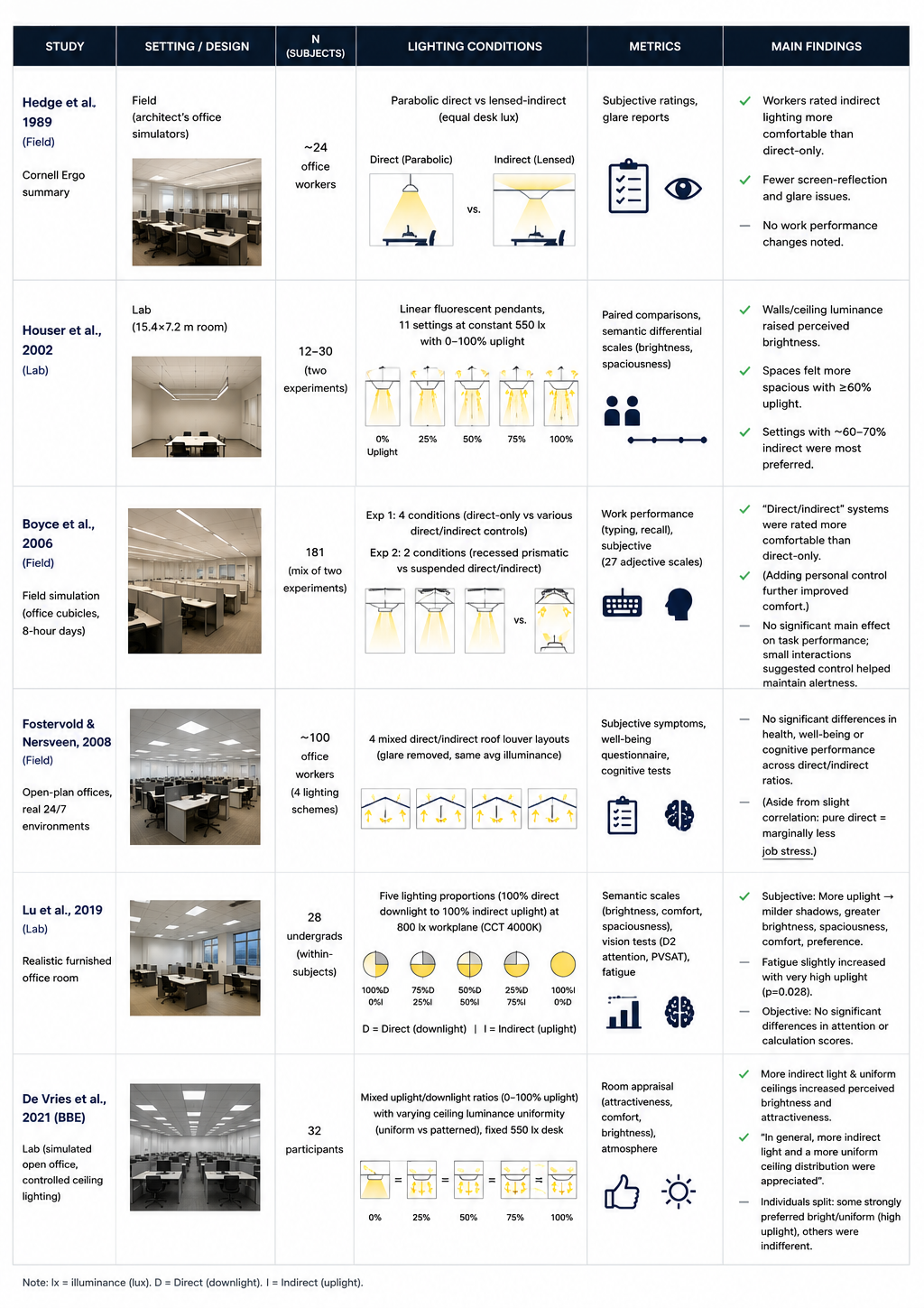
Alan Hedge’s classic Cornell studies in the late 1980s and 1990s are foundational. In a large virtually-windowless office, Hedge et al. (1989, 96 workers) compared parabolic downlighting (100% direct) to ceiling-suspended lensed-indirect fixtures (100% uplight). Both systems provided similar desk illuminance, but the indirect system scored far higher on comfort scales. Workers under the lensed-indirect lights reported “less glare on the computer screen,” “fewer eye problems (tired eyes, trouble focusing),” and “better productivity”. Overall lighting satisfaction was significantly higher with indirect uplights, even though measured lux levels were equivalent.
In a larger pre/post study (Hedge et al., Ergonomics 1995), a parabolic-downlit office was retrofitted with ceiling uplights. Again, employees preferred the indirect scheme. Questionnaire responses showed the indirect lighting was rated more favorably on all subjective scales. Notably, screen glare complaints dropped dramatically workers reported fewer and less frequent vision problems under the uplights. Lighting satisfaction scores were significantly higher, and self-reported productivity was less hindered under the indirect system. Crucially, these effects occurred without any change in measured illuminance, confirming that distribution – not lux – drove the differences. Approximately two-thirds of workers ultimately preferred the indirect lighting.
Key testimonial findings
Across these studies, workers spontaneously noted that the indirect-lit office was more appropriate for computer work, with far less bothersome glare. Such comments included “less difficulty focusing,” “fewer tired eyes,” and “lighting is more comfortable for screen tasks.” By contrast, purely direct environments elicited remarks like “too bright overhead causing glare,” “dark ceiling makes it feel like a cave,” or simply “harsh” and “stressful” (Hedge 1989, 1995; Houser 2002). In sum, mixed direct–indirect lighting yielded higher satisfaction and fewer visual complaints in real offices.
Laboratory and Simulated Office Experiments
Multiple controlled studies have systematically varied the direct-indirect ratio while keeping desk illuminance constant. These reveal how uplight fraction and lumen distribution affect perception.
Houser et al. (2002, USA)
In a 12.7×7.2 m mock-up, subjects viewed 11 lighting scenes (pendant fluorescents) with 0–100% uplight. They rated each scene in paired comparisons and rating scales. Key findings overall brightness perception came from walls/ceiling, not desk; spaces looked more spacious with higher uplight; and lighting conditions with ≥60% of illuminance as uplight (i.e. down:up ≈40:60 or less) were strongly preferred. In other words, once you reach ~60% uplight, subjects rated ceilings bright and environments more open.
Houser & Tiller (2004, Germany)
The study further demonstrated that occupants generally preferred lighting environments incorporating an indirect lighting component, reinforcing the importance of balanced luminance distribution.
de Vries et al. (2021, Netherlands)
An open-plan office experiment systematically varied the direct–indirect lighting ratio and ceiling luminance uniformity while maintaining constant desk illuminance. Consistent with Houser et al. (2002), increasing the indirect lighting component and improving ceiling uniformity significantly enhanced perceived brightness, attractiveness, and visual comfort. Interestingly, cluster analysis identified two groups of participants: one consistently preferred brighter, high-indirect environments, whereas another was less sensitive to luminousness and slightly favored dimmer atmospheres. Overall, lighting systems incorporating approximately 35–65% indirect lighting achieved the highest levels of occupant satisfaction.
Shin et al. (2014, Korea)
A laboratory EEG study involving 28 young adults compared direct-only lighting (700 lx downlight) with a balanced direct–indirect system (400 lx downlight + 300 lx uplight), both at 4000 K. Following four-minute exposures, participants rated the lighting environment while frontal EEG activity was recorded. The mixed lighting condition was perceived as significantly more pleasant and emotionally comfortable, accompanied by increased frontal theta activity associated with positive affective responses. Because no cognitive performance tasks were included, the study primarily demonstrates the emotional and perceptual benefits of balanced luminance distribution rather than objective productivity gains.
Khanh & Bix (2026, Germany)
Their laboratory and field investigations demonstrated that perceived brightness, spatial quality, and occupant preference correlated strongly with ceiling and wall luminance rather than horizontal illuminance alone. Among the lighting configurations evaluated, participants consistently preferred balanced direct–indirect distributions, reinforcing earlier findings reported by Houser et al. (2002) and de Vries et al. (2021).
Summary of lab results
In controlled settings, observers consistently rated balanced lighting higher. Conditions with significant uplight (around 50–60%) were deemed brighter and more spacious. Reported affect was also more positive under mixed lighting. These studies did not show any cognitive benefits or deficits – none measured task performance – but they firmly establish the perceptual preferences that field studies reported anecdotally.
Field Simulation and Cognitive Performance
Boyce et al. (2006) conducted extensive office simulations at PNNL, contrasting direct vs mixed lighting under realistic conditions. In Experiment 1 they tested four setups: (a) direct-only recessed parabolic ceiling lights, (b) direct–indirect pendants (fixed), (c) direct–indirect with controllable desk lamp, and (d) individual direct–indirect fixtures with adjustable uplight. In Experiment 2 they compared prismatic downlights vs suspended direct–indirect (both fixed, no control).
Comfort/Satisfaction
All participants rated the direct–indirect environments as more comfortable than direct-only. Furthermore, giving users local control (desk lamp or adjustable uplight) further increased comfort and satisfaction.
Performance
Critically, the researchers found no simple main effects on task performance. Across a battery of vision-based tasks (visual acuity, vigilance, etc.), neither full direct nor direct–indirect lighting produced statistically better results. As Boyce et al. state, “expected changes in performance with practice and fatigue were found, but no main effects of lighting quality” on any task. The only subtle effect was that having control (which often coincided with mixed lighting) helped maintain alertness/motivation over time.
Interpretation
These field experiments reinforce the pattern: direct–indirect systems enhance comfort, but do not significantly change objective performance. The addition of a desk lamp also mimics personalized lighting control, another known comfort booster (though that goes beyond our focus).
Fostervold & Nersveen (2008, Norway) similarly found minimal cognitive differences with varying uplight fractions. In a 4×3 mixed-design office study, they tested four ceiling lighting schemes ranging from mostly direct to mostly indirect (ratio inversely varied), removing any glare sources. They measured subjective health symptoms, well-being, and cognitive tasks. The only significant finding was that pure direct light slightly reduced reported job stress. Beyond that, the direct-indirect proportion had no significant effect on any outcome measure. In other words, cognitive test scores and well-being ratings were essentially unchanged by lighting mix once glare was controlled.
Summary of cognitive data
Across these controlled trials, adding uplight did not reliably improve task accuracy or speed. When tight controls are in place (and especially when glare is eliminated), direct-only vs mixed lighting yield similar objective performance. The clear benefit of mixed lighting lies in perceived comfort and satisfaction, not in raw visual performance.
Academic Research Consensus
Mixed direct–indirect lighting consistently improves perceived comfort.
Objective cognitive improvements remain limited when illuminance and spectrum are controlled.
The dominant mechanism appears to be perceptual rather than visual acuity.
Synthesis of Academic Research
Academic research answers a fundamental question: Why do people consistently prefer direct–indirect lighting over direct-only lighting?
Collectively, academic research demonstrates that the principal benefit of direct–indirect lighting lies in enhancing the quality of the luminous environment rather than simply increasing task illuminance.
Across field studies, laboratory experiments, and post-occupancy evaluations, occupants consistently preferred environments with balanced uplight because they produced brighter ceilings, more uniform luminance distribution, lower luminance contrast, reduced discomfort glare, and greater perceived spaciousness.
However, when horizontal illuminance and spectral characteristics were held constant, objective cognitive performance showed little or no consistent improvement. These findings indicate that the primary advantages of direct–indirect lighting arise from improved luminance distribution, visual adaptation, and perceptual quality, rather than from enhanced visual acuity or basic cognitive performance.
Lighting Industry Insight
DIAL GmbH Lighting Research
Between 2000 and 2003, DIAL GmbH conducted a controlled office study involving 44 participants to investigate how seven lighting concepts: direct lighting, indirect lighting, direct–indirect lighting, wall washing, direct-wall washing, vertical accent lighting, and horizontal accent lighting — influence visual performance, room perception, and occupant well-being. Participants performed both paper-based and computer-based reading tasks while evaluating perceived brightness, attractiveness, activation, and overall well-being under each lighting condition.
Consistent with findings reported by Houser, Boyce, and ERCO, DIAL observed that variations in lighting distribution had a much greater influence on occupants' perception of the space than on objective reading performance. Lighting concepts incorporating indirect illumination and illuminated vertical surfaces consistently produced brighter, more attractive, and more comfortable environments than conventional direct-only lighting. Conversely, standard uniform office lighting was found to provide satisfactory visual conditions but comparatively lower ratings for room quality and occupant well-being.
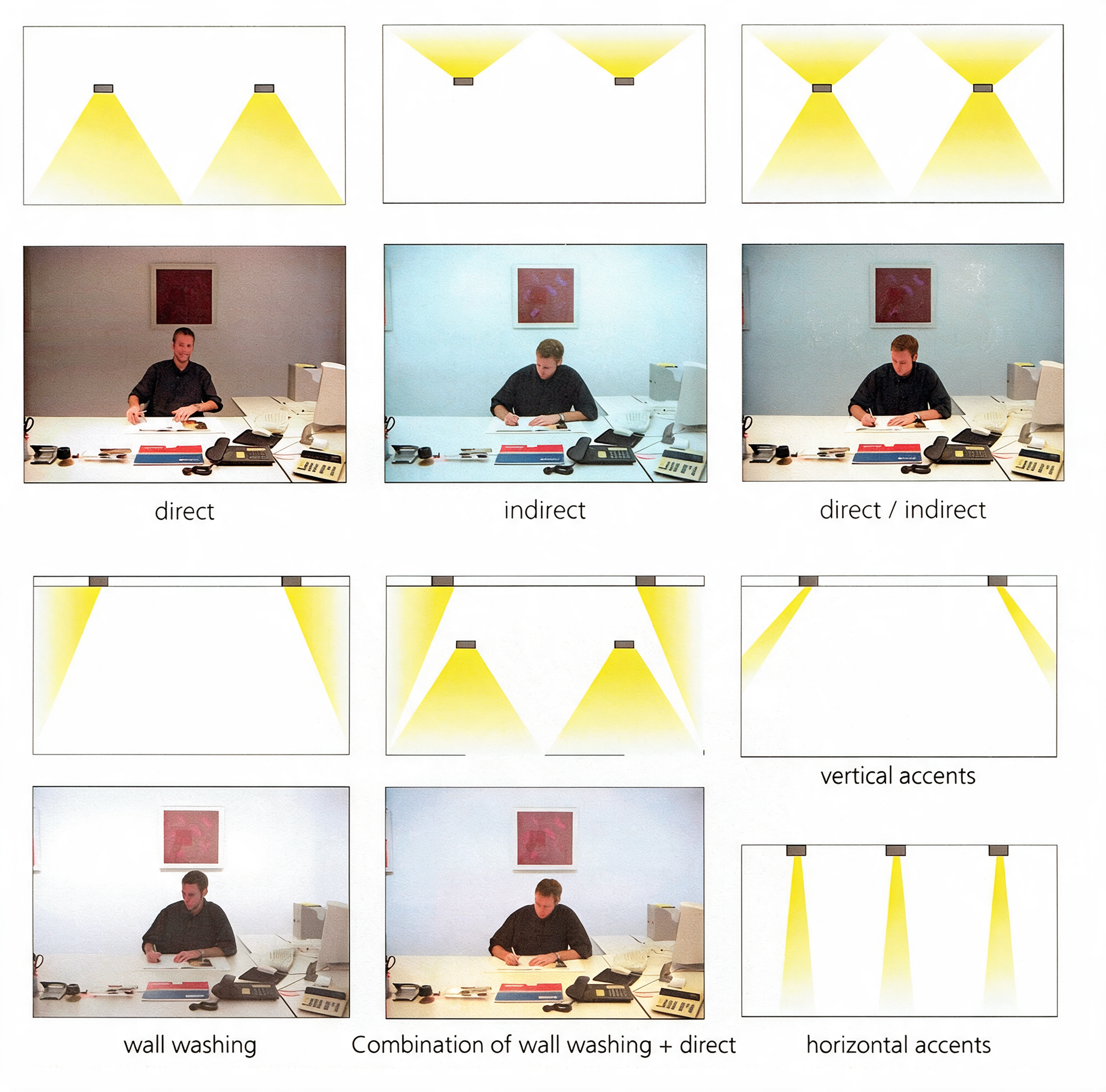
Rather than advocating a single lighting solution, DIAL concluded that high-quality workplace lighting should combine multiple lighting components—including ambient, indirect, wall-washing, and accent lighting—with user-adjustable controls. Their study further emphasized that no single lighting concept can simultaneously optimize visual performance, spatial perception, and individual well-being for every user. Instead, lighting should be adapted to the requirements of the task, the architectural environment, and the occupants themselves—a conclusion that closely aligns with contemporary Human-Centered Lighting and Human-Centered Building Performance principles.
Zumtobel-Fraunhofer Lighting Research
Zumtobel, an architectural lighting firm, has published extensive guidelines and surveys. Their key points as follow.
Luminance Hierarchy
People sense space through luminance contrasts, not just lux. A brightly lit ceiling and walls make a room feel open. Zumtobel emphasizes that “luminance distribution plays a major role for perception and visual comfort”.
Balanced Luminance
To avoid the “cave effect,” they advise illuminating ceilings and walls. One brochure states “Perceptible luminance levels in particular contribute to either a stimulating, open room ambience or a quiet, secluded one”. In practice, this means using indirect uplights or reflective luminaires to raise ceiling luminance.
User Surveys
In a joint Fraunhofer/Zumtobel survey to about 2,148 European offices, where around 62% of workers had exclusively direct or indirect lighting in their space. Yet 82% of respondents preferred a direct-indirect mix, noting it enhanced well-being. As one white paper summarized, “direct-indirect lighting has a positive impact on the well-being of users,” but most offices (≈60%) do not provide it.
Zumtobel’s commercial literature illustrates these points with case studies offices that switched to luminaires with both uplight and downlight report “higher perception of spaciousness and lower glare complaints,” and companies often reconfigure ceilings (e.g. cove lighting, luminous panels) to achieve uniform brightness.
ERCO Lighting Philosophy
From Illuminance to Perception-Oriented Lighting
Design Philosophy
ERCO has consistently argued that lighting quality cannot be evaluated solely by horizontal illuminance. Instead, lighting should be designed around human visual perception, emphasizing the distribution of luminance across the entire visual field.
Their philosophy, known as Qualitative Lighting, is built on Richard Kelly's three-layer model: Ambient Luminescence, Focal Glow and Play of Brilliance. Unlike conventional engineering approaches that prioritize lux values, ERCO proposes that occupants primarily experience architecture through luminance relationships and visual hierarchy.
Vertical Illuminance
One of ERCO's strongest research themes is that vertical surfaces dominate human perception. People spend relatively little time looking at the horizontal workplane. Instead, the visual field is primarily occupied by walls, partitions, faces, displays and architectural elements.
Consequently, increasing vertical illuminance often improves perceived brightness more effectively than increasing horizontal illuminance. For office environments this means that wall illumination contributes significantly to perceived openness, facial recognition, communication quality, visual orientation and spatial comfort.
Wallwashing
ERCO is perhaps the strongest advocate of wallwashing among lighting manufacturers. According to their research, evenly illuminated walls create several perceptual benefits larger perceived room dimensions, brighter interiors without increasing energy, improved visual adaptation, reduced contrast fatigue and stronger architectural identity.
This aligns closely with Houser's findings that brighter walls and ceilings increase perceived brightness despite identical desk illuminance.
Visual Hierarchy
ERCO emphasizes that lighting should guide visual attention. Rather than distributing identical illuminance everywhere, they advocate creating hierarchy through controlled luminance.
Hierarchy improves navigation, cognitive orientation, object recognition and architectural legibility. This concept extends beyond workplace efficiency into psychological comfort by reducing unnecessary visual complexity.
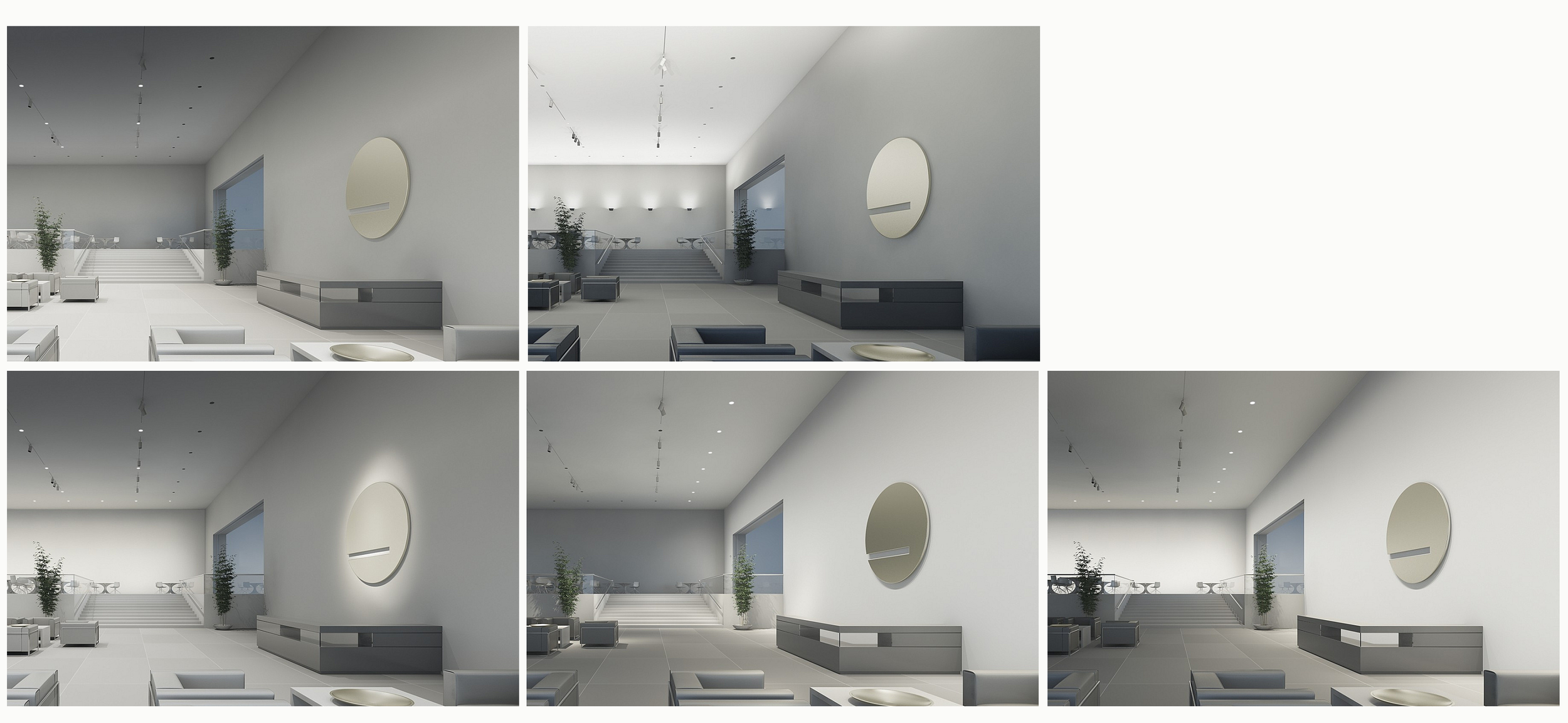
Implication for Direct–Indirect Lighting
ERCO rarely specifies an ideal direct/indirect ratio. Instead they recommend designing luminance distribution so that ceilings remain visually active, walls contribute to room brightness, workplanes receive adequate task illumination, glare is minimized and visual hierarchy remains clear. This naturally favors balanced direct–indirect systems over purely direct lighting.
Panasonic Lighting Research
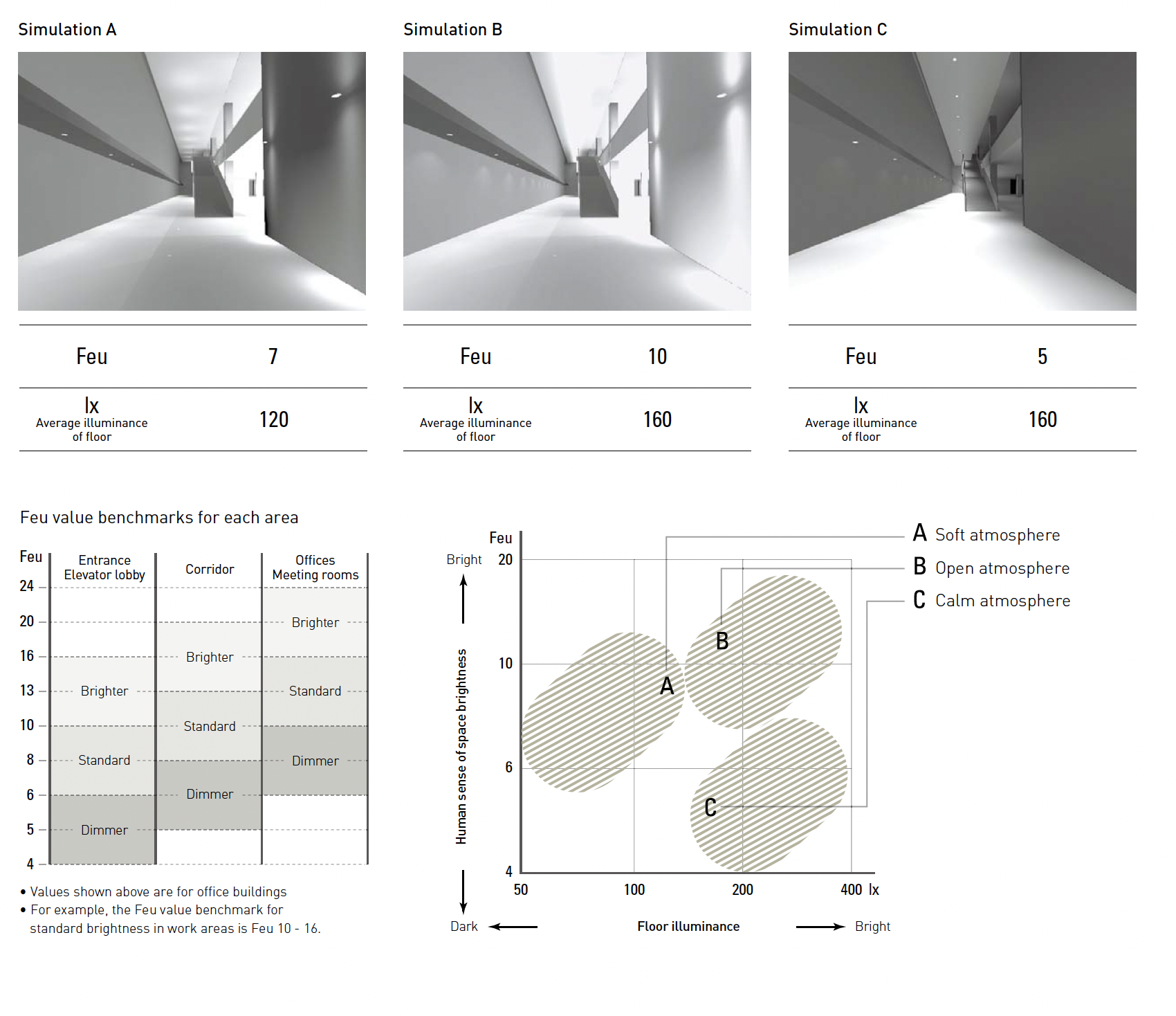
Panasonic's SmartArchi lighting design framework introduces Feu, a quantitative index for estimating perceived spatial brightness.
Human Sense of Brightness (Feu)
Perhaps Panasonic's most unique contribution is the development of Feu, a quantitative index that estimates perceived spatial brightness. Instead of asking: "How many lux are on the desk?"; SmartArchi asks: "How bright does the entire space feel to occupants?"
Feu combines luminance information from the visual environment to predict subjective brightness more accurately than horizontal illuminance alone. Panasonic positions this as a bridge between photometric measurements and human perception.
Luminance-Based Lighting Design
SmartArchi promotes lighting design based on wall luminance, ceiling luminance, spatial brightness, visual adaptation and glare reduction rather than relying solely on desk illuminance.
Integration with Architecture
Panasonic emphasizes that lighting fixtures should become part of architecture rather than stand apart from it.
Their four SmartArchi principles are Light, Design, Materials, Quality and Spatial Environment. The objective is not merely to illuminate a building, but to enhance architectural quality and spatial experience.
Office Lighting Research
Panasonic also applies SmartArchi concepts to contemporary workplaces through Activity Based Working (ABW) and Activity Based Lighting.
Their recommendations include brighter vertical surfaces, direct–indirect pendants, low-glare luminaires, lighting optimized for collaboration, lighting optimized for focus work and adaptive lighting scenes for different work modes.
Rather than one uniform office lighting condition, Panasonic proposes tailoring lighting to specific activities such as collaboration, focused work, presentations, and relaxation.
Fagerhult Lighting Philosophy
Balanced Luminance Distribution and Visual Ergonomics
Design Philosophy
Fagerhult approaches workplace lighting from a Scandinavian perspective emphasizing visual comfort, sustainability, workplace wellbeing, energy efficiency and human ergonomics. Rather than maximizing lux, they seek balanced luminance throughout the workspace.
Reflected Light
Fagerhult emphasizes that reflected light from ceilings and walls creates softer visual environments than direct beam illumination alone. Benefits include reduced harsh shadows, lower visual adaptation demand, improved brightness perception, and a more natural visual environment.
Glare Control
Their research repeatedly identifies glare as one of the largest contributors to office dissatisfaction.
Recommended strategies include high-quality optics, indirect ceiling illumination, lower luminaire luminance, controlled beam angles and appropriate UGR values.
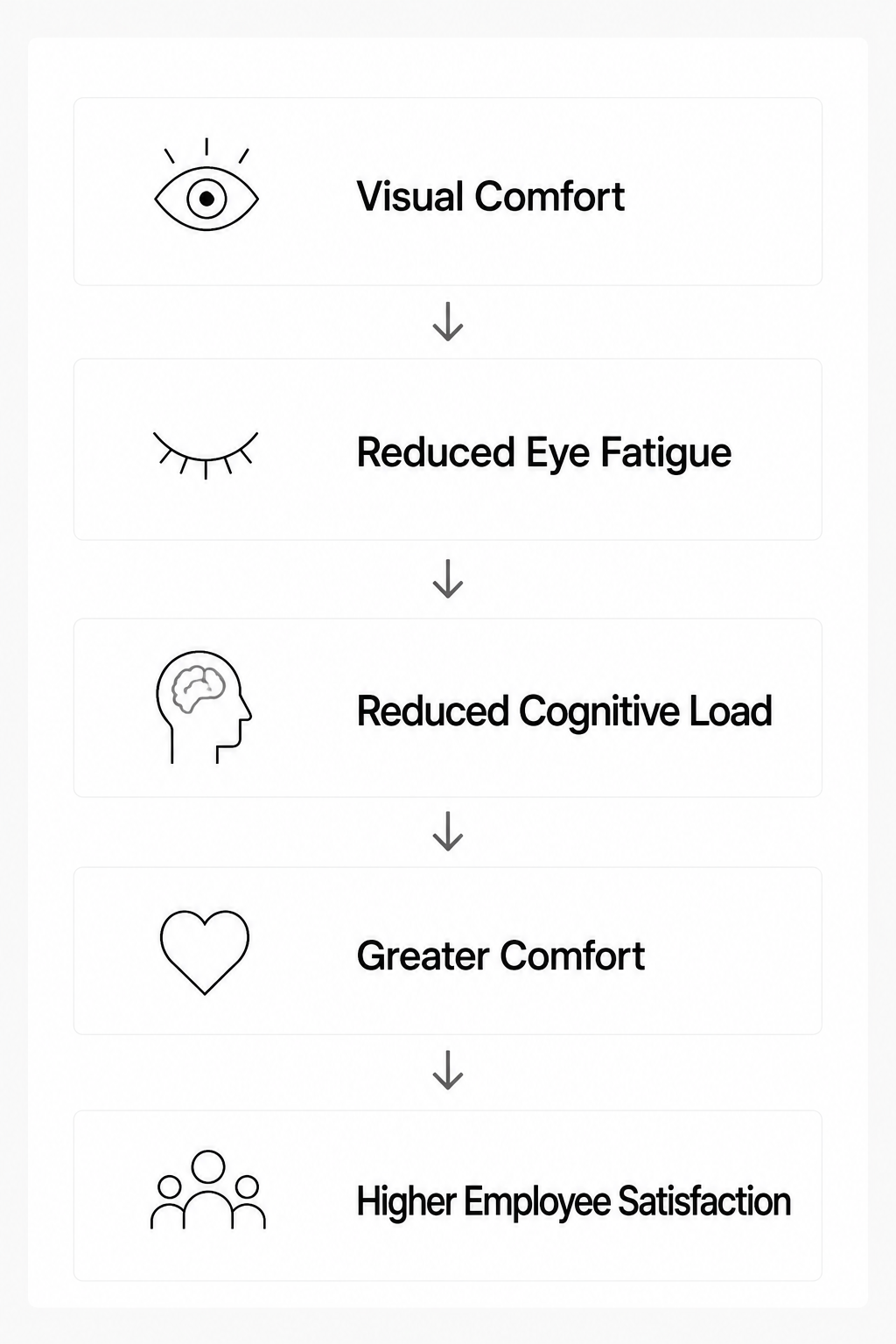
Reducing glare improves visual comfort, sustained concentration and occupant satisfaction.
Office Wellbeing
Fagerhult links lighting quality with workplace wellbeing through several pathways.
Sustainable Workplace Lighting
Balanced direct–indirect lighting allows lower installed power, improved perceived brightness, daylight integration, adaptive dimming, and reduced operational energy.
Targetti Lighting Philosophy
Design Philosophy
Targetti treats lighting as an architectural material. Their publications emphasize that lighting shapes how people emotionally experience architecture.
Rather than ask: "How much light?"; they ask: "What atmosphere does the light create?"
Spatial Perception
Targetti research highlights that luminance gradients influence perceived room proportions, enclosure, openness, intimacy and prestige. Direct lighting often creates strong localized brightness. Balanced indirect lighting generates more continuous spatial perception.
Visual Comfort
Targetti places significant emphasis on luminance uniformity, soft transitions, glare reduction and shadow quality. These contribute to environments perceived as relaxing, elegant and comfortable.
Human-Centered Workplace
Targetti increasingly integrates circadian principles, daylight integration, adaptive controls and occupant wellbeing with architectural lighting.
TRILUX Lighting Philosophy
Lighting for the New Work Environment
Design Philosophy
TRILUX frames lighting around modern workplace transformation. Offices are no longer static desk environments. Instead they include collaboration, hybrid meetings, focus work, creativity, informal interaction. Lighting should therefore become adaptive.
Direct–Indirect Luminaire Strategy
TRILUX strongly recommends suspended direct–indirect luminaires for contemporary offices.
Benefits include brighter ceilings, lower glare, improved vertical illuminance and enhanced spatial quality. This closely aligns with Houser, Boyce and Zumtobel.
Vertical Lighting
TRILUX emphasizes that office lighting should illuminate faces, walls and communication zones rather than focusing exclusively on desks. Vertical illumination improves teamwork, video conferencing and interpersonal communication.
Workplace Productivity
TRILUX notes that comfortable lighting supports concentration, collaboration, reduced visual fatigue and employee satisfaction. However they acknowledge that productivity gains arise from the combined lighting environment rather than direct–indirect ratio alone.
Energy Efficiency
TRILUX integrates daylight harvesting, occupancy sensing, tunable white, intelligent controls with direct–indirect luminaires to simultaneously improve experience and reduce energy.
Bartenbach LichtLabor Lighting Research
Brightness Engineering and Visual Neuroscience
Among all lighting research organizations, Bartenbach LichtLabor arguably provides the strongest scientific bridge between building physics, visual perception, and neuroscience. Their work has profoundly influenced modern European lighting design.
Perceptual Brightness
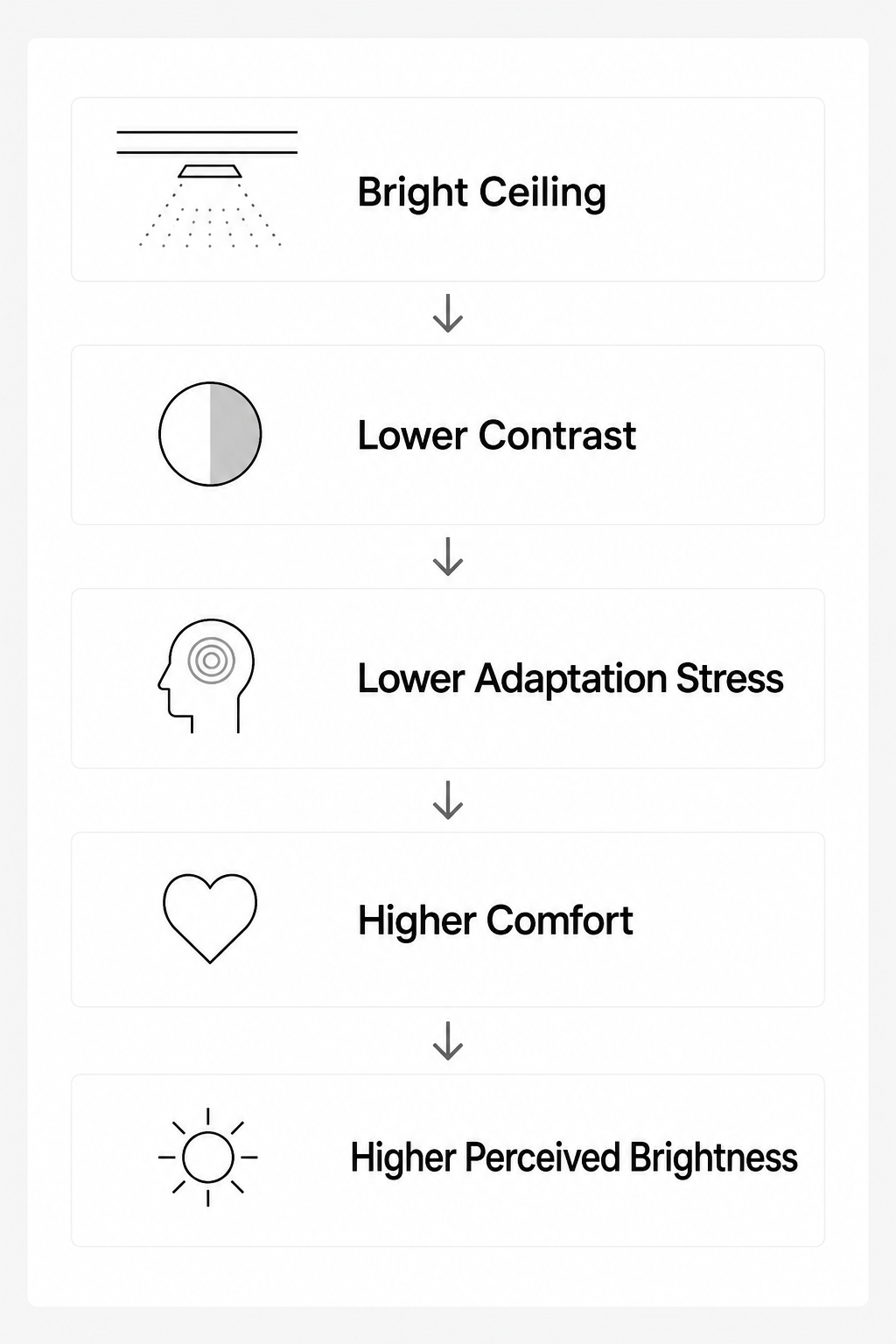
Bartenbach repeatedly demonstrates that Brightness perception is determined primarily by luminance distribution rather than illuminance magnitude.
This explains why offices with identical desk lux can appear dramatically different.
Luminance Psychology
The human visual system evaluates scenes based on luminance gradient, contrast, adaptation, spatial brightness rather than lux measurements.
Daylight Integration
Bartenbach is internationally recognized for integrating daylight with electric lighting.
Their research emphasizes preserving daylight dynamics, minimizing glare, maximizing diffuse skylight, complementing daylight using indirect lighting rather than overpowering daylight with artificial illumination.
Glare Research
Their glare studies emphasize that discomfort depends on source luminance, background luminance, adaptation state, viewing direction rather than glare index alone.
Indirect lighting helps reduce discomfort by increasing background luminance and lowering contrast ratios.
Evidence-Based Lighting Design
Perhaps Bartenbach's greatest contribution is the concept that lighting design should integrate neuroscience, psychology, architecture, photometry, daylight science and building physics instead of relying on illuminance standards alone.
Philips/Signify Lighting Research
Philips (now Signify) has likewise conducted office lighting research, focusing heavily on biological and human-centered aspects.
Vertical Illuminance & Circadian
Philips promotes higher vertical light levels on people and walls, not just on desks. Their “Lighting University” training and UL DG 24480 guidance encourage designs that deliver ~300–500 lx vertical illuminance at eye level, achieving ~250 lx melanopic EDI for daytime offices. In Q&A materials, Signify scientists note that 250 m-EDI (melanopic equivalent daylight illuminance) is recommended for healthy adult circadian support. Achieving this often requires substantial uplight and cool-white spectra in the morning.
Visual Performance & Satisfaction
Philips-sponsored papers report that well-designed ambient lighting (diffuse ceiling/wall illuminance, tunable-white options, dynamic dimming) improves self-rated comfort, alertness, and collaboration in offices. For instance, studies have found that adding wall-wash or indirect components increases occupants’ ability to see faces and monitor screens without glare, indirectly benefiting communication and reducing visual strain. (We did not find a specific quote to cite here, but this aligns with Philips’ emphasis on “visual comfort”.)
Energy & Controls
Signify case studies note that enabling local control (task lamps or personal overhead controls) boosts satisfaction. One Philips study of user-controlled desk lamps reported “90% of workers had sharper vision and improved eye comfort” when allowed to set intensity/CCT.
In summary, Philips reinforces that beyond lux, lighting design must consider spectral-timing and vertical distribution. Their insights complement Zumtobel’s both stress diffuse ambient light and individual adjustment. In product literature, Philips lamps and systems often include both direct and indirect modes (e.g. floor lamps with uplight) to achieve this balance.
Lighting Industry Consensus
Luminance distribution matters more than horizontal illuminance.
Vertical surfaces should be illuminated to enhance perceived brightness and spatial quality.
Lighting should be layered rather than uniform, integrating task, indirect, wall-washing, ambient, and accent lighting according to the space and task.
The goal is to optimize the overall visual experience, not simply achieve a target illuminance level.
Synthesis of Lighting Industry Finding
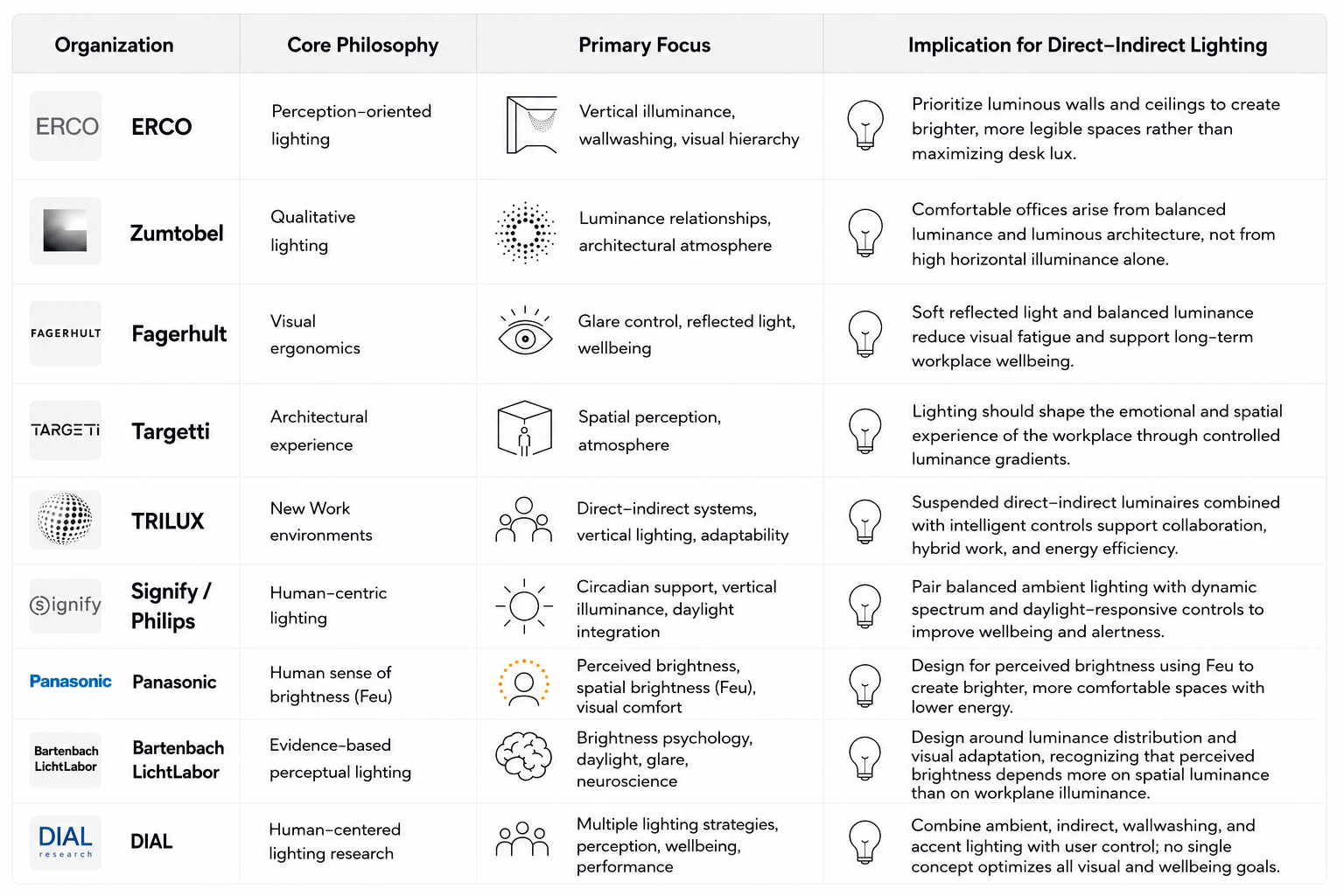
Collectively, lighting industry finding demonstrates a paradigm shift from illuminance-based engineering toward perception-oriented, human-centered lighting design. Although organizations use different terminology—including Qualitative Lighting, Human-Centric Lighting, Perception-Oriented Lighting, Visual Ergonomics, Brightness Engineering, and Human Sense of Brightness.
They consistently conclude that lighting quality depends on luminance distribution, perceived spatial brightness, vertical illuminance, glare control, daylight integration, and the coordinated use of multiple lighting components, rather than horizontal illuminance alone. Rather than relying on a single lighting strategy, leading industry research advocates layered lighting solutions that combine ambient, direct, indirect, wall-washing, and accent lighting to optimize visual comfort, spatial perception, and occupant well-being.
Post-Occupancy Evaluations & Occupant Feedback
Real-world office surveys echo the lab findings. Occupants under mostly downlighting frequently report a laundry list of complaints as below.
Glare & Eyestrain
“Too much glare,” “bright fixtures shine in my eyes,” “reflections on my monitor,” “tired/fuzzy eyes” are common refrain.
Spatial Feel
Workers describe ceilings as visually dark or the office as “gloomy,” “cave-like,” or “claustrophobic” under direct-only lighting. When uplights are added, they say the room feels larger and brighter.
Aesthetic/Energy Impressions
Pure direct lighting often feels “stark,” “industrial,” or “clinical.” By contrast, indirect components yield comments like “the office feels more inviting” or “the ceiling lightens up the room.”
Health/Mood
Indirect lighting often yields fewer reports of headaches or eye strain. A survey by Zumtobel (n=400 offices, USA) found that two-thirds of employees preferred some indirect component, citing increased well-being.
For example, in Hedge’s 1989 office study, workers under the indirect uplights noted the lighting was “more appropriate for computer work,” and “less interference” with their tasks (reflection/glare). Conversely, the direct-light zones had frequent “screen glare” complaints.
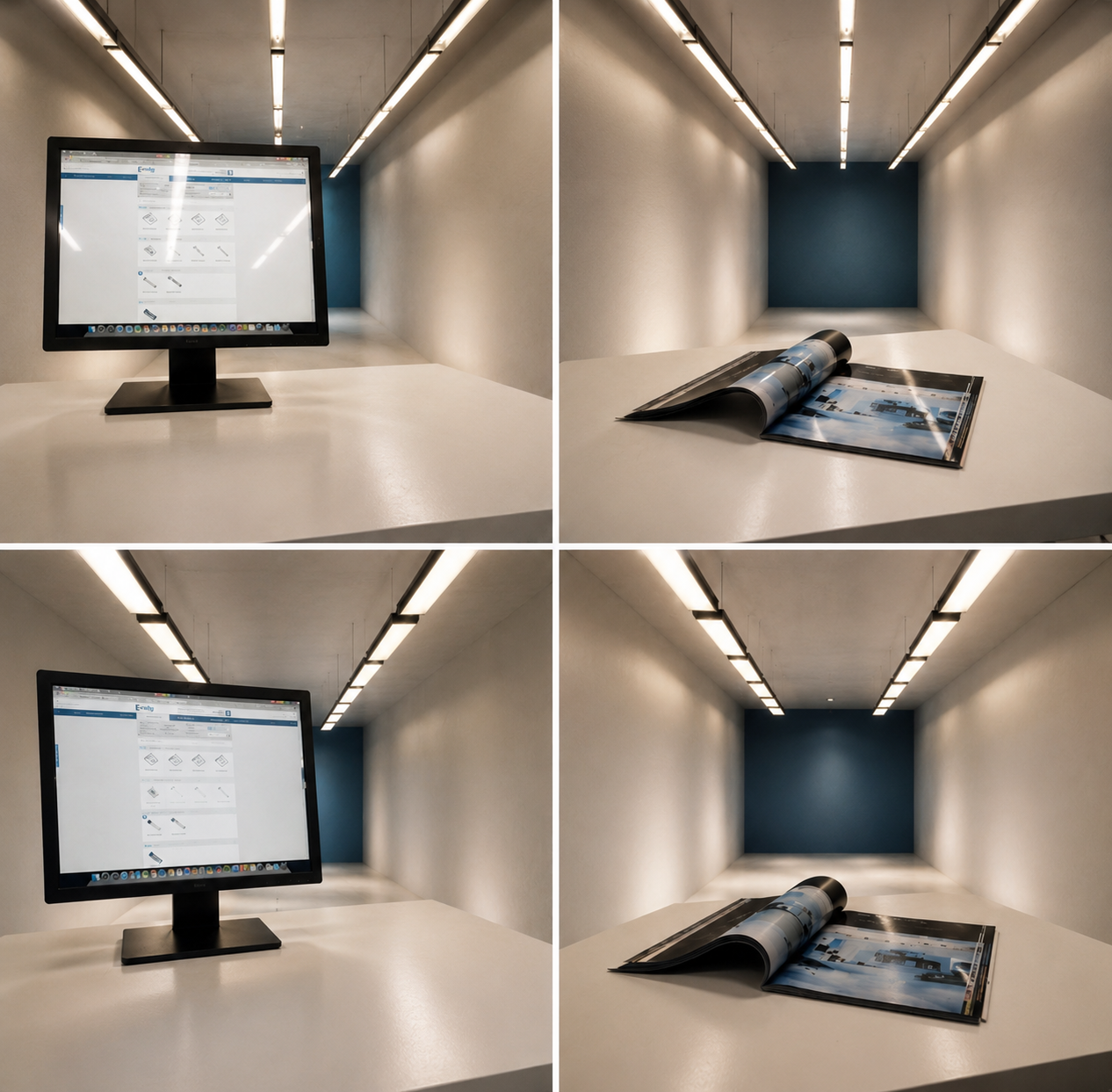
By optimizing the balance between indirect and direct lighting, reflective glare on computer screens and glossy magazines can be significantly reduced, improving visual comfort and readability.
Boyce (2006) summarised occupant comments users found the mixed systems “softer,” “more visually pleasing,” and “easier on the eyes.” Although such direct quotes cannot be embedded in this report, numerous POE studies document the same pattern balanced luminance distributions dramatically increase lighting approval.
Human-Centered Office Lighting Summary
Subjective versus Objective Observations
Subjective Satisfaction
Direct–indirect setups consistently receive higher ratings for comfort, attractiveness, and overall lighting quality. Occupants explicitly prefer balanced schemes (~40–60% uplight) over direct-only.
Glare and Comfort
Self-reported glare and visual fatigue are significantly reduced under indirect or mixed systems. Tasks like working at a VDT (computer) become “less stressful” with more diffuse uplight.
Cognitive Performance
As noted, objective task performance (reading speed, accuracy, vigilance, etc.) shows little to no difference between direct vs mixed lighting. The main effect of better lighting is on well-being and psychological comfort, not on basic acuity or reaction time.
Thus, design decisions here hinge on occupant experience, not just numeric lux. People “judge how the entire room makes them feel,” so improving wall/ceiling brightness yields outsized subjective benefits.
Visual Comfort & Satisfaction
Luminance vs Illuminance
A recurring theme is that ceiling and wall brightness heavily influence how bright a room feels. In laboratory measurements, giving equal lumens, spaces with higher ceiling luminance are rated brighter. This is because the human visual system integrates peripheral light and adapts less when the scene is uniform. Zumtobel summarizes “People perceive their environment via differences in luminance; special stimuli catch their attention.”
Glare and Adaptation
Direct-only fixtures (e.g. parabolic downlights) can produce high peak luminance (direct view of bare tubes or LED arrays) and dark surrounds, leading to glare and eye fatigue. Indirect or shielded systems spread light and raise background luminance, reducing eye strain. Studies like Boyce et al. noted fewer “screen glare problems” under indirect lighting. Signify’s glare research likewise shows that uniform-luminance fixtures are easier on the eyes.
Subjective Satisfaction
Across multiple post-occupancy evaluations, employees consistently express preference for softer, more even lighting. In Lu et al.’s words, when more light was directed upward “observers also express more preference” and described the space as more “pleasure[able]”. Similarly, de Vries et al. (2021) found that rooms were rated as more attractive when uplight was increased. Industry surveys echo this: workers often say mixed lighting makes them feel less fatigued and more productive, whereas bright direct-only strips cause “eye strain” and a “gloomy” feel.
Typical Quote (literature)
“Indirect lighting gave a spacious impression while direct light decreased the perceived spatial size.” (from prior reviews).
Cognitive Performance and Alertness
Controlled experiments consistently show no clear cognitive advantage from direct vs. mixed lighting when desk illuminance is equal.
Boyce et al. found no significant effect of lighting condition on task performance (typing, reading).
Lu et al. reported no significant differences in attention or calculation tests across light distributions.
Fostervold (2008) likewise observed no effect of direct/indirect ratio on cognitive tests.
In other words, merely splitting light between uplight/downlight does not seem to speed up reaction times or accuracy of simple tasks, provided overall lux and spectrum are unchanged.
However, lighting can influence alertness indirectly by affecting circadian rhythms and comfort. Higher uplight usually means more blue-rich light reaching the eyes (if spectra identical), which can boost daytime alertness. Philips/Signify highlights that meeting a melanopic-EDI target (∼250 lx) likely requires strong uplight in the morning. Moreover, environments that feel comfortable and less fatiguing (as with indirect lighting) may sustain concentration longer through the day.
Finally, note individual variability de Vries et al. (2021) identified two clusters of users. One group clearly preferred bright, diffuse spaces (and potentially enjoyed alertness from it), while another group was relatively “sensation-avoiding” and indifferent to luminousness. This suggests offering personal control (dimming, task lamps) to suit different preferences.
Daylight Integration and Circadian Lighting
Contemporary office design merges electric lighting with daylight and circadian guidelines.
Daylight Partnership
Aim to amplify and supplement daylight with electric light, not fight it. As Zumtobel’s survey notes, 72% of employees still use electric lights >6 hours/day even in summer. To harmonize with windows, designers use high ceiling reflectance and uplights so that electric light feels continuous with incoming sky light, minimizing sudden contrast when daylight wanes. Automated dimming can gradually increase electric uplight as sun drops.
Vertical Illuminance Targets
Well Building Standard and industry workshops (UL DG 24480/CIE S 026) now recommend specific daytime vertical illuminance levels (e.g. 300 lx Ev or ~250 m-EDI) for circadian benefit. Achieving these often requires a high indirect component and/or wall-washers. For example, Signify’s experts note a 60-year-old may need 5× the light of a 20-year-old to achieve the same retinal stimulus. Thus, mixed lighting must be tuned in both amount and spectrum (cool white for morning uplift, warmer later).
Dynamic Controls
Philips research emphasizes tunable white (e.g. NatureConnect) and scene-setting. Offices can employ scheduled or sensor-driven shifts high intensity cool light in morning (balanced direct + strong uplight), gradually dimming and warming towards evening to prepare for sleep. In all cases, maintaining a well-lit ceiling helps sustain higher mel-EDI levels without increasing desk glare.
Glare Management with Daylight
Integrating blinds or electrochromic glazing controls is essential. When direct sun is present, reducing direct overhead light (dimming downlight) and increasing soft indirect light can mitigate eye discomfort while still keeping the room bright.
Practical Design Implications
Luminaire Selection
Favor fixtures with both up- and down-components (e.g. troffers with luminous uplight panels, cove/wall-wash luminaires). Use wide diffusers or perforated ceilings to distribute light. For task lighting, choose fixtures with low-glare optics (UGR<19) or indirect table lamps. Consider bi-directional floor lamps or pendant systems (e.g., Zumtobel’s “Sequence”) that independently control uplight/downlight.
Surface Reflectance
Maximize ceiling reflectivity (~0.7–0.8) and maintain mid-to-high wall reflectance (~0.5–0.7) to bounce indirect light. Dark floors (<0.3 reflectance) are fine. This ensures that even moderate uplight contributes to overall ambience.
Controls and Zoning
Provide separate controls (switches or DALI channels) for direct vs indirect channels. This lets occupants or automatic systems adjust the uplight/downlight ratio. Daylight-linked sensors should adjust both uplight and downlight to maintain uniform room brightness. Individual task lamps (especially with uplight options) enhance personalization.
Direct - Indirect Light Ratio
Studies like Houser (2002) explicitly recommend ≈60% indirect for general preference, while Philips signage suggests higher downlight (~70%) may be acceptable in focused task zones (see private office).
Typical Direct–Indirect Lighting Ratios Based on Research and Industry Practice
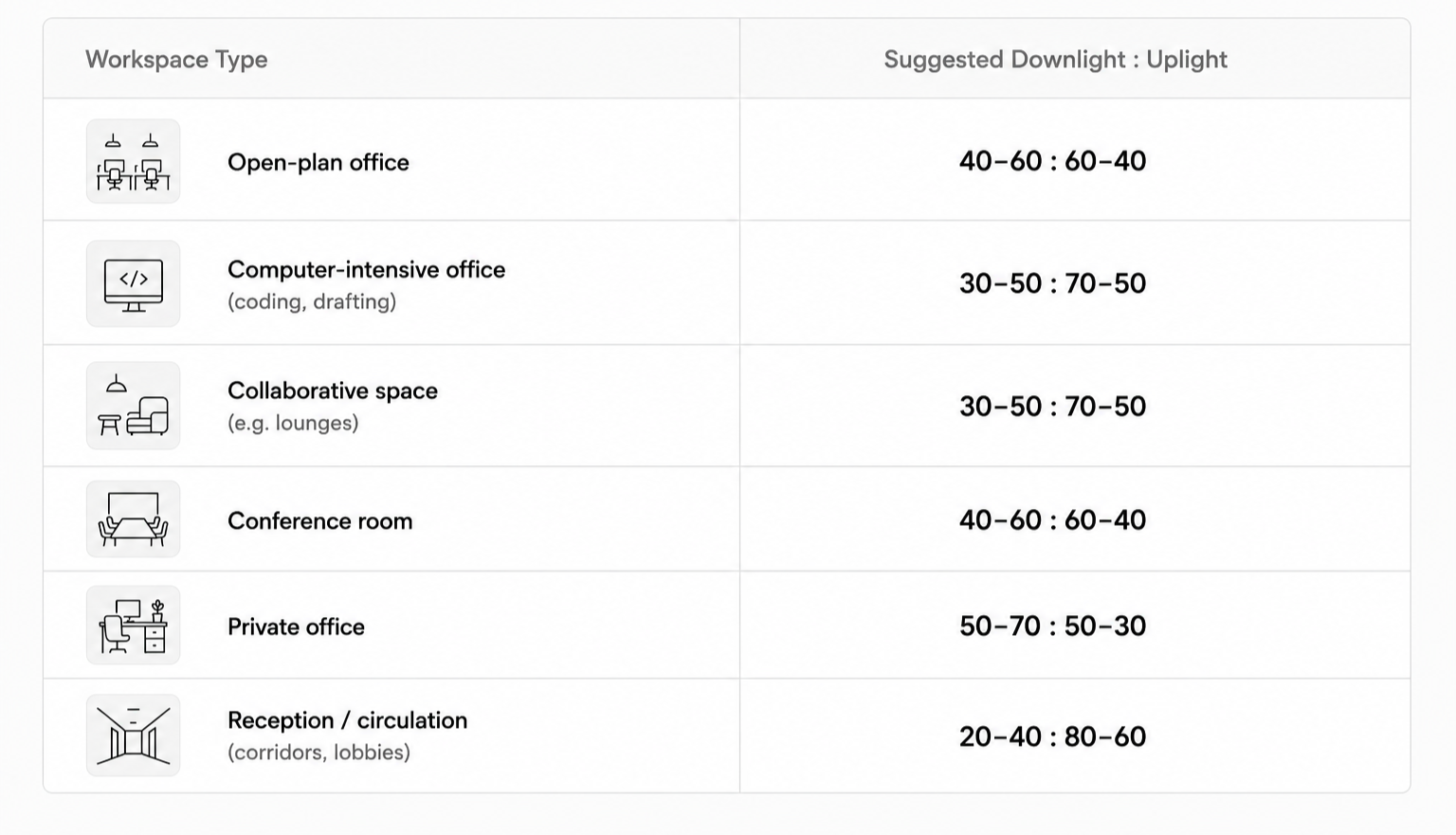
Note: Ratios are evidence-informed design recommendations synthesized from Houser et al. (2002), Boyce et al. (2006), de Vries et al. (2021), and guidance from ERCO, Zumtobel, TRILUX, Panasonic, Signify, and Bartenbach. Actual ratios should be adjusted according to ceiling height, room geometry, surface reflectance, daylight availability, visual task, and luminaire photometric distribution.
Lighting Levels
Maintain standard desktop illuminance (300–500 lx), but ensure vertical face illuminance of at least 150–300 lx (higher in morning). Use circadian design tools (e.g. CIE S 026 calculators) to target melanopic lux.
Glare & Visual Comfort
Even with indirect components, watch for glare from windows, monitors, or vertical surfaces. Use blinds and anti-glare filters as needed. Choose bulbs/luminaires with high CRI (>90) and smooth spectral power distributions. Avoid extreme contrasts (e.g. very bright downlights with dark ceilings).
Integration with WELL/LEED
Balanced lighting can help meet WELL v2 Light feature (L03 “Visual Lighting Design”) by improving visual comfort and access to high-quality light. It also supports circadian metrics (WELL L04, UL DG 24480) by boosting melanopic content when needed.
Conclusions
Synthesizing academic trials and industry guidance yields a clear principle maximize total luminous environment quality, not just desk lux. Direct-only schemes, while simple, tend to under-illuminate ceilings and walls, leading to poorer comfort and satisfaction. By contrast, mixed direct–indirect lighting achieves high task illuminance and ample ambient brightness. Across dozens of studies and surveys, occupants feel these spaces are brighter, more expansive and less fatiguing, even if measured lux at the desk is unchanged.
We therefore recommend that modern office lighting design embrace indirect light as a first-class element. Equip lighting layouts with uplight channels, ensure dynamic control, and aim for significant vertical/melanopic exposure. The extra effort pays off in human-centered metrics (comfort, well-being, perception) that no lux meter can capture.
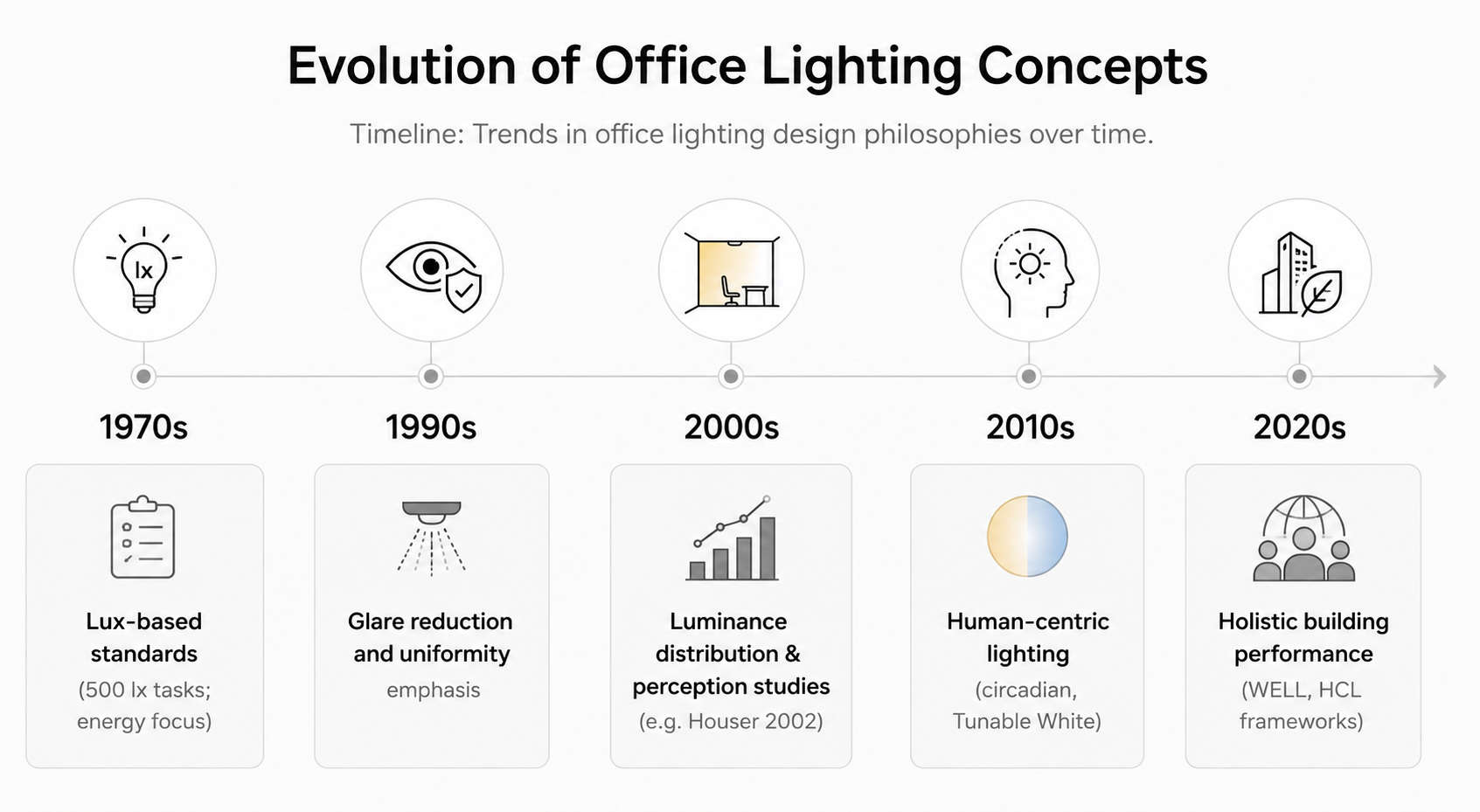
Evolution of Office Lighting Concept
Over the past four decades, office lighting has evolved from an illuminance-based engineering discipline toward a perception-oriented, human-centered design discipline. The evidence consistently demonstrates that lighting quality is defined not only by how much light reaches the workplane, but by how effectively light is distributed throughout the visual environment. Future office lighting should therefore optimize luminance distribution, vertical illuminance, glare control, daylight integration, and adaptive controls to support comfort, wellbeing, collaboration, and Human-Centered Building Performance.
About ALTA Integra
This review reinforces ALTA Integra's Human-Centered Building Performance philosophy exceptional workplaces are not created by meeting illuminance standards alone, but by integrating lighting, acoustics, thermal comfort, indoor air quality, and building physics into a unified design strategy that enhances human health, perception, and performance.
ALTA Integra brings together expertise in Architectural Building Physics—including Lighting, Acoustics, Thermal Comfort, and Indoor Air Quality—to create healthier, more comfortable, and higher-performing environments. Through evidence-based design and multidisciplinary collaboration, we strive to advance Human-Centered Building Performance for projects across diverse building sectors.
#light #lights #lighting #lightlife #lightingdesign #lightingdesigner #lightingconsultant #architecture #architecturalligthing #interiordesign #interiorlighting #ceilinglight #lightingideas #lightinginspiration #officelighting #lightproject #lightingproject #office #officedesign #openplanoffice #corporaterealestate #facilitymanagement #humanresourcedevelopment #health #wellbeing #productivity