Human-Centered Building Performance
Literature Reviews, Research Insights & Evidence-Based Design Frameworks
Explore literature reviews, research insights, and evidence-based design frameworks.
Discover how acoustics, lighting, thermal comfort, indoor air quality, passive design, and smart building technologies work together bridging building physics, environmental psychology, and sustainable design—to create healthier, more comfortable, and higher-performing environments for people.

Wireless Communication Technology from Electromagnetism Theory
With the publication of “A Dynamical Theory of Electromagnetic Field" in 1865, Maxwell demonstrated that electric and magnetic fields travel through space as electromagnetic waves moving at the speed of light. James Clerk Maxwell was a Scottish scientist in the field of mathematics and mathematical physics. Maxwell’s theory and equation about Electromagnetic have been called the "second great unification in physics” where the first one had been realized by Isaac Newton.

In 1885, Heinrich Rudolf Hertz, a German physicist was the first one who conclusively proved the existence of the electromagnetic wave which was theorized by James Clerk Maxwell 20 years back. Hertz also well known as the frequency unit (cycles per second) in honoring his work.

After success with his innovation of Alternating Current Power House, Nikola Tesla has a dream that people can communicate in real-time wirelessly from one part of the earth to the opposite part through electromagnetic waves. To realize his dream he built an experimental wireless tower in Shoreham, New York. The test facility was intended to be a transatlantic radiotelegraphy station and wireless power transmitter but was never completed due to funding drying up.

In the year 1900, Tesla claimed that there would be the precise wireless transmission of signals that would be received by devices no larger than a watch.

Tesla's Wardenclyffe wireless station, located in Shoreham, New York, was seen in 1904. Source: Wikimedia
A person who actually succeeds in making an engineering and commercial success of radio by innovating the work of Maxwell’s theory and Hertz experiment is Guglielmo Marconi. This was not a new idea; numerous investigators and inventors had been exploring wireless telegraph technologies and even building systems using electric conduction, electromagnetic induction, and optical (light) signaling for over 50 years, but none had proven technically and commercially successful.

Supported by his father, Marconi continued to read through the literature and picked up on the ideas of physicists who were experimenting with radio waves. Finally, In December 1894, Marconi demonstrated a radio transmitter and receiver to his mother, a set-up that made a bell ring on the other side of the room by pushing a telegraphic button on a bench. The role played by Marconi Co. wireless in maritime rescues raised public awareness of the value of radio and brought fame to Marconi, particularly the sinking of the RMS Titanic on 15 April 1912 and the RMS Lusitania on 7 May 1915.
After many reports began to appear about the success Guglielmo Marconi was having in developing a practical system of transmitting and receiving radio signals, then commonly known as "wireless telegraphy". Reginald Fessenden has no electricity knowledge but has a passion to become an electricity inventor. With help from an ex-assistant tester for Edison Machine Works, began limited radio experimentation and soon came to the conclusion that he could develop a far more efficient system than the spark-gap transmitter and coherer-receiver which had been created by Oliver Lodge and Marconi.

By 1899 he was able to send radiotelegraph messages between Pittsburgh and Allegheny City, using a receiver of his own design. In 1928, as part of a lecture reviewing "The Early History of Radio in the United States", H. P. Davis, commenting on entertainment offerings, asserted that "Reginald Fessenden, probably the first to attempt this, broadcast a program Christmas Eve 1906".
Nowadays, along with the development of audiovisual and digital technology, we know many wireless telecommunication and broadcast systems such as radio, television, and mobile phone. Thanks to James Clerk Maxwell a man who introduced his first theory of electromagnetism.

The evolution of Architecture’s Beauty and Science philosophy is by self-learning from its own history
Hegel's (1826) theory that architecture is the Absolute Spirit expresses cognitive content as an aspect of organizing the natural environment. As with Architecture History in general, Hegel offers a progressive account of architectural history, wherein successive stages the Symbolic, the Classical, and the Romantic periods bring increasing freedom among architectural objects from symbolism and purpose and enhanced expression of the Absolute Spirit.
Symbolic Architecture is where the shape of the architecture is trying to free itself from its nature, as Aristotle (384 BC) said that architecture form is pursuing the holiest picture of biological explorations as the “total form” of the animal. The paradigm example of Symbolic Architecture is Sphinx which might symbolize the holiest form of animal and the Pyramid that functions more as a symbol of the everlasting home for their king which regards as a son of God.

Sphinx and Pyramid is the paradigm example of Symbolic Architecture
Classical Architecture is a harmonious shape between form and function, the architecture is made from wood, stone, and marble. The architecture design and build with a purpose. The purpose of the temple mainly concentrated on the naos, the "dwelling" of the cult statue. A famous example of Classical Architecture is the Greek Temple. The elaboration of the temple's external aspects served to stress the dignity of the naos. Similar to the Pyramid the interior part of the architecture is remark as a sacred place.

An image of Greek temple made from stone and mud
Romantic Architecture philosophy is born after Christianity, so the interior function as a collective place for people to celebrate or worship. The architecture concept of beauty is beyond functionality with decorative ornament and stained glasses due to the development of material process technology and architecture science. This is true even of the Gothic, which Hegel takes as an ultimate (if qualified) success in the history of architecture for its metaphorical communication of spirit.
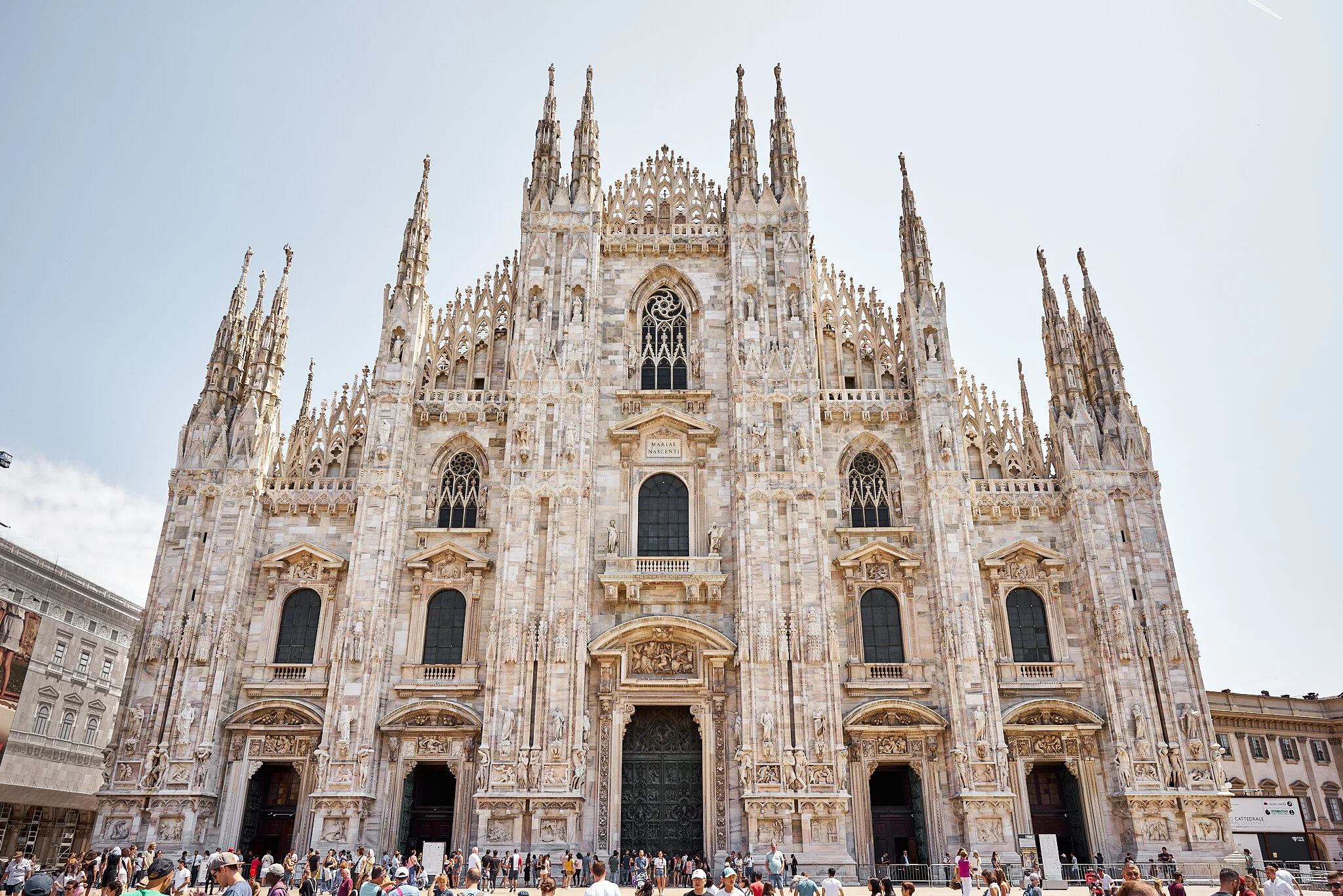
Along with the material technology and architecture science - Gothic Architecture is the enhanced expression of the Absolute Spirit
After Hegel's theory about Romantic Architecture which is the time when he lived, below are some thoughts from modern Architecture philosophers.
Merleau-Ponty (1945) that our existence in the world is best understood through ways it is shaped by the bodily experience of our surroundings. That bodily experience is relative to what appears in our visual field, to our tactile and kinesthetic engagement (hence to our position and motion), and to who we are as individuals and group members.
Graham (2012), the central problem of architectural aesthetics is to account for architectural meaning and value while embracing a synthesis of artistic value and utility (“engineering”) value.
J. Robinson (2012) offers an architectural application: our experience of the built environment shapes our appreciation of, and abilities to negotiate our surroundings.
ALTA Integra believes that smart and strategic integration of Architectural Building Physics knowledge such as Acoustic, Lighting, Thermal, Air Quality, and other disciplines into the built environment will make a big impact in our future history.

Modern architecture is to find the optimal blend of purpose, art and engineering
#philosophy #art #history #human #architecture #interior #science #engineering