Field Observation from Building Physics Perspective Blog
Climate → Nature → Human → Culture → Architecture → Cityscape
Explore real-world observations through the lens of building physics.
From climate and nature to human behavior, culture, architecture, and cityscapes, discover how environmental conditions shape the performance, comfort, sustainability, and experience of the built environment.

Observing the Modern Architecture of Mode Gakuen Cocoon Tower Tokyo
Mode Gakuen Cocoon Tower is one of the world's most recognizable educational buildings. Rising 204 meters across 50 stories in the heart of Tokyo, the tower was designed by Tange Associates with a distinctive cocoon-inspired form that symbolizes nurturing and supporting students throughout their educational journey.
The building is home to three educational institutions: Tokyo Mode Gakuen Fashion Vocational School, HAL Tokyo Special Technology and Design College, and Shuto Ikō Medical College.
This architectural observation explores how the building combines structural innovation, urban identity, and educational philosophy, earning international recognition including the 2008 Emporis Skyscraper of the Year award.
How Tange Associates Reinvented the University Campus for the Vertical City
Can a University Exist Without a Campus?
Cities have always shaped universities.
For centuries, great institutions of learning have expanded horizontally. Oxford grew around quadrangles. Bologna evolved through streets and piazzas. Harvard stretched across lawns and courtyards. Whether in Europe, America, or Asia, the idea of a university has remained remarkably consistent: knowledge flourishes when people have room to gather.
Tokyo challenges that assumption.
Home to more than 37 million people in its metropolitan region, the city is one of the densest urban environments on Earth. Every square metre competes for housing, offices, rail infrastructure, retail, and public space. In districts such as Shinjuku, where millions of passengers pass through the station every day, land is no longer simply expensive—it has become one of the rarest resources in the city.
Yet education continues to demand something that dense cities struggle to provide.
Community.
Universities are not merely collections of classrooms. They are ecosystems built around encounters that cannot be timetabled: a conversation after class, an unexpected critique from a lecturer, a discussion that begins over coffee and quietly evolves into a research project, a startup, or a lifelong friendship.
Traditional campuses understand this intuitively.
Their courtyards, gardens, covered walkways, cafés, and libraries are not leftover spaces between buildings; they are where much of education actually happens.
The paradox is obvious.
The denser a city becomes, the more valuable those spaces become.
The less land remains available to create them.
That raises a question that is becoming increasingly relevant not only for Tokyo, but also for Jakarta, Singapore, Hong Kong, Seoul, London, New York, and every growing metropolitan region confronting similar pressures.
Can a university survive without a campus?
Or perhaps more provocatively:
Can a skyscraper become a campus?
These were not abstract philosophical questions.
They became the starting point for one of the most ambitious educational buildings of the twenty-first century.
When Mode Gakuen decided to consolidate its three educational institutions into a single building, it did not simply commission another high-rise. It launched an invited architectural competition with an unusual requirement that immediately challenged conventional thinking.
The new building could not be rectangular.
More than 150 proposals from approximately 50 architectural firms attempted to answer the brief. Most explored new architectural forms. Only one fundamentally reconsidered what a university could become.
Tange Associates did not begin by designing a tower. They began by redesigning the idea of a campus.
Instead of asking how thousands of students could be accommodated vertically, they asked a far more human question.
How do people actually learn?
The answer was surprisingly simple.
People learn from teachers.
They also learn from one another.
Learning happens during lectures.
It also happens while walking to class, waiting for an elevator, sharing lunch, looking out of a window after several hours of concentrated work, or unexpectedly meeting someone from another discipline.
In other words, education is not confined to classrooms.
It unfolds continuously through the environment.
That philosophy gave birth to the Mode Gakuen Cocoon Tower, completed in 2008.
Rising 204 metres across 50 storeys, it remains the second tallest educational building in the world, accommodating nearly 10,000 students from Tokyo Mode Gakuen, HAL Tokyo, and Shuto Iko Medical College. Yet height is merely its most visible characteristic.
Its true innovation is almost invisible.
The building was conceived not as an object, but as an environmental system designed to nurture transformation.
The name itself reveals the intention.
A cocoon is not admired for its appearance.
It exists to create the conditions for growth.
Before a butterfly can fly, it requires protection, stability, and time. Paul Tange has explained that this biological process became the central metaphor for the project. Students arrive carrying curiosity, uncertainty, and ambition. The role of architecture is not simply to shelter them while they study, but to create an environment where they can develop intellectually, creatively, socially, and professionally before entering the world beyond the university.
That idea immediately resonated with me.
Not because I am an architect.
But because I spend my professional life studying Building Physics.
Architecture is often judged by its form.
Building Physics asks a different question.
How does a building influence the people inside it?
Does daylight help them remain alert?
Does the acoustic environment allow ideas to be exchanged effortlessly?
Does thermal comfort disappear into the background, allowing concentration rather than distraction?
Does fresh air sustain attention during long hours of learning?
Does technology quietly support collaboration instead of demanding attention?
These questions rarely appear on architectural drawings.
Yet they determine whether a building merely functions or genuinely improves human performance.
That is why, during my visit to Mode Gakuen Cocoon Tower in November 2023, I decided to experience the building differently.
I was not interested in counting floors or measuring the height of its iconic white lattice.
I wanted to understand something much more difficult to photograph.
I wanted to understand how the building felt.
Because the most memorable architecture is rarely remembered for its façade.
It is remembered for the invisible environmental conditions that quietly shape how people think, communicate, learn, and grow.
As the Finnish architect Juhani Pallasmaa writes,
"The task of architecture is to make visible how the world touches us."
Standing outside Shinjuku Station on a cool November afternoon, surrounded by trains, traffic, and one of the most intense urban environments on Earth, I had not yet entered the building.
And already, without fully realizing it, my body had begun reading the city—its sound, its movement, its density—preparing to notice the moment when all of those sensations would begin to change.

November 2023 — Walking Toward a Different Kind of Campus
The walk from Shinjuku Station to Mode Gakuen Cocoon Tower takes only a few minutes. Yet it feels like crossing two completely different worlds.
On a cool afternoon in November 2023, I emerged from one of the busiest transport hubs on Earth and immediately became part of Tokyo's relentless rhythm. Trains arrived with remarkable precision. Streams of commuters flowed across intersections without hesitation. Taxi engines idled at the curb while giant LED screens competed with mirrored façades for attention. Every direction seemed filled with movement.
Cities often communicate through architecture. Shinjuku communicates through energy.
As I walked through the district, I noticed something I have experienced in many global business centres—Singapore's Marina Bay, Hong Kong's Central, New York's Midtown.
The buildings were impressive.
The environment was exhausting.
Not because any individual building was poorly designed.
But because the city continuously demanded attention.
Our eyes tracked moving advertisements.
Our ears filtered overlapping conversations, traffic, train announcements, and pedestrian signals. Our bodies constantly negotiated crowds, changing directions, and varying temperatures as we moved between outdoor streets, underground passages, and air-conditioned shopping arcades.
Environmental psychologists describe this phenomenon as cognitive load—the mental effort required simply to process the surrounding environment.
Most people never consciously notice it.
Their brains simply become tired.
As a Building Physics consultant, I have learned that this invisible fatigue is often where architecture begins.
Not at the drawing board.
Not on the construction site.
But inside the human nervous system.
Long before we evaluate a building aesthetically, our sensory systems are already asking much simpler questions.
Is this place safe?
Can I hear clearly?
Can I see comfortably?
Can I breathe easily?
Can I remain here without effort?
These questions are ancient.
Architecture merely provides modern answers.
Seeing the Building Before Understanding It
Then I saw it.
Unlike its neighbouring towers, Mode Gakuen Cocoon Tower did not appear rigid or monumental.
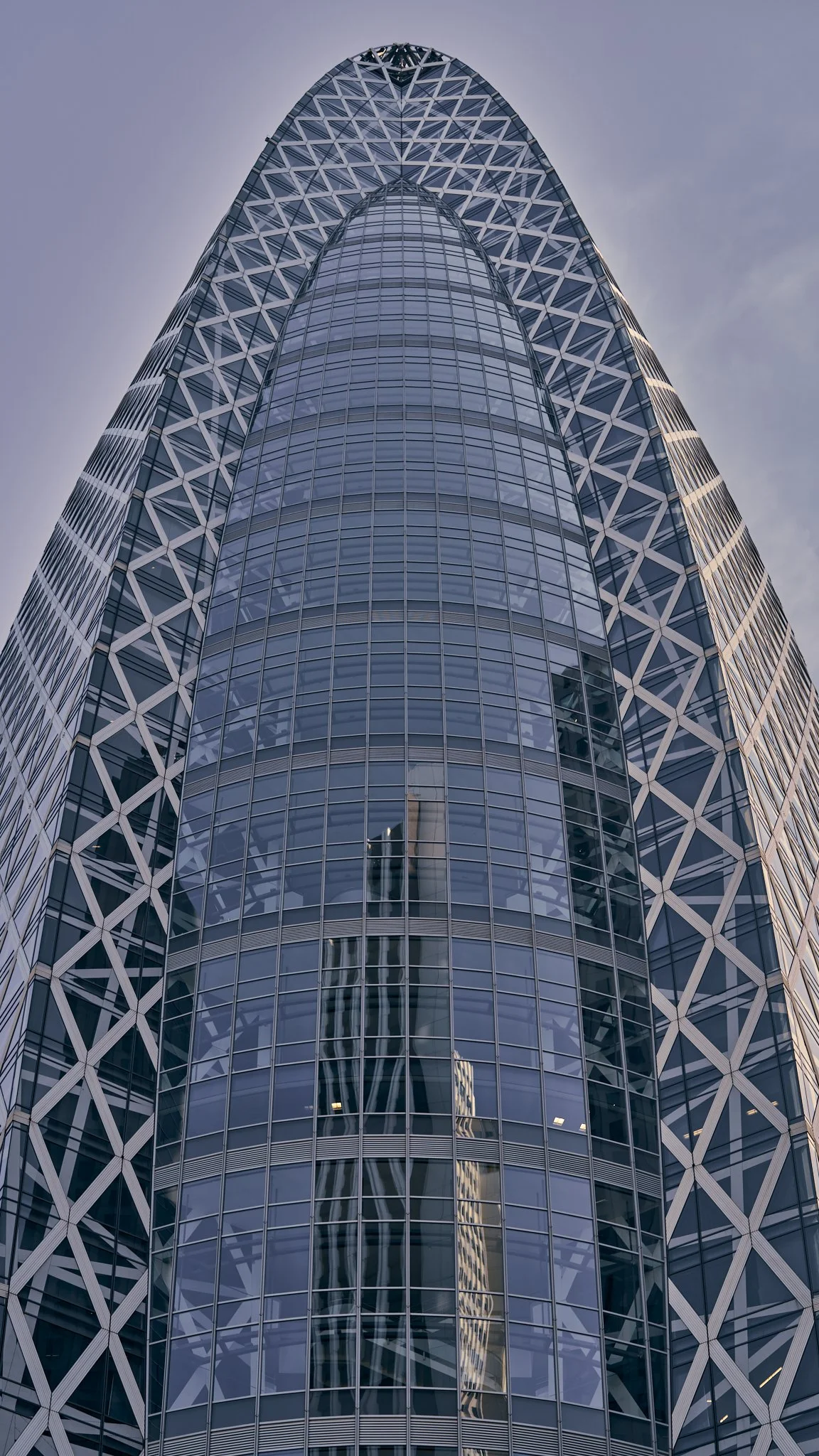
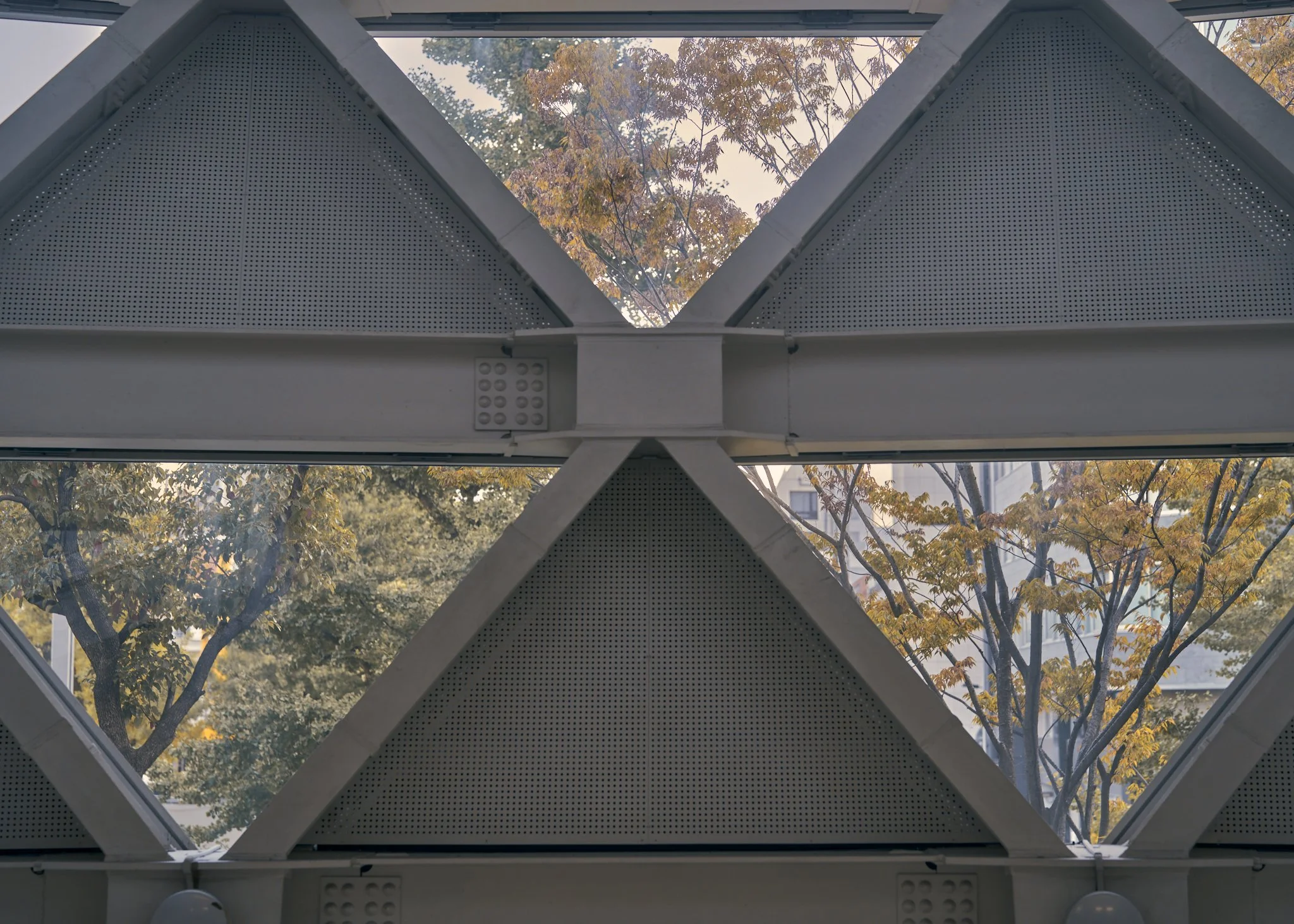
Its flowing elliptical profile rose above Shinjuku with unexpected softness. The white diagonal exoskeleton wrapped around the façade like woven fibres rather than structural bracing. Against the surrounding landscape of orthogonal office towers, it appeared almost biological.
Not aggressive.
Protective.
That impression was intentional.
Paul Tange has explained that the cocoon symbolises a place where transformation occurs before entering the outside world.
Students, like butterflies, require an environment that protects growth before expecting flight.
Standing across the street, however, I was not thinking about symbolism.
I was thinking about a much simpler question.
Why does this building already feel calmer than the city surrounding it?
The answer could not be found in the façade alone.
Buildings do not change human experience simply because they look different.
They change experience because they change environments.
At that moment I realised I was no longer observing architecture.
I was beginning to observe Building Physics.
Architecture Begins With the Body
People often assume we experience architecture visually.
I have gradually come to believe the opposite.
We experience architecture physiologically.
Vision certainly matters.
But vision is only one of several environmental systems our bodies evaluate every second.
Our ears constantly measure background noise.
Our skin evaluates radiant temperature and moving air.
Our lungs respond to freshness without asking permission.
Our eyes continuously adjust to brightness, glare, colour, contrast, and distance.
Together, these sensory systems perform thousands of unconscious environmental calculations every minute.
Remarkably, they complete this assessment long before we form an architectural opinion.
That is why two buildings with similar appearance can produce entirely different emotional responses.
One feels calm.
Another feels tiring.
One encourages conversation.
Another subtly discourages people from staying.
One disappears into the background.
The other constantly reminds occupants that they are inside a building.
“We shape our buildings; thereafter they shape us.”
The quotation is often interpreted politically.
I increasingly think it is biological.
Buildings continuously influence the way our nervous systems function.
Every hour.
Every day.
Every year.
A Different Kind of Design Brief
The story of Mode Gakuen Cocoon Tower becomes even more remarkable once its origins are understood.
When Mode Gakuen announced the competition for its new educational headquarters, it did something unusual.
Instead of prescribing a particular style, height, or architectural language, it imposed one deceptively simple restriction.
The building could not be rectangular.
At first glance, the requirement appears almost whimsical.
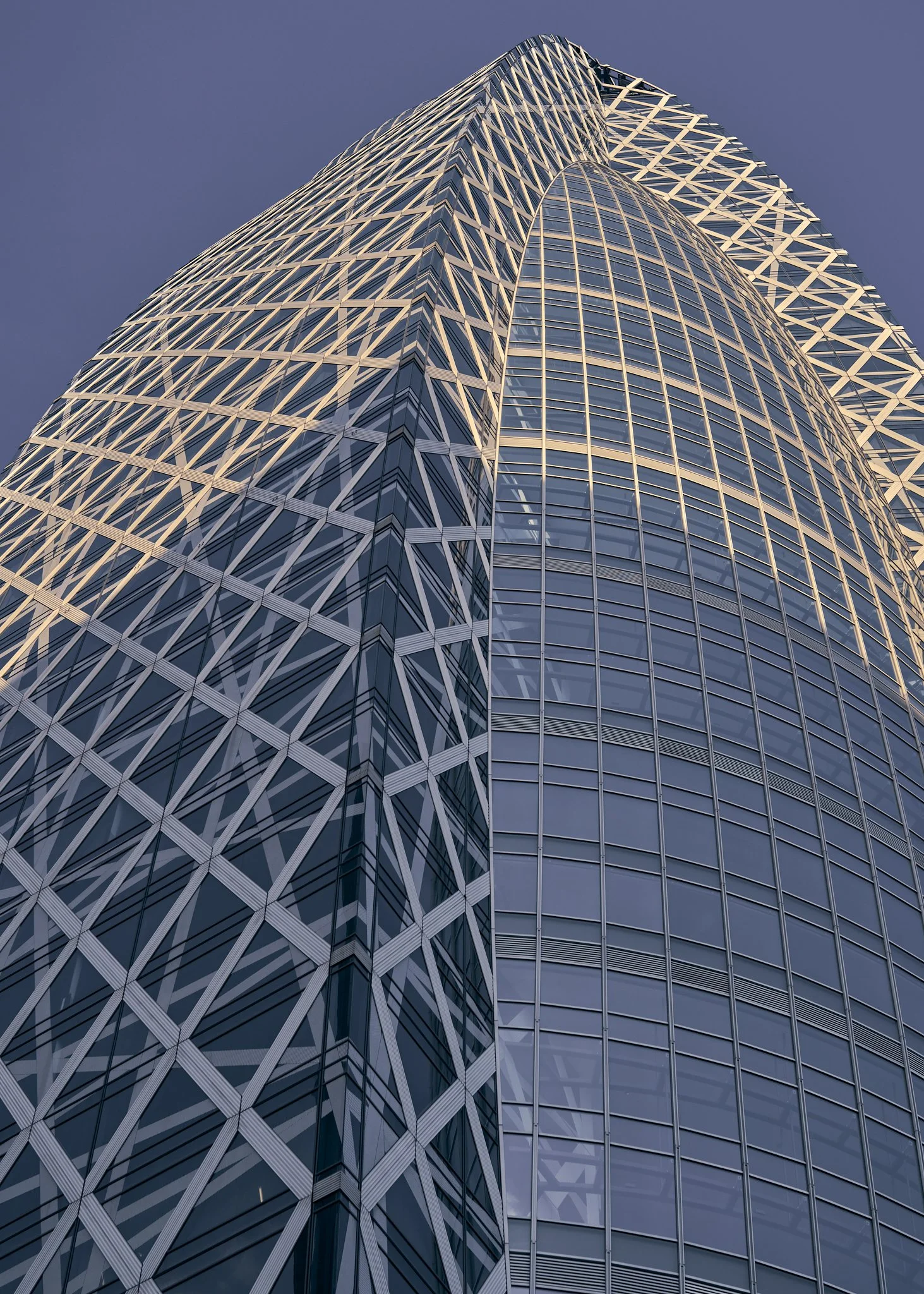
Why prohibit one of architecture's oldest geometries?
The answer becomes obvious once you understand the project.
A rectangular tower almost inevitably behaves like an office building.
Efficient floor plates.
Central lift core.
Double-loaded corridors.
Repeated floors.
Everything optimized for rentable area.
Everything optimized for efficiency.
But universities are not offices.
Their greatest value rarely emerges inside classrooms.
It emerges between them.
A conversation after a lecture.
A spontaneous debate.
An unexpected meeting between students from different disciplines.
A chance encounter that quietly changes someone's career.
The client therefore recognised something remarkably insightful.
If the building began as an office tower...
it would probably behave like one.
The competition was never searching for a new shape.
It was searching for a new educational typology.
Redesigning the Campus
Approximately 50 architectural firms submitted more than 150 proposals.
Most approached the challenge by asking,
"How do we fit a university into a skyscraper?"
Tange Associates reversed the question.
How should a skyscraper change in order to become a university?
That subtle shift transformed the entire project.
Instead of stacking independent classroom floors one above another, the architects organised the building into three-storey learning communities connected by generous Student Lounges overlooking Tokyo.
The lounges were not inserted after the classrooms had been planned.
They became the organising principle of the building itself.
Principal Architect Masaki Nakayama later explained that education extends far beyond formal lectures. Conversations after class, seeking advice from teachers, spending time with friends—even falling in love—are all essential parts of student life.
Those words stayed with me throughout my visit.
Most educational buildings are designed around teaching.
This one appeared to be designed around learning.
Those are not the same thing.
Teaching can happen inside a classroom.
Learning happens everywhere.
Before I Opened the Door
Standing outside the entrance, I paused for a moment before walking in.
The tower rose 204 metres above me.
Fifty storeys.
Nearly 10,000 students.
Three independent institutions.
One of the most constrained sites in Tokyo.
I knew the statistics.
I had already read about the structure, the engineering, the architectural awards, and the construction.
None of those facts interested me anymore.
Because the moment I reached for the entrance door, I realised something.
The most important part of the building could never be photographed.
It would only reveal itself after I stepped inside.
Not through its structure.
Not through its form.
But through something much quieter.
Through the gradual transition from the noise of Shinjuku into another environmental world, where my ears would notice the change before my eyes, where daylight would slowly begin replacing the urgency of the city, where temperature would quietly disappear from conscious thought, where fresh air and invisible technology would support thousands of students without ever asking to be noticed...
Daylight as Social Infrastructure
The longer I observed the Student Lounges, the less I thought about windows.
I began thinking about people.
Architects often describe daylight as a visual phenomenon.
Building scientists describe it as an environmental resource.
Watching students occupy this building, I started seeing it differently.
Daylight is social infrastructure.
It quietly determines where people choose to be.
No signs directed students toward the perimeter.
No furniture arrangement forced them to gather near the glazing.
Yet the brightest places slowly became the busiest.
The phenomenon unfolded almost invisibly.
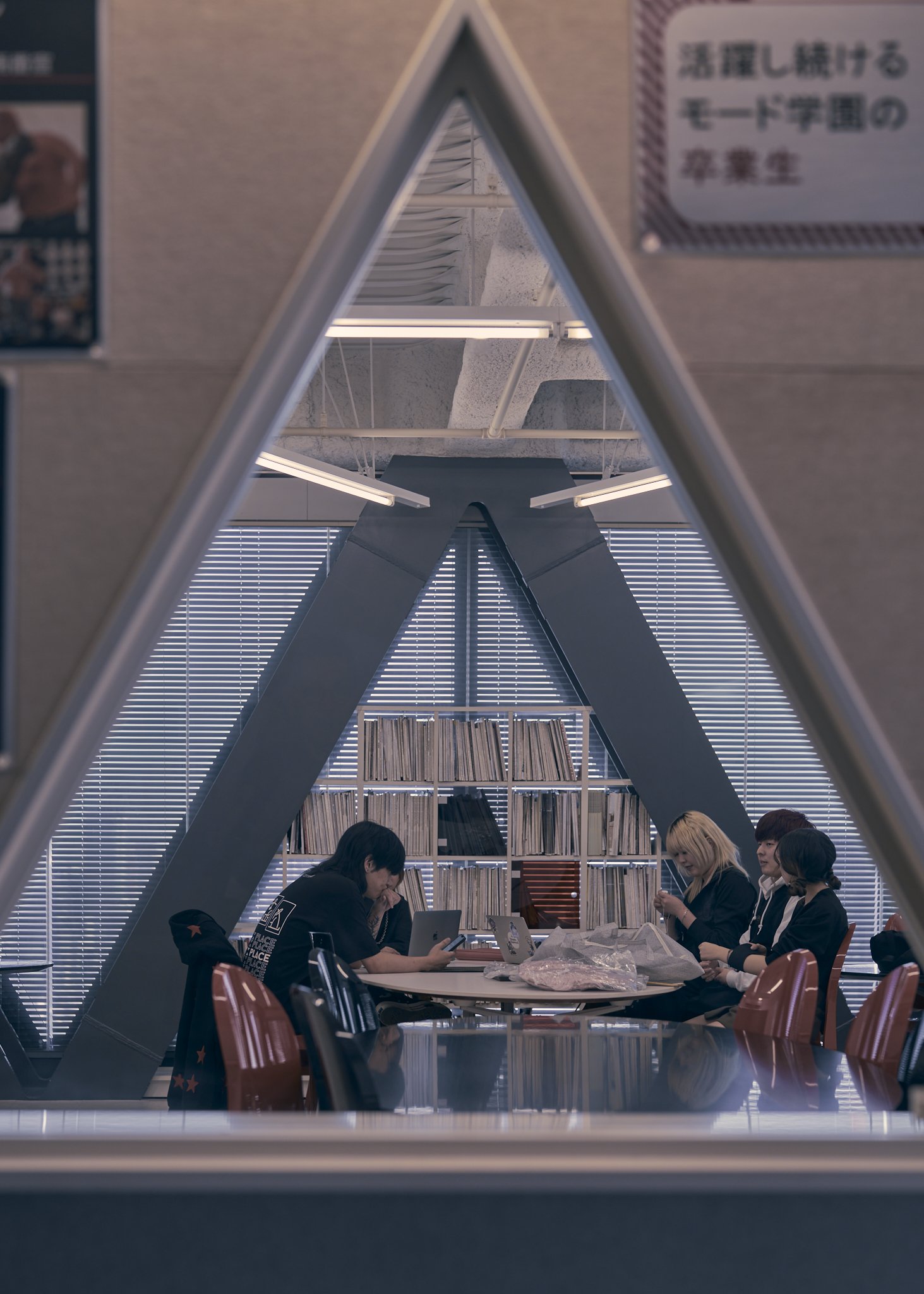
One student arrived carrying a portfolio and instinctively chose the table closest to natural light. A few minutes later another joined. Soon a conversation began. Across the atrium, two software engineering students rolled their chairs toward the window before opening their laptops. Nearby, several medical students paused beside the glazing, continuing a discussion that had clearly begun elsewhere.
Nobody appeared to be choosing daylight consciously.
Their bodies were.
Environmental psychology has long demonstrated that humans possess an innate preference for naturally illuminated environments. More recently, neuroscience has begun explaining why. Exposure to daylight helps synchronize our circadian rhythm—the internal biological clock regulating alertness, hormone production, mood, and sleep quality. Blue-rich morning daylight suppresses melatonin, encouraging wakefulness, while changing daylight throughout the afternoon helps the brain remain oriented in time.
Building standards such as the WELL Building Standard and LEED increasingly recognize these biological relationships. Designers now evaluate not only how much daylight enters a room, but also whether occupants maintain meaningful visual access to the outdoors.
Yet standing inside the Cocoon Tower, none of those standards entered my mind.
I simply noticed that nobody seemed eager to retreat into the darker corners of the building.
The environment quietly encouraged people to remain where other people already were.
That observation reminded me of the urbanist William H. Whyte, whose studies of successful public spaces revealed a deceptively simple truth:
"What attracts people most, it would appear, is other people."
The more I watched, the more I realized daylight was helping make those encounters possible.
Looking Up
One environmental quality impressed me more than any daylight metric ever could.
The building never allowed students to lose contact with the horizon.
Modern education increasingly takes place at arm's length.
Students spend hours looking at laptops.
Designers examine drawings.
Programmers study code.
Medical students review digital anatomy.
Every discipline asks the eyes to maintain near focus for extraordinary lengths of time.
Human vision, however, evolved for landscapes.
Not screens.
Every few minutes I noticed students interrupting their concentration with almost identical movements.
They looked up.
Not for long.
Perhaps three seconds.
Sometimes five.
Their gaze travelled beyond the glazing toward neighbouring towers, drifting clouds, or the distant skyline before quietly returning to notebooks, tablets, and computer monitors.
Those brief pauses fascinated me.
Building scientists describe this as window visibility or quality of view. Environmental psychologists describe the resulting mental recovery through Attention Restoration Theory, originally proposed by Rachel and Stephen Kaplan. The theory suggests that directed attention—our ability to concentrate intensely—gradually becomes fatigued and recovers when we briefly experience environments that require effortless observation.
Again, the terminology sounds technical.
The human experience is beautifully simple.
Your eyes stretch.
Your mind follows.
The room becomes easier to think inside.
Perhaps that is why the Student Lounges never felt like waiting areas.
They felt like places where ideas could breathe.
The Building Knows When to Disappear
As afternoon slowly progressed, another realization emerged.
The architecture itself had become almost invisible.
Earlier in the day I had admired the white diagonal lattice, the elegant geometry, and the remarkable structural expression.
Now I barely noticed them.
Instead, I noticed conversations.
People.
Movement.
Light.
It reminded me of something the Finnish architect Juhani Pallasmaa once wrote:
"The experience of architecture is multi-sensory; qualities of space, matter and scale are measured equally by the eye, ear, nose, skin, tongue, skeleton and muscle."
The more successful the environment became, the less attention it demanded.
That may be architecture's greatest paradox.
Buildings often strive to become iconic.
The best ones eventually disappear.
Not physically.
Perceptually.
Occupants stop thinking about architecture and begin thinking about one another.
As a Building Physics consultant, I find that profoundly important.
Clients frequently ask how to design more productive workplaces or more effective learning environments.
The answer rarely begins with technology.
Or furniture.
Or finishes.
It begins with environmental conditions that quietly remove friction from human interaction.
Great buildings do not force collaboration.
They reduce the environmental barriers that prevent it.
Then I Forgot About Temperature
Only after spending nearly an hour inside the building did I realize something almost impossible to notice.
I had completely stopped thinking about temperature.
That sounds insignificant.
It is one of the highest compliments I can give a building.
Thermal discomfort is remarkably demanding.
A room only two or three degrees warmer than expected subtly reduces concentration. A cold draft across the neck becomes impossible to ignore. Excessive radiant heat from glazing encourages occupants to move away from windows no matter how beautiful the view.
Here, none of those negotiations occurred.
I stood beside the façade overlooking Shinjuku, expecting the familiar sensation of solar heat radiating through glass.
It never arrived.
I walked deeper into the lounge expecting cooler pockets near the supply air diffusers.
There were none.
The environment remained astonishingly even.
Engineers describe this through operative temperature—the combined effect of air temperature, radiant temperature, humidity, and air movement—defined in standards such as ASHRAE 55 and ISO 7730. Unlike a thermostat reading, operative temperature reflects what the human body actually experiences.
The distinction matters.
Because comfort is not measured by the air.
It is measured by the person.
Like a perfectly tailored suit, the best thermal environment never draws attention to itself.
It simply fits.
Leaning quietly against the glazing, I watched sunlight continue its slow movement across the floor. A student removed a jacket, not because the room demanded it, but because the afternoon had gently warmed. Another shifted a chair slightly closer to the light. Somewhere behind me, elevator doors opened almost silently before disappearing beneath the low murmur of conversation, while outside the immense machinery of Shinjuku continued racing through another ordinary day, completely unaware that inside this tower, an invisible choreography of light, sound, temperature, fresh air, and human curiosity was unfolding with remarkable precision...
The Air You Never Notice
If sound was the first sensation to change when I entered the building, air was the last.
Or perhaps it never appeared at all.
Nearly two hours had passed before I realised I had not once become aware of the ventilation system.
No cold draft swept across the back of my neck.
No supply diffuser whispered overhead.
No familiar dryness lingered in my throat after long conversations.
The air simply existed—quietly, consistently, almost anonymously.
For a building accommodating nearly 10,000 students, that is an extraordinary achievement.
Educational buildings present one of the most demanding environmental challenges imaginable. Occupancy changes every hour. Lecture theatres empty while studios suddenly fill. Student lounges become social hubs between classes before gradually dispersing. Every additional person introduces heat, moisture, and carbon dioxide, continuously altering the indoor environment.
Unlike structure or façade, ventilation must constantly adapt to a building that never stops changing.
Yet the greatest success of ventilation is that occupants rarely notice it.
As the environmental engineer Ole Fanger, whose research fundamentally shaped modern thermal comfort science, famously observed,
"The best indoor climate is one that is not noticed."
Those words stayed with me as I continued walking through the tower.
Thinking Requires Oxygen—Not Just Ideas
We often celebrate universities as places where ideas flourish.
Less frequently do we acknowledge that ideas depend upon biology.
The human brain represents only about 2 percent of body weight, yet it consumes approximately 20 percent of the body's oxygen. Concentration, memory, judgement, and creativity are therefore influenced not only by teaching quality but also by the invisible chemistry of the air surrounding us.
Over the past decade, research from institutions including the Harvard T.H. Chan School of Public Health has demonstrated that improved indoor environmental quality—including lower carbon dioxide concentrations and better ventilation—is associated with significantly better cognitive performance in areas such as strategic thinking, information usage, and crisis response.
Carbon dioxide itself is not the villain at these concentrations.
Rather, it serves as a practical indicator of whether enough outdoor air is reaching occupants.
Standards such as ASHRAE 62.1 define minimum outdoor air ventilation rates for occupied spaces, while the WELL Building Standard encourages maintaining indoor CO₂ concentrations below approximately 800–1,000 ppm during occupied periods.
Numbers such as 800 ppm sound abstract.
The body interprets them differently.
It is the difference between leaving a two-hour lecture mentally alert...
or wondering why everyone suddenly feels tired.
Most people blame the lecturer.
Sometimes they should blame the air.
Air Is an Architectural Material
Walking through Mode Gakuen Cocoon Tower gradually changed the way I thought about ventilation.
Engineers often describe it through ductwork, air-handling units, filters, fans, and airflow calculations.
Occupants experience none of those things.
They experience freshness.
That difference is profound.
Architecture traditionally celebrates tangible materials.
Concrete.
Steel.
Glass.
Timber.
Stone.
Yet from the perspective of human physiology, air may be the most important building material of all.
Unlike walls or ceilings, it is the only material occupants continuously carry inside their own bodies.
Every breath becomes part of the building's environmental story.
That idea transformed the way I observed the Student Lounges.
Students were laughing.
Talking.
Working.
Some had clearly been there for hours.
Nobody appeared restless.
Nobody instinctively searched for an open window.
Nobody hurried away because the room felt stale.
The architecture had quietly removed another source of environmental friction.
Then I Noticed Something Else
Or perhaps...
I noticed what I could not notice.
Technology.
Modern educational buildings are saturated with technology.
Wireless access points.
Building Management Systems.
Environmental sensors.
LED lighting.
Digital signage.
Audio-visual networks.
Lecture capture.
Security systems.
Occupancy monitoring.
Thousands of interconnected devices quietly sustain the daily life of the building.
Most visitors never see them.
Nor should they.
The philosopher Martin Heidegger once wrote,
"The most useful thing is invisible in its usefulness."
Although he was writing about tools rather than buildings, the observation feels remarkably appropriate here.
The finest technology rarely announces itself.
It simply allows people to concentrate on something else.
Walking through the Cocoon Tower, I realised that technology was behaving much like daylight.
When it succeeded, attention shifted away from the system itself and toward human activity.
Students connected laptops without hesitation.
Presentations appeared effortlessly.
Wireless communication simply existed.
Environmental systems quietly adjusted lighting, ventilation, and thermal conditions without demanding interaction.
The building was intelligent.
But it never tried to appear intelligent.
Technology That Serves, Rather Than Dominates
This distinction feels increasingly important.
Many contemporary buildings celebrate technology almost as an architectural style. Screens become façades. Sensors become marketing features. Digital interfaces appear everywhere, reminding occupants how technologically advanced the building has become.
Mode Gakuen follows a different philosophy.
Technology remains almost entirely invisible.
It supports learning without becoming the subject of learning.
As I watched students moving between studios, classrooms, and lounges, it became obvious that nobody was paying attention to the infrastructure enabling their work.
They were paying attention to one another.
Perhaps that is the highest compliment modern technology can receive.
It disappears into human experience.
As the architect Cedric Price once provocatively asked,
"Technology is the answer, but what was the question?"
Walking through this building, the answer seemed clear.
Technology was never the destination.
It was the quiet foundation that allowed education, creativity, and collaboration to unfold without interruption.
Standing beside the glazing, I looked back across the three-storey atrium one more time.
Fashion students adjusted garments beneath the soft afternoon light.
Engineering students clustered around glowing laptop screens.
Medical students rehearsed presentations before quietly moving toward the next classroom.
Above them, unseen air continued circulating.
Lighting adjusted almost imperceptibly as clouds drifted across the Tokyo sky.
Thousands of digital signals moved silently through the building's nervous system.
Yet none of these invisible systems asked to be admired.
They simply continued working together, almost like the organs of a living body—breathing, sensing, adapting, and responding—while the people inside remained wonderfully unaware that one of the world's most sophisticated educational environments was quietly supporting every conversation, every sketch, every line of code, every question, and every possibility that might emerge before the day was over...
The Memory That Remains
Months after returning from Tokyo, I found that I could no longer remember certain technical details without opening my notebook.
I no longer remembered the exact dimensions of the atrium.
Or the structural grid.
Or the façade module.
Those facts remained important.
They simply weren't what stayed with me.
Instead, I remembered a quiet afternoon in November 2023.
A fashion student holding fabric against the daylight before making a design decision.
Two software engineering students debating a user interface while absentmindedly watching trains weave through Shinjuku below.
A lecturer pulling up a chair rather than ending a conversation.
A medical student standing silently for a moment at the window, allowing tired eyes to travel beyond the skyline before returning to a notebook.
None of these moments appeared extraordinary.
Together, they revealed something extraordinary.
The building had almost disappeared.
Not physically.
Experientially.
Its structure remained hidden behind conversations.
Its environmental systems dissolved into comfort.
Its technology became invisible behind human interaction.
Its architecture quietly stepped aside and allowed learning to take centre stage.
Juhani Pallasmaa once wrote:
"The task of architecture is to make visible how the world touches us."
Standing inside Mode Gakuen Cocoon Tower, I found myself wondering whether the finest architecture achieves something even more difficult.
It makes itself almost invisible.
It allows daylight to become thought.
Acoustics to become conversation.
Thermal comfort to become concentration.
Fresh air to become clarity.
Technology to become connection.
And space itself to become possibility.
As I reached Shinjuku Station once again, I turned for one last look toward the white cocoon rising above the evening skyline.
From a distance, it was once again an iconic skyscraper.
But I knew that its greatest achievement was not the elegance of its silhouette, the sophistication of its engineering, or even the ambition of its architecture.
Its greatest achievement existed where no photograph could fully capture it.
In the countless conversations unfolding beneath its quiet light.
In the ideas that would become prototypes, research papers, medical innovations, software companies, fashion collections, and careers.
In the invisible environmental conditions that had quietly supported every one of those moments.
Perhaps that is the future of architecture.
Not taller buildings.
Not smarter buildings.
Not more iconic buildings.
But buildings that understand something profoundly simple:
The true measure of architecture is never the height of the structure. It is the quality of life, learning, and human connection that unfolds within it.