Why Airports Need a Specialist Lighting and Daylighting Simulation Consultant
Lessons from International Airports I Have Visited: How Scientific Lighting Design Enhances Passenger Experience, Building Performance, and Sustainability
Airports are among the most demanding public buildings in the world. Every day, thousands of passengers rely on lighting to read flight information displays, navigate unfamiliar terminals, complete security screening, check in for flights, collect baggage, shop, dine, and simply move comfortably through the building.
Yet lighting serves a purpose far beyond visibility.
A well-designed lighting environment creates a sense of safety, reduces visual fatigue, lowers stress, enhances orientation, and showcases the architectural identity of the terminal. It transforms an airport from a transportation facility into a welcoming public destination.
Delivering all of these objectives simultaneously requires far more than selecting attractive luminaires. It requires scientific lighting design supported by accurate lighting and daylighting simulation.
What Is Lighting and Daylighting Modeling?
Lighting modeling is a scientific process that predicts how both natural daylight and artificial lighting will perform inside a building before construction begins. Using advanced simulation software, lighting consultants can accurately evaluate:
Illuminance levels (lux)
Daylight availability throughout the year
Glare risk
Uniformity of lighting
Visual comfort
Energy consumption
Integration between daylight and electric lighting
Compliance with international lighting standards
Instead of relying on assumptions or visual impressions, designers can make evidence-based decisions that optimize both human experience and building performance.
Why Is This Important for Airports?
Unlike offices or residential buildings, airports operate almost continuously under highly variable environmental conditions.
Passengers arrive during bright mornings, cloudy afternoons, heavy rain, late evenings, and overnight hours. A successful airport lighting strategy must perform consistently under every condition.
Without proper lighting simulation, terminals may experience:
Excessive glare from skylights or curtain walls
Dark circulation areas
Uneven lighting distribution
Poor visual comfort
Increased energy consumption
Difficulties reading signage and flight information
Reduced passenger satisfaction
These issues are often expensive—or impossible—to correct after construction.
Learning from Leading International Airports
Paris Charles de Gaulle Airport
The arrival corridors at Charles de Gaulle Airport demonstrate how carefully designed roof openings introduce abundant natural daylight while minimizing uncomfortable glare.
The result is an arrival experience that feels bright, spacious, and visually comfortable throughout the day.
Read the full case study: Architectural Daylighting Design at Charles de Gaulle Airport, France.

Amsterdam Schipol Airport
Schiphol Airport integrates continuous skylights along major circulation routes, allowing natural daylight to illuminate the terminal for much of the day.
Lighting simulation ensures that daylight and artificial lighting work together seamlessly from sunrise until evening, under sunny skies as well as overcast conditions, reducing energy consumption without compromising passenger comfort.
Read the full case study: Architectural Lighting and Daylighting at Amsterdam Schiphol Airport.

Tokyo Haneda Airport
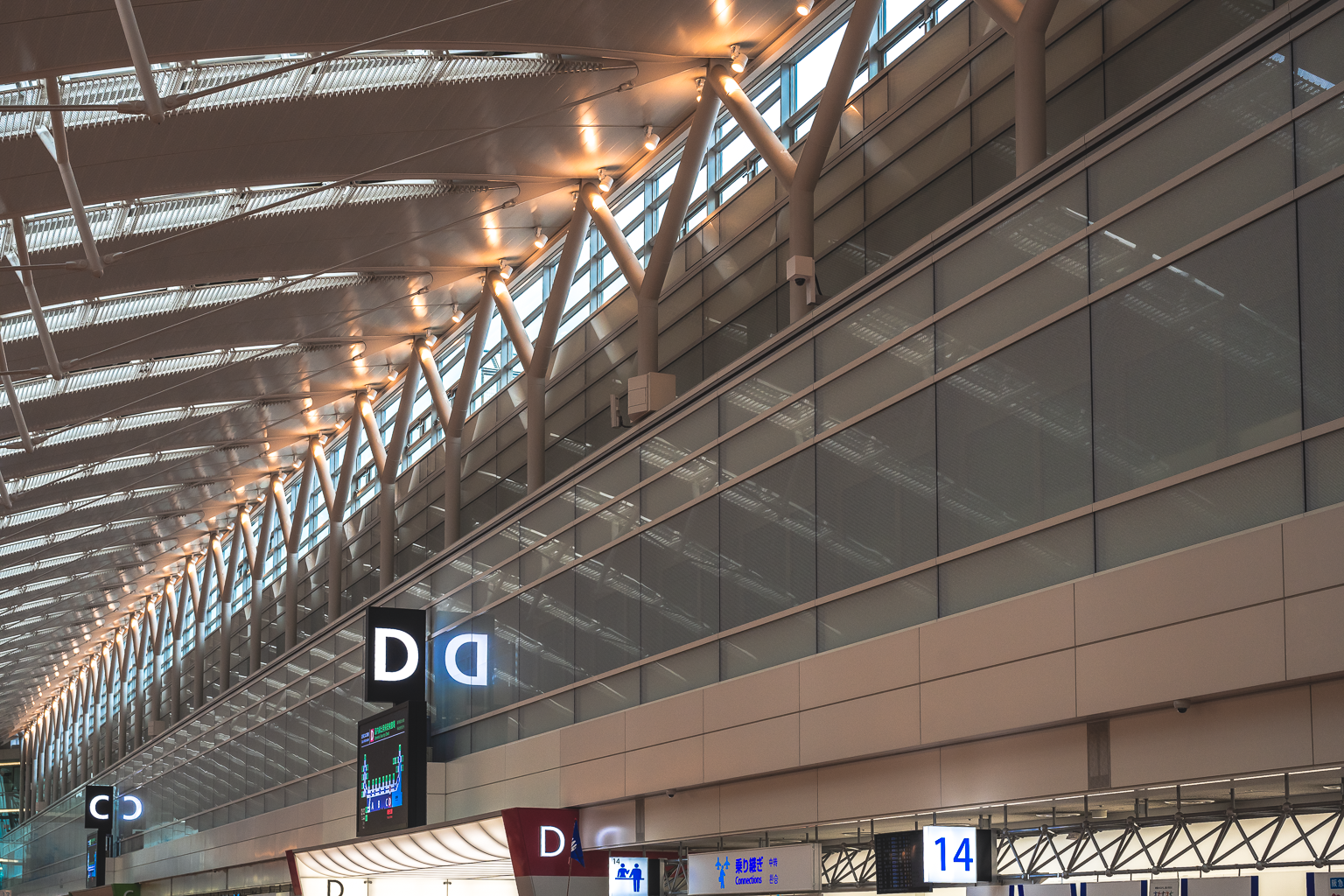
Haneda Airport introduces daylight from above through a continuous roof opening. Perhaps the most interesting engineering feature is the enormous roof skylight with daylight diffuser system.
The continuous clerestory windows along the upper façade admit diffuse natural daylight, while warm-colored spotlights mounted on the roof structure supplement the daylight. This creates a gradual transition between natural and artificial illumination rather than a sharp contrast.
Read the full case study: Architectural Lighting and Daylighting at Tokyo Haneda Airport
Luxembourg Findel Airport
At Luxembourg Findel Airport, skylights are positioned at carefully calculated angles to optimize solar penetration while limiting excessive solar heat gain.
This integrated daylighting strategy not only creates uniform illumination but also contributes to lower HVAC loads throughout both summer and winter, improving overall building energy performance.
Read the full case study: Architectural Lighting and Daylighting at Luxembourg Findel Airport.

The Value of Hiring a Specialist Lighting Consultant
Lighting is often perceived as a finishing element of architectural design.
In reality, it is one of the primary determinants of how people experience a building.
Specialist lighting consultants bring expertise that extends beyond luminaire selection. They combine architectural intent with human visual perception, building physics, energy efficiency, and advanced simulation techniques to create environments that are functional, comfortable, and emotionally engaging.
For airports, this expertise can help achieve:
Improved passenger comfort and wellbeing
Better wayfinding and orientation
Reduced glare and eye strain
Enhanced perception of safety
Lower operational energy costs
Greater architectural impact
Higher long-term asset value
The cost of professional lighting design during planning is relatively small compared with the long-term operational benefits it delivers over the life of the building.
Investing in Performance Rather Than Correcting Problems
The planning and design stage offers the greatest opportunity to improve building performance.
Some project teams hesitate to engage specialist lighting consultants because they believe simulation adds cost or extends the design schedule.
In reality, lighting modeling helps avoid costly modifications during construction or operation. Identifying performance issues early allows architects and engineers to optimize daylight openings, façade design, luminaire layouts, control strategies, and energy performance before decisions become expensive to change.
High-quality public buildings are not defined solely by iconic architecture—they are defined by how well they perform for the people who use them every day.
Human-Centered Building Performance by ALTA Integra
At ALTA Integra, we believe that exceptional buildings are created through the integration of architecture, engineering, and building physics.
As a multidisciplinary Building Performance Consultancy, we combine expertise in architectural lighting design, daylighting simulation, acoustic engineering, passive environmental design, audiovisual systems, building technology, and sustainable building certification to create healthier, more comfortable, and higher-performing environments.
Scientific research consistently demonstrates that the physical environment—including light, sound, temperature, airflow, and indoor environmental quality—profoundly influences human health, cognition, productivity, emotional wellbeing, and overall experience.
Our mission is to help clients design buildings that are not only visually remarkable but also scientifically optimized for people and the planet.