Architectural Insight: Sou Fujimoto Primitive Future Architecture
As architecture continues to evolve in response to rapid urbanization, technological advancement, environmental challenges, and changing patterns of human behavior, architects are increasingly challenged to rethink the relationship between people, space, nature, and the built environment. The future of architecture is no longer defined solely by form, efficiency, or technological performance, but by its ability to create meaningful connections between human experience, ecology, culture, and everyday life.
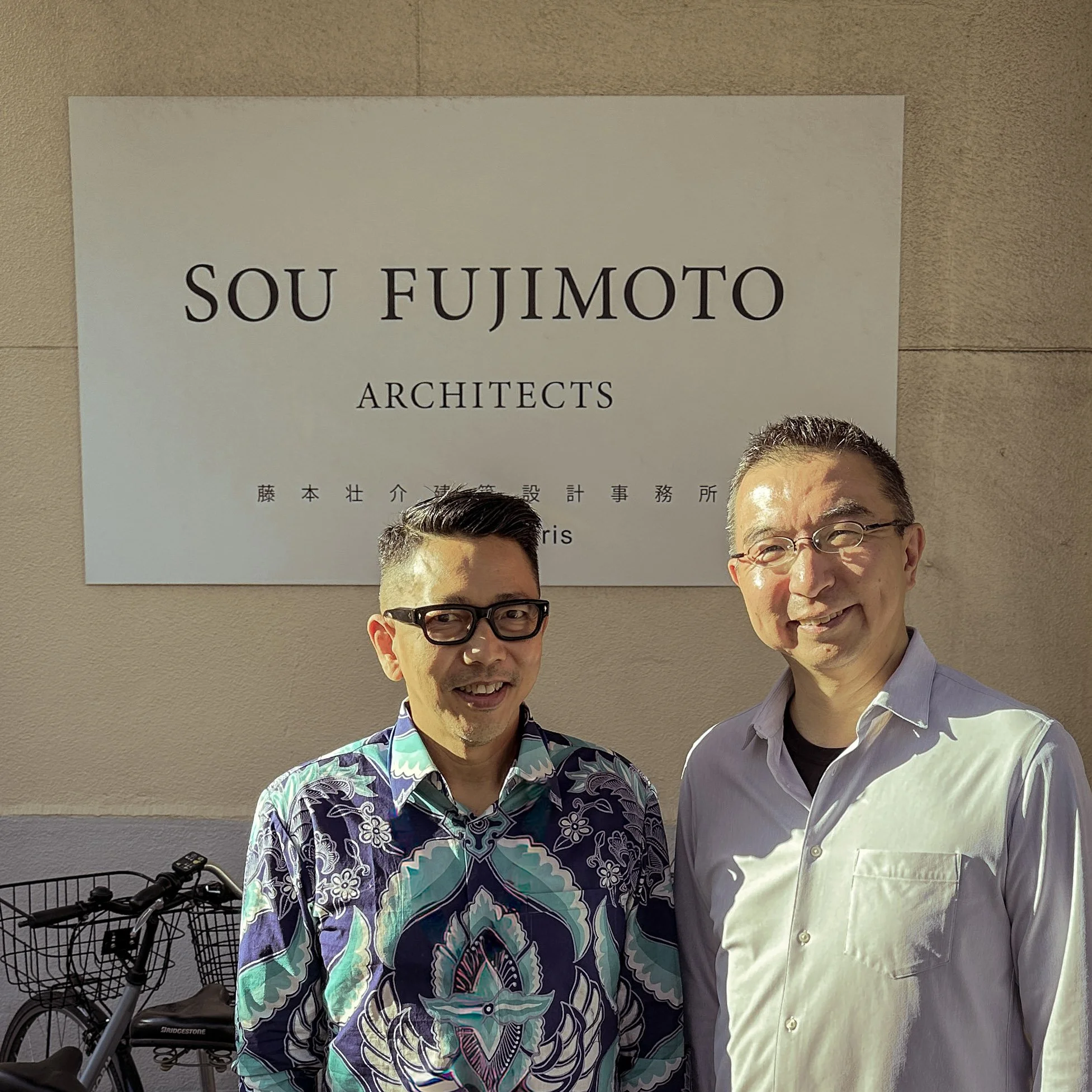
It was a valuable opportunity to meet internationally renowned Japanese architect Sou Fujimoto and learn directly about his architectural philosophy, “Primitive Future.” Recognized globally for his innovative approach to spatial design, Sou Fujimoto has become one of the most influential voices in contemporary architecture through projects that blur the boundaries between architecture, nature, city, and human activity. His work challenges conventional architectural thinking by exploring how buildings can function as open, flexible, and interconnected environments rather than fixed objects with predetermined uses.
One of the most compelling ideas discussed through “Primitive Future” is the belief that architecture should not be separated from nature, but instead emerge as a continuation of natural relationships and human behavior. Rather than creating rigid distinctions between inside and outside, public and private, building and landscape, Fujimoto’s work often seeks to establish layered environments where people can discover multiple ways of inhabiting space. His concept suggests that future architecture may become more adaptable, more porous, and more responsive to the complexity of contemporary life.
The philosophy of “Primitive Future” explores an interesting paradox: looking forward by reconnecting with fundamental human experiences. While technological innovation continues transforming cities and buildings, Fujimoto argues that architecture should still preserve qualities that encourage exploration, interaction, curiosity, and freedom. His projects frequently draw inspiration from natural systems such as forests, clouds, nests, and organic structures, creating environments that feel both contemporary and instinctively human.
A significant insight from the discussion was the idea that architecture should function less as an isolated object and more as a living framework for relationships. Buildings can become platforms that support social interaction, environmental connection, creativity, and community engagement. This perspective is increasingly relevant as designers worldwide explore human-centered environments, wellness-focused developments, sustainable urbanism, and adaptive building systems capable of responding to future uncertainties.
The exchange also reinforced the importance of interdisciplinary thinking within the built environment. Architecture today intersects with acoustics, lighting, environmental engineering, digital technologies, landscape design, sustainability, and building performance. Understanding how these disciplines work together is essential for creating environments that are not only visually compelling but also comfortable, resilient, healthy, and meaningful for the people who use them.
For our practice, learning directly from Sou Fujimoto offered valuable perspective on how future architecture may balance innovation with simplicity, technology with nature, and global progress with human experience. His approach highlights that meaningful design does not emerge solely through technological sophistication, but through a deeper understanding of how people interact with space, environment, culture, and one another.
As cities continue evolving toward more connected and sustainable futures, the principles behind “Primitive Future” provide an inspiring framework for rethinking how architecture can contribute to healthier, more adaptable, and more human-centered environments. The experience reinforced the belief that the future of design may not come from separating ourselves further from nature, but from finding new ways to reconnect architecture with the fundamental qualities of human life.