Exploring Integrated Acoustic Simulation Through DataKustik CadnaA, CadnaB, and CadnaR Software Systems
As building performance requirements become increasingly complex, acoustic design is evolving beyond isolated noise measurements and post-construction evaluations. Today, successful acoustic engineering requires predictive analysis, digital simulation, environmental assessment, and integrated building performance strategies that can evaluate sound behavior before construction begins. Advanced acoustic modeling software has become an essential tool in helping architects, engineers, developers, and consultants understand how sound interacts with buildings, infrastructure, workplaces, and urban environments.
As part of our ongoing commitment to technical development and global industry engagement, we visited DataKustik GmbH in Germany to explore the capabilities of the CadnaA, CadnaB, and CadnaR acoustic modeling platforms. Recognized internationally as one of the leading developers of acoustic simulation software, DataKustik provides advanced solutions for environmental noise prediction, building acoustics analysis, and indoor sound modeling. Their software systems are widely used by acoustic consultants, transportation authorities, environmental agencies, researchers, infrastructure planners, airports, industrial facilities, and engineering firms in more than 60 countries worldwide.
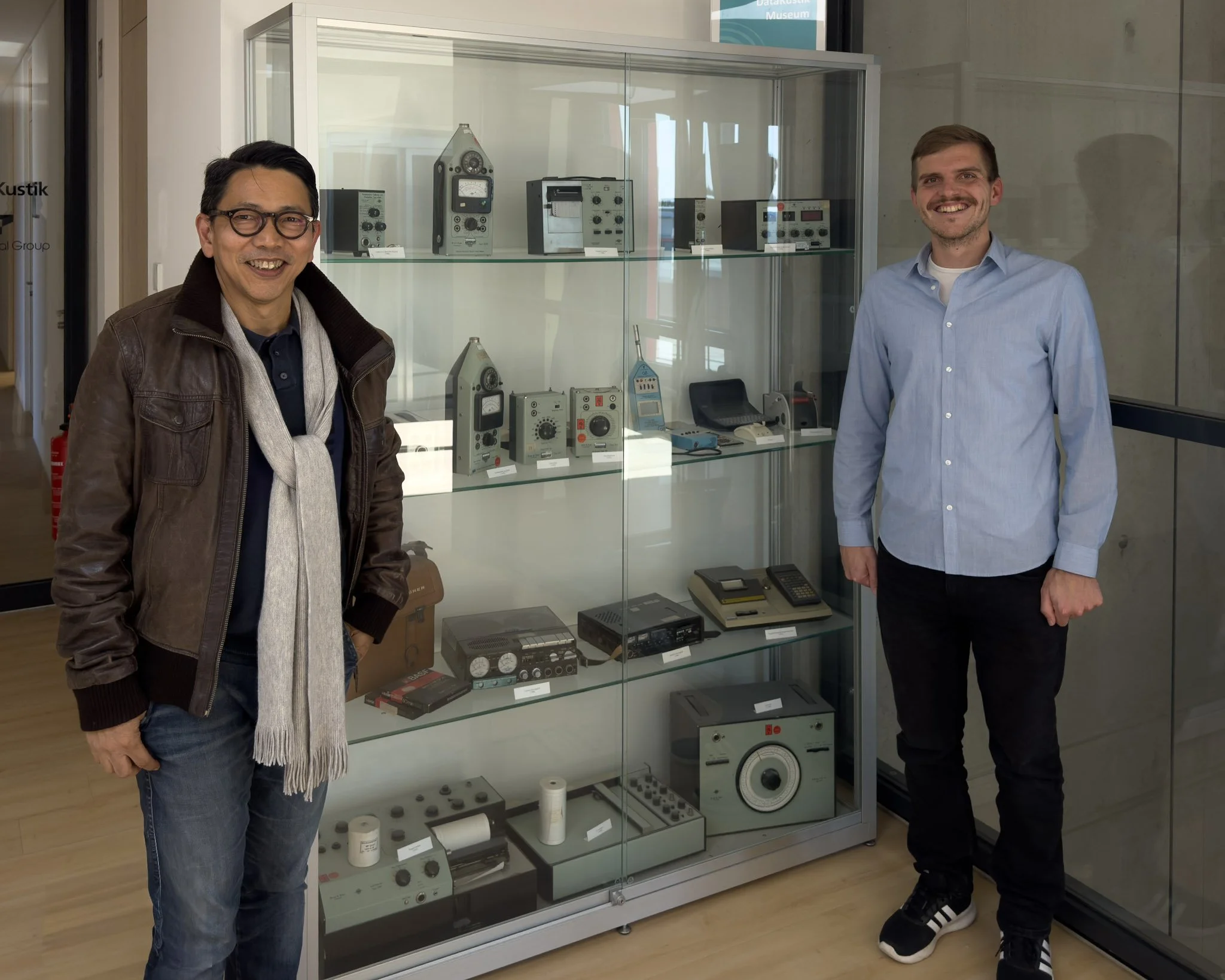
The visit provided valuable insight into how modern acoustic consulting increasingly relies on predictive modeling to support better design decisions. Rather than waiting until a project is completed to identify acoustic problems, simulation technologies enable acoustic performance to be evaluated during planning and design stages. This allows project teams to visualize sound propagation, assess environmental impact, optimize building performance, compare design alternatives, and implement mitigation strategies before construction begins.
One of the most significant aspects of the DataKustik ecosystem is the integration between CadnaA, CadnaB, and CadnaR within a single acoustic workflow. CadnaA is widely recognized as a leading platform for environmental noise prediction and urban noise mapping, supporting projects involving transportation systems, industrial facilities, airports, infrastructure corridors, and city-scale environmental assessments. The software enables detailed modeling of outdoor sound propagation, noise exposure analysis, façade evaluation, and environmental impact studies using advanced international calculation standards.
CadnaB extends the workflow into building acoustics by evaluating airborne and impact sound transmission between rooms and through building assemblies. The platform supports the assessment of façade performance, wall constructions, floor systems, doors, windows, and building envelope acoustic behavior. This capability is increasingly important as occupant comfort, privacy, wellness, hospitality standards, residential quality, and regulatory compliance become major priorities within contemporary developments.
CadnaR further expands the acoustic analysis process by focusing on indoor sound propagation and room acoustics performance. The software enables detailed simulation of sound behavior inside workplaces, auditoriums, conference facilities, educational spaces, industrial environments, hospitality projects, and public buildings. Applications include workplace noise assessment, room acoustic optimization, speech intelligibility analysis, acoustic treatment evaluation, and performance studies for multipurpose spaces.
What makes the DataKustik platform particularly valuable is its ability to connect outdoor environmental noise, building acoustic transmission, and indoor sound performance into one integrated modeling framework. Through the interoperability between CadnaA, CadnaB, and CadnaR, acoustic consultants can evaluate how external noise reaches a building façade, how sound transmits through architectural constructions, and how it ultimately behaves within occupied interior spaces. This integrated approach supports a more comprehensive understanding of acoustic performance throughout the entire building lifecycle.
The visit also reinforced the growing importance of computational modeling within sustainable and human-centered building design. Acoustic quality directly influences communication, productivity, learning outcomes, concentration, health, comfort, privacy, and overall user experience. As cities become denser and buildings become more technically sophisticated, predictive simulation tools help project teams make better-informed decisions that support both environmental performance and occupant well-being.
For our practice, exposure to advanced technologies such as CadnaA, CadnaB, and CadnaR strengthens our ability to integrate environmental acoustics, building physics, architectural acoustics, room acoustics, and digital performance simulation into a cohesive consulting methodology. The experience highlighted how data-driven acoustic analysis is becoming an increasingly important component of designing healthier, smarter, and more resilient built environments.
As acoustic engineering continues evolving through digital transformation, integrated simulation platforms such as the DataKustik ecosystem represent an important step toward bridging environmental performance, architectural design, technical precision, and human experience within the future of the built environment.