Improving Transmission Loss of Sound Insulation Panels Using Periodic Viscoelastic Materials
Publication Information
Paper Title: Transmission Loss Improvement of Sound Insulation Panel with Viscoelastic Material in Periodic Configuration
Abstract:
The advantage periodic viscoelastic material configuration at single panel and sound insulation panel to improve low frequency transmission loss is observed in this paper. Thus, the predictive formula for transmission loss could be obtained. The sample plates were made of MDF 3 mm. There were three periodic configurations that have been tested: orthogonal, diagonal, and ribbed. Transmission loss was measured to each sample: single panel, single panel with periodic configuration of viscoelastic material, sound insulation panel with periodic configuration of viscoelastic material. All of the measurement data were compared to the theoretical calculation.
It was found that transmission loss improvement along 125 Hz – 250 Hz of single panel with periodic configuration of viscoelastic material was only around 7 dB – 16 dB; while sound insulation panel was gained transmission loss up to 14 dB – 20 dB. The transmission loss trend line of diagonal periodic configuration appeared as the highest among other configurations.
Empirical formula of transmission loss along 125 Hz – 1000 Hz can be described as R ≈ 10 (log f- 2) x (0.6 ρs) + 9 (dB) for single with periodic configuration of viscoelastic material and R ≈ 10 (log f- 2) x (0.1 ρs) + 19 (dB) for sound insulation panel with periodic configuration of viscoelastic material.
Presented at: Regional Conference on Acoustics and Vibration (RECAV) 2017
Conference Date: 26–29 November 2017
Location: Bali, Indonesia
Research Areas:
Building Acoustics
Sound Insulation
Transmission Loss
Viscoelastic Materials
Structural Vibration Control
Architectural Acoustics
Noise Control Engineering
Building Physics
Acoustic Material Engineering
This publication reflects my ongoing commitment to applying scientific research and experimental testing to improve building performance. By combining material science, structural acoustics, and practical engineering, the research contributes to the development of more effective sound insulation systems that enhance occupant comfort and create quieter, healthier built environments.
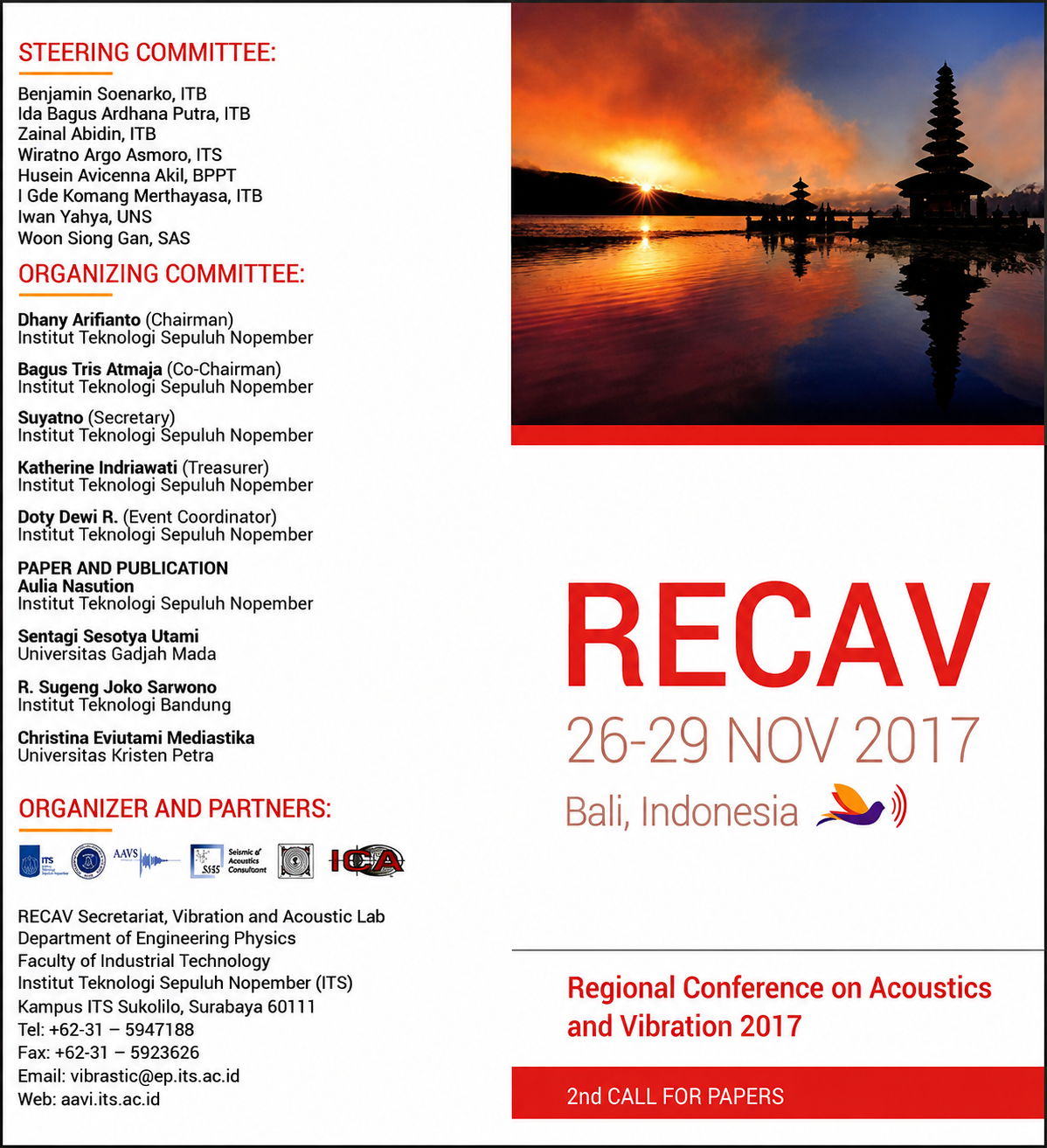
RECAV 2017 – Regional Conference on Acoustics and Vibration, Bali, Indonesia
Noise control has become one of the most important aspects of modern building design, particularly in offices, hotels, residential buildings, healthcare facilities, and educational environments. While conventional sound insulation systems perform reasonably well at mid and high frequencies, achieving effective low-frequency sound insulation remains a significant engineering challenge because structural resonance allows vibration energy to pass through partitions more easily.
This research, presented at the Regional Conference on Acoustics and Vibration (RECAV) 2017 in Bali, Indonesia, investigates an innovative approach to improving the transmission loss of sound insulation panels by incorporating periodically arranged viscoelastic materials within the panel structure. The study builds upon the principle that viscoelastic materials dissipate vibration energy by converting mechanical energy into heat, thereby reducing the amount of sound transmitted through building partitions.
The research experimentally evaluated several periodic viscoelastic configurations—including orthogonal, diagonal, and ribbed patterns—using 3 mm MDF specimens tested as both single-layer panels and composite sound insulation panels. Laboratory measurements were conducted following recognized ASTM acoustic testing procedures, and the measured transmission loss was compared with theoretical predictions to evaluate the effectiveness of each configuration.
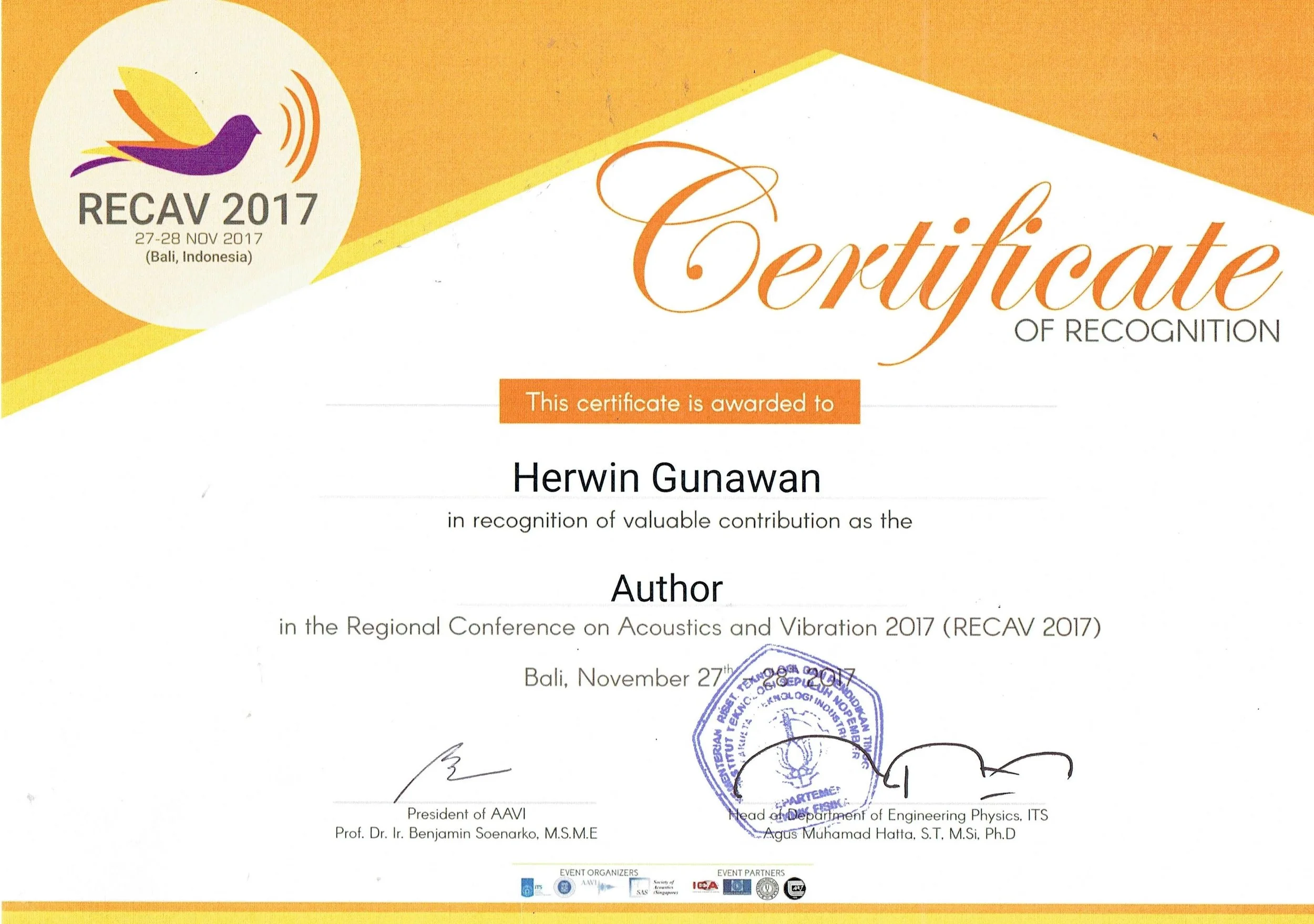
The results demonstrated that periodic viscoelastic configurations can substantially improve low-frequency acoustic insulation. For the 125–250 Hz frequency range, transmission loss increased by 7–16 dB for single panels incorporating viscoelastic material and by 14–20 dB for composite sound insulation panels. Among the tested configurations, the diagonal periodic arrangement delivered the most consistent performance and showed the strongest regression trend compared with the orthogonal and ribbed layouts. The study also developed empirical equations for predicting transmission loss between 125 Hz and 1000 Hz, providing a practical engineering reference for future acoustic panel design.
Beyond the numerical improvements, this research demonstrates how material engineering and structural configuration can work together to improve acoustic performance without relying solely on increasing wall thickness or mass. The findings contribute to the development of lighter, more efficient sound insulation systems that are applicable to high-performance buildings where occupant comfort, privacy, and environmental quality are critical design objectives.
Presenting this work at RECAV 2017 represents an important milestone in my research journey in building acoustics, noise control engineering, and building physics. The investigation strengthened my understanding of vibration damping, sound transmission mechanisms, and advanced acoustic material design—knowledge that continues to inform my consulting work at ALTA Integra in delivering evidence-based acoustic solutions for commercial, residential, institutional, and mixed-use developments.