Optimizing Small Room Acoustics Through Splayed Wall Design Using Finite Element Method
Publication Information
Paper Title: Study of the Effect of Splaying Wall to Modify Acoustic Modes Distribution in Small Room
Abstract:
Modes are known as one of the important acoustical issues in small rooms. These phenomena could drastically change the spectral and temporal characteristics of sound. Studies have been conducted on optimizing rectangular room dimensions, optimizing source and listener positions, and improving low-frequency performance using acoustic panels. However, achieving the best room ratio often requires significantly reducing the room dimensions.
This paper investigates the effect of splayed walls as an alternative approach to modifying room modes without sacrificing excessive usable space. Axial room modes from different room configurations—including random, splayed wall, Bolt, Louden, and Cox room ratios—were calculated and compared. The low-frequency characteristics of small rooms were analyzed using Finite Element Method (FEM) simulation, enabling sound pressure level (SPL) responses to be graphed and statistically evaluated.
The results show that introducing splayed walls into a room with random dimensions can redistribute room modes more evenly, producing a modal distribution comparable to the Cox room ratio, although with an increase in SPL standard deviation. Future work will investigate the perceptual significance of these findings through psychoacoustic evaluation.
Conference: Regional Conference on Acoustics and Vibration (RECAV) 2017
Date: 26–29 November 2017
Location: Bali, Indonesia
Research Topics:
Architectural Acoustics
Small Room Acoustics
Room Modes
Room Geometry Optimization
Finite Element Method (FEM)
Computational Acoustic Simulation
Passive Acoustic Design
Building Physics
This publication reflects my continuing commitment to applying scientific research and numerical analysis to solve real-world acoustic challenges, bridging academic investigation with practical engineering solutions for high-performance buildings.
RECAV 2017 – Regional Conference on Acoustics and Vibration, Bali, Indonesia
One of the most persistent challenges in small-room acoustics is the presence of room modes, or standing waves, which can create excessive bass peaks, deep nulls, and uneven frequency response. These modal resonances often color the sound, making accurate music reproduction, recording, and critical listening difficult.
In 2017, I presented this research at the Regional Conference on Acoustics and Vibration (RECAV 2017) in Bali, Indonesia. The study investigated an alternative architectural strategy for improving low-frequency performance without sacrificing valuable floor area.

Rather than relying solely on the traditional approach of resizing rooms to match recommended acoustic ratios such as Bolt, Louden, or Cox, this research explored whether splayed (non-parallel) walls could redistribute room modes while preserving more usable space.
To evaluate this concept, I developed numerical models using the Finite Element Method (FEM) to simulate the acoustic behavior of several room geometries. The research compared conventional rectangular rooms with optimized room ratios and a modified room incorporating splayed walls. The simulations analyzed modal distribution, sound pressure level (SPL), and standing-wave behavior across the low-frequency range.
The results showed that introducing splayed walls helped redistribute axial room modes more evenly and produced a more diffuse sound field while requiring significantly less reduction in room volume than redesigning the room to ideal proportions. Although some frequency peaks remained pronounced—indicating that additional treatments such as bass traps or optimized loudspeaker and listener placement would still be beneficial—the study demonstrated that room geometry itself can serve as an effective passive acoustic design strategy.
This research reinforced an important principle that continues to guide my consulting work today: excellent acoustics begin with architectural design rather than acoustic treatment alone. Decisions about room proportions, geometry, and building layout made during the earliest design stages can significantly influence the final acoustic performance of studios, home theaters, control rooms, meeting spaces, classrooms, and other critical listening environments.
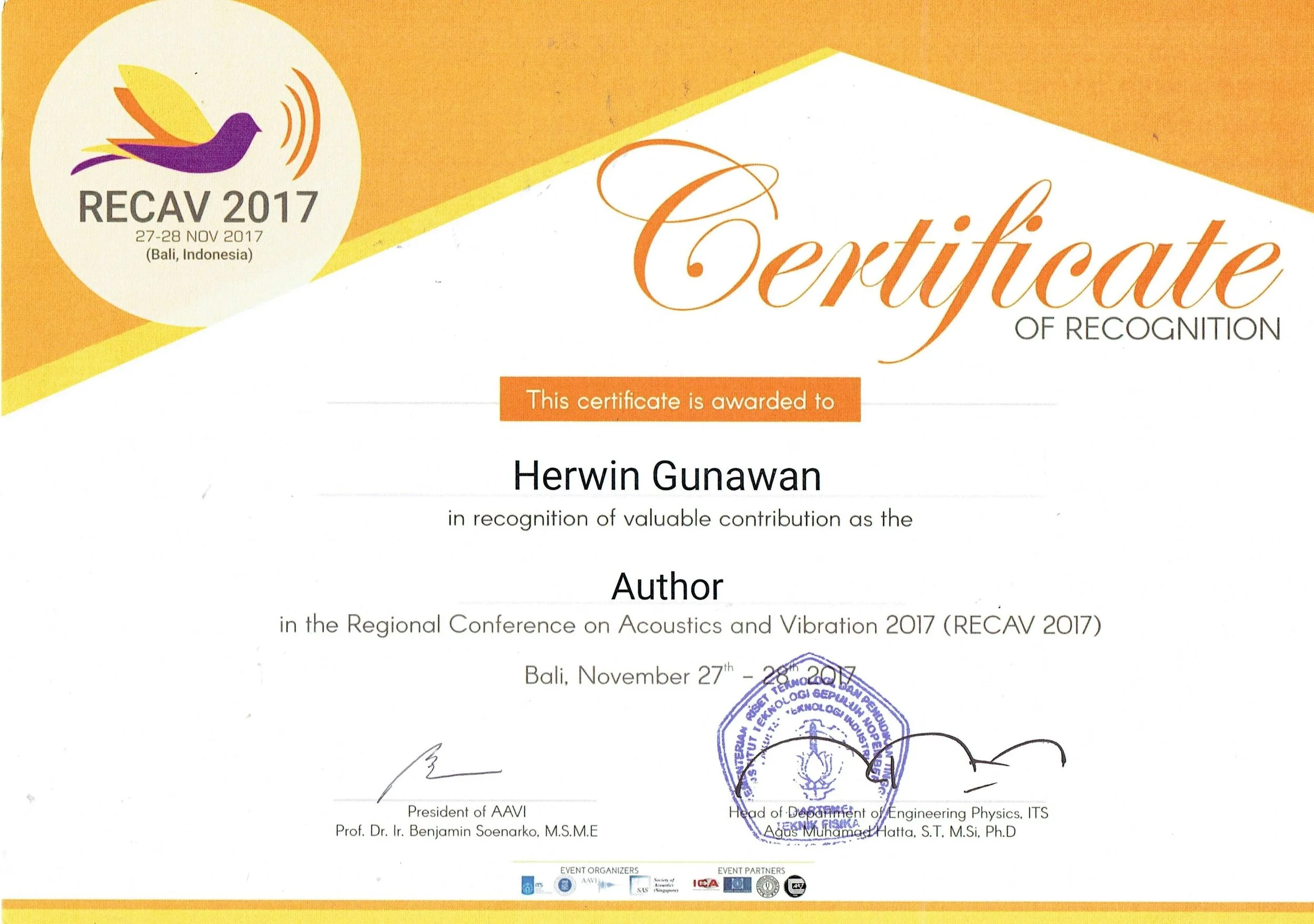
Presenting this paper at RECAV 2017 marked an important milestone in my professional journey, strengthening my expertise in architectural acoustics, building physics, and computational acoustic simulation. It also laid the foundation for my ongoing approach at ALTA Integra, where evidence-based engineering, numerical modeling, and human-centered building performance are integrated to create spaces that sound as good as they look.