Architectural Facade Lighting Design for Plaza Mandiri Jakarta
How We Translated Design Vision into Measurable and Performance-Based Facade Lighting for Plaza Mandiri (Now Wisma Danantara Jakarta)
For us, facade lighting design is not merely about making a building look beautiful at night. It is an instrument for shaping corporate identity, defining urban presence, and communicating the role of the building within the city after dark.
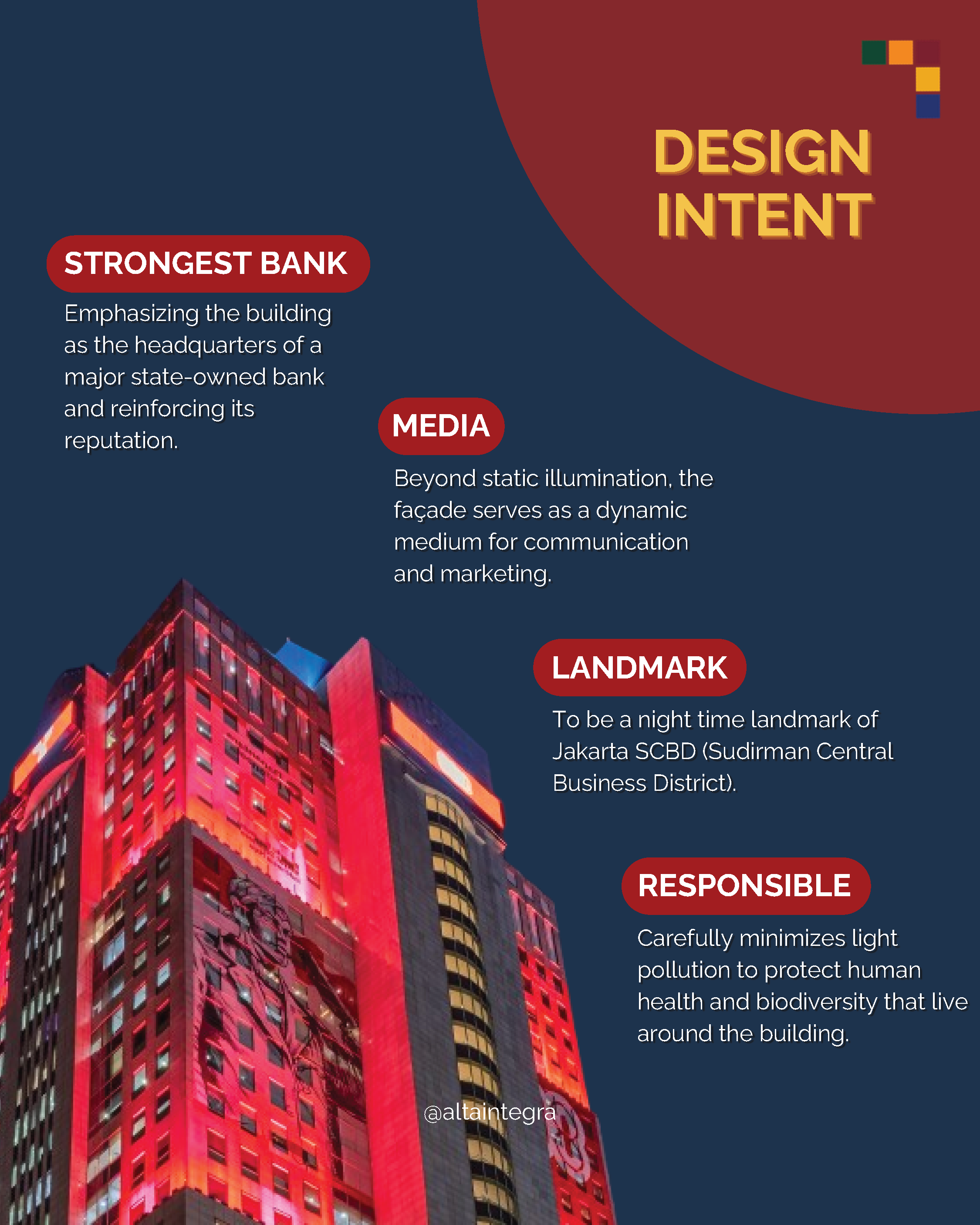
In the Plaza Mandiri project — now known as Wisma Danantara — the lighting design approach was developed from the corporate identity itself and translated into measurable architectural performance through four primary principles.
Reinforcing Bank Mandiri’s Corporate Identity
As the headquarters of Indonesia’s largest state-owned bank, the lighting composition was designed to express dignity, stability, and institutional presence.
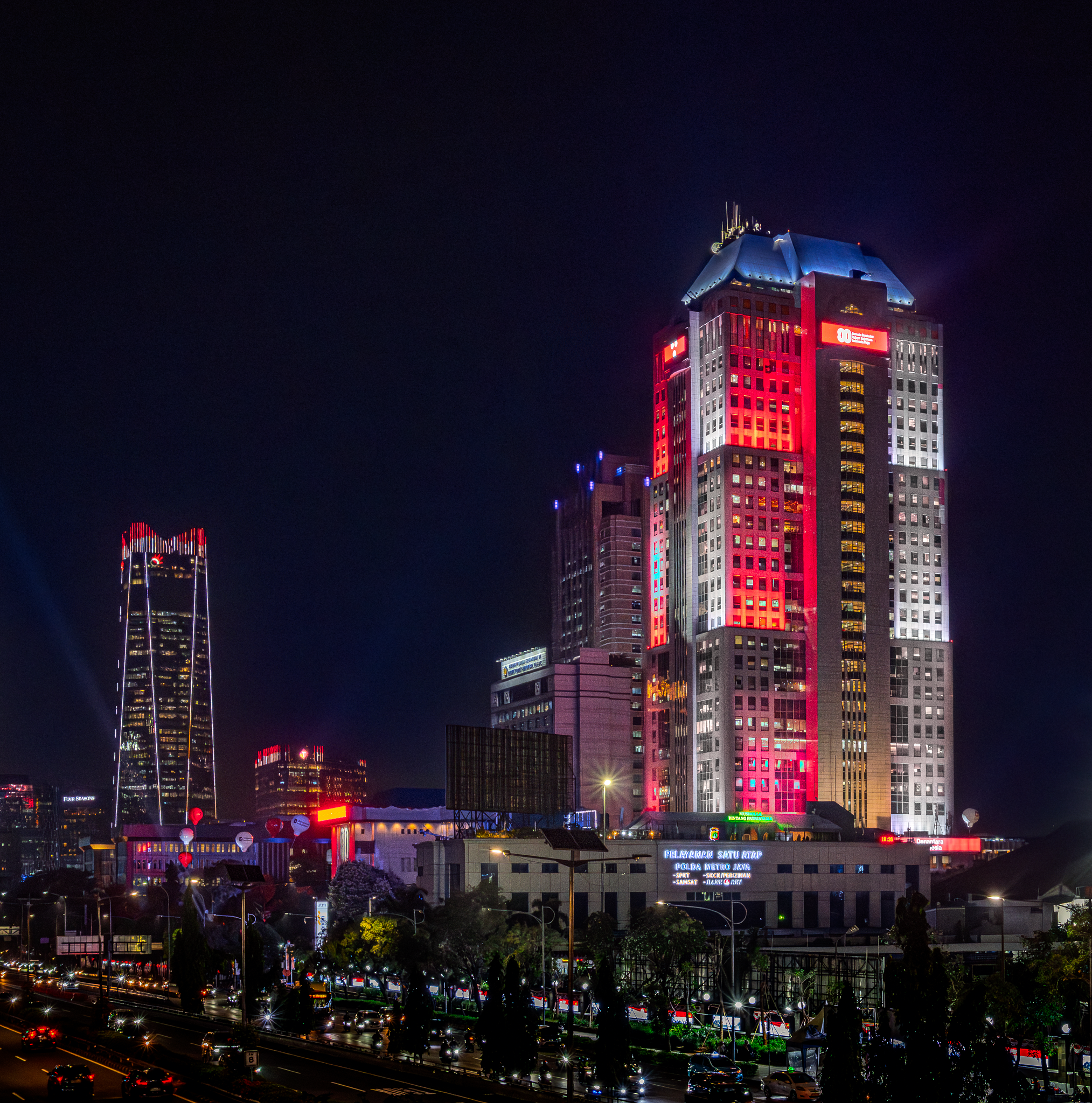
Rather than relying on excessive brightness, the facade illumination was carefully composed to create a refined and authoritative nighttime character that reflects the values of the corporation.
The design emphasizes visual hierarchy, proportion, and controlled luminance to strengthen the building’s identity within Jakarta’s skyline.
Facade as an Architectural Communication Medium
The facade was treated not only as an architectural surface, but also as a communication medium.
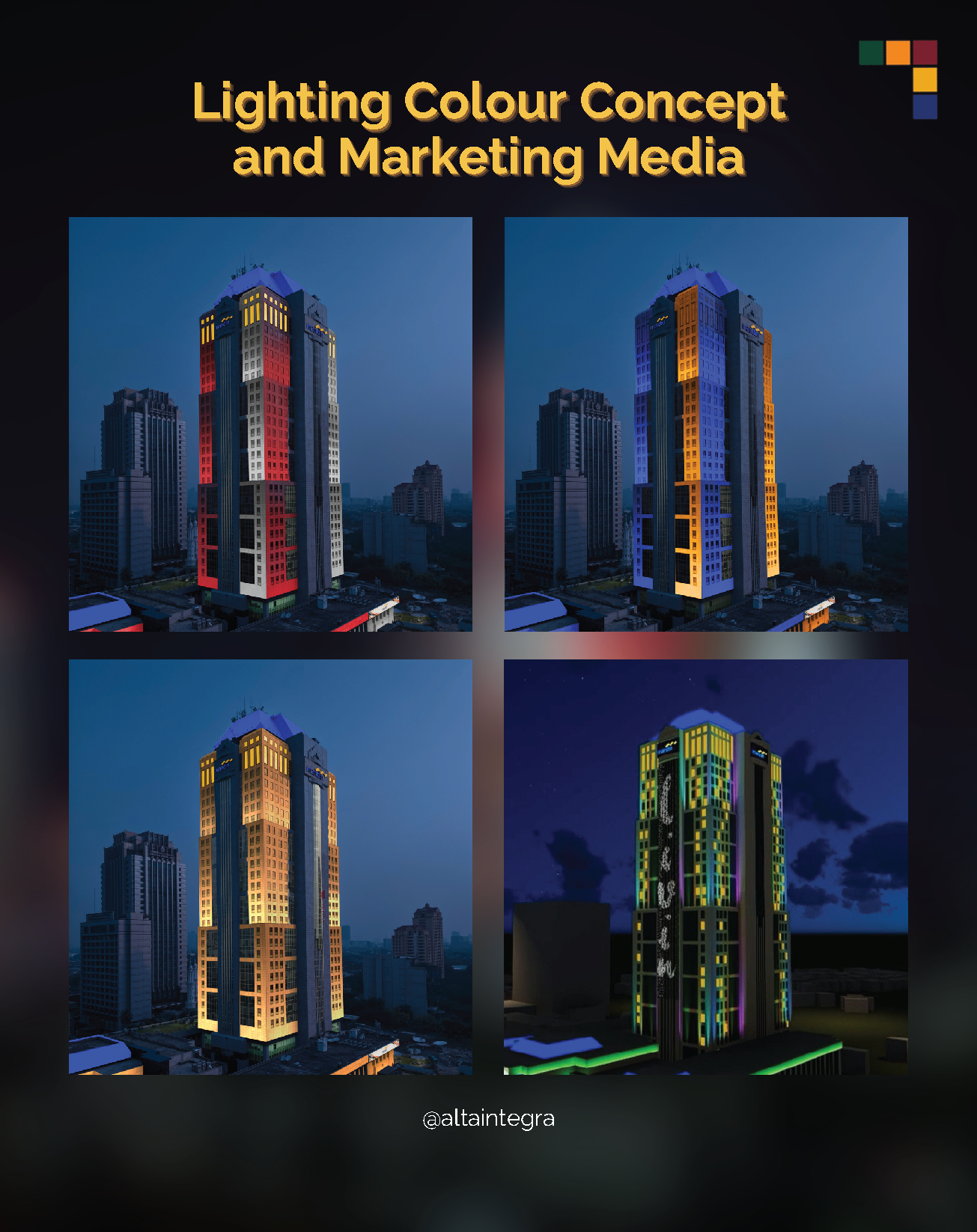
The lighting system was designed to support both static and dynamic lighting scenarios, enabling the integration of branding, corporate messaging, and special event illumination without compromising the architectural integrity of the building.
This approach allows the tower to remain adaptable for future marketing and urban activation strategies while maintaining visual coherence.
Creating a Landmark Within the SCBD District
Located within Jakarta’s prominent SCBD business district, the project aimed to establish a strong nighttime identity while avoiding unnecessary visual domination over its surroundings.
The lighting design carefully balances visibility and contextual sensitivity, allowing the building to become a recognizable urban landmark without contributing to excessive visual clutter or aggressive skyline competition.
The result is a facade presence that feels iconic, elegant, and contextually integrated into the urban nighttime environment.
Urban Nighttime Environment Challenge
One of the major challenges surrounding the project was the increasingly dense nighttime lighting environment within Jakarta’s SCBD district.
The surrounding urban context consists of high-rise office towers, commercial developments, digital media facades, street lighting, and illuminated architectural elements that collectively contribute to elevated ambient brightness and visual congestion at night.
In highly illuminated business districts, facade lighting can easily become excessive, visually aggressive, and environmentally disruptive when buildings compete for attention through uncontrolled brightness.
This condition may contribute to:
Visual fatigue
Excessive glare
Loss of architectural hierarchy
Skyglow and urban light pollution
Reduced nighttime environmental quality
Disturbance to surrounding occupants and ecosystems
The challenge for Plaza Mandiri was therefore not simply to make the building brighter, but to create a facade lighting identity that remained elegant, recognizable, and environmentally responsible within an already saturated nighttime environment.
Measurable and Performance-Based Design Process
The lighting development process combined qualitative architectural evaluation with quantitative lighting analysis to ensure that design decisions were visually effective and technically measurable. Below are our three step design process:
Night Time Environmental Light Analysis
Baseline lux level measurements were conducted to understand the surrounding nighttime lighting conditions and contextual urban brightness.
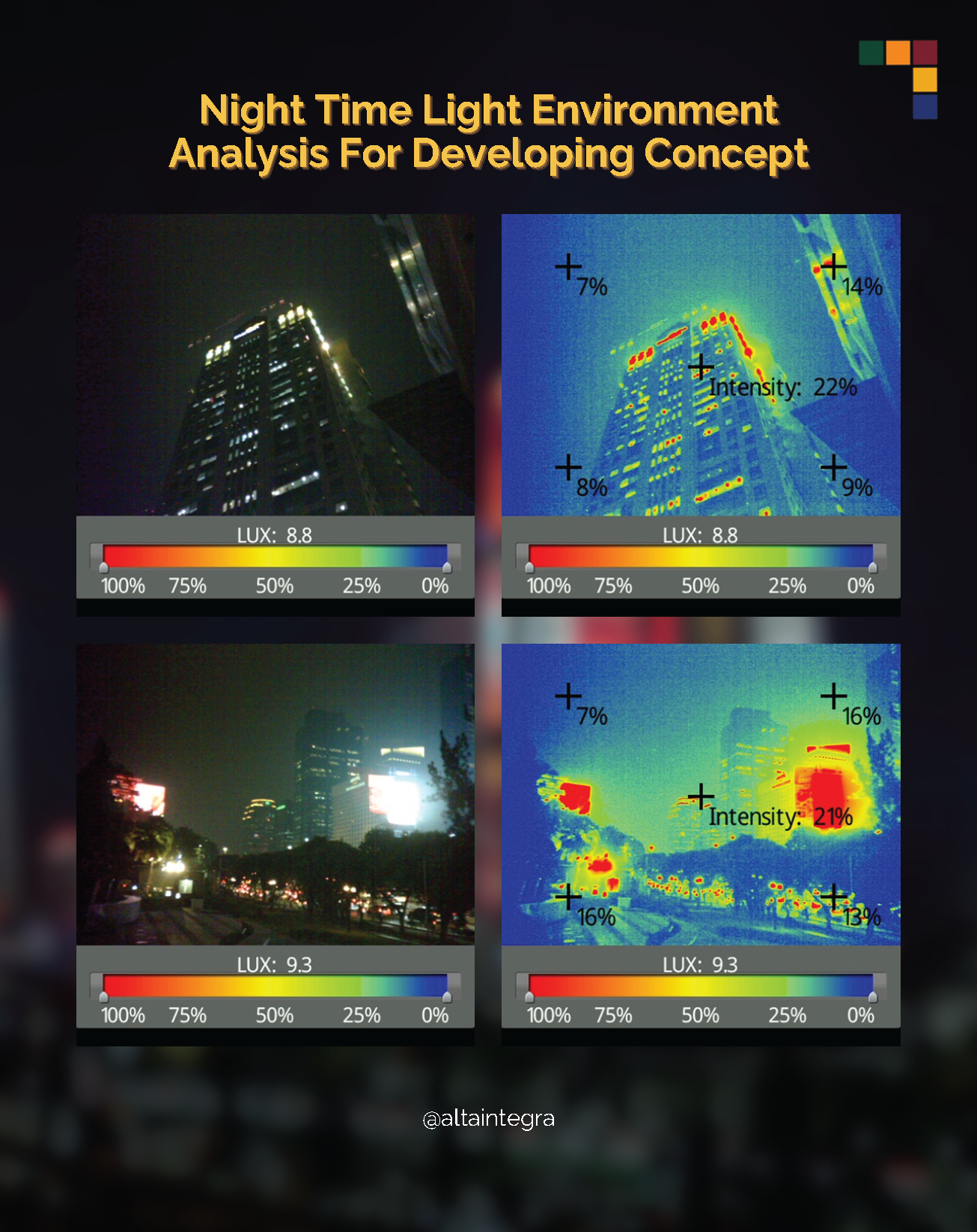
False Colour Mapping Evaluation
False colour luminance mapping was utilized to evaluate facade brightness distribution, visual hierarchy, and lighting balance across the architectural surfaces.
3D Visual Validation
Three-dimensional renderings and simulations were developed to validate the visual impact, architectural perception, and urban integration of the lighting concept before implementation.
Environmental Responsibility and Nighttime Wellbeing
Environmental responsibility became an essential part of the design strategy.
The project considered the impact of artificial lighting on human health, visual comfort, and the nighttime urban ecosystem through controlled illumination levels and mitigation of unnecessary light pollution.
The design approach focused on:
Controlled luminance levels
Reduced glare
Balanced facade brightness
Limitation of upward light spill
Improved nighttime visual comfort
Reduced environmental disturbance
Instead of maximizing brightness output, the facade lighting was calibrated to achieve visual effectiveness with measured environmental sensitivity.
This methodology supports a more sustainable and human-centric urban lighting environment.

Contextual, Measurable, and Relevant Lighting Design
This approach ensured that the facade lighting was not only visually striking, but also contextual, measurable, and relevant to its architectural, urban, and environmental responsibilities.
By integrating architectural lighting design with corporate identity, urban sensitivity, and environmental performance, the Plaza Mandiri (Wisma Danantara) project demonstrates how facade lighting can become a strategic design instrument that shapes both city image and human nighttime experience.