Speaking Engagement: RECAV 2017 Sketch Up EASE Architectural Acoustic Modeling Training
As digital simulation technologies become increasingly important in the design and engineering process, acoustic modeling has emerged as an essential tool for predicting, analyzing, and optimizing building acoustic performance before construction begins. The ability to accurately simulate sound behavior within spaces allows architects, engineers, consultants, and project teams to make informed decisions that improve communication, occupant comfort, speech intelligibility, and overall environmental quality.
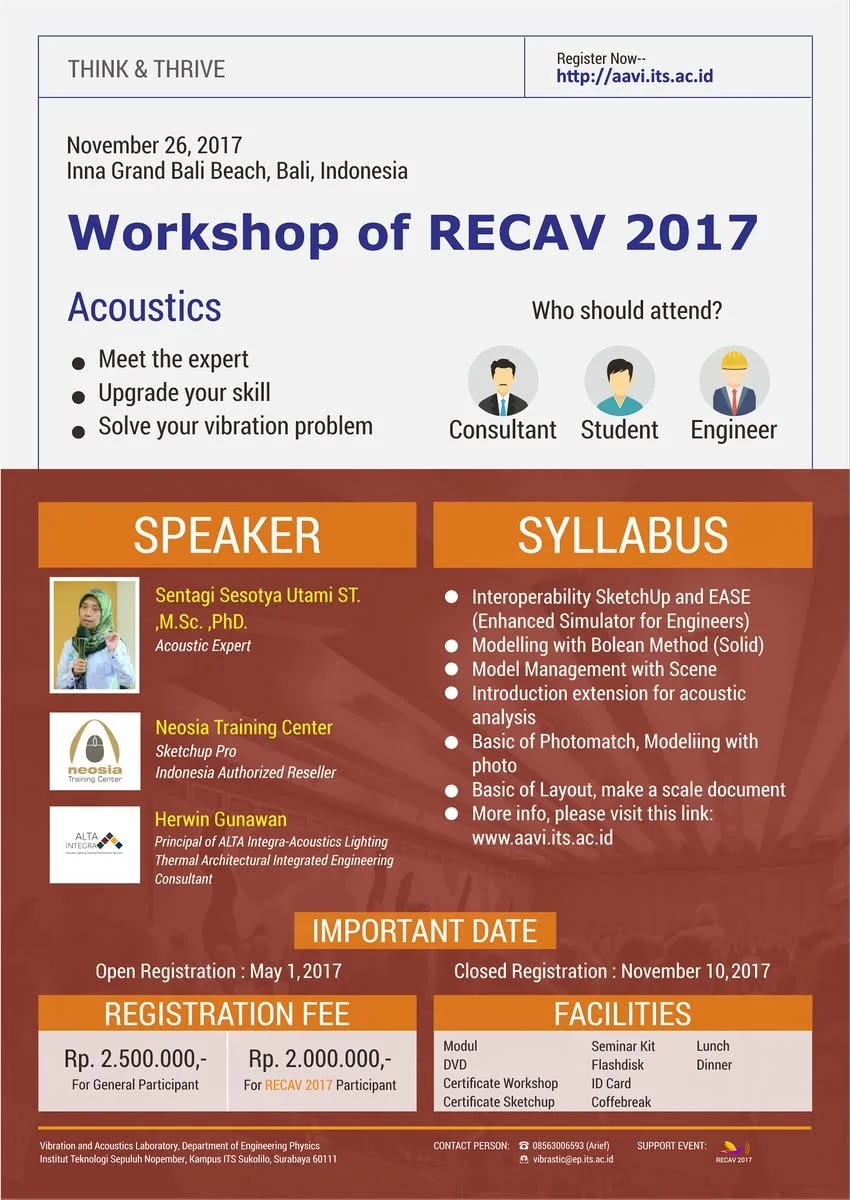
As part of the Regional Conference on Acoustics and Vibration (RECAV) 2017 in Bali, Indonesia, I was invited to contribute as a speaker and acoustic modeling trainer, sharing practical methodologies for applying digital simulation tools in architectural acoustics and building performance engineering. The workshop brought together consultants, engineers, researchers, and students seeking to strengthen their understanding of acoustic analysis, modeling workflows, and performance-based design strategies.
The training focused on the integration of SketchUp and EASE (Enhanced Acoustic Simulator for Engineers) for acoustic simulation and room acoustics analysis. Participants explored digital modeling techniques, acoustic geometry development, model management, simulation workflows, and visualization methods used to evaluate sound behavior within architectural environments. These tools enable project teams to predict acoustic performance, assess design alternatives, optimize room acoustics, and support evidence-based decision-making during the design process.
A key objective of the workshop was to demonstrate how acoustic considerations can be incorporated earlier in project development rather than being addressed after construction. Through predictive modeling and simulation, acoustic performance can be evaluated proactively, reducing design risks while supporting more effective collaboration between architects, engineers, interior designers, and building owners.
Beyond software training, the session highlighted the broader role of acoustics in creating healthy, comfortable, and high-performing environments. Acoustic quality directly influences learning outcomes, workplace productivity, communication effectiveness, privacy, and occupant well-being. As buildings increasingly prioritize human-centered design, acoustic engineering continues to play a critical role in shaping the overall user experience.
For our practice, contributing as a trainer at RECAV 2017 reflected an ongoing commitment to advancing professional knowledge, supporting industry development, and promoting evidence-based approaches to acoustic design. Sharing expertise with the next generation of engineers and consultants reinforces the importance of combining technical rigor, practical experience, and digital innovation to create better-performing built environments.
The experience remains an important milestone in our professional journey, demonstrating the value of knowledge sharing and collaboration in advancing the field of architectural acoustics, building performance engineering, and environmental design.