Auditorium Mandiri University - Audiovisual Acoustic Lighting Design Integration
High Performance Audiovisual Seamless Integration
Effective Learning Space for Zoom Meeting, Video Conference, Multimedia Presentation, Live Streaming, and Live Music for Higher Education Environment
Project Overview
The auditorium at Mandiri University was envisioned as a multifunctional academic and institutional gathering space capable of supporting lectures, seminars, conferences, presentations, performances, and hybrid learning activities within a contemporary higher education environment.
To support these diverse functions, the project required an integrated approach combining audiovisual system, architectural acoustics and lighting design planning to create a comfortable, flexible, and technologically adaptive auditorium experience.
The consultancy scope focused on developing a performance-driven environment that enhances speech intelligibility, visual comfort, communication quality, and overall audience experience while maintaining architectural coherence and operational flexibility.

The Challenge
Modern university auditoriums are increasingly expected to support multiple event typologies within a single space.
The project presented several key challenges:
Maintaining speech clarity across varying occupancy conditions
Supporting both live and hybrid presentation formats
Balancing acoustic control with architectural aesthetics
Managing lighting conditions for audience comfort and camera visibility
Integrating audiovisual infrastructure without disrupting interior architecture
Ensuring flexibility for educational, ceremonial, and multimedia events
Unlike conventional lecture halls, multifunction auditoriums require careful coordination between sound, light, visual communication, and spatial perception to create an environment that performs effectively for both in-person and digital audiences.
The project also required balancing technical performance with long-term operational usability and maintenance efficiency.

Our Approach - Define Acoustic & Lighting Performance
Our approach began by understanding the auditorium as a human-centered communication environment rather than simply a technical event space.
The design strategy integrated:
Architectural acoustic analysis
Lighting quality evaluation
Audiovisual system coordination
Spatial communication hierarchy
User experience considerations
Rather than treating acoustics, lighting, and AV systems as separate disciplines, the project developed these components as interconnected layers influencing audience perception, communication clarity, and spatial comfort.
The acoustic strategy focused on improving:
Speech intelligibility
Reverberation control
Audience listening comfort
Noise management
Spatial sound consistency
The lighting approach prioritized:
Visual hierarchy
Audience comfort
Presenter visibility
Camera-friendly illumination
Flexible scene control
Meanwhile, the audiovisual system was designed to support:
Hybrid learning environments
Digital presentations
Multimedia events
Scalable communication infrastructure
Integrated operational control

Human-Centered Performance Strategy
The project adopted a human-centered performance strategy where environmental quality was measured not only through technical specifications, but through human perception and communication effectiveness.
The design considered how people:
Listen
See
Focus
Communicate
Interact within the auditorium environment
The acoustic environment was calibrated to reduce listening fatigue and improve speech clarity across audience seating areas.
Lighting design was carefully balanced to support:
Comfortable facial visibility
Reduced glare
Visual adaptation
Audience engagement
Camera and broadcast performance
The audiovisual strategy focused on creating intuitive and seamless communication experiences for lecturers, speakers, students, and hybrid participants.
By integrating environmental comfort with technological functionality, the auditorium becomes more than a presentation venue — it becomes a high-performance educational communication space.

Design Integration
A key aspect of the project was multidisciplinary coordination between architecture, acoustics, lighting, and audiovisual technology.
The integration process included:
Acoustic simulation and material evaluation
Lighting scene and luminance hierarchy studies
Audiovisual infrastructure planning
Display visibility analysis
Spatial coordination with architectural elements
Equipment integration within interior design
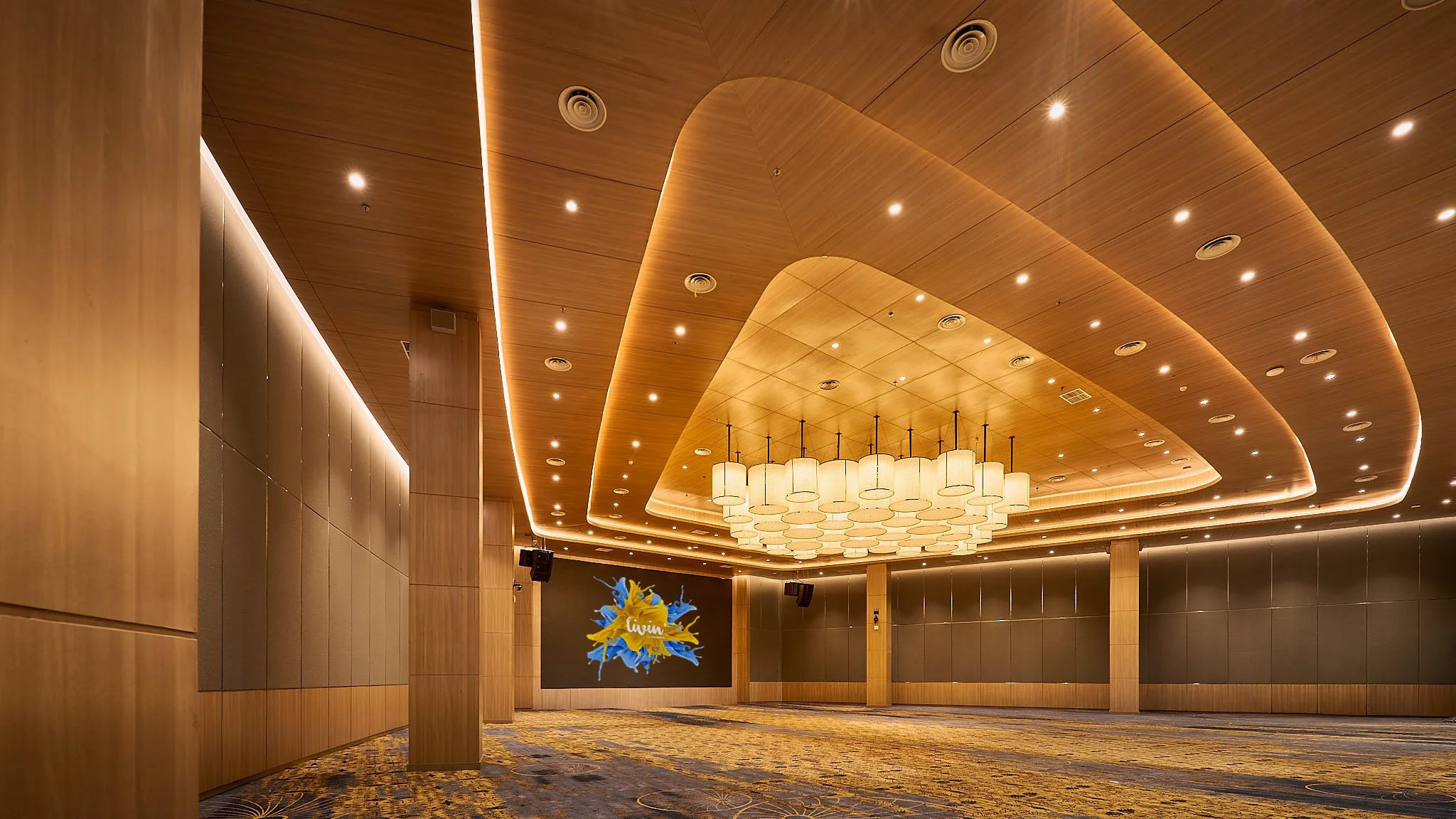
Careful integration ensured that technical systems remained visually discreet while supporting optimal environmental performance.
This approach minimizes visual clutter, improves operational usability, and preserves the architectural character of the auditorium interior.
Outcome
The final design creates a flexible and performance-oriented auditorium environment capable of supporting contemporary academic communication and hybrid learning activities.
Acoustic strategies were developed to optimize reverberation time and speech intelligibility for lectures, conferences, and hybrid learning environments.
Through integrated acoustic, lighting, and audiovisual consultancy, the auditorium achieves:
Improved speech intelligibility
Enhanced audience comfort
Better presentation visibility
Flexible multimedia capability
Human-centered communication quality
Seamless technology integration
The project demonstrates how multidisciplinary environmental design can elevate educational spaces beyond conventional technical infrastructure into immersive and effective learning environments.
Rather than functioning solely as an event venue, the auditorium becomes an adaptive communication ecosystem that supports education, collaboration, and institutional engagement within a modern university setti

Project Information
Project: Mandiri University
Sector: Corporate Higher Education
Location: Jakarta, Indonesia
Service: Audiovisual System, Building Acoustic, Architectural Acoustic, Architectural Lighting
Consultant: Herwin Gunawan / ALTA Integra
Year: 2022